Albert Einstein and Charlie Chaplin were two of the most iconic figures of the 20th century, known for entirely different reasons. A memorable exchange from early in their friendship perfectly and humorously illustrates these differences.
Einstein once expressed his admiration for Chaplin’s art, saying, “What I most admire about your art is its universality. You don’t say a word, yet the whole world understands you!”
Chaplin’s response, delivered with impeccable comedic timing, was, “True. But your glory is even greater! The whole world admires you, even though they don’t understand a word of what you say.”
I find myself in agreement with Chaplin. While I may not grasp the intricacies of Einstein’s scientific achievements, I admire him as a profound thinker who grappled with life’s deepest questions. His reflections on the universe and our place within it have been particularly inspiring to me since my youth.
Einstein’s curiosity and search for meaning are traits that many of us can relate to. He once expressed a desire to ask God about the origins of the universe, believing that such knowledge would lead to a deeper understanding of life’s purpose. He said, “I used to think that if I could ask God one question, it would be about how the universe began, because then all the rest would be just equations. But as I got older, I became less concerned with how the universe began. Instead, I would want to know why he started the universe. If I knew that, then I would know the purpose of my own life.”
Furthermore, Einstein pondered the nature of the universe and our perception of it, stating, “The most important decision we make is whether we believe we live in a friendly or hostile universe.” This quote underscores the power of our beliefs and attitudes in shaping our experiences and interactions with the world around us. A friendly universe is one where we see opportunities for growth and connection, while a hostile universe may lead to fear and isolation.
The Einstein quote that resonates with me the most is, “A human being is a part of the whole, called by us ‘Universe,’ a part limited in time and space. He experiences himself, his thoughts and feelings as something separated from the rest, a kind of optical delusion of his consciousness. This delusion is a kind of prison for us, restricting us to our personal desires and to affection for a few persons nearest to us. Our task must be to free ourselves from this prison by widening our circle of compassion to embrace all living creatures and the whole of nature in its beauty. Nobody is able to achieve this completely, but the striving for such achievement is in itself a part of the liberation and a foundation for inner security.” In this quote, Einstein alludes to the Buddhist concept of interconnectedness and the illusion of separateness. However, Einstein likely only grasped the theoretical concept and did not experience the oneness with the universe. The Buddha, on the other hand, has seen the truth, experienced the oneness, and achieved inner realization.
Over two thousand five hundred years ago, Shakyamuni crossed the Nairanjana River and sat under a Bodhi tree, where he was immersed in deep inner contemplation. At that time, he was tormented by worldly desires, hunger, craving for sleep, and fear and doubt. But he triumphed over these internal demons and continued his inner quest.
Then, like a limitless, penetrating beam of light, Shakyamuni experienced a moment of clarity in which he gained profound insight that life is eternal and one with the vast cosmos. He became a Buddha—a person awakened to the supreme truth of the Law of life.
The Buddha, Siddhartha Gautama, achieved enlightenment under the Bodhi tree, and the first words he spoke were: “How amazing, how amazing, all sentient beings possess the wisdom and virtue of the Tathagata. However, due to delusions and attachments, they cannot realize it. “
In the eyes of the Buddha, all sentient beings inherently possess the wisdom, the characteristics, and the blessings of the Tathagata within their minds that are troubled by afflictions, defilements, and the cycle of birth and death. Through this teaching, we know that Buddha-nature is inherently present in all sentient beings.
Einstein’s words resonate with the teachings of Buddha, who attained enlightenment and taught that all beings are interconnected. Buddha’s teachings emphasize compassion and understanding for all living beings, recognizing that we are all part of the same universe. Unlike Einstein, who believed that complete compassion was unattainable, Buddha demonstrated that it is possible to embrace all living beings and the universe in its entirety with love and kindness.
However, Buddhism is much deeper and vaster than just these concepts. All Buddhas possess three bodies and four wisdoms. The Mahāyāna theory of the three bodies—the dharma-body, the reward-body, and the response-body—is most common. The dharma body (法身) is considered to be the eternal, indestructible true principle, the Buddha’s original body. The response body (應身) is considered to be the Buddha’s manifest body, but in Mahāyāna Buddhism, it is regarded as the personification body, which manifests from the true principle according to the temperaments and abilities of sentient beings in order to save them.
The reward body (報身) is manifested as a combination of the other two and is therefore not simply the eternal true principle, nor simply an impermanent personality. Rather, it is an ideal body possessed by those who have awakened to the true principle based on meritorious practice. It is the living form of the eternal principle, possessing individuality. This is a general explanation, and there have been many interpretations of the Buddha-body theory in the history of Buddhism, among which there are significant differences. The three bodies are not separate entities but three integral aspects of a single Buddha.
The four wisdoms of Buddha are: Great Mirror Wisdom, which is still and void—motionless; Universal Wisdom, which is capable of facing mind-defilements without attaching to them through love or aversion; Wonderful Observing Wisdom, which has the ability to discriminate and discern the wide field of sensory impressions, while at the same time never experiencing unbridled and reactionary patterns of thought; and Perfecting Wisdom, which can direct all the sense faculties into observing phenomena without being constrained by dualism.
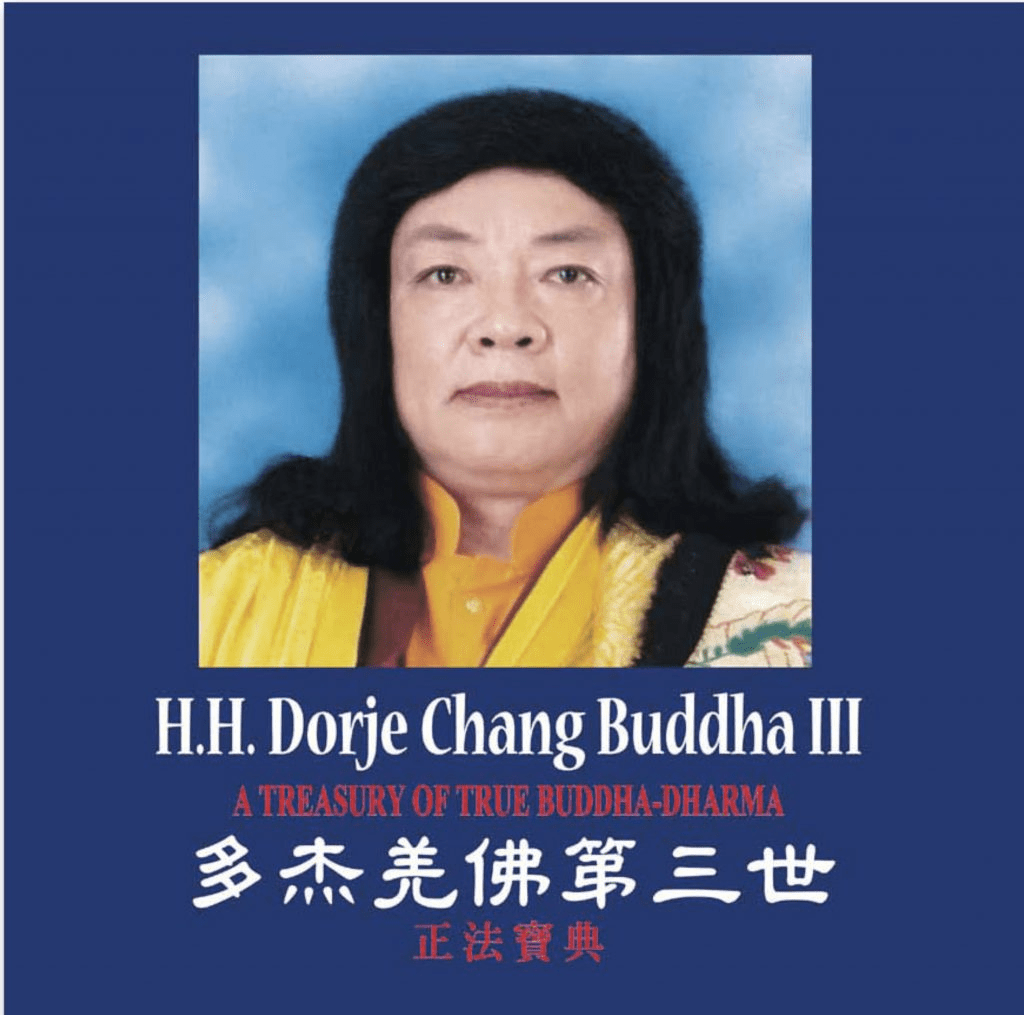
Buddha possesses vast knowledge, superb skills, magnificent supernormal power, and comprehensive wisdom of the universe. The treasure book, “H.H. Dorje Chang Buddha III,” stands as a testament to this statement. However, this book contains only a drop of water from the vast ocean of Buddha’s teachings and wisdom.
The video below showcases the boundless compassion and highlights the extraordinary accomplishments of H.H.Dorje Chang Buddha III. It was published by China Educational Channels TV and features interviews with Buddhist disciples from around the globe.
Discovering the Root of Buddhism, Propagating True Buddha Dharma(H.H. Dorje Chang Buddha III)
In my eyes, Yunnan Province is the most beautiful province in China. Its mild climate throughout the four seasons and its unique geographical location give Yunnan breathtaking natural scenery. The numerous ethnic minorities in Yunnan add to its diverse cultural customs. Yunnan is both romantic and passionately exotic, yet also elegant and graceful. It is truly charming and enchanting. Jizu Mountain is one of my favorite places there.
Mount Jizu (Chicken-foot Mountain) is situated in Dali Prefecture. The mountain is located to the northeast of Erhai and forms the tripoint of three counties: Heqing, Binchuan, and Dali City. With three mountain ranges to the front and one range to the rear, it resembles a chicken’s foot, hence its common name is Mount Cock’s Foot or Mt. Cock’s Claw. Yet another name for this mountain is Nine Strata Cliffs.
Mount Jizu is a famed holy mountain in Buddhism. Its main peak, Tianzhu Peak, rises some 3,240 metres above sea level. The mountain is vegetated with dense forests and bamboo groves.
From it, visitors can see the sunrise in the east, floating clouds to the south, Cangshan Mountain to the west and Jade Dragon Snow Mountain in the north. They are described as the “four wonders seen from the mountain top.”
The best viewing spot for the four wonders of Jizu Mountain is at its highest point, the Golden Top Temple. The view from the temple is wide and open, with visibility for more than ten kilometers. Watching the sunrise in the east is the king of the four wonders. Early winter mornings are the best season to witness the sunrise, as the reduced moisture increases visibility.
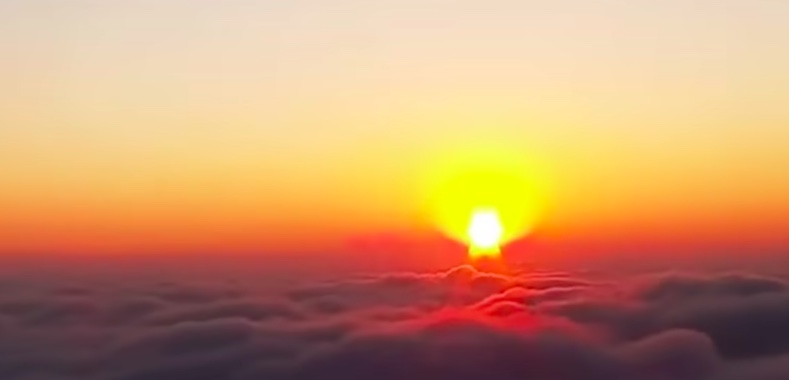
Before dawn in winter, the stars in the sky gradually dim, and the eastern horizon begins to whiten. A hint of orange appears on the just-yellowing horizon. In just a few minutes, the orange-red sun leaps above the horizon, and its dazzling rays spread across the entire landscape. If there are rolling clouds, they turn into a dazzling orange-red color within seconds. The sun’s rays, like an arrow carrying a force of ten thousand pounds, fly straight at everyone. In an instant, a huge spark bursts open in one’s heart. The ruddy morning sun is so bright that it’s hard to keep one’s eyes open. However, once you get used to it, the earth has already begun to revive, welcoming a new day in the dawn.
The best season to view the silver Cangshan and jade Erhai from the west is still in winter and spring. In these two seasons, snow accumulates on the peaks of Cangshan. Looking west from Golden Top Temple, you’ll see the plateau’s pearl, Erhai Lake, which runs between the mountains and valleys, reflecting silver waves. It’s as if pearls are dancing on the water’s surface. At the place where the water meets the mountains, you’ll find the nineteen peaks of Cangshan neatly arranged. The pure white snow on the mountain peaks becomes even more noble silver under the sunlight. The mountains and the sea echo each other, with the mountains towering and magnificent, and the water soft and charming. This is a masterpiece of beauty that cannot be drawn!
The best time to view the colorful clouds from the south is in the evening when the sun is about to set. Try to choose a time when the clouds are most densely gathered. Standing at the Golden Top Temple and looking south, you’ll see the undulating mountains covered in mist, which either wraps around or disperses in clouds, drifting freely in the blue sky, transforming into various shapes. The afterglow of the setting sun is scattered among the light and leisurely drifting clouds, blooming with a burst of colorful brilliance!
Jade Dragon refers to the “Jade Dragon Snow Mountain,” whose peak is covered in snow all year round, so it can be viewed at any time. Looking north from the Golden Top Temple, the snow-capped mountains stretching for dozens of miles look like an outstretched dragon, crystal clear as jade, pure white and flawless, without a speck of dust.
There are some other scenic views of Jizu Mountain that appear at different times and moments, unique to Jizu Mountain. Every year in the summer and autumn rainy season, sudden storms suddenly stop, and the surrounding mountains are still in the mist, except for a part of the clouds above Jinding Temple which disperse and sunlight reappears. At this time, a circle of seven-colored light circles surrounds Jinding Temple, which is one of the Eight Scenic Views, known as “Tianzhu Buddha Light.” Similarly, during the summer and autumn rainy season, Jizu Mountain sometimes experiences strong winds, thunderous sounds, flashes of lightning, and heavy rain in the valleys. However, Huashou Gate, located under Tianzhu Peak and below the Sheshen Cliff, is still clear and sunny. The sound of thunder echoes here and lingers for a long time. This is the famous “Huashou Qing Lei.”
The most abundant trees on Jizu Mountain are “pine and oak.” These trees come together to form a vast forest.
Whether you look from a distance or up close, the “forest sea” of Jizu Mountain stretches for dozens of kilometers, from the mountain peak to the valley, casting shadows with its pine trees. The forest is deep and lush, and when the wind, whether gentle or strong, blows through, the leaves rustle, creating music reminiscent of the thunderous galloping of a thousand horses. Sitting in the mountain and quietly listening to this has a special charm. This landscape is known as “Wan He Song Tao”.
There are more beautiful scenic views waiting for you to explore.
Besides the beautiful scenery, Jizu mountain is a legendary buddhist holy place.
According to Buddhist scriptures, in ancient times, Shakyamuni Buddha demonstrated to the assembly at the Lingshan Meeting by holding up a flower, and everyone remained silent. Only Venerable Mahakasyapa deeply understood the Buddha’s intention and broke into a faint smile. The Buddha said, “I have the true Dharma eye treasury, the wondrous heart of Nirvana, which I entrust to you.” He also told Mahakasyapa that he would pass on the kasaya robe to him, which would then be transferred to Maitreya when he appears in the world. Venerable Mahakasyapa bowed to the Buddha’s feet and respectfully followed the Buddha’s intention. After the Buddha’s Nirvana, Venerable Mahakasyapa gathered the true Dharma three treasures in the city of Vaishali. He later entrusted the true Dharma three treasures to Ananda and went to Jizu Mountain alone, holding the kasaya robe given to him by the Buddha. He entered meditation at the Huashoumen.
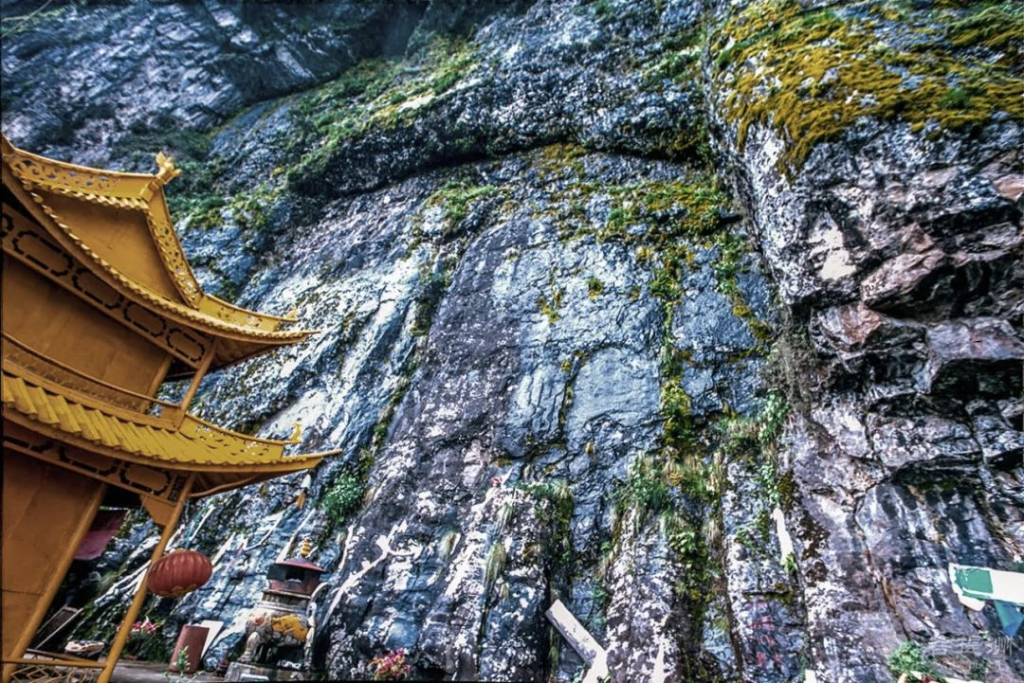
Huashou Gate is 40 meters high, with a sheer cliff face as if cut with a knife. A large stone gate is embedded at the top, and a vertical crack in the middle divides the cliff into two panels, with a “stone lock” hanging in the middle. The stone gate is covered with Hada (ceremonial scarves), and there are prayer flags around it. With an altitude of nearly 3000 meters, the landscape is very similar to that of Tibet.
When Maitreya Buddha is born in this world, he will also climb Jizu Mountain and go to the place where Venerable Mahakasyapa meditated. With a snap of his fingers, the mountain peak will open, and Mahakasyapa will pass on the robe and say his farewell. After the respectful ceremony, he will ascend into the sky, display divine transformations, and enter nirvana.
From the Buddhist scriptures, it can be seen that Jizu Mountain is the place where Venerable Mahakasyapa meditated, and it is also the future place of Maitreya. Its connection with Buddhism will never be severed for billions and trillions of years.
Jizu Mountain’s religious story stretches back nearly 1,000 years. Beginning during the Three Kingdoms period, several nunneries were built upon its slopes. But it was not until the time of the Tang Dynasty, four hundred years later, that the first known Buddhist temple was completed.
Throughout the following centuries, the construction of many other shrines and sanctuaries continued. By the late seventeenth century, during the Qing Dynasty, Jizu Mountain’s religious importance reach its zenith. At that point, according to official historical accounts, there were 42 temples and monasteries, 65 separate nunneries and more than 5,000 religious devotees residing on the mountain.
The mountain enjoys great prestige in South Asia and Southeast Asia, and shares the same fame with Wutai Mountain, Ermei Mountain, Putuo Mountain and Jiuhua Mountain in China. The mountain is a birthplace for Zen Buddhism.
The main sacred sites of Jizu Mountain include: Zhusheng Temple, Huashou Gate, Jinding Temple, Bronze Buddha Hall, Mahakasyapa Hall, Xuyun Zen Temple, Biyun Temple, Huashou Fangguang Temple, etc.
Jinding Temple
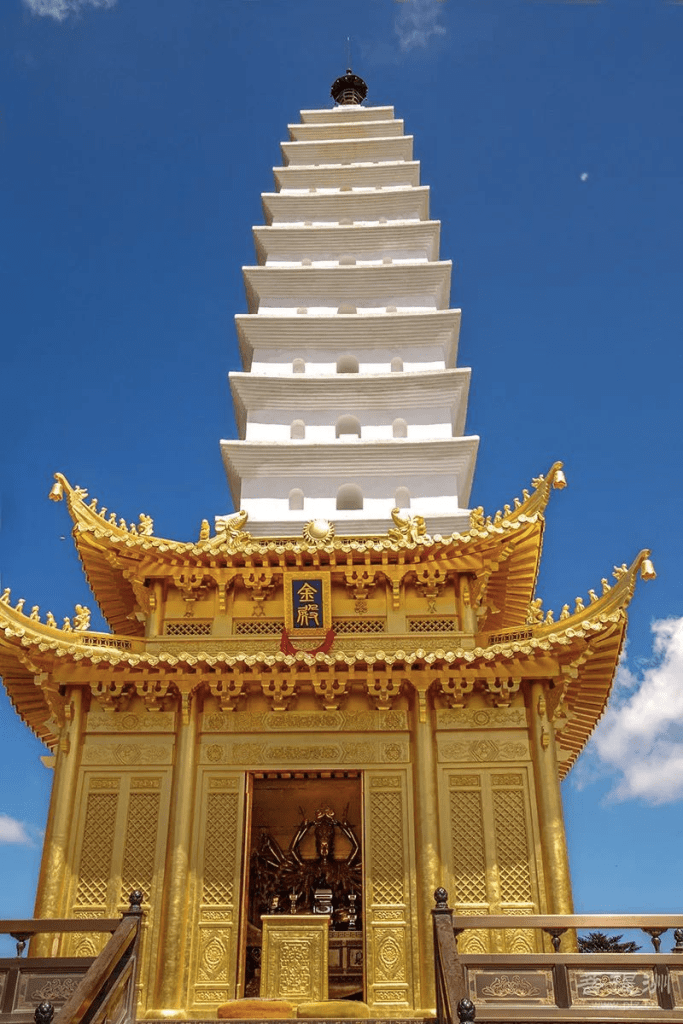
Golden Hall at Jinding Temple and LengYan Pagoda
The front entrance of Jinding Temple is typical Baizhu architecture style
Mahakasyapa Hall
From a high vantage point, the Mahakasyapa (Jia Ye) Hall is hidden among the lush green pines and cypresses in the depths of white clouds.
The Mahakasyapa Hall’s main hall houses a statue of the venerable Mahakasyapa, which is carved from camphor wood
Sutra about Wisdom and the Foolishness [賢愚経] ( A sutra translated into Chinese in 445 by Hui-chüeh and others. It contains sixty-two Buddhist tales (sixty-nine tales, in a separate extant edition). A Collection of Records concerning the Tripitaka, the catalog of the Buddhist canon compiled by Seng-yu (445–518), ascribes the translation of the Sutra on the Wise and the Foolish to others. According to that work, T’an-hsüeh, Wei-te, and six other priests went westward from northwestern China to Khotan on the southern edge of the Takla Makan Desert to seek Buddhist scriptures. They happened upon a great Buddhist ceremony that was held once every five years at a monastery. There they heard the learned monks expound the Buddhist scriptures and rules of monastic discipline in the language of Khotan. T’an-hsüeh and the others translated and recorded the lectures in Chinese. Later they returned from Khotan and, upon reaching the region of Turfan, compiled the lectures given by the monks in Khotan as a single sutra, which is known as the Sutra on the Wise and the Foolish. The sutra contains stories explaining the causal relationship between incidents in one’s past existence and those in one’s present existence. In each of these stories, Shakyamuni Buddha makes a connection between someone living in the present and a person involved in a past incident. The law of cause and effect states that every single action in the universe produces a reaction no matter what. We need to abstain from anything that is evil, do everything that is good, and use the correct understanding and views to cultivate. Don’t violate any of the precepts, otherwise you will end in miserable retribution.
This story comes from ” Karma Scriptures about Wisdom and Foolishness “, the third volume in the ” Weimiao Bhiksuni “. In the era of Buddha Sakyamuni, many aristocratic women after ordination were very worried that their habits, such as lust, anger and ignorance, had not been eliminated yet. So they gathered to consult Bhiksuni Weimiao who had already attained the arhatship. Weimiao Bhiksuni told everyone the pain of the desire to bring, and tells the story of her previous life experience…
“The Discourse on the Ten Wholesome Ways of Action” comes from The Western Jin Dynasty Tripitaka tokharia country dharmaraksa translation “The Buddha speaks for hailongwang”in Yuezhi of the Western Jin Dynasty. It’s the 11th charpet “Ten virtues and six paradigms”.
At one time, the Buddha stayed in the palace of the Dragon King of the Ocean together with an assembly of eight thousand great Bhikshus and thirty-two thousand Bodhisattvas and Mahasattvas altogether. At that time the World Honored One told the Dragon King saying:
Because all beings have different consciousness and thoughts, they perform. too different actions and as a consequence there is the turning around in all the different courses of existence. Oh Dragon King, do you see the variety of shapes and appearances in this meeting and in the great ocean, are they not different from one another.
Thus among all of them there is none which is not made by the mind, whether it is brought about by whole-some or unwholesome bodily, verbal, and mental actions, and yet the mind is formless it cannot be grasped or perceived, but it is the unreal accumulation and arising of all dharmas which are ultimately without owner, without I and mine. Although that which is manifested by each (being) according to its actions is not the same, there is nevertheless really no creator in these (actions). Therefore all dharmas are inconceivable and inexpressible, their own nature is phantom like. The wise ones knowing this ought to cultivate wholesome actions. Through this the aggregates sense-bases and elements that will be given rise to, will all be upright and those who will see them will not grow tired of them.
Oh Dragon King, when you behold the body of the Buddha born from a hundred thousand of Kotis of merit, with all the marks adorned, the splendor of its radiance covering the whole of the great assembly, even if there were immeasurable Kotis of Ishvara and Brahma devas they all would not come again into appearance.
Those who look with reverence at the Tathágata’s body how can they but not be dazzled. You again behold all these great Bodhisattvas of marvelous appearance, dignified and pure. All this comes into being entirely through the merit of cultivating wholesome actions. Again all the powerful ones like the eight classes of devas and dragons, and suchlike they also come into being because of the merits of wholesome actions.
Now all beings in the great ocean are of course and mean shapes and appearances, they all whether small or large performed unwholesome bodily, verbal, and mental actions out of all kinds of thoughts from their own minds. Thus is that each being receives its own result according to its action.
You ought to practice and to study constantly in this way, and also to bring beings to a thorough understanding of cause and effect and to the practice of wholesome actions.
In this you must have unshakable right view and you must not fall again into the views of annihilation and eternity. As to the fields of merit you rejoice in them, respect them and support them because of this you will also be respected and supported by men and devas.
Oh Dragon King you must know that Bodhisattva has one method which enables him to cut off all sufferings of evil destinies. What kind of methods is this? It is constantly, day and night, to recollect, to reflect on and to contemplate on the wholesome dharmas so as to cause the wholesome dharmas to increase from thought-moment to thought-moment, without allowing the least unwholesome thought to mingle in. This will then enable you to cut off all evil forever, to bring the wholesome dharmas to completion and to be constantly near all the Buddhas, Bodhisattvas, and other holy communities.
Speaking about wholesome dharmas, the bodies of men and devas, the Illumination of the Sravakas, the Illumination of the Pratyekas, and the Highest Illumination, they are all accomplished depending on these dharmas which are to be considered as fundamental. Therefore they are called wholesome dharmas.
These dharmas are the ten wholesome ways of actions. What are these ten? They are the ability to give up forever killing, stealing, wrong conduct, lying, slandering, harsh language, frivolous speech, lust, hate, and wrong views.
Oh Dragon King, if one gives up taking life then one will accomplish ten ways of being free from vexations.
What are the ten?
1]. One give universally to all beings without fear.
2]. One always has a heart of great compassion towards all beings.
3]. All habitual tendencies of hate in oneself will be cut off forever.
4]. One’s body is always free from illness.
5]. One’s life is long.
6]. One is constantly protected by non-human beings.
7]. One is always without bad dreams, one sleeps and wakes happily.
8]. The entanglement of enmity is eradicated and one is free from all hatred.
9]. One is free from the dread of evil destinies.
10]. When one’s life comes to an end one will be born as a Deva.
These are the ten. If one is one who is able to turn-towards the Highest Perfect Illumination, one will at a later time become a Buddha and attain to the ability peculiar to the Buddha, to live as long as one wishes.
Again, oh Dragon King, if one gives up stealing then one will attain to ten kinds of dharmas which can protect one’s confidence. What are the ten?
1]. One’s wealth will increase and accumulate and cannot be scattered or destroyed by Kings, robbers, floods, fires, and careless sons.
2]. One is thought of with fondness by many people.
3]. People do not take advantage of one.
4]. Everywhere one is praised.
5]. One is above the worry, that one oneself could be injured.
6]. One’s good name spreads.
7]. One is without fear in public.
8]. One is endowed with wealth, long life, strength, peace, happiness, and skill in speech, without deficiencies.
9]. One always thinks of giving.
10]. At the end of one’s life, one will be born as a Deva.
These are the ten. If one is one who is able to turn towards the Highest Perfect Illumination, one will at a later time become a Buddha, and attain to the realization of the purified great illumination wisdom.
Again, oh Dragon King, if one gives up wrong conduct one will attain to four kinds of dharmas which are praised by the wise. What are the four?
1]. All one’s faculties are tuned and adjusted.
2]. One is free from turmoil and excitement.
3]. One is praised and extolled by the world.
4]. One’s wife cannot be encroached upon by anybody.
These are the four. If one is one who is able to turn towards the Highest Perfect Illumination one will at a later time become a Buddha, and attain the master sign of the Buddha, of a concealed organ.
Again, oh Dragon King, if one gives up lying then one will attain to the eight dharmas which are praised by the devas. What are the eight?
1]. One’s mouth is always pure and has the fragrance of a blue lotus flower.
2]. One is trusted and obeyed by all the world.
3]. What one says is true and one is loved by men and devas.
4]. One always comforts beings with loving words.
5]. One attains to excellent bliss of mind and one’s actions, speech, and thoughts are pure.
6]. One’s speech is faultless and one’s mind is always joyful.
7]. One’s words are respected and are followed by men and devas.
8]. One’s wisdom is extraordinary and cannot be subdued.
These are the eight. If one is one who is able to turn towards the Highest Perfect Illumination, one will at a later time become a Buddha, and attain to the true speech of the Tathágata.
Again, oh Dragon King, if one gives up slandering one will then attain to five kinds of incorruptible dharmas. What are the five?
1]. One attains to an incorruptible body because no harm can be done to one.
2]. One gets an incorruptible family because no one can destroy it.
3]. One attains to incorruptible confidence because this is in line with one’s own actions.
4]. One attains to an incorruptible spiritual life because what one cultivates is firmly grounded.
5]. One gets incorruptible spiritual friends because one does not mislead or delude anybody.
These are the five. If one is one who is able to turn-towards the Highest Perfect Illumination, one will at a later time become a Buddha, and receive a holy retinue which cannot be corrupted by any Mara or heretic.
Again, oh Dragon King, if one gives up harsh language then one will attain to the accomplishment of eight kinds of pure actions. What are the eight?
1]. One’s speech is meaningful and reasonable.
2]. All that one says is profitable.
3]. One’s words are bound to be truthful.
4]. One’s language is beautiful and marvelous.
5]. One’s words are accepted by others.
6]. One’s words are trusted.
7]. One’s words cannot be ridiculed.
8]. All one’s words are spoken in love and enjoyed by others.
These are the eight. If one is one who is able to turn towards the Highest Perfect Illumination, he will be endowed with the perfect characteristic of the Brahma voice of the Tathágata.
Again, oh Dragon King, if one gives up frivolous speech then one will attain to the accomplishment of the three certainties. What are the three?
1]. One is certain to be loved by the wise.
2]. One is certain to be able to answer questions with wisdom and according to reality.
3]. One is certain to have the most excellent dignity and virtue among men and devas and one is without falsehood.
These are the three. If one is one who is able to turn towards the Highest Perfect Illumination, one will at a later time become a Buddha, attain to the Tathágata’s ability to predict everything, and none of the predictions are ever in vain.
Again, oh Dragon King, if one gives up lust, then one will attain to the accomplishment of the five kinds of freedom. What are the five?
1]. Freedom of bodily, verbal, and mental actions because one’s six faculties are perfect.
2]. Freedom as regards property because all enemies and robbers cannot rob one.
3]. Freedom with regard to merit because whatever one wishes one will be provided with.
4]. Freedom of being in the position of a King, because precious, rare and marvelous things will be reverently offered to one.
5]. The things one will get will surpass in excellency by a hundred times that what one is looking for, because in times by-gone one was neither stingy nor envious.
These are the five. If one is one who is able to turn towards the Highest Perfect Illumination, one will at a later time become a Buddha, be especially revered in all three realms and all of the beings of the three realms will respectfully make offering to one.
Again, oh Dragon King, if one gives up hatred then one will attain to eight kinds of dharmas of joy of mind. What are the eight?
1]. One’s mind is free from the desire to injure and to annoy others.
2]. One’s mind is free from hatred.
3]. One’s mind is free from the desire to dispute and to argue.
4]. One’s mind is gentle and upright.
5]. One has attained to the mind of loving kindness of a saint.
6]. One is of a mind that always acts beneficially giving peace to beings.
7]. One’s bodily appearance is dignified and one is respectfully treated by all.
8]. Because one is kind and forbearing, one will be born soon in the Brahma World.
These are the eight. If one is one who is able to turn towards the Highest Perfect Illumination, one will in later times become a Buddha, attain to the mind of the Buddha that is free from obstacles. People will not become tired of looking at him.
Again, Oh Dragon King, if one gives up wrong views, one will attain to the accomplishment of ten meritorious dharmas. What are the ten?
1]. One attains to genuinely good bliss of mind and one gets genuinely good companions.
2]. One has deep confidence in the law of cause and effect and one would rather lose one’s life than do evil.
3]. One takes refuge in the Buddha only and not in devas or others.
4]. One is of a straight mind and right views, and leaves behind the net of doubts about good and evil fortune.
5]. One will not be born again in an evil course of existence but will always be born as a man or Deva.
6]. Immeasurable blessings and wisdom will increase sublimely from turn to turn.
7]. One will forever leave the wrong path and tread the holy path.
8]. The view of a personality will not arise in one and one gives up all evil actions.
9]. One will abide in unobstructed understanding.
10]. One will not fall into any difficult conditions.
These are the ten. If one is one who is able to turn towards the Highest Perfect Illumination, one will at a later time become a Buddha, realize quickly all Buddha-dharmas and accomplish the mastery of the higher spiritual powers.”
At that time the World Honored One further told the Dragon King saying:
“If there is a Bodhisattva who is able to give up killing and harming, and practice giving, follow these wholesome actions at the time he treads the path, he will therefore always be rich in wealth, without anybody being able to rob him, he will have a long life and not die untimely, and he will not be injured by any robbers or enemies.
Because he gives up taking what is not given and practice giving, he will always be rich in wealth without there being anybody who can rob him. He will be most excelling beyond comparison (in this respect), and will be able to collect completely all the store of Buddha-dharmas.
Because he gives up the impure way of living and practices giving, he will always be rich in wealth without anybody being able to rob him. His family will be virtuous and obedient. There will be nobody who can look at his mother, wife, and daughter with a lustful mind.
Because he gives up false speech and practices giving, he will always be rich in wealth without anybody being able to rob him. Giving up all slandering he takes up the true Dharma. That which he does according to his vows will certainly bear fruit.
Because he gives up speech that causes dissension and practices giving, he will always be rich in wealth without anybody being able to rob him. His family will be harmonious and all the members of the family have the same aspirations and joys in common and will never unreasonably dispute with one another.
Because he gives up coarse evil speech and practices giving, he will always be rich in wealth without anybody being able to rob him. At all gatherings people joyfully accept him as their teacher. His words will be received with trust without opposition.
Because he gives up meaningless speech and practices giving, he will always be rich in wealth without anybody being able to rob him. His words are not spoken in vain, but are received with respect by all people. He is able and skilled in solving doubts and uncertainties.
Because he gives up the greedy mind and practices giving, he is always rich in wealth without anybody being able to rob him. All he has he gives to others with kindness. His confidence is firm and his understanding well grounded. He is endowed with great authority and strength.
Because he gives up the angry mind and practices giving, he is always rich in wealth without anybody being able to rob him. He quickly accomplishes by himself the wisdom of the mind that is free from obstruction. All his faculties are well dignified and all those who see him respect and love him.
Because he gives up the perverted mind and practices giving, he is always rich in wealth without anybody being able to rob him. He is always born in family, which is possessed of right views, reverence and confidence. He sees the Buddha, hears the dharma and supports the Community of Monks. He never forgets or loses the great Illumination Mind.
These are the great benefits obtained by a Great Being (Mahasattva), who at the time he cultivates the Bodhisattva path, practices the ten wholesome actions and adorns them with giving.
Thus, oh Dragon King, I am summarizing. Because one adorns the practice of the ten wholesome ways of action with morality, the meaning and benefit of all the Buddha-dharma can arise and the great vows are brought to completion.
Because one adorns this practice of the ten wholesome ways of actions with patience, one attains to the perfect voice of the Buddha and all the marks will be lovely.
Because one adorns this practice with effort, one is able to destroy the Mara enemy and enter into the store of Buddha-dharmas.
Because one adorns this practice with meditation, therefore mindfulness, wisdom, shame, conscientiousness and calm will arise.
Because one adorns this practice with wisdom one is able to cut off wrong views arising from discrimination.
Because one adorns this practice with loving kindness no thought of anger or harming will arise in oneself towards any being.
Because one adorns this practice with compassion, one will have sympathy towards all beings and will never get weary of and indifferent to them.
Because one adorns this practice with sympathetic joy, one’s mind when seeing somebody cultivating the good will be free from envy and jealousy.
Because one adorns this practice with serenity, one will not have a mind that is neither attached to favorable circumstances or that resents adverse circumstances.
Because one adorns this practice with the four ways of helping others, one will always be diligent in helping and teaching all beings.
Because one adorns this practice with the foundations of mindfulness, one will be able to be skillful in the practice of the contemplation of the four foundations of mindfulness.
Because one adorns this practice with the four right efforts, one will be able to cut off and remove entirely all unwholesome dharmas.
Because one adorns this practice with the four roads to power, one’s body and mind will always be calm and at ease.
Because one adorns this practice with the five faculties, deep confidence will be firmly established, there will be unremitting effort, one is always free from confusion and from delusion, one is at peace and well balanced, and all the defilement will be cut off.
Because one adorns this practice with the five powers, all enmity will be entirely destroyed and one cannot be harmed.
Because one adorns this practice with the seven factors of illumination, one will always well awake to all dharmas.
Because one adorns this practice with the Noble Eightfold Path, one will attain to perfect wisdom which will always be present before oneself.
Because one adorns this practice with calm meditation, one is able to wash away all the bonds and latent tendencies.
Because one adorns this practice with insight meditation, one is able to know the self nature of all dharmas according to reality.
Because one adorns this practice with the means, one will quickly attain to the fulfillment of the conditioned and unconditioned happiness.
Oh Dragon King, you should know that these ten wholesome actions can lead up to the completion of the Ten Powers of the Tathágata, of the Four Kinds of Fearlessness, of the Eighteen Dharmas that distinguish the Buddha and of all Buddha-dharmas. You should therefore practice and train with diligence.
Oh Dragon King, it is like the towns and villages, they all depend on the great ground where they stand. All the herbs, grasses, flowers, trees, and woods also depend on the ground for their growth. With these ten wholesome ways of actions it is the same. All men and devas are established (in their human and Deva nature) depending on them. The illumination of all the Sravakas, of all the Pratyekas, the way of the Bodhisattva, all Buddha-dharmas they all are attained and come to fruition due to these ten wholesome great grounds.
After the Buddha had spoken this discourse, the Dragon King of the Ocean, together with the great assembly, all the devas, asuras, and so on, all rejoiced greatly, received it with confidence and put it reverently into practice.
It has been nearly three years since the COVID-19 pandemic broke throughout the world. Statistics tell us at least 201 countries and regions across the globe reported confirmed cases, accumulating to more than 620 million cases, over 6 million of which resulted in death. The coronavirus pandemic created chaos in the world order, directly affecting the health of hundreds of millions of people and resulting in fumbled responses early on from some of the world’s best-equipped countries.
Strict lockdown measures were implemented to stem the spread of the disease, and the resulting interruption to human travel, financial systems, and logistics of all areas resulted in broad and serious consequences to the economy, culture, travel, education, medical systems, mental health, social habits, and overall wellbeing. As the world stepped up to fight the pandemic, resources and people were mobilized in countries of every size to find solutions—large and small—that solve the many pandemic-related concerns we now face.
National medical systems treated the sick as private-sector pharma rushed to develop vaccines, treatments, medications and medical equipment. Governments issued emergency relief funds while churches and non-profits turned their attention to addressing the need for medical supplies. The goal was a unified one—to stop the virus from spreading and ending life.
The Buddhist community responded in kind as COVID-19 began to ravage communities in every country. The Pope of World Buddhism, H.H. Dorje Chang Buddha III, took the lead to donate protective and pandemic-fighting supplies to public service organizations and hospitals. H.H. Dorje Chang Buddha III said to people, “The emergence of the pandemic is due to cause and effect. There have been many pandemics of different types and forms in the history of human society. Covid-19 is a contagious pandemic, which means it is infectious. It can morph into different variations due to changes in human body and the weather conditions and cause new infections to people. That, however, will result in the generation of anti-bodies in humans. Although this disease cannot be fully exterminated, vaccines can be quite effective in protecting humans. Therefore, don’t stress out, and don’t worry. Do what the government asks you to do. Follow the government’s regulations. Get vaccinated so that you can protect yourself and your family. Do know that humans will not be stopped by the pandemic. At the end, everything will be reopened, because the nation will not be stopped, and the world will not be stopped.”
As foretold by H.H. Dorje Chang Buddha III, humans have gradually developed anti-bodies and vaccines and treatments have arrived. Global pandemic prevention policies continue to evolve, and the pandemic started to ease in 2021. In September of 2022, the World Health Organization (WHO) Director-General, Tedros Adhanom Ghebreyesus told reporters that, “although we are not there yet, the end of the COVID-19 pandemic is in sight.”
The World Buddhism Association Headquarters is a non-profit religious organization in the United States which has many branch Buddhist organizations, associations, Buddhism-learning academies, temples, Dharma centers, and Dharma-listening locations in the world. The purpose of the association is to spread the pure and supreme Buddha’s teachings and Dharma voices of Namo H.H. Dorje Chang Buddha III and Namo Shakyamuni Buddha to Buddhists, promoting that people abide by these teachings to do good deeds, give, practice compassion, abstain from bad deeds, and commit to all good conduct. By altruistically contributing and dedicating oneself to the nation and society, the world can be filled with auspiciousness.
With Buddhist Dharma assemblies on specific Buddhist occasions, attendees chant Buddhist Sutras, prostrate themselves and pray to the Buddhas and Bodhisattvas to grant blessings and protections to all. The holy birthday of Medicine Guru Buddha—known by many names and the Lord of the Pure Lapis Lazuli World of the East—lands on the 29th day of the 9th month in the lunar calendar. The Medicine Buddha made twelve great vows and vowed to cure diseases and pain for living beings of the worlds in ten directions in their current lifetime, to let living beings obtain happiness and peace of mind, to increase living beings’ fortune and longevity, and to guide living beings to liberation. All Buddhists respect and admire Medicine Guru Buddha for His vows and their effect on current beings.
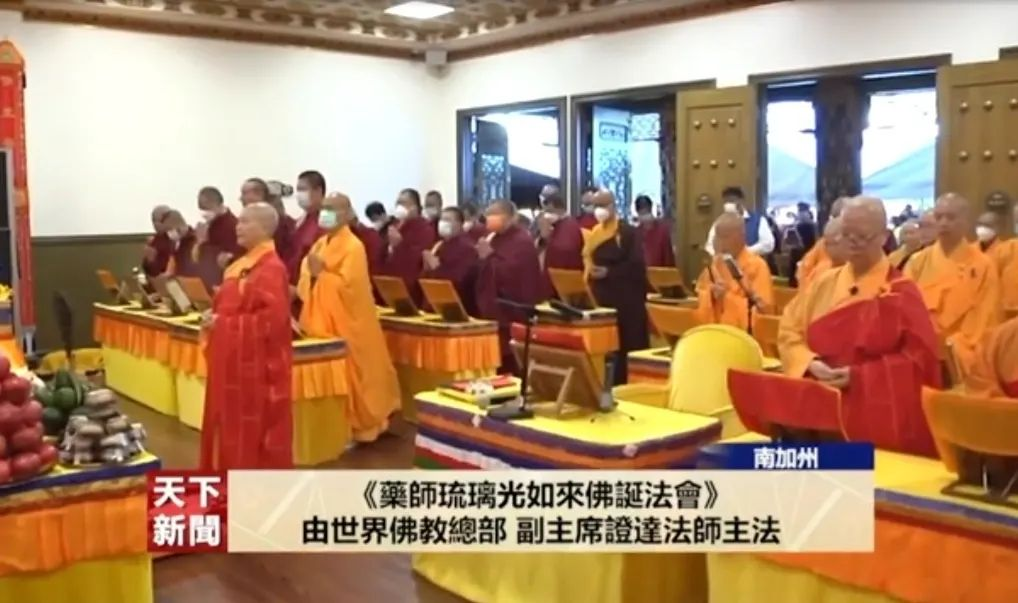
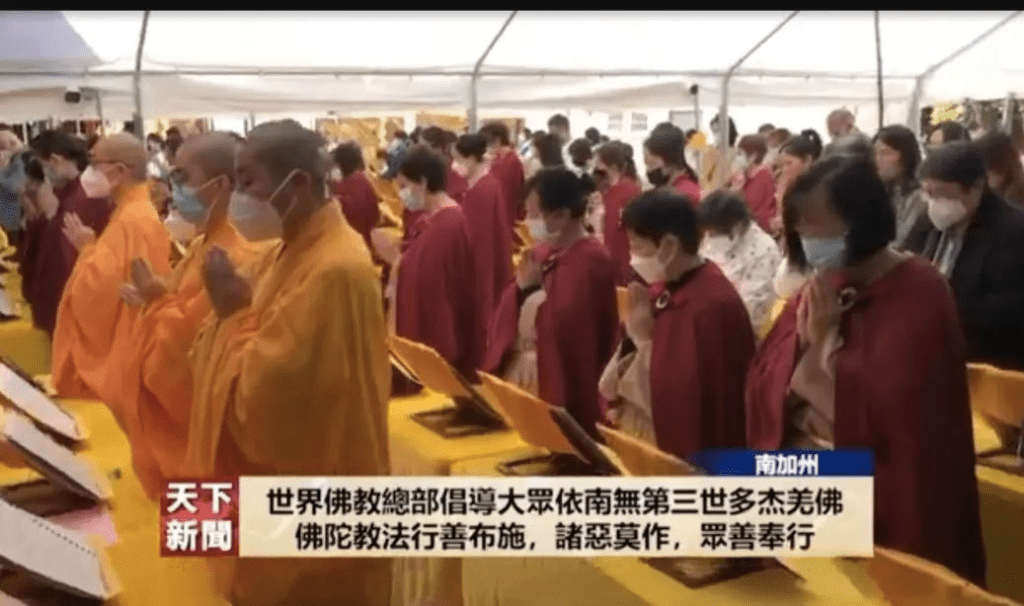
In accordance, the World Buddhism Association Headquarters held two Dharma events on October 29 and October 30 to honor Namo Medicine Buddha’s holy birthday. On October 29th, a Dharma Assembly was held in the inner bay of Marian Del Ray, California to release captured lives in observance of the Buddha-Stipulated Day of Releasing Lives. October 30th, the Dharma Assembly convene to respectfully celebrate the birthday of Namo Medicine Buddha at the Holy Miracles Temple in Pasadena, California. Several hundred Buddhists from across the world attended, including holy gurus, eminent monastics, rinpoches, acaryas, Dharma-listening masters, and householders.
The Holy Miracles Temple is owned by the World Buddhism Association Headquarters. It is a temple where authentic Buddha Dharma is practiced and where many real Buddha Dharma’s holy feats have been manifested and shown to the world.
Within the temple, the Grand Hall of Shakyamuni Buddha is presently the only Inner-Tantric Mandala in the world—a place where Two Great Dharma Requirements have been met. Within the hall, the Pope of World Buddhism Namo H.H. Dorje Chang Buddha III has presided over many significant holy Dharma Assemblies which manifested the powers of Buddha Dharma, transmitted unparalleled Buddha Dharmas to disciples, and imparted the universal truth. His Holiness illuminates the grand path to liberation that encompasses both the practices of cultivation and Dharma.
Among the temple’s other wonders is the Hall of Buddha Dipankara and the Holy Hall of Bodhisattva Avalokiteshvara. On March 7, 2014, the Holy Blessing Dharma Assembly was held in the place that is now the Hall of Buddha Dipankara to celebrate the First Issue of Imparting the Absolute Truth Through Heart Sutra, a Buddhist Sutra imparted by Namo H.H. Dorje Chang Buddha III. There, onlookers witnessed a number of Buddhas bestow holy amritas of three different colors, shining down through the roof, passed through a crystal bowl cover into the empty Dharma Bowl.
Today, the Hall of Buddha Dipankara is a sanctuary for Buddhists to light lamps in offering and increase their merits. Great Holy Gurus, Holy Gurus, and Dharma masters chant mantras, read out Buddhist Sutras, and practice Dharmas to pray for and bless lamp lighters. It is said, when one lights the bright lamp of blessing in front of Buddha Dipankara in the holy hall where amritas were once bestowed, the blessings power outshines that of any brought by lamps lit in common-place halls.
Hall of Buddha Dipankara in Holy Miracle Temple
In the Holy Hall of Bodhisattva Avalokiteshvara, the holy statue of Namo Great Compassionate Bodhisattva Avalokiteshvara is placed for people to worship. In this hall, the body of Shengzun Yinhai, a noted disciple of Namo H.H. Dorje Chang Buddha III, was placed after his passing. During the month his body resided in the hall in the Holy Miracles Temple, a series of divine transformations and holy feats took place. His body transformed as, from the tenth day of his passing, the wrinkles on his visage began to disappear and his bones and muscles began grew fuller. His complexion was rosy once more and his hair and fingernails continued to grow. Shengzun Yinhai transformed and realized a non-decaying vajra body—a state never before witnessed in Buddhist history. This transformation marked a new holy chapter in the history of Buddhist accomplishments after passing, and the western media was quick to report on the media.
The Dharma Assembly to Respectfully Celebrate the Buddha’s Birthday of Namo Medicine Buddha was held in the Grand Hall of Shakyamuni Buddha of the Holy Miracles Temple on October 30. The Vice Chairperson of the World Buddhism Association Headquarters and also the Honorable Chairperson of the International Buddhism Sangha Association, Jiaozun Zhengda, who is a holy guru of Gold Button Level II, together with the Abbot of the Hua Zang Si Temple, Ruzun Ruohui, a holy guru of Gold Button Level I, as well as the Abbot of the Sanger Mission Bodhi Monastery, Dharma Master Juehui presided over the Dharma ceremony. Notable holy gurus, eminent monks and nuns, and monastics led the Buddhist chanting. The attendees chanted the Bhaisajya Guru Vaidurya Prabha Raja Sutra—The Medicine Guru Vaidurya Prabha Tathagata’s Fundamental Vows Merit Sutra—in synchronicity.
With praises to the Buddha and offerings made to the Buddha, the two Dharma events included chanting the sutra and the mantras as well as releasing lives. The assembly returned the merits to and prayed for the living beings in the world, praying to Namo Medicine Buddha and the Buddhas and Bodhisattvas in the ten directions to give blessings and to protect living beings so that the pandemic is eradicated from the world, peace and friendship persist internationally, the world rids itself of calamity and all enjoy good fortune, health, and longevity.
Maitreya Buddha is said to be Future Buddha. In various Buddhist sutra such as Amitabha Sutra, as well as Lotus Sutra, Maitreya Buddha is believed to be called as Ajita.
Maitreya Buddha
In the world of Buddhist eschatology, Maitreya literally means the future Buddha. Maitreya Buddha is considered as the 5th Buddha that is believed to appear in this Kalpa or era. Thus, Maitreya Buddha is considered as the Future Buddha that is yet to appear in this age. In various Buddhist sutra such as Amitabha Sutra, as well as Lotus Sutra, Maitreya Buddha is believed to be called as Ajita.
According to Buddhist history and tradition, Maitreya Buddha is believed to be Bodhisattva who will appear in the Earth in the future, will achieve Nirvana and will teach the people of Earth the pure Dharma just like Shakyamuni Buddha did. According to the Buddhist texts as well scriptures, Maitreya Buddha will be considered as the successor of the living Buddha i.e. Gautama Buddha. The Prophecy of Maitreya Buddha coming back to the terrestrial world is written in most of the major Schools of Buddhism in many Buddhist countries
Attributes of Maitreya Buddha
Many Maitreya Buddha statues, Buddha images are shown with different attributes as well as Hand mudras as well as postures. The Maitreya Buddha statues are represented with all the attributes that must be in the attributes of Bodhisattva. Most of the Buddha statues of Maitreya Buddha are pdepicted with both hands using Dharmachakra Mudra.
Maitreya Buddha is also represented as holding lotus flower in each hand of the statues. Each hands also possessed a Wheel of Dharma as well a ritual base. Both Wheel of Dharmaas well as ritual vase are shown on the top of lotus flower. The wheel of dharma on the top of lotus shows that maitreya Buddha emphasize his mission to spread and teach Dharma to all beings. While the Ritual vase on the top of lotus shows that Maitreya Buddha will be born in the family of low cast while Buddhist history shows that Shakyamuni Buddha was born in the family of high cast.
Laughing Buddha as Maitreya Buddha
Laughing Buddha is shown as the next Maitreya Buddha in the Chinese Buddhism. Laughing Buddha is also believed to be a Bodhisattva and will be the next Matreya Buddha. There are various Buddha statues that represents Maitreya Buddha but Laughing Buddha is one of the most popular known Buddha in the whole world especially for his fat belly and smiling face.


















 Peace LiLy