The Swan’s Gift

The Swan’s Gift

By Brenda Seabrooke

Anton was a farmer who lived with his wife Rubina and their seven children at the edge of the forest. He worked hard and they were happy for many years. Then one spring, the rains didn’t fall and Anton’s wheat died in the fields. As winter came on, their food supply grew smaller and smaller. Soon, Anton’s shoulders were stooped with worry. Rubina’s plump apple cheeks withered. The children no longer sang or laughed or danced, for they were all too hungry.

Every day Anton went out to hunt for food but returned without firing a shot. And every day, Rubina added water to the onion soup until there was nothing in the pot but water. When Anton saw his family crying with hunger, he wanted to cry too.

But instead, he took his gun and went out again into the cold, cold night. He had to find something for them to eat: a bird or a rabbit. But the black branches were empty of birds and no rabbits crouched in the frozen shrub. The only tracks Anton saw were his own.

He came to a small hill and knew it was the last one he would be able to climb before his strength was gone. His feet were numb and his breath rasped in the freezing air. At the top of the rise, he stopped to rest, scanning the snow for tracks. In despair, Anton turned to go. Just then, he saw below him a lake that was not yet frozen over. Its edge was lacy with ice and at its center floated a swan of such dazzling beauty that Anton could not look away. Its stark white feathers gleamed against the dark water and as Anton watched, the swan seemed to grow larger until its image filled his eyes.

Suddenly, juices flowed into Anton’s mouth. He could taste succulent roast swan and see his children’s faces glowing as his family sat at the table eating again. He raised his gun and sighted down the long barrel. Anton put his finger on the trigger. The swan seemed to be looking at him, listening for the shot that would kill it. He lowered the gun. The swan was the most beautiful creature Anton had ever seen. As he watched, the swan fanned its magnificent wings.

Anton closed his eyes and thought of his family. Again, he raised his gun. Hours seemed to pass. The feathers on the swan’s breast moved gently with each beat of its heart, and Anton could feel his own heart beating. He lifted his heavy wet feet, walked a few steps, and then dropped to his knees. “I can’t do it,” he said.

“Why not?” asked a voice as soft as snow or feathers ruffling in a gentle wind.

“I cannot kill beauty. If I kill this swan, my family will have food for one or two meals. And then what? We will be hungry again and it will have been for nothing.”

Anton was too tired to be surprised that he was speaking to the swan or the wind or the night. He was too tired to walk back home. He bowed his head with sadness for his family.

With a cry, the swan lifted its wings, rose from the lake, and circled Anton, water dropping from its wing feathers.As the water hit the snow, it froze into crystals that sparkled in the moonlight. Anton reached out and touched one. It was hard, harder than ice, and did not melt in the warmth of his hand.

“A diamond!” Anton said. Quickly, he scooped up the diamonds that lay in a glittering circle around him. He filled his pockets with them and set off through the snow to a nearby village.

Anton was no longer tired. He no longer felt the cold. He woke up the innkeeper, calling, “I need food.”

“Your crops failed,” said the innkeeper. “Everyone knows you have no money.”

“I have a diamond,” said Anton.

“Where would the likes of you get a diamond?” the man scoffed.

“Let me in and I will explain.”

The innkeeper fed Anton cold venison and sweet dumplings while Anton told his story, and the innkeeper’s wife packed a sledge for him with roast chickens and cheeses and onions and turnips. Then they sent Anton on his way so that they could begin looking for the magic swan themselves.

Rubina met him at the door. “Did you find any food? Mischa has fainted.”

“No. But look what I have brought.” Anton showed her the sledge.

“But how did you get it?” she asked.

For answer, he spilled the diamonds onto the table.

“Oh,” cried Rubina, “you have turned to robbery!”

“No,” said Anton. And he told her all about the swan, and how it had circled him with the diamonds falling from its wings.

Anton and Rubina woke the children even though it was the middle of the night, and they all sat at the table eating slowly, enjoying the flavor of the food and wonderful feeling in their stomachs. Rubina’s black eyes sparkled as she filled her children’s bowls. Anton felt his strength returning. Several of the children hummed as they were put to bed.

Anton and Rubina and their children were never hungry again, for they used their diamonds wisely and well. News of the magic swan spread throughout the land and many people searched for it. But the swan was never found.

Sometimes when Anton was alone in the forest, the image of the swan rose before him. He saw again the gleam of its feathers, the coral glow of its beak, and the magnificent reach of its wings as it glided silently across the sky.

Link:https://peacelilysite.com/2024/05/20/the-swans-gift/

Source: https://files.schudio.com/st-marys-ce-primary-school/files/documents/year_2_reading_1(1).pdf

The Wisdom in Chinese Idiom

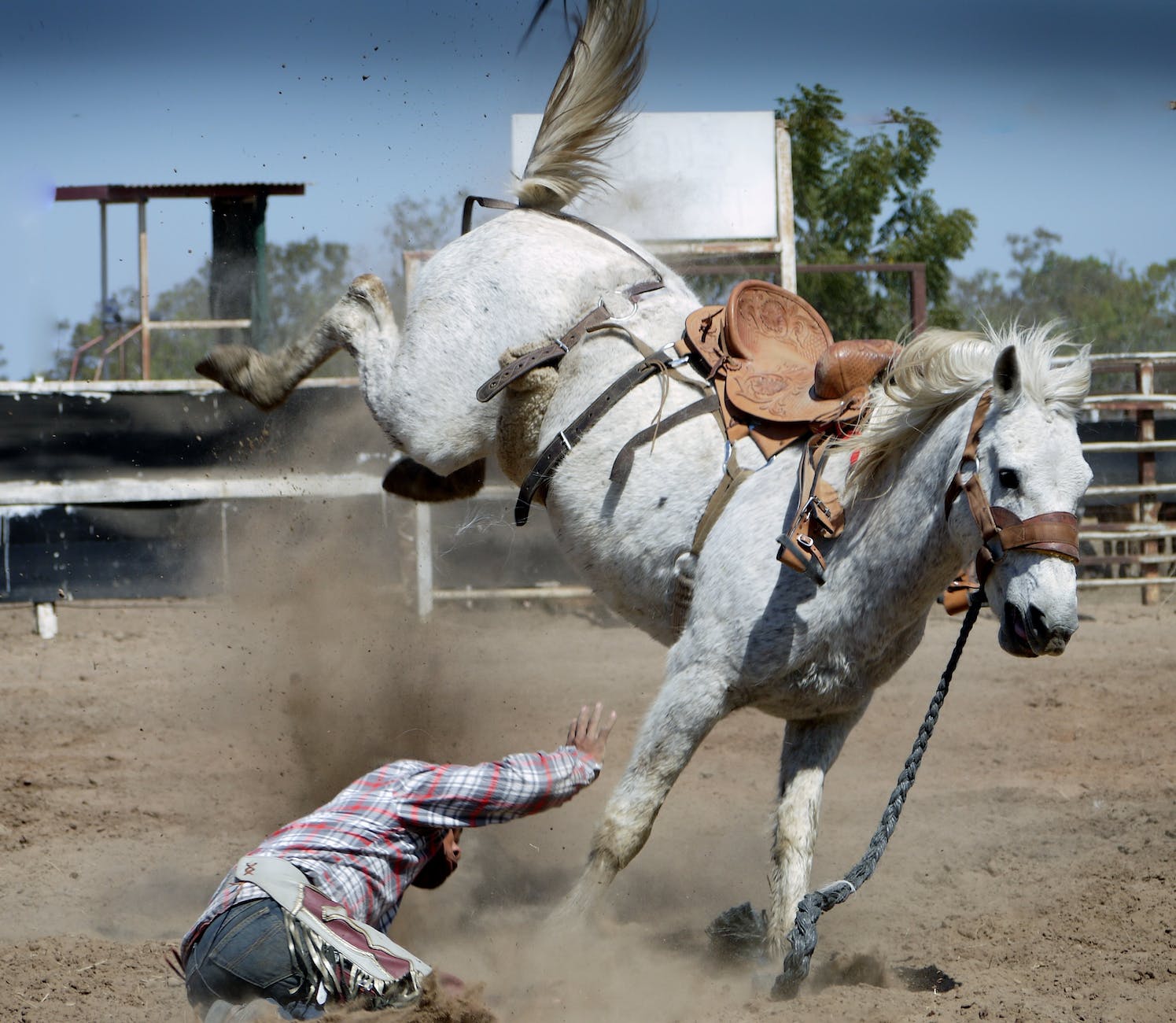
Photo by Helena Lopes on Pexels.com

Embracing Life’s blessings and the challenges

In the annals of ancient wisdom, tales of great insight and philosophical musings have been passed down through generations. One such tale is that of Sai Weng, a man living on the northern frontier whose experiences teach us a valuable lesson about the unpredictability of life. This story illuminates the idea that blessings and curses often come disguised, and it reminds us of the importance of embracing life’s ups and downs with equanimity and resilience.

A long time ago, there lived a man named Sai Weng on the northern frontier of China. One day, his beloved white stallion ran off into the territory of the northern people, leaving Sai Weng without his cherished companion. His son was heartbroken. Naturally, his neighbors sympathized with him, considering it a great misfortune. Surprisingly, Sai Weng remained unperturbed and uttered these words: “Perhaps this will soon turn out to be a blessing.”

After a few months, the horse returned to Sai Weng, accompanied by another magnificent horse from the north. The neighbors were amazed by his good fortune and congratulated him on his newfound wealth. Yet, Sai Weng, ever wise, cautioned them by saying, “Oh, of course I am pleased…. but who knows if this is lucky or unlucky?.”

And so it did, for Sai Weng’s son, who grew fond of horse riding, had a terrible accident and broke his leg while riding the new horse. Once again, the neighbors expressed their sympathies, believing it to be an unfortunate turn of events. However, Sai Weng responded with his characteristic insight, saying, “I cannot know if these injuries will turn out to be something good or something bad.”

Photo by Pixabay on Pexels.com

In due time, war broke out along the border with the northern people. The able-bodied men from Sai Weng’s village were called to arms to defend their homeland. Tragically, most of them perished in the battle. But Sai Weng and his son were spared, as the son’s injury prevented him from joining the fight. It was then that the true meaning of Sai Weng’s words became apparent – what seemed like a curse had, in fact, saved their lives.

Sai Weng’s story offers us profound insights into the nature of life and the ever-changing circumstances we encounter. It teaches us that appearances can be deceiving and that our judgments based on surface-level observations may not reflect the true nature of a situation. It urges us to refrain from hasty conclusions and remain open to the possibilities that lie ahead.

The concept of predestination is introduced in this tale, highlighting the idea that some things in life are beyond our control and are determined by fate. While we cannot alter the hand we are dealt, we can choose how we respond to it. Sai Weng’s calm acceptance and his ability to find hidden good opportunities in apparent setbacks demonstrate the importance of adapting to circumstances with grace and wisdom.

When fortune smiles upon us, it is essential to remain humble and vigilant, aware that circumstances can change unexpectedly. Gratitude for our blessings should be accompanied by a sense of preparedness for potential challenges. Similarly, when faced with adversity, we must remember that it is temporary and maintain hope and optimism for the future.

Sai Weng’s tale serves as a timeless reminder of the unpredictable nature of life and the need for a balanced perspective. It teaches us not to be overly complacent during favorable times and not to be disheartened by setbacks and obstacles. By embracing the ebb and flow of life, we can cultivate resilience, wisdom, and gratitude. As we navigate our own journeys, let us remember the lessons of Sai Weng and approach life with equanimity. By seeing beyond the surface and embracing both the blessings and the challenges.

Photo by Alex on Pexels.com

Embracing Life’s blessings and the challenges

Link:https://peacelilysite.com/2023/06/13/the-wisdom-in-chinese-idiom/

#ChineseCulture #ChineseIdiom #Wisdom #BlessingsandCurses#Equanimity #Unpredictable#Story #Tale

The Three Questions

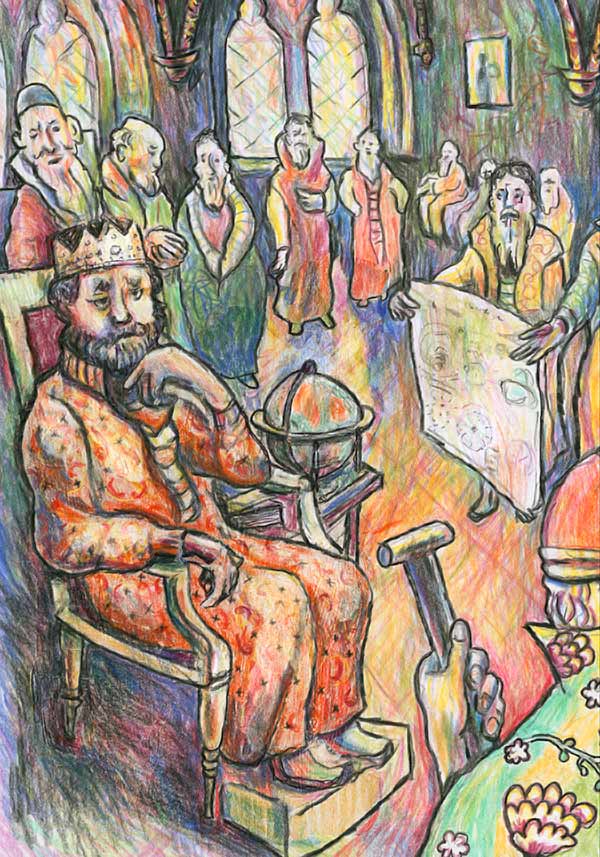
drawing of a kings throne room

By Leo Tolstoy

It once occurred to a certain king that if he always knew the right time to begin everything; if he knew who were the right people to listen to, and whom to avoid; and, above all, if he always knew what was the most important thing to do, he would never fail in anything he might undertake.

And this thought having occurred to him, he had it proclaimed throughout his kingdom that he would give a great reward to anyone who would teach him what was the right time for every action, and who were the most necessary people, and how he might know what was the most important thing to do.

And learned men came to the king, but they all answered his questions differently.

In reply to the first question, some said that to know the right time for every action, one must draw up in advance a table of days, months, and years, and must live strictly according to it. Only thus, said they, could everything be done at its proper time. Others declared that it was impossible to decide beforehand the right time for every action, but that, not letting oneself be absorbed in idle pastimes, one should always attend to all that was going on, and then do what was most needful. Others, again, said that however attentive the king might be to what was going on, it was impossible for one man to decide correctly the right time for every action, but that he should have a council of wise men who would help him to fix the proper time for everything.

But then again others said there were some things which could not wait to be laid before a council, but about which one had at once to decide whether to undertake them or not. But in order to decide that, one must know beforehand what was going to happen. It is only magicians who know that; and, therefore, in order to know the right time for every action, one must consult magicians.

Equally various were the answers to the second question. Some said the people the king most needed were his councilors; others, the priests; others, the doctors; while some said the warriors were the most necessary.

To the third question, as to what was the most important occupation, some replied that the most important thing in the world was science. Others said it was skill in warfare; and others, again, that it was religious worship.

All the answers being different, the king agreed with none of them, and gave the reward to none. But still wishing to find the right answers to his questions, he decided to consult a hermit, widely renowned for his wisdom.

The hermit lived in a wood which he never quitted, and he received none but common folk. So the king put on simple clothes and, before reaching the hermit’s cell, dismounted from his horse. Leaving his bodyguard behind, he went on alone.

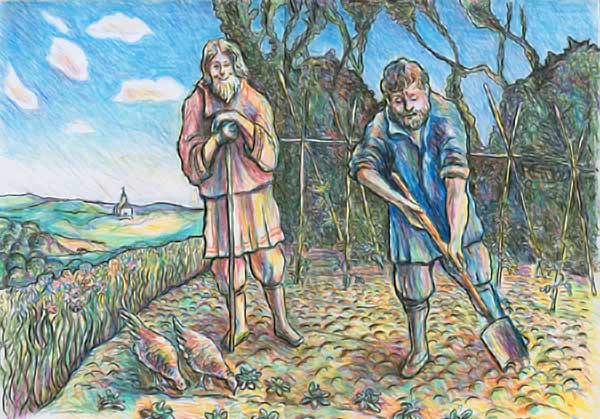
When the king approached, the hermit was digging the ground in front of his hut. Seeing the king, he greeted him and went on digging. The hermit was frail and weak, and each time he stuck his spade into the ground and turned a little earth, he breathed heavily.

The king went up to him and said: “I have come to you, wise hermit, to ask you to answer three questions: How can I learn to do the right thing at the right time? Who are the people I most need, and to whom should I, therefore, pay more attention than to the rest? And, what affairs are the most important and need my first attention?”

drawing of a man working in garden

The hermit listened to the king, but answered nothing. He just spat on his hand and recommenced digging.

“You are tired,” said the king, “let me take the spade and work awhile for you.”

“Thanks!” said the hermit, and, giving the spade to the king, he sat down on the ground.

When he had dug two beds, the king stopped and repeated his questions. The hermit again gave no answer, but rose, stretched out his hand for the spade, and said:

“Now rest awhile – and let me work a bit.”

But the king did not give him the spade, and continued to dig. One hour passed, and another. The sun began to sink behind the trees, and the king at last stuck the spade into the ground, and said:

“I came to you, wise man, for an answer to my questions. If you can give me none, tell me so, and I will return home.”

“Here comes someone running,” said the hermit. “Let us see who it is.”

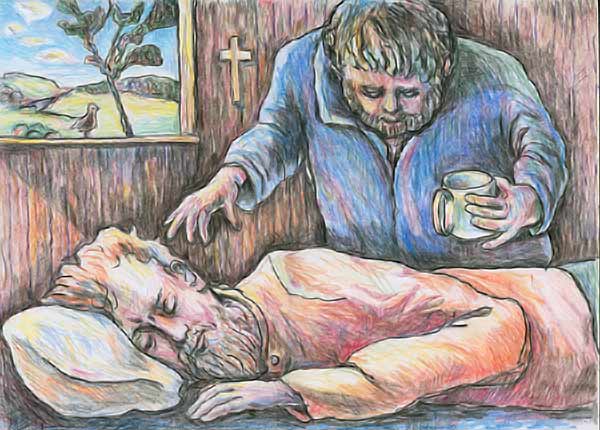
The king turned round and saw a bearded man come running out of the wood. The man held his hands pressed against his stomach, and blood was flowing from under them. When he reached the king, he fell fainting on the ground, moaning feebly. The king and the hermit unfastened the man’s clothing. There was a large wound in his stomach. The king washed it as best he could, and bandaged it with his handkerchief and with a towel the hermit had. But the blood would not stop flowing, and the king again and again removed the bandage soaked with warm blood, and washed and re-bandaged the wound. When at last the blood ceased flowing, the man revived and asked for something to drink. The king brought fresh water and gave it to him. Meanwhile the sun had set, and it had become cool. So the king, with the hermit’s help, carried the wounded man into the hut and laid him on the bed. Lying on the bed, the man closed his eyes and was quiet; but the king was so tired from his walk and from the work he had done that he crouched down on the threshold, and also fell asleep – so soundly that he slept all through the short summer night.

drawing of a man caring for sick person

When he awoke in the morning, it was long before he could remember where he was, or who was the strange bearded man lying on the bed and gazing intently at him with shining eyes.

“Forgive me!” said the bearded man in a weak voice, when he saw that the king was awake and was looking at him.

“I do not know you, and have nothing to forgive you for,” said the king.

“You do not know me, but I know you. I am that enemy of yours who swore to revenge himself on you, because you executed his brother and seized his property. I knew you had gone alone to see the hermit, and I resolved to kill you on your way back. But the day passed and you did not return. So I came out from my ambush to find you, and came upon your bodyguard, and they recognized me, and wounded me. I escaped from them, but should have bled to death had you not dressed my wound. I wished to kill you, and you have saved my life. Now, if I live, and if you wish it, I will serve you as your most faithful slave, and will bid my sons do the same. Forgive me!”

The king was very glad to have made peace with his enemy so easily, and to have gained him for a friend, and he not only forgave him, but said he would send his servants and his own physician to attend him, and promised to restore his property.

Having taken leave of the wounded man, the king went out into the porch and looked around for the hermit. Before going away he wished once more to beg an answer to the questions he had put. The hermit was outside, on his knees, sowing seeds in the beds that had been dug the day before.

The king approached him and said, “For the last time, I pray you to answer my questions, wise man.”

“You have already been answered!” said the hermit, still crouching on his thin legs, and looking up at the king, who stood before him.

“How answered? What do you mean?” asked the king.

“Do you not see?” replied the hermit. “If you had not pitied my weakness yesterday, and had not dug these beds for me, but had gone your way, that man would have attacked you, and you would have repented of not having stayed with me. So the most important time was when you were digging the beds; and I was the most important man; and to do me good was your most important business. Afterwards, when that man ran to us, the most important time was when you were attending to him, for if you had not bound up his wounds he would have died without having made peace with you. So he was the most important man, and what you did for him was your most important business. Remember then: there is only one time that is important – now! It is the most important time because it is the only time when we have any power. The most necessary person is the one with whom you are, for no man knows whether he will ever have dealings with anyone else: and the most important affair is to do that person good, because for that purpose alone was man sent into this life.”

This story reminded me of something that Henry Shukman, an English Spiritual Director Emeritus and a Zen Buddhism practitioner, once said: ‘Now… is always and ever the most important thing… there is only one place that fulfillment can happen: here and now.’

The Three Questions

Link: https://peacelilysite.com/2023/03/09/the-three-questions/

#LeoTolstoy #Hermit#Spiritual #HenryShukman #King #ZenBuddhism#MoralStory

Source: https://www.plough.com/en/topics/culture/short-stories/the-three-questions