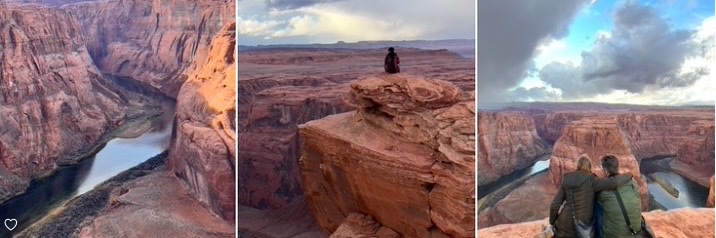
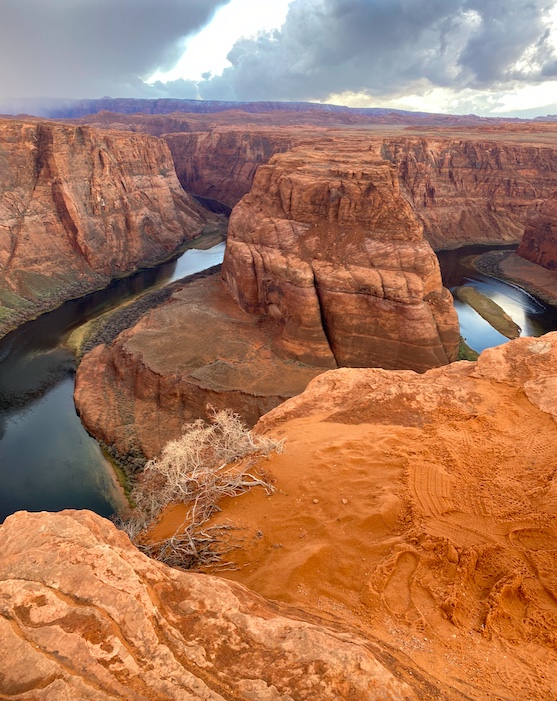
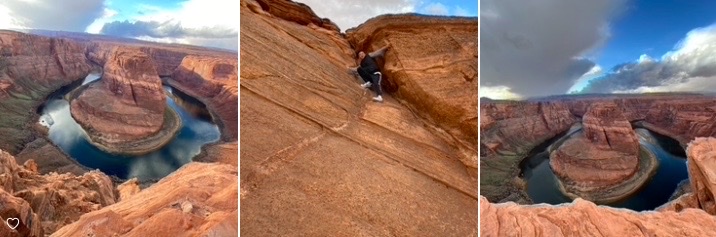
During our family trip, one of the most stunningly beautiful places we visited was Horseshoe Bend. As we approached the overlook, I was immediately impressed by the diamond blue water and the strange-shaped cliffs that surrounded the bend in the Colorado River. We stepped near the edge of the cliffs, and it was stunning how large the canyon was. The river was far below the towering cliff-sides, and I felt almost dizzy being so small and so high above the canyon floor.
We walked around the overlook area, which was full of visitors admiring the landscape. Despite the large crowd, everyone seemed to be happy, enjoying the beauty of nature and forgetting about the unhappiness in their lives. It was as if they were all experiencing the healing power of nature.
People were busy taking photos and posing for pictures, trying to preserve their memories of this awe-inspiring landscape that was formed over millennia of the river carving through the rock. And it made me realize how important it is to protect and preserve our planet, our beautiful home Earth.
The river, although beautiful, was much below its usual water height, due to the ongoing drought and unsustainable water use in this area. As a society, we need to focus on preventing global climate change, cleaning up pollution, and taking care of our planet for future generations. Instead of spending resources on trying to inhabit other planets, which are currently devoid of life, we need to work together to save our own planet.
If we don’t take action, our future generations might not have the same opportunities to experience and appreciate the beauty of nature that we have today. Earth is our only place for food, shelter, and energy for at least the next thousand years. So let’s join hands and work together to protect and preserve our beautiful home planet, so that our future generations can enjoy the same wonders of nature that we do today.
Our visit to Horseshoe Bend was more than just a family vacation. It was a powerful reminder that we all have a responsibility to protect and preserve our planet. As a result, I have made a personal commitment to reduce my consumption of unnecessary goods, and to practice the principles of “reduce, reuse, and recycle.” Additionally, I pray for an end to man-made disasters, such as war, and for the regeneration of healing powers from everyone’s heart.
In reflecting on this experience, I was reminded of the words of Peace Pilgrim, who said, “Remember the power of thought, and think only about the best that could happen. Dwell only upon the good things you want to see happen. Remember, through thought you create your inner conditions and help to create the conditions around you. We are all helping to make a great decision.” These words inspire me to focus on positivity and to believe that my thoughts and actions can create positive change in the world.
The third stop of our family winter break trip was the Ligai Canyon, and what an incredible experience it turned out to be. We had initially planned to visit Antelope Canyon, but all the tour tickets were sold out. Instead, the agent suggested we visit Ligai Canyon, a similar but lesser-known destination, the ticket is $70 per person, and we were pleasantly surprised by what we found.
Ligai Canyon is located on Navajo private property, and all the tour guides are from the same family. Our tour guide was knowledgeable and friendly, he shared a wealth of information about the Navajo culture and way of life. He told us about the significance of blue as a protective color and showed us his beautiful turquoise bracelet. He also shared details about the four sacred mountains, the use of native herbs for medicine, and the Navajo’s life on their huge ranch, which is 6 miles by 6 miles.
We had very small group, just 6 people, and the tour place was not crowded at all. The tour guide shared that when he was a child, the canyons were his playground, and he and his friends had parties in the upper Antelope Canyon during their high school years. He never imagined that people would pay theme park prices to visit these places that were once their playgrounds.
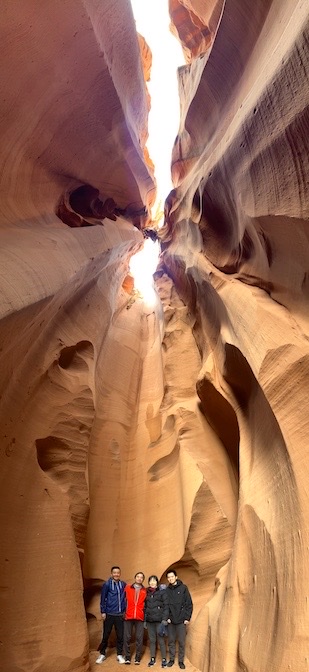
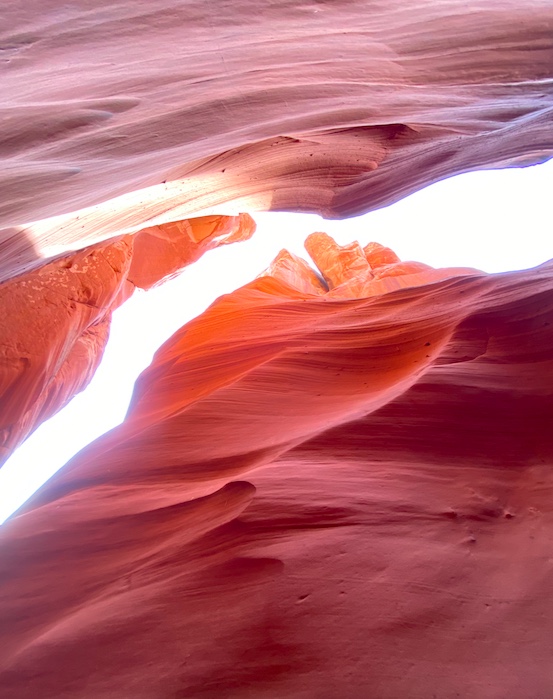
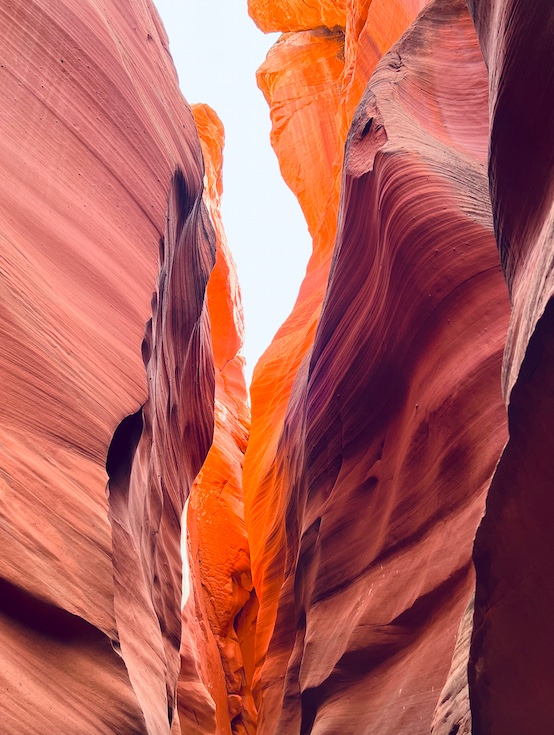
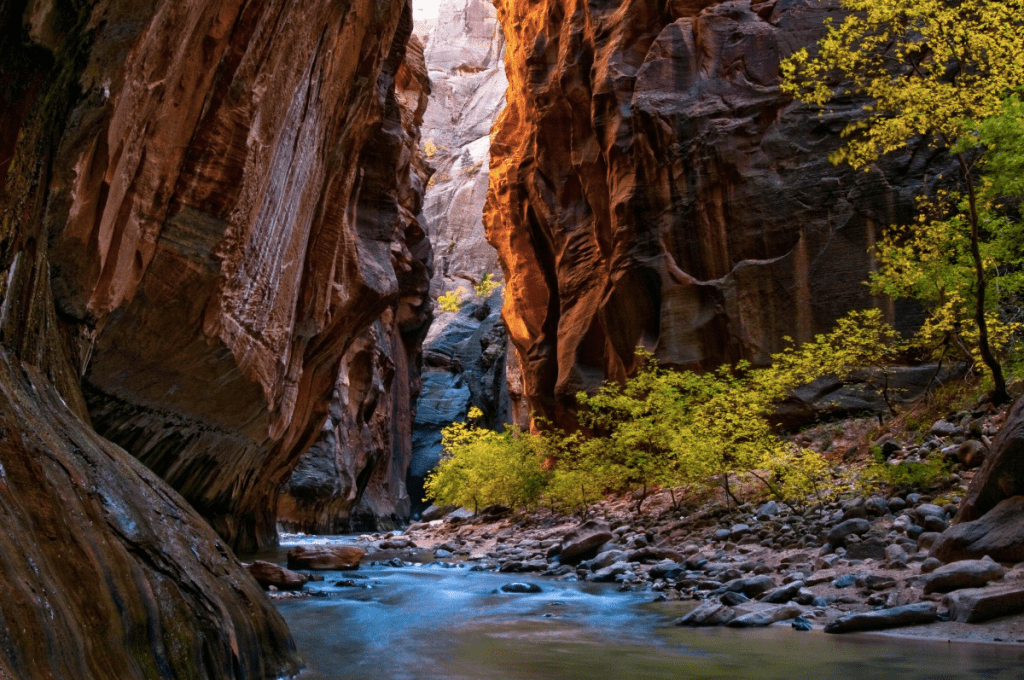
The Canyon truly captures the beauty and power of nature. It’s awe-inspiring to think about how the canyon was formed over millions of years by the forces of water and wind. The intricate patterns and shapes carved into the stone walls of the canyon are a testament to the sheer force of nature.
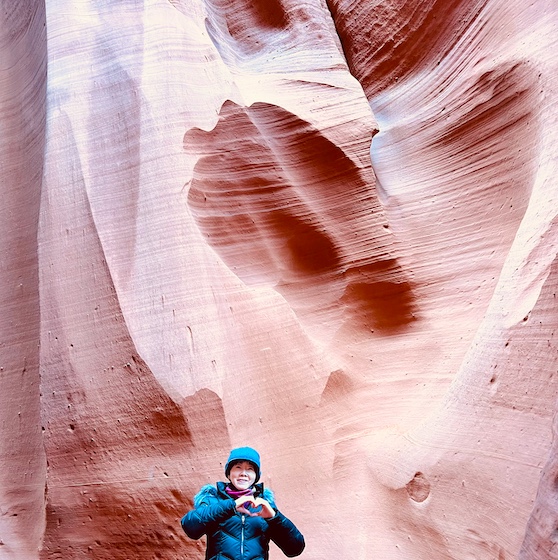
As you explore the canyon, you’ll be struck by the diversity of its features. From the heart-shaped carvings on the walls to the narrow pathways and towering cliffs, each aspect of the canyon offers something unique and breathtaking. The dynamic spiral shapes that wind their way up the walls are particularly mesmerizing, and add to the overall sense of movement and energy that permeates the canyon.
Another striking feature of the Ligai Canyon is its reddish hue. This rich, vibrant color is the result of the iron oxide in the rock, and adds an extra layer of beauty to an already stunning landscape. Whether you’re gazing up at the towering cliffs or admiring the intricate patterns on the walls, you’ll be awed by the sheer magnificence of this natural wonder.
At the end of the tour, our guide imparted some wise words to my two sons. He told them to learn from their grandparents and parents, and to hold onto their native language, as there is a wealth of wisdom and knowledge contained within it. My sons were deeply moved by his words, and I could see that they had taken his message to heart.
I hope that they will continue to pass down the Chinese culture to future generations, preserving its rich history and traditions. This was truly the highlight of the tour for me, and I am grateful for the guide’s insights and encouragement. By imparting these valuable lessons to my sons, he has given them a gift that they will carry with them for the rest of their lives.
Our second stop on the road trip was Zion National Park. Zion National Park is a stunning natural wonder with over 200 sq. miles of diverse landscapes, towering cliffs, and diverse flora and fauna. It attracts more visitors than Yosemite National Park last year. Zion offers a unique blend of adventure, beauty, and inspiration.
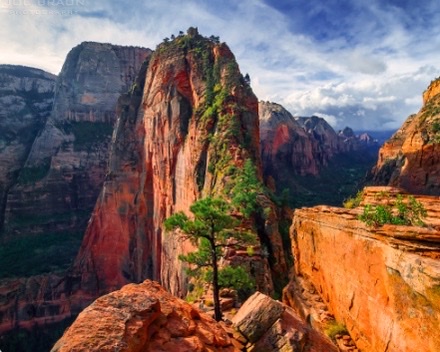
One of the hikes we did was the Angel’s Landing trail, a 5-mile round trip that is considered to be very challenging. The trail is steep and zigzags up the mountain, and a permit is required to complete the entire hike.
Despite the difficulty, my older son and husband were determined to reach the summit. They persevered and eventually made it to the top, where they were rewarded with breathtaking views of the surrounding mountains and valleys. In winter time the mountain top gets really icey, micro spikes are highly recommended.
I was unable to finish the Angel’s Landing trail, due to the challenging winding path resembling Lombard Street. I had to stop just before the permit-required section, feeling exhausted. Nevertheless, I still appreciated the views from my stopping point. Although I didn’t reach the summit, the overall experience was still memorable.
It’s worth noting that the Angel’s Landing trail can be dangerous, and since 2004, 17 people have died while attempting it. It’s important to be prepared and take all necessary precautions when tackling this challenging hike.
Riverside Trails
We explored other trails at the following day, like the Riverside Trail, but the weather didn’t cooperate. Despite heavy rain and feeling cold and wet, we were unable to fully enjoy the hike. However, we look forward to returning to the majestic and awe-inspiring Zion National Park in better weather. Overall, Zion National Park was an amazing experience and it is a must-see destination for anyone who loves nature and outdoor activities.
It was late January, just a few weeks before Chinese New Year, when we headed to Zhoushan in Zhejiang Province. It was bitterly cold and traveling to Mount Putuo (普陀) for a two-day visit was not good timing. COVID-19 was—and still is—running rampant around the world. Any kind of travel required constant and painstaking vigilance, including full compliance with stringent prevention measures in China. Nevertheless, our destination looked as beautiful as ever, a glimmering island in the great ocean, celebrated as the “Buddha-land in the sea.” (Haitian fogou 海天佛國)
Mount Putuo is very environmentally friendly. Except for public buses, no vehicles are allowed, so we had to leave our car at the wharf. Most residents simply cycle around for their daily errands, and even said bicycles are under a quota control. For visitors to move about, you can take a bus, cycle, or simply walk. Roads and pathways are well maintained, and there is a long road that connects all the temples on the island, big or small, affording a pleasant journey at one’s own pace.
It was warm and sunny with a gentle breeze by the time we reached the island in the early afternoon. As there were very few visitors, we could stroll around at our leisure, enjoying the sunlight’s embrace. “You are so lucky,” commented our trip’s docent. “It was so windy in the morning that the ferry service was about to be suspended. In a week, the entire mountain might be closed to prevent the chance of further infections, no matter how sporadic.” We were blessed with the good fortune of a joyful excursion.
Mount Putuo is classified by the Chinese government as an “AAAAA Grade Scenic Resort and Historic Site,” attracting about 10 million visitors each year under normal circumstances. Visitation, though down 40 per cent during the pandemic in 2020, has rebounded sharply; as of April, 2.8 million people had visited Mount Putuo, a fivefold increase. The effort to attract visitors is ongoing: the Putuo Mountain College of the Buddhist Academy of China was recently completed, and Guanyin Dharma Park opened last November.
Putuo is a Chinese transliteration of the Sanskrit Potalaka, which is mentioned in several Buddhist scriptures, including the Gandavyuha Sutra (added as the final sutra in the Avatamsaka Sutra). Potalaka is described as the holy residence of Avalokiteshvara, the bodhisattva of compassion. According to Guang Xing, Mount Putuo was identified as the mythical Potalaka mountain by Buddhist monks and Chinese literati (Guang 2011: 1-22). It has been the pilgrimage site of Avalokiteshvara for about a millennium, honored as one of the four sacred Buddhist mountains in Chinese Buddhism. We speak here of Guanyin, the feminine form of Avalokiteshvara popularized in Chinese Buddhism. We will return to Guanyin below. For now, we simply need to know that Mount Putuo’s status matches that of Mount Wutai (五台) for Manjushri, Mount Jiuhua (九華) for Kshitigarbha, and Mount Emei (峨眉) for Samantabhadra.
There seem to be three main demographics for visitors to Mount Putuo: sightseers, pilgrims, and students of Buddhism. The majority of sightseers are visitors who do not have much knowledge of Buddhism, nor much interest in its history, sutras, or temples. Nevertheless, everyone, regardless of background, recognizes this place as one expecting reverence and respect for the buddhas and bodhisattvas. When we worship and make our wishes before the famous 33-meter statue of Nanhai Guanyin, we are also introspecting, contemplating, and reflecting on the vicissitudes and travails of our lives.
The town nearby is neat and chic, full of activity and interesting souvenirs for tourists to commemorate their visit. Even in the winter, Mount Putuo is generously covered with greenery and vegetation, with a multitude of species including ancient camphor trees and the rare wild plants of Carpinus putoensis (普陀鵝耳櫟). They are one of the major treasures on Mount Putuo and monoecious. There are red and yellow variations coexisting, but they do not mature at the same time, so the pollination rate is extremely low. When the Sun is shining, the leaves of many trees turn golden in the backdrop of the Prussian blue sky, surrounded by the various temples. It is truly a picturesque sight.
Carpinus Putoensis Cheng. From baidu
The beautiful scenery, unique to Mount Putuo, is reminiscent of places I have visited in Japan. The connection between Mount Putuo and Japan can be traced back to the Tang dynasty (618–907), when a Japanese Zen and Tendai monk-pilgrim named Egaku (Chinese: 慧鍔; Hui’E) wanted to bring a statue of Guanyin from Mount Wutai to Japan. However, his voyage back via Mount Putuo was hampered by storms and waves despite several attempts. One day, Egaku had a dream in which he realized that the statue of Guanyin did not want to leave. He decided to enshrine it and built a simple hut near the Tidal Sound Cave. Immediately, his ship sailed through and he was able to return to Japan. This is the story of Guanyin “bu ken qu” or “unwilling to go,” and is the source of many folktales surrounding the establishment of temples and monasteries on Mount Putuo. Exchanges between Mount Putuo and Japan continued over many centuries.
Guanyin is the real protagonist linking Japan and China, with Guanyin known as Kannon or Kanzeon in Japan. Belief in this personification of compassion and benevolence has a long history in China. First introduced from India in the Western Han dynasty (202 BCE–9 CE), Avalokiteshvara was adapted and amalgamated into Chinese culture, most famously through the female figuration and her unique 32 transformations (Guang 2011: 1-22). Beginning in the Song dynasty (960–1279), the Chinese transformed the bodhisattva into the Goddess of Mercy, depicted in the feminine. (Minneapolis Institute of Art)
Belief in Guanyin has flourished in China ever since, going beyond even religious boundaries in everyday life (Guang 2011: 1-22). She is not confined to monastic life, as it is said in the Universal Gate chapter of the Lotus Sutra that any worldly being in danger will be delivered instantly on calling her name. Therefore, Guanyin has been worshipped and revered by all classes of people. As she is a compassionate divinity with countless virtues and merits, she is endowed with transcendental power. She excels in skilful means, allowing her to appear in whatever form needed by sentient beings. And that, in my opinion, is probably the reason behind the 32 forms in the Chinese tradition, including Guanyin Yangzhi (楊枝), or Willow Branch Guanyin. The Guanyin Yangzhi is only one example among many of her history-rich gender transitions.
Willow Branch Guanyin. From online source
We were able to visit a 2.5-meter-high, 2.2-meter-wide monument of Guanyin Yangzhi at a nunnery of the same name. The nunnery, situated at the foot of Putuo’s Western Xiangwang Peak, was built in 1608. The artistic style was pioneered by Yan Liben (閻立本), a famous figure painter in the Tang dynasty, while the stele’s engravings appeared during the Ming dynasty (1368–1644). Holding a tender willow branch in her right hand and a clear water vase in the left, Guanyin is luxuriously crowned with pearls and precious stones, dressed in sumptuously embroidered garments, and adorned with agate, amber, and pearls. She spreads dewdrops to all the world’s quarters to dispel suffering and pain.
Guanyin is replete with the marks of beauty, dignity, and calm. Except for her face, there are not many traditionally female features shown. Indeed, she appears tall and somehow mighty and masculine, standing on her bare feet. Her belly bulges out slightly, and she has large hands and feet. While beholding her, I could not help but think of the mural of Padmapani, another manifestation of Avalokiteshvara, at Ajanta Cave No.1, in India. Painted during the sixth century BCE, the bearer of the blue lotus is a male figure with a slender body. Both forms of Avalokiteshvara are crowned and bejewelled, have physically beautiful features, and appear composed and graceful.
Padmapani, Ajanta Cave 1. From alamy.com
There are many temples on Mount Putuo, but the two most well known are Puji Temple (普濟寺) or the “front temple” (又稱前寺), and Huiji Temple (慧濟寺) on the peak of the mountain. They receive the most pilgrims, but Fayu Temple (法雨寺) is my personal favorite; when there is no pedestrian crowding, it has a gentle and soothing atmosphere. It is surrounded by towering ancient trees, suspending the visitor in time between past and present. From a distance, one can see that the gate to the monastery is unique, unlike those of other temples on Mount Putuo, which are painted in yellow ochre. Here it is light red in color: a soft, ambient hue that emphasizes an atmosphere of paradisical peace and bliss.
Upon entering and reaching the main hall of Nine Dragons, where a statue of Guanyin is enshrined, one feels a strong sense of sublime and resplendent majesty. Yuantong Hall of the Fayu Temple is renowned for its resplendent appearance and ingenious interior structure, with a large ball hanging from the ceiling of its dome surrounded by nine vertical rafters. Each rafter is carved with a dragon that rears its head in a scramble for the ball. This intricate layout is called the Bracket with Nine Coiling Dragons and is ascribed to Emperor Kangxi (康熙) (1654–1722), who used the materials of the former palace of the Ming dynasty in Nanjing to reconstruct an earlier monastery, Zhenhai Monastery, on Mount Putuo.
Fayu Temple. From the author
What strikes me most, however, is not Fayu Temple’s imperial heritage, but rather two great minds that made their mark here. Venerable Yinguang (印光) (1861–1940) was the 13th patriarch of the Pure Land tradition and the abbot of Fayu Temple for decades. Meanwhile, Ven. Hongyi (弘一) (1880–1942) wrote in traditional calligraphy Fayu Temple’s nameplate of “heavenly flowers and Dharma rain”—first devised by Emperor Kangxi. Li Shu Tong (李叔同) was Hongyi’s secular name. A wealthy and rakish young man, he was also an eclectic and learned scholar of high culture. He relinquished what he possessed and committed to living a monastic life. Fully devoted to promulgating Buddhism, he rose to become an eminent monk.
At some point, the two monastics met each other. It is said that Master Hongyi admired Master Yinguang and asked him to be his teacher. Humble and modest, Master Yinguang refused, but invited him to stay as long as he wanted. The two spent seven days together, studying, practicing, and meditating without a single word exchanged. They simply were, as minds think alike, without verbal obstructions, thoughts traveling and flowing effortlessly. How wonderful it is to exist together beyond words. But in the era of the Internet, we are bombarded with so many words and so much information that we lose our sense of their meaning, let alone their authenticity.
If we wish to be heard, we need to be sincere, candid, and heartfelt. “Guanyin” in Chinese means the Perceiver of Sounds, or “Guanshiyin,” the Perceiver of World’s Sounds. As chanted in the Universal Gate chapter of the Lotus Sutra: “Perceiver of the World’s Sounds, heavenly voice, the voice of the sea’s tide—magnificent, rich and harmonious surpassing all worldly sounds.” If we keep Guanyin in our hearts and call on her sincerely, she will always respond.
Taihang Mountain Grand Canyon National Forest Park is located in the east of Huguan county area between the two provinces of Shanxi and Henan, north from Hugaun 30 kilometers from the county. And Taihang Mountain Grand Canyon has been rated as one of “China’s best ten grand canyons”.
The Taihang Grand Canyon extends 50 km from north to south, 1.5 km wide from east to north, with an altitude from 800 to 1739 meters. Peaks upon peaks were formed billions of years ago during an active movement of Earth’s crust. Hundreds of peaks, cliffs, gorges, waterfalls and springs form a unique and fascinating world. The three famous scenic spots in the Canyon are Peach Blossom Valley, Taihang Sky Road, and Wangxiangyan (Royal Rock).
In the scenic spot, thousands of peaks contend for beauty, strange, unique topography and geomorphology, rare animals and plants resources made of Taihang Grand Canyon of the most wonderful natural scenery. With three gorges of Five Fingers Gorge, Longquan Gorge, Wangmang Gorge as the main line, there has opened up Purple Cloud Cave, and Yungai Temple, water demon Hole and Zhenze Palace four major scenic spots.
Waterfalls can be found throughout the canyon, thundering down from the high mountains, and gently washing down over one platform after another. The 346-meter-tall Peach Blossom Waterfall presents an amazing scene in the Peach Blossom Valley.
Peach Blossom Valley
The Taihang Sky Road is located in the summit of the Mount Taihang, with a total length of 30 km. It’s not only an essential part of the sightseeing, but also an excellent lookout for a bird’s eye view of the Taihang Mountain.
Taihang Sky Road
Deep in the Taihang Canyon, there are several small villages. The houses are all built with local materials – stones. You could see the stone streets, stone walls, stone roof, stone pillars and stairs everywhere.
Besides, the world-class international gliding base is Located 1,190 meters above sea level on the Mt Linlu of the Mount Taihang Range, and the landform here offers an ideal launch platform. Air currents rise along the cliffs to finally gather at the 60-angle peak. The peak covers an area of 16,000 square meters and can accommodate up to 30 gliders launching simultaneously. Gliding competitions have been held here annually since 1992.
The Grand Canyon Rafting, whole length is 4500 meters and the drop is 85 meters. The whole journey is located in the mountain forest belt. The trees on both sides of the river are lush and the scenery is picturesque, it is beautiful to drift on the water, as if in fairyland.








 Peace LiLy