88,28. THE BULL CALLED DELIGHTFUL [ALL DESERVE RESPECT]


88,28. THE BULL CALLED DELIGHTFUL [ALL DESERVE RESPECT]

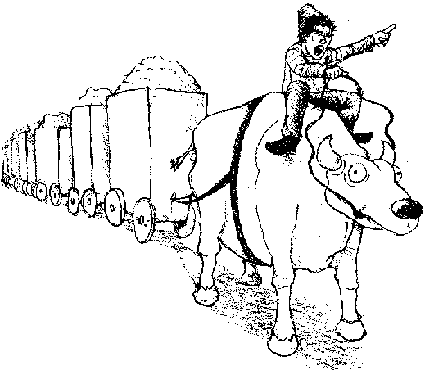
Once upon a time, in the country of Gandhara in northern India, there was a city called Takkasila. In that city the Enlightenment Being was born as a certain calf. Since he was well bred for strength, he was bought by a high class rich man. He became very fond of the gentle animal, and called him ‘Delightful’. He took good care of him and fed him only the best.

When Delightful grew up into a big fine strong bull, he thought, “I was brought up by this generous man. He gave me such good food and constant care, even though sometimes there were difficulties. Now I am a big grown up bull and there is no other bull who can pull as heavy a load as I can. Therefore, I would like to use my strength to give something in return to my master.”

So he said to the man, “Sir, please find some wealthy merchant who is proud of having many strong bulls. Challenge him by saying that your bull can pull one hundred heavily loaded bullock carts.”

Following his advice, the high class rich man went to such a merchant and struck up a conversation. After a while, he brought up the idea of who had the strongest bull in the city.

The merchant said, “Many have bulls, but no one has any as strong as mine.” The rich man said, “Sir, I have a bull who can pull one-hundred heavily loaded bullock carts.” “No, friend, how can there be such a bull? That is unbelievable!” said the merchant. The other replied, “I do have such a bull, and I am willing to make a bet.”

The merchant said, “I will bet a thousand gold coins that your bull cannot pull a hundred loaded bullock carts.” So the bet was made and they agreed on a date and time for the challenge.

The merchant attached together one-hundred big bullock carts. He filled them with sand and gravel to make them very heavy.

The high class rich man fed the finest rice to the bull called Delightful. He bathed him and decorated him and hung a beautiful garland of flowers around his neck.

Then he harnessed him to the first cart and climbed up onto it. Being so high class, he could not resist the urge to make himself seem very important. So he cracked a whip in the air, and yelled at the faithful bull, “Pull, you dumb animal! I command you to pull, you big dummy!”

The bull called Delightful thought, “This challenge was my idea! I. have never done anything bad to my master, and yet he insults me with such hard and harsh words!” So he remained in his place and refused to pull the carts.

The merchant laughed and demanded his winnings from the bet. The high class rich man had to pay him the one-thousand gold coins. He returned home and sat down, saddened by his lost bet, and embarrassed by the blow to his pride.

The bull called Delightful grazed peacefully on his way home. When he arrived, he saw his master sadly lying on his side. He asked. “Sir, why are you lying there like that? Are you sleeping? You look sad.” The man said, “I lost a thousand gold coins because of you. With such a loss, how could I sleep?”

The bull replied, “Sir, you called me ‘dummy’. You even cracked a whip in the air over my head. In all my life, did I ever break anything, step on anything, make a mess in the wrong place, or behave like a ‘dummy’ in any way?” He answered, “No, my pet.”

The bull called Delightful said, “Then sir, why did you call me ‘dumb animal’, and insult me even in the presence of others? The fault is yours. I have done nothing wrong. But since I feel sorry for you, go again to the merchant and make the same bet for two-thousand gold coins. And remember to use only the respectful words I deserve so well.”

Then the high class rich man went back to the merchant and made the bet for two-thousand gold coins. The merchant thought it would be easy money. Again he set up the one-hundred heavily loaded bullock carts. Again the rich man fed and bathed the bull, and hung a garland of flowers around his neck.

When all was ready, the rich man touched Delightful’s forehead with a lotus blossom, having given up the whip. Thinking of him as fondly as if he were his own child, he said. “My son, please do me the honor of pulling these one-hundred bullock carts.”

Lo and behold, the wonderful bull pulled with all his might and dragged the heavy carts, until the last one stood in the place of the first.

The merchant, with his mouth hanging open in disbelief, had to pay the two-thousand gold coins. The onlookers were so impressed that they honored the bull called Delightful with gifts. But even more important to the high class rich man than his winnings, was his valuable lesson in humility and respect.

The moral is: Harsh words bring no reward. Respectful words bring honor to all.

88,28. The Bull Called Delightful [All Deserve Respect]

Link: https://hhdorjechangbuddhaiiiinfo.com/2024/07/30/8828-the-bull-called-delightful-all-deserve-respect/

#Buddhisttalesforyoungandold #Buddhiststories #storiesforkids #moralstories #Buddha #Jatakastories #PansiyaPanasJataka

How to Get the Biggest Benefits of Walking

How to Get the Biggest Benefits of Walking

Lose weight, lower blood pressure, and reduce stress when you walk this way

By Sally WadykaUpdated

May 2, 202

Getting exercise through walking is as easy as lacing up your sneakers and hitting the pavement or trail. Doing so is a safe way to get a workout without needing a gym, and it can boost your mental and physical health in several important ways.

“Walking is the most studied form of exercise, and multiple studies have proven that it’s the best thing we can do to improve our overall health, and increase our longevity and functional years,” says Robert Sallis, MD, a family physician and sports medicine doctor with Kaiser Permanente.

In its 2018 scientific report to the Department of Health and Human Services, the Physical Activity Guidelines Advisory Committee noted that walking is the most popular aerobic activity and has one of the lowest injury rates of any form of exercise.

And a 2019 study of more than 44,000 Canadians found that people living in more walkable neighborhoods had a lower overall risk of cardiovascular disease. That’s a reason to advocate for local infrastructure that makes walking easier, says lead author Nicholas Howell, PhD, of the Li Ka Shing Knowledge Institute at St. Michael’s Hospital in Toronto.

Still, in the short term, “even in less walkable neighborhoods, there are ways to be active in your daily routines,” Howell says. He suggests running errands on foot, parking farther from your destination, or getting off the bus a stop early. Those small adjustments “can help fit in a few extra steps each day,” Howell says. “And they all add up.”

Here, we explain what walking can do for you—and how to maximize its many benefits.

Photo by Pixabay on Pexels.com

Benefits of Walking

1. Lower body mass index (BMI): A study from the University of Warwick in Coventry, England, published in 2017 in the International Journal of Obesity confirms that those who walk more and sit less have lower BMIs, which is one indicator of obesity. In the study, those who took 15,000 or more steps per day tended to have BMIs in the normal, healthy range.

2. Lower blood pressure and cholesterol: The National Walkers’ Health study found that regular walking was linked to a 7 percent reduced risk of high blood pressure and high cholesterol.

3. Lower fasting blood sugar (glucose): Higher blood glucose levels are a risk factor for diabetes, and the National Walkers’ Health Study also found that walkers had a 12 percent lower risk of type 2 diabetes.

4. Better memory and cognitive function: A 2021 study published in the Journal of Alzheimer’s Disease found that when adults 55 or older with mild cognitive impairment were assigned to either stretching and toning exercises or to aerobic training—mostly walking—both groups showed some improvement on cognitive tests. But when compared with the stretching and toning group, the group that walked for fitness improved aerobic fitness more, had decreased stiffness in neck arteries, and showed increased blood flow to the brain in ways that researchers think could provide more cognitive benefits in the long term.

clinical trial of older adults in Japan published in the Journal of the American Geriatrics Society in 2015 found that after 12 weeks, men and women in a prescribed daily walking exercise group had significantly greater improvements in memory and executive function (the ability to pay focused attention, to switch among various tasks, and to hold multiple items in working memory) compared with those in a control group who were told just to carry on with their usual daily routine.

And a study of 299 adults, published in the journal Neurology in 2010, found that walking was associated with a greater volume of gray matter in the brain, a measure of brain health.

5. Lower stress and improved mood: Like other types of aerobic exercise, walking—especially out in nature—stimulates the production of neurotransmitters in the brain (such as endorphins) that help improve your mental state.

6. Longer life: In a review of studies published in 2014 in the International Journal of Behavioral Nutrition and Physical Activity, researchers found that walking for roughly 3 hours a week was associated with an 11 percent reduced risk of premature death compared with those who did little or no activity.

And it’s never too late to reap the benefits of walking: A small 2013 study in the journal Maturitas found that seniors with an average age of 80 who walked just four times a week were much less likely to die over the study’s 10-year follow-up period than those who walked less.

Link:https://wisdomtea.org/2021/12/15/how-to-get-the-biggest-benefits-of-walking/