Once upon a time, in the country of Gandhara in northern India, there was a city called Takkasila. In that city the Enlightenment Being was born as a certain calf. Since he was well bred for strength, he was bought by a high class rich man. He became very fond of the gentle animal, and called him ‘Delightful’. He took good care of him and fed him only the best.
When Delightful grew up into a big fine strong bull, he thought, “I was brought up by this generous man. He gave me such good food and constant care, even though sometimes there were difficulties. Now I am a big grown-up bull and there is no other bull who can pull as heavy a load as I can. Therefore, I would like to use my strength to give something in return to my master.”
So he said to the man, “Sir, please find some wealthy merchant who is proud of having many strong bulls. Challenge him by saying that your bull can pull one- hundred heavily loaded bullock carts.”
Following his advice, the high class rich man went to such a merchant and struck up a conversation. After a while, he brought up the idea of who had the strongest bull in the city.
The merchant said, “Many have bulls, but no one has any as strong as mine.” The rich man said, “Sir, I have a bull who can pull one hundred heavily loaded bullock carts.” “No, friend, how can there be such a bull? That is unbelievable!” said the merchant. The other replied, “I do have such a bull, and I am willing to make a bet.”
The merchant said, “I will bet a thousand gold coins that your bull cannot pull a hundred loaded bullock carts.” So the bet was made and they agreed on a date and time for the challenge.
The merchant attached together one-hundred big bullock carts. He filled them with sand and gravel to make them very heavy.
The high class rich man fed the finest rice to the bull called Delightful. He bathed him and decorated him and hung a beautiful garland of flowers around his neck.
Then he harnessed him to the first cart and climbed up onto it. Being so high class, he could not resist the urge to make himself seem very important. So he cracked a whip in the air, and yelled at the faithful bull, “Pull, you dumb animal! I command you to pull, you big dummy!”
The bull called Delightful thought, “This challenge was my idea. I have never done anything bad to my master, and yet he insults me with such hard and harsh words!” So he remained in his place and refused to pull the carts.
The merchant laughed and demanded his winnings from the bet. The high class rich man had to pay him the one thousand gold coins. He returned home and sat down, saddened by his lost bet, and embarrassed by the blow to his pride.
The bull called Delightful grazed peacefully on his way home. When he arrived, he saw his master sadly lying on his side. He asked, “Sir, why are you lying there like that? Are you sleeping? You look sad.” The man said, I lost a thousand gold coins because of you. With such a loss, how could I sleep?”
The bull replied. “Sir, you called me ‘dummy’. You even cracked a whip in the air over my head. In all my life, did I ever break anything, step on anything, make a mess in the wrong place, or behave like a ‘dummy’ in any way?” He answered, “No, my pet.”
The bull called Delightful said, “Then sir, why did you call me ‘dumb animal’, and insult me even in the presence of others? The fault is yours. I have done nothing wrong. But since I feel sorry for you, go again to the merchant and make the same bet for two thousand gold coins. And remember to use only the respectful words I deserve so well.”
Then the high class rich man went back to the merchant and made the bet for two-thousand gold coins. The merchant thought it would be easy money. Again he set up the one hundred heavily loaded bullock carts. Again the rich man fed and bathed the bull, and hung a garland of flowers around his neck.
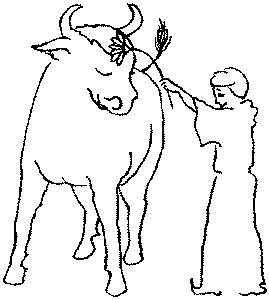
When all was ready, the rich man touched Delightful’s forehead with a lotus blossom, having given up the whip. Thinking of him as fondly as if he were his own child, he said, “My son, please do me the honour of pulling these one hundred bullock carts.”
Lo and behold, the wonderful bull pulled with all his might and dragged the heavy carts, until the last one stood in the place of the first.
The merchant, with his mouth hanging open in disbelief, had to pay the two thousand gold coins. The onlookers were so impressed that they honoured the bull called Delightful with gifts. But even more important to the high class rich man than his winnings, was his valuable lesson in humility and respect.
The moral is: Harsh words bring no reward. Respectful words bring honor to all.
Once upon a time there was a world famous teacher in Takkasila, in north-western India. He had 500 high class students who learned sacred teachings from him.
It just so happened that one of these high class students had been named ‘Bad’ by his parents. One day he thought, “When I am told, ‘Come Bad’, ‘Go Bad’, ‘Do this Bad’. it is not nice for me or others. It even sounds disgraceful and unlucky.”
So he went to the teacher and asked him to give him a more pleasant name, one that would bring good fortune rather than bad. The teacher said, “Go. my son, go wherever you like and find a more fortunate name. When you return, I will officially give you your new name.”
The young man named Bad left the city, and traveled from village to village until he came to a big city. A man had just died and Bad asked what his name was. People said. “His name was Alive.” “Alive also died?” asked Bad. The people answered, “Whether his name be Alive or whether it be Dead, in either case he must die. A name is merely a word used to recognize a person. Only a fool would not know this!” After hearing this, Bad no longer felt badly about his own name – but he didn’t feel good about it either.
As he continued on his way into the city, a debt-slave girl was being beaten by her masters in the street. He asked, “Why is she being beaten?” He was told, “Because she is a slave until she pays a loan debt to her masters. She has come home from working, with no wages to pay as interest on her debt.” “And what is her name?” he asked. “Her name is Rich.” they said. “By her name she is Rich. but she has no money even to pay interest?” asked Bad. They said, ‘Whether her name be Rich or whether it be Poor, in either case she has no money. A name is merely a word used to recognize a person. Only a fool would not know this!” After hearing this, Bad became even less interested in changing his name.
After leaving the city, along the roadside he met a man who had lost his way. He asked him, “What is your name? ” He replied, ‘My name is Tourguide.” “You mean to say that even a Tourguide has gotten lost?” asked Bad. Then the man said, “Whether my name be Tourguide or whether it be Tourist, in either case I have lost my way. A name is merely a word used to recognize a person. Only a fool would not know this!”
Now completely satisfied with his own name, Bad returned to his teacher.
The world famous teacher of Takkasila asked him, “How are you, my son? Have you found a good name?” He answered, “Sir, those named Alive and Dead both die, Rich and Poor may be penniless, Tourguide and Tourist can get lost. Now I know that a name is merely a word used to recognize a person. The name does not make things happen, only deeds do. So I’m satisfied with my name. There’s no point in changing it.”
The teacher summarized the lesson his pupil had learned this way – “By seeing Alive as dead, Rich as poor, Tourguide as lost, Bad has accepted himself.”
The moral is: “A rose by any other name would smell as sweet.”
Master Xu Yun was a renowned Zen Buddhist Holy monk, and was one of the most influential Buddhist Masters of the late 19th and 20th centuries.
Master Xu Yun renounced himself at nineteen years old, and passed away when he was one hundred and twenty years old. He had hundreds of thousands of disciples and a great many legendary stories. One time he tamed a general in Yunnan province using his extraordinary wisdom and bravery.
Master Xu Yun
General Li Genyuan was the commander of the Yunnan New Army at that time. He had studied overseas in Germany before returning to China and was a young and energetic general. He regarded himself a strong believer of science and perceived Buddhism as superstition. He wanted very much to have Buddhism removed. Because of that, he came up with the excuse that there were tens of thousands of monks in Mount Jizhu and they might organize armed resistance. Therefore, he personally led his troops to Mount Jizhu. On their way, the several thousands of officers and soldiers were demolishing temples and arresting monks.
When Elder Monk Xu Yun, abbot of Zhu Sheng Temple in Mount Jizhu, heard about this, he decided to come down from the mountain in person to persuade Li Genyuan to stop. When Li Genyuan saw this thin yet spirited elder monk who had his long beard hanging down, noticing Xu Yun’s uncommon grace and peaceful and calm manner, he was spontaneously startled, “Oh! This is Xu Yun. He does have a little uncommon demeanor!”
Li Genyuan harshly shouted, “I want to catch you. Now you even dare send yourself to me! Maybe you label yourself as not fearing death. Let me ask you, how many lives do you have?”
Xu Yun kept his head up and replied calmly, “Great Commander, I, Xu Yun, have only one life. Also, I am not any hero or brave man who does not fear death. I am just a monastic person. Today, I do not shy away from your killing weapons and risk my death to meet you, Great Commander. My purpose is to beseech an order from you, Great Commander, to save Buddhism. I ask you, Great Commander, to immediately stop demolishing temples and destroying Buddhism.”
“Are you really not afraid of death?” Li Genyuan had a cold smile.
Xu Yun did not have the slightest fear on his face and smiled gently and calmly, “I, Xu Yun, have made up my determination to die for Buddhism long ago. If, before my death, you, Great Commander, can give me an opportunity to state my cause clearly and stop doing damages to Buddhism in the future, I am willing to die.”
Li Genyuan spoke coldly, “You answer me first. You kept saying wanting to die for Buddhism and tell me not to destroy Buddhism. Let me ask you. What benefit does Buddhism have?”
Xu Yun replied with a smile, “The Buddha established Buddhism to advocate great love and great compassion, serve the world and benefit the population, and broadly save living beings from suffering and hardship. Buddhism persuade and transform people in the world to do goodness and remove evil, cultivate conduct and virtue, and save oneself as well as others. Buddhism first teaches people to cure their minds. The mind is the source and origin of all afflictions. Once the origin is correct, all things can be in serenity and peace will be everywhere. The world will be calm and peaceful.”
Li Genyuan’s face turned a little milder, “I admit that you have good eloquence of debate. However, what is the use of these statues sculpted with mud and carved from wood? These statues lead people into superstition for nothing!”
Xu Yun stated calmly, solemnly, and respectfully, “The Buddha spoke about the appearance of Buddha-dharma. The appearance is to express the dharma. Not expressing with appearance, the dharma cannot be publicized. The Buddha statues made of sculptures are to symbolize the Buddha’s solemn elegance and loving compassion, to let people generate homage, confidence, and respectful fear from viewing. Without respectful fear in mind, people will do all kinds of malicious acts, thereby creating calamities and upheavals. Even if we just talk about customs in the world, examples are Confucius’ statue in his temple at Mount Ni, an ancient person named Ding Lan carved wood statues of his parents to repent for not being filial enough earlier, worshipping ancestors in ancestral temples by all clans in China, and bronze statues seen in all Western countries. All are for the purpose of letting people view and generate respect and faith. Buddha statues are sculpted with mud and carved from wood. However, what we respect and pay homage to are not the materials of earth and wood. Rather, we respect and pay homage to the symbolized Buddhas and Bodhisattvas with great love and great compassion. As a result, thoughts of all kinds can develop in the mind to induce us to save ourselves and save others. The enthusiasm of respect and faith arises from seeing Buddha statues. The merit and effect are inconceivable!”
Li Genyuan nodded, “It does sound reasonable, hearing what you said. However, my mind does not submit to that. You monks talk about cause and effect and talk about samsara (transmigration). These superstitious views and concepts are elusive without bases in science. I studied science and military in the West. I despise these old superstitions the most. That is why I am determined to uproot them. I would like to hear how you can skillfully argue about that.”
Xu Yun smiled, “First, I need to explain what superstition is. The so-called superstition refers to blindly following and obeying without clearly understanding the truth and knowing the ultimate reason and, moreover, without distinguishing good or bad and upright from evil. Examples are, killing people to sacrifice for evil deities, slaughtering cattle, sheep, chicken, duck, or other lives to worship ghosts and gods, presenting gold and silver to bribe and beg ghosts and gods for blessing wealth, engaging in sexual misconduct to please demonic ghosts and demonic deities, using ghosts and deities as excuses to raise money with selfish purposes, mocking ghosts and deities to carry out despicably intolerable malicious conduct or direct people to do things violating loyalty, trust, and benevolence, teaching people to steal, rape, and kill, teaching people to commit fraud and extortion, and encouraging cruelty and disorder. All acts of these types belong to superstition! If a faith teaches people with loyalty, filial act, benevolence, and love, advocates faith, trust, and peace, praise and spread etiquette, firmly cultivate humility, promote great love and great compassion of Buddhism, broadly save living beings to leave suffering and hardship to arrive at bliss and peace, teach people in the world to help and support each other with loving compassion, use loving compassion, benevolence, and virtue to teach and transform the world, pursue goodness and break away from malicious deeds, and take refuge in correct teaching and abandon evil dogmas, how can superstition come from such correct faith and correct wisdom?”
Li Genyuan quietly listened and the cruel and offending expression on his face gradually disappeared. He said, “Elder Monk, these statements are truly reasonable! However, you did not explain cause and effect and samsara clearly. These do not agree with science!”
Xu Yun said, “The so-called science is the accumulation and investigation of the wisdom and knowledge of humanity. The approach is inheriting from the past and developing the future, knowing the past to probe the future, and using what is known to investigate and validate the unknown. The learning from such investigation and validation never stops or stays at the same place. People must quest and probe incessantly. Only that is the true spirit of science! The scientific knowledge at the current time is of course greatly advanced from that of the ancient and middle ages. However, does that mean there is nothing unknown already? Does that mean we have completely understood all subtleties and secrets of the universe?”
Li Genyuan said, “Of course we have not been able to do that yet.”
Xu Yun smiled, “Sutras of Buddhism already studied the genuine knowledge exhaustively several thousand years ago. It has been known that the universe never ends through all lifetimes. Matters in existence will annihilate and will be reborn after annihilation, in different shape and state. It is just a process of transforming between different form bodies. On the other hand, only in the current era, Western scientists stated the law of matter’s conservation. Buddhist sutras stated the world’s continuity and living beings’ continuity long ago. These agree completely with the law of physics of the universe. Why do you say the concept of samsara is not scientific?”
Li Genyuan asked, “What do these have to do with samsara and cause and effect?”
Xu Yun said, “The law of cause and effect is the law and principle governing the cycle of the universe! All things must first have the causes of birth and annihilation and then have the consequences. This is the cycle from the law of cause and effect! All sentient beings have wisdom and power of consciousness. After the death of the physical body, the power of consciousness still exists, which is the soul that worldly people talk about. A person who cultivates, practices, and carries out good conduct has a concentrated mind and calmed spirit and knows to go toward goodness and avoid calamity by instinct. Focusing the mind to chant Amitabha Buddha’s name will let one to know about going to the World of Ultimate Bliss. If this person practices good conduct, Buddhas and Bodhisattvas will naturally come to receive him. Conversely, if a person has done a lot of malicious acts and evil deeds and has a surly, hostile, and unkind mind nature, then his conscience is closed and his wisdom is also all lost. That means his power of consciousness and soul also got lost. Moreover, because he does not know chanting the Buddha’s name, he will naturally devolve. With a muddled head and not knowing the direction, he can only follow his karmas to transmigrate and cannot get out. Consequently, he has to suffer life after life and also has to pay back for his earlier malicious acts. This is the law and principle of the universe. Things all have coming and going and undergo the never-ending cycle. What is unscientific in the law of cause and effect and samsara?”
Hearing this, Li Genyuan was horrified. He was sweating all over but felt chilling to the bone. He was extremely moved and said sincerely, “Elder Master Xu, hearing this speech from you is more beneficial than studying in school for ten years to me, your disciple! I, your disciple, studied overseas in the West and only learned some skin-deep and hair-thin science. I really do not know the profound principles of the universe and even absurdly wanted to destroy Buddhism! From listening to your teaching and discourse, I am now completely clear. I ask you, Elder Master Xu, to allow me to take refuge before you to become a Buddhist disciple!”
Xu Yun smiled, “Great Commander, please get up. Since you, Great Commander, have become clear and have the determination to believe in Buddhism, this shows you, Great Commander, still has a very deep root of goodness and can realize the truth quickly. However, please first develop more opportunities to get close to Buddha-dharma and let real faith develop in your mind and become firm and unmovable, the matter of taking refuge can be talked about after that.”
Li Genyuan immediately said, “Elder Master Xu, please do not call me, your disciple, great commander anymore. Even though you, Elder Master Xu, do not want to accept me as your disciple today, I, your disciple, have already submitted to you in my mind. Please call me by name directly.”
In that evening, Li Genyuan gave the order to light up candles to talk with Xu Yun at night about the principles of Buddhism. From the clear manifestation of the law of cause and effect to the inter-webbed net of karmas, consequences of karmas and karmic conditions, the continuity of the world, the continuity of living beings, and other fundamental principles of Buddhism, and to the profound axioms in Buddhist sutras, Xu Yun introduced the profundity of the universe. Li Genyuan was completely convinced and had full admiration. They spoke until after midnight and were very high-spirited.
Li Genyuan sighed, “Without hearing Elder Master Xu’s earnest teaching and explanation today, I really do not know the fact that the principles of Buddhism and Buddha-dharma are so broad, great, and profound. I now have the complete faith and submission! I am determined to take refuge in Buddha-dharma.”
The next morning, Li Genyuan personally guarded Xu Yun to return to the temple. Wearing his military uniform indicating a general’s rank, Li Genyuan led the horse in person. Xu Yun, who was 72 years old, was sitting on the horse. They slowly walked to the temple’s gate. Behind them were several dozens of horse-riding guarding officers. With the shining Sun, golden light appeared from the mountain. Starting from the mountain top and coming downward, trees and grasses were covered with golden color. The scene of the entire mountain shining golden light was extremely splendid and solemn.
About one thousand and seven hundred years ago, in China’s Jin Dynasty, there was a very famous writer named Tao, Yuanming. He wrote a fictional short story called “Land of Peach Blossoms”. The story described the people that lived in Qin dynasty who found a remote and secretive place to escape from their oppressive government. After many years of fighting between the small countries, Qin Shi Huang finally conquered whole mainland of China. The ordinary people already suffered a lot from constant wars and battles. Yet, they were still forced to built the Great Wall, the A Fang Palace and the Terracotta Warriors. All people in the country lived a miserable life, and they wanted to find a place they could hide away from the turmoil. Since that time, “Land of Peach Blossoms” is a symbol of a place that is extremely beautiful and where everything seems perfect; there is no killing, no massacre, no horror, a place far away from modern life.
When I look at the painting of H.H. Dorje Chang Buddha III: A Hidden Wonderland, I immediately think about the “Land of Peach Blossoms”. I have imaged the “Land of Peach Blossoms” many times in my heart, wishing I could live there sometime. This painting is a tangible reflection of what I had imagined, and even more beautiful, splendid, and heavenly like.
The style of this painting is Western oil painting plus a mysterious technique that combines the dual skills of fine brushwork and freehand brushwork. The paint has three dimensional sculpture-like effects. From the harmonious unification of these three elements, a holy land of immortals with an unusual landscape of inexhaustible beauty comes into being. It is as if the viewer is taken to a palatial cave, to a world of no worries, and is looking over this wonderland that is beyond our world. The marvelous variations in color, light, and atmosphere are so enchanting that the viewer is carried away to that place, fascinated in the loveliness of it all.
Could such a paradise, this Land of Peach Blossoms, truly exist? Could I set foot in that painted world?
“The remotest corners of the earth are still part of the human world. Those who search for the truth in their dreams perceive themselves as wise, virtuous persons. To find out through which mountain pass you can leave this dusty world full of impediments, look for the cave hole with remnants of light, for that will lead to the land of Peach Blossoms”.
H.H. Dorje Chang Buddha III wrote this poem containing a profound message in order to express the true meaning of this painting: Nowhere in this human realm can one find a place not of ordinary people, not of this mundane world. All born as human beings are in a dream of confusion. However, they usually believe they are seeking the truth. In realty, they are just indulging in self-appreciation and self-consolation. As such, they cannot block the great flow of impermanence. However, there is one opportunity whereby you can attain control over your own living and dying and be guaranteed to transcend this world of mortals. When you see the wondrously intriguing cave hole with remnants of light, know this is the source you are seeking. That is the paradise of immortals, the land of Peach Blossoms, a holy land beyond this world.
Once upon a time the Bodhisattva – the Enlightenment Being – was born into a high class family in northern India. When he grew up he gave up the ordinary desires of the everyday world and became a holy man. He went to the Himalayan Mountains where 500 other holy men became his followers.
He meditated throughout his long life. He gained supernatural powers – like flying through the air and understanding people’s thoughts without their speaking. These special powers impressed his 500 followers greatly.
One rainy season, the chief follower took 250 of the holy men into the hill country villages to collect salt and other necessities. It just so happened that this was the time when the master was about to die. The 250 who were still by his side realized this. So they asked him, “Oh most holy one, in your long life practicing goodness and meditation, what was your greatest achievement?”
Having difficulty speaking as he was dying, the last words of the Enlightenment Being were, “No Thing.” Then he was reborn in a heaven world.
Expecting to hear about some fantastic magical power, the 250 followers were disappointed. They said to each other. “After a long life practicing goodness and meditation. our poor master has achieved ‘nothing’.” Since they considered him a failure, they burned his body with no special ceremony, honors, or even respect.
When the chief follower returned he asked, “Where is the holy one?” “He has died,” they told him. “Did you ask him about his greatest achievement?” “Of course we did,” they answered. “And what did he say?” asked the chief follower. “He said he achieved ‘nothing’,” they replied, “so we didn’t celebrate his funeral with any special honors.”
Then the chief follower said, “You brothers did not understand the meaning of the teacher’s words. He achieved the great knowledge of ‘No Thing’. He realized that the names of things are not what they are. There is what there is, without being called ‘this thing’ or ‘that thing’. There is no ‘Thing’.” In this way the chief follower explained the wonderful achievement of their great master, but they still did not understand.
Meanwhile, from his heaven world, the reborn Enlightenment Being saw that his former chief follower’s words were not accepted. So he left the heaven world and appeared floating in the air above his former followers’ monastery. In praise of the chief follower’s wisdom he said, “The one who hears the Truth and understands automatically, is far better off than a hundred fools who spend a hundred years thinking and thinking and thinking.”
By preaching in this way, the Great Being encouraged the 500 holy men to continue seeking Truth. After lives spent in serious meditation, all 500 died and were reborn in the same heaven world with their former master.
At the time of the ancient living Buddha, there was an old beggar woman called by the name “Relying on Joy.” She would watch the kings, prince, and common peoples make offerings to the Buddha and his disciples. There was nothing she would have liked more than to be able to do the same. One day she went out begging, but at the end of a whole day all she had was one small coin. She took it to the oil-merchant to try to buy some oil. He told her that she could not possibly buy anything with so little money. But when he heard that she wanted the oil to make an offering to Buddha, he took pity on her and gave her the oil she wanted.
The beggar woman took the oil to the monastery, where she lit a lamp. She placed it before the Buddha, and made this wish: “I have nothing to offer but this tiny lamp. But through this offering, in the future may I be blessed with the lamp of wisdom. May I free all beings from their darkness. May I purify all their obstructions and lead them to enlightenment.” Over time that night, the oil on all the other lamps went out. But the beggar woman’s lamp was still burning at dawn, when the Buddha’s disciple Maudgalyayana came to collect all the lamps. When he saw that one was still alight, full of oil and with a new wick, he thought: “ There is no reason why this lamp should still be burning in the day time.” And he tried to blow it out.
But it kept on burning. He tried to snuff it out with his fingers, but it stayed alight. He tried to smother it with his robe, but it still burned on. The Buddha had been watching all along, and said: “ Maudgalyayana, do you want to put out that lamp? You cannot. You cannot even move it, let alone put it out. If you were to pour the water from all of the oceans of this world over this lamp, it still wouldn’t go out. The water in all the rivers and lakes of the world could not extinguish it. Why? Because this lamp was offered with devotion and with purity of heart and mind. And that motivation has made it of tremendous benefit.” When the Buddha had said this, the beggar woman approached him, and he made a prophesy that in the future she would become a perfect buddha, called: “Light of the Lamp.”
In our own lives, we must remember that it is the source of our motivation that determines the significance of our deeds. After all, it is easier for a rich man to give than for a poor man to give the same amount. It is difficult to give something of immense value, or if that something is everything you have, just to help someone who is more in need. You can help someone, but maybe in the back of your mind you are thinking: If I help him, I will reap some benefits from this myself. Or you can help someone, knowing that you are giving your time, energy or possessions without any expectation of benefiting yourself. The latter should be our motivation. Remember: it is not only actions that demonstrate the good that we do, but the motivation behind our actions.
Elder monk Dorje Losang, one of great perfection and great accomplishment, was the incarnation of the Venerable Vimala-prabha who came to this world in response to its needs. Elder Dharma King Dorje Losang was a disciple of H.H. Dorje Chang Buddha III. He was in the habit of displaying his supernatural powers and thereby manifested the Buddha-dharma. Examples of this are written in the book True Stories About a Holy Monk. He learned and practiced Buddhism under H.H. Dorje Chang Buddha III for many years. Day and night, he did not sleep and did not rest. He did not even have a bed. He only had a mat made of rush stems that he took with him when traveling.
Dharma King Losang received deep teachings originating from the lineage of H.H. Dorje Chang Buddha III. He was so appreciative of H.H. Dorje Chang Buddha III that he wept profusely. He made a great vow to act according to the teachings of H.H. Dorje Chang Buddha III and save living beings.
Throughout his entire life, Dharma King Losang led a simple life. He had a correct view of the Dharma. He was not attached to things of the world. Before he passed away, he simply said to everyone, “I am leaving. It would be well if you recited Amitabha Buddha’s name more.” On the second day of the eighth month of the Chinese lunar calendar (October in regular calendar) in the year 2004, he made good on his promise and passed away. Monks from the Bao Guang Temple rushed over to the place where he lived and took his body to the Bao Guang Temple.
In the afternoon of the day Dharma King Losang was cremated, a variety of wonderful phenomena appeared. They were very extraordinary. Monks, nuns, laymen, and laywomen surrounded Dharma King Losang’s body and chanted the name of Amitabha Buddha. Each of them had their own particular feelings toward the wonderful phenomena that appeared.
At 4:20 in the afternoon, the cremation fire was lit. Everyone gathered around the body of Dharma King Losang, which became engulfed in soaring flames. The huge fire looked like a fire dragon circling in the furnace. The wooden container in the furnace holding Dharma King Losang’s body turned into a fireball. However, at this time, a dignified image of elder Dharma King Losang’s head suddenly appeared. Everyone became excited and spontaneously began chanting loudly in unison the Six Syllable Great Brightness Mantra.
During the cremation process, the person in charge of the cremation, Monk Ji Xin Shi, added all together four barrels of firewood into the furnace. He said, “I have never used so much firewood for a cremation.” After the fire raged for a while, people thought that the elder Dharma King’s body had already turned to ashes. However, at this time, the elder Dharma King’s head and body suddenly became visible. His head and body were not burned in the slightest. His clothes, however, were burned to ashes. Still, his head and body could not catch on fire.
In Buddhism history, there were records that stated Master Milarepa could not be burned by any fire of this world. During Dharma King Losang’s cremation, such a phenomenon unexpectedly appeared before our eyes. The elder Dharma King truly deserves to be called “Vajra Dorje Losang Dharma King.” Everyone in attendance then understood the wonderful and profound meaning of “a Vajra body cannot be burned by fire of this world.”
In the midst of the fire, Dharma King Losang sat in the cross-legged lotus posture and manifested the Mahakala state. Everyone loudly chanted mantras. They supplicated that the body catch on fire so that they could collect shariras. They then heard a sudden popping sound. The body of the Dharma King finally caught on fire. After the cremation ceremony ended, the set of monk’s clothes worn by Dharma King Losang during his life was put into the cremation furnace. Light immediately flashed repeatedly inside the furnace. Then, the furnace emitted a great burst of light. Additionally, it intermittently emitted fragrant scents. Everyone was jubilant.
Under normal circumstances, the entire cremation process only takes a little more than one hour. However, the body of Dharma King Losang burned for more than six hours. This is truly a rare event in this world. One can imagine just what kind of Vajra body he had. After the cremation, 141 shariras (relics) were collected from his remains. The six hour cremation of his indestructible Vajra body, which was a manifestation of the Dharma, and the collection of shariras/firm relics thoroughly prove that Dharma King Losang indeed learned the true Dharma of the Buddha from H.H. Dorje Chang Buddha III. Dharma King Losang was not like those people of the world whose practice of the Buddha-dharma is merely uttering empty theories. The holy phenomena described above occur only as a result of the true Buddha-dharma. Thus, we should again stop and think. We often say, “The Buddha-dharma is difficult to seek. The true Dharma is difficult to encounter.” However, H.H. Dorje Chang Buddha III does indeed teach the true Dharma of the Buddha. As a result, we see that one after another of his disciples have attained great accomplishment (liberation). Shouldn’t we think about how we will face our own liberation from the cycle of reincarnation?
Now all the Buddhist disciples should know that the true, precious and supreme Buddha Dharma has been presented in front of us, we should wholeheartedly follow the H.H. Dorje Chang Buddha III‘s teachings and go to the Buddha Land at the end of our life on earth.
In September 5th, 2015 a great Dharma Assembly — Jin Gang Fa Man Ze Jue was successfully conducted by Wang Zha Shang Zun at a Temple in Los Angeles. This was an amazing and very high level ceremony to determine who was and who was not an authentic incarnation of a Buddha. Wang Zhan Shang Zun is a most impressive and powerful elder man who is worthy of our respect. I have met many dharma kings of different sects, but no one is like Wang Zha Shang Zun. His power and virtue surpass all of them.
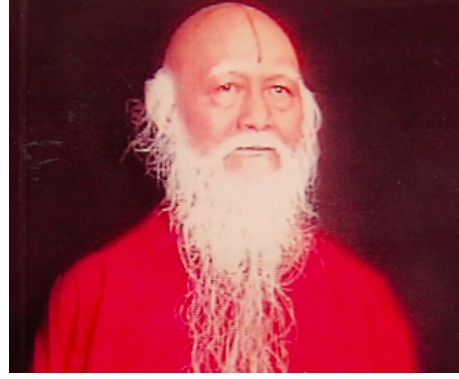
After the ceremony, I had the extreme good fortune to meet an attendant of his who speaks English and requested to prostrate to the Shang Zun, which to my surprise, was granted. It is very difficult to meet him. The Assistant told me that, to date, probably less than 100 persons in the U.S. have had the good fortune to meet him privately. The attendant took me to the place where this great mahasattva was staying. I was very excited to be able to see him again. Wang Zha Shang Zun mostly speaks Tibetan, but I am told he can also speak Mandarin Chinese. His voice was as I had remembered from the ceremony. Seeing him up close, I realize that he is probably over six feet tall and in excellent health. I had guessed that he must be at least sixty as I knew he had spent 45 years in seclusion in Tibet, but from his appearance guessed he could be even younger. His attendant told me that Shang Zun had already turned 93. He is very spirited and looked like and had the energy and bearing of a much younger man. As for his appearance, he has a most remarkable full beard, large kind eyes, bushy eyebrows, a rectangular face, and is bald. I was reminded of images of Bodhidharma, the “barbarian” with such a beard and eyebrows who went to China from India, only Wang Zha Shang Zun is considerably more handsome than the great patriarch of Zen is usually portrayed to be. However, what is most impressive is his incredible modesty and humility. This is what it is like to be in the presence of a great holy being!
I had wanted to meet him to express my gratitude for the empowerment I received at the Jin Gang Fa Man Ze Jue Dharma Assembly, but also just to show my respect because I knew that only someone of very high attainment could have performed that dharma. When I offered him prostrations, he would always tell me to prostrate instead to H.H. Dorje Chang Buddha III. His attendant told me that this holder of three gold buttons at a Shang Zun level always carried an image of the Buddha Master with him and did this. When he went back to his living space, the first thing he would do was to put H.H. Dorje Chang Buddha III’s image and Shakyamuni Buddha’s image in a high place and make offerings to them. I again prostrated, but it was just as before. Wang Zha said, “The Buddha Master is here. You should prostrate to the Buddha Master. How can I accept your prostrations?” The other dharma kings I have met always accepted and even arrogantly awaited my prostrations while silently seating on their throne. Wang Zha Shang Zun is certainly the top chief great dharma king among all dharma kings, but he is still so humble. I was very touched. Again I realized how very, very fortunate I am.
Wang Zha Shang Zun is very easy to communicate with and very amiable. Every sentence he says with a smile. He also provided me with hot tea having his assistant serve me using traditional China teacups. I accepted the teacup and put it aside on the table. Wang Zha then told me that “the quality of this tea is not very good. It comes from Tibet and is called Old Eagle Tea”. However, the fragrance of the tea, was so wonderful that it betrayed his humble portrayal. I requested from Wang Zha Shang Zun how to practice the Green Tara Mirror Altar Dharma (Jing Tan Fa). The Shang Zun said, “First you have to have a good mirror. Then you get the dharma transmitted through holy inner tantric initiation. The most important thing is that you should practice according to the Buddha Master’s teachings, and let all people know that they should do good and cease evil. It is then very easy to succeed with this dharma. But you should decide by yourself if you want to practice this dharma. The Buddha Master proposed that we should cultivate ourselves and opposed the miraculous. I am not telling you to practice this Green Tara Altar Dharma.”
The time flew by so quickly. My mouth was dry and I realized I needed to drink the tea, but when I lifted the cup, the cup is so heavy it is as if it were glued to the table. I couldn’t move it even when I exerted a lot of force. I was so surprised. I put that cup on the table. How can I now not lift it? This time Wang Zha Shang Zun saw what was happening and told me, “It is no use to use force. Force cannot lift it. You have to use your mind to lift it. When your mind is not attached to anything, everything will follow your mind.” Then Wang Zha Shang Zun asked me to lift it again. Very strange. It was as if it was weightless. I easily lifted it and also when I opened the cover of the cup, there is a moving image like a video in the cover. I clearly saw a picture of one of my fellow brothers from the past and a moment when I was in Japan. It was very clear, but it quickly started to disappear. I was really surprised. I used my eyes to follow the cover. After a while it completely disappeared. Then Shang Zun said. “Any object can be used as a mirror.” So I suddenly understood why my mind and my cultivation are so important and cannot be replaced by anything else.
I pray that each of you take advantage of this most fortunate fact that the H.H. Dorje Chang Buddha is living in this world now and practice the Dharma that you learn. I also pray that you all quickly become accomplished.
Namo H.H. Dorje Chang Buddha III! Namo Shakyamuni Buddha!
A very ashamed and fortunate disciple, Zhaxi Zhuoma prostrates and offers special thanks to Wang Zha Shang Zun for teaching her this important lesson.
Hua Zang Si at San Francisco, has many Holy Treasures and holy manifestations. Several years ago, I was very fortunate to have a chance to see an unimaginable Buddha Dharma relic — Dharma Tent. According to mundane logical thinking, it is impossible for such a mysterious thing to have occurred in this world. However it truly did occur in tis world in front of a number of people! I would like to say that I do not know how to explain this. Ordinary language, high-tech principles, or the most advanced scientific theories cannot explain such a thing. This mysterious thing simply cannot be explained. It is truly wonderful, magnificent, and unbelievable!
The monastic introduced to me, the holy feat occurred in January of 2005. After the grand opening of the Hua Zang Si temple, Rinpoches and Dharma Teachers exhibited their ultimate artistic wisdom relating to carving vines. They made a dharma tent. They then went to H.H. Dorje Chang Buddha III and asked him to consecrate their tent.
Kuru Rinpoche said, “This Padmasambhava dharma tent is an indestructible treasure that removes the negative karma of living beings.”
H.H. Dorje Chang Buddha III smiled and said, “Everything that comes into being through causes and conditions illusorily exists. All sentient beings must die. All non-sentient things must perish. All of these things are impermanent.”
A Dharma Teacher then said, “This dharma tent looks very wonderful. It is not impermanent in the least.”
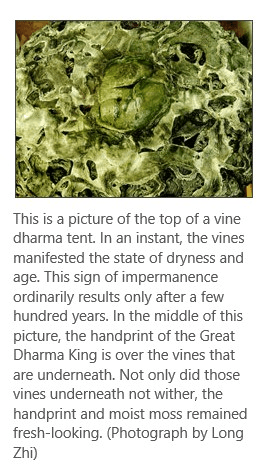
H.H. Dorje Chang Buddha III replied, “In every moment, it is arising, growing old, and dying. In every moment, it is in a state of impermanence. Your ordinary eyes cannot see such a process. If in a few hundred years from now you take another look at it, you will see that those entangled vines on the top of the tent are dried up. Actually, with respect to time and space, there is no past or future. Today, the causes and conditions are ripe. Watch!”
H.H. Dorje Chang Buddha III then pressed his hand upon the top of the dharma tent in the middle of the entangled vines. Halfway turning his hand, he then hit the vines once. A crackling sound could then be heard. A few minutes later, people looked at the vines and saw that their color had changed. They had withered and were dried up. In just a moment of time, they became a thousand-year-old cultural relic. They were thoroughly dried up, withered, and ruined. When the Great Dharma King lifted his hand, everyone saw that the Great Dharma King’s hand left an impression upon the vines when it pressed them down. Everyone also saw that the vines that were under the Great Dharma King’s hand did not wither, their color and luster did not change, they did not have any wrinkles, and they did not show any signs of dryness or aging. With respect to that part of the vines, no sign of the process of impermanence could be seen. Everyone was shocked!
At that time, H.H. Dorje Chang Buddha III gave the following explication: “All such phenomena do not truly exist. They are illusory phenomena. The Buddha expounded the dharma for forty-nine years, which was also a manifestation of illusory existence. There actually was not dharma that he had spoken of. If you obtain the Mahamudra of Liberation and realize the true, original nature of all phenomena (i.e. the original essence of all being, the true thusness or reality-nature), then it is exactly like this hand imprint analogy–there will be no impermanence nor birth and death. The Buddha expounded all of the dharmas. Sages attained the state of realization, and such dharmas were thereby real. Ordinary beings were confused, and such dharmas were thereby false. But who can turn the false into the real? Who possesses the dharma that leads to realization? Thus, only the correct dharma of the Buddha turns illusion into reality. All of you should listen, ponder, and deeply understand the Great Master’s discourse entitled “The Essence of Seeing One’s Original Nature.” Receiving such an initiation is truly an indestructible treasure. Today you have seen signs of impermanence relating to the dharma tent. Such signs are only an analogy. Such a manifestation is illusory and was done for fun only. Do not take it as being the absolute or ultimate truth. It is just art that one can dismiss with a laugh.”
This lecture by H.H. Dorje Chang Buddha III has profound meaning and is worthy of pondering. Although this feat is illusory in nature, who else can manifest such an impermanent illusion? If one cannot manifest illusory phenomena, nor can one turn illusion into reality, then how can one give expression to one’s realization? How can such a person possibly claim that he possesses the Buddha-dharma?
The dharma tent with vines on top is a wonderful treasure and evidence of a holy feat. Monastics have already respectfully received it in San Francisco, where it is worshipped as an object of veneration at the Hua Zang Si temple.
Rinpoches, Great Dharma Teachers, and laypersons observe the holy signs of permanence and impermanence that appeared on the top of the Padmasambhava dharma tent. (Photograph by Ru-Jun Zheng)
Hua Zang Si is my favorite sacred spiritual worship place in the bay area. In there I find peace, relaxation, and harmony, and a home for my soul. I have gone there many times, to chant the sutra, join the meditation sessions, and participate in Dharma assemblies.
Hua Zang Si, an impressive-looking temple located in the center of the Mission District in San Francisco. The building was formerly the St. John’s Evangelical Lutheran Church, built in 1903, and has been repurposed as a Chinese temple. To me it is really a friendly symbol that different religions can coexist in harmony.
The large outside facade of the temple is painted red color, made the building a very outstanding and eye-catching landmark in the neighborhood. Red is a good color in Chinese culture that symbolizes auspiciousness and warding off evil spirits。
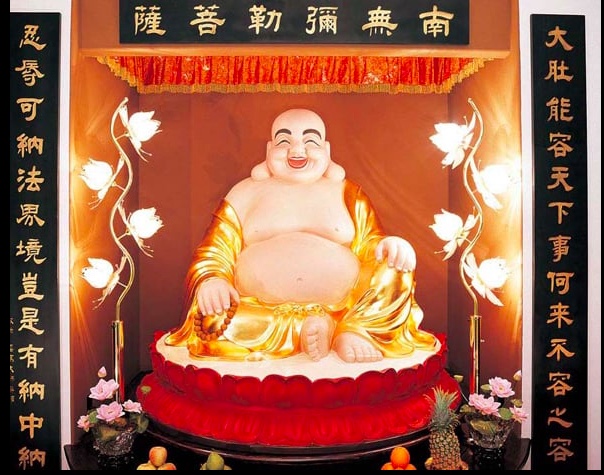
Once entering the temple, I feel like I am in another world. The marvelous statue at the entrance of the temple is an oversize representation of a jolly, laughing Buddha: Maitreya Bodhisattva (the next Buddha in this Saha world). It is such a warm welcoming sign. The big belly not only means jolly, it also means tolerating those intolerable things in the world. So when you look at the statue, you will start to feel that learning Buddhism is happy and kind.
The right line of the couplet is “da du neng rong tian xia shi he lai bu rong zhi rong.” As self-cultivators, we should be like the Buddhas and Bodhisattvas. We should have a broad mind, open heart, and great tolerance. The left line of the couplet is “ren ru ke na fa jie jing qi shi you na zhong na.” The first priority for one who learns Buddhism and cultivates himself is to be patient and forbearing under insult. The thought of patience or tolerance does not arise from his mind. Everything in all of the dharma realms can change from ordinary to holy.
Walking inside, the first floor is Shakyamuni Buddha Hall. The golden statue of Shakyamuni Buddha is a very dignified-looking Buddhist statue. On the left side is the one thousand-armed and one thousand-eyed Guanyin Bodhisattva, an awe-inspiring statue. On the right side is Skanda Bodhisattva, a standing majestic full-body armored statue. With a sword in hand, Skanda Bodhisattva is a Buddha Dharma protector, and it is believed he can subjugate demons and evil spirits.
Shakyamuni Buddha
One thousand-armed and one thousand-eyed Guanyin Bodhisattva
Skanda Bodhisattva
The second floor is Amitabha Buddha Hall. The twenty-one-foot-high statue of Amitabha Buddha (designed by H.H. Dorje Chang Buddha III) has been generally recognized as the most majestic Buddhist statue in the world. It is an extremely solemn sight. The color painted on the face is so lifelike, one feels like seeing the real Amitabha Buddha from western paradise. The Buddha’s eyes seem alive as well, looking down at all beings full of compassion and love. Every time when I look at the Buddha, I feel so moved and touched, tears fill my eyes. I can’t help but to kneel down and pray wholeheartedly: Please Buddha save me from the birth-death cycle, please take me to the western pure land. I feel my whole body melted into the compassionate gaze of the Buddha.
In the center of Amitabha Buddha hall, there is a large circular mandala on which a Yun sculpture (carved by H.H. Dorje Chang Buddha III) depicting Mt. Sumeru is placed. In that Yun sculpture are shariras (sacred relics) of the Shakyamuni Buddha for worshipping.
Directly facing the Amitabha Buddha is a tall Dharma altar, there is a huge blue Dorje Chang Buddha image. Dorje Chang Buddha is also called Buddha Vajradhara or Ruler of the Vajra Beings. In the entire universe, Dorje Chang Buddha is the first Buddha with form and is the highest Buddha. That is, the highest leader of Buddhism in the entire universe came into being in the form of Dorje Chang Buddha. It was Dorje Chang Buddha who began transmitting dharma and saving living beings in the dharmadhatu. As a result, Buddhism was born and the Buddha-dharma began spreading.
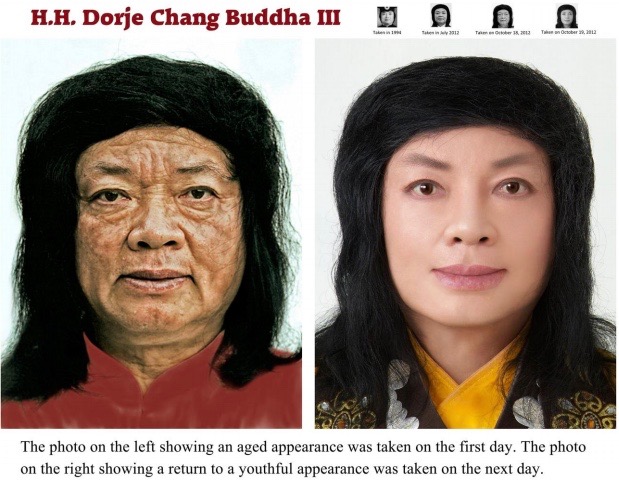
In front of the image of Dorje Chang Buddha are photos of H.H. Dorje Chang Buddha III. Dorje Chang Buddha has come to this world twice. The first time was in the form of the holy and venerable Vimalakirti, who was Dorje Chang Buddha II. The second time was in the form of H.H. Wan Ko Yeshe Norbu, who is Dorje Chang Buddha III.
These photos were true records of the holy miracle Buddha Dharma. On October 18, 2012, H.H. Dorje Chang Buddha III within ten minutes, reversed his appearance back to a youthful look. This incredible Buddha Dharma ever practiced successfully by Guru Rinpoche long time ago in Tibet.
Hua Zang Si has many Holy Treasures , make sure you check them out at the corner of this hall as well.
The third floor contains a library of Buddhist scriptures.
The backyard — a city oasis in the shadow of surrounding Victorians — is home to a magnolia tree, which the faithful say rained nectar for three days, along with a miraculous lotus tub used in the bathing of the Buddha and heavenly beings.
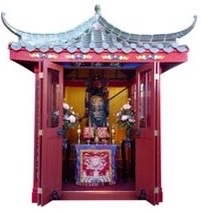
Further back, there is Dharma protector pavilion, a statue of the Dharma Protecting Deity Guan Yu was installed inside.
Guan Yu took refuge in Master Zhiyi at Yuquan Hill. He then manifested great supernatural power and constructed the Yuquan Temple overnight on a barren lot, where he resolved to become a protector of Buddhism. That is why, upon the plea of many Buddhist practitioners, he was recommended to be the Dharma Protecting Deity of Hua Zang Si.
Hua Zang Si is different from other temples that propagate only one sect within Buddhism. It teaches all of the various sects within Buddhism. If you want to know and learn Buddhism, Hua Zang Si is the best place to start with.













 Peace LiLy