The term “Zhuo Huo Ding” (Tummo Concentration 拙火定) is widely recognized in Tibet. Practicing this skill has the potential to alter body temperature, and when mastered, it is believed to eliminate all diseases within oneself. Moreover, adept practitioners can employ Zhuo Huo to heal others, and advanced individuals may even achieve the transformation of their bodies into light. However, finding individuals who have truly mastered this skill is rare nowadays. Notably, there have been recent reports of Tibetan yogis practicing Zhuo Huo in winter, gradually drying wet felt cloth draped over their bodies.
While many have heard about the dharma of Tummo Concentration, witnessing a genuine manifestation of Tummo power is exceptionally challenging. In contemporary Tibet, India, and other locations, numerous lamas engage in Tummo concentration. However, when they emerge from extended seclusion practices, only a few manage to demonstrably raise their body temperature. At most, they symbolically wear a wet blanket while moving around the temple. Those who attain this initial level are revered as holy and venerable, reflecting the gradual loss of tantric dharmas across generations.
Tummo concentration, as a high-class Buddha-dharma of meditation, is an essential practice for cultivating the life power of the body, mind-wind, and bright spot, leading to the accomplishment of a rainbow-light body. Regardless of the ailment, Tummo practice is believed to have the capacity to eliminate it entirely, making it the nemesis of the demon of illness. Positioned within the realm of supreme yoga, mastering this dharma combined with Vajra Body Substitution Meditation can elevate one to the rank of a Bodhisattva at the twelfth stage or higher.
Two types of Tummo concentration practices exist: Yoga Tummo from Tibetan Esoteric Buddhism and Corpse-Laying Tummo, regarded as the “King of Tummo.” The practitioner’s ability to raise body temperature correlates with their realization power, surpassing typical human body temperatures. The realization power evolves through four steps, from the Initial Warmth Step to the Delight at Extreme Temperature. Each step corresponds to an increase in body temperature and an augmentation of the practitioner’s healing abilities.
Comparisons between practitioners often highlight the mastery of Zhuo Huo, with some claiming attainment of high levels. However, when juxtaposed with the technique of the renowned Rinpoche Wangze, these claims fall short.
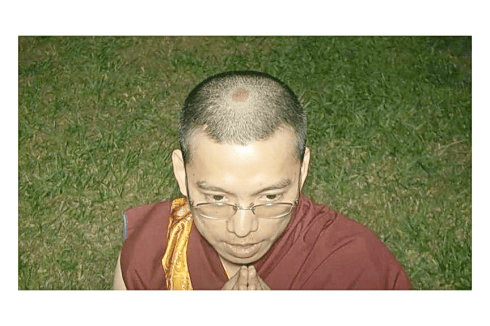
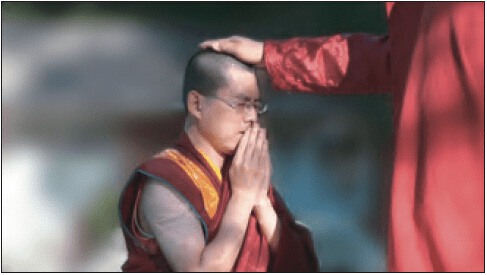
On October 15, 2009, five Buddhist masters of the Gelug school, including the 8th SongJi Rinpoche, Gamadega Gonglare Rinpoche, Yongdeng Gongbu Rinpoche, American Rinpoche Zhaxi Zhuoma, and the 16th Chongdi Rinpoche, received a “Zhuo Huo removal of obstacles blessing” from the highly respected Holy Master Wangze Rinpoche, in the United States. Wangze Rinpoche is a devoted disciple of H.H. Dorje Chang Buddha III. This blessing miraculously eliminated their illnesses and negative karma.
During the blessing ceremony, Rinpoche Wangze engaged in a sequence of actions with SongJi Rinpoche. First, he placed his palm in front of SongJi, making three deliberate motions of opening and closing his hand while instructing him to pay close attention. Subsequently, Rinpoche Wangze gently rested his palm on the top of SongJi’s head. Initially, SongJi perceived the touch as gentle and soft. However, within a few minutes, a sensation of heat began to radiate from his feet, gradually enveloping his back, neck, the back of his head, and culminating at the top of his head.
Suddenly, Rinpoche Wangze’s palm emitted an intense, fiery sensation at the crown of SongJi’s head, causing an unbearable pain within a mere two seconds. Describing the experience, SongJi expressed, “It was more agonizing than placing a red-hot iron on the top of my head.” In that brief span, a conspicuous red lump manifested on the crown, with certain areas burning through the skin and emitting black smoke. Simultaneously, SongJi experienced an extraordinary sense of physical and mental comfort. Several hours later, a yellow, crystal-like substance emerged at the site of the lump. According to insights from an elderly hidden yogi, this phenomenon is known as “merit honey,” a rare and auspicious occurrence indicating the elimination of impurities or karmic obstacles accumulated by Buddhists.
SongJi Rinpoche experienced an extraordinary sense of physical and mental comfort. Several hours later, a yellow, crystal-like substance emerged at the site of the lump
Following the release of merit honey, all existing ailments in SongJi Rinpoche’s body miraculously vanished. Kama Dege Gongla Rinpoche, belonging to the Kagyu sect, also underwent the Zhuo Huo Dispelling Obstacles Empowerment from Wangze Rinpoche. In a matter of seconds, a distinctive mark was burned into his philtrum. Yongdeng Gongbu Rinpoche bore a notable imprint on his forehead and between his eyebrows, outcomes of the empowerment. Zhaxi Zhuoma Rinpoche, too, retained a Zhuo Huo mark on her throat, accompanied by the flow of black qi from the respective marks.
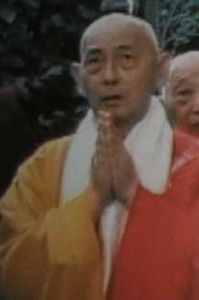
Venerable Dharma Teacher Tonghui (1922-2013) served as the Abbot of Longju Temple, renowned for Jiangxi Mazu. A devoted disciple of H.H. Dorje Chang Buddha III, he immersed himself in the teachings and practices of dharma. Also known as Elder Monk Tonghui, he transcended the ordinary, attaining the revered status of a holy monk.
Venerable Master Tong Hui, born Tang Zhenbang on March 5, 1922, in Penglai town, Suining City, Sichuan Province, belonged to the Han ethnicity. Renowned for his intelligence from a young age, he adhered to a vegetarian diet and practiced abstinence, following his parents’ guidance. In 1931, he entered monkhood under Master Pu Jing at Jinwen Temple in Pengxi. Full ordination followed in 1940, under Venerable Master Miaoneng at Baoguang Temple, and further studies in Chengdu’s Jingci Temple under Master Nenghai in 1941. Residing at Longju Temple with Master Miaoneng in 1942, he served during the transmission of the Great Precepts by Master Nenghai. Master Nenghai was one of the most eminent monks in last century.
Post-liberation, Longju Temple faced dispersion, confiscation of properties, and occupation during the Cultural Revolution. As the warehouse keeper, Venerable Master Tong Hui personally bore the repercussions of stolen food, enduring imprisonment to spare innocent people. False accusations regarding the team’s beekeeping further led to additional years in prison. His unwavering compassion and selflessness epitomized the Buddhist spirit.
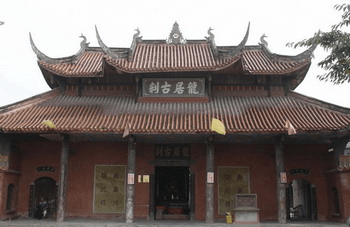
Reopened by the government on December 16, 1986, Longju Temple underwent extensive renovations under the venerable master’s guidance. The Arhat Hall, Main Hall, Scripture Hall, and Accommodation Building were constructed, while the main gate, Ksitigarbha Hall, Hall of Heavenly Kings, and Bell Tower were restored. The restoration of large Buddha and Bodhisattva statues, as well as Arhat statues, showcased the venerable master’s dedication. Numerous instances of his awe-inspiring virtue were evident, such as his ability to attract dharma-protecting deities and revive a withered ginkgo tree with Bodhi Holy Water.
Front Entrance of Longju Temple
Grand Hall in Longju Temple
Moreover, Venerable Master Tong Hui made significant contributions to Buddhism by bringing back Buddha and Bodhisattva statues made of Burmese jade from temples in Dayi County and Daying County.
A legendary story recounts Master Tonghui’s visit to Burma in 1992. Venerable Dharma Teacher Tonghui went to Burma to respectfully receive and take back with him a Jade Statue of the Buddha. The night before the Dharma teacher arrived, many people in Burma suddenly dreamed that he was a golden Arhat and would soon come to Burma. The next day when he arrived in Burma, hoards of people made offerings to him. In Hinayana Buddhism, Arhats are praised in the same way that Bodhisattvas who attained the marvelous fruit of enlightenment are praised. It is clear that Venerable Dharma Teacher Tonghui was an amazing and great sage.
Venerable Dharma Teacher Tonghui peacefully passed away on February 26, 2013, at the age of 92. His preserved body, following ancient Buddhist rituals, was respectfully opened three years later on June 12, 2016, revealing a full and jade-colored flesh body in the urn. This sacred event reaffirmed the authenticity and practicality of true Buddha Dharma.
The flesh body of Venerable Dharma Teacher Tonghui is now enshrined in Longju Temple for people to respectfully admire.
As we step into the Chinese New Year of 2024 (February 10th), ushering in the Year of the Dragon, we embark on a journey through the intricate tapestry of Chinese culture and folklore. Beyond the tangible creatures represented in the Chinese Zodiac, the dragon stands as a mystical symbol shrouded in enigma. Join us as we delve into the tales, traditions, and jubilations surrounding the Year of the Dragon, uncovering the profound significance of the Chinese Lunar New Year and its ancient lunar calendar.
The Chinese New Year, also known as the Spring Festival, is intricately linked with the Chinese Lunar Calendar, a timekeeping system rooted in the moon’s phases. Unlike the Gregorian calendar, the Chinese Lunar Calendar dates back over four millennia, its inception during the Xia Dynasty and refinement during the Shang Dynasty. It serves not only as a means to measure time but also reflects the Chinese people’s harmonious rapport with nature. Aligned with the agricultural cycle, the lunar calendar aids in agricultural endeavors, guiding farmers in sowing and reaping.
IVAN/GETTY IMAGES
More than a mere chronometer, the Chinese Lunar Calendar embodies a cultural legacy brimming with significance. Grounded in the principles of yin and yang, the five elements, and the Chinese zodiac, it offers a holistic understanding of existence. This venerable calendar not only demarcates the passage of time but also orchestrates cultural ceremonies, festivals, and customary observances.
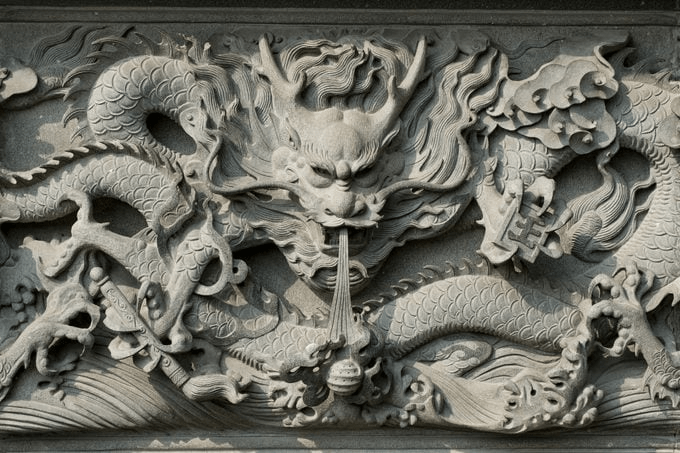
In ancient China, the dragon reigned as a symbol synonymous with imperial authority. Emperors, considering themselves the “Sons of Heaven,” identified with the dragon, an emblem of celestial power. This perception permeated society, fostering a collective belief in the Chinese people’s lineage from dragons. Rooted in mythology, folklore, and cultural symbolism, dragons hold a special place in Chinese ethos, embodying myriad virtues and auspicious qualities.
Legends abound in Chinese mythology, recounting the exploits of the Four Dragon Kings, guardians of the seas in the cardinal directions. Revered for their prowess and rain-summoning abilities, these divine beings epitomize the grace and might associated with dragons. Similarly, the tale of Nezha and the Dragon Prince underscores the dragon’s dual role as a symbol of strength and wisdom, transcending conventional boundaries.
This mural depicting the Four Dragon Kings is preserved in Baiyun Temple, Beijing.
Ancient myths narrate the existence of the Nine Sons of the Dragon, each endowed with unique abilities shaping the natural world. From thunderous roars to water manipulation, these dragon progeny epitomize the elemental forces governing existence. The dragon’s omnipresence in imperial symbolism further underscores its significance, depicting the dragon as the epitome of majesty and sovereignty.
As the Chinese New Year approaches, customs and celebrations honoring the dragon come alive:
Dragon Dances: The iconic dragon dance involves a team of performers manipulating a long, undulating dragon puppet through the streets. This dynamic display is believed to bring good luck and drive away evil spirits.
KEVIN FRAYER/GETTY IMAGES
Dragon Boat Festival: While not directly related to the Chinese New Year, the Dragon Boat Festival is another celebration featuring dragon imagery. Races are held with elaborately decorated boats to commemorate the tragic death of the poet Qu Yuan.
Dragon Lanterns: During the Lantern Festival, which marks the end of the Chinese New Year celebrations, dragon-shaped lanterns light up the night sky, creating a mesmerizing spectacle.
H.H. Dorje Chang Buddha III, a vocal artist, many years ago, has even composed a unique masterpiece, the energetic and festive song “Chinese Dragon,” showcasing the dragon’s cultural significance.
The dragon, shrouded in myths and revered in Chinese culture, takes center stage as we welcome the Year of the Dragon. These captivating stories and customs not only enrich our understanding of Chinese folklore but also highlight the dragon’s enduring role as a symbol of power, wisdom, and good fortune. As the dragon dances through the streets and the Lunar New Year festivities unfold, let us embrace the magic of this mythical creature and wish for a year filled with prosperity and auspicious beginnings. May the dragon bring its legendary blessings to all in the Year of the Dragon!
(This is the text of an article published in the Asian Journal on Oct. 6, 2004.)
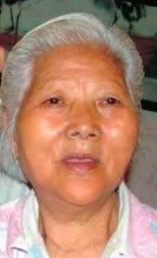
Elder laywoman Quan-Fang Lu who was a disciple of Great Dharma King Yangwo Yisinubu1, was from Chengdu, Sichuan. She and her husband, layman Guang-Ming Wang, had been Buddhists since the 1950’s. When they took refuge in Buddhism, they received an initiation and Dharma transmission from the Great Dharma King. In the 1950’s, they were working in Tibet. Because of their underlying karmic conditions, they received the guidance of an outstanding Rinpoche of Tibetan esoteric Buddhism. That Rinpoche told them that Great Dharma King Yangwo Yisinubu possessed the best and highest Buddha Dharma. After going through many hardships, they brought their son to the Great Dharma King. The Great Dharma King was not even seven years old at the time. The three of them formally acknowledged the Great Dharma King as their Master. Laywoman Quan-Fang Lu and her husband Guang-Ming Wang then resolutely decided to have their son stay by the side of the Great Dharma King in order to receive his training and Dharma teachings.
They have been very pious and respectful toward the Great Dharma King, and they have diligently practiced the Dharma that the Great Dharma King transmitted to them. Over the past years, certain people have spread rumors and made false accusations against the Great Dharma King. Laywoman Quan-Fang Lu and her husband Guang-Ming Wang were filled with righteous indignation at this. They vigorously berated the contemptible conduct of those rascals who spread rumors, fabricated lies, and deceived people.
Based upon layman Guang-Ming Wang’s own pious heart and upon the Great Dharma King’s realization, which is like that of a Buddha, in November of 2003, layman Guang-Ming Wang passed on to the Western Paradise of Ultimate Bliss. At his cremation, layman Guang-Ming Wang left behind 11 sarira firm relics.
In the middle of August, 2004, laywoman Quan-Fang Lu told her son Min Wang that she would soon pass away. Min Wang telephoned the Great Dharma King a few times, beseeching the Great Dharma King to cause his loving mother to stay alive longer. When Min Wang’s mother found out about these calls, she admonished her son, “Those who learn Buddhism and cultivate themselves must understand that the law of cause and effect never fails. My karmic connection with this world is about to end. My karmic connection with the Dharma is now complete. The Dharma King Master will help me go to the Western Paradise of Ultimate Bliss.”
As expected, at around noon on September 9th, the crown of elder laywoman Lu’s head suddenly opened. The crown of her head became as soft as cotton. At that time, a colorful auspicious light filled the room. Amitabha Buddha came to escort her away. Beautifully set off by a huge white Buddha light, the pure gold bowl of Amitabha Buddha slowly descended. The red lotus flowers in the bowl were bright-colored. Two photographs were hurriedly taken of this extremely rare and holy sight. Heavenly music could be heard. Imitating the Buddha, elder laywoman Lu assumed the “auspicious recumbent posture.” Amid the Buddha light, she passed on to the Western Paradise of Ultimate Bliss. The next day, her body was placed in the Buddha worshipping hall of Bao Guang Temple in Xindu, which is one of the four great Chan (Zen) temples in China. Right after her body was placed there, an image of the Great Dharma King suddenly emitted bright light. A colorful Buddha light went round and round the Great Dharma King’s image. A fragrant scent wafted through the air.
Photo showed lotus light on the top of laywoman Lu’s house
News of such phenomena began to spread. More and more people came to chant mantras and sutras for the benefit of laywoman Lu, respectfully see her off to the next realm, and observe the ceremony. Day and night, the chanting of Amitabha Buddha’s name did not stop. On the evening of September 10th, eminent Tibetan Rinpoches and Lamas who were all disciples of the Great Dharma King arrived at the temple after having traveled a great distance. They came to perform Buddhist rites. On the evening of September 11th, the machine used to chant the name of Amitabha Buddha suddenly emitted the shocking sound of the Great Dharma King chanting the name of Amitabha Buddha. The Great Dharma King was in the United States. The monastics and laypersons in attendance were all extremely moved.
At around noon on September 12th, a holy sight appeared for the first time in history! A painting of Amitabha Buddha hangs in the Buddha worshipping hall of the temple. In front of Amitabha Buddha’s chest, a heavenly window to the Western Paradise of Ultimate Bliss suddenly opened. This heavenly window directly displayed the sights of the Western Paradise of Ultimate Bliss! People were seething with excitement. They were so pleasantly surprised they could hardly control themselves. Through that heavenly window to a Buddha land that appeared in front of the painting of Amitabha Buddha, all of those who had the requisite karmic affinity saw Amitabha Buddha. They even saw the protuberance on top of Amitabha Buddha’s head. They saw Kuan YinBodhisattva wearing white clothes and holding willow tree branches. They alssaw Mahasthamaprapta Bodhisattva. In that heavenly window, elder laywoman Lu was reciting the name of Amitabha Buddha. Her lips were constantly moving, her eyes blinked, and her head swayed. She looked the same as when she recited Amitabha Buddha’s name when she was alive.
The image of Great Dharma King Yangwo Yisinubu appeared in that heavenly window. He was wearing a red Dharma robe and a Dharma crown. When he appeared, people excitedly shouted words such as, “Master, I see you!” “Great Dharma King Master, by following you we do not fear even death!” “Great Dharma King, my whole family wants to take refuge in you! We want to learn the true Buddha Dharma from you!” People were awestruck by these holy scenes. They could not control their emotions. The sounds of people marveling, shouting, and kowtowing could be heard.
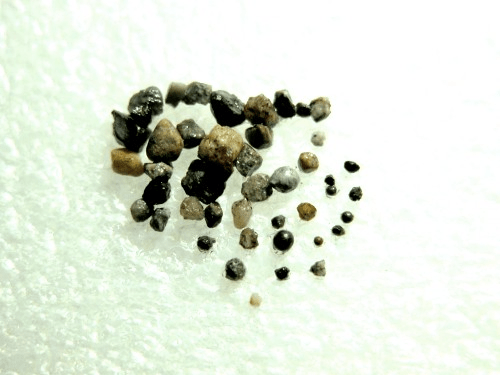
During the cremation of laywoman Lu, holy sights continually appeared. Lotus flowers emerged. Images of the Dharma King, the Three Holy Ones of the Western Paradise (Amitabha Buddha, Kuan Yin Bodhisattva, and Mahasthamaprapta Bodhisattva), and Maitreya Bodhisattva all appeared. Vajra Dharma protecting deities and dragon-spirit Dharma protecting deities stood in a circle on both sides of her. Fire phoenix flew to and fro inside the cremation furnace. Beautiful scenes of pagodas and towers from the Western Paradise of Ultimate Bliss repeatedly appeared. People before the cremation furnace were filled with Dharma joy and began prostrating. They were so moved they began to cry. The sound of joyous laughter filled the temple.After the cremation was completed, people collected 49 sarira firm relics from the bone ashes of laywoman Quan-Fang Lu.
49 solid relics from the ashes of the remains of Layman Lu Quanfang after his cremation
1.Here and below the words Great Dharma King Yangwo Yisinubu, Great Dharma King, or Dharma King Master refers to H.H. Dorje Chang Buddha III Wan Ko Yeshe Norbu Holiest Tathagata.
Disciples of Buddhism and honorary guests were treated to a vibrant grand opening for a new house of worship in central Las Vegas.
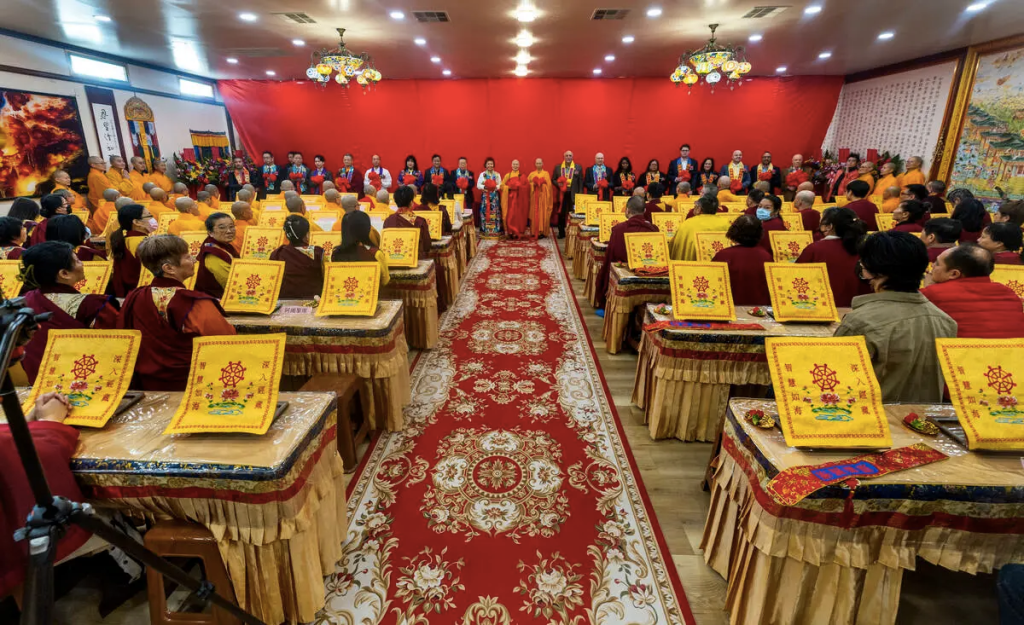
On the morning of January 18, 2024, the Benevolence Temple came alive with the vibrant festivities that commenced with a traditional Dragon Dance. Performers skillfully gyrated to the rhythmic beats of booming and clanking drums, creating an electrifying atmosphere. As they made their entrance into the packed temple, cloth-covered deities loomed overhead, surrounded by bountiful fresh fruit and food offerings.
The temple “will extend equal care to all sentient beings regardless of race, gender, or religion,” according to the organization. “The term ‘benevolence’ signifies language, actions, and thoughts that are kind, caring, and beneficial to others.”
Elected officials — or their representatives — entered and lined up in front of the main shrine, each holding a red ribbon shaped like a flower. They each were handed scissors to cut strands in a lavish ribbon-cutting ceremony.
The curtain shielding the shrine was pulled to reveal a large golden statue at the center of what appeared to be a tranquil garden.
“Great day for the state of Nevada,” Nevada Lt. Gov. Stavros Anthony said in his opening remarks. “I want to congratulate you on this significant milestone for your temple and your efforts to unify local residents and people from different religions and races.”
The temple — led by Holy Guru Jiaozun Zhengda, vice president of the World Buddhism Headquarters — will preach the teachings of Namo Dorje Chang Buddha III and Namo Shakyamuni Buddha, according to the organization.
“Naming a Buddhist temple with these words expresses the original intention of Holy Guru Jiaozun Zhengda to propagate the cause of Buddhism through selflessness and compassionate virtuous deeds, with the vow to enable sentient beings to learn the Buddhist Dharma and attain liberation through a compassionate Bodhi mind,” the organization wrote.
The Las Vegas Benevolence Temple was founded in 2019 but operated at a temporary site before it found its new home, 700 E. St. Louis Ave., which was vacant four months ago.
The Buddha statues were declared sacred in a Thursday ceremony. Now, the temple will offer meditation guidance, teach Dharma discourses and the chants of Mahayana Buddhism, according to the organization.
The disciples will participate in charity, the organization wrote. “The objective is to contribute in a practical way to the local community while spreading the doctrines of Buddhism to the public.”
The Metropolitan Police Department and City Council members Victoria Seaman and Olivia Diaz sent representatives.
“The community will benefit from the sanctuary that your temple provides,” Anthony said to applause.
Namo H.H. Dorje Chang Buddha III is the only certified Buddha in our world and the first in history to truly manifest the great accomplishments of the Five Vidyas according to the highest standards of Buddhism, encompassing both exoteric and esoteric teachings. Additionally, he is the only Buddha, apart from Shakyamuni Buddha, to have a government proclamation of ‘Buddha Day’ worldwide. As the true embodiment of the Supreme Dharma Lord, Namo H.H. Dorje Chang Buddha III is the highest leader of the entire Buddhist faith.
Many highly realized Buddhist leaders including Bodhisattva Dharma Kings and the leaders of major sects and schools have recognized H.H. Dorje Chang Buddha III as the third true incarnation in this world of the original samboghakaya dharma king. A full listing of the Dharma Kings and other Rinpoches with their letters of recognition and congratulation may be found in the treasure book H.H. Dorje Chang Buddha III.
Namo H.H. Dorje Chang Buddha III is the unprecedented great sage who embodies selfless virtue, being the first to altruistically benefit all sentient beings without accepting any offerings.
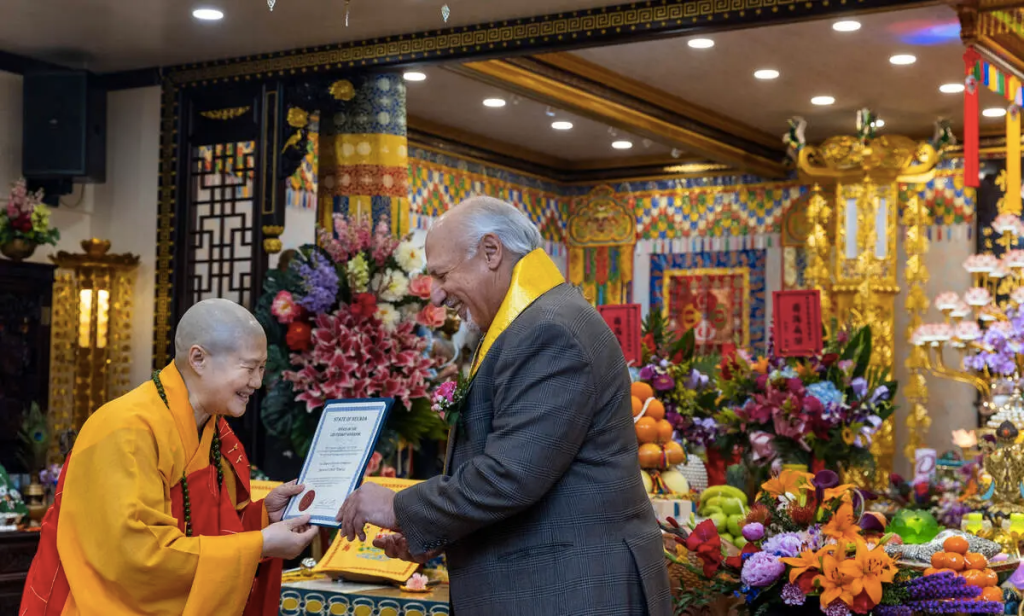
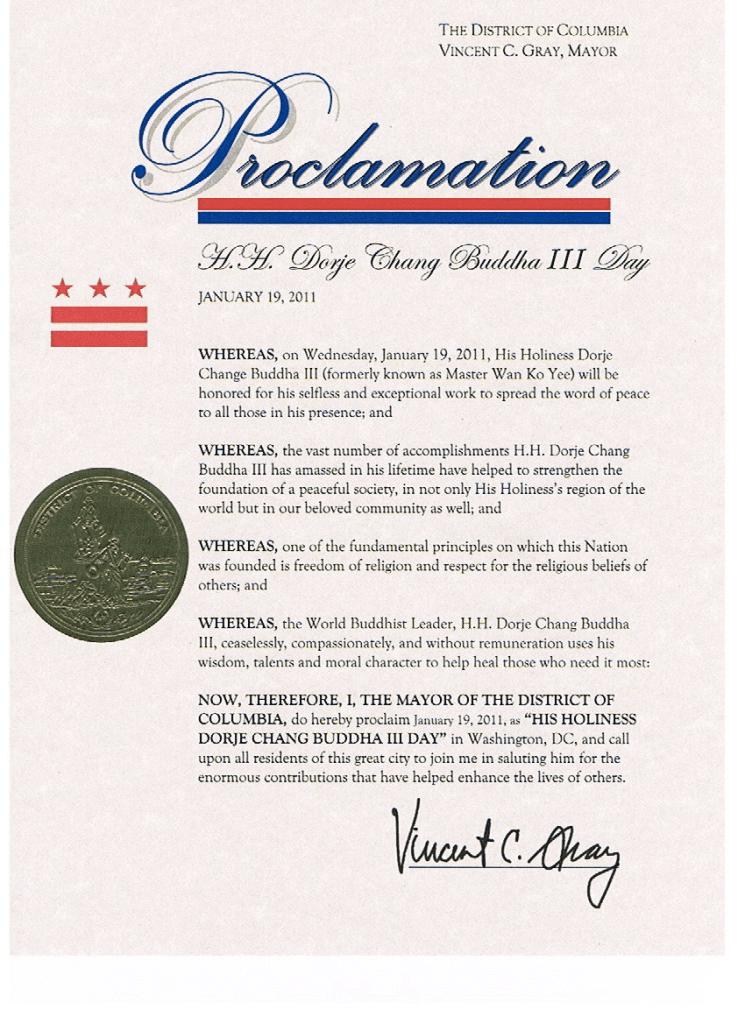
The awards and honors bestowed upon H.H. Dorje Chang Buddha III are numerous. For instance, the Mayor of Washington, D.C., proclaimed January 19, 2011, as ‘H.H. Dorje Chang Buddha III Day,’ urging people to pay homage to him. The U.S. Congress Lantos Foundation for Human Rights and Justice issued an open letter praising the esteemed Buddhist leader H.H. Dorje Chang Buddha III for his outstanding contributions to humanity, supporting his tireless efforts to enhance moral civilization, promote prosperity in the United States, and foster world peace.
In February 2011, the entire U.S. Congress, along with the Chairman of the National Prayer Breakfast, extended an invitation to H.H. Dorje Chang Buddha III as a religious leader to participate in the prayer breakfast led by President Obama, attended by the highest authorities of the executive, legislative, and judicial branches. Moreover, H.H. Dorje Chang Buddha III received the ‘Presidential Gold Medal’ from President Bush on behalf of the Asian Pacific American Advisory Committee, the ‘International Service and Leadership Award’ from the Martin Luther King Legacy Association, and 56 other major awards from senators, representatives, governors, and various levels of government.
The World Peace Prize was awarded the highest honor to H.H. Dorje Chang Buddha III in 2011!
In June 2011, Namo the Third Supreme Tathagata received the highest honor of the World Peace Prize in the U.S. Congress. This prestigious award is presented by the ‘World Peace Mission.’ Since its establishment in 1989, the World Peace Prize has been awarded to individuals dedicated to mediating political disputes, international and economic matters, contributing to the safety and stability of human society. The World Peace Mission is an international evangelical missionary organization with the goal of promoting peace, upholding the spirit of equality, and fostering cooperation among religions.
Recipients of the highest honor of the World Peace Prize include the 40th President of the United States, Ronald Reagan; the revered Mahatma Gandhi of India; the 12th President of the Philippines, Ramos; the fourth President of Indonesia, Wahid; former Egyptian President Mubarak; former President Nakamura of Palau; the first President of Mongolia, Punsalmaagiin Ochirbat; the first President of South Korea, Lee Seung-won; former Israeli Prime Minister Rabin; former Nigerian President Yakubu Gowon; Ethiopian Prime Minister Meles Zenawi, among others. The World Peace Prize was co-founded by former U.S. Congressman Robert Leggett and evangelical religious leader Dr. Han Min-su. Guided by the principle of benefiting others, they promote religious cooperation and uphold human peace. The World Peace Prize Committee comprises outstanding judges from different countries, backgrounds, races, and beliefs, demonstrating the spirit of human unity.
H.H. Dorje Chang Buddha III has been recognized by the World Peace Prize Committee for selflessly dedicating himself globally, saving others. His wisdom and compassionate embrace encompass all races, ethnicities, cultures, and religions, bringing goodness, peace, and harmony to everyone. Wherever he goes, his humility and compassion unite people. His contributions to human society, including teachings, healing, and charitable work, truly embody the compassion of Buddha, becoming a role model for all. His sublime character shines through his teachings, healing, charity work, leading people onto the paths of morality and charity. Simultaneously, he is an outstanding artist, pointing out a non-violent, charitable, and loving path for humanity through his teachings, practices, arts, and poetry.
United States Senate Resolution No. 614
In December 2012, the 112th United States Congress Senate unanimously passed Resolution 614, commending the World Peace Prize and its recipients. In this resolution, the U.S. Senate not only acknowledged the World Peace Mission as an organization with a sublime core spirit but also recognized the World Peace Prize as a prestigious award presented by the World Peace Mission to honor individuals who have made significant contributions to peace and human enlightenment. The Senate also affirmed the World Peace Prize Evaluation Committee’s recognition of H.H. Dorje Chang Buddha III for his contributions to a wide range of humanitarian activities benefiting people in various communities worldwide. Additionally, the Senate acknowledged the numerous awards bestowed upon H.H. Dorje Chang Buddha III, including the Presidential Gold Medal presented by President George W. Bush on behalf of the Asian Pacific American Advisory Committee, recognizing his outstanding contributions to art, medicine, morality, Buddhism, spiritual leadership, and American society.
The Senate resolution uses ‘H.H.’ to title and honor H.H. Dorje Chang Buddha III, indicating the highest esteem of the U.S. Congress for his supreme and unparalleled status. Simultaneously, the Senate resolution records explicitly express the U.S. Congress’s recognition of the World Peace Prize Evaluation Committee as a sublime and honorable international organization.”
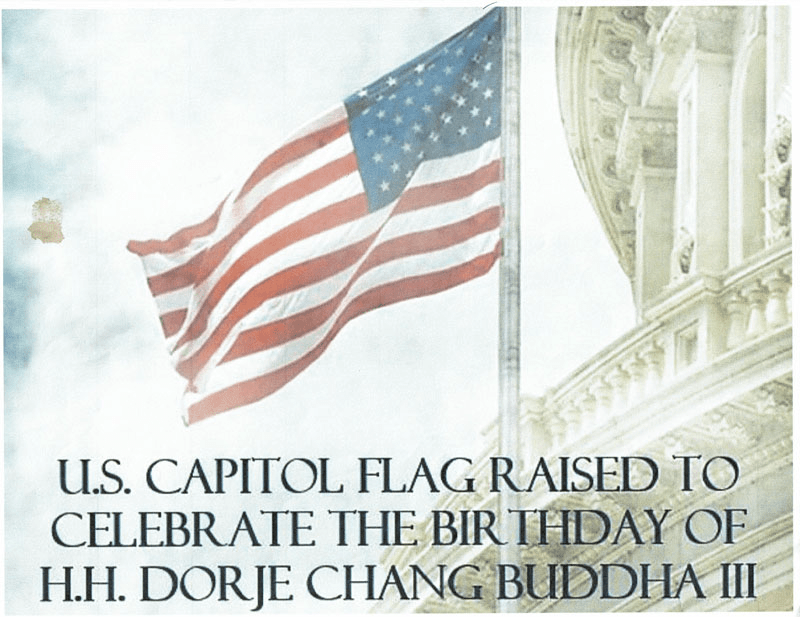
In May 2018, the U.S. Congress raised the flag in tribute to H.H. Dorje Chang Buddha III!
On May 15, 2018, the American flag was hoisted at the Capitol building in Washington, D.C., waving in the air to specially celebrate the happy birthday of H.H. Dorje Chang Buddha III! The flag-raising statement from the U.S. Congress reads: ‘On the occasion of the birthday of H.H. Dorje Chang Buddha III, the American flag flies over the Capitol, paying tribute to the supreme leader of all Buddhists, H.H. Dorje Chang Buddha III.
In 2018, the World Peace Prize Committee bestowed upon H.H. Dorje Chang Buddha III the title and staff of ‘World Buddhist Pope.’ Faced with this pinnacle honor and position in the world, H.H. Dorje Chang Buddha III refused to accept it. Despite repeated pleas from the World Buddhist Headquarters, His Holiness adamantly declined. In the end, due to circumstances, the title was accepted on his behalf. His Holiness solemnly stated, ‘I am just a practitioner. What is this about a World Buddhist Pope? In Buddhist history, there are Buddhas, Bodhisattvas, Vajras, Arhats, Elders, Dharma Kings, Geshe, Khenpo, Abbots, and Head Monks, but never have I seen a Buddhist Pope. Even if they confer the title today, so what? The term ‘Pope’ may be invaluable to others, but for me, a humble practitioner, it is nothing more than a joke! I am merely a servant of sentient beings, doing practical things for their benefit. Though my abilities are limited, can’t I contribute a bit of goodwill? The World Buddhist Headquarters accepted the Pope’s staff on my behalf; it was not my delegation. It was received by the headquarters, their affair, and I have no right to intervene. I remain myself. At the headquarters, I saw the top of the staff adorned with the presence of Shakyamuni Buddha. At that moment, I raised the staff above my head in reverence to Shakyamuni Buddha – the Lord of Buddhism. I am, as always, a humble practitioner.’
His Holiness Dorje Chang Buddha III’s words and actions embody the unparalleled enlightenment of a true Buddha. Regardless of praise or criticism, His Holiness remains undisturbed, dedicating all vows and actions to the liberation and benefit of sentient beings. Upholding the true Buddhist Dharma, free from sectarian distinctions, he imparts teachings to disciples such as Hou Yu Shan and Lin Liu Hui Xiu, guiding them to the Pure Land, meeting Amitabha Buddha, returning to the human world prepared, and attaining rebirth at the right time. His Holiness invited Amitabha Buddha to transmit teachings to Zhao Yu Sheng, and disciples like Hai Lao Monk and Lu Dong Zan have achieved remarkable results, demonstrating the effectiveness of his teachings.
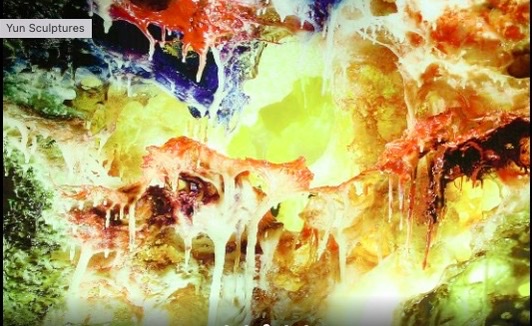
H.H. Dorje Chang Buddha III has received numerous worldly honors, introducing unparalleled Yun Sculpture art to the world. Nurturing disciples who have attained liberation and genuine accomplishments in the sacred teachings of Buddhism, His Holiness has also left sacred traces globally. These achievements attract officials, celebrities, and Buddhist disciples worldwide, seeking to meet and learn from him. The H.H. Dorje Chang Buddha III Culture and Art Museum houses His Holiness’s masterpieces, including the revered ‘Yun Sculpture.’ This new form of sculptural art is considered an invaluable creation that transcends replication in the human world. The museum proudly preserves the first piece of Yun Sculpture, ‘One Stone Horizontal Charm.’
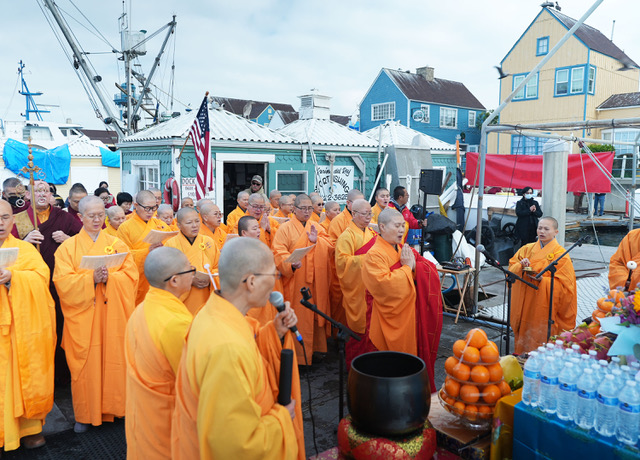
To commemorate January 19th as ‘H.H. Dorje Chang Buddha III Day,’ the H.H. Dorje Chang Buddha III Culture and Art Museum organized a grand blessing and liberation event on January 14, 2024, at the Marina Del Rey waterfront in Los Angeles. The ceremony was presided over by Venerable Shi Zhengda, Vice Chairman of the World Buddhist Headquarters. Over 300 participants from various states in the United States, Canada, Hong Kong, and other regions attended the event. Globally, Buddhist temples and centers joined in activities such as liberation ceremonies, disaster relief, education assistance, and aid for the impoverished to celebrate this auspicious day. The activities sought blessings, wisdom, well-being, disaster relief, national peace, and world peace amid the challenges of today’s global society.
The Explanation of the Buddha’s Title – “H.H. Dorje Chang Buddha III
On April 3, 2008, a solemn and dignified first-publishing ceremony of a fact-recording book entitled H.H. Dorje Chang Buddha III, which published jointly by the World Buddhism Publishing LLC and the World Dharma Voice, Inc., was held at the Library of the Congress of the United States. The book was also formally accepted into the collection of the Library of the Congress of the United States. Only since that time, did people in the world know that Master Wan Ko Yee, who had been broadly respected by the great masses and who had also been known as Great Dharma King Yangwo Yeshe Norbu, had been recognized by the world’s leaders, regent dharma kings, and great rinpoches of Buddhism through official documents as the third incarnation of Dorje Chang Buddha, who is the primordial Sambhogakaya Buddha of the universe. The Buddha’s name is H.H. Dorje Chang Buddha III. Since then, people began to address His Holiness the Buddha by “Namo[1] Dorje Chang Buddha III.” This is similar to the situation that Sakyamuni Buddha’s name was Prince Siddhartha Gotama before attaining Buddhahood. However, after Sakyamuni Buddha had attained Buddhahood, His title changed to “Namo Sakyamuni Buddha.” That is why we now address His Holiness the Buddha as “H.H. Dorje Chang Buddha III.” In particular, on December 12, 2012, the Senate Resolution No. 614 of the United States Congress officially used “His Holiness” in the name addressing Dorje Chang Buddha III (That is to say, “H.H. Dorje Chang Buddha III.”) Since then, the title and status of H.H. Dorje Chang Buddha III has been definitive by nature. And, as a matter of fact, “Dorje Chang Buddha III” is a name used legally in governmental and official legislative documents. Therefore, the previously used respected name and titles such as “Wan Ko Yee,” Great Master, and Great Dharma King no longer exist. However, the news below was published before the Buddha’s title of H.H. Dorje Chang Buddha III was publicly announced. At that time, people did not know about the true status of His Holiness the Buddha. Therefore, to respect the true history, we still kept the names used before the title of H.H. Dorje Chang Buddha III was legitimately determined in republishing this news. However, all must clearly know that the only legitimate name of His Holiness the Buddha is H.H. Dorje Chang Buddha III and all other names used before the legitimate determination no longer exist.
Elder Monk Yi Zhao, the rightful heir of the Dharma lineage of Elder Monk Xu Yun, holds the esteemed position of the 44th great master within the Lin Chi sect of Zen Buddhism. Currently, he stands as the highest master in the realm of Zen Buddhism worldwide.
In June 2000, H.H. Dorje Chang Buddha III presided over a Buddhas Bestowing Nectar Dharma Assembly. Following the assembly, an interview with Elder Monk Yi Zhao took place. The following is a transcription derived from the video tape of the Nectar Dharma Assembly.
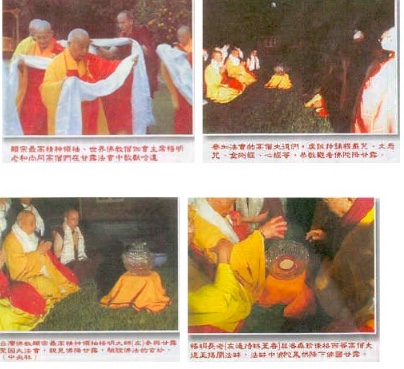
QUESTION: Could you please briefly describe the wonderful occurrences that took place during the Buddhas Bestowing Nectar Dharma Assemblythat you attended? ANSWER: We first saw the Dharma King. We then saw the Dharma King practice the Dharma to raise the consciousness of certain beings to higher realms of existence. We took a look and there were only a few wasps (yellow-jackets). After the Dharma King practiced the Dharma for a period of time, he said that he had already summoned many beings, such as solitary spirits, Kinnaras, etc. in order to raise their consciousness. When we went to take another look, we saw that there were many wasps. I do not know the exact number, but there must have been over ten thousand of them. During another period of time the Dharma King said that the raising of their consciousness is almost complete. Those wasps were specially benefited. Why were there all of those wasps? Certain solitary spirits, certain kinnaras and other beings took on the physical form of wasps, arrived at the scene and received the consciousness raising Dharma. What is receiving the consciousness raising Dharma?
We human beings must eat and drink in order to survive and grow. However, after those solitary spirits received the consciousness raising Dharma, they were able to take birth in a heavenly realm in the Western Paradise or in another buddha realm. We went over and took another look. We noticed that all of the wasps had departed. Why did none of them remain? They received the consciousness raising Dharma and were raised. Therefore, none of them remained, because they were liberated. This is what we first saw at the dharma assembly. The next part of the assembly was the “Buddhas Bestowing Nectar.” There were five or six of us. There were about a dozen monks and nuns. It was not only Chinese people who participated in this part of the assembly. There were even non-Chinese people there! At this time, a bowl was placed about 30 feet away from the Dharma King. What type of bowl was this? It was a crystal bowl. The crystal bowl was placed on the ground. The bowl was in the middle of two opposite lines of people. The bowl was not far from the two lines of people. Everyone sat on the ground and looked at the bowl. This crystal bowl had a lid and was a bit smaller than a washbowl.
There was another bowl that was small. Elder Wu Ming was asked to wash that small bowl with water. After he washed it, he was asked to wipe it dry. He wiped the inside of the bowl so well that not one drop of water remained. This bowl was then placed back inside of the crystal bowl. The Dharma King then told everybody to stare at the bowl. He said that our vision must remain fixed on the bowl. All of us began to stare at the bowl. After awhile, what did the bowl appear to contain? A meteor. Of course, it was not a real meteor. It seemed as if rain had fallen. What exactly was in the bowl? It was white. It descended with flashes of light. It took a while for it to descend. The Dharma King then told us to open the bowl and look inside. The small bowl was inside the crystal bowl, yet flashes of light could be seen within the crystal bowl. This interior bowl slowly became filled. What color was the substance that filled the bowl? It seemed to be white. It was not pure white. It looked like milk, but it was not milk. It was like that of the finest cream. It was a a very savory taste with a bit of sweetness. The Dharma King personally fed it to all of us during the Dharma Assembly. Rays of red light descended. Flashes of red light descended. The strange thing was that each person’s perception of the color of this light was different.
Why? Since each person’s level of cultivation and state of realization are different, there were differences in the supernormal states they perceived. I followed Elder Monk Xu Yun ever since I was young. I also met Master Tai Xu. The two of them practiced different dharma methods and therefore had different states of realization. I have met many practitioners of Buddhism such as those who practice the dharma of the Pure Land School, those who practice Zen meditation, etc. However, I have never seen the supernormal state of nectar descending from the sky. What about this time? This time, I personally saw it. I truly saw it. This is a very rare occurrence. I obtained a certain insight from this experience. Of course, people have different levels of realization. What did the Great Dharma King rely upon in his Tantric visualization? He relied upon our original nature in his visualization. The usefulness arose from the prajna of true emptiness. This even includes nectar bestowed from the sky. The light of the Tathagata descended out of emptiness. This was the wonderful effect of the Dharma King’s application of prajna.
What is Prajna? It is realization that all phenomena are empty. Things arise from true emptiness. Emptiness can bring about wonderful effects. Wonderful effects arise from prajna. All realities thus arise. All phenomena thus arise. Over the past several decades of my life, that was the only time when I actually saw the supernormal state of nectar descending from the sky. I have followed many great elderly monks when they practice the dharma in private. I could not see any effects. However, this time at the Dharma Assembly, I truly saw certain effects. Today I am describing to everybody the facts concerning nectar that descended from the sky. So that everybody will understand, I am not talking about exoteric Buddhism or esoteric Buddhism. I am saying that the wonderful effects of the buddha dharma are beyond logic and reason. If we cultivate ourselves sincerely, we certainly will experience these wonderful effects. Of course, if you meet a good teacher, your cultivation will progress rapidly. If you do not meet up with a good teacher, yet you still diligently cultivate yourself on your own, you will naturally encounter a good teacher in the future. These are my personal insights. Today I have briefly described nectar descending from the sky, which I personally saw. It truly occurred.
QUESTION: With respect to the effects of the nectar on you, after you ate the nectar, was there any great change in your state of realization?
ANSWER: After eating nectar one’s physical strength naturally increases and one’s internal practices are benefited. It helps one’s cultivation, no matter what method of cultivation one practices. Of course, this is something incredible. Whenever a thought arises in my mind, no matter what type of thought it may be, I will introspect upon it. I will immediately become vigilant. I will immediately introspect. If my mind has even just a little greed or anger, I will get rid of it. I feel better physically. Although I am now over 70 years old, my physical condition is not bad. It is a little better than before. I think that each person will experience different effects from having eaten nectar. Why? Each person’s karma is different and each person’s insights into life are different.
For example, fish see the ocean water as something to live in. Human beings view the ocean water as a means of eating, yet celestial beings see this body of water as colored glaze. Each person’s insights are different. Each person will experience different effects from having eaten nectar. Although the effects are different, the nectar will plant a certain seed within the person. Take for example, those who recite Amitabha Buddha’s name. Even though they continually recite Amitabha Buddha’s name, who knows when they will be able to obtain Buddhahood. However, some people recite Amitabha Buddha’s name only a few times or ten times, yet they are able to be reborn in the Western paradise. This is because the underlying karmic conditions of each person are different. Therefore, each person will experience different effects from having eaten nectar. Nevertheless, the nectar will provide each of them with benefits to further their liberation. These are my opinions, understandings, and feelings.
QUESTION: Did the lecture of the Great Dharma King provide you with any insight or great benefit?
ANSWER: What did the Great Dharma King speak about: Emptiness and prajna. Each sentence that he spoke contained prajna wisdom. It was not a general lecture. If it had been, then the words would have been simple. However, all of his words reflected prajna wisdom. That is, all phenomena arise out of emptiness. All of our thoughts of greed, hatred, ignorance, conceit, and doubt arise out of attachment to the concept of self or out of attachment to the concept that the things of the world are real. When these two attachments spur our thoughts, then the various afflictions arise. What type of affliction arises? Pleasure and suffering. From the perspective of our pure, original nature, pleasure and suffering are born of ignorance. Why? To do evil is suffering. One does evil due to the obscuration of ignorance. We can turn this around and speak of pleasure. There is an impure way of doing good. For example, when we do good, we might do so in order to be benefited in a future life. This is an impure way of doing good which leads to more suffering within cyclic existence.
This way of doing good is tainted. Why? When we do a good deed we must not have any attachment in our minds. If we have any attachment in our mind then we will not obtain liberation. Therefore, the Dharma King said that all phenomena are empty. Prajna is the most important thing in the nature of everything. We, if we can understand the Dharma King’s words that all phenomena are empty, then we can simply see the objective truth without giving rise to thoughts of suffering, pleasure, goodness, and evil. Everything arises from the coming together of the four great elements. We should realize prajna through understanding that true emptiness is the true nature of all phenomena. Wonderful effects are produced from true emptiness.
We should understand that all phenomena must go through the process of arising, existing, changing (deteriorating), and passing away. Living beings go through the process of birth, aging, sickness, and death. From where does this process originate? It originates from true emptiness. Using the prajna that has penetrated the empty nature of phenomena we can see the four great elements of earth, water, fire, and wind come together due to the maturing of certain conditions. The four great elements disperse when these conditions end. However, why do we become attached to the worldly phenomenon so as to give rise to all afflictions and all hindrances? We must rely upon the contemplation of prajna to eliminate all ignorance. we must use the flames of wisdom to burn away all negative karma created out of ignorance. every sentence spoken by the Dharma King was permeated with prajna. We will be tremendously benefited from reflecting upon his words. These are my impressions. In the future all one has to do is read just one of the Dharma King’s works and that will be enough. It will be sufficient to only focus on one method. Even if you only assimilate one sentence of the Dharma King’s words, the beneficial effects could last for your entire life or even last for an infinite amount of time in the future.
The original nature of all phenomena is emptiness. Out minds should not dwell on the past, present, or future. Our minds should not dwell on any phenomena or anything that exists in the external world. When we do not dwell on anything, what type of mind do we have? A pure mind. Our various views emanate from our consciousness and form the external environment. These views are based on ignorance. If based upon a pure mind, we are able to contemplate phenomena, yet not become attached to phenomena; abide in emptiness, yet not become attached to emptiness. If we are able to practice the total detachment of the Middle Way, then we can obtain liberation. Each sentence that the Dharma King spoke truly went to the heart of prajna. Each sentence has the potential to break our cycles of birth and death and totally eliminate our ignorance.
H.H. Dorje Chang Buddha III ‘s traditional Chinese painting, “Old Tree,” stands as a masterpiece adorned with vibrant red plum blossoms. The depiction of a weathered old plum tree in a sea of ink unfolds a narrative of transformations—dense, light, dry, wet—unveiling the radiant beauty of its once youthful charm. The myriad red plum blossoms, seemingly engaged in a dance, cluster and clamor upon the branches, invoking an immediate sense of lively springtime. This painting is a testament to the profound artistic prowess encapsulated in H.H. Dorje Chang Buddha III ‘s work.
Embedded within the Chinese cultural tradition is the notion of the common origin of calligraphy and painting. H.H. Dorje Chang Buddha III seamlessly incorporates calligraphic brushstrokes into painting, preserving the interconnected signs of brush and ink on the canvas. This approach transforms the expressive painting into a visual symphony, akin to calligraphy music. The technique of “flying white” in calligraphy, where white spaces delicately appear amidst smooth brushstrokes, takes on a purposeful role in painting. Originating as an imprint left by the speed of the brush, “flying white” becomes a unique brush and ink technique through profound aesthetic reflections.
“Flying white” becomes a vivid recorder of authentic emotions during the writing process. The brush swiftly glides over the paper, conveying passion and resonating with the engraving sensation found in seal carving. The depiction of the main trunk of the old plum tree in “Old Tree” superbly utilizes this technique. The contrast between subdued flying white and rich ink creates a musical and vivid rhythm of black, white, and gray within the composition.
The essence of a good painting lies in its “subtlety,” an intricate quality that goes beyond precision or meticulousness. For H.H. Dorje Chang Buddha III , the process of painting is akin to flowing clouds and water—an expression of natural improvisation and delicate arrangement. As the ancients wisely said, “Add a little to Pan An’s beauty, and it becomes more; subtract a little, and it becomes less.” The subtle artistry in “Old Tree” showcases the artist’s profound insight into the delicate nuances of expression.
The quality of a work is deeply intertwined with the artist’s inherent cultivation, reaching a high realm based on the principle of “selflessness.” This term, often misunderstood, refers to losing oneself entirely in the painting process—where both mind and hand are forgotten. Artworks created in this state possess a power that transcends philosophical texts, offering a simple and clear depiction of inherent reality.
In real life, each person has unique perceptions and emotions, yet lacking rationality makes it challenging to transform these into creativity. True masters of art, exemplified by H.H. Dorje Chang Buddha III , possess not only a sublime inner world and rationality but also the ability to keenly grasp fleeting sensations and transform them into robust vitality. Their ability to endure solitude, maintain genuine nobility, and leave traces of distinctive qualities results in the creation of genuinely original works of art. The great art masters, with a spiritual realm surpassing ordinary individuals, exhibit an otherworldly and extraordinary noble quality that defines their artistic genius. In “Old Tree,” we witness not just a painting but a symphony of artistry, capturing the essence of H.H. Dorje Chang Buddha III ‘s profound mastery.
(Translated from a report in Chinese published in Las Vegas Chinese Newspaper on June 3, 2014)
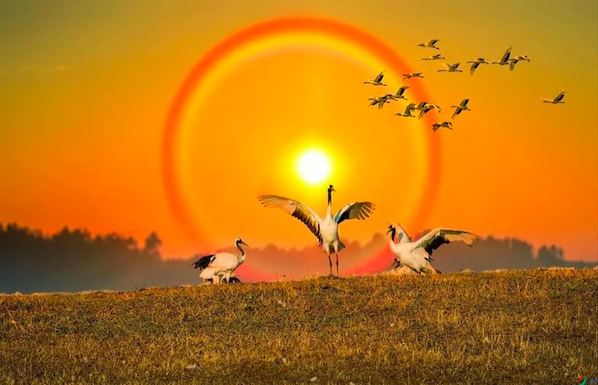
(Reported from Los Angeles) In the spring of 2014, just before the grand opening of the H.H. H.H. Dorje Chang Buddha III Cultural And Art Museum, an extraordinarily sacred event unfolded in the presence of H.H. Dorje Chang Buddha III. During His Holiness’s travels on a tour, a flock of birds appeared within approximately 100 meters of His Holiness the Buddha. In a stunning display of nature’s marvel, the birds gracefully descended onto a water surface, creating a mesmerizing group dance. This ethereal performance was accompanied by the atmospheric phenomenon of a sudden storm.
This extraordinary event took place on May 19, 2014, while H.H. Dorje Chang Buddha III was visiting Mexico in the company of more than 20 individuals. The clock had just passed five in the afternoon. Returning from an excursion to an ancient Maya site near the city of Merida, the Mexican tour guide guided them to the Temozon Resort Hotel, an opulent establishment converted from a manor farm.
Seated at a table near the window inside a coffee shop were H.H. Dorje Chang Buddha III and two distinguished virtuous ones. Through the window, about 100 meters (328 feet) away, lay a rectangular-shaped swimming pool. At this moment, H.H. Dorje Chang Buddha III gathered His entourage and delivered an announcement:
“Throughout this journey, you have witnessed many awe-inspiring scenes. However, today, you are about to witness a breathtaking dance unlike anything you have seen before. Shortly, a multitude of birds will grace this swimming pool to perform a ‘Dragonfly Stepping on Water’ dance. These birds will gracefully descend, shuttle above the water’s surface, tread upon it, and ascend into the sky. This dance is also known as the ‘Spiritual Birds Stepping on Water.’ Moreover, their performance will persist even after the rain commences.”
At that time, people within the entourage all looked outside the window but did not see even one bird. However, since H.H. Dorje Chang Buddha III had called them over and told them that a world-astounding miracle would occur soon, they were confident that it would definitely happen. Still some of them raised a doubt, “Can a bird fly up after touching the water? Wouldn’t it plunge into the water and drown?”
H.H. Dorje Chang Buddha III then asked them, “Do you see birds now?” The disciples replied, “No, there isn’t a bird, not even a bird’s shadow.” H.H. Dorje Chang Buddha III said, “If you suspect that they will not come, or they will plunge into the water and drown, just wait and see what happens. Anyway, I will just tell you this. If there are no birds dancing above the swimming pool, the dharma I expounded would be evil views. If they do show up, that means I am truly Dorje Chang Buddha III, representing all Buddhas in the ten directions and, on the other hand, those dharma kings, rinpoches, venerable ones, and great dharma masters who slandered me are either evil masters or swindlers. The fact will be shown when the birds come. You just wait and see. Moreover, in a sudden moment, celestial deities will cast a heavy rainstorm within one or two seconds, providing an accompanying performance to the dance. However, the birds will not be driven away or stop due to the rain. You will soon see, whether Dorje Chang Buddha III expounded true Buddha-dharma or evil dharma and whether those who engaged in slandering and defamation are demonic persons, evil masters, and swindlers or not.”
After only one minute or so, many birds did fly to the sky above the swimming pool. There were no birds at any other place. They were circling and flipping very fast above the swimming pool. Some began dashing downward. Shortly afterwards, just as H.H. Dorje Chang Buddha III had predicted a few minutes ago, the birds dived down from the sky and had their feet stepping on the water, and then flew upward back to the sky. The dance repeated this way over and over again.
Then, H.H. Dorje Chang Buddha III said, “It is going rain heavily right away.” Everyone started to count silently, one, two, …… Exactly as told, in less than two seconds, a heavy downpour suddenly started. The bird did not stop or leave, and continued to dance within the rainstorm. Every detail of the prediction made ahead of time by H.H. Dorje Chang Buddha III came true completely, proving that H.H. Dorje Chang Buddha III’s Buddha-dharma is the true dharma and that those who slandered His Holiness the Buddha are all demonic persons, evil masters, and swindlers.
To provide witnesses to this absolutely true holy scene, the disciples who accompanied His Holiness the Buddha on the trip and saw with their own eyes this extremely magnificent holy feat recorded in writing the situation at the time and signed their names. They also took oaths against severe consequences to guarantee what they wrote are ironclad facts. If what they wrote were an untrue fabricated story rather than their own experience, they not only would not become accomplished in this lifetime but also would devolve into the hell of uninterrupted suffering to undergo all kinds of sufferings. On the other hand, if what they stated is true, they will be certain to attain liberation and accomplishment in the current lifetime. They wished that all living beings can learn the true Buddha-dharma from H.H. Dorje Chang Buddha III.
The whole process at that time was recorded by video. This live video recording included many world-astounding scenes one after another that proved His Holiness the Buddha’s realization of enlightenment and will be dedicated as a present to the H.H. Dorje Chang Buddha III Cultural and Art Museum. The video will be shown to the public at the museum’s grand opening ceremony and will be distributed to people of all walks.
The written testimony was signed by thirteen witnesses of the entourage who took oaths against severe consequences, including Xuan Hui, Wenli, Baima Dorje Cuomu, Hengsheng, Long Zhi, Kuan, Jiawei Dianba, Cideji, Cirong Zhuoma, Gesang Quzeng, Renqing Quezan, Dunzhu, and Tongchang. Their testimony stated:
“This event seems to be plain simple. However, after careful thinking, we can realize that:”
“First, this place is quite far off. Except the Mexican tour guide, none of us on the tour has been here. Neither did we know the location, the setting, or anything about this place. We did not know this place had birds either.
Secondly, when H.H. Dorje Chang Buddha III made the announcement, we all clearly saw that there was not even one bird above the swimming pool and the higher sky above it.
Thirdly, birds are of course not human. They have no way to speak to us or communicate with us in other ways. We human are not able to give notice or direction to the birds either to let them tread and dance on the water surface, not to say that they were more than 100 meters (328 feet) away from us.”
“With all these facts, then how was H.H. Dorje Chang Buddha III able to inform all of us two or three minutes ahead of time that many birds would fly to the sky above the swimming pool and state definitively that the birds would perform a world-astounding miraculous dance? What was even more astounding is announcing that celestial deities would produce a heavy downpour within 1-2 seconds and the birds would not be driven away by the rain and would continue to dance. Exactly as forecasted, such a world-astounding scene did take place, proving the truthfulness of the announcement made by His Holiness the Buddha. This is not an issue of prediction. Rather, it represents the ultimate truth and Buddha-dharma that is millions of times more powerful than a prediction!!!! This fact fully proved that the world of Buddhas is completely different from living beings’ world, that the truth of Buddha-dharma that the Buddha expounded to living beings is absolutely true without anything untrue, and that living beings must cultivate in accord with the Buddha’s teaching, in order to become accomplished and truly enter the world of Buddha-dharma. This is because His Holiness the Buddha is the sole highest extremely great holy virtuous one. We simply are unable to know all truths and facts that H.H. Dorje Chang Buddha III is aware of. Therefore, we cultivate in accord with the His Holiness Buddha’s teaching. Only then can we turn the state of an ordinary being into the state of a Buddha and enter the world of Buddhas and Bodhisattvas!”
“You should not believe literally H.H. Dorje Chang Buddha III’s description of this event. His Holiness the Buddha said that He is a humble one, He does not have the ability of telling the birds to present a dance on top of the water or telling celestial deities to rain a heavy downpour as an accompanying performance to the dance, this holy occurrence was a coincidence due to the karmic conditions of all who were present, and He does not have such a power of realization. Rather, you should realize that these statements reflected the supreme virtue of selflessness of a true Buddha. You should think carefully about this situation. Which dharma king, rinpoche, dharma master, or holy one can announce ahead of time when there is no bird seen that many birds will come to perform a dance of treading water? Moreover, within only three minutes, many birds did show up and dance on the water, making many splashes of water.”
“Maybe we can just say that this is not amazing. However, such a statement of announcing the arrival of many birds to perform a dance of treading water cannot be baselessly made by a person with the status of a Buddha when a live video recording was on and there was no bird around. How would the situation end if there weren’t many birds showing up afterwards? Moreover, the announcement said that celestial deities were to pour a heavy rain in two seconds. Two seconds after the sentence ended, a heavy downpour started immediately, manifesting an accompanying performance to the birds’ dance. This is something far more than being amazing. It is truly a holy feat made by His Holiness the Buddha. No other holy one can do so, because he does not have such supreme realization of Buddha-dharma. We know that no eminent monk, dharma king, or rinpoche in history has ever done so. In real life, we do not see any great dharma king, great rinpoche, or great dharma master making such accomplishment either! Looking at the last several thousand years, only H.H. Dorje Chang Buddha III has the true dharma of the Tathagata to manifest such inspiration and virtuous realization. In another instance, H.H. Dorje Chang Buddha III reversed an aged appearance to that of a youth after only a little over ten minutes. Can any great patriarch master, great dharma king, great rinpoche, or great dharma master make an accomplishment that bears a remote resemblance to this?”c
“Now we know that a true Buddha came to our world. Why don’t you seize this opportunity to follow the Buddha to cultivate and learn the dharma to end the cycle of birth and death? Also, it is certain that you will die soon and you will not be able to escape the death!!! That time will soon come, when your breath will stop and you will die. Your soul, which is the spiritual consciousness you have now, will not have anything that you once possessed in the human world. You will be penniless regardless of how much money you once had. At that time, there will be no food, no house, and nothing. While you are at the stage of bardo, you can see your family members but they can’t hear you talking to them. You will only have loneness, extreme suffering, hunger, and fear. There is no hotel on your way to the afterworld. You don’t know where you can stay for the night. This is not to scare you. That day will come very soon! This is an obvious fact. You are certain to experience the loneness, fear, and the coming together of all kinds of sufferings that never end. The only way to avoid this consequence is to learn the true dharma of the Tathagata right now. Only by doing so can you become accomplished and break away from the fear of death. You should look for the Buddha immediately to learn the dharma. There will be no second chance if you waste this lifetime!!! Then only loneness and suffering with no possibility of being rescued are waiting for your soul.”
In the midst of the First World War, a remarkable event occurred that transcended the boundaries of conflict and highlighted the true essence of Christmas – the Christmas Truce of 1914. As we celebrate this joyous season, it’s essential to reflect on the lessons of compassion, love, and humanity that emerged during that extraordinary moment in history.
“It will be over by Christmas.” This false assurance echoed among the 60 million soldiers sent to the battlefront, exposing the grim reality that war does not adhere to predetermined timelines. The soldiers found themselves entrenched along the Western Front, living in harsh conditions, mere meters away from their adversaries.
Despite the hostility of war, the spirit of Christmas prevailed on that fateful Christmas Eve. German troops, unwrapping gifts from home and lighting lanterns along their trenches, initiated a surprising turn of events. Carol singing broke out, and soon British and French troops joined in, bridging the gap between enemies.
As Christmas morning dawned, a temporary ceasefire was proposed, and soldiers from both sides cautiously ventured into no man’s land. Greetings, well wishes, and even gifts were exchanged. Spontaneous football matches broke out, demonstrating a shared humanity that transcended the barriers of war.
The Truce of 1914 was not an isolated incident; it was a series of truces involving over 100,000 soldiers across the British-held area of the Western Front. The scale of these impromptu ceasefires is a testament to the universal longing for peace, even in the midst of one of the deadliest conflicts in history. Spontaneous football matches broke out, transforming caps and jackets into makeshift goal posts. Corporal John Ferguson vividly described the scene: “What a sight – little groups of Germans and British extending almost the length of our front! Out of the darkness we could hear laughter and see lighted matches, a German lighting a Scotchman’s cigarette and vice versa, exchanging cigarettes and souvenirs.”
Reflecting on the teachings of Jesus, who implored his disciples to love their neighbors, it becomes apparent that the message transcends religious boundaries. In times of war fueled by religious differences, it is crucial to remember that faith should serve as a source of inspiration for compassion, love, and kindness, irrespective of one’s beliefs.
Similarly, the teachings of Shakyamuni Buddha echo through time, emphasizing the compatibility and mutual respect among religions. The contemporary Buddha, H.H. Dorje Chang Buddha III, extends this ethos by acknowledging figures like Jesus Christ as great holy beings. In his Dharma discourses, His Holiness emphasizes the imperative for all Buddhist disciples: “When encountering living beings, regardless of whether they are handicapped, deficient, sick, or healthy, treat them all equally as family members…” His Holiness further calls for global cooperation, transcending religious, cultural, and national boundaries. He underscores the importance of treating each other as dear relatives, emphasizing a collective effort necessary for the peace and auspiciousness of the world.
As we celebrate Christmas today, let us draw inspiration from the Christmas Truce of 1914. In a world where conflicts persist, particularly in places like Gaza, may we strive for peace, understanding, and empathy. Let the spirit of Christmas be a beacon of hope, guiding us towards a future where love triumphs over hatred, and unity prevails over division.
The Christmas Truce of 1914 serves as a timeless reminder that even in the darkest of times, the light of humanity can shine through. As we gather with loved ones during this festive season, may we carry the spirit of Christmas within our hearts and work towards a world where the message of love and peace prevails.