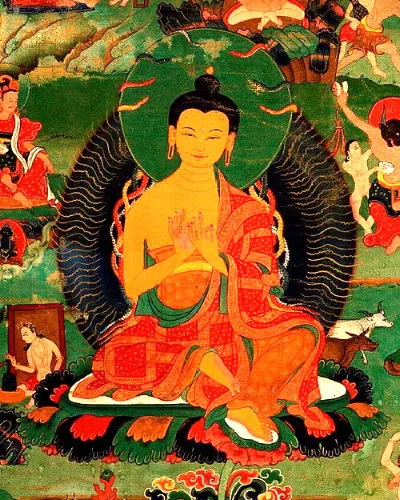
A Golden Bowl and an Awakened Heart — A Story of Awareness and Transformation

Nāgārjuna was a great Buddhist master from ancient India, widely respected as a profound philosopher and teacher who illuminated the path of wisdom and emptiness. Known for his deep insight and compassionate guidance, he helped many turn their minds toward awakening.

There is a story often told about him:

Nāgārjuna lived a simple and pure life, traveling from place to place, guiding others with wisdom.

One day, he arrived in a prosperous kingdom. The queen, a devoted follower of the Dharma, was overjoyed to hear of his visit. She had a beautiful golden bowl specially made, inlaid with precious jewels, and offered it to him with great respect.

When Nāgārjuna entered the city on his alms round, the queen personally presented the golden bowl. He accepted it calmly, without excitement or attachment, just as he would accept any ordinary offering.
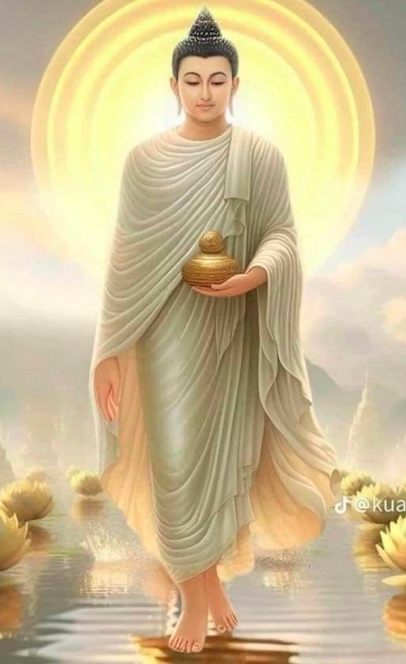
Carrying the bowl, he quietly left the city and returned to a dilapidated hut where he was staying.

A thief saw everything.

He thought to himself, “Such a valuable bowl in the hands of a man who lives with nothing—how long can he keep it? If someone is going to take it, why not me?”

So he followed Nāgārjuna in secret.

As night fell, Nāgārjuna returned to his crumbling shelter. There were no doors, no roof—hardly a place anyone would visit.

The thief hid nearby, waiting for the right moment, planning to act once the master fell asleep.

After finishing a simple meal, Nāgārjuna gently placed the golden bowl outside, in a visible spot, and then sat down quietly.

The thief was stunned. He had not expected this.

After hesitating, he stepped forward and asked softly, “Aren’t you afraid someone will take your bowl?”

Nāgārjuna looked at him calmly and said, “Since you are already here, why hide? If you need it, you may take it.”

The thief was taken aback and found himself unable to reach for it.

“Do you not know how valuable this is?” he asked.

Nāgārjuna smiled gently. “If the mind is bound by it, even something precious becomes a burden. If the mind is not attached, even something simple is enough.”

The thief fell silent for a long moment, then said, “If you can see a golden bowl this way, then what you have must be far more valuable. Can you teach me?”

Nāgārjuna nodded. “Yes. But first, you must learn to observe your own mind.”

“How do I do that?” the thief asked.

“When a thought arises—whether of desire, grasping, or wanting to take something—simply be aware of it clearly. Do not follow it, do not suppress it, do not act on it. Just see it as it is.”

“That sounds easy,” the thief said.

“It sounds easy,” Nāgārjuna replied, “but it is not.”

The thief agreed to try.
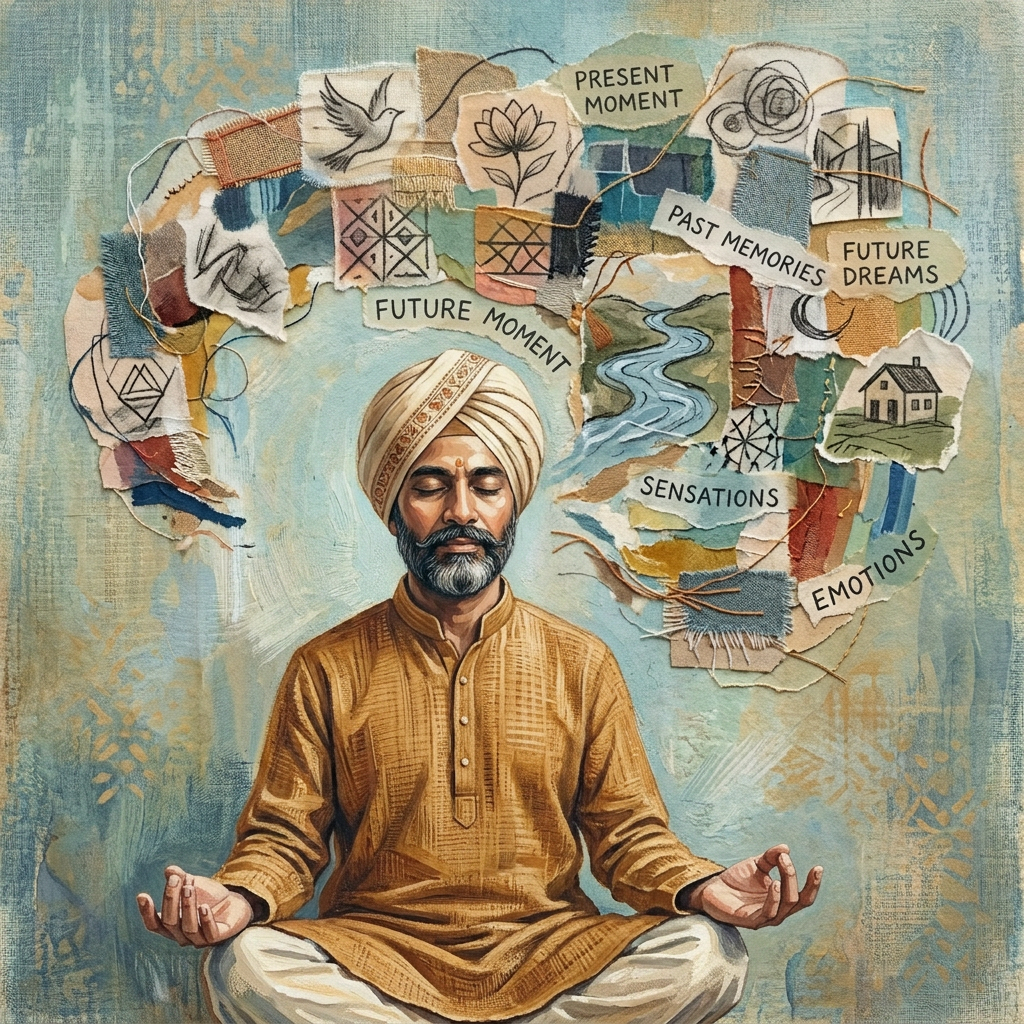
Person meditating with illustrated thoughts about present moment, past memories, future dreams, sensations, and emotions

When he next attempted to steal, he began to watch his own thoughts. Yet each time he clearly saw the moment of greed arise, something within him shifted. His hand could no longer move forward.

Again and again, he tried—but whenever awareness was present, the urge lost its force.

After some time, he returned to Nāgārjuna, empty-handed.

“I can no longer steal,” he said quietly. “The moment I truly see my thoughts, the desire disappears.”

Nāgārjuna looked at him and said, “It is not that you have lost something. It is that you have begun to see clearly.”

Tears filled the thief’s eyes. “I once believed that gaining more would bring satisfaction. Now I see that when the mind becomes still, the peace and ease I feel are greater than any wealth.”

He knelt and said, “Please allow me to follow you and learn.”

Nāgārjuna replied, “The moment you are willing to face your own mind, your practice has already begun.”

This story has been passed down not to suggest that one should ignore right and wrong, but to remind us:

True transformation does not come from force, but from clear awareness.
True letting go is not merely giving things up, but releasing attachment in the heart.

When we begin to truly see our own minds, many attachments naturally fall away. And perhaps, the real turning point begins the moment we are willing to truly see ourselves.

Link:https://peacelilysite.com/2026/04/27/a-golden-bowl-and-an-awakened-heart-a-story-of-awareness-and-transformation/

The Monk Who Remembered His Past Lives: A Tale of Karma, Awakening, and Renewal

In the Tang Dynasty, there lived a monk named Jian Kong (Venerable “Mirror-of-Emptiness”), who in his previous life had been a diligent spiritual practitioner. Yet after reincarnating, he was born not as a monk, but as a poor scholar—one who, despite twenty long years of effort, could not pass the imperial examinations. He had no money, no connections, and often struggled even to find a simple meal. Hunger followed him like a shadow.

One day, after days of near-starvation, he set out toward a nearby temple, hoping to find something—anything—to eat. But halfway there, by the side of a river, his strength gave out completely. Weighed down by exhaustion and despair, he collapsed on the riverbank and began to cry. He was already around forty-five years old, and life felt unbearably harsh.

As he wept, a Brahmin monk suddenly appeared before him, radiant and calm.

Venerable Dharma Master,” the monk said, “are you satisfied with the taste of wandering through worldly life?

The scholar was startled.
Satisfied? It has been nothing but suffering! But I am a layman—why do you call me “Dharma Master”? That title doesn’t belong to me.

The Brahmin monk smiled gently.
You are starving and confused now, so you’ve forgotten everything.

He reached into his bag and took out a large, fist-sized date.
“This is a special fruit from my homeland. Eat it. Then you’ll understand.”

The scholar ate the date. Sleepiness washed over him at once, and he lay down beside the river. When he awoke, something astonishing had occurred—
his entire past life came flooding back.

He remembered that he, the Brahmin monk standing before him, and three others had all been fellow practitioners in their previous lives. Filled with emotion, he asked:

What about Monk Zhen? How is he doing in this life?

The Brahmin monk replied, “In his past life he had not yet cut off worldly attachments, nor had he achieved realization. In this life, he has become a monk again in Sichuan. He has now completely severed his desire for fame and fortune. He will attain accomplishment in this very life.

The scholar asked about another of their five companions.
And Master Shen? What about him?
His wishes remain unfulfilled,” the monk answered.

Then he asked about the third companion, Master Wu.
The monk sighed gently:
You know him. In our past life, he once joked before a stone Buddha statue: ‘If I cannot attain supreme enlightenment, then at least let me become a mighty nobleman.’
Well, his vow has come true. Just yesterday, I heard he was appointed a general. He has completely forgotten he was once a monk.*”

Finally, the Brahmin monk turned to him and said:

Among the five of us, I alone have attained liberation. And you—of all of us—you alone have fallen to such a state that you cannot even find enough food to fill your stomach.

The scholar was bewildered.
In my past life,” he said, “for decades I ate only one meal a day and wore one tattered robe for over thirty years. I practiced diligently and lectured on the Dharma tirelessly. I was a well-known Dharma Master. How could my karma now be so miserable?

The Brahmin monk answered with unmistakable compassion:

Yes, you cultivated hard. But when you taught the Dharma, you often mixed in ideas from Daoist and other non-Buddhist teachings. This confused your listeners. You also held back special teachings out of stinginess, unwilling to share them openly. And although you kept the precepts, you broke them in many subtle ways. Given all this, your current life’s hardship is already a fortunate result.

Hearing this, the scholar felt deep remorse and sadness. But instead of despair, a new resolve arose within him.

He vowed to renounce worldly life and become a monk once more.

Seeing his sincerity, the Brahmin monk took out a mystical mirror from his bag.
In it, the scholar saw with clarity:

  • his own past lives,
  • the karmic results of all beings’ actions,
  • even the future rise and fall of the Dharma.

The mirror was said to be like the Seven-Jewel Trees of the Pure Land, which reveal the karmic truths of the universe with perfect brightness.

With this profound vision, his conviction became unshakable.
He immediately entered monastic life, practiced with genuine diligence, and in time became a highly respected and accomplished master.

Link: