Namo Dorje Chang Buddha III Complete Sutra Collection

During this Dharma-Ending Age, H.H. Dorje Chang Buddha III descended to the human realm, demonstrating perfect mastery of both Exoteric and Esoteric Buddhism, as well as unsurpassed accomplishment in the Five Vidyas—the disciplines through which Buddhas and Bodhisattvas benefit sentient beings.

Over the past 2,000 years, the teachings of the Buddha have been distorted through mistranslation and misinterpretation by patriarchs, eminent monastics, and scholars. Recognizing these errors, H.H. Dorje Chang Buddha III corrected the deviations that had crept into the Dharma, restoring its original purity, wisdom, and power.

Having come to the saha world during this degenerate age, Namo Dorje Chang Buddha III left behind irrefutable, supreme examples of omniscient realization in the Exoteric and Esoteric teachings, as well as in the Five Vidyas. He also provided incisive, complete sutras and audio recordings of the Dharma He expounded. These supreme Dharma treasures are essential for all Buddhist practitioners to study and put into practice in order to attain realization and liberation.

In short, anyone who wishes to achieve true accomplishment and liberation must earnestly study the “Namo Dorje Chang Buddha III Complete Sutra Collection.

Namo Dorje Chang Buddha III Complete Sutra Collection primarily consists of the transcriptions of the Dharma discourses by Namo Dorje Chang Buddha, and also includes all of the Buddha’s sutras, poems, writings, and other works. Given the urgent needs of those studying the teachings and the vast quantity and length of the Buddha’s discourses, Namo Dorje Chang Buddha III Complete Sutra Collection is being published in volumes over time (up to now, six volumes have been published).

Volume I: Dharma Expounded During a Trip to the East
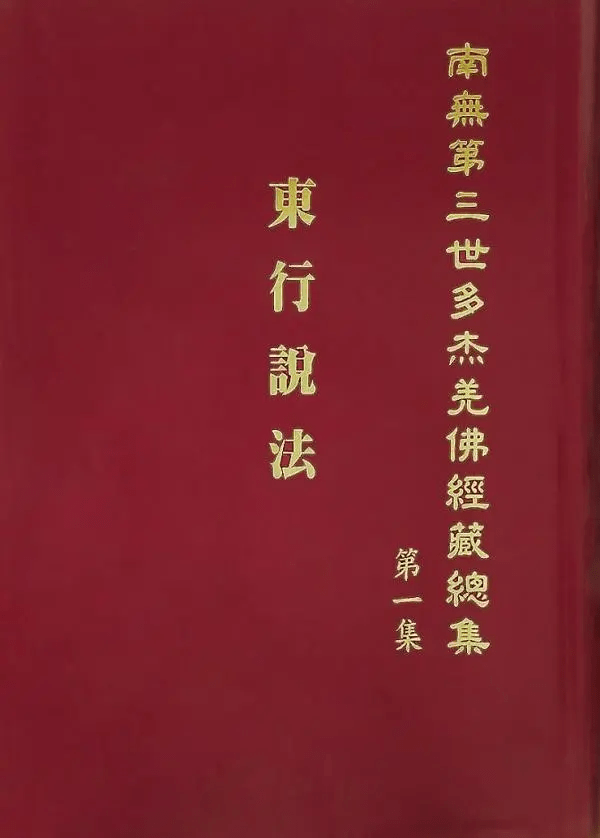
On November 13, 2008, the United States Congress held an art exhibition for the Buddha Mother (Professor Yuhua Shouzhi Wang) inside the Capitol Building in Washington, D.C. To ensure the safe transportation of the artworks, it was decided to rent a recreational vehicle (RV), forming a convoy with the truck carrying the artworks. Namo Dorje Chang Buddha III, the Buddha Mother, and accompanying disciples all traveled and lived in the RV during the journey.

The convoy led by Namo Dorje Chang Buddha III departed from Los Angeles on October 25, 2008, and arrived in Washington, D.C. on November 10. Following the successful completion of the Buddha Mother Professor Yuhua Shouzhi Wang’s art exhibition at the Capitol on November 13, the group returned on November 26. The journey lasted 33 days, traversing more than 20 states from the western to the eastern United States. Except for the time spent in D.C., where they were occupied with preparing the exhibition, Namo Dorje Chang Buddha III gave Dharma discourses to His disciples almost every evening during the trip. These teachings were compiled into the Dharma Expounded During a Trip to the East, totaling 19 volumes.

Throughout the journey, many holy manifestations occurred wherever Namo Dorje Chang Buddha III went, some of which were mentioned by the Buddha during the teachings. On the day before the journey concluded, Namo Dorje Chang Buddha III even performed a Dharma rite to eliminate obstacles for His disciples. Moreover, after returning to Los Angeles, at the Buddha’s Vajra Mandala in Pasadena, holy nectar descended from the Buddha, confirming that the Dharma Teaching Journey to the East is a pure and supreme Tathagata Dharma of the Buddha.

Volume II: Dharma Expounded During a Trip in Response to the Needs of Disciples
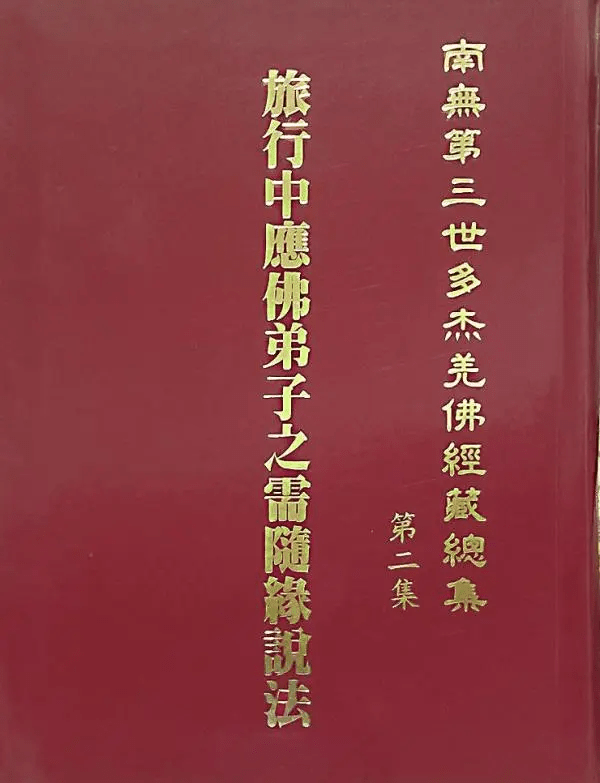
In October 2021, after the government lifted the restrictions on public gatherings and travel due to the Covid-19 pandemic, Namo Dorje Chang Buddha III, the Buddha Mother, and accompanying disciples set out by car along the coastal Highway 1, traveling from Los Angeles to San Francisco. Along the way and during their stay in San Francisco, Namo Dorje Chang Buddha III gave Dharma discourses daily, addressing questions raised by His disciples.

After returning to Los Angeles, Namo Dorje Chang Buddha III made a special trip to Las Vegas because Rocket, the guardian dog of the Las Vegas Dharma center, had dashed out the gate and was fatally hit by a car. The Buddha performed a transcendental liberation ceremony for Rocket and also gave daily Dharma teachings to His disciples.

From these two trips, a total of fifteen volumes of Dharma discourses were compiled.

Volume III: Expounding the Absolute Truth through the Heart Sutra
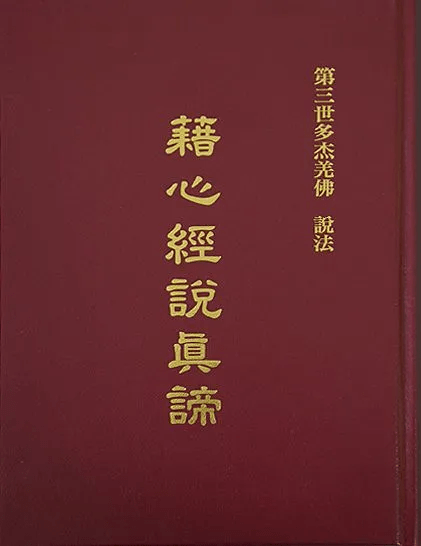
H.H. Dorje Chang Buddha III expounds the Dharma using the words and profound meanings of the Heart Sutra, illuminating the relationship between the mind, the Buddha, and sentient beings. This can also be described as an explanation of the impermanence and permanence of all things—both sentient and insentient—in the universe, as well as the principles of formation, existence, decay, and emptiness versus the truth of no formation, existence, decay, or emptiness. What is a Buddha? What is the relationship between sentient beings and the Buddha? What does it mean to attain liberation from the cycle of birth and death? H.H. Dorje Chang Buddha III clearly explains the true essence of Buddhism and the meaning of liberation.

The Dharma teachings of H.H. Dorje Chang Buddha III are profoundly insightful, precise, and easy to understand. One can only say that, in the thousands of years of Buddhist history, this is the first time such a supreme, precious Buddhist text and highest-level classic has appeared.

Volume IV: Fundamental Dharma Expounded in the East

Fundamental Dharma Expounded in the East is the first publicly released series of Dharma discourses given by Namo Dorje Chang Buddha III to all disciples in 1995. It is a compilation of selected teachings and instructions delivered between 1992 and 1994, during a time when people were not yet aware of His true identity as a Buddha and only knew Him as Master Yi Yungao.

Namo Dorje Chang Buddha III titled this set of teachings “Foundational Dharma Teachings” to emphasize that the principles explained within are essential for every Buddhist practitioner—they are truths that must be clearly understood and applied in actual cultivation on the path of learning Buddhism and practicing the Dharma.

Through direct discourses, answers to disciples’ questions, empowerment during Dharma practices, and reports of disciples’ personal experiences, Namo Dorje Chang Buddha III helps people deeply comprehend the Dharma, gain thorough insight, and apply it concretely in their lives. At the same time, by respectfully listening to these Dharma discourses, we can truly come to recognize that the “supreme greatness” of Namo Dorje Chang Buddha is fully deserved and genuinely manifested.

Volume V: Dharma Expounded During a Trip to Taiwan

Dharma Expounded During a Trip to Taiwan is a compilation of selected Dharma discourses given by Namo Dorje Chang Buddha III between 1995 and 1996. The complete set consists of 18 volumes, organized into the following sections:

  1. Volume 1: The Supreme and Incomparable Dharma
    This volume presents a profound and rare teaching of the highest order.
  2. Volumes 2 to 6: The True and Unimaginable Deeds of Namo Dorje Chang Buddha III
    These five volumes document the holy manifestations and teachings of Namo Dorje Chang Buddha III during His visits to the United States, Japan, Hong Kong, and Taiwan from April to May 1995.
  3. Volume 7:
    This volume contains the teachings given by Namo Dorje Chang Buddha III in early July 1995 when He received a group of Taiwanese Buddhist disciples.
  4. Volumes 8 to 10:
    These volumes recount the events surrounding the disciple Peng Chubin, who in a previous life violated the vows he had solemnly made before Buddhas and Bodhisattvas, resulting in karmic retribution that destined him to die a violent death in each lifetime. In this life, upon encountering Namo Dorje Chang Buddha III, the Buddha not only foretold Peng Chubin’s impending tragic situation in advance, but also performed a great Dharma to empower and save him, ultimately freeing him from his karmic death sentence. These volumes also include teachings from September 1995 and reports from disciples Peng Chubin and Yu Lihua.
  5. Volumes 11 to 14:
    These volumes contain Dharma discourses given by Namo Dorje Chang Buddha III in Guangdong and Hainan in January 1996.
  6. Volume 15:
    This volume records two disciples reporting their Dharma practice progress to Namo Dorje Chang Buddha III.
  7. Volume 16:
    This volume includes teachings given by Namo Dorje Chang Buddha III during the summer of 1996 at His residence on Yinsi Street in Chengdu.
  8. Volumes 17 to 18:
    These final two volumes feature discourses given by Namo Dorje Chang Buddha III during His travels to Wulingyuan in Zhangjiajie, Hunan, in the summer of 1996.

Volume VI: Dharma Expounded During a Trip to the United States

At the end of September 1998, due to a significant karmic cause related to the Dharma, H.H. Dorje Chang Buddha III came to the United States alone in a simple and unassuming manner. During His 40-day stay on the West Coast of the U.S., in addition to visiting many cities in Southern California, He also led His disciples along the coastal Highway 1 northward to San Francisco and visited the world-famous casino city, Las Vegas.

To ensure His disciples received the greatest benefit, H.H. Dorje Chang Buddha III upheld the consistent practice of Buddhas throughout history—whenever He arrived at a place, He would do His best to make time to expound the Dharma for the public, offering teachings anytime and anywhere. He diligently nurtured His disciples’ correct understanding and views. The Dharma Expounded During a Trip to the United States is a compilation of the Dharma discourses delivered by H.H. Dorje Chang Buddha III during this visit. From the titles of these discourses, one can see that He gave teachings in Los Angeles, Las Vegas, at the then headquarters of the “Yi Yungao Master International Cultural Foundation,” and other locations. Out of great compassion, H.H. Dorje Chang Buddha III began by addressing even the most basic questions posed by the disciples at the time. Step by step, He guided their growth, encouraging them not only to cultivate themselves in the Buddha-Dharma, but also to give rise to bodhicitta and compassion, to widely propagate the radiant and magnificent Dharma, and to help more kind-hearted beings learn the conduct of the Buddhas and walk the path of liberation.

In October 1998, H.H. Dorje Chang Buddha III led fourteen disciples from Los Angeles on a road trip along Highway 1 to San Francisco. The evil demons, knowing that this journey marked an important karmic event for the entire Dharma realm—whereby the true Buddha-Dharma would begin to flourish in America and the Western world, leading countless sentient beings of the Saha world to attain accomplishment and liberation—launched an assault. The Demon King Mara specifically sent many demon generals with their minions, attempting to destroy this great Dharma propagation event by taking the lives of the Buddha’s disciples.

As a result, various demons and evil spirits continuously created disturbances along the route, attacking and sabotaging H.H. Dorje Chang Buddha III and His entourage. What was originally planned as a one-day trip took five days to complete. Yet, the demons could not ultimately prevent the Buddha’s mission of spreading the Dharma and saving sentient beings. H.H. Dorje Chang Buddha III subdued each demon one by one. Under His guidance, all the disciples safely arrived in San Francisco, symbolizing that the authentic Buddha-Dharma of H.H. Dorje Chang Buddha III would indeed blossom and bear fruit in the United States and throughout the Western world, bringing auspiciousness and liberation to the sentient beings of the Saha world.

Link: https://peacelilysite.com/2025/05/02/namo-dorje-chang-buddha-iii-complete-sutra-collection/

Ten Paths to Happiness

Mahāratnakūṭa: 30. The Maiden Sumati

The “Ten Paths to Happiness” sutra, where an eight-year-old girl named Sumati asks Buddha ten profound questions. These questions explore essential aspects of human life and happiness, and Buddha provides insightful answers. This sutra is significant as it presents complex philosophical ideas in an accessible manner through the dialogue between Buddha and a child.

Thus have I heard. At one time, the Buddha was in the city of Rājagṛha, on the mountain of Gṛdhrakūṭa, along with a great assembly of bhikṣus, twelve hundred and fifty people in all. The bodhisattva-mahāsattvas there numbered ten thousand in all.

At that time in the city of Rājagṛha, there was a laywoman named Sumati, who was in her eighth year. Her appearance and features were upright, colorful, and beautiful, appearing so nice that those who saw her were happy. Already, she had approached and made offerings before innumerable buddhas of the past, planting good roots. When that maiden went to the place of the Tathāgata, she bowed her head at the feet of the Buddha, and then circled around him three full times to the right. Kneeling with palms joined, she spoke a gāthā:

Anuttarā Samyaksaṃbodhi
Is a lamp for the entire world!
Of the practices of a bodhisattva,
I wish you would hear my questions!

The Buddha said to Sumati, “You may now ask questions as you like, and the answers will cut through your net of doubts.” At that time, Sumati went before the Buddha and spoke a gāthā to inquire:

How can one attain upright features
And a body of wealth and nobility?
Moreover, what causes and conditions
Make kinship difficult to destroy?

How may one perceive oneself
Receiving birth by transformation,
Arising from a thousand-petaled lotus flower,
And giving reverence to the bhagavāns face-to-face?

How is one able to attain realization
Of supreme and sovereign superknowledge,
And go off to innumerable lands
To pay homage to the buddhas?

How can one attain blamelessness,
So that others will have belief,
Purely removing obstacles to the Dharma
And forever departing from the deeds of Māra?

How is one able, at the end of life,
To attain perception of the buddhas,
Hear the speech of the pure Dharma,
And not be subject to suffering?

Great compassionate supremely honored one,
I merely wish you would speak of these for me!

At that time, the Buddha spoke to the maiden Sumati, saying, “Excellent, excellent! It is good that you are able to ask about such profound matters. Now listen carefully, listen carefully and well mindfully, and I will tell you.” Sumati then spoke, saying, “Just so, Bhagavān. We are joyfully wishing to hear it.”

The Buddha told Sumati, “A bodhisattva who accomplishes four dharmas receives an upright body. What are these four? [1] The first is not giving rise to a mind of hatred for bad friends. [2] The second is to abide in great kindness. [3] The third is to have profound delight in the correct Dharma. [4] The fourth is to create images of the Buddha.”

“Moreover, Sumati, a bodhisattva who accomplishes four dharmas will attain a body that is rich and noble. What are these four? [1] The first is that you should give timely gifts. [2] The second is to do so without a mind of disdain for others. [3] The third is to do so with happiness. [4] The fourth is to do so without expecting any reward.”

“Moreover, Sumati, a bodhisattva who accomplishes four dharmas will attain birth by transformation before the buddhas, seated upon a lotus flower. What are these four? [1] The first is to give flowers, fruit, and fine powdered incense as offerings to the Tathāgata and to the stūpas. [2] The second is not to tell lies or harm others. [3] The third is to make images of the Tathāgata placed within a lotus flower. [4] The fourth is to give rise to profound and pure faith in the bodhi of the buddhas.”

“Moreover, Sumati, a bodhisattva who accomplishes four dharmas may travel from one buddha-land to another buddha-land. What are these four? [1] The first is to not perceive others’ cultivation of goodness as obstruction or annoyance. [2] The second is to never hinder others when they are expounding the Dharma. [3] The third is to burn lamps and make offerings to the stūpas of the Tathāgata. [4] The fourth is to constantly strive to cultivate the dhyānas.”

“Moreover, Sumati, a bodhisattva accomplishes four dharmas for the station of blamelessness in the world. What are these four? [1] The first is to draw near to virtuous friends without a mind of flattery. [2] The second is to not have a mind of jealousy regarding others’ excellence in the Dharma. [3] The third is to always be happy when others receive honors and recognition. [4] The fourth is to not vainly criticize the practices of a bodhisattva.”

“Moreover, Sumati, a bodhisattva accomplishes four dharmas for his speech to be believed by others. What are these four? [1] The first is develop speech and cultivation always in unison. [2] The second is to not do evil things to virtuous friends. [3] The third is to not find faults in the Dharma one has heard. [4] The fourth is to not give rise to a mind of evil for one who speaks the Dharma.”

“Moreover, Sumati, a bodhisattva accomplishes four dharmas for being able to leave obstacles to the Dharma and quickly attain purity. What are these four? [1] The first is to accept the Threefold Discipline with profound conviction. [2] The second is that one does not give rise to slander for extremely profound sūtras. [3] The third is to perceive the newly-developed intention of a bodhisattva as the arising of the mind of omniscience. [4] The fourth is regarding sentient beings with great kindness and equanimity.”

“Moreover, Sumati, a bodhisattva accomplishes four dharmas for being apart from māras. What are these four? [1] The first is to fully know the equality of the nature of dharmas. [2] The second is to give rise to determination. [3] The third is to constantly strive to be mindful of the Buddha. [4] The fourth is to transfer over all good roots.”

“Moreover, Sumati, a bodhisattva accomplishes four dharmas so that at the end of life, the buddhas manifest before him. What are these four? [1] The first is to fulfill the wishes of others by giving what they are seeking. [2] The second is giving rise to profound faith and understanding of good dharmas. [3] The third is to give adornments to the bodhisattvas. [4] The fourth is to diligently make offerings to the Triple Gem.”

At that time, the maiden Sumati heard what the Buddha had spoken, and said, “Bhagavān, as the Buddha has spoken of the practices of a bodhisattva, so will I practice them! Bhagavān, among these forty practices, if there is one that is lacking or uncultivated, then this will be conflicting with the Buddha’s teachings and deceiving the Tathāgata.”

At that time, Venerable Mahāmaudgalyāyana spoke to Sumati, saying, “The practice of a bodhisattva is extremely difficult to carry out. You are now developing this extraordinary great aspiration. How will you attain accomplish mastery over this vow?”

Sumati replied, “Venerable, if my great aspiration is true and not void, able to bring these practices to complete fulfillment, then may the three thousand great thousand-worlds shake in six directions, and the heavens rain wondrous flowers, and may the drum of heaven sound of its own accord!” When this had been spoken, flowers fell from the sky like rain, and the drum of heaven sounded of its own accord, and the three thousand great thousand-worlds shook in six directions.

At this time, Sumati again addressed Maudgalyāyana, “From my true words, in a future era I will attain buddhahood, just as Śākyamuni, the Tathāgata. In my land there will be no deeds of Māra, and not even the words for evil destinies, or for women. If what I say is not fabrication, then may the bodies of those in the great assembly all take on a hue of gold!” After speaking this, the assembly took on a hue of gold. At that time, Venerable Mahāmaudgalyāyana then arose from his seat, bared his right shoulder, and bowed with his head at the Buddha’s feet. He spoke saying, “Bhagavān, from these things I have developed the mind of a bodhisattva and even that of the assembly of bodhisattva-mahāsattvas!”

At that time, Dharma Prince Mañjuśrī spoke to Sumati, saying, “In what dharma do you abide to make this sincere aspiration?” Sumati replied, saying, “Mañjuśrī, it is not proper to ask this. Why? This is because in the Dharma Realm there is nothing which abides.” He also asked, “Then what is Bodhi?” She answered, “The non-differentiation of dharmas is what is called Bodhi.” He also asked, “Then what is it that is called a bodhisattva?” She answered, “A bodhisattva is one who is aware that all dharmas are equal to the manifestation of empty space.” He also asked, “What is it that is called the practice of Bodhi?” She answered, “The practice of Bodhi is like a mirage, or like the echo of a valley.” He also asked, “With what underlying meaning do you say such things?” She answered, “In this I do not perceive even the slightest thing which may be underlying or manifest.”

He also asked, “If it is as you say, then all ordinary people would have Bodhi.” She answered, “You speak of Bodhi as being different from an ordinary person? You should not have this view. Why? These are all of the same characteristic of the Dharma Realm, to be neither grasped nor abandoned, with nothing to accomplish or destroy.” He again asked, “How many beings are able to fully understand your meaning?”

She answered, “Their number is like the number of illusory minds and mental functions. The illusion of sentient beings is already able to understand my meaning.” Mañjuśrī said, “Illusions are without basis, so how can there be such minds and mental dharmas?” She answered, “The Dharma Realm is also such, neither existing nor non-existing, and for the Tathāgata is it also such as this.”

At that time, Mañjuśrī addressed the Buddha, saying, “Bhagavān, this Sumati is extraordinary, even able to accomplish such dharma-patience!” The Buddha said, “Thusly, thusly! What she has spoken is sincere and true. In such a way, this maiden has long since developed the mind of Bodhi, throughout the past thirty eons, even developing the destiny of my supreme Bodhi, causing such abiding in the patience of the non-arising of dharmas.”

Link:https://peacelilysite.com/2024/07/12/ten-paths-to-happiness/

https://lapislazulitexts.com/tripitaka/T0310-LL-30-sumati/ Translated from Taishō Tripiṭaka volume 11, number 310.

The Life and Legacy of A Great Translator — Kumarajiva (III)

Photo by Jeremy Bishop on Pexels.com

Long and Tortuous Blooding Journey to China

Emperor Fu-Chien (337-385), also known as Fu-Jian, became increasingly interested in Buddhism. In 379, he conquered the city of Hsiang-yang and invited Tao-an to establish his renowned center for the translation of Buddhist scriptures and texts in the capital of Ch’ang-an, which Fu Chien fully supported. Tao-an, impressed by Kumarajiva’s spiritual, philosophical, and linguistic abilities, urged Fu Chien to invite him to Ch’ang-an. However, the warlord-emperor, in his aggressive manner, dispatched Lu Kuang with an army to conquer Kucha and capture Kumarajiva. Kucha fell to Lu Kuang, and Kumarajiva willingly accompanied the conquering general to Ch’ang-an in 383.

Then, a series of unexpected events occurred. Tao-an died in 385, and six months later, the Yao family attacked and conquered Ch’ang-an, killing Fu Chien. The new dynasty continued the policies of the previous rulers, such as preserving Tao-an’s translation center and promoting Buddhist studies, eagerly anticipating the arrival of Kumarajiva in the capital. Lu Kuang, upon hearing of the conquest of Ch’ang-an, halted his return and declared himself independent, establishing a state known as Later Liang with its center at Ku-tsang. Although Lu Kuang was not a Buddhist and did not care for spiritual matters, he recognized the political value of Kumarajiva.

Lu Kuang held Kumarajiva captive for sixteen years, subjecting him to numerous indignities while also using him as a military adviser. During this time, the rulers of Ch’ang-an pleaded for his release, but to no avail. Kumarajiva found this period of his life difficult and frustrating, as he was mocked for his beliefs and practices and could not pursue the work he felt destined to do. Despite this, he did not become passive or disheartened. Instead, he used this time to learn about China from the rugged soldiers who had traversed much of the country. He also quietly gathered texts to take with him to Ch’ang-an and thoroughly mastered the Chinese language.

Eventually, Yao Hsing, the second ruler of the new dynasty at Ch’ang-an, grew tired of fruitless negotiations with Lu Kuang and took a daring risk. In 401, his armies attacked and conquered Ku-tsang (in present-day Afghanistan). Kumarajiva was rescued unharmed, and in 402, he was welcomed into Ch’ang-an. He finally realized a dream he had conceived in his twenties, but it took until his fifties to come to fruition.

This image has an empty alt attribute; its file name is image-37.png
An artist’s impression of a translation session

Kumarajiva was warmly received by Yao Hsing, who bestowed upon him the title Teacher of the Nation. The fruitful phase of his life, which has profoundly influenced Chinese Buddhist tradition from the moment he entered Ch’ang-an to the present day, began with his arrival and lasted barely a decade. Within six days of taking up residence in his new home, he accepted the suggestion of a monk named Seng-jui, later one of his chief disciples, and began to translate a text on meditation, the Tso-ch’an san-mei ching. He found that the translation centre founded by Tao-an had been preserved and supported by Yao Hsing, and he marvelled at the quality of the work his predecessor had undertaken. He found himself surrounded by an enormous group of knowledgeable monks who were ready to continue the work of translation under his guidance. He rapidly reorganized the centre so that new translations could be made even while the accomplishments of the previous generation could be reviewed and revised. Within the next few years he translated almost fifty works in about three hundred volumes.

Like Tao-an, Kumarajiva thought that the ko-i or ‘matching the meaning’ method of translation, in which unfamiliar Sanskrit Buddhist concepts were replaced by well-known Chinese Taoist words, compromised Buddha’s teachings. A review of Tao-an’s work convinced him, however, that too strict an insistence on literal translation, sometimes requiring the creation of awkward neologisms, rendered beautiful texts obscure. His belief that a translation should accurately convey the tone and texture of a teaching inseparably from its content compelled him to adopt a new methodology for translation. He chose to emphasize the central theme of a text or treatise and to edit passages which would seem unnecessarily repetitive to Chinese readers. Once he had arranged the working force at his disposal to his satisfaction, he would read a text aloud, sentence by sentence, before a large congregation. Yao Hsing would often attend these sessions, and sometimes he held the original palm-leaf manuscript in his own hands while Kumarajiva explained it. After each sentence, Kumarajiva explained its meaning and offered an oral translation in Chinese. The congregation would comment on the results and suggest improvements. Meanwhile, a recorder would write down the approved translation, and later an editor would review the whole text for style and internal consistency. Finally, a calligrapher would correct the Chinese ideographs to be sure there were no ambiguities in transmission of the texts.

Kumarajiva’s influence was not limited to the so-called barbarous kingdoms of northern China. In 378 Hui-yuan, one of Tao-an’s chief disciples, had gone south and made his abode in a monastic community at Lu-shan, a mountain famous amongst Taoists, Confucians and Buddhists for its majesty and mystery. Within a few years, he became the informal leader of the Southern Chinese Buddhist community. Shortly after Kumarajiva’s arrival in Ch’ang-an in 402, Hui-yuan wrote to him and encouraged him to continue the work of Tao-an. A year later, hearing that Kumarajiva might return to Kucha, he wrote again, strongly urging him to remain in China. During the next few years the two monks exchanged letters on philosophical and monastic subjects, and eighteen of these exchanges survive. Hui-yuan enquired about many issues, but he was most interested in gaining a clear understanding of the dharmakaya, the highest vehicle of a Buddha. Kumarajiva distinguished between dharmakaya, the ultimate body of Buddha, and dharmadhatujakaya, the invisible body consciously evolved by a Bodhisattva to serve humanity in the world even after physical death. Thereby he showed how that which is ultimately real is reflected in subtle material form through one-pointed and universal consciousness. In these letters answering questions posed by a serious disciple of buddhadharma, one can glimpse something of Kumarajiva’s own profound insight and understanding. In general, he preferred to remain hidden behind the lustre of his translations and refrained from writing treatises setting out his own views.

Seng-jui is said to have rejoiced after attending a translation session with Kumarajiva, because for the first time he caught a glimmer of understanding of the enigmatic concept of shunyata. The collective work of Kumarajiva and his colleagues produced texts which were readable, comprehensible and inspiring. After a millennium and a half his translations are still read and studied, and they are often used as the basis for new translations into other languages, including English. Even though he translated a range of sutras and commentaries from a variety of Buddhist teachings, such as the Prajnaparamita literature, the Vimalakirti Sutra and the Surangama Sutra, his most famous and influential work was his powerful rendition of the Lotus Sutra, known in Sanskrit as the Saddharma Pundarika Sutra and in Chinese as Miao-fu lien-hua. In it one finds harmoniously combined Kumarajiva’s astounding linguistic facility and his profound grasp of the scope and depth of buddhadharma. Perhaps less obvious to the modern reader is the remarkable support Yao Hsing gave to this sort of project. Also, Kumarajiva never hesitated to point out the enormous support he received from knowledgeable and enthusiastic monks who worked together with an exemplary spirit of harmony and cooperation.

Golden copy of the “Universal Gateway”, Chapter 25 of the Lotus Sutra kept in Taiwan National Palace Museum. One of the many excellent works of Kumarajiva

Within just 11 years, Kumarajiva and his team translated 384 volumes, including sutras, commentaries, and other Buddhist texts. Since that time, his translations have been held in high regard by modern scholars due to the smooth flow of the work which conveys deeper meaning than just literal rendering. If it wasn’t for Kumarajiva, many of the great Mahayana texts may not have been preserved until today.

The major scriptures translated by Kumarajiva between 401-413 CE include:

  • Smaller Sukhavati-vguha (Amitabha Sutra) in 1 volume, 402 CE
  • Vajracchedika Prajnaparamita Sutra (Diamond Sutra) in 1 volume, 402-412 CE
  • Satyasiddhi Shastra, (Treatise on the Completion of Truth) in 20 volumes, 402-412 CE
  • Mahaprajnaparamita Upadesha (Treatise on the Great Perfection of Wisdom Sutra) in 100 volumes, 402-405 CE
  • Shatika-shastra (Treatise in One Hundred Verses) in 2 volumes, 404 CE
  • Sarvastivadin Vinaya (Ten-Category Vinaya) in 61 volumes, 404-409 CE
  • Panchavimshati Sahasrika Prajnaparamita Sutra (Perfection of Wisdom Sutra in Twenty-five Thousand Lines) in 27 volumes, 404 CE
  • Vimalakirti Nirdesha Sutra (Vimalakirti Sutra) in 3 volumes, 406 CE
  • Astasahasrika Prajnaparamita Sutra (Perfection of Wisdom Sutra) in 10 volumes, 408 CE
  • Madhyamaka-shastra (Treatise on the Middle Way) in 4 volumes, 409 CE
  • Dvadashamukha Shastra (Treatise on the Twelve Gates) in 1 volume, 409 CE
  • Maitreyavyakarana Sutra in 1 volume
  • Shurangama-samadhi Sutra in 2 volumes
  • Karunikaraja Prajnaparamita Sutra in 2 volumes
  • Brahmajala Sutra (Brahma Net Sutra) in 2 volumes
  • Saddharmapundarika Sutra (Lotus Sutra) in 8 volumes
  • Dasabhumikavibhasa in 17 volumes

Temple Dedicated for Kumarajiva in WuWei, China


Pagoda enshrining Kumarajiva‘s Tongue Relics

On his deathbed, Kumarajiva prophesied to his closest disciples that his cremation would serve as a criterion of his success as a translator. If he had made errors – a possibility he was always willing to acknowledge – his entire body would be consumed by the funeral flames. However, if he had not erred, then his tongue would remain untouched by the fire. His disciples testified that his tongue survived the cremation of his body unharmed. This precious tongue relic is now preserved at the Kumarajiva Temple, located in Wuwei, in northwest China’s Gansu Province. It is the only temple in the world named after Kumarajiva. Additionally, the Kumarajiva Pagoda, built in the 4th century, was an important structure on the Silk Road. The elegant 12-storey brick pagoda was destroyed during a great earthquake in 1927, but was later rebuilt.

The judgement of history concurs with Kumarajiva’s disciples: his work became the backbone of the grand organic edifice of Buddhist thought and teaching that arose in China, even as the buddhavachana began to wane in India. Kumarajiva gave his life to a sacred mission, the full significance of which his contemporaries could not fathom. However, they correctly sensed from the magnetic force of his presence that subsequent generations would benefit immensely from his selfless service.

Kumarajiva’s translations were instrumental in the development of Buddhism in China, as he was able to transmit the true meaning of Buddhism through his works, which contributed to the development of schools such as the Pure Land, Tian Tai, San Lun, and many others. His translated sutras were always considered central to their principal readings.

The Life and Legacy of A Great Translator — Kumarajiva (III)

Link:https://peacelilysite.com/2023/04/06/the-life-and-legacy-of-a-great-translator-kumarajiva-iii/

#Buddhism #Kucha#Kumarajiva #Buddhist# Kashgar#GreatTranslator #BuddhistSutra #Prajnaparamita #Mahayanasutra#WuWeiChina #KumarajivaTemple #KumarajivaPagoda

Source: https://www.tsemrinpoche.com/tsem-tulku-rinpoche/great-lamas-masters/kumarajiva-the-great-translator-from-kucha.html, https://khyentsefoundation.org/the-life-and-legacy-of-kumarajiva/, https://japanesemythology.wordpress.com/study-notes-the-influence-of-kumaraju-kumarajiva-upon-japan/

The Discourse on the Ten Wholesome Ways of Action

“The Discourse on the Ten Wholesome Ways of Action” comes from The Western Jin Dynasty Tripitaka tokharia country dharmaraksa translation “The Buddha speaks for hailongwang”in Yuezhi of the Western Jin Dynasty. It’s the 11th charpet “Ten virtues and six paradigms”.


The Discourse On The Ten Wholesome Ways Of Action


Thus have I heard:

At one time, the Buddha stayed in the palace of the Dragon King of the Ocean together with an assembly of eight thousand great Bhikshus and thirty-two thousand Bodhisattvas and Mahasattvas altogether. At that time the World Honored One told the Dragon King saying:

Because all beings have different consciousness and thoughts, they perform. too different actions and as a consequence there is the turning around in all the different courses of existence. Oh Dragon King, do you see the variety of shapes and appearances in this meeting and in the great ocean, are they not different from one another.

Thus among all of them there is none which is not made by the mind, whether it is brought about by whole-some or unwholesome bodily, verbal, and mental actions, and yet the mind is formless it cannot be grasped or perceived, but it is the unreal accumulation and arising of all dharmas which are ultimately without owner, without I and mine. Although that which is manifested by each (being) according to its actions is not the same, there is nevertheless really no creator in these (actions). Therefore all dharmas are inconceivable and inexpressible, their own nature is phantom like. The wise ones knowing this ought to cultivate wholesome actions. Through this the aggregates sense-bases and elements that will be given rise to, will all be upright and those who will see them will not grow tired of them.

Oh Dragon King, when you behold the body of the Buddha born from a hundred thousand of Kotis of merit, with all the marks adorned, the splendor of its radiance covering the whole of the great assembly, even if there were immeasurable Kotis of Ishvara and Brahma devas they all would not come again into appearance.

Those who look with reverence at the Tathágata’s body how can they but not be dazzled. You again behold all these great Bodhisattvas of marvelous appearance, dignified and pure. All this comes into being entirely through the merit of cultivating wholesome actions. Again all the powerful ones like the eight classes of devas and dragons, and suchlike they also come into being because of the merits of wholesome actions.

Now all beings in the great ocean are of course and mean shapes and appearances, they all whether small or large performed unwholesome bodily, verbal, and mental actions out of all kinds of thoughts from their own minds. Thus is that each being receives its own result according to its action.

You ought to practice and to study constantly in this way, and also to bring beings to a thorough understanding of cause and effect and to the practice of wholesome actions.

In this you must have unshakable right view and you must not fall again into the views of annihilation and eternity. As to the fields of merit you rejoice in them, respect them and support them because of this you will also be respected and supported by men and devas.

Oh Dragon King you must know that Bodhisattva has one method which enables him to cut off all sufferings of evil destinies. What kind of methods is this? It is constantly, day and night, to recollect, to reflect on and to contemplate on the wholesome dharmas so as to cause the wholesome dharmas to increase from thought-moment to thought-moment, without allowing the least unwholesome thought to mingle in. This will then enable you to cut off all evil forever, to bring the wholesome dharmas to completion and to be constantly near all the Buddhas, Bodhisattvas, and other holy communities.

Speaking about wholesome dharmas, the bodies of men and devas, the Illumination of the Sravakas, the Illumination of the Pratyekas, and the Highest Illumination, they are all accomplished depending on these dharmas which are to be considered as fundamental. Therefore they are called wholesome dharmas.

These dharmas are the ten wholesome ways of actions. What are these ten? They are the ability to give up forever killing, stealing, wrong conduct, lying, slandering, harsh language, frivolous speech, lust, hate, and wrong views.

Oh Dragon King, if one gives up taking life then one will accomplish ten ways of being free from vexations.

What are the ten?

1]. One give universally to all beings without fear.

2]. One always has a heart of great compassion towards all beings.

3]. All habitual tendencies of hate in oneself will be cut off forever.

4]. One’s body is always free from illness.

5]. One’s life is long.

6]. One is constantly protected by non-human beings.

7]. One is always without bad dreams, one sleeps and wakes happily.

8]. The entanglement of enmity is eradicated and one is free from all hatred.

9]. One is free from the dread of evil destinies.

10]. When one’s life comes to an end one will be born as a Deva.

These are the ten. If one is one who is able to turn-towards the Highest Perfect Illumination, one will at a later time become a Buddha and attain to the ability peculiar to the Buddha, to live as long as one wishes.

Again, oh Dragon King, if one gives up stealing then one will attain to ten kinds of dharmas which can protect one’s confidence. What are the ten?

1]. One’s wealth will increase and accumulate and cannot be scattered or destroyed by Kings, robbers, floods, fires, and careless sons.

2]. One is thought of with fondness by many people.

3]. People do not take advantage of one.

4]. Everywhere one is praised.

5]. One is above the worry, that one oneself could be injured.

6]. One’s good name spreads.

7]. One is without fear in public.

8]. One is endowed with wealth, long life, strength, peace, happiness, and skill in speech, without deficiencies.

9]. One always thinks of giving.

10]. At the end of one’s life, one will be born as a Deva.

These are the ten. If one is one who is able to turn towards the Highest Perfect Illumination, one will at a later time become a Buddha, and attain to the realization of the purified great illumination wisdom.

Again, oh Dragon King, if one gives up wrong conduct one will attain to four kinds of dharmas which are praised by the wise. What are the four?

1]. All one’s faculties are tuned and adjusted.

2]. One is free from turmoil and excitement.

3]. One is praised and extolled by the world.

4]. One’s wife cannot be encroached upon by anybody.

These are the four. If one is one who is able to turn towards the Highest Perfect Illumination one will at a later time become a Buddha, and attain the master sign of the Buddha, of a concealed organ.

Again, oh Dragon King, if one gives up lying then one will attain to the eight dharmas which are praised by the devas. What are the eight?

1]. One’s mouth is always pure and has the fragrance of a blue lotus flower.

2]. One is trusted and obeyed by all the world.

3]. What one says is true and one is loved by men and devas.

4]. One always comforts beings with loving words.

5]. One attains to excellent bliss of mind and one’s actions, speech, and thoughts are pure.

6]. One’s speech is faultless and one’s mind is always joyful.

7]. One’s words are respected and are followed by men and devas.

8]. One’s wisdom is extraordinary and cannot be subdued.

These are the eight. If one is one who is able to turn towards the Highest Perfect Illumination, one will at a later time become a Buddha, and attain to the true speech of the Tathágata.

Again, oh Dragon King, if one gives up slandering one will then attain to five kinds of incorruptible dharmas. What are the five?

1]. One attains to an incorruptible body because no harm can be done to one.

2]. One gets an incorruptible family because no one can destroy it.

3]. One attains to incorruptible confidence because this is in line with one’s own actions.

4]. One attains to an incorruptible spiritual life because what one cultivates is firmly grounded.

5]. One gets incorruptible spiritual friends because one does not mislead or delude anybody.

These are the five. If one is one who is able to turn-towards the Highest Perfect Illumination, one will at a later time become a Buddha, and receive a holy retinue which cannot be corrupted by any Mara or heretic.

Again, oh Dragon King, if one gives up harsh language then one will attain to the accomplishment of eight kinds of pure actions. What are the eight?

1]. One’s speech is meaningful and reasonable.

2]. All that one says is profitable.

3]. One’s words are bound to be truthful.

4]. One’s language is beautiful and marvelous.

5]. One’s words are accepted by others.

6]. One’s words are trusted.

7]. One’s words cannot be ridiculed.

8]. All one’s words are spoken in love and enjoyed by others.

These are the eight. If one is one who is able to turn towards the Highest Perfect Illumination, he will be endowed with the perfect characteristic of the Brahma voice of the Tathágata.

Again, oh Dragon King, if one gives up frivolous speech then one will attain to the accomplishment of the three certainties. What are the three?

1]. One is certain to be loved by the wise.

2]. One is certain to be able to answer questions with wisdom and according to reality.

3]. One is certain to have the most excellent dignity and virtue among men and devas and one is without falsehood.

These are the three. If one is one who is able to turn towards the Highest Perfect Illumination, one will at a later time become a Buddha, attain to the Tathágata’s ability to predict everything, and none of the predictions are ever in vain.

Again, oh Dragon King, if one gives up lust, then one will attain to the accomplishment of the five kinds of freedom. What are the five?

1]. Freedom of bodily, verbal, and mental actions because one’s six faculties are perfect.

2]. Freedom as regards property because all enemies and robbers cannot rob one.

3]. Freedom with regard to merit because whatever one wishes one will be provided with.

4]. Freedom of being in the position of a King, because precious, rare and marvelous things will be reverently offered to one.

5]. The things one will get will surpass in excellency by a hundred times that what one is looking for, because in times by-gone one was neither stingy nor envious.

These are the five. If one is one who is able to turn towards the Highest Perfect Illumination, one will at a later time become a Buddha, be especially revered in all three realms and all of the beings of the three realms will respectfully make offering to one.

Again, oh Dragon King, if one gives up hatred then one will attain to eight kinds of dharmas of joy of mind. What are the eight?

1]. One’s mind is free from the desire to injure and to annoy others.

2]. One’s mind is free from hatred.

3]. One’s mind is free from the desire to dispute and to argue.

4]. One’s mind is gentle and upright.

5]. One has attained to the mind of loving kindness of a saint.

6]. One is of a mind that always acts beneficially giving peace to beings.

7]. One’s bodily appearance is dignified and one is respectfully treated by all.

8]. Because one is kind and forbearing, one will be born soon in the Brahma World.

These are the eight. If one is one who is able to turn towards the Highest Perfect Illumination, one will in later times become a Buddha, attain to the mind of the Buddha that is free from obstacles. People will not become tired of looking at him.

Again, Oh Dragon King, if one gives up wrong views, one will attain to the accomplishment of ten meritorious dharmas. What are the ten?

1]. One attains to genuinely good bliss of mind and one gets genuinely good companions.

2]. One has deep confidence in the law of cause and effect and one would rather lose one’s life than do evil.

3]. One takes refuge in the Buddha only and not in devas or others.

4]. One is of a straight mind and right views, and leaves behind the net of doubts about good and evil fortune.

5]. One will not be born again in an evil course of existence but will always be born as a man or Deva.

6]. Immeasurable blessings and wisdom will increase sublimely from turn to turn.

7]. One will forever leave the wrong path and tread the holy path.

8]. The view of a personality will not arise in one and one gives up all evil actions.

9]. One will abide in unobstructed understanding.

10]. One will not fall into any difficult conditions.

These are the ten. If one is one who is able to turn towards the Highest Perfect Illumination, one will at a later time become a Buddha, realize quickly all Buddha-dharmas and accomplish the mastery of the higher spiritual powers.”

At that time the World Honored One further told the Dragon King saying:

“If there is a Bodhisattva who is able to give up killing and harming, and practice giving, follow these wholesome actions at the time he treads the path, he will therefore always be rich in wealth, without anybody being able to rob him, he will have a long life and not die untimely, and he will not be injured by any robbers or enemies.

Because he gives up taking what is not given and practice giving, he will always be rich in wealth without there being anybody who can rob him. He will be most excelling beyond comparison (in this respect), and will be able to collect completely all the store of Buddha-dharmas.

Because he gives up the impure way of living and practices giving, he will always be rich in wealth without anybody being able to rob him. His family will be virtuous and obedient. There will be nobody who can look at his mother, wife, and daughter with a lustful mind.

Because he gives up false speech and practices giving, he will always be rich in wealth without anybody being able to rob him. Giving up all slandering he takes up the true Dharma. That which he does according to his vows will certainly bear fruit.

Because he gives up speech that causes dissension and practices giving, he will always be rich in wealth without anybody being able to rob him. His family will be harmonious and all the members of the family have the same aspirations and joys in common and will never unreasonably dispute with one another.

Because he gives up coarse evil speech and practices giving, he will always be rich in wealth without anybody being able to rob him. At all gatherings people joyfully accept him as their teacher. His words will be received with trust without opposition.

Because he gives up meaningless speech and practices giving, he will always be rich in wealth without anybody being able to rob him. His words are not spoken in vain, but are received with respect by all people. He is able and skilled in solving doubts and uncertainties.

Because he gives up the greedy mind and practices giving, he is always rich in wealth without anybody being able to rob him. All he has he gives to others with kindness. His confidence is firm and his understanding well grounded. He is endowed with great authority and strength.

Because he gives up the angry mind and practices giving, he is always rich in wealth without anybody being able to rob him. He quickly accomplishes by himself the wisdom of the mind that is free from obstruction. All his faculties are well dignified and all those who see him respect and love him.

Because he gives up the perverted mind and practices giving, he is always rich in wealth without anybody being able to rob him. He is always born in family, which is possessed of right views, reverence and confidence. He sees the Buddha, hears the dharma and supports the Community of Monks. He never forgets or loses the great Illumination Mind.

These are the great benefits obtained by a Great Being (Mahasattva), who at the time he cultivates the Bodhisattva path, practices the ten wholesome actions and adorns them with giving.

Thus, oh Dragon King, I am summarizing. Because one adorns the practice of the ten wholesome ways of action with morality, the meaning and benefit of all the Buddha-dharma can arise and the great vows are brought to completion.

Because one adorns this practice of the ten wholesome ways of actions with patience, one attains to the perfect voice of the Buddha and all the marks will be lovely.

Because one adorns this practice with effort, one is able to destroy the Mara enemy and enter into the store of Buddha-dharmas.

Because one adorns this practice with meditation, therefore mindfulness, wisdom, shame, conscientiousness and calm will arise.

Because one adorns this practice with wisdom one is able to cut off wrong views arising from discrimination.

Because one adorns this practice with loving kindness no thought of anger or harming will arise in oneself towards any being.

Because one adorns this practice with compassion, one will have sympathy towards all beings and will never get weary of and indifferent to them.

Because one adorns this practice with sympathetic joy, one’s mind when seeing somebody cultivating the good will be free from envy and jealousy.

Because one adorns this practice with serenity, one will not have a mind that is neither attached to favorable circumstances or that resents adverse circumstances.

Because one adorns this practice with the four ways of helping others, one will always be diligent in helping and teaching all beings.

Because one adorns this practice with the foundations of mindfulness, one will be able to be skillful in the practice of the contemplation of the four foundations of mindfulness.

Because one adorns this practice with the four right efforts, one will be able to cut off and remove entirely all unwholesome dharmas.

Because one adorns this practice with the four roads to power, one’s body and mind will always be calm and at ease.

Because one adorns this practice with the five faculties, deep confidence will be firmly established, there will be unremitting effort, one is always free from confusion and from delusion, one is at peace and well balanced, and all the defilement will be cut off.

Because one adorns this practice with the five powers, all enmity will be entirely destroyed and one cannot be harmed.

Because one adorns this practice with the seven factors of illumination, one will always well awake to all dharmas.

Because one adorns this practice with the Noble Eightfold Path, one will attain to perfect wisdom which will always be present before oneself.

Because one adorns this practice with calm meditation, one is able to wash away all the bonds and latent tendencies.

Because one adorns this practice with insight meditation, one is able to know the self nature of all dharmas according to reality.

Because one adorns this practice with the means, one will quickly attain to the fulfillment of the conditioned and unconditioned happiness.

Oh Dragon King, you should know that these ten wholesome actions can lead up to the completion of the Ten Powers of the Tathágata, of the Four Kinds of Fearlessness, of the Eighteen Dharmas that distinguish the Buddha and of all Buddha-dharmas. You should therefore practice and train with diligence.

Oh Dragon King, it is like the towns and villages, they all depend on the great ground where they stand. All the herbs, grasses, flowers, trees, and woods also depend on the ground for their growth. With these ten wholesome ways of actions it is the same. All men and devas are established (in their human and Deva nature) depending on them. The illumination of all the Sravakas, of all the Pratyekas, the way of the Bodhisattva, all Buddha-dharmas they all are attained and come to fruition due to these ten wholesome great grounds.

After the Buddha had spoken this discourse, the Dragon King of the Ocean, together with the great assembly, all the devas, asuras, and so on, all rejoiced greatly, received it with confidence and put it reverently into practice.

The Discourse on the Ten Wholesome Ways of Action

Link: https://peacelilysite.com/2022/12/09/the-discourse-on-the-ten-wholesome-ways-of-action/

#Discourse #TenWholesomeWaysofAction#BuddistSutra #ShakymuniBuddha#TenVirtues #TenGoodDeeds#BuddhistPrecepts

Source: http://read.goodweb.net.cn/NEWS/news_view.asp?newsid=14868