Achieving Nothing (No Thing)

Achieving Nothing (No Thing)

Once upon a time the Bodhisattva – the Enlightenment Being – was born into a high class family in northern India. When he grew up he gave up the ordinary desires of the everyday world and became a holy man. He went to the Himalayan Mountains where 500 other holy men became his followers.

He meditated throughout his long life. He gained supernatural powers – like flying through the air and understanding people’s thoughts without their speaking. These special powers impressed his 500 followers greatly.

One rainy season, the chief follower took 250 of the holy men into the hill country villages to collect salt and other necessities. It just so happened that this was the time when the master was about to die. The 250 who were still by his side realized this. So they asked him, “Oh most holy one, in your long life practicing goodness and meditation, what was your greatest achievement?”

Having difficulty speaking as he was dying, the last words of the Enlightenment Being were, “No Thing.” Then he was reborn in a heaven world.

Expecting to hear about some fantastic magical power, the 250 followers were disappointed. They said to each other. “After a long life practicing goodness and meditation. our poor master has achieved ‘nothing’.” Since they considered him a failure, they burned his body with no special ceremony, honors, or even respect.

When the chief follower returned he asked, “Where is the holy one?” “He has died,” they told him. “Did you ask him about his greatest achievement?” “Of course we did,” they answered. “And what did he say?” asked the chief follower. “He said he achieved ‘nothing’,” they replied, “so we didn’t celebrate his funeral with any special honors.”

Then the chief follower said, “You brothers did not understand the meaning of the teacher’s words. He achieved the great knowledge of ‘No Thing’. He realized that the names of things are not what they are. There is what there is, without being called ‘this thing’ or ‘that thing’. There is no ‘Thing’.” In this way the chief follower explained the wonderful achievement of their great master, but they still did not understand.

Meanwhile, from his heaven world, the reborn Enlightenment Being saw that his former chief follower’s words were not accepted. So he left the heaven world and appeared floating in the air above his former followers’ monastery. In praise of the chief follower’s wisdom he said, “The one who hears the Truth and understands automatically, is far better off than a hundred fools who spend a hundred years thinking and thinking and thinking.”

By preaching in this way, the Great Being encouraged the 500 holy men to continue seeking Truth. After lives spent in serious meditation, all 500 died and were reborn in the same heaven world with their former master.

The moral is: When the wise speak, listen!

Link: https://wisdomtea.org/2022/05/26/achieving-nothing-no-thing/

Big Merit from a Small Wholehearted Offering

Photo by Ravi Kant on Pexels.com

Big Merit from a Small Wholehearted Offering

At the time of the ancient living Buddha, there was an old beggar woman called by the name “Relying on Joy.” She would watch the kings, prince, and common peoples make offerings to the Buddha and his disciples. There was nothing she would have liked more than to be able to do the same. One day she went out begging, but at the end of a whole day all she had was one small coin. She took it to the oil-merchant to try to buy some oil.  He told her that she could not possibly buy anything with so little money. But when he heard that she wanted the oil to make an offering to Buddha, he took pity on her and gave her the oil she wanted.

The beggar woman took the oil to the monastery, where she lit a lamp. She placed it before the Buddha, and made this wish: “I have nothing to offer but this tiny lamp. But through this offering, in the future may I be blessed with the lamp of wisdom. May I free all beings from their darkness. May I purify all their obstructions and lead them to enlightenment.” Over time that night, the oil on all the other lamps went out. But the beggar woman’s lamp was still burning at dawn, when the Buddha’s disciple Maudgalyayana came to collect all the lamps. When he saw that one was still alight, full of oil and with a new wick, he thought: “ There is no reason why this lamp should still be burning in the day time.” And he tried to blow it out.

But it kept on burning. He tried to snuff it out with his fingers, but it stayed alight. He tried to smother it with his robe, but it still burned on. The Buddha had been watching all along, and said: “ Maudgalyayana, do you want to put out that lamp? You cannot. You cannot even move it, let alone put it out. If you were to pour the water from all of the oceans of this world over this lamp, it still wouldn’t go out. The water in all the rivers and lakes of the world could not extinguish it. Why? Because this lamp was offered with devotion and with purity of heart and mind. And that motivation has made it of tremendous benefit.” When the Buddha had said this, the beggar woman approached him, and he made a prophesy that in the future she would become a perfect buddha, called: “Light of the Lamp.”

In our own lives, we must remember that it is the source of our motivation that determines the significance of our deeds. After all, it is easier for a rich man to give than for a poor man to give the same amount. It is difficult to give something of immense value, or if that something is everything you have, just to help someone who is more in need. You can help someone, but maybe in the back of your mind you are thinking: If I help him, I will reap some benefits from this myself.  Or you can help someone, knowing that you are giving your time, energy or possessions without any expectation of benefiting yourself. The latter should be our motivation. Remember: it is not only actions that demonstrate the good that we do, but the motivation behind our actions.

Big Merit from a Small Wholehearted Offering

Link: https://peacelilysite.com/2022/05/20/buddhism-stories-peace-and-motivation/

#BuddhismStories#BuddhismTeachings#Buddha#Offering

Source: https://mp.weixin.qq.com/s/DdUnZ6VcBFGo3qMd0d1_UA

26. LADYFACE [ASSOCIATION]

26. Ladyface [Association]

Buddhist Tales for Young and Old, volume 1, Prince Goodspeaker, Stories 1-50

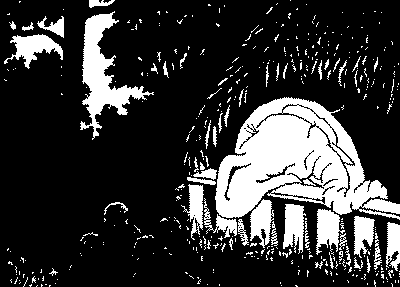
Once upon time, the King of Benares had a royal bull elephant who was kind, patient and harmless. Along with his sweet disposition, he had a lovely gentle face. So he was affectionately known as ‘Ladyface’.

One night, a gang of robbers met together just outside the elephant shed. In the darkness they talked about their plans for robbing people. They spoke of beating and killing, and bragged that they had given up ordinary goodness so they would have no pity on their victims. They used rough he-man type gutter language, intended to scare people and show how tough they were.

Since the nights were quiet, Ladyface had nothing else to do but listen to all these terrible plans and violent rough talk. He listened carefully and, as elephants do, remembered it all. Having been brought up to obey and respect human beings, he thought these men were also to be obeyed and respected, even as teachers.

After this went on for several nights, Ladyface decided that the correct thing to do was to become rough and cruel. This usually happens to one who associates with those of a low-minded cruel nature. It happens especially to a gentle one who wishes to please others.

A ‘mahout’ is what the Indians call the special trainer and caretaker of a particular elephant. They are usually very close. Early one morning, Ladyface’s mahout came to see him as usual. The elephant, his mind filled with the night’s robber-talk, suddenly attacked his mahout. He picked him up in his trunk, squeezed the breath out of him, and smashed him to the ground, killing him instantly. Then he picked up two other attendants, one after another, and killed them just as ferociously.

Word spread quickly through the city that the once adored Ladyface had suddenly gone mad and become a frightening man-killer. The people ran to the king for help.

It just so happened that the king had an intelligent minister who was known for his understanding of animals. So he called for him and asked him to go and determine what sickness or other condition had caused his favorite elephant to become so insanely violent.

This minister was the Bodhisatta, the Enlightenment Being. Arriving at the elephant shed, he spoke gentle soothing words to Ladyface, and calmed him down. He examined him and found him in perfect physical health. As he spoke kindly to Ladyface, he noticed that the elephant perked up his ears and paid very close attention. It was almost as if the poor animal were starved for the sound of gentle words. So the understanding minister figured out that the elephant must have been hearing the violent words or seeing the violent actions of those he mistook for teachers.

He asked the elephant guards, “Have you seen anyone hanging around this elephant shed, at night or any other time?” “Yes, minister,” they replied, “for the last couple of weeks a gang of robbers has been meeting here. We were afraid to do anything, since they were such mean rough characters. Ladyface could hear their every word.”

The minister returned immediately to the king. He said, “My lord king, your favourite elephant, Ladyface, is in perfect physical health. I have discovered that it was by hearing the rough and vulgar talk of thieves during many nights, that he has learned to be violent and cruel. Unwholesome associations often lead to unwholesome thoughts and actions.”

The king asked, “What is to be done?” The minister said, “Well my lord, now we must reverse the process. We must send wise men and monks, who have a high-minded kind nature, to spend just as many nights outside the elephant shed. There they should talk of the value of ordinary goodness and patience, leading to compassion, loving-kindness and harmlessness.”

So it was carried out. For several nights the kind wise ones spoke of those wonderful qualities. They used only gentle and refined language, intended to bring peacefulness and comfort to others.

Lo and behold, hearing this pleasant conversation for several nights, Ladyface the bull elephant became even more peaceful and pleasant than before!

Seeing this total change, the minister reported it to the king, saying, “My lord, Ladyface is now even more harmless and sweet than before. Now he is as gentle as a lamb!”

The king said, “It is wonderful indeed that such a madly violent elephant can be changed by associating with wise men and monks.” He was amazed that his minister seemed to be able to read the mind of an elephant. So he rewarded him appropriately.

The moral is: As rough talk infects with violence, so do gentle words heal with harmlessness.

26. Ladyface [Association]

Link: https://hhdorjechangbuddhaiiiinfo.com/2022/05/16/26-ladyface-association/

INTERPRETER’S INTRODUCTION – BUDDHIST TALES FOR YOUNG AND OLD, VOLUME 1, STORIES 1-50

#Buddhisttalesforyoungandold #Buddhiststories #storiesforkids #moralstories #Buddha #Jatakastories #PansiyaPanasJataka

Dirty Bath Water [Cleanliness]

25. Dirty Bath Water [Cleanliness]

Buddhist Tales for Young and Old, volume 1, Prince Goodspeaker, Stories 1-50

Once upon a time, in a kingdom in India, the finest of the royal horses was taken down to the river to be bathed. The grooms took him to the same shallow pool where they always washed him.

However, just before they arrived, a filthy dirty horse had been washed in the same spot. He had been caught in the countryside and had never had a good bath in all his life.

The fine royal horse sniffed the air. He knew right away that some filthy wild horse had bathed there and fouled the water. So he was disgusted and refused to be washed at that place.

The grooms tried their best to get him into the water, but could do nothing with him. So they went to the king and complained that the fine well-trained royal stallion had suddenly become stubborn and unmanageable.

It just so happened that the king had an intelligent minister who was known for his understanding of animals. So he called for him and said, “Please go and see what has happened to my number one horse. Find out if he is sick or what is the reason he refuses to be bathed. Of all my horses, I thought this one was of such high quality that he would never let himself sink into dirtiness. There must be something wrong.”

The minister went down to the riverside bathing pool immediately. He found that the stately horse was not sick, but in perfect health. He noticed also that he was deliberately breathing as little as possible. So he sniffed the air and smelled a slight foul odour. Investigating further, he found that it came from the unclean water in the bathing pool. So he figured out that another very dirty horse must have been washed there, and that the king’s horse was too fond of cleanliness to bathe in dirty water.

The minister asked the horse grooms, “Has any other horse been bathed at this spot today?” “Yes,” they replied, “before we arrived, a dirty wild horse was bathed here.” The minister told them, “My dear grooms, this is a fine royal horse who loves cleanliness. He does not wish to bathe in dirty water. So the thing to do is to take him up river, where the water is fresh and clean, and wash him there.”

They followed his instructions, and the royal horse was pleased to bathe in the new place.

The minister returned to the king and told what had happened. Then he said, “You were correct your majesty, this fine horse was indeed of such high quality that he would not let himself sink into dirtiness!”

The king was amazed that his minister seemed to be able to read the mind of a horse. So he rewarded him appropriately.

The moral is: Even animals value cleanliness.

25. Dirty Bath Water [Cleanliness]

Link: https://peacelilysite.com/2022/05/12/dirty-bath-water-cleanliness/

INTERPRETER’S INTRODUCTION – BUDDHIST TALES FOR YOUNG AND OLD, VOLUME 1, STORIES 1-50

#Buddhisttalesforyoungandold #Buddhiststories #storiesforkids #moralstories #Buddha #Jatakastories #PansiyaPanasJataka

The Great Horse Knowing-One [Courage]

The Great Horse Knowing-One [Courage]

Buddhist Tales for Young and Old, volume 1, Prince Goodspeaker, Stories 1-50

Once upon a time, King Brahmadatta ruled in Benares, in northern India. He had a mighty horse, who had been born in the land of Sindh, in the Indus River valley of western India. Indeed, this horse was the Enlightenment Being.

As well as being big and strong, he was very intelligent and wise. When he was still young, people noticed that he always seemed to know what his rider wanted before being told. So he was called Knowing-one.

He was considered the greatest of the royal horses and was given the very best of everything. His stall was decorated and was always kept clean and beautiful. Horses are usually faithful to their masters. Knowing-one was especially loyal and was grateful for how well the king cared for him. Of all the royal horses, Knowing-one was also the bravest. So the king respected and trusted him.

It came to pass that seven neighbouring kings joined together to make war on King Brahmadatta. Each king brought four great armies — an elephant cavalry, a horse cavalry, a chariot brigade and ranks of foot soldiers. Together the seven kings, with all their armies, surrounded the city of Benares.

King Brahmadatta assembled his ministers and advisers to make plans for defending the kingdom. They advised him, “Do not surrender. We must fight to protect our high positions. But you should not risk your royal person in the beginning. Instead, send out the champion of all the knights to represent you on the battlefield. If he fails, only then must you yourself go.”

So the king called the champion to him and asked, “Can you be victorious over these seven kings?” The knight replied, “If you permit me to ride out on the bravest and wisest, the great horse Knowing-one, only then can I win the battle.” The king agreed and said, “My champion, it is up to you and Knowing-one to save the country in its time of danger. Take with you whatever you need.”

The champion knight went to the royal stables. He ordered that Knowing-one be well fed and dressed in protective armor, with all the finest trimmings. Then he bowed respectfully and climbed into the beautiful saddle.

Knowing-one knew the situation. He thought, “These seven kings have come to attack my country and my king, who feeds and cares for and trusts me. Not only the seven kings, but also their large and powerful armies threaten my king and all in Benares. I cannot let them win. But I also cannot permit the champion knight to kill those kings. Then I too would share in the unwholesome action of taking the lives of others, in order to win an ordinary victory. Instead, I will teach a new way. I will capture all seven kings without killing anyone. That would be a truly great victory!”

Then the Knowing-one spoke to his rider. “Sir knight, let us win this battle in a new way, without destroying life. You must only capture each king, one at a time, and remain firmly on my back. Let me find the true course through the many armies. Watch me as you ride, and I will show you the courage that goes beyond the old way, the killing way!”

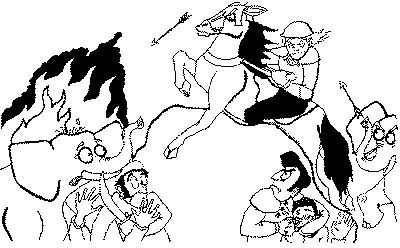
As he spoke of ‘a new way’, and ‘the true course’, and ‘the courage that goes beyond’, it seemed the noble steed became larger than life. He reared up majestically on his powerful hind legs, and looked down on all the armies surrounding the city. The eyes of all were drawn to this magnificent one. The earth trembled as his front hoofs returned to the ground and he charged into the midst of the four armies of the first king. He seemed to have the speed of lightning, the might of a hundred elephants, and the glorious confidence of one from some other world.

The elephants could remember no such horse as this, and so the elephant cavalry retreated in fear. The horses knew that this their relative was the worthy master of them all, and so the horse cavalry and the chariot brigade stood still and bowed as the Great Being passed. And the ranks of foot-soldiers scattered like flies before a strong wind.

The first king hardly knew what had happened, before he was easily captured and brought back into the city of Benares. And so too with the second, third, fourth and fifth kings.

In the same way the sixth king was captured. But one of his loyal bodyguards leaped out from hiding and thrust his sword deep into the side of the brave Knowing-one. With blood streaming from the wound, he carried the champion knight and the captured sixth king back to the city.

When the knight saw the terrible wound, he suddenly became afraid to ride the weakened Knowing-one against the seventh king. So he began to dress in armour another powerful war horse, who was really just as big as Knowing-one.

Seeing this, though suffering in great pain from his deadly wound, Knowing-one thought, “This champion knight has lost his courage so quickly. He has not understood the true nature of my power — the knowledge that true peace is only won by peaceful means. He tries to defeat the seventh king and his armies in the ordinary way, riding an ordinary horse.

“After taking the first step of giving up the killing of living beings, I cannot stop part way. My great effort to teach a new way would disappear like a line drawn in water!”

The great horse Knowing-one spoke to the champion knight. “Sir knight, the seventh king and his armies are the mightiest of all. Riding an ordinary horse, even if you slaughter a thousand men and animals, you will be defeated. I, of the mighty tribe of Sindh horses, the one called Knowing-one, only I can pass through them harming none, and bring back the seventh king alive!”

The champion knight regained his courage. The brave horse struggled to his feet, in great pain. While the blood continued to flow, he reared and charged through the four armies, and the knight brought back the last of the seven warlike kings. Again all those in his path were spared from harm. Seeing their seven kings in captivity, all the armies laid down their weapons and asked for peace.

Realizing that the great horse Knowing-one would not live through the night, King Brahmadatta went to see him. He had raised him from a colt, so he loved him. When he saw that he was dying, his eyes filled with tears.

Knowing-one said, “My lord king, I have served you well. And I have gone beyond and shown a new way. Now you must grant my last request. You must not kill these seven kings, even though they have wronged you. For a bloody victory sows the seeds of the next war. Forgive their attack on you, let them return to their kingdoms, and may you all live in peace from now on.

“Whatever reward you would give to me, give instead to the champion knight. Do only wholesome deeds, be generous, honour the Truth, and kill no living being. Rule with justice and compassion.”

Then he closed his eyes and breathed his last. The king burst into tears, and all mourned his passing. With the highest honours, they burned the body of the great horse Knowing-one — the Enlightenment Being.

King Brahmadatta had the seven kings brought before him. They too honored the great one, who had defeated their vast armies without spilling a drop of blood, except his own. In his memory they made peace, and never again did these seven kings and Brahmadatta make war on each other.

The moral is: True peace is only won by peaceful means.

The Great Horse Knowing-One [Courage]

Link: https://peacelilysite.com/2022/05/03/the-great-horse-knowing-one-courage/

INTERPRETER’S INTRODUCTION – BUDDHIST TALES FOR YOUNG AND OLD, VOLUME 1, STORIES 1-50

#Buddhisttalesforyoungandold #Buddhiststories #storiesforkids #moralstories #Buddha #Jatakastories #PansiyaPanasJataka

22. THE DOG KING SILVER [JUSTICE]

22. THE DOG KING SILVER [JUSTICE]

Buddhist Tales for Young and Old, volume 1, Prince Goodspeaker, Stories 1-50

Once upon time, the King of Benares went to his pleasure garden in his fancy decorated chariot. He loved this chariot, mostly because of the rich hand-worked leather belts and straps.

On this occasion, he stayed in his pleasure garden all day long and into the evening. It was late when he finally got back to the palace. So the chariot was left outside in the compound all night, instead of being locked up properly.

During the night it rained heavily, and the leather got wet, swelled up, became soft, and gave off an odour. The pampered palace dogs smelled the delicious leather scent and came down into the compound. They chewed off and devoured the soft wet chariot straps. Before daybreak, they returned unseen to their places in the palace.

When the king woke up and came down, he saw that the leather had been chewed off and eaten by dogs. He called the servants and demanded to know how this happened.

Since they were supposed to watch the palace dogs, the servants were afraid to blame them. Instead, they made up a story that stray dogs, the mutts and mongrels of the city, had come into the grounds through sewers and storm drains. They were the ones who had eaten the fancy leather.

The king flew into a terrible rage. He was so overcome by anger that he decided to take vengeance against all dogs. So he decreed that whenever anyone in the city saw a dog, he was to kill him or her at once!

The people began killing dogs. The dogs could not understand why suddenly they were being killed. Later that day, they learned of the king’s decree. They became very frightened and retreated to the cemetery just outside the city. This was where their leader lived, the Dog King Silver.

Silver was king not because he was the biggest or strongest or toughest. He was average in size, with sleek silver fur, sparkling black eyes and alert pointed ears. He walked with great dignity, that brought admiration and respect from men as well as dogs. In his long life he had learned much, and was able to concentrate his mind on what is most important. So he became the wisest of all the dogs, as well as the one who cared most for the others. Those were the reasons he was king of the dogs.

In the cemetery, the dogs were in a panic. They were frightened to death. The Dog King Silver asked them why this was. They told him all about the chariot straps and the king’s decree, and the people killing them whenever they saw them.

King Silver knew there was no way to get into the well-guarded palace grounds. So he understood that the leather must have been eaten by the dogs living inside the palace.

He thought, “We dogs know that, no matter how different we may appear, somehow we are all related. So now I must make my greatest effort to save the lives of all these poor dogs, my relatives. There is no one to save them but me.”

He comforted them by saying, “Do not be afraid. I will save you all. Stay here in the cemetery and don’t go into the city. I will tell the King of Benares who are the thieves and who are the innocent. The truth will save us all.”

Before setting out, he went to a different part of the cemetery to be alone. Having practiced goodness all his life, and trained his mind, he now concentrated very hard and filled his mind with feelings of loving-kindness. He thought, “May all dogs be well and happy, and may all dogs be safe. I go to the palace for the sake of dogs and men alike. No one shall attack or harm me.”

Then the Dog King Silver began walking slowly through the streets of Benares. Because his mind was focused, he had no fear. Because of his long life of goodness, he walked with a calm dignity that demanded respect. And because of the warm glow of loving-kindness that all the people sensed, no one felt the rising of anger or any intention to harm him. Instead, they marvelled as the Great Being passed, and wondered how it could be so!

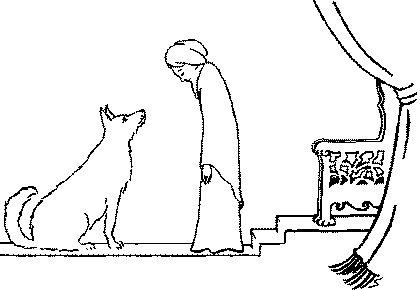
It was as if the whole city were entranced. With no obstruction, the Dog King Silver walked right past the palace guards, into the royal hall of justice, and sat down calmly underneath the king’s throne itself! The King of Benares was impressed by such courage and dignity. So when servants came to remove the dog, he ordered them to let him remain.

Then the Dog King Silver came out from under the throne and faced the mighty King of Benares. He bowed respectfully and asked, “Your majesty, was it you who ordered that all the dogs of the city should be killed?” “It was I,” replied the king. “What crime did the dogs commit?” asked the dog king. “Dogs ate my rich beautiful chariot leather and straps.” “Do you know which dogs did this?” asked King Silver. “No one knows,” said the King of Benares.

“My lord,” said the dog, “for a king such as you, who wishes to be righteous, is it right to have all dogs killed in the place of the few guilty ones? Does this do justice to the innocent ones?” The king replied, as if it made perfect sense to him, “Since I do not know which dogs destroyed my leather, only by ordering the killing of all dogs can I be sure of punishing the guilty. The king must have justice!”

The Dog King Silver paused for a moment, before challenging the king with the crucial question – “My lord king, is it a fact that you have ordered all dogs to be killed, or are there some who are not to be killed?” The king suddenly became a little uneasy as he was forced to admit, before his whole court, “It is true that most dogs are to be killed, but not all. The fine pure-breeds of my palace are to be spared.”

Then the dog king said, “My lord, before you said that all dogs were to be killed, in order to insure that the guilty would be punished. Now you say that your own palace dogs are to be spared. This shows that you have gone wrong in the way of prejudice. For a king who wishes to be righteous, it is wrong to favor some over others. The king’s justice must be unbiased, like an honest scale. Although you have decreed an impartial death to all dogs, in fact this is only the slaughter of poor dogs. Your rich palace dogs are unjustly saved, while the poor are wrongly killed!”

Recognizing the truth of the dog king’s words, the King of Benares asked, “Are you wise enough to know which dogs ate my leather straps and belts?” “Yes my lord, I do know,” said he, “it could only be your own favorite palace dogs, and I can prove it.” “Do so,” said the king.

The dog king asked to have the palace pets brought into the hall of justice. He asked for a mixture of buttermilk and grass, and for the dogs to be made to eat it. Lo and behold, when this was done they vomited up partly digested pieces of the king’s leather straps!

Then the Dog King Silver said, “My lord, no poor dogs from the city can enter the well-guarded palace compound. You were blinded by prejudice. It is your dogs who are the guilty ones. Nevertheless, to kill any living being is an unwholesome thing to do. This is because of what we dogs know, but men do not seem to know – that somehow all life is related, so all living beings deserve the same respect as relatives.”

The whole court was amazed by what had just taken place. The King of Benares was suddenly overcome by a rare feeling of humility. He bowed before the dog king and said, “Oh great king of dogs, I have never seen anyone such as you, one who combines perfect wisdom with great compassion. Truly, your justice is supreme. I offer my throne and the kingdom of Benares to you!”

The Enlightenment Being replied, “Arise my lord, I have no desire for a human crown. If you wish to show your respect for me, you should be a just and merciful ruler. It would help if you begin to purify your mind by practising the ‘Five Training Steps’. These are to give up entirely the five unwholesome actions: destroying life, taking what is not given, sexual wrong-doing, speaking falsely, and drunkenness.”

The king followed the teachings of the wise dog king. He ruled with great respect for all living beings. He ordered that whenever he ate, all dogs, those of the palace and those of the city, were to be fed as well. This was the beginning of the faithfulness between dogs and men that has lasted to this day.

The moral is: Prejudice leads to injustice, wisdom leads to justice.

22. The Dog King Silver [Justice]

Link: https://hhdorjechangbuddhaiiiinfo.com/2022/04/26/22-the-dog-king-silver-justice/

INTERPRETER’S INTRODUCTION – BUDDHIST TALES FOR YOUNG AND OLD, VOLUME 1, STORIES 1-50

#Buddhisttalesforyoungandold #Buddhiststories #storiesforkids #moralstories #Buddha #Jatakastories #PansiyaPanasJataka

21. THE TREE THAT ACTED LIKE A HUNTER [IMPATIENCE]

21. THE TREE THAT ACTED LIKE A HUNTER [IMPATIENCE]

Buddhist Tales for Young and Old, volume 1, Prince Goodspeaker, Stories 1-50

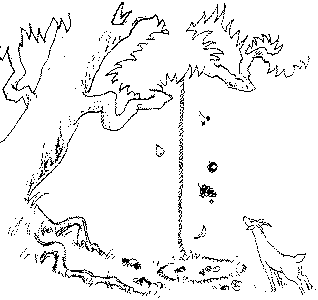
Once upon a time, there was an antelope who lived in the deep forest. He ate the fruits that fell from the trees. There was one tree that had become his favorite.

In the same area there was a hunter who captured and killed antelopes and deer. He put down fruit as bait under a tree. Then he waited, hiding in the branches above. He held a rope noose hanging down to the ground around the fruits. When an animal ate the fruit, the hunter tightened the noose and caught him.

Early one morning the antelope came to his favorite tree in search of fruits to eat. He did not see that the hunter was hiding in it, with his noose-trap ready. Even though he was hungry, the antelope was very careful. He was on the lookout for any possible danger. He saw the delicious looking ripe fruits at the foot of his favorite tree. He wondered why no animal had yet eaten any, and so he was afraid something was wrong.

The hiding hunter saw the antelope approaching from a distance. Seeing him stop and take great care, he was afraid he would not be able to trap him. He was so anxious that he began throwing fruits in the direction of the antelope, trying to lure him into coming closer.

But this was a pretty smart antelope. He knew that fruits only fall straight down when they fall from trees. Since these fruits were flying towards him, he knew there was danger. So he examined the tree itself very carefully, and saw the hunter in the branches. However, he pretended not to see him.

He spoke in the direction of the tree. “Oh my dear fruit tree, you used to give me your fruits by letting them fall straight down to the ground. Now, throwing them towards me, you do not act at all like a tree! Since you have changed your habits, I too will change mine. I will get my fruits from a different tree from now on, one that still acts like a tree!”

The hunter realized his mistake and saw that the antelope had outsmarted him. This angered him and he yelled out, “You may escape me this time, you clever antelope, but I’ll get you next time for sure!”

The antelope realized that, by getting so angry, the hunter had given himself away a second time. So he spoke in the direction of the tree again. “Not only don’t you act like a tree, but you act like a hunter! You foolish humans, who live by killing animals. You do not understand that killing the innocent brings harm also to you, both in this life and by rebirth in a hell world. It is clear that we antelopes are far wiser than you. We eat fruits, we remain innocent of killing others, and we avoid the harmful results.”

So saying, the careful antelope leaped into the thick forest and was gone.

The moral is: The wise remain innocent.

21. The Tree that Acted Like a Hunter [Impatience]

Link: https://hhdorjechangbuddhaiiiinfo.com/2022/04/19/21-the-tree-that-acted-like-a-hunter-impatience/

INTERPRETER’S INTRODUCTION – BUDDHIST TALES FOR YOUNG AND OLD, VOLUME 1, STORIES 1-50

#Buddhisttalesforyoungandold #Buddhiststories #storiesforkids #moralstories #Buddha #Jatakastories #PansiyaPanasJataka

How To Practice Humility

How To Practice Humility

Most of the Buddhist disciples know that: “Among the highest unconditioned Dharmas imparted by the Buddha, patience under humiliation and adversity is the foremost Dharma “. In the Six Paramitas1, Buddha request all disciples to endure insults, to overcome hate and anger.

So many ancient virtuous ones made use of slander, verbal abuse, and harm directed at
them from other people, transforming such experiences into enlightenment and great
compassion. In the end, they became holy ones. Zen Master Yongjia said, “If there were
no slander and praise that create enemies and friends, how would you show the power of lovingkindness and patience that stems from no-birth?” Here are some stories, that could inspire us to practice humility.

(一)

Hanshan and Shide — Song of Endurance

Master Hanshan and Shide were legendary monks lived in China about one thousand years ago. People said that Hanshan and Shide were the incarnation of Manjushri and Puxian Bodhisattva.

Once Master Hanshan asked Master Shide:” What shall I do if someone mistreats me, slanders me, bullies me, insults me, ridicules me, disparages me, belittles me, offends me, or deceives me?”

Shide answered: You just tolerate him, let him be, avoid him, respect him, ignore him, be kind to him, and wait for a few years to see what becomes of him.

(二)

Is That So!?

Photo by Pixabay on Pexels.com

Japnese Zen Master Hakuin was greatly respected and had many disciples. At one time in his life, he lived in a village hermitage, close to a food shop run by a couple and their beautiful, young daughter. One day the parents discovered that their daughter was pregnant. Angry and distraught, they demanded to know the name of the father. At first, the girl would not confess but after much harassment, she named Hakuin. The furious parents confronted Hakuin, berating him in front of all of his students. He simply replied, “Is that so?”

When the baby was born, the family gave it to Hakuin.  By this time, he had lost his reputation and his disciples. But Hakuin was not disturbed. He took delight in caring for the infant child; he was able to obtain milk and other essentials from the villagers. A year later, the young mother of the child was troubled by great remorse. She confessed the truth to her parents – the real father was not Hakuin but rather a young man who worked at the local fish market. The mortified parents went to Hakuin, apologizing, asking his forgiveness for the wrong they did him. They asked Hakuin to return the baby. Although he loved the child as his own, Hakuin was willing to give him up without complaint. All he said was: “Is that so?”

(三)

Only a Buddha is the King of Compassion, Free of Any Anger or Hatred, Who Benefits Living Beings Without Any Consideration of Personal Honor or Disgrace

H. H.  Dorje Chang Buddha III set the greatest example of Patiently endure humiliation and adversity for all the Buddhist disciples in the world. He never minds and never appeals or complains about any framing, persecution, or slandering against Him.

In the past decade, H.H.  Dorje Chang Buddha III has suffered greatly for withstanding long-term persecution for his religious activities. A member country of the Interpol has once requested the Interpol to issue a warrant for His arrest. The request was subsequently withdrawn voluntarily by this member country after some years. Upon thorough investigation, in October of 2008, the 72nd session of the Commission for the Control of Interpol’s Files withdrew the arrest warrant and the entire case against H.H.  Dorje Chang Buddha III. Interpol also issued a document stating in definite terms that the arrest warrant against H.H.  Dorje Chang Buddha III has been cancelled and all of its member countries have been notified of the cancellation.

Although H.H.  Dorje Chang Buddha III long ago received official notification of the withdrawal of the arrest warrant and the removal of the entire case, He has never shown such documents to prove His innocence.

H.H.  Dorje Chang Buddha III, recieved 2010 World Peace Prize as Top Honor Prize recipient. When people of the “World Peace Prize Awarding Council” asked Him, after learning the facts, why He had not published INTERPOL’s conclusion from investigation to refute the rumors, H. H. Dorje Chang Buddha III said, “I will bear all negative karmas and sins of living beings, and I will give all my good karmas and merit to you. These are the things I will do. If I show stuff to exonerate me, then the people who slandered me would be tarnished. Who will bear their sins and negative karmas in that case?”

The video below is of buddhist disciple Hongxi Fazang’s sincere repent. He did so many defamations to H.H.  Dorje Chang Buddha III, yet the greatly loving and greatly compassionate Buddha still accepted him as a disciple and teaches him as same as before.

Note1: Six Paramitas — 1 Be generous, overcome greed, 2 Keep precepts, overcome violations, 3 Endure insults, overcome hate and anger, 4 Be energetic, overcome laziness, 5 Be Concentrated, overcome disorder, 6 Develop prajna, overcome ignorance.

How To Practice Humility

Link: https://peacelilysite.com/2022/04/07/how-to-practice-humility/

Source: https://kannondo.org/is-that-so/,

Statement From the World Peace Prize Awarding Council,

Truth Revealed: Zhou Yongkang and Chen Shaoji Jointly Framed H.H. Dorje Chang Buddha III

#DorjeChangBuddhaIII #HHDorjeChangBuddhaIII#DorjeChangBuddha#HanshanandShide#Zen MasterHakuin#Endureinsults#Humiliation#WorldPeacePrize#TopHonorPrize#Humility

20. THE MONKEY KING AND THE WATER DEMON [ATTENTIVENESS]

20. The Monkey King and the Water Demon [Attentiveness]

Buddhist Tales for Young and Old, volume 1, Prince Goodspeaker, Stories 1-50

Once upon a time, far away in a deep forest, there was a nation of 80,000 monkeys. They had a king who was unusually large, as big as a fawn. He was not only big in body, he was also ‘large in mind’. After all, he was the Bodhisatta — the Enlightenment Being.

One day, he advised his monkey nation by saying, “My subjects, there are poisonous fruits in this deep forest, and ponds possessed by demons. So if you see any unusual fruit or unknown pond, do not eat or drink until you ask me first.” Paying close attention to their wise king, all the monkeys agreed to follow his advice.

Later on, they came to an unknown pond. Even though they were all tired out and thirsty from searching for food, no one would drink without first asking the monkey king. So they sat in the trees and on the ground around the pond.

When he arrived, the monkey king asked them, “Did anyone drink the water?” They replied, “No, your majesty, we followed your instructions.” He said, “Well done.”

Then he walked along the bank, around the pond. He examined the footprints of the animals that had gone into the water, and saw that none came out again! So he realized this pond must be possessed by a water demon. He said to the 80,000 monkeys, “This pond is possessed by a water demon. Do not anybody go into it.”

After a little while, the water demon saw that none of the monkeys went into the water to drink. So he rose out of the middle of the pond, taking the shape of a frightening monster. He had a big blue belly, a white face with bulging green eyes, and red claws and feet. He said, “Why are you just sitting around? Come into the pond and drink at once!”

The monkey king said to the horrible monster, “Are you the water demon who owns this pond?” “Yes, I am,” said he. “Do you eat whoever goes into the water?” asked the king. “Yes, I do,” he answered, “including even birds. I eat them all. And when you are forced by your thirst to come into the pond and drink, I will enjoy eating you, the biggest monkey, most of all!” He grinned, and saliva dripped down his hairy chin.

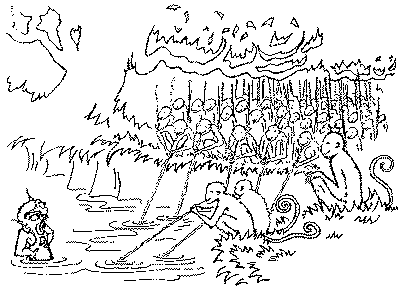
But the monkey king with the well-trained mind remained calm. He said, “I will not let you eat me or a single one of my followers. And yet, we will drink all the water we want!” The water demon grunted, “Impossible! How will you do that?” The monkey king replied, “Each one of the 80,000 of us will drink using bamboo shoots as straws. And you will not be able to touch us!”

Of course, anyone who has seen bamboo knows there is a difficulty. Bamboo grows in sections, one after another, with a knot between each one. Any one section is too small, so the demon could grab the monkey, pull him under and gobble him up. But the knots make it impossible to sip through more than one section.

The monkey king was very special, and that is why so many followed him. In the past, he had practiced goodness and trained his mind with such effort and attention, that he had developed very fine qualities of mind. This is why he was said to be ‘large in mind’, not because he simply had a ‘big brain’.

The Enlightenment Being was able to keep these fine qualities in his mind, and produce a very unlikely event – a miracle. First, he took a young bamboo shoot, blew through it to make the knots disappear, and used it to sip water from the pond. Then, amazing as it may sound, he waved his hand and all the bamboo growing around that one pond lost their knots. They became a new kind of bamboo.

Then, all his 80,000 followers picked bamboo shoots and easily drank their fill from the pond. The water demon could not believe his green eyes. Grumbling to himself, he slid back under the surface, leaving only gurgling bubbles behind.

The moral is: “Test the water before jumping in.”

20. The Monkey King and the Water Demon [Attentiveness]

Link: https://hhdorjechangbuddhaiiiinfo.com/2022/03/28/20-the-monkey-king-and-the-water-demon-attentiveness/

INTERPRETER’S INTRODUCTION – BUDDHIST TALES FOR YOUNG AND OLD, VOLUME 1, STORIES 1-50

#Buddhisttalesforyoungandold #Buddhiststories #storiesforkids #moralstories #Buddha #Jatakastories #PansiyaPanasJataka

Short Stories With Deep Meanings

Short Stories With Deep Meanings

Photo by Shane Kell on Pexels.com

Birdsnest

In the Tang Dynasty, there was a peculiar Zen master. He didn’t even have a Dharma name, and his practice was very special. He did not live in a temple. He settled himself in an awning like a bird nest on the top of a pine tree.  People called him “the Zen Master of the Birdsnest”. Many visitors hiked to the remote forest to seek the monk’s wise advices. 

Bai Juyi, was a very famous Chinese poet, also a high level officer at that time. One time, Bai Juyi traveled long distance to visit the Zen Master. He asked Zen Master Birdsnest, “Can you tell me what is the most important thing the Buddha ever said?”

      The Zen master replied, “Don’t do any bad things, and do all the good things.”

      Bai Juyi thought this answer is far too simple, he sneered, “Even a three-year-old can say this.”

      Zen Master Birdsnest said: “Although a three-year-old child can say it, but an eighty-year-old man still finds it very difficult to do it.”

Photo by PhotoMIX Company on Pexels.com

Determination

Master Qinluan was a famous Japanese Zen master. At the age of nine, he made up his mind to become a monk and asked Zen Master Cizhen to shave his ordination for him. Zen Master Cizhen asked him, “Why do you want to become a monk when you are so young?” Qinluan said: “Although I am only nine years old, my parents have both died. I don’t understand why people must die. Why must I be separated from my parents? Therefore, I must become a monk and explore these truths.”

Zen Master Cizhen said: “Very well. I’m willing to accept you as a disciple. However, it’s too late today, so I’ll shave you tomorrow morning.” Qin Luan said, “Master! Although you said that you will shave me early tomorrow morning, I am still young and ignorant. I can’t guarantee whether my determination to become a monk will last until tomorrow. Besides, Master, you are so old, you can’t guarantee that you will even wake up tomorrow morning!” After listening this words, Zen Master Cizhen was surprisingly happy, and said joyfully, “Yes! What you said is absolutely right. Now I will shave for you!”

Three Moves by Mencius’s Mother

Mencius, was a famous scholar well-known for his erudition. He was one of the greatest representatives of Confucianism in ancient China.

He had a great mother, who really focused on education. Once his family lived near a graveyard when he was a child. Therefore, he often played near the grave and imitated people’s crying or digging the tombs. When his mother saw this, she said: “It’s not a good place for a child to live in.”

His mother moved the family to a house near a market. Soon Mencius began  to amused himself by imitating peddler’s hawking and bargaining. His mother found this place still not good for a child to live in. She decided to move away again.

At last they settled down near a school. Mencius quickly began copying the students’ reading and writing. He also took pleasure by imitating the sacrificial rites on ceremony and formalities of  courtesy. He became more polite and hardworking. Then his mother said: this is a good place for a child !.

Short Stories With Deep Meanings

Link: https://peacelilysite.com/2022/03/25/short-stories-with-deep-meanings/

#MonkBirdnest#Buddhism#BaiJuyi#Mencius#Confucianism