Ode to The Plum Blossom

Ode to The Plum Blossom

Recently, I stumbled upon breathtaking plum blossoms while taking a walk. These delicate flowers evoked feelings of warmth and joy, reminding me of the arrival of spring. In Chinese culture, plum blossoms, beyond just being a physical flower, have become a symbol of perseverance and resilience in the face of harsh winter conditions. This significance was achieved through the extensive descriptions, sublimations, and chanting by literati and scholars over the ages. In ancient China, plum blossoms were considered a lucky symbol and were welcomed as a sign of the arrival of spring during the New Year.

When I was a child, my father taught me to recite the poem “Ode to the Plum Blossom” by Zedong Mao, reminding me to be fearless and strong like the plum blossom that blooms amidst harsh winter conditions. I really like the poem, and can still remember it.

Ode to the Plum Blossom

—to the tune of Bu Suan Zi

By Zedong Mao, December 1961

Wind and rain escorted Spring’s departure, 

Flying snow welcomes Spring’s return. 

On the ice-clad rock rising high and sheer 

A flower blooms sweet and fair. 

Sweet and fair, she craves not Spring for herself alone, 

To be the harbinger of Spring she is content. 

When the mountain flowers are in full bloom 

She will smile mingling in their midst.

But after many years of struggles, I realized that bravery and strength aren’t always enough, especially in managing relationships and family. As a wife and mother, I learned the importance of being magnanimous, compassionate, forbearing, and not rigid. I have since embraced the peaceful and compassionate philosophy of Buddhism.

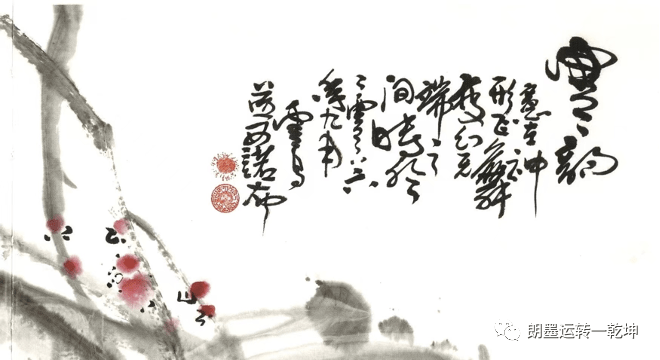
H.H. Dorje Chang Buddha III, the contemporary Buddha, wrote a poem “Plum Fragrance in the Holy Land.” He broke from traditional poetry styles, instead opting for surreal techniques to directly convey spiritual essence.

To the Tune of “Jiang Jun Song”

Plum Fragrance in the Holy Realm

Reveal her icy bearing and proud bones,

See how plum blossom commands the scene,

The crowd of beauties suddenly lacks color,

Seductive peach has lost its looks.

A few casual strokes,

So many eons of wind and dust.

The smoke and fire of the human world all disappears,

Leaving only a pure fragrance from the paper,

It wafts over me, awakening my mind.

The smile of the enchanted dream still remains,

Buddha Vajradhara has come

Three times to this world.

To this Buddha Land of merciful compassion

That great one has brought purity,

Feelings of the brush,

Traces of the brush,

One smile in the wind and dust,

Now the wind and dust,

So many eons of wind and dust.

The Buddha also created an ink painting to accompany the poem. The poem delves deeper into the artist’s thoughts, while the painting provides a visual representation.
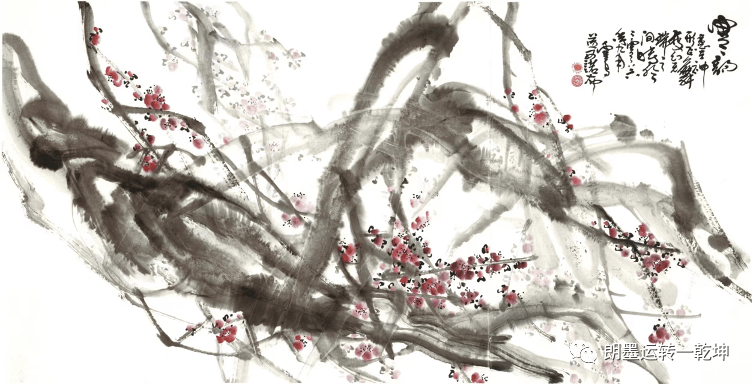
The plum blossoms depicted in the paintings symbolize the artist’s state of mind, embodying inner beauty refined from impurities. The brushwork, casually applied, was accomplished with an unfettered hand and detached mind, free of the slightest artificiality. It is a seemingly ever-changing work. Its charm, tone, transitions, and depictions represent the highest level of Eastern ink-and-wash paintings. A transparent layer of lighter ink on top of darker ink is clearly visible, imbuing the painting with a pure and fragrant air and providing the viewer with a feeling of comfort and ease.

The plum blossoms created by these skilled pens are eternal. While natural blooms may come and go, Buddha’s compassion remains steadfast.

Ode to The Plum Blossom

Link: https://peacelilysite.com/2023/02/02/ode-to-the-plum-blossom/

#DorjeChangBuddhaIII #HHDorjeChangBuddhaIII#DorjeChangBuddha#IAMA#InternationalArtMuseumofAmerica#ChinesePaintings#PlumBlossom#Paintings#

Source: https://www.oktranslation.com/LiteraryTranslation/lt_info32200.html
Chinese Plum Blossom Paintings

Chinese Plum Blossom Paintings

One of the most beloved flowers in China, the plum blossoms (méi-huā, 梅花) have been frequently depicted in Chinese painting and poetry for centuries. The Chinese see its blossoms as both a symbol of winter as well as a harbinger of spring. It is precisely for this reason that the blossoms are so beloved, as they bloom most vibrantly amidst the winter snow, after most other plants have shed their leaves, and before other flowers appear. They are seen as an example of resilience and perseverance in the face of adversity. Though neither the plum tree nor its blossoms are very striking, they manage to exude an otherworldly exquisiteness and beautiful elegance. The demeanor and character of the plum tree thereby serves as a metaphor for inner beauty and humble display under adverse conditions. Because they blossom in winter, the plum blossom is a member of the “Three Friends of Winter (歲寒三友)”, along with the pine and the bamboo. The plum blossom is also a member of the “Four Gentlemen (四君子)” in Chinese art (the others being orchid, bamboo, and chrysanthemum), symbolizing nobility. In China, there are over 300 recorded cultivars of mei, which can be broadly divided by color into white, pink, red, purple, and light green types.

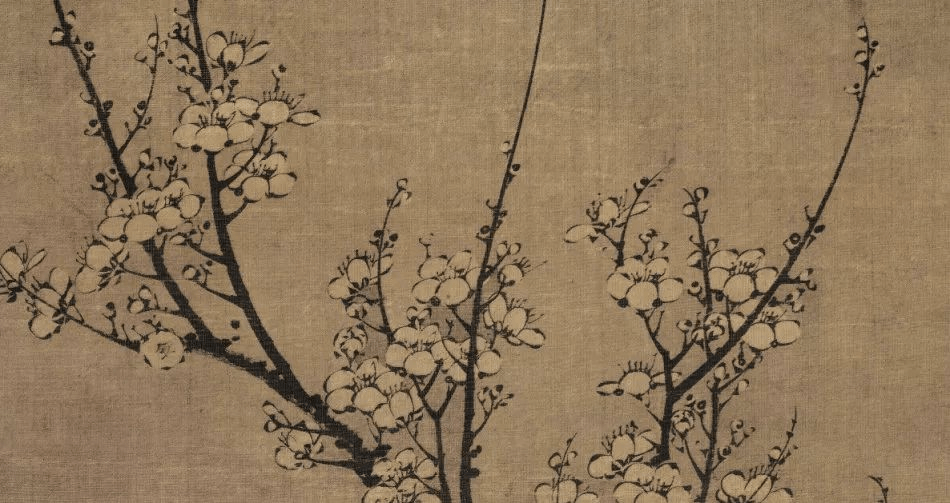
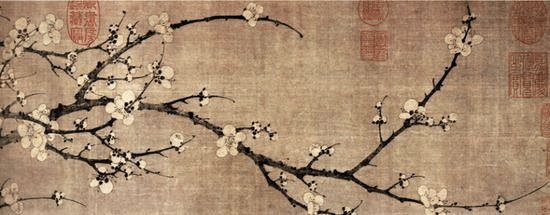
When we look through all of the ancient and modern books on plum blossom paintings, it is not difficult to discover that all of the famous master plum blossom painters had extensive knowledge, deep understanding of ancient and their own contemporary times, and immense talents. No artist in history can be found who lacked virtue and learning and still was capable of painting highly exquisite plum blossom paintings. The plum blossom paintings of ancient artists such as Mian Wang and Dongxin Jin and the modern artist Changshuo Wu are splendid works based upon the profound knowledge and virtue of their creators.

Mian Wang ( 1287-1359 ) : Early Spring at South Corner of Garden
Artist: Dongxin Jin (1687 – 1764)
Artist: Changshuo Wu (1844 – 1927)

As a contemporary artist, the Pop of Buddhist, H.H. Dorje Chang Buddha III has also painted dozens of masterpieces of plum blossom compositions. All in the book entitled Collected Plum Blossom Paintings, Calligraphy, Poems, and Songs. Wielding the brush with great facility, His Holiness creates paintings that are completely devoid of mundane garishness, have the exquisite look of ancient bronze and stone inscriptions, and are imbued with a scholarly air. His Holiness’s painting skills have surpassed the ordinary and reached the consummate mastery of a holy being. Below are several art works from the book. Some of the paintings are in the exhibition of The International Art Museum of America.

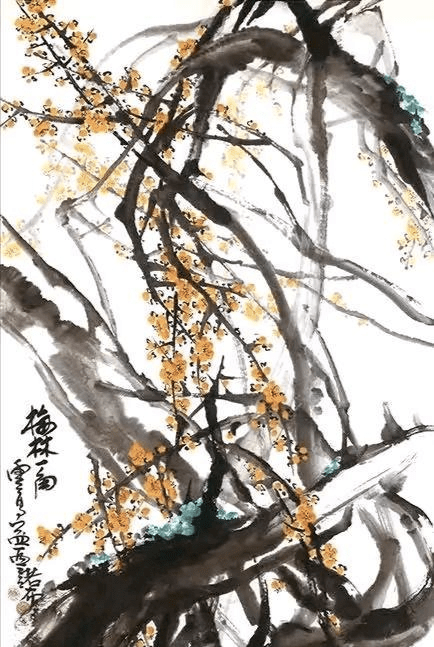
Small Portion of a Plum Grove

Yellow plum blossoms bloom in winter and are generally used during Chinese New Year celebrations as a symbol of great auspiciousness. The painting expresses beauty of a real plum blossom grove.

Drunk in a Green Garden

The turquoise plum blossom is a rare species of plum blossom. These elegant, sublime flowers have a strong resistance to coldness and a scent that is quite fresh and fragrant. This painting has a vigorous and firm style yet maintains great simplicity. The brushwork is bold, vigorous, and completely unconstrained. Large, dancing strokes of a casual hand and free mind bring to form branches and twigs.

Plum Fragrance in the Holy Realm

The brushwork, casually applied, was accomplished with an unfettered hand and detached mind, free of the slightest artificiality. It is a seemingly ever-changing work. Its charm, tone, transitions, and depictions represent the highest level of Eastern ink-and-wash paintings. A transparent layer of lighter ink on top of darker ink is clearly visible, imbuing the painting with a pure and fragrant air and providing the viewer with a feeling of comfort and ease.

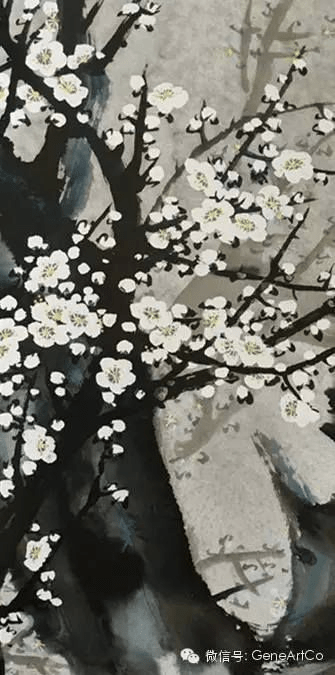
Winter Powder

A most elegant and valued plum flower called ‘Dong Fen” (winter powder). It is widely known to be the king of whiter plum blossoms. A strong contrast is presented by the graceful dense ink that was used to paint the tree trunk and the whiting used to form the flowers. The spatial effect of fairness adds to the charm of the picture, showing an awareness of both emptiness and form. A very special aspect of this painting is that the artist did not apply powerful, bold strokes of uneven contour and content. Rather, ink was applied through a gradual moistening process, manifesting the strong talent of the artist.

Chinese Plum Blossom Paintings

Link: https://peacelilysite.com/2022/11/03/chinese-plum-blossom-paintings/

#DorjeChangBuddhaIII #HHDorjeChangBuddhaIII#DorjeChangBuddha#IAMA#InternationalArtMuseumofAmerica#ChinesePaintings#PlumBlossom#Paintings#WangMian#WuChangShuo

Source: https://www.comuseum.com/painting/flower-painting/plum-blossom/

Mist, Clouds, and Autumnal Color

Artist: H.H. Dorje Chang Buddha III 

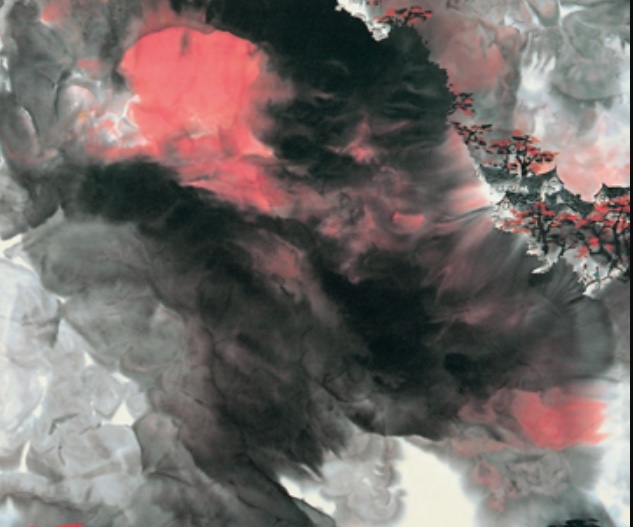
Mist, Clouds, and Autumnal Color – A Splash-ink Painting

I love all four seasons, but Autumn is my favorite. Autumn is an artist, painting the world in vibrant hues of red and gold. The sunshine is warm and soft, and the sweet joy of the harvest season fills the air. And to top it all off, the weather is just about perfect. There is truly no better time to just sit down and take in the beauty of nature.

Many artists aspire to capture this beauty in brush and ink, to keep a souvenir of Fall’s charm. When I saw the painting Qiu She Yan Yun (Mist, Clouds, and Autumnal Color) for the first time, I felt as if I had melted into the distinct autumnal colors and mist.

“Mist, Clouds, and Autumnal Color” is a splash-color painting that conveys a very strong sense of flowing watery ink and colors. An air of power and grandeur expressed through clouds that seem to swallow mountains and waters pervades the entire painting. The natural captivating charm of this scene is similar to the charm of a scene on the ground after a long, flowing river has just rolled by. This setting is embellished with red maple leaves and houses amid autumnal, cloudy mountains, presenting a wonderful image distinctly characteristic of fall.

When carefully examining the watery ink that produced such charm, one can see beautiful areas that are themselves paintings within a painting and details that are hidden within rough brushwork. Even within small areas are subtle variations of darkness and light, of the surreal and the real, all the while embodying splendid charm.

The artist highly preserves traditional painting skills, large-scale splash-ink technique, freehand brush work and fine brush stroke. Very tiny signs of charm can be seen amid this large-scale splash-ink painting. Soaring charm and exceptional beauty are words that aptly describe this art work.

This painting is in permanent collection of The International Art Museum of America located in downtown San Francisco.

Mist, Clouds, and Autumnal Color – A Splash-ink Painting

Link: https://peacelilysite.com/2022/09/22/mist-clouds-and-autumnal-color/

#SplashinkPainting#ChinesePainting #DorjeChangBuddhaIII #HHDorjeChangBuddhaIII#DorjeChangBuddha#IAMA#InternationalArtMuseumofAmerica#Art#Artist

Unique Lotuses in Ink – By Dr. Yuhua Shouzhi Wang

Unique Lotuses in Ink – By Dr. Yuhua Shouzhi Wang

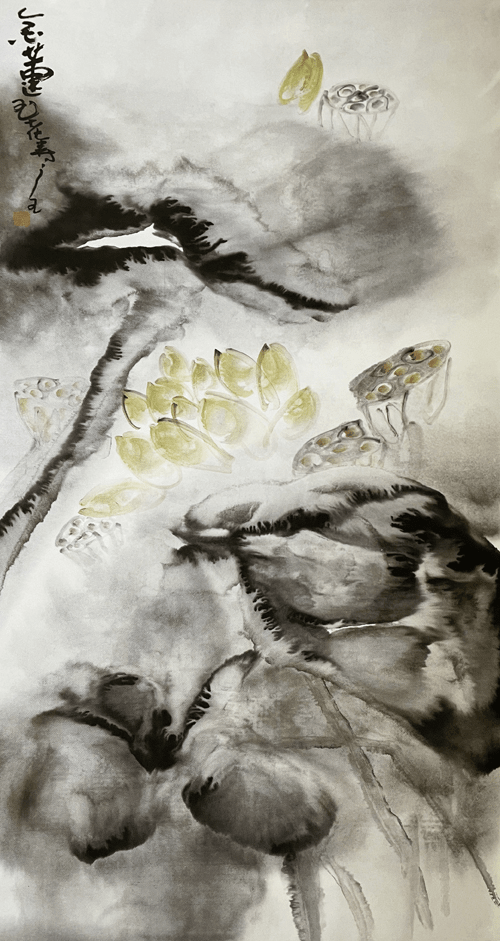
This painting’s arrangement is classically simple and straightforward. The brushwork conveys both simplicity and adeptness. Each lotus stem was painted with just one stroke from top to bottom. The important fact is that the artist dared to adopt an extremely plain and uncreative artistic conception, yet remarkably powerful, seasoned painting skills casually applied are reflected deep within this
painting. This work also reveals the artist’s inner power based on her broadmindedness. Even more wonderful is the fact that no touchups whatsoever were added to the lotus stems to enhance their charm. Painting skills alone were relied upon to capture both the spirit and form of the stems,resulting in a very enuine-looking image. The seedpod, flower, and leaves are in complete concert with one
another. The style is vivacious, elegant, free of conventionality, and wonderfully spellbinding.

Someone who does not believe in the difficulty of painting a lotus stem with just one stroke should try it himself. He will then know how very difficult it is. A work of this quality can only be successfully created by an artist who has reached great heights in painting and whose artistry is devoid of any trace of vulgarity. This is a precious painting in which the extraordinary can be seen within the seemingly ordinary. It is no wonder that Yu Hua Shouzhi Wang was praised by experts as “the unmatched master of lotus flower paintings from ancient times to now” when her artwork was exhibited in the United States Capitol.

Dr. Yuhua Shouzhi Wang is the Lifetime Honorary Chairwoman of the International Art Museum of America. The museum has a dedicated gallery exhibiting her artworks. Her paintings encompass a broad range of styles and subject matters, including landscapes, animals, flowers, birds, and so forth, all of which have reached the summit of world class artistic excellence. Her artistic achievement has reached perfection at the summit of the “ten ultimate artistries.”

Professor Wang’s works have been exhibited and widely acclaimed in the United States, China, Asia, and Europe. In 2008, the United States Congress held an exhibition of the professor’s works, calling her art a “treasure of the world.” The U.S. Congressional Record chronicled the recognition that “her lotus flower paintings are unsurpassed and are extremely valuable.” Professor Yuhua Shouzhi Wang has also been critically acclaimed by news media that “she fuses vivacity, power, color, scholarly essence, quintessence of stone and bronze inscriptions, spirituality, erudition, and morality into oneness in her art. She is the foremost artist in the world.”

Professor Wang is a person of humility and noble morality. She is modest, unassuming, beneficent and genial. The characteristics of an artist’s paintings essentially reflect the character of the painter.

Unique Lotuses in Ink – By Dr. Yuhua Shouzhi Wang

Link: https://peacelilysite.com/2022/09/14/unique-lotuses-in-ink-by-dr-yuhua-shouzhi-wang/

#ProfessorYuHuaShouZhiWang#Art#Artist#ClassofEase#InternationalArtMuseumofAmerica#TenUltimateArtistries#ArtistofFirstclassstanding#Inkpaintings#LotusPainters

Xi Zhen Yi Shou – A Chinese Painting of Three Pandas

A Chinese Painting of Three Pandas

Pandas are a precious and rare animal, and thus are the emblem of the World Society for the Protection of Animals. Pandas are chubby, cute and charmingly naive, and their eyes seem to communicate a slight sadness. How can one not love these real-life teddy bears?

Many years ago, I visited the Panda Reserve area in SiChuan, China. There, I got the chance to see and touch these fluffy beasts up close(for a fee, of course)! So I wore a disposable cloth and hugged the panda. It was so warm and soft! Truly, an unforgettable experience. I was even given a piece of bamboo to taste. Very tender and juicy. Unfortunately, the panda though I was stealing its food, and to avoid hurting its feelings I let it eat the rest. This is without a doubt my go to destination after the pandemic!

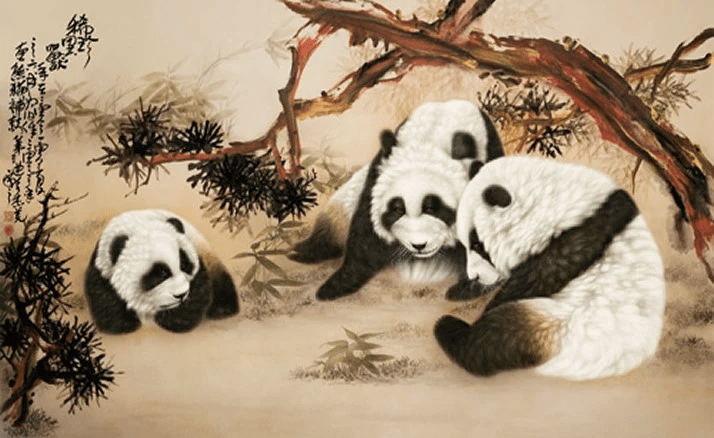
All over the world, there are many paintings of pandas. One time, I saw a chinese painting of Pandas at International Art Museum of America located at downtown San Francisco. The painting reminds me the soft, warm, fury touching feeling of the huge with the Panda. The three pandas look as if they were created by a magical heavenly brush. There is an extremely vivacious appeal, a deeply touching liveliness to these pandas.Pervading such paintings is an air of purity, cleanliness, and hopefulness. The three pandas in this painting all have innocent expressions and look vividly real. The scattered perspective technique of Chinese paintings was combined with the three-dimensional perspective technique of oil paintings. The colors are richly charming, and the layout is exquisite. Empty space and color are mutually complimentary in a fascinating way.
The pandas and the surrounding scene blend into one harmonious image. These lifelike pandas painted in fine brushwork with meticulous attention to detail contrast perfectly with the surrounding scene painted in freehand brushwork. The painting style is plain, vigorous and mature. There is order within the seeming disorder and interesting juxtaposition between the real and the abstract. The achievement of using complimentary bold and delicate strokes in one painting, as H.H.  Dorje Chang Buddha III does, sets His artistry apart from conventional artistry.

A Chinese Painting of Three Pandas

Link: https://peacelilysite.com/2022/09/02/xi-zhen-yi-shou-chinese-painting-of-three-pandas/

#Panda#ChinesePainting#DorjeChangBuddhaIII #HHDorjeChangBuddhaIII#DorjeChangBuddha#IAMA#InternationalArtMuseumofAmerica

See My Home – A Chinese Painting By H.H. Dorje Chang Buddha III

See My Home – A Chinese Painting By H.H. Dorje Chang Buddha III

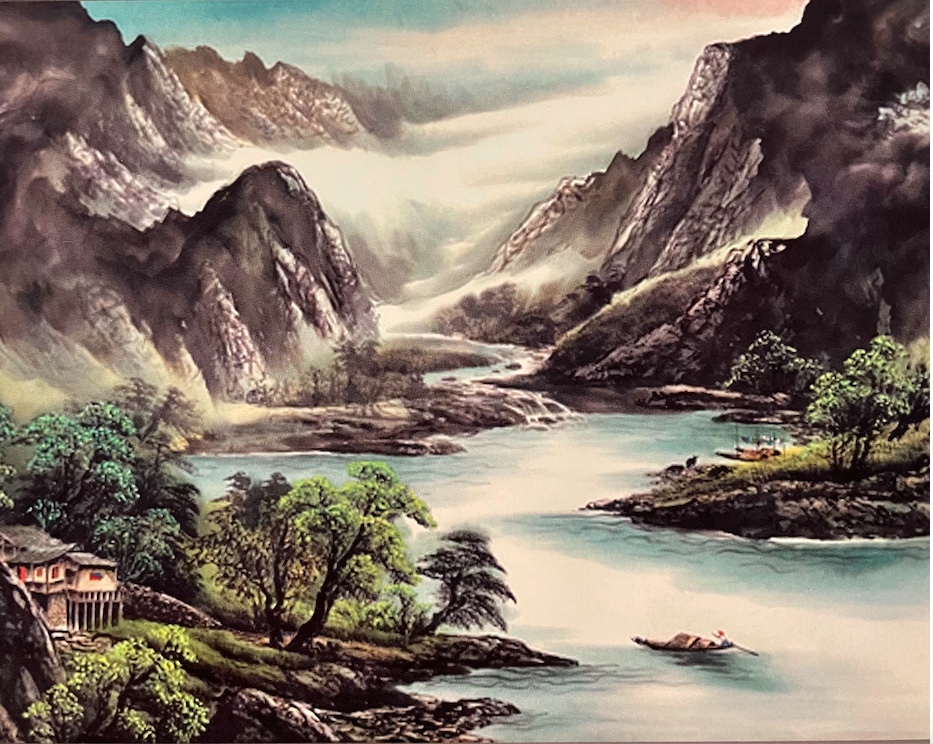
The first time I saw this Chinese ink painting, I cried from the bottom of my heart. What a wonderland beyond this world, how I wish I could live there! It gave me the deep impression of otherworldliness, leisureliness and tranquility. This place is not for ordinary people, it is the place for the holy hermits living untethered from the world. The painting seems like a clear spring flowing through my body and purifying my soul. People have said: a good painting is like a fine poem, like a beautiful song. Looking at this transcendental art piece, I could hear the elegant Chinese classic music “River flowing down from the tall mountain”, and see the gentle pleasant whisper of the clouds sweeping through the forest. It also reminds me one of the Cold Mountain’s poem:

Clambering up the Cold Mountain path,
The Cold Mountain trail goes on and on:
The long gorge choked with scree and boulders,
The wide creek, the mist blurred grass.
The moss is slippery, though there’s been no rain
The pine sings, but there’s no wind.
Who can leap the world’s ties
And sit with me among the white clouds?

Here you can see the artist combined different kinds of painting skills: center brush-tip technique, side brush-edge technique, large-scale freehand brush work, splash-ink technique and fine brush stroke. The mountain scenery was painted with black ink and heavy hues of green. This artwork not only preserves traditional painting skills but also manifests the realistic effect of modern Western oil paintings.

In Chinese paintings, it is very difficult to apply the perspective technique, with its three-dimensional look, to paintings in which the center brush-tip technique is used to express scholarly charm. However, this painting combines four different elements: the three-dimensional perspective technique together with the scattered perspective technique, the splash-ink technique with lines freehand brushwork, and realism. Attributes from both Chinese and Western paintings form a single stylish charm. It depicts a pristine rural setting, a land accompanied by mountain, river, sun and moon spirits. One regards a place as home when one has cherished feelings toward the local customs and conditions of that place. Wouldn’t you like such a home?

This painting is in permanent collection of The International Art Museum of America.

#MasterWanKoYee #DorjeChangBuddhaIII #HHDorjeChangBuddhaIII#DorjeChangBuddha#IAMA#InternationalArtMuseumofAmerica

See My Home – A Chinese Painting By H.H. Dorje Chang Buddha III

Link: https://peacelilysite.com/2022/05/27/see-my-home-a-chinese-painting-by-h-h-dorje-chang-buddha-iii/

Dr. Yuhua Shouzhi Wang’s Paintings and Achievements

Dr. Yuhua Shouzhi Wang’s Paintings and Achievements

Professor Yuhua Shouzhi Wang is a world-renowned painter. Throughout Asia, she is the only artist to whom the New York Academy of Art conferred the title of international preeminent artist of first class standing. 

The art world has classified the quality of ink painting into four different levels: Class of Proficiency, Class of Wonderment, Class of Divinity, and Class of Ease. Artwork of the Class of Proficiency has the ability to present a resemblance of objective reality, achieving likeness in form. This is the first stage of artistic creation. The art world calls it the stage of sketching. This is a stage that an artist cannot skip, yet they also cannot remain at this status quo, because this is an elementary stage. The next level is the Class of Wonderment. Artworks of this Class demonstrates highly skilled techniques. The artist is able to paint anything at will without revealing any trace of effort. However, one also cannot remain stagnant at this stage.

The next level after the Class of Wonderment is the Class of Divinity where the art carries likeness of ‘form’ and likeness of ‘spirit.’ In ink painting, the highest state of accomplishment is the Class of Ease where the artist attains natural ease by using simple brushstrokes to fully capture the form. With the most succinct brushwork and the most superb technique, the artist depicts objective reality and attains a state of miraculousness where both form and spirit are fully captured. This is the kind of art that viewers never get tired of appreciating; it leaves a wonderful aftertaste. There are only about a dozen people in the history of art who have attained such a class.

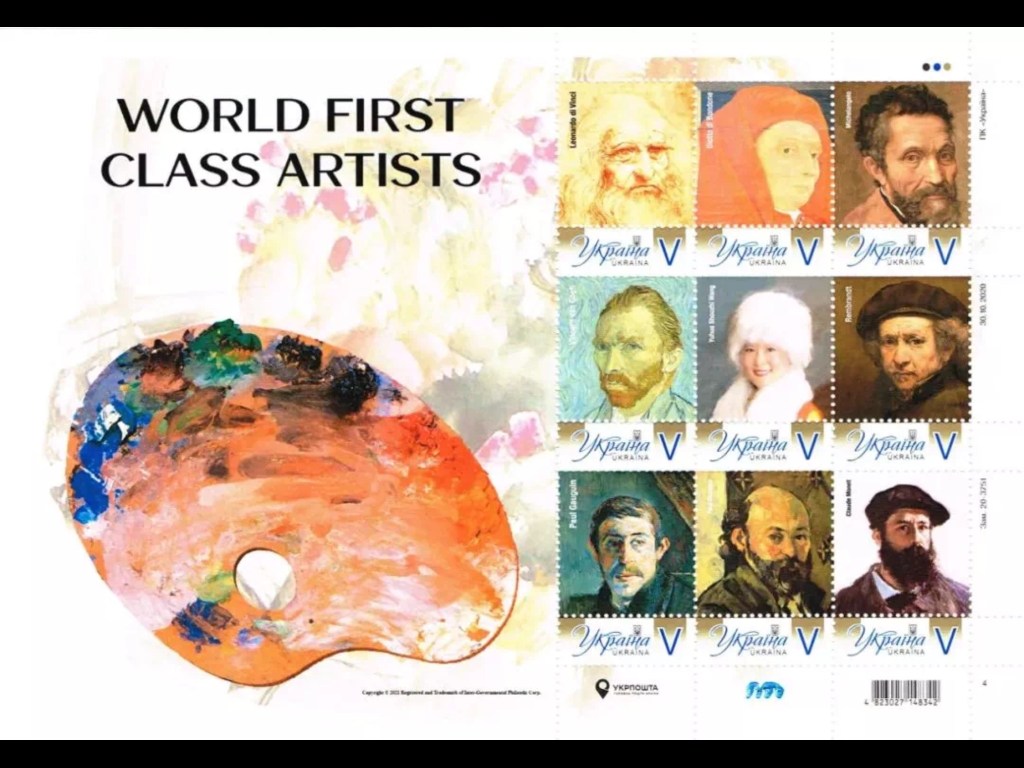
Stamps published in Ukraine

 In 2008, the United States Congress exhibited her sculptures and paintings in the Gold Room in the Rayburn Congressional Building which received rave reviews. Professor Stephen Farthing of the University of the Arts in London, United Kingdom, determined that “Professor Wang’s paintings reach across cultures to celebrate the space that exists intellectually and emotionally between representation and abstraction, between a fact and an idea…Dr. Wang’s paintings may draw heavily on the traditions of Eastern art, but they present themselves as extraordinarily Western ideas and images.”

in 2013, out of the works of all painters, the World Federation of UNESCO Clubs, Centers and Associations (WFUCA) awarded the title “WFUCA2013” to the artworks of Professor Yuhua Shouzhi Wang. In 2020, the United States National Commission for UNESCO Clubs, Centers, and Associations conferred on her the “International First-Class Artist” title along with the issuance of a certificate and badge.

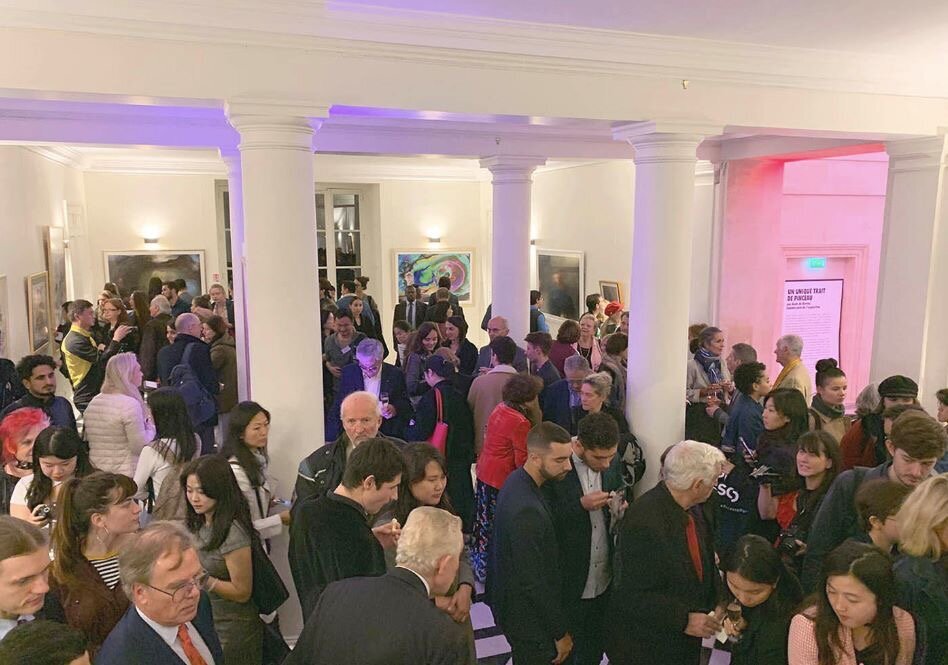
In 2019, When Professor Wang’s solo exhibition was held at the Shanghai Exhibition Center that used to be the Sino-Soviet Friendship Building, a record-breaking number of people visited the show. The Museum Director Wu Shufang stated that the museum had never experienced such an overwhelming number of visitors since its official opening, and for this exhibition, they had to post notices to limit admission. Same year, she held a solo exhibition, titled One Flower, Two Worlds at the Louvre in Paris in 2019 and created a sensation in French art circles. This exhibition showcases 27 of Professor Wang’s extraordinary artworks each of which has reached the height of the Class of Ease.

More than 200 distinguished members of society, artists, collectors, entrepreneurs, and art lovers attended the exhibition opening; including representatives from French museums, professors from French art institutes, French nobilities, renowned artists, celebrities, representatives from auction houses, art critics and journalists from major news media. They all marveled at the artworks and expressed their praises. They considered this an unprecedented experience for French people.

Simply put, the artistry of Professor Yuhua Shouzhi Wang has attained the highest level of artistry in ink painting which is the Class of Ease. One of Professor Yuhua Shouzhi Wang’s paintings Pomegranates in a Basket realized a top auction price of US$1.27 million at the Gianguan Auction House in New York on March 13 of 2019. It clearly shows that the art of Professor Yuhua Shouzhi Wang is recognized by art collectors and people of foresight alike.

Dr. Yuhua Shouzhi Wang is the Lifetime Honorary Chairwoman of the International Art Museum of America. The museum has a dedicated gallery exhibiting her artworks. Her paintings encompass a broad range of styles and subject matters, including landscapes, animals, flowers, birds, and so forth, all of which have reached the summit of world class artistic excellence. Based on her lotus and water lily paintings, artists have acclaimed that Professor Yuhua Shouzhi Wang is the foremost lotus painter of all times. No artist in the past would have been able to surpass her accomplishment, and her works will continue to inspire generations to come. Among all notable lotus painters, her skills are extremely profound, substantial, and masterful, and she is among the most distinguished artists in history. Her artistic achievement has reached perfection at the summit of the “ten ultimate artistries.”

The well-known saying, “Deeply hidden talent not easily revealed” aptly describes Dr. Yuhua Shouzhi Wang’s morality and inner refinement. The characteristics of an artist’s paintings essentially reflect the character of the painter. From the paintings below you can find humility, inner peace, harmony and noble morality of professor Wang.

Golden Lotuses

The approach of Professor Yuhua Shouzhi Wang to draw flowers in gold and create leaves with splashed watery ink exhibits high elegance, great beauty, and lovely simplicity. The technique of Professor Yuhua Shouzhi Wang to paint lotus flowers in varying degrees of darkness and lightness enables her to represent fully a striking charm in both tone and form. Every stroke is lively, vigorous, graceful, and without the slightest air of affectation. Applying mature and seasoned artistry, she fully displays on paper her unfettered, natural, unattached state of mind. The brushwork was completed with ease and spontaneity, free of any inhibition. The atmosphere is strong but very elegant and pure. This entire painting provides much comfort to the eyes.

Brushstrokes as Spontaneous as Dancing Dragons and Snakes
Springtime Snow-White Plum Blossoms as Pure as Jade
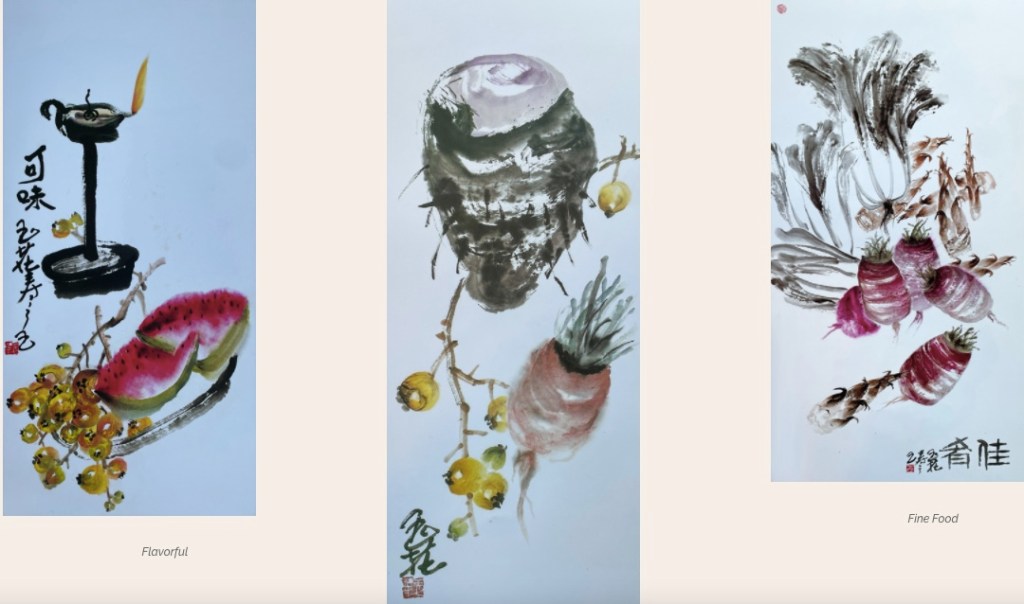
The Ink-wash paintings of Dr. Yuhua Shouzhi Wang
Loquats and Radish Staring at Taro

Some of professor Wang’s paintings have been published on stamps.

Dr. Yuhua Shouzhi Wang’s Paintings and Achievements

Link: https://peacelilysite.com/2022/04/20/dr-yuhua-shouzhi-wangs-paintings-and-achievements/

#ProfessorYuHuaShouZhiWang#Art#Artist#ClassofEase#InternationalArtMuseumofAmerica#TenUltimateArtistries#ArtistofFirstclassstanding#Inkpaintings#LotusPainters

Source: Professor Xingyi Gu   |  Wed, 16 Oct 2019, 12:40:15 EDT https://www.send2press.com/wire/solo-exhibition-of-professor-yuhua-shouzhi-wang-international-preeminent-artist-of-first-class-standing-amazes-art-world-at-palais-du-louvre/h International Art Museum of America.

Professor Yuhua Shouzhi Wang

Professor Yuhua Shouzhi Wang


Dr. Yuhua Shouzhi Wang is the Lifetime Honorary Chairwoman of the International Art Museum of America. The museum has a dedicated gallery exhibiting her artworks. Her paintings encompass a broad range of styles and subject matters, including landscapes, animals, flowers, birds, and so forth, all of which have reached the summit of world class artistic excellence. Based on her lotus and water lily paintings, artists have acclaimed that Professor Yuhua Shouzhi Wang is the foremost lotus painter of all times. No artist in the past would have been able to surpass her accomplishment, and her works will continue to inspire generations to come. Among all notable lotus painters, her skills are extremely profound, substantial, and masterful, and she is among the most distinguished artists in history. Her artistic achievement has reached perfection at the summit of the “ten ultimate artistries.”

Professor Wang’s works have been exhibited and widely acclaimed in the United States, China, Asia, and Europe. In 2008, the United States Congress held an exhibition of the professor’s works, calling her art a “treasure of the world.” The U.S. Congressional Record chronicled the recognition that “her lotus flower paintings are unsurpassed and are extremely valuable.” Professor Yuhua Shouzhi Wang has also been critically acclaimed by news media that “she fuses vivacity, power, color, scholarly essence, quintessence of stone and bronze inscriptions, spirituality, erudition, and morality into oneness in her art. She is the foremost artist in the world.” Back in 2013, out of the works of all painters, the World Federation of UNESCO Clubs, Centers and Associations (WFUCA) awarded the title “WFUCA2013” to the artworks of Professor Yuhua Shouzhi Wang.

B 3436
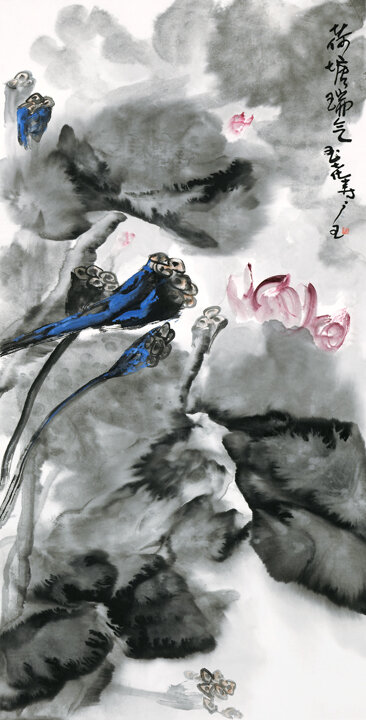
荷塘瑞氣

The Kingdom of Thailand’s Department of Culture especially organized a solo exhibition of the art of Professor Yuhua Shouzhi Wang at their Ratchadamnoen Contemporary Art Center in Bangkok. The Department of Culture also notified all university and middle school teachers and students to visit the exhibition and study the artworks. In 2019, When Professor Wang’s solo exhibition was held at the Shanghai Exhibition Center that used to be the Sino-Soviet Friendship Building, a record-breaking number of people visited the show. The Museum Director Wu Shufang stated that the museum had never experienced such an overwhelming number of visitors since its official opening, and for this exhibition, they had to post notices to limit admission.

In 2019, when her works were exhibited at the Louvre Museum in Paris, guests – including artists, collectors, and art critics – were thrilled and overwhelmed with joy, praise, and admiration. They felt that the French people had never had such an experience before. The experts acclaimed that Prof. Yuhua Shouzhi Wang is a virtuoso of equal standing as Van Gogh, Cezanne, Gaugain, and Monet. They said, “Professor Wang’s paintings are so magnificent that they amaze us. We have never thought that the level of artistry of Eastern ink painting can surpass that of a few centuries of Western traditions. Professor Wang is the only one who has achieved that.”

Professor Yuhua Shouzhi Wang’s art works were exhibited at the Louvre Museum in Paris in 2019.

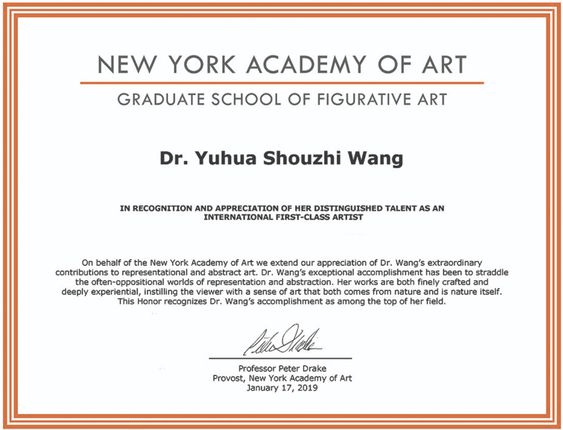
Renowned art critic Aude de Kerros has commented: “I have curated and critiqued so many art exhibitions, yet I have never seen an exhibition like this where all the guests are so touched and amazed by the art, and all of them expressed praise. I truly cannot describe their surprise and joy. The art experts do not even want to leave after seeing such exquisite artworks. You can see that so many people are staying this late and they are not leaving.” Professor Peter Drake, Provost of the New York Academy of Art, presented a certificate to recognize Prof. Yuhua Shouzhi Wang‘s extraordinary contributions to representational and abstract art, stating “Dr. Wang’s exceptional accomplishment has been to straddle the often-oppositional worlds of representation and abstraction. Her works are both finely crafted and deeply experiential, instilling the viewer with a sense of art that both comes from nature and is nature itself.” The Provost also personally led graduate students to the International Art Museum of America to see Professor Wang’s artworks in the Museum’s collection. He also gave lectures on site. Faculty members and students were all thrilled to see the original paintings in the museum, and they studied the artworks by copying them.

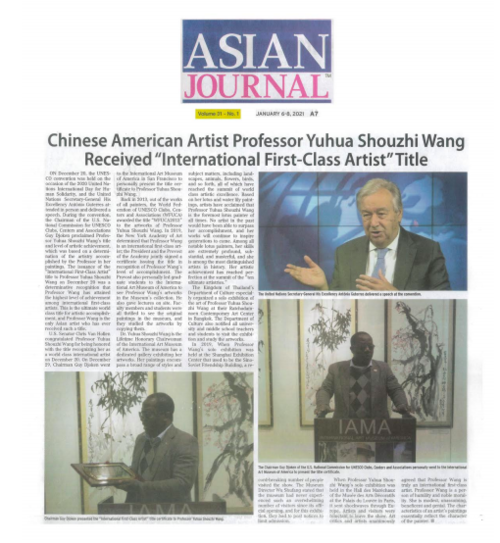
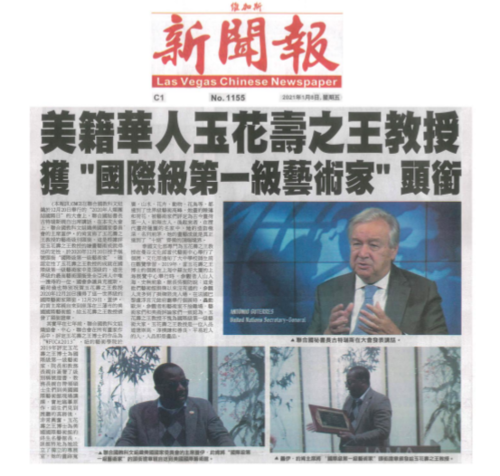
On December 20, 2020, the UNESCO convention was held on the occasion of the 2020 United Nations International Day for Human Solidarity, and the United Nations Secretary-General His Excellency António Guterres attended in person and delivered a speech. During the convention, the Chairman of the U.S. National Commission for UNESCO Clubs, Centers and Associations Guy Djoken proclaimed Professor Yuhua Shouzhi Wang’s title and level of artistic achievement, which was based on a determination of the artistry accomplished by the Professor in her paintings. The issuance of the “International First-Class Artist” title to Professor Yuhua Shouzhi Wang on December 20 was a determinative recognition that Professor Wang has attained the highest level of achievement among international first-class artists. This is the ultimate world class title for artistic accomplishment, and Professor Wang is the only Asian artist who has ever received such a title.

Screen Shot 2021-01-13 at 10.42.06 AM.png
Screen Shot 2021-01-13 at 10.53.45 AM.png
Screen Shot 2021-01-13 at 10.52.54 AM.png

U.S. Senator Chris Van Hollen congratulated Professor Yuhua Shouzhi Wang for being honored with the title recognizing her as a world class international artist on December 20. On December 29, Chairman Guy Djoken went to the International Art Museum of America in San Francisco to personally present the title certificate to Professor Yuhua Shouzhi Wang.

Professor Wang is a person of humility and noble morality. She is modest, unassuming, beneficent and genial. The characteristics of an artist’s paintings essentially reflect the character of the painter.

Professor Yuhua Shouzhi Wang

Link: https://peacelilysite.com/2022/02/15/professor-yuhua-shouzhi-wang/

#YuhuaShouzhiWang#ChinesePainting#EasternInkPainting#InternationalArtMuseumofAmerica

Da Mo Zu Shi, A Chinese Painting Appreciation

Da Mo Zu Shi, A Chinese Painting Appreciation

Patriarch Bodhidharma (Da Mo Zu Shi) was the most legendary master in Chinese Zen Buddhism history, and he’s been well known in China. When I was young, my grandmother used to tell me the folk tales of Patriarch Bodhidharma. I’ve always wondered what Patriarch Bodhidharma looked like.

One day in International Art Museum of America, I saw a painting of Da Mo Zu Shi, the artist is H.H. Dorje Chang Buddha III. It gave me a really deep impression — A majestic black-faced holy monk, seemingly quiet but reflecting unparalleled spiritual power, seems to have traveled through thousands of years of time and space, and suddenly appeared in front of me.

This painting, drawn in the freehand style, was created from only a small number of brush strokes. The point of view of the picture, the thick and imposing character modeling, and the simple and rich color application endow the picture with an ancient and muddy artistic style. 

Through the artist’s seasoned brushwork, this painting captures the natural essence of all things. Let’s look at some specific parts of the picture. Bright eyes shine under the dark eyebrows like full autumn moons. The mouth seems to breathe with the grandeur of eternity.

Hair, eyebrows, and beard are painted with brush strokes like scraping iron; the facial contours of the characters are drawn with iron lines, and the brushwork is refined and powerful. At the bottom of the picture is the robe of the patriarch, made by heavy and strong brushwork.

This artistry, devoid of the slightest affectation, shows the natural ease with which the artist wields the brush when creating calligraphy and paintings. It is the essence of Zen, the truth of the universe, naturalness that is free of attachment.

Patriarch Bodhidharma was the twenty-eighth generation descendant of Zen Buddhism. About a thousand years ago, he came to China. He crossed the mountains and deserts on foot, and crossed the rivers with a reed raft. 

Upon reaching China, the Patriarch met a monk named Huike. At that time, Master Huike was quite famous but still an ordinary monk, not having reached enlightenment. Due to a series of misunderstandings, Master Huike believed that the Patriarch Bodhidharma was insulting the scriptures of Buddhism, and thus he assumed he must be a devil. So Huike was ready to denounce Patriarch Bodhidharma.

Master Huike had a chain of iron beads hanging around his neck. He took it off and threw it at Patriarch Bodhidharma with all his strength. This act of violence caught his target by surprise, knocking out his two front teeth.

Naturally, the Patriarch’s first reflex was to spit out his broken teeth. But he was an Arhat at the time, which meant that should his teeth touch the ground, there would be a three year drought. To spare the common people from this disaster, he swallowed his broken teeth and left without saying a word. His actions showed great compassion and forbearance. 

Humbled by the Bodhidharma’s strength of character, Master Huike followed the patriarch, becoming his disciple, and, eventually, the second generation of Zen master in China.

The portrait of the Patriarch seems to exhale a holy breath, which lightens the lives of all those around it. It expresses the original nature of Zen, eternal and immutable. Those who view it have experienced a great spiritual encounter, which brings about a subtle but powerful change in their lives. 

Da Mo Zu Shi, A Chinese Painting Appreciation

Link: https://peacelilysite.com/2022/01/21/da-mo-zu-shi-a-chinese-painting-appreciation/

#DorjeChangBuddhaIII #HHDorjeChangBuddhaIII#DorjeChangBuddha#IAMA#InternationalArtMuseumofAmerica

ARTISTIC ACCOMPLISHMENTS OF H.H. DORJE CHANG BUDDHA III


ARTISTIC ACCOMPLISHMENTS OF H.H. DORJE CHANG BUDDHA III

H.H. Dorje Chang Buddha III

The accomplishments and contributions of H.H.  Dorje Chang Buddha IIIare extremely comprehensive. The book entitled H.H. Dorje Chang Buddha III published in 2008 shows some of the accomplishments of H.H. Dorje Chang Buddha III in thirty different main categories. Within the one category of painting and calligraphic artistry alone, H.H. Dorje Chang Buddha III  has created Chinese paintings, oil paintings, different styles of calligraphy, etc. In addition to being able to paint in the styles of the currently existing schools of painting, such as the Realism School, the Abstract School, the Line School, the Impressionist School, and other schools, H.H. Dorje Chang Buddha III has independently originated sixteen unique schools of painting. They are called: 1) the Chaoshi School; 2) the Chouxiang Yunwei School; 3) the Wenfeng School; 4) the Fangfa School; 5) the Menglong School; 6) the Xiangtong School; 7) the Fanjuan School; 8) the Puomo Xiantiao Xiezhen School; 9) the Weiyin School; 10) the Fanpu School; 11) the Miaoxie School; 12) the Puomo Weiyun School; 13) the Kuangxi School; 14) the Yousi School; 15) the Banqi School; and 16) the Houdui Sekuai School (Thickly Piled Patches of Color School).

Many famous painters spent their entire lives focusing on one kind of artistic subject or theme in order to establish their own school of that one style. However, not only did H.H.  Dorje Chang Buddha III found sixteen schools of painting, He also developed the style of each school to a state of perfect artistry. This has naturally resulted in the distinct school of painting called “The H.H. Dorje Chang Buddha III School of Multiple Styles,” which no painter in history can match!

At the fourth session of the World Poets and Culture Conference held in Hungary in 1994, more than 5,600 experts and scholars representing 48 countries and regions unanimously approved conferring upon H.H.  Dorje Chang Buddha III the title “Distinguished International Master,” which has an honorific status comparable to a head of state. The certificate was signed by Sir Juan Antonio Samaranch, the then President of the International Olympic Committee.

On February 10, 2004 the Royal Academy of Arts of the United Kingdom conferred upon H.H.  Dorje Chang Buddha III the title of “Fellow,” a title never before conferred in the history of that academy. The Royal Academy of Arts in the United Kingdom was founded in 1768 by the then King of Britain, George III. That academy has received the patronage and support of the royal family up to this day. Professor Phillip King, President of the Royal Academy, awarded the Certificate of Fellow to H.H.  Dorje Chang Buddha III at the British Embassy in Washington, DC. The cultural counselor of the embassy attended the award ceremony in person. Professor Phillip King said, “This is the first artist to receive this title in the more than 200-year history of the Royal Academy of Arts in the United Kingdom.”

Since the year 2000, paintings by H.H. Dorje Chang Buddha III  have repeatedly broken price records in art markets, selling for the highest prices for paintings by any living artist. The market price has now reached more than US$1,000,000 per square foot. Moreover, market prices recorded at international art auctions and evidence of sales prove that limited release copies of paintings by H.H.  Dorje Chang Buddha III are sold at the world’s highest prices, reaching over US$380,000 each, thus surpassing copies of paintings by Picasso, Monet, Van Gogh, and other extremely famous painters in the world.

Many works of art by H.H. Dorje Chang Buddha III are exhibited at the International Art Museum of America, which is a non-profit public-benefit art museum located in downtown San Francisco in the United States. Furthermore, the International Art Museum of America is offering to buy paintings by H.H.  Dorje Chang Buddha III in the style of the Thickly Piled Patches of Color School at a price of over US$1,000,000 per square foot. However, it is still very hard to find any such paintings offered for sale.

ARTISTIC ACCOMPLISHMENTS OF H.H. DORJE CHANG BUDDHA III

Link: https://peacelilysite.com/2021/12/29/artistic-accomplishments-of-h-h-dorje-chang-buddha-iii/

#MasterWanKoYee #DorjeChangBuddhaIII #HHDorjeChangBuddhaIII