My Father Before Me — The Unspoken Bond Between Fathers and Sons

There are few relationships as powerful—and as quietly transformative—as the one between a father and a son. Yet in modern life, it’s often overlooked. We talk about mothers and children, but the emotional depth between fathers and sons remains one of the least explored terrains of the human heart.

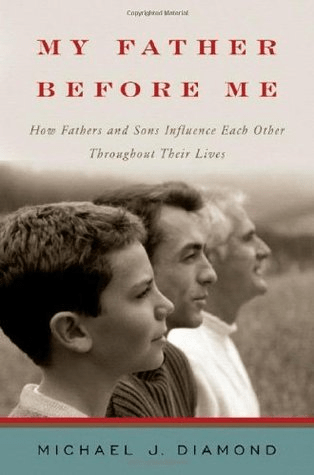
In My Father Before Me: How Fathers and Sons Influence Each Other Throughout Their Lives, psychoanalyst Michael J. Diamond takes us into that emotional landscape with remarkable sensitivity. Through vivid stories, psychological insight, and tender reflection, he reveals how fathers and sons shape, challenge, and heal each other across a lifetime.

Most people think of fatherhood as a one-directional journey: the father influences the son. But Diamond turns that idea around. He shows that the father–son relationship is mutual, not hierarchical.

A father helps mold his son—but the son also transforms the father. Each becomes a mirror for the other’s hopes, fears, and hidden strengths.

Diamond writes about how fatherhood can awaken parts of a man he never knew existed. When a son is born, the father doesn’t just gain a child—he also gains a deeper understanding of himself. The baby’s presence demands patience, tenderness, and emotional openness. In nurturing another, the father learns to nurture himself.

Moments That Change Everything

Diamond fills the book with moving, relatable stories that show this mutual transformation.

One story tells of a man who, having grown up with a distant father, vows to be emotionally present for his own son. Yet when his son enters adolescence and begins to push back, the man feels rejected and hurt—just as he once felt with his own father. Through reflection, he realizes that this is his chance to break the cycle: to stay connected even when it’s uncomfortable. In doing so, both he and his son begin to heal wounds that stretch back generations.

In another example, a father describes watching his young son struggle to build a toy tower. His first instinct is to step in and fix it, but he resists. Instead, he watches quietly, offering small words of encouragement. When the tower finally stands, he sees not just his son’s triumph—but his own growth in learning to let go.

These moments, Diamond suggests, are not small. They are the foundation of how love, trust, and resilience are built between generations.

The Phases of the Father–Son Journey

Diamond explores how this relationship evolves through every stage of life:

  • Early Childhood: The father is a protector and guide, introducing the child to the outside world. But he also begins to sense his son’s individuality—someone both familiar and mysterious.
  • Adolescence: As the son seeks independence, conflict can arise. Here the father’s challenge is to stay connected without controlling—to allow the son to become his own person.
  • Adulthood: When the son grows up, both men must renegotiate their roles. Often, the adult son begins to understand his father with new empathy, and the father learns to accept his son as an equal.
  • Later Years: In time, roles may reverse—the son becomes the caregiver, the listener, the one offering strength. This reversal, Diamond suggests, completes the circle of life.

Through each phase, fathers and sons are constantly exchanging something precious: understanding, forgiveness, and love.

Redefining Masculinity

A core theme in My Father Before Me is emotional honesty. Diamond challenges old stereotypes of men as stoic and distant. True masculinity, he argues, is not about dominance or silence—it’s about being open, authentic, and emotionally present.

When a father shows vulnerability, it doesn’t make him weak—it makes him real. And when a son witnesses that authenticity, he learns that being a man means embracing both strength and tenderness.

In one memorable story, a son recalls seeing his father cry for the first time—after the death of the grandfather. “That day,” he says, “I stopped fearing emotion. I realized that love and grief are part of the same heart.”

A Relationship That Never Stops Evolving

Even when fathers and sons grow older, the dialogue between them continues. Diamond describes adult sons helping aging fathers find meaning and dignity in later life. Some reconcile after years of distance. Others simply learn to say what was once left unsaid: “I love you,” “I understand you,” or even “I forgive you.”

These late-life moments, he writes, can be profoundly healing. They remind us that it is never too late to reach across the years—to understand, to listen, and to love.

A Mirror for All of Us

Whether you’re a father, a son, or simply someone reflecting on your family history, My Father Before Me offers both insight and comfort. It reminds us that every father carries the echoes of his own father within him—and that every son, in turn, shapes what fatherhood will mean for the next generation.

Ultimately, Diamond’s message is one of hope: that through empathy, self-awareness, and courage, fathers and sons can support each other’s growth, forgive each other’s shortcomings, and honor the love that lies beneath it all.

Link:https://peacelilysite.com/2025/10/29/my-father-before-me-the-unspoken-bond-between-fathers-and-sons/

Thirty Million Words: How a Parent’s Voice Shapes a Child’s Future

“Imagine a child’s brain as a garden. Every word you speak is like a drop of water nurturing growth.”

One cold winter morning in 1995 at a Chicago hospital, Dr. Dana Suskind, a cochlear implant surgeon, held the small hand of a boy who had just undergone surgery. Technically, the boy could now hear. Yet weeks passed, and he still didn’t speak a word. Dr. Suskind wondered—what was missing? She discovered that while technology could restore hearing, it could not replace something even more vital: the daily language environment a child grows up in. Without rich and loving conversation, the boy’s world remained silent in a deeper sense.

This experience led Dr. Suskind to research the profound role parents play in shaping their children’s language and cognitive development. She founded the Thirty Million Words (TMW) initiative, inspired by a groundbreaking 1995 study by child development researchers Betty Hart and Todd Risley. Hart and Risley discovered a striking reality: by the age of three, children from higher-income families had heard about thirty million more words than children from lower-income families.

From birth to age three, a child’s brain forms 1 million neural connections every second. Every conversation is brain-building—especially when it’s warm, eye-to-eye, and responsive.

Quantity matters—more words create more neural connections.

Quality matters more—it’s not just talking to a child, but engaging with them in responsive conversations.

Children who heard more words also experienced more encouraging interactions, richer vocabulary, and emotionally supportive tones from their parents. Meanwhile, children who heard fewer words were often exposed to more negative or directive language (“Stop that!” “Don’t do this!”) and fewer warm, conversational exchanges. By the time these children entered school, the gap had already set the stage for differences in learning, confidence, and future opportunities.

Dr. Suskind’s TMW initiative encourages parents to intentionally fill their children’s early years with abundant, meaningful, and loving conversation. She emphasizes the Three T’s:

  1. Tune In – Notice what your child is focused on and talk about it.
  2. Talk More – Use a rich variety of words to describe, explain, and explore the world together.
  3. Take Turns – Engage in back-and-forth conversation, even before your child can speak words.

For example:

  • Instead of saying, “Don’t touch that!” try: “That’s sharp, sweetie. Let’s find something safer to play with.”
  • Instead of a quick “Good job,” you might say: “I love how you stacked those blocks so high! You worked so carefully.”
  • During a walk, point to things you see—“Look at that big red leaf!”—and let your child respond, even with just a gesture or sound.

But there’s another crucial element—how you speak. A gentle tone, warm facial expressions, and genuine interest create an emotional space where a child feels safe and valued. Neuroscience shows that when a child feels emotionally secure, their brain is more receptive to learning and language development.

Dr. Suskind’s work reminds us that parents are a child’s first and most influential teachers—not because of expensive toys or formal lessons, but because of the warmth, curiosity, and attention they share through conversation.

You don’t need a degree or a script. Your voice, attention, and curiosity are enough. Whether in the supermarket, on a walk, or during bedtime, every exchange plants seeds for your child’s future thinking, confidence, and empathy.

The goal isn’t to force constant chatter but to weave language naturally into your shared life—reading together before bed, singing songs in the car, talking about the day while cooking dinner. Over time, these small, daily moments accumulate into millions of words, building both vocabulary and a deep sense of connection.

The Thirty Million Words message is clear: Every word you speak to your child is a gift that shapes their mind and heart.

Because one day, those little ears won’t just remember the words you spoke—they’ll carry the mindset, resilience, and love you planted with them.

Link: https://peacelilysite.com/2025/08/14/thirty-million-words-how-a-parents-voice-shapes-a-childs-future/

Dr. Jeff Walker’s Rising Stars: Transforming Arts Education Through Passion and Purpose

Matthew Kayser Contributor

Jeff Walker

In a world increasingly dominated by artificial intelligence and digital innovation, Dr. Jeff Walker, a retired neurosurgeon turned philanthropist, is on a mission to “keep the humans in the humanities.”  His Walker’s Rising Stars Scholarship Program, launched in 2003 in partnership with the Pinellas Education Foundation in Florida, has awarded over $970,000 to high school students excelling in Dance, Instrumental, Theater, Visual Arts, and Vocal Performance. 

Now, with a bold vision to expand the program nationally, Walker is poised to reshape arts education across the United States: “I want this to expand to cover the whole country and change arts education in high school and college,” says Walker, who has made it his mission to provide free education for all. 

Walker’s inspiration—rooted in personal tragedy, a love for the arts, and a deep commitment to education—drives a movement that empowers young artists to pursue their dreams without the crushing weight of student debt. 

His path to philanthropy was anything but conventional. A Duke-trained neurosurgeon who performed over 10,000 operations and established a major trauma center in Florida, Walker’s career was defined by precision and impact. 

Yet his drive to give back stems from a deeply personal experience at age five. “I had a tragic event, a near-drowning incident,” he recalls. His best friend didn’t know how to swim. Influenced by childhood media and misunderstanding the risks, he pushed him into the water. The outcome was devastating: his friend drowned, and Walker nearly did too. “I felt so guilty, blocked it out for 15 years,” he says. “I think I tried to overcompensate by helping people. It was something that took an incredibly long time for me to forgive myself for.” 

This tragedy instilled a lifelong mission to serve others—first through medicine and later through philanthropy. His medical journey began under the influence of his father, a dentist and university chairman, and his mother. “I scrubbed in on over 200 open-heart operations,” he says. But it was in medical school that he discovered neurosurgery, drawn to the brain as “what you are.” He completed his residency at Duke by 1985, laying the foundation for a career that blended science with service. 

Walker’s love for the arts, though not as a performer, also shaped his vision: “I played the piano when I was younger, very methodical, classical music,” he shares. A humbling moment came at 15 when a friend played a Beatles song effortlessly, revealing Walker’s limitations. “I couldn’t do that at all,” he admits. 

Yet, this experience underscored his belief in the arts as a universal force: “Every culture has their own dance, songs, music, symphonies, operas—the arts are a unifying factor,” he says. “There’s so much diversity in America today, and this brings everyone together.” 

In 2003, Walker channeled his passion for education and the arts into the Walker’s Rising Stars Scholarship Program, partnering with the Pinellas Education Foundation to support local high school students. The program, which awards scholarships for arts education, is a vibrant celebration of talent, culminating in an annual event at the Mahaffey Theater. 

“The kids get there at noon, we have lunch, they audition during the day, and then put on a show at night—three-minute acts, five categories, with the county jazz band. Families are cheering, it’s super fun,” he says. 

The program’s impact transcends financial support. After the show, students gather backstage, hugging and celebrating. “They’re all aspiring artists, and you can feel the love,” Walker says. 

As a father of four and grandfather of eight, Walker connects deeply with the pride parents feel at these events. “You’ve taken these kids to music, art, dance lessons for years, and to see them on stage as young adults—the pride and love bounce off the walls.” 

The scholarships address the broader student loan crisis, which Walker views as a significant burden on young people. “Every dollar is $1 the family doesn’t have to spend on education,” he says. 

Beyond financial relief, the program instills confidence and recognition. “It’s not easy to get on that stage, knowing hundreds of kids are vying for that spot,” Walker says. “The confidence they get is key.” 

He recalls a student letter that captures the program’s transformative power: “She wrote, ‘I was going to go to St. Pete College, but after winning this, I’m going to Manhattan School of Art.’ It’s a life-changing event.” 

Walker estimates that the program changes “about half the kids’ lives,” with alumni achieving remarkable success. “They’re making a living in the arts,” he says proudly. 

Walker’s inspiration for Rising Stars is grounded in his belief in education as a pathway to opportunity: “As a Duke-trained neurosurgeon, I went to school a long time, and I owe everything I have to my education,” he states. “In the end, when you look back on your life, it’s not what you get, it’s what you give.” 

This philosophy fuels his commitment to expanding arts education, particularly in public schools. “Education is the way out,” he says. “Through hard work and education, I still believe in the American Dream—you can be anything.” 

Walker also recognizes the challenges the arts face in an increasingly digital age. He trademarked the phrase “keep the humans in the humanities” to emphasize the need for genuine human creativity. “How do you combat that? You create a generation of talented singers, dancers, actors,” he explains. The program reinforces human expression and creativity during a time when automation is on the rise. 

Now, Walker has announced the national expansion of Rising Stars, choosing the prestigious Sundance Film Festival to unveil his plan. His goal: establish 1,000 program sites, each supported by a $4 million endowment that yields 5% annually to fund 25,000 students each year. “After four years, that’s 100,000 Rising Stars in college—enough to transform arts programs,” he calculates. 

The national rollout will replicate the local model, with auditions and performances administered through public school districts and education foundations. “Everything goes through the school district, the teachers,” Walker says, highlighting a grassroots approach. Local events will feed into regional, state, and national competitions—potentially televised to amplify awareness and participation. 

“This will bring every community together to support their young people,” he says, envisioning the program as a unifying force during divisive times. 

Walker also sees the initiative as a response to the underfunding of arts education. “In high school, the arts are underfunded,” he notes. “Everybody’s talking STEM these days, but an education in the arts is very difficult.” 

The program aims to uplift students pursuing creative careers, helping them gain recognition, validation, and the resources they need to thrive. “This program tells them, ‘You’re a great singer, artist, you’ve got talent,’” Walker says. “It gives them the confidence to pursue their dreams.” 

Scaling Rising Stars nationwide presents challenges, but Walker remains focused: “As a Duke-trained neurosurgeon, I didn’t get here by luck. We have a plan.” 

He’s connecting with artists’ unions and entertainment professionals to grow the network of supporters. To aid in funding, Walker has even developed a travel toothbrush—with proceeds directed toward scholarships—and is exploring other creative avenues to generate resources. “This is a generational project,” he says. “If you can’t get the generation behind it, it’s not going to happen.” 

Walker’s long-term goal is free college education for students in the arts—including room and board. “I envision a future where Rising Stars have their own dorms, live and perform together, support each other,” he says. “If a student’s parent gets sick and they can’t afford school, let’s have a concert to raise money so they don’t drop out.” 

For Walker, the legacy is not about awards but impact: “In 2035, if every Oscar, Emmy, or Tony category has a Rising Star, that’d make me happy,” he says. 

What brings him joy is the personal fulfillment: “At first, I thought it was about sitting in the front row, hearing nice things,” he reflects. “But it makes me happy inside. I’m a good person, and this brings fulfillment, self-satisfaction, and love for myself.” 

As Walker’s Rising Stars prepares to take the national stage, it stands as a powerful testament to one man’s belief in the power of art, education, and human connection to change lives and strengthen communities. 

Link:https://peacelilysite.com/2025/07/15/dr-jeff-walkers-rising-stars-transforming-arts-education-through-passion-and-purpose/

Source: https://www.usatoday.com/story/special/contributor-content/2025/07/09/dr-jeff-walkers-rising-stars-transforming-arts-education-through-passion-and-purpose/84524014007/