Kindness Is the Best Feng Shui

Feng shui has long held a mysterious allure in Chinese traditional culture. For centuries, it has been highly respected and followed by many. Even in today’s modern society, interest in feng shui remains strong. From choosing a home to arranging furniture, people often seek out feng shui masters to predict their fortune or improve their luck. This enthusiasm has even spread beyond China, gaining popularity in many countries as a fashionable practice.

But have you ever wondered what kind of feng shui truly brings good fortune? The following story offers a fresh and enlightening perspective.


A wealthy man once bought a piece of land and built a luxurious villa. Because his wife loved lychees, he planted many lychee trees in the backyard. During the renovation, a friend suggested that he consult a feng shui master to ensure there were no negative formations. Though skeptical of feng shui, the wealthy man decided to give it a try and traveled to Hong Kong to invite a renowned master with over thirty years of experience.

After meeting the master at the train station and sharing lunch, they drove to the man’s home. Along the way, whenever another car tried to overtake them, the master noticed that the wealthy man would gently slow down and give way. “You’re a steady driver,” the master remarked.

The man smiled and replied, “Most of the people overtaking are probably in a hurry. I don’t want to hold them up.”

As they approached the town, the streets grew narrower, and the man slowed the car even more. Suddenly, a laughing child darted out from an alley. The man quickly hit the brakes. Instead of accelerating again, he kept watching the alley. Moments later, another child ran out, chasing the first.

“How did you know there was another child coming?” the master asked, surprised.

The man explained, “Kids always run in groups when playing. One laughing child usually means others are nearby.”

The master gave him a thumbs-up and said with a smile, “You’re very thoughtful.”

When they arrived at the villa, just as the man was about to unlock the door, several birds suddenly flew up from the backyard. He turned to the master and said, “Please wait a moment.”

“Is something wrong?” the master asked.

“There are probably children in the yard stealing lychees. If we go in now, they’ll panic. If they fall while trying to run, they might get hurt. Let’s give them a bit more time. We can wait here and let them enjoy the fruit.”

The master stood in silence for a while, then said, “Take me back to the train station. There’s no need to examine the feng shui of your house.”

The man was puzzled. “Why, Master?”

The master looked at him and said sincerely, “Wherever you are, that place already has the best feng shui.”


This story opens our eyes to a deeper truth: the most powerful feng shui isn’t found in the placement of objects or the direction of a door — it’s found within us. Our behavior, compassion, and moral integrity shape the energy we bring into the world.

Everyone desires good fortune and happiness, but many look for it in the wrong places. Some rely solely on feng shui arrangements or fortune tellers, hoping for shortcuts to a better life. But these are often just psychological comforts, lacking true substance.

The law of cause and effect governs all things: “Plant good causes to reap good results; avoid bad causes to prevent misfortune.” Only by performing good deeds and cultivating a kind heart can we attract blessings and peace. Relying purely on external feng shui while ignoring inner morality goes against this fundamental principle.

In truth, our actions and intentions are our personal feng shui. Kindness is the most powerful feng shui one can have.

As the saying goes: “A fortunate person lives in a fortunate place, and a fortunate place is inhabited by a fortunate person.” Here, “fortunate person” means someone with a kind and upright heart. A person’s energy — their “magnetic field” — reflects their character. Even the best feng shui cannot save someone with selfish or harmful intent, while a good-hearted person can transform even a less-than-ideal environment into a space of warmth and harmony.

When we live with compassion and integrity, we naturally draw good karma, success, and joy into our lives. At that point, we no longer need to search for feng shui — we are the feng shui.

Kindness is the best feng shui. May we all cultivate it from within.

Link:https://peacelilysite.com/2025/05/01/kindness-is-the-best-feng-shui/

The Weight of Words: A Story That Reminds Us to Speak Wisely

Once upon a time in a small village, an old man spread a rumor that his neighbor was a thief. The accusation quickly circulated, and the young man was arrested. However, after a thorough investigation, the truth emerged—the young man was innocent. Though he was released, the damage had already been done. As he walked home, shame and humiliation clung to him like a heavy shadow. In pain and frustration, he took the old man to court for defamation.

In court, the old man defended himself, saying, “They were just comments. I didn’t mean any real harm.”

The judge paused and then said, “Before I pass judgment, I want you to do something. Write down everything you said about this young man on a piece of paper. Then cut the paper into small pieces, and on your way home, scatter them to the wind. Tomorrow, return for your sentence.”

The old man did as he was told. The next day, he stood before the judge once again.

“Before I deliver your sentence,” the judge said, “go out and gather every piece of paper you threw away yesterday.”

“But that’s impossible!” the old man protested. “The wind has carried them far and wide—I’ll never be able to get them all back.”

The judge nodded gravely. “Exactly. Just like those pieces of paper, your careless words have been scattered beyond recall. A few simple comments have the power to destroy a person’s honor and reputation—damage that can be nearly impossible to undo.”

The old man bowed his head in shame and asked for forgiveness.

This story speaks to a deep truth: our words, once spoken, can never be fully taken back.

Benjamin Franklin once said, “Fool’s hearts are in their mouths; wise men’s mouths are in their hearts.” These timeless words caution us against speaking recklessly. A wise person thinks carefully before they speak—choosing words with care, filtering emotion through understanding, and weighing their potential impact. Such restraint not only prevents misunderstandings and harm but also reflects emotional maturity and compassion.

Think more. Speak less.

In Buddhist teachings, this idea is beautifully echoed through the precepts on right speech. Practitioners are taught to be mindful of their word karma and to avoid four kinds of harmful speech:

  1. Lying
  2. Harsh speech
  3. Divisive speech
  4. Idle chatter

Each of these can sow seeds of suffering—for others and for ourselves.

Let’s remind ourselves daily: Be the master of your mouth, so you’re not a slave to your words.

Gossip can be more damaging than theft—it steals a person’s dignity, honor, and credibility, none of which are easy, or even possible, to restore. A wise saying puts it well: “When your feet slip, you can recover your balance. But when your tongue slips, you can never recover your words.”

Let us choose silence over harm, kindness over carelessness, and wisdom over impulse. Because our words, like our actions, carry the power to build—or break—the world around us.

Link:https://peacelilysite.com/2025/04/24/the-weight-of-words-a-story-that-reminds-us-to-speak-wisely/

The Power of a Sincere Heart: How True Generosity Creates Boundless Merit

In the Buddhist scriptures of China, a profound story is recorded—one that illuminates the immeasurable merit of a sincere offering.

Once, there was a poor girl who survived by begging. She often watched wealthy young ladies, accompanied by attendants, visit the temple to offer alms and perform good deeds. Seeing their generosity, she felt a deep yearning to cultivate merit but had nothing to give. Determined, she worked tirelessly to save whatever she could. After much effort, she managed to save a single coin. Though small in value, it represented all she had. With unwavering devotion, she took her humble offering to the temple.

The abbot, upon learning of her sincerity, was deeply moved. He gathered his disciples and announced, “Today, I will personally preside over the offering and pray for this devout laywoman!”

Not long after, an extraordinary turn of events unfolded.

After the queen of the land passed away, the grieving king sank into sorrow. To lift his spirits, his ministers organized a hunting expedition. As the royal party rode through the forest, the king noticed a shimmering light ahead. Curious, he approached and discovered a breathtakingly beautiful young woman. Though her clothes were tattered, she radiated an ethereal grace.

Captivated by her presence, the king brought her back to the palace. Before long, she became his new queen.

Overjoyed by her newfound fortune, she reflected on her past: “This must be the reward of my small act of generosity! I only donated one coin, yet it planted the seed for such incredible merit. Now that I have wealth, I should return to the temple to express my gratitude with a much grander offering!”

Determined to make a grand gesture, she dressed in the finest attire, adorned herself with jewels, and loaded dozens of carts with silver and gold for donation. As she approached the temple, she thought, “Before, when I gave only one coin, the abbot personally prayed for me. Now that I bring such vast riches, surely the reception will be even greater!”

Upon her arrival, she expected an elaborate welcome. Yet, to her surprise, only a few monks came to receive her offerings, and the rituals were conducted in the usual manner.

Perplexed, she approached an elderly monk and asked, “Why is it that when I was poor and donated a single coin, the abbot himself prayed for me? Yet today, when I bring such wealth, only a few monks perform the prayers?”

The monk smiled gently and replied, “At that time, your single coin was all you had. You gave it with pure devotion and joy, holding nothing back. Now, though you bring great wealth, it is but a fraction of your fortune, and your heart is tainted with pride. The true merit of an offering comes not from its size but from the sincerity of the giver’s heart.”

Shakyamuni Buddha taught that for a donation to generate immense benefit, it must possess three essential qualities:

  1. Before Giving – A Joyful Heart
    True generosity begins with happiness. The donor should give not out of duty, pressure, or expectation of reward, but with a heart full of joy, seeing giving as an opportunity to cultivate virtue and compassion.
  2. While Giving – A Clear and Sincere Mind
    The act of giving should be free from hesitation, regret, or pride. A pure offering is made with an open heart, solely for the benefit of others, without seeking recognition or return.
  3. After Giving – A Sense of Fulfillment
    Once the offering is made, the giver should not feel regret or attachment. Instead, they should feel a deep sense of satisfaction, knowing they have planted seeds of merit for the future.

This story serves as a timeless lesson: It is not the amount we give that determines the merit of our offering, but the purity of our heart. A sincere and joyful offering—no matter how small—carries boundless blessings.

So the next time you give, remember: True generosity is not measured in gold or silver, but in the depth of your sincerity.

Link:https://peacelilysite.com/2025/04/02/the-power-of-a-sincere-heart-how-true-generosity-creates-boundless-merit/

100. A Mother’s Wise Advice [Non-violence]


100. A Mother’s Wise Advice [Non-violence]

Once upon a time, the son of Brahmadatta was ruling righteously in Benares, in northern India. It came to pass that the King of Kosala made war, killed the King of Benares, and made the queen become his own wife.

Meanwhile, the queen’s son escaped by sneaking away through the sewers. In the countryside he eventually raised a large army and surrounded the city. He sent a message to the king, the murderer of his father and the husband of his mother. He told him to surrender the kingdom or fight a battle.

The prince’s mother, the Queen of Benares, heard of this threat from her son. She was a gentle and kind woman who wanted to prevent violence and suffering and killing. So she sent a message to her son — “There is no need for the risks of battle. It would be wiser to close every entrance to the city. Eventually the lack of food, water and firewood will wear down the citizens. Then they will give the city to you without any fighting.”

The prince decided to follow his mother’s wise advice. His army blockaded the city for seven days and nights. Then the citizens captured their unlawful king, cut off his head, and delivered it to the prince. He entered the city triumphantly and became the new King of Benares.

The moral is: Kind advice is wise advice.

100. A Mother’s Wise Advice [Non-violence]

Link: https://hhdorjechangbuddhaiiiinfo.com/2024/10/22/100-a-mothers-wise-advice-non-violence/

#Buddhisttalesforyoungandold #Buddhiststories #storiesforkids #moralstories #Buddha #Jatakastories #PansiyaPanasJataka

98. A Man Named Wise [Cheating]

Once upon a time, the Enlightenment Being was born in a merchant’s family in Benares, in northern India. He was given the name Wise. When he grew up, he began doing business with a man whose name just happened to be Verywise.

It came to pass that Wise and Verywise took a caravan of 500 bullock carts into the countryside. After selling all their goods they returned to Benares with their handsome profits.

When it came time to split their gains between them, Verywise said, “I should get twice as much profit as you.” “How come?” asked Wise. “Because you are Wise and I am Verywise. It is obvious that Wise should get only half as much as Verywise.”

Then Wise asked, “Didn’t we both invest equal amounts in this caravan trip? Why do you deserve twice as much profit as I?” Verywise replied, “Because of my quality of being Verywise.” In this way their quarrel went on with no end in sight.

Then Verywise thought, “I have a plan to win this argument.” So he went to his father and asked him to hide inside a huge hollow tree. He said, “When my partner and I come by and ask how to share our profits, then you should say, ‘Verywise deserves a double share.”‘

Verywise returned to Wise and said, ‘My friend, neither of us wants this quarrel. Let’s go to the old sacred tree and ask the tree spirit to settle it.”

When they went to the tree Verywise said solemnly, “My lord tree spirit, we have a problem. Kindly solve it for us.” Then his father, hidden inside the hollow tree, disguised his voice and asked, “What is your question?” The man’s cheating son said, “My lord tree spirit, this man is Wise and I am Verywise. We have done business together. Tell us how to share the profits.” Again disguising his voice, his father responded, “Wise deserves a single share and Verywise deserves a double share.”

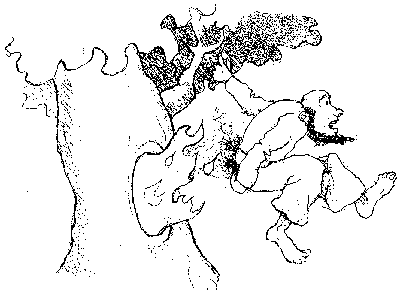
Hearing this solution, Wise decided to find out if it really was a tree spirit speaking from inside the tree. So he threw some hay into it and set it on fire. Immediately Verywise’s father grabbed onto a branch, jumped out of the flames and fell on the ground. He said in his own voice, “Although his name is Verywise, my son is just a clever cheater. I’m lucky that the one named Wise really is so, and I’ve escaped only half toasted!”

Then Wise and Verywise shared their profits equally. Eventually they both died and were reborn as they deserved.

The moral is: A cheater may be clever but not wise.

98. A Man Named Wise [Cheating]

Link: https://hhdorjechangbuddhaiiiinfo.com/2024/10/08/98-a-man-named-wise-cheating/

#Buddhisttalesforyoungandold #Buddhiststories #storiesforkids #moralstories #Buddha #Jatakastories #PansiyaPanasJataka

77. THE SIXTEEN DREAMS [CHAPTER 1. PANIC]

77. THE SIXTEEN DREAMS [CHAPTER 1. PANIC]

Once upon a time there was a king called Brahmadatta who was ruling in Benares, in northern India. One night he had sixteen frightening nightmare dreams. He awoke in the morning in a cold sweat, with his heart thumping loudly in his chest. The sixteen dreams had scared him to death. He was sure they meant that something terrible was about to happen. In a panic, he called for his official priests, to ask their advice.

When the priests arrived at the royal bed chamber, they asked the king if he had slept well. He told them that it had been the worst night of his life, that he had been scared to death by sixteen dreams, and that he was desperate to find out their meanings.

At this the priests’ eyes lit up. They asked him, “What were these dreams, your majesty?” King Brahmadatta told them all sixteen dreams. The priests pounded their foreheads and exclaimed, “Oh what horrors! It couldn’t be worse, your majesty. Such dreams as these can mean only one thing — danger!”

The king asked them, ‘What danger, oh priests? You must tell me the meaning at once!” They replied, It is certain, your majesty, these dreams show that one of three disasters will take place — terrible harm to the kingdom, to your life, or to the royal wealth.”

The king had feared as much. He wrung his hands as the sweat kept pouring from his body. He was shaking all over with terror and panic. He asked, “Tell me, oh worthy royal priests, is there any way to avoid this disaster?” “Indeed, it is very dangerous,” they said. “If you do nothing, the end is certain. But we can prevent it. If we couldn’t, then all our training and learning would be useless. Trust us, lord.”

The panic-stricken king cried out, “Just tell me what to do, priests. I’ll do anything! What can you do to save me, my kingdom and my wealth?” “We must offer the greatest animal sacrifice that has ever been seen,” they said. “We must kill, as sacrificial offerings, four of every type of animal that lives!”

Although he was usually a gentle, kind and merciful ruler. King Brahmadatta was so frightened that he couldn’t think straight at all. Paralyzed with fear, he put all his hope and faith in his priests. He gave them permission to prepare the gigantic slaughter.

The priests said, “Have no fear, your majesty, we will take care of everything. We will prevent the coming doom!” They knew they would be paid well to perform the sacrifice. And the meat from the killed animals would be theirs as well. Their secret thoughts were, “This is a great way for us to get piles of money, and the best food and drink too!”

The priests got to work organizing the biggest sacrifice Benares had ever seen. Just outside of town they dug a huge pit. Into it they put the most perfect ones they could find of all the animals — land animals, birds and fish. From each kind they selected four to be killed in the ceremony. It became known as the ‘Four-from-all’ sacrifice.

Meanwhile, the king’s senior teaching priest had a promising young pupil. He was gentle and compassionate, and very well-educated. He wondered about all that was happening. So he asked the teacher priest, “Oh master, you have taught me well the wise teachings of old. Can you show me anywhere it says the killing of one will save the life of another?”

The priest answered, “What kind of question is that? Open your eyes and be realistic, my boy. Don’t you see that this great sacrifice, the Four-from-all, will make us rich? You must be trying to help the king hold onto his riches! “

The idealistic and sincere pupil said, “You have not answered my question, master. If this sacrifice is to be your work, it shall be mine no longer!” With these words he departed and went to the royal pleasure garden to consider what he would do.

It just so happened that the Enlightenment Being had been born into a rich high class family. For many generations the men in that family had been priests, just like the ones who were now preparing the Four-from-all sacrifice. But when the Bodhisatta grew up he abandoned the life of a rich priest. Instead he went to the Himalayas and lived as a humble forest monk. He concentrated his mind in meditation and entered high mental states. He gained the sweetest inner happiness, and even miraculous supernatural powers.

This forest monk loved all the animals. When he heard about what was happening in Benares he was filled with tenderness and compassion. He decided, “I must teach the ignorant people and release them from the chains of superstition. I will go to the city at once!” Then he used his supernatural power to fly through the air to Benares. In an instant he was seated on a rock in the king’s pleasure garden. His gentle nature made him glow like a golden sunrise.

The idealistic young student approached and recognized him as a great holy man. He bowed respectfully and sat on the ground. The forest monk asked him, “Young man, do you have a good and just king reigning here in Benares?”

“Yes”, said the student, “our king is kind and good. But he is being misled by the royal priests. He had sixteen dreams which left him completely panic-stricken. The priests took advantage of this when he told them his dreams. They have convinced him to have a huge sacrifice and kill many animals. Oh holy one, please tell the king the true meanings of his dreams. Free the many helpless beings from fear and death.”

The holy man said, “If he comes and asks me, I will tell him.” “I will bring him, sir,” said the young man. “Kindly wait here a short while until I return.”

The student went to the king and told him there was a marvelous holy man seated on a rock in the royal pleasure garden. He told him he had said he could interpret the king’s dreams. Hearing this, the king went with him to the garden. A crowd followed behind.

77. The sixteen dreams [Chapter 1. Panic]

Link: https://hhdorjechangbuddhaiiiinfo.com/2024/02/27/77-the-sixteen-dreams-chapter-1-panic/

#Buddhisttalesforyoungandold #Buddhiststories #storiesforkids #moralstories #Buddha #Jatakastories #PansiyaPanasJataka

Embracing the Spirit of Christmas

A Reflection on the 1914 Christmas Truce

In the midst of the First World War, a remarkable event occurred that transcended the boundaries of conflict and highlighted the true essence of Christmas – the Christmas Truce of 1914. As we celebrate this joyous season, it’s essential to reflect on the lessons of compassion, love, and humanity that emerged during that extraordinary moment in history.

“It will be over by Christmas.” This false assurance echoed among the 60 million soldiers sent to the battlefront, exposing the grim reality that war does not adhere to predetermined timelines. The soldiers found themselves entrenched along the Western Front, living in harsh conditions, mere meters away from their adversaries.

Despite the hostility of war, the spirit of Christmas prevailed on that fateful Christmas Eve. German troops, unwrapping gifts from home and lighting lanterns along their trenches, initiated a surprising turn of events. Carol singing broke out, and soon British and French troops joined in, bridging the gap between enemies.

As Christmas morning dawned, a temporary ceasefire was proposed, and soldiers from both sides cautiously ventured into no man’s land. Greetings, well wishes, and even gifts were exchanged. Spontaneous football matches broke out, demonstrating a shared humanity that transcended the barriers of war.

The Truce of 1914 was not an isolated incident; it was a series of truces involving over 100,000 soldiers across the British-held area of the Western Front. The scale of these impromptu ceasefires is a testament to the universal longing for peace, even in the midst of one of the deadliest conflicts in history. Spontaneous football matches broke out, transforming caps and jackets into makeshift goal posts. Corporal John Ferguson vividly described the scene: “What a sight – little groups of Germans and British extending almost the length of our front! Out of the darkness we could hear laughter and see lighted matches, a German lighting a Scotchman’s cigarette and vice versa, exchanging cigarettes and souvenirs.”

Reflecting on the teachings of Jesus, who implored his disciples to love their neighbors, it becomes apparent that the message transcends religious boundaries. In times of war fueled by religious differences, it is crucial to remember that faith should serve as a source of inspiration for compassion, love, and kindness, irrespective of one’s beliefs.

Similarly, the teachings of Shakyamuni Buddha echo through time, emphasizing the compatibility and mutual respect among religions. The contemporary Buddha, H.H. Dorje Chang Buddha III, extends this ethos by acknowledging figures like Jesus Christ as great holy beings. In his Dharma discourses, His Holiness emphasizes the imperative for all Buddhist disciples: “When encountering living beings, regardless of whether they are handicapped, deficient, sick, or healthy, treat them all equally as family members…” His Holiness further calls for global cooperation, transcending religious, cultural, and national boundaries. He underscores the importance of treating each other as dear relatives, emphasizing a collective effort necessary for the peace and auspiciousness of the world.

As we celebrate Christmas today, let us draw inspiration from the Christmas Truce of 1914. In a world where conflicts persist, particularly in places like Gaza, may we strive for peace, understanding, and empathy. Let the spirit of Christmas be a beacon of hope, guiding us towards a future where love triumphs over hatred, and unity prevails over division.

The Christmas Truce of 1914 serves as a timeless reminder that even in the darkest of times, the light of humanity can shine through. As we gather with loved ones during this festive season, may we carry the spirit of Christmas within our hearts and work towards a world where the message of love and peace prevails.

Embracing the Spirit of Christmas: A Reflection on the 1914 Christmas Truce

Link:https://peacelilysite.com/2023/12/20/embracing-the-spirit-of-christmas/

#SpiritofChristmas #Christmas #ChristmasTruce #WorldWarI #Peace#Compassion #Religion #History

Source: https://www.visionofhumanity.org/the-christmas-truce/#:~:text=As%20the%20German%20soldiers%20lit,were%20communicated%20between%20the%20trenches.