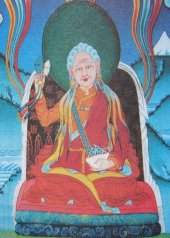
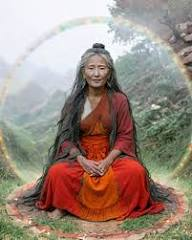
In the rich tapestry of Tibetan Buddhism, there are extraordinary practitioners whose lives themselves become teachings. Among them, Ayu Khandro (阿玉康卓) — also known by her Dharma name Dorje Peldron — stands as one of the most inspiring yoginis of the Nyingma tradition. Her life is not merely a story; it is a living example of devotion, perseverance, and profound realization.
Born in 1839 in the remote region of Kham, eastern Tibet, Ayu Khandro began her spiritual journey at a young age. She received teachings from many of the greatest masters of her time, including Jamyang Khyentse Wangpo, Jamgon Kongtrul, Chokgyur Lingpa, Nyala Pema Dundul, Adzom Drukpa, and Togden Rangrig — figures who were central to the non-sectarian Rimé movement in Tibetan Buddhism.
Unlike many who seek comfort or recognition, Ayu Khandro chose a life of renunciation and yogic discipline. She wandered widely across Tibet, lived in caves and hermitages, and devoted herself to decades of intense meditation. She spent more than fifty years in retreat, including prolonged periods of dark retreat, known in Tibetan as Yangti Nagpo — an advanced Dzogchen practice where the meditator withdraws from external light to focus inwardly on the nature of mind.
Dzogchen — The Great Perfection
Ayu Khandro’s life was profoundly rooted in Dzogchen (Great Perfection) — a teaching that points directly to the intrinsic, luminous nature of consciousness. Rather than seeking external accomplishments, she focused entirely on direct inner realization.
She was recognized as a terton — a revealer of hidden teachings — and was particularly known for transmitting sacred practices and giving initiations to practitioners, including the renowned master Chogyal Namkhai Norbu Rinpoche, who later wrote her biography based on her own oral account.
Ayu Khandro lived to the remarkable age of 115. In 1953, near the end of her life, she received visitors, gave away her precious possessions, and continued to teach and encourage those around her. After she passed away, it is reported in Tibetan Buddhist biography that her body remained in meditation posture for about two weeks before any signs of physical change occurred. By the end of this period, her body had shrunk to a fraction of its original size — an occurrence some traditions associate with deep spiritual attainment in Dzogchen practice, where the physical elements dissolve into subtler states.
This remarkable account, while extraordinary, is part of how her life has been transmitted in spiritual biographies — not as a spectacle, but as a sign of the depth and authenticity of her practice.
What makes Ayu Khandro’s life especially compelling is not just her longevity or her meditative achievements, but her steadfast devotion to the Dharma. She never sought fame or comfort. Instead, she walked the rugged paths of realization, teaching through action rather than words, presence rather than proclamation. Her retreats, pilgrimages, and meditation practices were not about escape, but about coming fully home to the true nature of mind.
Although few of us will ever undertake decades of meditation in darkness or faraway hermitages, Ayu Khandro’s life still speaks directly to modern seekers. In an era filled with distraction and ambition, her example invites us to ask:
What is true commitment?
How deeply can we trust the path we walk?
Can we place inner understanding above outer achievement?
Her life encourages us to remember that spiritual depth is not measured by loud accomplishments, but by quiet fidelity to practice.
Ayu Khandro remains a powerful reminder that liberation is not found on the surface of life, but in its quiet depths. Her unwavering dedication, her silent courage, and her embrace of the path offer inspiration — not as myth, but as a living reminder of what is humanly possible when devotion meets discipline.
H.H. Dharma King Kyabje Trulshik Chokyi Lodro is one of the most accomplished masters of the Nyingma sect in the present age. He is also one of the few remaining great masters of Tibetan Buddhism who has real and extensive knowledge, real training, and true cultivation. He is a lineage holder of many important dharma lineages. He is a great dharma king who does not distinguish among the various sects of Buddhism. H.H. Dharma King Trulshik and the most magnificent modern dharma kings of Buddhism, such as the H.H. Dudjom Dharma King and H.H. Dharma King Dilgo Khyentse, have been masters and disciples of one another. H.H. Dharma King Trulshik also taught the dharma of many lineages to the 16th Karmapa. He is a personal master of H.H. the Dalai Lama as well as a master of the most recent reincarnation of the H.H. Dudjom Dharma King, H.H. Dharma King Dilgo Khyentse, and H.E. Dharma King Tulku Ugyen.
Many Rinpoches had different views concerning which great Bodhisattva H.H. Dharma King Trulshik was the incarnation of. Thus, the International Buddhism Sangha Association held an unprecedented Drawing Lots From a Golden Vase Ceremony to affirm the true reincarnated identity of H.H. Dharma King Trulshik and others. There were ten possible identities recognized by various rinpoches. One lot was drawn from among 120 lots to affirm the true reincarnated identity of H.H. Dharma King Trulshik. That drawing affirmed that H.H. Dharma King Trulshik is the nirmanakaya of Maitreya Bodhisattva, which is the reincarnated identity that H.H. Dorje Chang Buddha III recognized before that lot was drawn.
In history, H.H. Dharma King Trulshik incarnated as Thonmi Sambhota, who created the Tibetan written language. Later, he incarnated as the great translation master Bairotsana, who was one of the twenty-five major disciples of Guru Padmasambhava. H.H. Dharma King Trulshik will be the next Buddha of this Good Eon (Bhadra-kalpa) of one thousand Buddhas. At that time, all of his disciples who heard him expound the Buddha-dharma will attain accomplishment in the dharma.
The dharma king was born on September 10, 1924, the year of the wooden rat, which was the exact birthday of Guru Padmasambhava. He was born in Wengre Cave, which is a holy place of cultivation in southern Tibet. Many auspicious phenomena appeared at the time of his birth. The father of the dharma king, Dianjin Queda, was a practitioner of yoga. His mother, Jiangyang Wangmu, was a descendent of Zhangba Jialei, who was the first Drukpa Dharma King and founder of the magnificent Drukpa lineage.
The dharma king was extraordinary ever since childhood, especially with respect to his deep self-cultivation. When he was four years old, his master, Zhachu Rinpoche (who was a disciple H.H. Dharma King Trulshik personally taught in his previous life as Trulshik Dongak Lingpa), invited him to the Zhalongpu Monastery in the Latuo Xueka District. At that time and place, memories of his prior life spontaneously welled up in the mind of the dharma king. He recounted in detail past events of that prior lifetime. Zhachu Rinpoche had personally witnessed those past events of his former master. Zhachu Rinpoche wept as he orally corroborated each of those events without exception. Zhachu Rinpoche was truly astonished by this and firmly believed that this boy must be the incarnation of Trulshik Dongak Lingpa. After the rinpoche practiced the Selection of Karmic Affinity Dharma, he affirmed that the boy was undoubtedly the incarnation of Trulshik Dongak Lingpa.
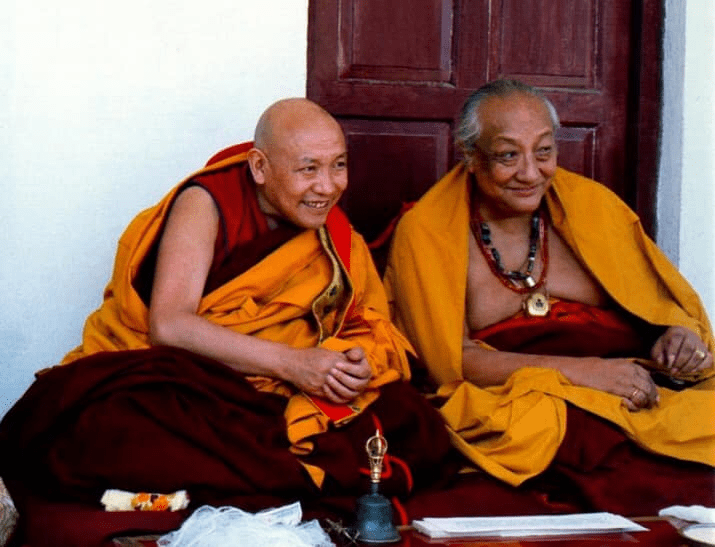
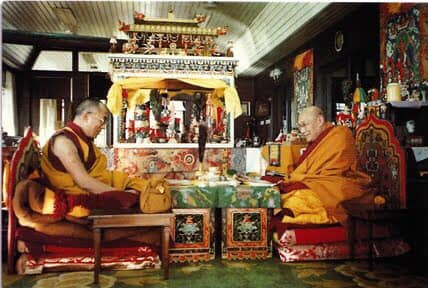
Dharma King Dilgo Khyentse Rinpoche (right) and his main Dharma heir, the Fifth Dharma King Trulshik Rinpoche (left)
The Gelug sect’s Dalai Lama invited the Nyingma sect’s Dharma King Trulshik to transmit the supreme Dharma
At the Mindrolling Monastery, the dharma king engaged in extensive learning. He received all of the monk precepts from his precept masters Cuikenqiong Rinpoche and Mindrolling Kenqian Khyentse Norbu according to the “Formal Pronouncement on Precepts” lineage passed down from Laqian Qianba Lasa. Present-day dharma kings unanimously agree that H.H. Dharma King Trulshik is one of the most important lineage-holders of this lineage. H.H. Dharma King Trulshik holds three types of precepts that are on different levels: the Pratimoksa precepts, the Bodhisattva precepts, and the precepts for tantric masters. The dharma king is one who truly wears a golden precept robe. Not only does he abide by the precepts for monks, he also completely abides by all of the Hinayana, Mahayana, and Vajrayana precepts. That is why he deserves to be called a “holder of the Vajra Three Secrets Vows.” H.H. Dharma King Trulshik is the main transmitter of the monastic vows within the Nyingma lineage.
The dharma king has received teachings on the sutras and tantras, as well as other teachings. He has visited famous masters in many places to learn Buddha-dharma, including over thirty famous masters who belong to ancient and modern sects of esoteric Buddhism. The dharma king has studied all of the dharma teachings of these important lineages and has put them into practice. He still learns assiduously even after he completed a strict three-year retreat. Accepting the request of Zhachu Rinpoche, the dharma king became the khenpo of the Zhalong Dongga Qielin Monastery, where he is responsible for upholding, protecting, and spreading the dharma.
Throughout his whole life, the dharma king has wholeheartedly cultivated himself in retreat. Every day he abstains from speaking until 10:00 in the morning. Each year the dharma king goes into retreat in his own temple for as much as nine months. All of the great Tibetan rinpoches acknowledge that as a master of masters, the dharma king has the greatest abilities and power to clearly point out the way leading to realization of one’s original nature. That is why extremely virtuous masters send their capable disciples to the dharma king in order to seek teachings and empowerment.
H.H. Dharma King Trulshik has vast and profound learning. His practice is solid and flawless. He is unassuming and amiable. No one in today’s world can match his profound experience, training, and realization. Many practitioners of the various sects regard him as a venerable Dharma King Master with limitless wisdom and vast supernatural powers. H.H. Dharma King Trulshik has recognized the identities of the person who is the incarnation of H.H. Dharma King Dilgo Khyentse, the person who is the incarnation of H.E. Dharma King Tulku Ugyen, and persons who are incarnations of other important rinpoches. He has also transmitted dharma to and performed initiations for such people. The dharma king is a magnificent practitioner of the Great Perfection Dharma and a magnificent accomplished one in our current age. He is a model master of this century with disciples spread all over the world.
After H.H. Dharma King Trulshik saw who His Holiness Dorje Chang Buddha III Wan Ko Yeshe Norbu is through the limitless omniscience displayed in A Treasury of True BuddhaDharma, he stated that His Holiness Wan Ko Yeshe Norbu has reached the highest state of Buddhahood in the few-thousand-year history of Buddhism, having truly attained complete. Dharma King Trulshik wrote a respectful congratulation letter.
RESPECTFUL CONGRATULATIONS His Holiness Buddha Vajradhara (Dorje Chang Buddha) Yangwo Wan Ko Yeshe Norbu: I recently learned that the book about you, A Treasury of True BuddhaDharma, was published a long time ago. The content of that book includes the traditional Tibetan five major vidyas and five minor vidyas. In terms of modern branches of learning, the book involves more than thirty different branches of learning. Thus, I entered samadhi and visualized the Three Jewels the Buddha, the dharma, and the sangha. I pervasively spread bodhicitta and wished that all living beings would realize the supreme, absolute truth and Buddhahood. May the propagation of A Treasury of True Buddha-Dharma be the karmic condition whereby living beings in the three spheres leave the sufferings of reincarnation and obtain the fruit of wonderful happiness. It will become the cause whereby each sentient being who has descended into the abyss of the six realms of reincarnation leaves suffering and attains happiness. I hereby specially convey my respectful congratulations!
Buddhist monk Ngawang Chokyi Lodro, having the undeserved name of Khenpo Zhalong Trulshik Shatrul Written on the auspicious day of June 28, 2007


 Peace LiLy