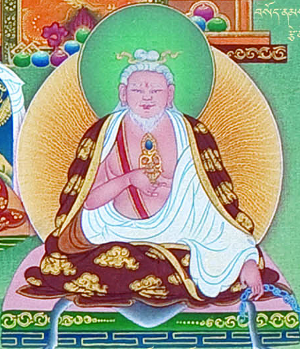
H.E. Tangtong Gyalpo is a greatly accomplished person within Tibetan esoteric Buddhism who attained the rainbow body. He is a great Bodhisattva known and respected by one and all in Tibet.
He is also an extremely holy person who has made huge contributions to the Tibetan people. It was this great Bodhisattva who was the father of medicine, ferryboats, bridges, and operas in Tibet. He has brought to the living beings of Tibet limitless blessings. To this day, Tibetan temples and families continue to worship H.E. Tangtong Gyalpo Bodhisattva.
The first Tangtong Gyalpo left the household life to become a monk when he was very young. He studied the sutras and treatises and became good at debating the sutras. Although he possessed the Five Vidyas, he remained modest, simple, and down-to-earth. In order to provide a model of self-cultivation, H.E. Tangtong Gyalpo followed and learned under many people of great virtue.
He also engaged in solitary, quiet cultivation for a long period of time at the Eri Temple. Later, he received teachings directly from Dakini Niguma and became a person greatly accomplished in the dharma. People praised H.E. Tangtong Gyalpo with the following words: “In the vast realm of emptiness, there is a yogi who intensively studies emptiness and who is like the King of Fearlessness. His name is Tangtong Gyalpo.” He has also been respectfully called Zhibai Wangxiu Tangtong Gyalpo, which means the accomplished, free and unhindered Tangtong Gyalpo!
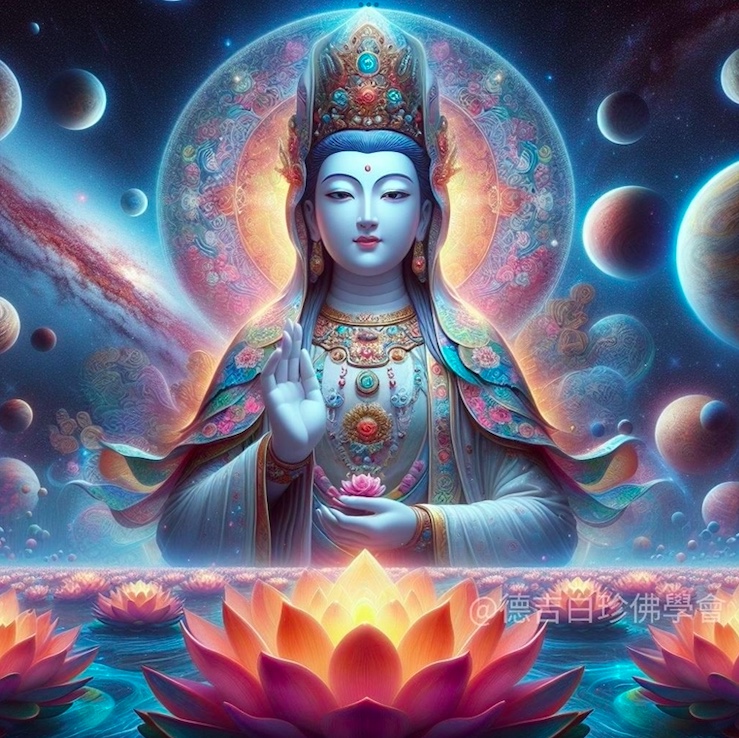
During a certain year in history, there was a serious drought and famine in Tibet. H.E. Tangtong Gyalpo conducted a Dharma Assembly in front of the Sakyamuni Buddha statue in the Jo-khan Temple in Lhasa. At that Dharma Assembly, he wrote “A Prayer to Eliminate Famine.” Many people then saw Kuan Yin Bodhisattva in the sky disseminating various grains. The famine ended not long after that.
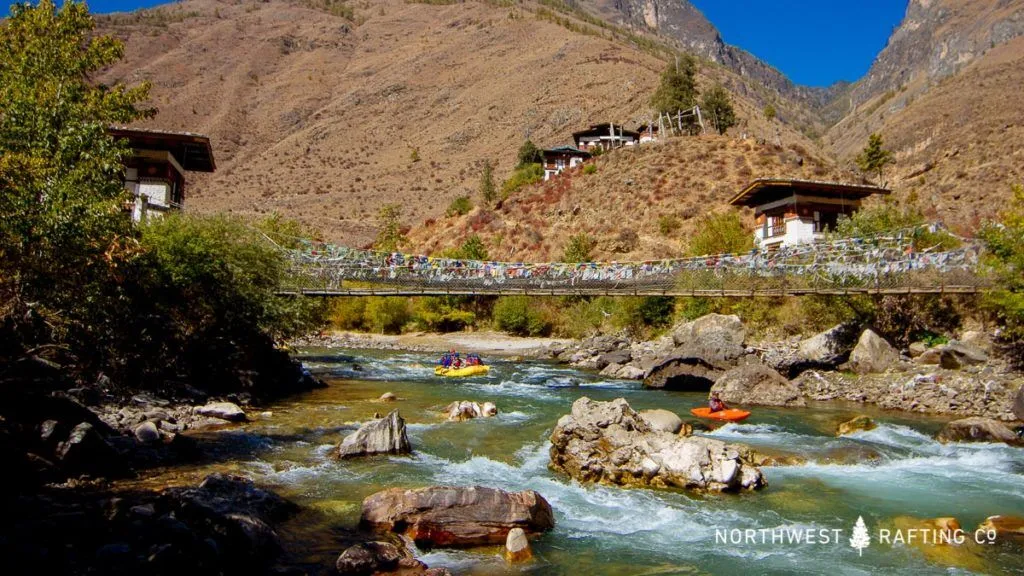
There was another time when war and chaos occurred in the Muya district of Kham in Tibet, causing people to leave their homes and wander about. H.E. Tangtong Gyalpo made a vow and wrote “A Prayer to End War and Chaos.” People in that area very soon after that ended their mutual hatred and instead treated one another in a peaceful, friendly, and loving manner. There was another year when a pestilence broke out in a large area covering a religious site of the Sakya sect, causing countless deaths. The chanting of mantras and the offering of sacrifices could not end the pestilence. Thus, H.E. Tangtong Gyalpo again practiced dharma and wrote “A Prayer to End the Disaster of Illness.” As a result, the pestilence disappeared forthwith. In previous times in Tibet, it was very difficult for people to cross rivers. The river waters mercilessly took away people’s lives as they attempted to cross the rivers. Thus, H.E. Tangtong Gyalpo made improvements to ferryboats and began building bridges. In that lifetime, he built fifty iron-chain bridges, sixty wooden bridges, and many temples. One of those temples was the Tangge Lakong (the Tangtong Gyalpo Temple), which was the first temple in the Derge region. With respect to medicine, H.E.Tangtong Gyalpo established the Medicine King Temple at Jiabori in Lhasa, invented a white pill that cured all kinds of internal medical diseases, and invented a red pill that cured epidemic diseases. Thus, he became the founder of Tibetan medicine. That white pill and red pill are used in Tibetan medicine even to this very day to relieve the sufferings of living beings.
This 600 year old bridge crosses the Paro Chhu (Paro River) and was traditionally restored in 2005 after being washed away during a 1969 flood. The bridge was originally built by the legendary Thangtong Gyalpo
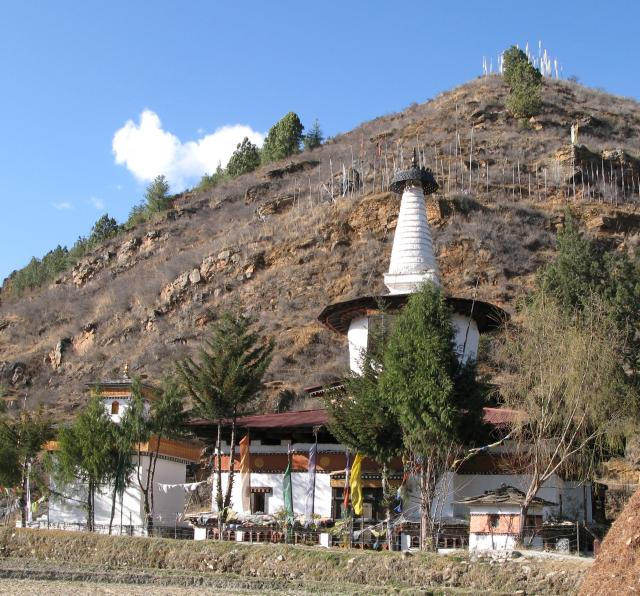
Dungtse Lhakhang, a temple in form of a chörten near Paro in Bhutan was built by Thangtong Gyalpo. The roof construction is made of iron.
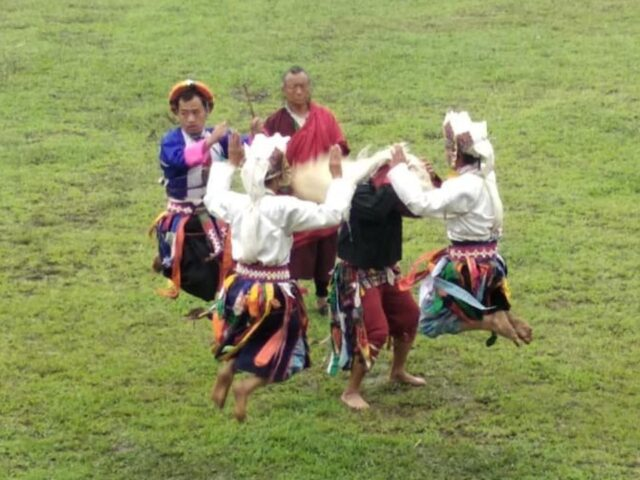
H.E. Tangtong Gyalpo Bodhisattva also wrote many Tibetan operas and established the Ache Lhamo opera troupe, the members of which acted out Tibetan historical stories through song and dance and pioneered Tibetan operas. The Achi Lhamo opera, with the starting troupe of seven sisters who worked on the saint’s bridges, is still performed and enjoyed hugely to these days during the new year celebration and on festive occasions.
Achi Lhamo Opera Composed by Thang Tong Gyalpo Still Prevalent in Bhutan
H.E. Tangtong Gyalpo was the supreme leader of four esoteric sects within India, Bhutan, Sikkim, Mongolia, and Eastern Tibet. He possessed teachings from many dharma lineages, the most remarkable of which were the lineage to extend one’s life and the lineage to bring in wealth and change one’s fortune. Everyone in Tibet, no matter what sect he or she belonged to, believed in and practiced such lineages and scriptures. Countless disciples of H.E. Tangtong Gyalpo became accomplished in the dharma under his teachings and attained great supernatural powers, wisdom and great compassion. More than one hundred disciples of his attained the rainbow body or the transformation rainbow body. All Tibetan people know that H.E. Tangtong Gyalpo is truly a great patriarch of Tibetan esoteric Buddhism and a great Bodhisattva. Later, each time H.E. Tangtong Gyalpo incarnated into this world. He was a great patriarch who spread the dharma, liberated living beings, and pervasively benefited people.
Thang Tong Gyalpo Present Reincarnation
H.E. the sixteenth Tangtong Gyalpo Bodhisattva (Thangtrul Rinpoche) took birth in Bhutan. His physical appearance resembles that of Guru Padmasambhava. Even when he sleeps, his eyes remain open. He saw H.H. Wan Ko Yeshe Norbu (Dorje Chang Buddha III) during a Dharma Assembly that took place in 2005 at Hua Zang Si in San Francisco, U.S.A. In a supernatural state of samadhi, he instantly saw that H.H. Dorje Chang Buddha, the highest ancient Buddha in the dharma realm, had already come to this world again. He at once formally acknowledged H.H. Dorje Chang Buddha III Wan Ko Yeshe Norbu as his master. H.H. Dorje Chang Buddha III asked him, “Did you follow and learn dharma under Guru Padmasambhava? Why have you come here?”H.E. Tangtong Gyalpo answered that he had received teachings directly from Guru Padmasambhava and from H.H. Sakya Trizin who is the nirmanakaya of Manjushri Bodhisattva. He also said that he had come to request the highest dharma in order to save living beings. H.H. Dorje Chang Buddha III immediately snapped His fingers, and a dharma bowl manifested awesome power. H.H. Dorje Chang Buddha III then accepted H.E. Tangtong Gyalpo as one of his disciples who is on the level of a great venerable one and performed an initiation for him. H.E. Tangtong Gyalpo took that dharma bowl back to his home country.
He later learned that the book A Treasury of True Buddha-Dharma about the H.H. Dorje Chang Buddha III Wan Ko Yeshe Norbu Holiest Tathagata was about to be published. He thereupon organized many rinpoches to practice the Kuan Yin Dharma one billion times as an offering to His Holiness Dorje Chang Buddha III. He also sent his written congratulations stating that His Holiness is the master of Buddhas, the magnificence of His Holiness is supreme and that in this world no other holy being in history can compare with His Holiness.
H.H. Dorje Chang Buddha III accepted H.E. Tangtong Gyalpo as his disciple at Hua Zang Si temple San Francisco
The True Story of Khenchen Tsewang Rigdzin (Khenpo Chaiwan Runzheng)
Article provided by Jinghan
There have been great practitioners who attained the accomplishment of the Rainbow-Light Body (the ability of moving one’s body anywhere at will without being blocked or stopped by any material or force) in our current era. This is a true story. A Khenpo who cultivated at the Zhuqing Temple, in order to liberate himself at the time of Cultural Revolution in China and in order to inspire the later generations to believe in the Buddha-dharma, manifested his entering of nirvana in the form of demonstrating his Rainbow-Light Body.
There really have been great practitioners with the accomplishment of Rainbow-Light Body! Khenpo Chichengluozhu once investigated and reported such an event.
Under Shining Daylight and in Front of Many People’s Eyes, a Person Vanished with His Body into Nowhere
Investigation on a person’s mysterious disappearance 44 years ago
Time can erase people’s memory on many things in the past. As each day slipped by us, we may suddenly realize that the past would never come back. Only some very special events will pass the filtering of time to remain at the bottom of our hearts and coalesce into unforgettable scenes in our memory.
I am certain that, to many people who live in Tongde County, Huangnan Region, Qinghai Province, Khenchen Tsewang Rigdzin (Khenpo Chaiwan Runzheng) is such a treasured memory in their minds. This great accomplished practitioner of the Nyingma Sect who suddenly flew away and disappeared into the sky in September, 1958, in front of the soldiers who escorted him, has evolved from a topic of after-dinner chat among local people into a legendary character in people’s minds. He was eventually elevated into the status of a spiritual leader and source of confidence. During the time of over 40 years that the story has been spread by word of mouth, a question exists. Is this an image created by people’s illusion for resting their fragile hearts, or is this a living drama of freedom from birth and death performed by a truly accomplished practitioner with the achievement of flying and vanishing away? Many people, including myself, had thought about, analyzed, and even doubted this matter. However, we all based our thinking on a simple and self-evident truth: we cannot rule out the possible existence of something we did not see. Insisting on seeing-with-my-own-eyes and hearing-with-my-own-ears may still lead to hearing “true stories” from other people. In analyzing a complex event, respecting the facts is the best way in finding the underlying truth. Only time can provide the most fair and eventual testing and judgment. With such a motive, I stepped onto the legendary land of Huangnan in Qinghai Province. My sole purpose was to depict a true picture of and provide the true story about Khenchen Tsewang Rigdzin (Khenpo Chaiwan Runzheng), for benefiting the people, especially the future generations.
1. Brief Introduction on the Life of Khenchen Tsewang Rigdzin (Khenpo Chaiwan Runzheng)
Before I describe the process and findings from my investigation, let me first give an introduction on the life of this Master of the Nyingma Sect to the readers. I’d like to stress the following: the information and materials I collected were all from reliable sources.
Khenchen Tsewang Rigdzin (Khenpo Chaiwan Runzheng) was born in 1883, in Maiwa Village of Hongyuan County, Sichuan Province. At the age of 10, he entered the Zhaxiquenang (meaning auspicious dharma bell) Temple to study the dharma. When he was 15, he had a formal ceremony to receive the precepts and became a monk. Then, he immediately went to the Zhuqing Temple, one of the six major temples of the Nyingma Sect to study the Tripitaka and took refuge with a number of great accomplished masters. At the age of 25, he received the perfect and complete precepts of Bhiksu to become a monk. Since then, he strictly abided by the precepts and carefully avoided violations as if protecting his own eyes. Eventually, his clothing, waist belt, meditation mattress and other things used daily all had a clear and pure scent coming out of them. During this long period of cultivation and questing for the dharma, he received many initiations within the lineage of the Nyingma Sect, and demonstrated many times that he had above-normal character, including being conversant in the Sutra and Tantra teachings and superlative wisdom. When he was 30, he was accepted by Maipeng Rinpoche to learn the profound dharma. When the Master taught him the dharma with the linage from Manjushri Bodhisattva, he was instantly enlightened by the essence of the Bright and Great Perfection. From then on, he easily commanded many Sutras and the classic books of Esoteric Buddhism (tantras).
Khenchen Tsewang Rigdzin (Khenpo Chaiwan Runzheng) then went to the mountains to cultivate ascetic practices. His ascetic practices can truly be regarded as representative and a role model among all ascetic practitioners. First, because of the living conditions at the time, the external environment for practicing asceticism was extremely challenging and tough. On the other hand, Khenchen Tsewang Rigdzin’s (Khenpo Chaiwan Runzheng’s) will and determination through his persistence and devotion under the cruel conditions were very moving and inspiring to other people. Every meal, he just ate a little roasted barley flour along with a bowl of water. Such a daily intake of thin flour soups had made a small bag of roasted barley flour last for a whole year. He lived such a life without sufficient food throughout the long period of ascetic practices. At one time, when roasted barley flour and cooking oil was used up, he had to cook the cow-skin container bag for cooking oil as food to sustain his life. The lack of food was not the only major hindrance for Khenchen Tsewang Rigdzin (Khenpo Chaiwan Runzheng). With no oil for light at night, he could only study books by moonlight. While climbing the hill following the movement of moonlight, he would eventually reach the summit peak. There was such scenery at the place he was cultivating: when the sunlight began to shine on the summit peak, his shadow would be there to see off the last ray of moonlight. During the nights without moonlight, he would use the almost lightless light from the ashes of the cooking bonfire to read the Sutras.
To Tsewang Rigdzin (Chaiwan Runzheng), his sleeping at night had almost been completely substituted by meditation. He had no additional clothing to what he wore during the day for keeping warm at night. Through such ascetic practices, one night in his dreams, he met the founding master of Tibetan Esoteric Buddhism, Guru Padmasambhava, who was wearing an amber necklace. Since then, his wisdom was so stimulated that he was able to memorize and recite Sutras that are as long as 24,000 words.
While cultivating inside the snow mountain near the Zhuqing Temple, Khenchen Tsewang Rigdzin (Khenpo Chaiwan Runzheng) ate only one meal a day. Sometimes, he might be without food for three days in a row. To make himself more alert and to keep from falling asleep during meditation, he sat on the snow-covered ground with bare-feet, wearing only one short skirt! Due to the long-time exposure to ice and snow, his feet suffered permanent damage and since then he could only walk with the aid of two walking sticks.
That is how this genuine practitioner cultivated himself under all types of hardships and stress. He applied all aspects of his three karmas of body, voice, and mind to quest for and to experience the essence of the dharma. At the same time, his life demonstrated, to people in this world, the possibility and pathway in attaining enlightenment in one’s current life. Even the side effects he suffered in the form of bodily handicaps (he needed to be carried in order to move) was just an indication of not being attached to worldly affairs from an accomplished practitioner with the achievement of the Rainbow-Light Body. Huadan, the care-taker of Khenchen Tsewang Rigdzin (Khenpo Chaiwan Runzheng), had in-depth knowledge on this. Once, Huadan was tying the waist belt for his master. Unexpectedly, the whole belt completely penetrated the waist of the Master and came back to his hand. Huadan was totally surprised. He did the tying one more time and made a tight knot. However, when he started to use a little force to tighten the belt, the whole belt again completely penetrated the Master’s body. Only then Huadan realized the real reason for what happened.
With the achievement of the Rainbow-Light Body, there was no shadow from the body of Khenchen Tsewang Rigdzin (Khenpo Chaiwan Runzheng) under light during evenings and at night. Another indication of the Rainbow-Light Body achievement is that the body cannot be blocked or stopped by any worldly material or force. Another care-taker of Khenchen Tsewang Rigdzin (Khenpo Chaiwan Runzheng), Arluo, had personally witnessed the penetrating capability of the Master’s body.
One day, Arluo was leaving home to run an errand. As usual, he left the Master resting in the bedroom and locked the door when leaving the house. When he was returning home from the errand, he was totally shocked to see the Master sitting outside the house. Normally, the Master would be carried to get out of the house for sunlight. How could he get out this time, with the door being locked? Arluo verified that the door was still locked and without any damage. Then he checked the window, which was also closed from the inside. Besides, the size of the window would not even allow a person to get through. The only possible answer was that Khenchen Tsewang Rigdzin’s (Khenpo Chaiwan Runzheng’s) body had become a Rainbow-Light Body or Vajra-immortal body.
Khenchen Tsewang Rigdzin (Khenpo Chaiwan Runzheng) had pushed away all worldly attachment to concentrate on cultivating the path toward the supreme Buddha-dharma. However, due to certain causes and affinity, in 1951, at the elderly age of 68, he was respectfully invited to be in change of the Shangdan Temple in Tongde County, Huangnan Region of Qinghai Province. At that time, Khenchen Tsewang Rigdzin (Master Chaiwan Runzheng) was quietly cultivating in the Yellow-Dragon Holly Mountain in Jiuzhaigou area of Sichuan Province. The invitation came from Jinmei-deqing-duojie, the reincarnated third-generation Zhongwuo Rinpoche, who was the founding master of the Digan Temple in Tongde County. At that time, the construction of the Shangdan Temple was not completed yet. With the help of Jinmei-deqing-duojie Rinpoche, Master Tsewang Rigdzin (Chaiwan Runzheng) oversaw the completion and opening of Shangdan Temple at the end of 1951. Since then, I have been the abbot of the Shangdan Temple. Before 1958, Shangdan Temple had been the home base of Khenchen Tsewang Rigdzin (Khenpo Chaiwan Runzheng) for propagating the dharma and benefiting living beings.
Another event that occurred during this period can be regarded as a footnote to the later mysterious disappearance of Khenchen Tsewang Rigdzin (Khenpo Chaiwan Runzheng). After he had settled in Shangdan Temple, his hometown Hongyuan kept sending people to ask him to come back. Khenchen Tsewang Rigdzin (Khenpo Chaiwan Runzheng) declined all their invitations. Once, after going to the toilet, he called his disciples over and said, “These (people from Hongyuan) insisted on getting me back there, but I will not go. Through the years, my practice of the Phowa Dharma has reached a very high level. I am able to reincarnate myself. The temple here is still relatively new, you all must manage everything well. If they force me to go back, I will reincarnate myself on the way back.”
This story tells us that Khenchen Tsewang Rigdzin (Khenpo Chaiwan Runzheng) was able to control his life or death using the Phowa Dharma. There were more examples that provided explanations to what he did later on. Here is another.
Three people, Dawa, Wangqin and Nanda, who currently still live in Tongde County, remember to this day an event that occurred shortly before Khenchen Tsewang Rigdzin’s (Khenpo Chaiwan Runzheng’s) flying away. At the time, they and the Khenpo were to be sent to prison. Before starting their prison terms, the four and some other detainees were temporally held in a military camp. Dawa was 21 years old and Wangqin and Nanda were about the same age. The three all witnessed a scene of the Khenpo’s practicing the Phowa Dharma in front of people.
When the Khenpo chanted the first sound of “Ho”, they all saw that his hair pointed upward and his ears were growing and expanding, until reaching the forehead. At that time, an officer quickly came and pointed his pistol toward the Khenpo’s head. The Khenpo was not at all affected by this. He spitted another “Ho.” The three then saw that all his hairs were pointing up and the ears had grown to the top of his head. The officer then yelled to the Khenpo for a while, as if telling him not to make the sound of “Ho” again. The Khenpo calmly accepted the officer’s instruction and stopped the Phowa Dharma. He said OK to the officer.
44 years after that, the elderly Dawa was still very moved when talking about that event: “I was very close to the Master at the time. There were only two people between him and me. I clearly saw the entire process from beginning to the end. Now I understand. If the Master wished to leave, he could have done that right away but he chose to stay for the time being.”
2. Flying Away into the Sky
Let’s end here the brief introduction about Khenchen Tsewang Rigdzin’s (Khenpo Chaiwan Runzheng’s) life before his flying-away. What is described below is one popular version of the event that was commonly known to the elder local people in Tongde County. This version was known to most people and believed by most people. Our investigation, witness interviewing, analysis and verification were conducted around this version.
According to local people, one day in September of 1958, a mass assembly was to be held near the Digan Temple in Tongde County to criticize and interrogate Khenchen Tsewang Rigdzin (Khenpo Chaiwan Runzheng). At that time, he was already in jail in the County Prison. Several small hills must be crossed from the prison to the site of the mass assembly. Several soldiers were escorting the Khenpo after taking him from the prison. Because of his handicap, the Khenpo was allowed to ride on the back of a red yak. When the group of five or six people were approaching their destination, an extremely strong and violent whirlwind (cyclone) suddenly took place. The wind was so strong that none of the soldiers could open their eyes. Their location at the time was close to the top of a hill, with a distance of several kilometers from the Digan Temple. After the wind had gone away, the soldiers started to look around. However, Khenchen Tsewang Rigdzin (Khenpo Chaiwan Runzheng) was no longer on the yak. Before starting the trip, to prevent an accident, the soldiers had tied the Khenpo tightly on the back of the yak with rope. All their efforts were proven to be in vain, because the Khenpo had flown into the sky, accompanied by several auspicious colored clouds. This event was witnessed by many people at the scene.
3. My Investigation
If you come to Tongde County and mention the name of Khenchen Tsewang Rigdzin (Khenpo Chaiwan Runzheng) to people, almost anyone will tell the above story to you in similar details. Even though the story is so commonly known, I still decided to do my investigation from the start. My first goal was to clarify the doubt many people may have. On the other hand, I wanted to have the facts recorded truthfully. I wished to find out: did people put their feelings into the story so the truth got covered by kind lies? Also, between legend and fact, to what degree and scope can the truth be re-manifested?
The people I interviewed in my investigation included some who were escorting the Khenpo at the time; those who were near the location when the Khenpo was flying away, including some eye witnesses; and a number of people who listened to the entire story from eye witnesses. When putting their words into text, I wrote down exactly what they said almost without editing a word. My goal was to let the readers draw their own conclusions naturally, without being influenced by the subjective and, possibly, already fixed thinking in my mind. I believe that this style of truthfully presenting the original narration would be convincing to the readers.
My first interview was with the elderly Zhimei, who is 77 years old now. He was a local shepherd in Tongde County. He told me:
“On the day when Master Tsewang Rigdzin (Chaiwan Runzheng) was taken from the prison to the site of the mass meeting, I was watching cattle on one of the hills he must pass. I saw several soldiers passing by with the Master. They tied the Master onto the back of a red yak. When they went over the top of the hill, I was with the cattle half way on the hill. Then, I suddenly saw the Master, in monk’s clothing, started to ascend from the other side of the hill. At the beginning, he was flying up slowly. Eventually he disappeared into the clouds. Many people said that there was a strong swirling wind and auspicious colorful clouds appeared in the sky but I did not see those scenes. This may be because I was half way up this side of the hill, while the Master had already gone to the other side. All I saw was that the Master flew into the sky. I saw that with my own eyes. I was still young then with good eye sight. It would be impossible that what I saw was some illusion. Years later, the charges to those jailed in 1958 were dropped. The Master’s hometown Hongyuan also sent people to request the Master’s remains from Tongde County. I knew that they would not get them because the Master flew away into the sky. I saw that with my own eyes. I told this to my family members but I dare not to tell the people from Hongyuan. After all these years, now as an elderly person of almost 80 years old, I am telling this story again from my memory. Do you think I would fabricate it to deceive you? I absolutely do not have any false statement in it. I do not have any reason to lie on this. In general, there are two possible motives for one to lie. One is trying to reap benefits from doing so. The other is being forced to lie and under pressure. My situation has nothing to do with either of these. That’s why I can guarantee you that I did not make any false statement in what I said.”
The elderly Zhimei was an eye witness of the event. The next person I met, Chongpeier, provided detailed collaborating materials in many aspects. Also, he was the most talkative person among those I interviewed.
Chongpeier is over 60 now. He is a local resident and currently stays at home after retiring from his job. He was a middle-level cadre of Tongde County. He described to me, in great detail, what he learned on this event:
“I remember that it was a day in October of 1988. I was the director of the Bureau of Industry and Commerce Management of Tongde County then. On that day, when it was near the end of workday, a Han (mandarin) person came to see me and invited me to have dinner with him. At the dinner table, he told me his purpose of looking for me. His name was Li Desheng and he was from the Shangchun Village of Huangzhong County in Qihai Province. He came to Tongde County to buy about 500 head of cattle and lambs from local people. He wanted to ask me a favor of collecting less taxes and fees from him. He told me that he knew many senior officials in Tongde County very well, but not me. I asked him where he had worked before. He said that he has been a soldier in the security force of Tongde County and had risen to the position of a squad leader. While we were enjoying wine and dining, he told me a miraculous experience of his that was beyond imagination:
‘I saw a person who flew away in front of my own eyes. At that time, I and several soldiers of my squad were escorting that Lama from the prison to the mass meeting site near the Digan Temple. We tied him tightly onto the back of a yak and surrounded him as we were on our way. While we were climbing the hill and close to the top, he started to chant something that we could not understand. At the top of the hill, we ordered him to stop making the sound. Then we saw that the other side of the hill was flat land. Suddenly, many pieces of colored clouds flew over. The Lama got carried away by the clouds!
Father Francis Tiso, a Catholic Priest and renowned scholar of Tibetan Buddhism, shares the unforgettable story behind his riveting book Rainbow Body and Resurrection: Spiritual Attainment, the Dissolution of the Material Body, and the Case of Khenpo A Chö. Khenpo A Chö was a Tibetan monk who, through retreat, prayer, and meditation, prepared his body to turn into radiant light upon his own death. When Khenpo A Chö died, he achieved this phenomenon (it’s called the rainbow body), and in the year 2000, Father Tiso traveled to Tibet to report on its profound significance and how it connects to resurrection across other religions, including the resurrection of Jesus Christ. “They started calling me the Jesus Lama,” Father Tiso tells Wonderstruck’s Elizabeth Rovere, marking one of the many surprising and tender moments from his remarkable journey.
In Vajrayana traditions of Tibetan Buddhism, tangible matter is considered to be made up of five elements: space, air, fire, water, and earth. As described in Tibetan literary sources, including TheTibetan Book of the Dead, the elemental energies that make up the cosmos are understood to be undifferentiated from those that make up the human body. Therefore, the body is simultaneously an individual person and the cosmic whole.
Certain Buddhist meditation practices are meant to alter the gravitational field of these five elements that constitute the body, transforming them into the five radiant lights of the color spectrum. The Tibetan name given to this physical fluorescence is jalu, literally meaning, “rainbow body.” Rainbow body is also the name given to the transformation of the ordinary physical body as a result of years of specific disciplined practices.


 Peace LiLy