The mystery of what happens after we die has intrigued humanity for centuries. While various belief systems and religions offer their interpretations, the quest for scientific evidence has been an ongoing journey. “Many Lives, Many Masters” by Dr. Brian Weiss takes us on a remarkable voyage through past-life regression therapy, providing substantial evidence that life does not end with death. As a Buddhist who has at times questioned the concept of the life and death cycle, I found this book to be a profound revelation that resonated with my own beliefs.
Dr. Brian Weiss, a prominent psychiatrist and skeptic, had his beliefs challenged when he began treating a patient named Catherine through traditional psychotherapy. Surprisingly, under hypnosis, Catherine began to recall not only her past life experiences but also the concept of reincarnation, which greatly differed from Dr. Weiss’s own beliefs.
What makes “Many Lives, Many Masters” particularly compelling is the abundance of real-life incidents documented throughout the book. Dr. Weiss’s meticulous recording of Catherine’s past-life memories, her interactions with various spirits, and her ability to provide verifiable information from the past all serve as a testament to the reality of her experiences. These experiences create a strong argument for the idea that life continues beyond the physical realm.
Brian Weiss’s background as a trained psychiatrist lends scientific credibility to his exploration of past-life regression therapy. He applies rigorous methodologies to Catherine’s case, ensuring that her experiences are thoroughly documented and verifiable. This scientific approach is essential in making the case for life after death, even to skeptics.
As a Buddhist, I have often contemplated the concept of rebirth and karma, central tenets in Buddhist philosophy. “Many Lives, Many Masters” aligns with these beliefs, providing further validation for the idea of reincarnation and the continuation of life beyond death. The book has given me renewed confidence in the cycle of life and death, offering a fresh perspective on the timeless teachings of Buddhism.
“Many Lives, Many Masters” is a book that challenges the boundaries of conventional thinking and encourages readers to explore the idea that life extends beyond the physical realm. Dr. Brian Weiss’s compelling documentation of real-life instances and his scientific approach make this a captivating read for individuals from all walks of life. Whether you approach this book as a person of faith, a skeptic, or someone in between, it offers a thought-provoking and enlightening journey into the possibility of life after death.
There are certain pieces of writing that strike a chord in us, resonating with our deepest emotions and thoughts. One such masterpiece is Bert Hellinger’s poem “The Life”. As a profound expression of the human experience, it has the power to touch and inspire people from all walks of life. In this blog post, I would like to share this beautiful poem with you and explore its meaning and impact.
The Life
Bert Hellinger
Life destroys everything superfluous, until only the important remains
Life does not leave you in peace, so you stop fighting, and accept everything as it is?
Life takes what you have, until you stop complaining and learn gratitude
Life sends you troubled people so that you can heal and stop projecting what you have inside.
Life lets you fall again and again, until you decide to learn the lesson.
Life takes you out of the way and presents you with crossroads, until you stop wanting to control and learn to flow like a river.
Life puts you enemies on the road, until you stop “reacting”.
Life frightens you and startles you as many times as necessary, until you lose the fear and regain faith.
Life takes away your true love, it does not grant or allow it, until you stop trying to buy it with trinkets.
Life distances you from the people you love, until you understand that we are not this body, but the soul that powers it.
Life laughs at you so many times, until you stop taking everything so seriously and laugh at yourself. Life breaks you and breaks you in as many parts as necessary for the light to penetrate.
Life confronts you with rebels, until you stop trying to control.
Life repeats the same message, even with shouts and slaps, until you finally listen.
Life sends you thunder and storms, so you wake up. Life humiliates and defeats you again and again until you decide to let the EGO die.
Life denies you goods and greatness until you stop wanting goods and greatness and you begin to serve. Life cuts your wings and prunes your roots, until you need neither wings nor roots, but only disappear in the forms and fly from the Self.
Life denies you miracles, until you understand that everything is a miracle.
Life shortens your time, so you hurry to learn to live. Life ridicules you until you become nothing, until you become nobody, and so you become everything.
Life does not give you what you want, but what you need to evolve.
Life hurts you, hurts you, torments you, until you let go of your whims and tantrums and appreciate just breathing.
Life hides treasures from you, until you start your journey, until you go out to look for them.
Life denies you God, until you see it in everyone and everything.
Life shortens you, prunes you, takes you away, breaks you, disappoints you, cracks you, … until only LOVE remains.”
I came across Bert Hellinger’s “The Life” during a time of personal introspection, and it had a profound effect on me. The poem’s words were like a gentle whisper, reminding me of life’s intricate tapestry—its joys, sorrows, challenges, and triumphs. It helped me appreciate the beauty of the journey, the importance of embracing every moment, and the interconnectedness of all things. I believe that this poem has the potential to offer comfort, hope, and a fresh perspective to others who may be seeking it. It is a reminder to live life fully, to love deeply, and to find meaning in every experience.
I hope that Bert Hellinger’s “The Life” has touched your heart and soul as much as it has mine. May you find encouragement and inspiration within its verses to navigate the complexities of life with grace and courage. Life is a gift—a beautiful, ever-unfolding mystery that we have the privilege of exploring. Embrace it with open arms, cherish the moments, and let this poem be a guiding light on your journey. Remember, in the words of Hellinger, “The life that awaits us and that we always wanted, is there, ready for us to enter.”
After learning about Eastern painting, American painter Graves said: “I realized that art and nature are landscapes of the soul, from which we can perceive the essence of human existence.” When you are fortunate enough to encounter these masterpieces, you will gain insight into the essence of Eastern art.
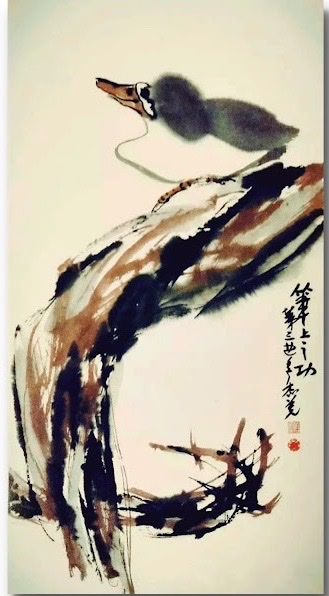
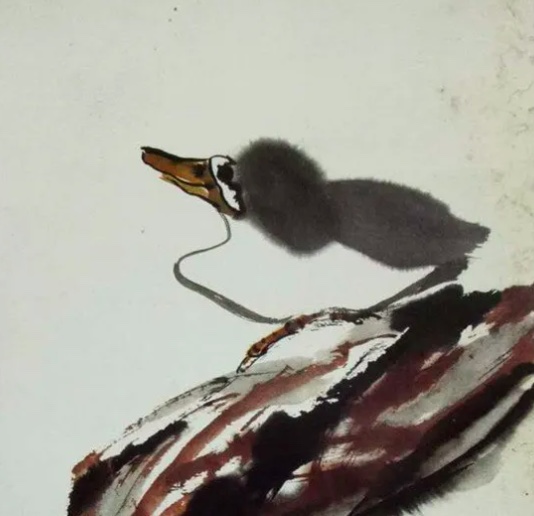
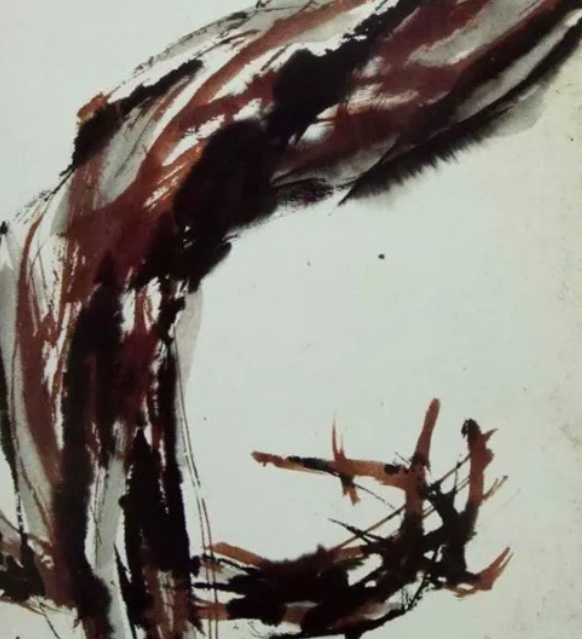
“Bi Shang Zhi Gong (Skillful Brushwork)” is a masterpiece of Chinese flower and bird painting that appears fresh and clear at first glance, profound in meaning after viewing, and unforgettable after further contemplation. The composition is extremely simple: in the center of the painting is a uniquely shaped bird with a flat, long beak and a spotlessly white belly. It sits comfortably and alone on the curved, thick trunk. Its eyes are ethereal and deep, as if completely focused; its posture demonstrates that wherever it is, is the focal point.
Upon careful observation, you will find that everything in the painting is in a state of colorful transformation. The bird’s head and back are painted with two blocks of ink that are close in shade, creating a melting effect, with the ink color seemingly still wet and spreading around.
The trunk’s ink lines are clear and distinct, resembling a tree yet not quite a tree, as if constantly changing in the impermanence. At the bottom left of the tree, a branch twists and turns out, creating an S-shaped composition in the painting that is still in motion. The painting also uses color sparingly, with only a warm and friendly purple-brown color applied to the bird’s beak and the trunk.
This painting has a fascinating story behind it. It was created in 1982 during the filming of a movie in Sanhe, Sichuan. The painting captures an on-the-spot portrayal of a real-life scene. The artist used ink sparingly, treating it as if it were as precious as gold, while still showcasing his exceptional skills. At the time, the News Film Studio of China was producing a documentary exclusively about the artist, Master Yi Yungao (H.H. Dorje Chang Buddha III).
The cameramen and other observers witnessed a wild duck landing on a withered tree trunk. Master Yi Yungao quickly picked up his brush and swiftly completed the entire painting. By the time the wild duck took flight again, the painting had already been finished. Furthermore, the artistic mastery embodied in this artwork is extraordinary. It not only preserves the elegance, purity, and high-quality of traditional paintings but also introduces a new style—expressing the artistic conception of returning to original purity and simplicity. The artist, with an unfettered hand and mind, applies his most mature skills without the slightest attachment and with minimal, natural brushstrokes.
This masterpiece Chinese painting by H.H. Dorje Chang Buddha III is rich in literary atmosphere and varied in layers. It does not merely depict the external world, but rather it serves as a true manifestation of the inner spirit, transcending the natural material form to open up the world through the illumination of life’s spiritual light, reflecting the spiritual world. Appreciating the painting can reveal the pure world behind it, where everything, including the self, is forgotten, remaining untainted.
Albert Einstein and Charlie Chaplin were two of the most iconic figures of the 20th century, known for entirely different reasons. A memorable exchange from early in their friendship perfectly and humorously illustrates these differences.
Einstein once expressed his admiration for Chaplin’s art, saying, “What I most admire about your art is its universality. You don’t say a word, yet the whole world understands you!”
Chaplin’s response, delivered with impeccable comedic timing, was, “True. But your glory is even greater! The whole world admires you, even though they don’t understand a word of what you say.”
I find myself in agreement with Chaplin. While I may not grasp the intricacies of Einstein’s scientific achievements, I admire him as a profound thinker who grappled with life’s deepest questions. His reflections on the universe and our place within it have been particularly inspiring to me since my youth.
Einstein’s curiosity and search for meaning are traits that many of us can relate to. He once expressed a desire to ask God about the origins of the universe, believing that such knowledge would lead to a deeper understanding of life’s purpose. He said, “I used to think that if I could ask God one question, it would be about how the universe began, because then all the rest would be just equations. But as I got older, I became less concerned with how the universe began. Instead, I would want to know why he started the universe. If I knew that, then I would know the purpose of my own life.”
Furthermore, Einstein pondered the nature of the universe and our perception of it, stating, “The most important decision we make is whether we believe we live in a friendly or hostile universe.” This quote underscores the power of our beliefs and attitudes in shaping our experiences and interactions with the world around us. A friendly universe is one where we see opportunities for growth and connection, while a hostile universe may lead to fear and isolation.
The Einstein quote that resonates with me the most is, “A human being is a part of the whole, called by us ‘Universe,’ a part limited in time and space. He experiences himself, his thoughts and feelings as something separated from the rest, a kind of optical delusion of his consciousness. This delusion is a kind of prison for us, restricting us to our personal desires and to affection for a few persons nearest to us. Our task must be to free ourselves from this prison by widening our circle of compassion to embrace all living creatures and the whole of nature in its beauty. Nobody is able to achieve this completely, but the striving for such achievement is in itself a part of the liberation and a foundation for inner security.” In this quote, Einstein alludes to the Buddhist concept of interconnectedness and the illusion of separateness. However, Einstein likely only grasped the theoretical concept and did not experience the oneness with the universe. The Buddha, on the other hand, has seen the truth, experienced the oneness, and achieved inner realization.
Over two thousand five hundred years ago, Shakyamuni crossed the Nairanjana River and sat under a Bodhi tree, where he was immersed in deep inner contemplation. At that time, he was tormented by worldly desires, hunger, craving for sleep, and fear and doubt. But he triumphed over these internal demons and continued his inner quest.
Then, like a limitless, penetrating beam of light, Shakyamuni experienced a moment of clarity in which he gained profound insight that life is eternal and one with the vast cosmos. He became a Buddha—a person awakened to the supreme truth of the Law of life.
The Buddha, Siddhartha Gautama, achieved enlightenment under the Bodhi tree, and the first words he spoke were: “How amazing, how amazing, all sentient beings possess the wisdom and virtue of the Tathagata. However, due to delusions and attachments, they cannot realize it. “
In the eyes of the Buddha, all sentient beings inherently possess the wisdom, the characteristics, and the blessings of the Tathagata within their minds that are troubled by afflictions, defilements, and the cycle of birth and death. Through this teaching, we know that Buddha-nature is inherently present in all sentient beings.
Einstein’s words resonate with the teachings of Buddha, who attained enlightenment and taught that all beings are interconnected. Buddha’s teachings emphasize compassion and understanding for all living beings, recognizing that we are all part of the same universe. Unlike Einstein, who believed that complete compassion was unattainable, Buddha demonstrated that it is possible to embrace all living beings and the universe in its entirety with love and kindness.
However, Buddhism is much deeper and vaster than just these concepts. All Buddhas possess three bodies and four wisdoms. The Mahāyāna theory of the three bodies—the dharma-body, the reward-body, and the response-body—is most common. The dharma body (法身) is considered to be the eternal, indestructible true principle, the Buddha’s original body. The response body (應身) is considered to be the Buddha’s manifest body, but in Mahāyāna Buddhism, it is regarded as the personification body, which manifests from the true principle according to the temperaments and abilities of sentient beings in order to save them.
The reward body (報身) is manifested as a combination of the other two and is therefore not simply the eternal true principle, nor simply an impermanent personality. Rather, it is an ideal body possessed by those who have awakened to the true principle based on meritorious practice. It is the living form of the eternal principle, possessing individuality. This is a general explanation, and there have been many interpretations of the Buddha-body theory in the history of Buddhism, among which there are significant differences. The three bodies are not separate entities but three integral aspects of a single Buddha.
The four wisdoms of Buddha are: Great Mirror Wisdom, which is still and void—motionless; Universal Wisdom, which is capable of facing mind-defilements without attaching to them through love or aversion; Wonderful Observing Wisdom, which has the ability to discriminate and discern the wide field of sensory impressions, while at the same time never experiencing unbridled and reactionary patterns of thought; and Perfecting Wisdom, which can direct all the sense faculties into observing phenomena without being constrained by dualism.
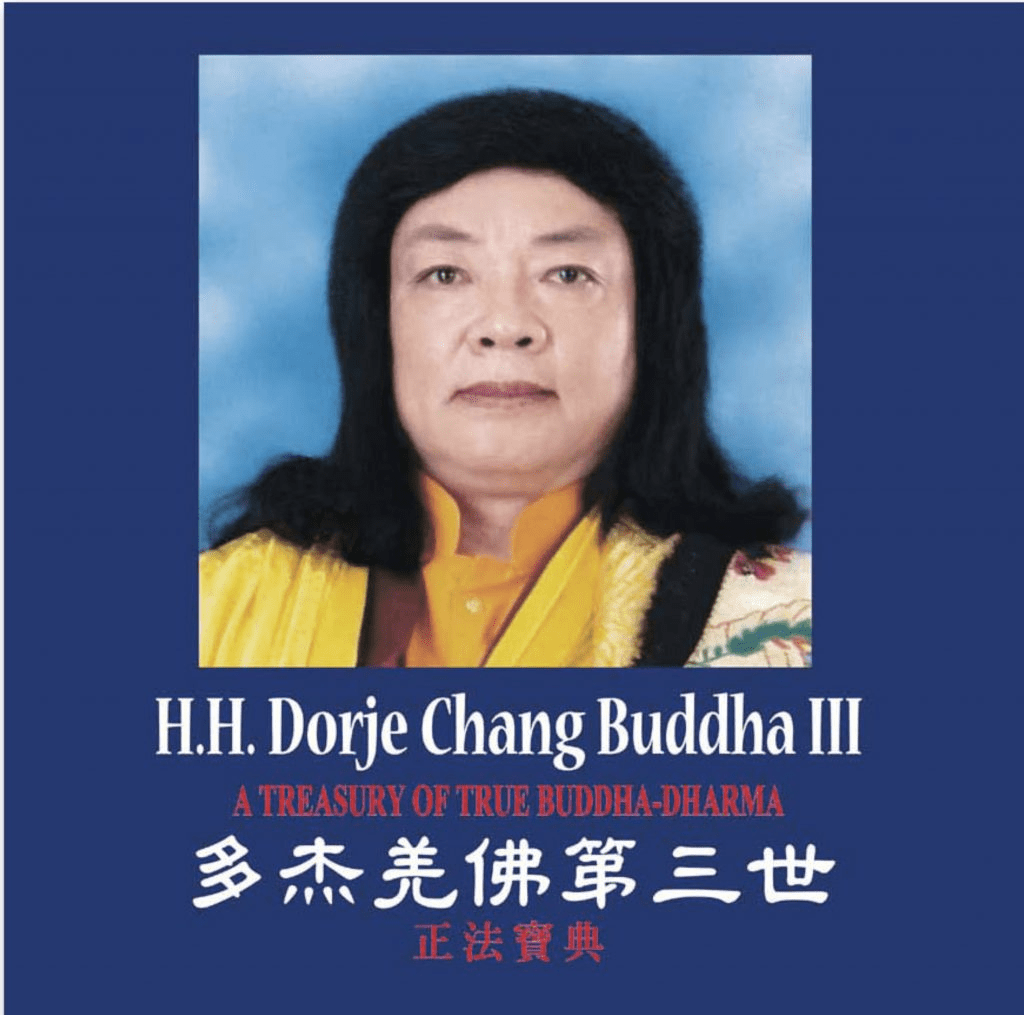
Buddha possesses vast knowledge, superb skills, magnificent supernormal power, and comprehensive wisdom of the universe. The treasure book, “H.H. Dorje Chang Buddha III,” stands as a testament to this statement. However, this book contains only a drop of water from the vast ocean of Buddha’s teachings and wisdom.
The video below showcases the boundless compassion and highlights the extraordinary accomplishments of H.H.Dorje Chang Buddha III. It was published by China Educational Channels TV and features interviews with Buddhist disciples from around the globe.
Discovering the Root of Buddhism, Propagating True Buddha Dharma(H.H. Dorje Chang Buddha III)
Tantra is the secret or esoteric part of Buddhist practice. It is often referred to as the vajrayana or Diamond Path. It is also used as a term for the secret scriptures or esoteric writings. Although it includes the highest dharma within the Buddha-dharma, you should not consider it to be superior or that the exoteric Buddhism practiced by other sects should be considered a low level of dharma. The Buddha-dharma is not divided into high and low as comparisons. All 84,000 dharma methods came into being in response to the different innate faculties of living beings. The Buddha-dharma has only one truth no matter how it is expressed.
Exoteric Buddhism and vajrayana Buddhism are not two separate schools. Exoteric Buddhism is half of a dharma system. True vajrayana Buddhism includes the teachings of the various schools of exoteric Buddhism plus mantras, mudras, visualization, mandala offerings practiced either as a group or alone, and inner and outer tantric initiations. It includes a foundation in the cultivation of the “dharmakaya” from exoteric buddhism as well as the more advanced cultivation of the “sambhogakaya” and the “nirmanakaya.” In vajrayana or tantric practice one strives to realize all three kayas in one lifetime. However, this is ONLY possible if one is able to follow a true vajra master and receive authentic inner tantric initiation.
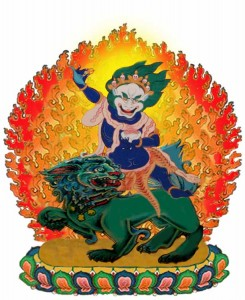
Lion Vajra, an important dharma protector in the Buddha School
True esoteric Buddhism includes all the teachings of the exoteric schools as well as the secret teachings and practices. There are those who claim to be esoteric teachers who can only offer intricate hand movements or mudras, chant mantras, make mandala offerings, or lead the disciple through elaborate visualizations, but who teach or know little of the exoteric sutras. This is not true esoteric Buddhism. Without the foundation in the essential doctrine of the Buddha as found in the Tripitaka, one should not even do the esoteric practices, let alone teach them. That is why the authentic temples which has holly masters teach meditation practices from the Theravadan and Zen or Ch’an Schools, along with certain Pure Land Practices and those of the Hua-yen and Fa-hsiang Schools and others as well as the esoteric methods. Disciples are taught according to their particular karmic affinity with the dharma.
Sometimes these exoteric techniques are taught concurrently with certain esoteric or tantric practices and sometimes they must be mastered prior to introduction to tantra. Not all students are able to receive tantra, which in its highest forms can bring liberation in this lifetime. However, everyone can progress and reach high levels of achievement, according to their efforts and karma. All of the teachings of our temples are to lead beings to liberation from the suffering of the cycle of life and death. That is the only purpose in practicing Buddhism! This is an important point!
Those who learn exoteric Buddhism exclusively are learning only the foundational aspect (some of the theoretical or doctrinal part) of Buddhism. The esoteric vehicle contains the lessor vehicle teachings AND the complete and unsurpassed mahayana teachings of both exoteric and the esoteric Buddhism AND the esoteric practices and rituals.
Tantric initiation is a ceremony within vajrayana Buddhism whereby dharma is transmitted according to tantra by means of a master’s limitless merit and power. During the ceremony, the master visualizes that he or she becomes one with a Buddha or Bodhisattva. During this ceremony the disciple is empowered by the master to carry out specific meditation practices. The student is ritually entered into a mandala of a particular tantric deity by his or her vajra master. He or she is thus empowered to practice the spiritual practices (sadhana) or associated mantras, mudras, and visualization of that deity.
There are three classes of initiation: Outer-tantric initiations, inner-tantric initiations and secret or supreme-tantric initiations (also called “holy” initiations). Each of these three classes is further divided into various dharma methods. During the highest and greatest inner-tantra and secret-tantra initiations there must be supernormal states that are manifested in front of the disciple at the Buddhist altar area (mandala). These miraculous states must be in accordance with the Tibetan tantra laid down by the Buddhas. The disciple is actually turned over to the Buddhas and Bodhisattvas during these initiations. You must remember that unless you personally see the manifestation of supernatural dharma powers, then you have not received an inner-tantric initiation. Most initiations given today are outer-tantra initiations. The supreme or holy initiations are rarely given with very few masters having the ability to perform this type of practice. Vajra masters must undergo certain tests that demonstrate their level of realization to be able to perform this type of ceremony.
Transmission of the greatest dharma requires true nectar during the initiation. For example, the highest dharma within vajrayana Buddhism, the initiation of Ati-yoga, Great Perfection of the Vajra division, requires nectar as an indispensable holy element for cleansing one’s negative karma and is the resource for planting the “Seeds of Vajra.” Other forms of inner trantric initiations can also eliminate karmic obstructions. Disciples can deeply penetrate into the dharma through inner-tantra initiations.
One must have accumulated considerable merit from past practices and good deeds to be able to receive tantra. There are certain preliminary practices that must be performed which can vary depending on the karma of the disciple. There are exceptions possible for 1) those who have completed these steps in a past life; 2) those with exceptional merit due to extraordinary offerings or actions in this life; and 3) through the grace of the guru.
Tantra requires the initiation or empowerment of a qualified teacher or master who provides specialized teachings, rituals, and practices to enable the disciple to root out or eliminate the dark side of his/her psyche and thus become like the Bodhisattvas and Buddhas. Supernormal powers are viewed as the natural outcome of realization and are used by qualified teachers. However, ordinary disciples are not allowed to discuss or display their supernormal powers. Only very highly evolved Bodhisattvas and Buddhas dare to display such powers and then only to help living beings. A person seeking initiation must demonstrate an understanding of emptiness, exhibit high moral conduct, and have developed an altruistic desire to help all beings. Any empowerment will have limited impact without a proper foundation of preliminary practices or Prayogas. It recognizes that supernormal powers cannot be given to one who has not eliminated the negative aspects of the self.
Today as in times past, the highest tantric teachings and practices are only transmitted orally and are held in great secrecy between the teacher and the disciple. Because of the power of these teachings, it is recognized that the student must be thoroughly prepared to receive them. A true master will usually test a disciple for six to twelve years or longer before transmitting the higher teachings.
A Zen practitioner was meditating by the river when he heard struggling sounds. Upon opening his eyes, he saw a scorpion struggling in the water.
He reached out to lift it up, only to be stung by the scorpion’s raised stinger. He placed the scorpion on the bank and continued meditating.
After a while, he heard struggling sounds again. Opening his eyes, he saw the scorpion had fallen back into the water.
He rescued it again, and of course, was stung once more. He continued meditating.
After a while, he had the same unfortunate encounter.
A nearby fisherman said, “You’re so foolish, don’t you know that scorpions sting people?”
The Zen practitioner replied, “I know, I’ve been stung three times.”
The fisherman asked, “Then why do you still save it?”
The Zen practitioner said, “Stinging is its nature, compassion is mine. My nature will not change because of its nature.”
At that moment, he heard struggling sounds again. Looking down, it was the same scorpion.
He looked at his swollen hand, then at the struggling scorpion in the water, and without hesitation, reached out to it again.
This story beautifully illustrates the Buddhist principle of compassion and loving-kindness towards all living beings, regardless of their actions. It embodies the teachings of the Buddha, who emphasized the importance of cultivating a heart full of compassion.
The practice of compassion is central to the Buddhist path. In Mahayana Buddhism, the Bodhisattva ideal embodies the ultimate expression of compassion. A Bodhisattva is one who, motivated by great compassion, has generated bodhicitta, the spontaneous wish to attain Buddhahood for the benefit of all sentient beings.
Moreover, the story reminds us of the great sacrifices made by Siddhartha Gautama, who later became known as Shakyamuni Buddha. He renounced his life of luxury and privilege to seek the ultimate truth of life and the universe. His journey was fueled by the desire to find a way to liberate all beings from the cycle of birth and death, known as samsara.
However, after two and a half millennia, the profound teachings of Shakyamuni Buddha have been gradually forgotten. To revive and propagate the Dharma once more, the primordial Tathagata Buddha, Dorje Chang Buddha, incarnated as H.H. Dorje Chang Buddha III in our world.
H.H. Dorje Chang Buddha III has not only brought the highest form of Buddha Dharma to this world but also set a remarkable example for all disciples through his boundless compassion and humility.
In the past decade, H.H. Dorje Chang Buddha III has endured significant suffering due to long-term persecution for his religious activities. A member country of Interpol once requested that the organization issue a warrant for his arrest. This request was later voluntarily withdrawn by the member country after several years. Following a thorough investigation, in October of 2008, the 72nd session of the Commission for the Control of Interpol’s Files withdrew the arrest warrant and dismissed the entire case against H.H. Dorje Chang Buddha III. Interpol also issued a document stating unequivocally that the arrest warrant against H.H. Dorje Chang Buddha III has been canceled and all member countries have been informed of the cancellation.
Although H.H. Dorje Chang Buddha III received official notification of the withdrawal of the arrest warrant and the removal of the entire case, he has never publicly displayed such documents to prove his innocence. Despite enduring slander, H.H. Dorje Chang Buddha III chose not to disclose this irrefutable evidence. When the World Peace Prize Awarding Council inquired about this, he responded by explaining that his duty is to bear all of the karmic offenses committed by living beings and to bestow upon them all of the good karma and merit that he has cultivated. He expressed concern that if he were to prove his innocence using those documents, those who slandered him would be perceived as guilty. He questioned, “Who, then, will bear their karmic offenses?”
There have been many instances that highlight his holiness’s profound compassion. For example, some of his disciples once left and defamed him, but he still welcomed them back with open arms and treated them no differently than before.
H.H. Dorje Chang Buddha III often reminds his disciples that he harbors no enemies and that all sentient beings are his dearest relatives. He encourages everyone to reflect on their own actions and to strive to lead a life filled with kindness, patience, and understanding.
His Holiness Dorje Chang Buddha III embodies the essence of selflessness and serves as a moral beacon for all to follow. He has also demonstrated how peace can be achieved through determination, humility, and the perseverance to champion its cause even in the face of adversity.
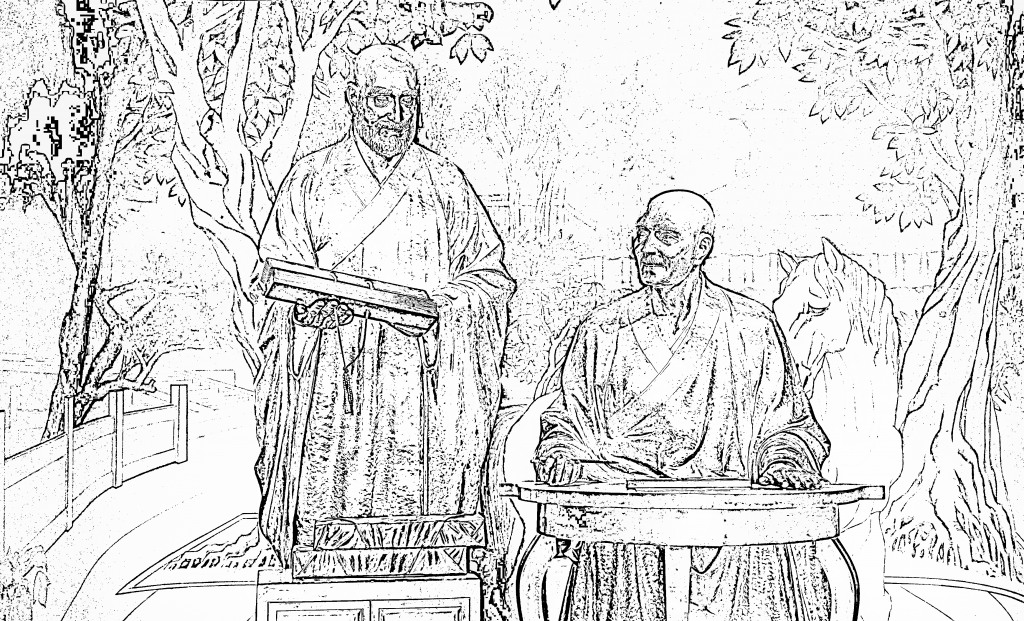
In 64 AD, Emperor Ming of the Eastern Han Dynasty sent Cai Yin and others on a mission to the Western Regions to retrieve Buddhist scriptures. The following year, in 65 AD, Cai Yin, Qin Jing, and others met the esteemed Indian monks She Moteng and Zhu Falan in Greater Yuezhi (present-day Afghanistan), where they were introduced to Buddhist scriptures and statues for the first time. In 67 AD, the Han envoy team returned to Luoyang with the high monks She Moteng, Zhu Falan, and the Buddhist scriptures and statues carried by a white horse. The two high monks were welcomed with a grand reception by Emperor Ming, who also commissioned the construction of China’s first temple, the White Horse Temple in Luoyang, especially for them.
White Horse Temple
On the first day of the first month in the fourteenth year of Yongping, Taoists from the Five Sacred Mountains submitted a petition requesting a competition with the Brahmin monks to determine the superiority of China’s native Taoism versus the foreign Buddhism. Emperor Ming granted the Taoists’ request. In 71 AD, a historic Buddhist-Taoist debate and contest unfolded in Chinese Buddhist history.
As the competition began, the Taoists said, “Let’s start with debating. You monks pride yourselves on eloquently explaining the Dharma, don’t you? So, let’s have a debate! If you can make one point, we will make two; if you raise one, we will counter with three. Go ahead and present your profound arguments!”
She Moteng slowly lifted one foot and raised it towards the sky, smiling, and said, “Amitabha, I have raised one, now it’s your turn to raise three!”
The Taoists looked at each other, stumped, and couldn’t think of a way to counter for a long time. They then changed the subject: “Let’s compare theories. You Buddhists call yourselves ‘Inner Learning,’ while you call us ‘Heterodox.’ But throughout history, when discussing inner and outer, inner has always been smaller than outer. So, your Inner Learning is small, and cannot compare to our great Heterodox!”
She Moteng brought his palms together in a gesture of respect and slowly explained: “The emperor resides in the inner palace, while the common people live in the outer city; although the inner palace is small, the emperor is great. The heart is inside the body, while the hands and feet are outside, the activity of the heart is boundless, while the movements of the hands and feet are limited. This is another example of how the inner is superior to the outer. Think carefully, the Inner Learning of Buddhism is much greater than the Heterodox!”
The Taoists, unable to win the debate, finally said, “Let’s compare magical powers!” How to compare? By placing the scriptures spoken by the Buddha and the scriptures spoken by the Taoist tradition together and burning them with fire. If one’s scriptures burn, then they are false; if one’s scriptures don’t burn, then they are true.
So, in the south of White Horse Temple, two high platforms were set up, one in the east and one in the west. The east platform held the Buddhist scriptures, images, and relics, while the west platform held the Taoist scriptures.
At that time, five hundred Taoist priests gathered the Taoist scriptures and magical texts together and prayed to the Supreme Lord Laozi, saying: “Oh, Taoist Virtuous Sage! Please show great divine power, and make our Taoist scriptures not burn, and let the Buddhist scriptures burn.”
Many of the Taoist priests at that time had supernatural powers – some could ride clouds and fog, some could fly in the sky and hide underground, and some could become invisible. Invisible means that you could see him right in front of you, and then suddenly he’s gone! There were Taoist priests with such abilities. They could use evasion techniques – Qimen Dunjia, to escape, and with Taoist spells and incantations, they had great supernatural powers.
But what happened when the fire was lit? The Buddhist scriptures did not burn; they emitted light! The Buddha’s relics also emitted a five-colored light, and the scriptures emitted light up into the sky, as if the sun was shining upon the world.
What about the Taoist scriptures? They caught fire as soon as they were burned and were completely destroyed by the fire. Those who could ride clouds and fog could no longer ride clouds or exhibit supernatural powers; those who could fly in the sky could no longer fly; those who could hide underground could no longer hide; those who could become invisible could no longer become invisible. Their spells and incantations also lost their effectiveness and had no power.
She Moteng and Zhu Falan, the two venerable monks, were responsible for overseeing this scripture contest, which was of great significance for the rise or fall of Buddhism. To strengthen the faith of the masses, She Moteng and Zhu Falan displayed eighteen divine transformations, levitating in the sky and reciting the following verses:
“The fox is not of the lion’s kind, a lamp is not as bright as the sun and moon; a pond cannot hold the vast sea, a hill cannot match the towering mountain. The Dharma cloud descends upon the world, the Dharma rain nourishes all beings. Supernatural powers are rare, manifesting everywhere to transform sentient beings.”
“The fox is not of the lion’s kind” means that, although the fox spirit is cunning and can change shape, it is far inferior to the lion. The fox and the lion cannot be compared; they are not of the same kind. This is saying that the breadth of Taoism is like the smallness of the fox, different from Buddhism, which has the grandeur of a lion.
“The lamp is not as bright as the sun and moon” refers to how the light of a lamp or a candle, which were small in the past, is far less bright than the light of the sun and moon. This means that the scriptures and teachings of Taoism are like the light of a lamp, while the Buddhist scriptures and teachings are like the light of the sun and moon, incomparable.
“A pond cannot hold the vast sea” means that a small pond has a limited capacity and can only hold a small amount of water, while the vast sea can accommodate many rivers. The pond and the sea cannot be spoken of in the same breath. This is a metaphor comparing the theories of Taoism to a small pond, while the teachings of Buddhism are like the vast and boundless sea.
“A hill cannot match the towering mountain” means that a small hill cannot compare to the grand and towering Mount Song, one of the Five Sacred Mountains of China. If the practice of Taoism is like a small hill, then the profound teachings of Buddhism are like the towering cliffs and deep ravines of ancient trees.
“The Dharma cloud descends upon the world, the Dharma rain nourishes all beings” means that when Buddhism spread to China, it was like a cloud of Dharma, like sweet dew, pervading the world and nourishing all beings.
“Supernatural powers are a rare thing” means that I have now shown supernatural powers, which is a rare and precious thing in the world.
“Everywhere transforming sentient beings” means that in reality, I did not want to show supernatural powers, and I did not want to compete with you. This is a last resort, for the purpose of guiding you and leading you to a brighter path, I am doing this as a convenient means.
After this contest, Buddhism took deep roots in China, not only producing a succession of talented individuals but also establishing a glorious foundation. White Horse Temple became the first and foremost temple in Chinese Buddhist history, and temples began to be built one after another. Ever since then the marvelous fruits and wondrous flowers of Chinese Buddhism have continued to flourish from generation to generation.
The True Story of Khenchen Tsewang Rigdzin (Khenpo Chaiwan Runzheng)
Article provided by Jinghan
There have been great practitioners who attained the accomplishment of the Rainbow-Light Body (the ability of moving one’s body anywhere at will without being blocked or stopped by any material or force) in our current era. This is a true story. A Khenpo who cultivated at the Zhuqing Temple, in order to liberate himself at the time of Cultural Revolution in China and in order to inspire the later generations to believe in the Buddha-dharma, manifested his entering of nirvana in the form of demonstrating his Rainbow-Light Body.
There really have been great practitioners with the accomplishment of Rainbow-Light Body! Khenpo Chichengluozhu once investigated and reported such an event.
Under Shining Daylight and in Front of Many People’s Eyes, a Person Vanished with His Body into Nowhere
Investigation on a person’s mysterious disappearance 44 years ago
Time can erase people’s memory on many things in the past. As each day slipped by us, we may suddenly realize that the past would never come back. Only some very special events will pass the filtering of time to remain at the bottom of our hearts and coalesce into unforgettable scenes in our memory.
I am certain that, to many people who live in Tongde County, Huangnan Region, Qinghai Province, Khenchen Tsewang Rigdzin (Khenpo Chaiwan Runzheng) is such a treasured memory in their minds. This great accomplished practitioner of the Nyingma Sect who suddenly flew away and disappeared into the sky in September, 1958, in front of the soldiers who escorted him, has evolved from a topic of after-dinner chat among local people into a legendary character in people’s minds. He was eventually elevated into the status of a spiritual leader and source of confidence. During the time of over 40 years that the story has been spread by word of mouth, a question exists. Is this an image created by people’s illusion for resting their fragile hearts, or is this a living drama of freedom from birth and death performed by a truly accomplished practitioner with the achievement of flying and vanishing away? Many people, including myself, had thought about, analyzed, and even doubted this matter. However, we all based our thinking on a simple and self-evident truth: we cannot rule out the possible existence of something we did not see. Insisting on seeing-with-my-own-eyes and hearing-with-my-own-ears may still lead to hearing “true stories” from other people. In analyzing a complex event, respecting the facts is the best way in finding the underlying truth. Only time can provide the most fair and eventual testing and judgment. With such a motive, I stepped onto the legendary land of Huangnan in Qinghai Province. My sole purpose was to depict a true picture of and provide the true story about Khenchen Tsewang Rigdzin (Khenpo Chaiwan Runzheng), for benefiting the people, especially the future generations.
1. Brief Introduction on the Life of Khenchen Tsewang Rigdzin (Khenpo Chaiwan Runzheng)
Before I describe the process and findings from my investigation, let me first give an introduction on the life of this Master of the Nyingma Sect to the readers. I’d like to stress the following: the information and materials I collected were all from reliable sources.
Khenchen Tsewang Rigdzin (Khenpo Chaiwan Runzheng) was born in 1883, in Maiwa Village of Hongyuan County, Sichuan Province. At the age of 10, he entered the Zhaxiquenang (meaning auspicious dharma bell) Temple to study the dharma. When he was 15, he had a formal ceremony to receive the precepts and became a monk. Then, he immediately went to the Zhuqing Temple, one of the six major temples of the Nyingma Sect to study the Tripitaka and took refuge with a number of great accomplished masters. At the age of 25, he received the perfect and complete precepts of Bhiksu to become a monk. Since then, he strictly abided by the precepts and carefully avoided violations as if protecting his own eyes. Eventually, his clothing, waist belt, meditation mattress and other things used daily all had a clear and pure scent coming out of them. During this long period of cultivation and questing for the dharma, he received many initiations within the lineage of the Nyingma Sect, and demonstrated many times that he had above-normal character, including being conversant in the Sutra and Tantra teachings and superlative wisdom. When he was 30, he was accepted by Maipeng Rinpoche to learn the profound dharma. When the Master taught him the dharma with the linage from Manjushri Bodhisattva, he was instantly enlightened by the essence of the Bright and Great Perfection. From then on, he easily commanded many Sutras and the classic books of Esoteric Buddhism (tantras).
Khenchen Tsewang Rigdzin (Khenpo Chaiwan Runzheng) then went to the mountains to cultivate ascetic practices. His ascetic practices can truly be regarded as representative and a role model among all ascetic practitioners. First, because of the living conditions at the time, the external environment for practicing asceticism was extremely challenging and tough. On the other hand, Khenchen Tsewang Rigdzin’s (Khenpo Chaiwan Runzheng’s) will and determination through his persistence and devotion under the cruel conditions were very moving and inspiring to other people. Every meal, he just ate a little roasted barley flour along with a bowl of water. Such a daily intake of thin flour soups had made a small bag of roasted barley flour last for a whole year. He lived such a life without sufficient food throughout the long period of ascetic practices. At one time, when roasted barley flour and cooking oil was used up, he had to cook the cow-skin container bag for cooking oil as food to sustain his life. The lack of food was not the only major hindrance for Khenchen Tsewang Rigdzin (Khenpo Chaiwan Runzheng). With no oil for light at night, he could only study books by moonlight. While climbing the hill following the movement of moonlight, he would eventually reach the summit peak. There was such scenery at the place he was cultivating: when the sunlight began to shine on the summit peak, his shadow would be there to see off the last ray of moonlight. During the nights without moonlight, he would use the almost lightless light from the ashes of the cooking bonfire to read the Sutras.
To Tsewang Rigdzin (Chaiwan Runzheng), his sleeping at night had almost been completely substituted by meditation. He had no additional clothing to what he wore during the day for keeping warm at night. Through such ascetic practices, one night in his dreams, he met the founding master of Tibetan Esoteric Buddhism, Guru Padmasambhava, who was wearing an amber necklace. Since then, his wisdom was so stimulated that he was able to memorize and recite Sutras that are as long as 24,000 words.
While cultivating inside the snow mountain near the Zhuqing Temple, Khenchen Tsewang Rigdzin (Khenpo Chaiwan Runzheng) ate only one meal a day. Sometimes, he might be without food for three days in a row. To make himself more alert and to keep from falling asleep during meditation, he sat on the snow-covered ground with bare-feet, wearing only one short skirt! Due to the long-time exposure to ice and snow, his feet suffered permanent damage and since then he could only walk with the aid of two walking sticks.
That is how this genuine practitioner cultivated himself under all types of hardships and stress. He applied all aspects of his three karmas of body, voice, and mind to quest for and to experience the essence of the dharma. At the same time, his life demonstrated, to people in this world, the possibility and pathway in attaining enlightenment in one’s current life. Even the side effects he suffered in the form of bodily handicaps (he needed to be carried in order to move) was just an indication of not being attached to worldly affairs from an accomplished practitioner with the achievement of the Rainbow-Light Body. Huadan, the care-taker of Khenchen Tsewang Rigdzin (Khenpo Chaiwan Runzheng), had in-depth knowledge on this. Once, Huadan was tying the waist belt for his master. Unexpectedly, the whole belt completely penetrated the waist of the Master and came back to his hand. Huadan was totally surprised. He did the tying one more time and made a tight knot. However, when he started to use a little force to tighten the belt, the whole belt again completely penetrated the Master’s body. Only then Huadan realized the real reason for what happened.
With the achievement of the Rainbow-Light Body, there was no shadow from the body of Khenchen Tsewang Rigdzin (Khenpo Chaiwan Runzheng) under light during evenings and at night. Another indication of the Rainbow-Light Body achievement is that the body cannot be blocked or stopped by any worldly material or force. Another care-taker of Khenchen Tsewang Rigdzin (Khenpo Chaiwan Runzheng), Arluo, had personally witnessed the penetrating capability of the Master’s body.
One day, Arluo was leaving home to run an errand. As usual, he left the Master resting in the bedroom and locked the door when leaving the house. When he was returning home from the errand, he was totally shocked to see the Master sitting outside the house. Normally, the Master would be carried to get out of the house for sunlight. How could he get out this time, with the door being locked? Arluo verified that the door was still locked and without any damage. Then he checked the window, which was also closed from the inside. Besides, the size of the window would not even allow a person to get through. The only possible answer was that Khenchen Tsewang Rigdzin’s (Khenpo Chaiwan Runzheng’s) body had become a Rainbow-Light Body or Vajra-immortal body.
Khenchen Tsewang Rigdzin (Khenpo Chaiwan Runzheng) had pushed away all worldly attachment to concentrate on cultivating the path toward the supreme Buddha-dharma. However, due to certain causes and affinity, in 1951, at the elderly age of 68, he was respectfully invited to be in change of the Shangdan Temple in Tongde County, Huangnan Region of Qinghai Province. At that time, Khenchen Tsewang Rigdzin (Master Chaiwan Runzheng) was quietly cultivating in the Yellow-Dragon Holly Mountain in Jiuzhaigou area of Sichuan Province. The invitation came from Jinmei-deqing-duojie, the reincarnated third-generation Zhongwuo Rinpoche, who was the founding master of the Digan Temple in Tongde County. At that time, the construction of the Shangdan Temple was not completed yet. With the help of Jinmei-deqing-duojie Rinpoche, Master Tsewang Rigdzin (Chaiwan Runzheng) oversaw the completion and opening of Shangdan Temple at the end of 1951. Since then, I have been the abbot of the Shangdan Temple. Before 1958, Shangdan Temple had been the home base of Khenchen Tsewang Rigdzin (Khenpo Chaiwan Runzheng) for propagating the dharma and benefiting living beings.
Another event that occurred during this period can be regarded as a footnote to the later mysterious disappearance of Khenchen Tsewang Rigdzin (Khenpo Chaiwan Runzheng). After he had settled in Shangdan Temple, his hometown Hongyuan kept sending people to ask him to come back. Khenchen Tsewang Rigdzin (Khenpo Chaiwan Runzheng) declined all their invitations. Once, after going to the toilet, he called his disciples over and said, “These (people from Hongyuan) insisted on getting me back there, but I will not go. Through the years, my practice of the Phowa Dharma has reached a very high level. I am able to reincarnate myself. The temple here is still relatively new, you all must manage everything well. If they force me to go back, I will reincarnate myself on the way back.”
This story tells us that Khenchen Tsewang Rigdzin (Khenpo Chaiwan Runzheng) was able to control his life or death using the Phowa Dharma. There were more examples that provided explanations to what he did later on. Here is another.
Three people, Dawa, Wangqin and Nanda, who currently still live in Tongde County, remember to this day an event that occurred shortly before Khenchen Tsewang Rigdzin’s (Khenpo Chaiwan Runzheng’s) flying away. At the time, they and the Khenpo were to be sent to prison. Before starting their prison terms, the four and some other detainees were temporally held in a military camp. Dawa was 21 years old and Wangqin and Nanda were about the same age. The three all witnessed a scene of the Khenpo’s practicing the Phowa Dharma in front of people.
When the Khenpo chanted the first sound of “Ho”, they all saw that his hair pointed upward and his ears were growing and expanding, until reaching the forehead. At that time, an officer quickly came and pointed his pistol toward the Khenpo’s head. The Khenpo was not at all affected by this. He spitted another “Ho.” The three then saw that all his hairs were pointing up and the ears had grown to the top of his head. The officer then yelled to the Khenpo for a while, as if telling him not to make the sound of “Ho” again. The Khenpo calmly accepted the officer’s instruction and stopped the Phowa Dharma. He said OK to the officer.
44 years after that, the elderly Dawa was still very moved when talking about that event: “I was very close to the Master at the time. There were only two people between him and me. I clearly saw the entire process from beginning to the end. Now I understand. If the Master wished to leave, he could have done that right away but he chose to stay for the time being.”
2. Flying Away into the Sky
Let’s end here the brief introduction about Khenchen Tsewang Rigdzin’s (Khenpo Chaiwan Runzheng’s) life before his flying-away. What is described below is one popular version of the event that was commonly known to the elder local people in Tongde County. This version was known to most people and believed by most people. Our investigation, witness interviewing, analysis and verification were conducted around this version.
According to local people, one day in September of 1958, a mass assembly was to be held near the Digan Temple in Tongde County to criticize and interrogate Khenchen Tsewang Rigdzin (Khenpo Chaiwan Runzheng). At that time, he was already in jail in the County Prison. Several small hills must be crossed from the prison to the site of the mass assembly. Several soldiers were escorting the Khenpo after taking him from the prison. Because of his handicap, the Khenpo was allowed to ride on the back of a red yak. When the group of five or six people were approaching their destination, an extremely strong and violent whirlwind (cyclone) suddenly took place. The wind was so strong that none of the soldiers could open their eyes. Their location at the time was close to the top of a hill, with a distance of several kilometers from the Digan Temple. After the wind had gone away, the soldiers started to look around. However, Khenchen Tsewang Rigdzin (Khenpo Chaiwan Runzheng) was no longer on the yak. Before starting the trip, to prevent an accident, the soldiers had tied the Khenpo tightly on the back of the yak with rope. All their efforts were proven to be in vain, because the Khenpo had flown into the sky, accompanied by several auspicious colored clouds. This event was witnessed by many people at the scene.
3. My Investigation
If you come to Tongde County and mention the name of Khenchen Tsewang Rigdzin (Khenpo Chaiwan Runzheng) to people, almost anyone will tell the above story to you in similar details. Even though the story is so commonly known, I still decided to do my investigation from the start. My first goal was to clarify the doubt many people may have. On the other hand, I wanted to have the facts recorded truthfully. I wished to find out: did people put their feelings into the story so the truth got covered by kind lies? Also, between legend and fact, to what degree and scope can the truth be re-manifested?
The people I interviewed in my investigation included some who were escorting the Khenpo at the time; those who were near the location when the Khenpo was flying away, including some eye witnesses; and a number of people who listened to the entire story from eye witnesses. When putting their words into text, I wrote down exactly what they said almost without editing a word. My goal was to let the readers draw their own conclusions naturally, without being influenced by the subjective and, possibly, already fixed thinking in my mind. I believe that this style of truthfully presenting the original narration would be convincing to the readers.
My first interview was with the elderly Zhimei, who is 77 years old now. He was a local shepherd in Tongde County. He told me:
“On the day when Master Tsewang Rigdzin (Chaiwan Runzheng) was taken from the prison to the site of the mass meeting, I was watching cattle on one of the hills he must pass. I saw several soldiers passing by with the Master. They tied the Master onto the back of a red yak. When they went over the top of the hill, I was with the cattle half way on the hill. Then, I suddenly saw the Master, in monk’s clothing, started to ascend from the other side of the hill. At the beginning, he was flying up slowly. Eventually he disappeared into the clouds. Many people said that there was a strong swirling wind and auspicious colorful clouds appeared in the sky but I did not see those scenes. This may be because I was half way up this side of the hill, while the Master had already gone to the other side. All I saw was that the Master flew into the sky. I saw that with my own eyes. I was still young then with good eye sight. It would be impossible that what I saw was some illusion. Years later, the charges to those jailed in 1958 were dropped. The Master’s hometown Hongyuan also sent people to request the Master’s remains from Tongde County. I knew that they would not get them because the Master flew away into the sky. I saw that with my own eyes. I told this to my family members but I dare not to tell the people from Hongyuan. After all these years, now as an elderly person of almost 80 years old, I am telling this story again from my memory. Do you think I would fabricate it to deceive you? I absolutely do not have any false statement in it. I do not have any reason to lie on this. In general, there are two possible motives for one to lie. One is trying to reap benefits from doing so. The other is being forced to lie and under pressure. My situation has nothing to do with either of these. That’s why I can guarantee you that I did not make any false statement in what I said.”
The elderly Zhimei was an eye witness of the event. The next person I met, Chongpeier, provided detailed collaborating materials in many aspects. Also, he was the most talkative person among those I interviewed.
Chongpeier is over 60 now. He is a local resident and currently stays at home after retiring from his job. He was a middle-level cadre of Tongde County. He described to me, in great detail, what he learned on this event:
“I remember that it was a day in October of 1988. I was the director of the Bureau of Industry and Commerce Management of Tongde County then. On that day, when it was near the end of workday, a Han (mandarin) person came to see me and invited me to have dinner with him. At the dinner table, he told me his purpose of looking for me. His name was Li Desheng and he was from the Shangchun Village of Huangzhong County in Qihai Province. He came to Tongde County to buy about 500 head of cattle and lambs from local people. He wanted to ask me a favor of collecting less taxes and fees from him. He told me that he knew many senior officials in Tongde County very well, but not me. I asked him where he had worked before. He said that he has been a soldier in the security force of Tongde County and had risen to the position of a squad leader. While we were enjoying wine and dining, he told me a miraculous experience of his that was beyond imagination:
‘I saw a person who flew away in front of my own eyes. At that time, I and several soldiers of my squad were escorting that Lama from the prison to the mass meeting site near the Digan Temple. We tied him tightly onto the back of a yak and surrounded him as we were on our way. While we were climbing the hill and close to the top, he started to chant something that we could not understand. At the top of the hill, we ordered him to stop making the sound. Then we saw that the other side of the hill was flat land. Suddenly, many pieces of colored clouds flew over. The Lama got carried away by the clouds!
Some ancient structures were purposely and skillfully constructed at the riskiest of locations or sometimes just had their appearance altered to reflect a sense of danger and awe. These ancient buildings are so remarkable that even modern scientists are amazed and astounded by them.
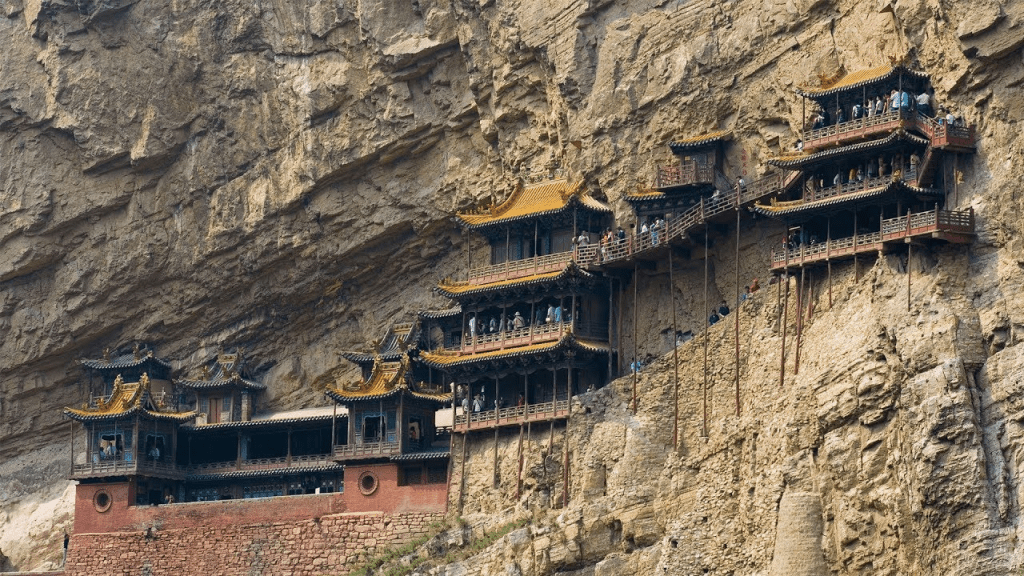
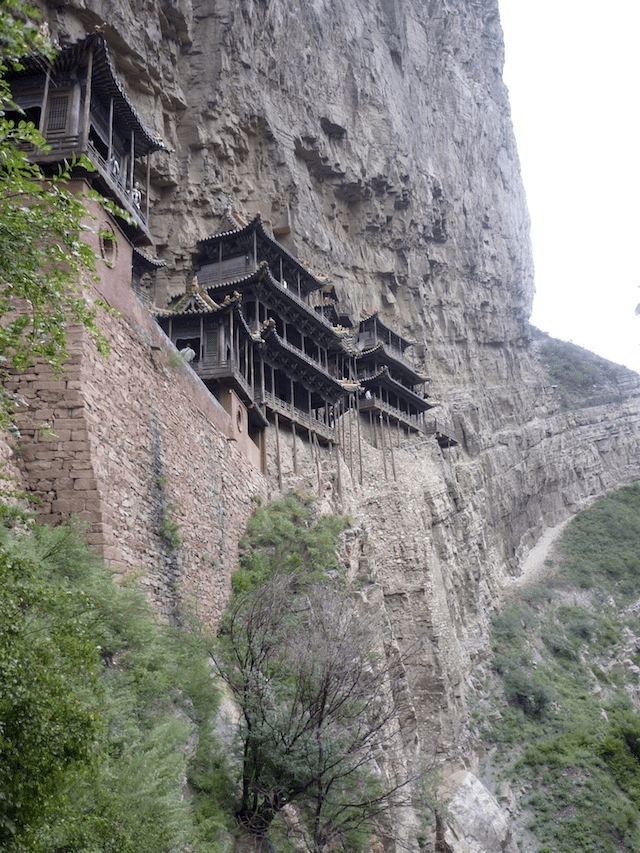
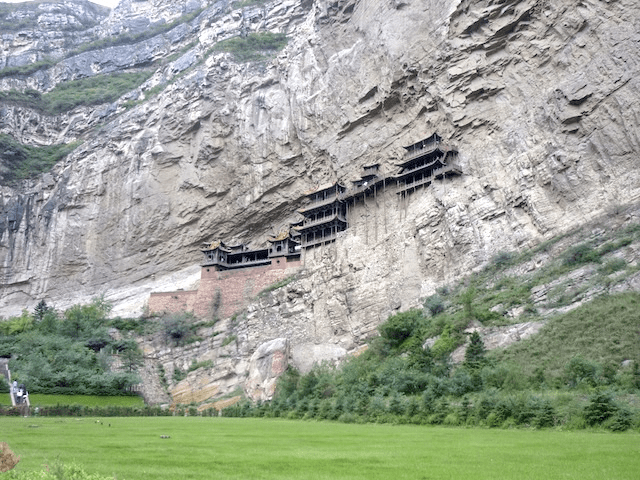
There are 10 most dangerous structures in the world, XuanKongSi Temple in China is one of them. Temples and monasteries were usually built on the ground, and if there was no money or it was necessary to hide from someone, then under the ground in caves. It seems impossible to think of anything else, but the temple tells us otherwise. It turns out that in one of the northern provinces of China, there is a so-called Hanging Temple which seems to be attached to the Rock at a height of 75 meters. It was built almost 1500 years ago in 491 during the northern Wei Dynasty. The Chinese call this Temple complex XuanKongSi.
The temple is located in Shanxi Province, 65 kilometers southeast of the city of Datang, it looks as if the entire Temple is held up on a steep Cliff by the power of Prayer. Perhaps prayers help because the temple is unique; it is the only Temple of three religions in China. It combines Buddhist, Taoist, and Confucian altars. It has everything that other temples have: the main gate, the bells, and drum Towers, the main and side Halls. The largest structure of the monastery is called sangana, and it stands on a stone ledge. There are also 40 halls in Pavilions, but they are smaller than the sangana. They are built on pallets that lie on beams hammered into the Rocks. The rock is used as the back wall of the rooms, and niches are made in it for statues. The larger the niches, the more statues they contain, and the larger they are.
Upon first glance, the temple’s buildings seem to have been partially swallowed by an expanding mountain rather than built onto and into it. Some of the pathways that connect the separate buildings are hewn into the mountain. Others feature the same design as the buildings themselves – parked atop seemingly impossibly-thin wooden poles.
It is composed of three main sections:
North Pavilion
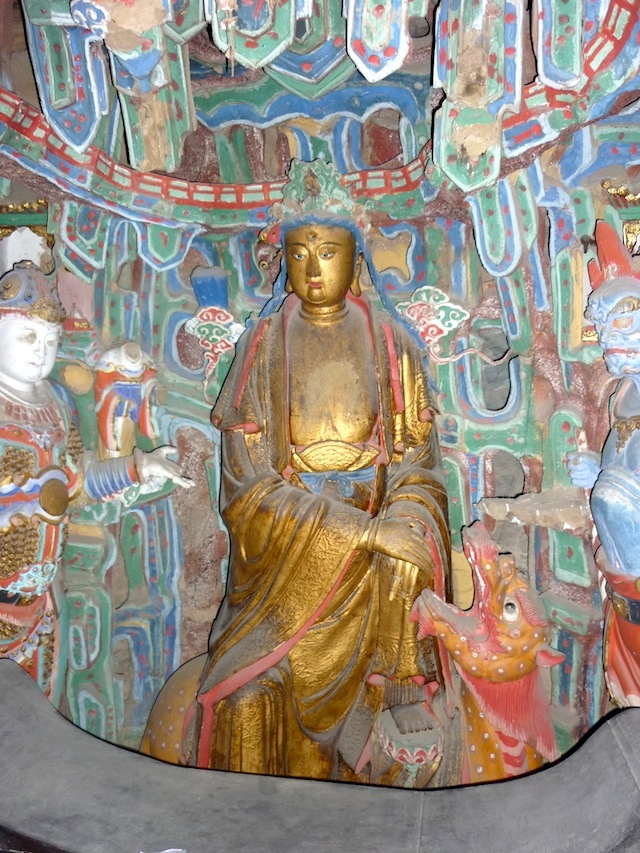
This pavilion is three storeys tall, 4 metres (13 feet) wide and 7 metres (23 feet) in length. Wufo Hall, which is located on the lowest floor is dedicated to the Five Dhyani Buddhas. Above it is Guanyin Hall and on the top storey is Sanjiao Hall. Sanjiao Hall, or the Hall of the Three Religions is widely regarded as the most important room in the Hanging Temple, at least in terms of symbology. It contains large statues of Buddha Shakyamuni, Lao-Tze and Confucius standing together.
SanJiao Hall
Given that the Hanging Temple is the only surviving example of the concept of the Three Teachings Harmonious as One, the Hall of Three Religions is perhaps the most important of these chambers. The idea of Three Teachings Harmonious as One, which emphasises the complementary nature and unifying ideas of Buddhism, Taoism and Confucianism, flourished during the Ming and Qing Dynasties.
Accordingly, the hall features sculptures of deities of all three religions. Three large statues take centre stage here: Buddha Shakyamuni in the middle, flanked by Lao-Tze on his left and Confucius on his right.
GuanYin Hall
South Pavilion
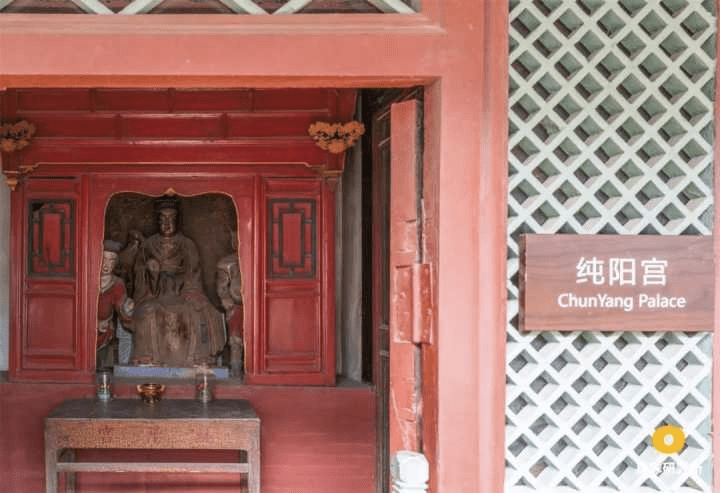
Slightly larger than the North Pavilion, it is also three storeys tall and 4 metres wide but longer at 8 meters (26 feet). The North Pavilion contains Sanguan Hall. It is the biggest hall of the Hanging Temple and is home to a 2-metre tall clay sculpture, the largest in the complex. On the middle storey is Chunyang Palace, which is dedicated to Lü Dongbin, one of the Eight Immortals of Taoism. He is the most popular Taoist character in Chinese culture. Leiyin Hall, which is dedicated to Buddhist deities is on the top storey.
The Long Bridge
The top storeys of the two pavilions are linked by a 10-metre (30 feet) bridge (a stairway has been cut into the mountainside to link the lowest storeys). A small balcony for worshipping sits above the bridge.
However, as impressive as the Hanging Temple appears from the outside, the bulk of the builders’ efforts went into the portion of the complex that is ensconced within the rock. 40 halls and pavilions lie inside, covering an area of 125 m2.
The biggest and most prominent halls are the Hall of Three Religions, Guanyin (Avalokiteshvara) Hall, Hall of Shakyamuni, Qielan Hall (Hall of Sangharama), Sanguan Hall (Hall of the Three Officials) and Chunyang Hall.
Spread throughout the other halls are 78 sculptures made from stone, terracotta, copper and iron. They are remarkable for their vivid and detailed depiction of facial features and clothing.
Construction
Despite its precarious location and the logistical challenges construction must have presented, no design feature that is seen in other temples of the period has been spared. The two main buildings sport traditional multiple-roof designs, eaves and balconies with images of auspicious creatures like dragons common to Chinese holy structures.
Today, the part of the temple that extends beyond the face of the cliff is supported by poles made of oak. These poles have been inserted into holes chiselled out of the rock. From a distance, the brown oaken poles meld into the background, making the temple appear to float in the air.
Amazingly, the real support framework for the temple complex is hidden within the mountain and the structure itself. If these external vertical poles were removed, the hanging temple would continue to hang!
While it’s impossible to overlook the fact that the architecture disrupts the natural rock wall formation, a closer examination reveals something quite astounding. The way the roof, walls, and other structures seamlessly integrate with the rock pattern suggests that significant care and effort were put into minimizing any unnecessary destruction.
A unique mechanical theory guided the construction of the framework. Crossbeams were partially inserted into the rock as the foundation, while the rock in the back provided support. The Hanging Monastery seems to defy gravity, appearing to float in midair.
At certain points, a roof will abruptly end at an outcrop, only to resume on the other side, leaving the stone intact. This not only benefits the structural integrity of the building but also signifies a harmony with nature, a state to which all Buddhists aspire.
Construction experts from countries including Britain, Germany, and Italy have visited the monastery. In their opinion, the Hanging Monastery, which melds mechanics, aesthetics, and Buddhism, is a rarity. The monastery and everything it represents is a significant cultural achievement of the Chinese people.















 Peace LiLy