Hong Kong’s superstar Jacky Cheung has achieved numerous successes in the entertainment industry and is widely recognized as a superstar. However, few people know about his dedication to studying Buddhism. Jacky Cheung’s master is H.H. Dorje Chang Buddha III, an internationally acclaimed master in arts, philosophy, and culture. He was awarded the International Master of Arts and Culture by the World Cultural Conference, comprising experts from 48 countries and regions. Additionally, the Chinese government built a grand museum in his honor in Dayi County, Sichuan, highlighting his unique achievements and contributions.
Around 1995, at the earnest request of many disciples, including Jacky Cheung, H.H. Dorje Chang Buddha III composed a unique masterpiece called “Rare Supreme Chant.” The lyrics, composition, singing, and chanting were all personally handled by the master.
The song’s melody is rich, and its sound changes are exquisite, ranging from powerful and resonant to gentle and intricate. It includes lion’s roars, sacred chants, deep contemplations, and even modern rock and rap elements. The singing techniques transcend traditional vocal resonance, harmonizing with the cosmic realm. This “Rare Supreme Chant” not only broadens the listener’s auditory experience, allowing them to hear various sounds, but also elevates the mind, nurtures moral strength, and purifies body and soul through the blessings of H.H. Dorje Chang Buddha III’s voice.
According to those who provided musical accompaniment for H.H. Dorje Chang Buddha III, his lyrics and melodies are filled with ancient charm and profound knowledge. His voice is versatile and spontaneous, making it difficult to complement with our limited cultural and musical expertise. While they believe his unaccompanied voice is superior, they fear that without accompaniment, the music might be too challenging for listeners to appreciate, thus missing the compassionate intention behind its creation. Despite these challenges, they made an effort to provide accompaniment, hoping listeners would understand and appreciate the master’s work. Listeners are encouraged to attentively enjoy and experience the profound benefits of the music.
The Great Bright Six Syllable Mantra is a very popular Buddhist song, with many audiotapes and CDs distributed worldwide. However, His Holiness’s rendition of the Great Bright Six Syllable Mantra is entirely different from all others I have heard. It is in a powerful vajra style, and at the end of the song, His Holiness uses the lion’s roar voice, with a bursting energy that seems to penetrate the universe and awaken all living beings.
The great bright six syllable mantra
The song “Guo Ping Chang” describes the scenery and feelings of His Holiness passing through Ping Chang (a place in Sichuan).
The sound of the flute sends me across Pingqiang, The boat docks at Wuyou, filled with lantern-lit halls. The spring breeze warmly welcomes visitors, Mist colors the dusk, but the mountains remain evergreen.
This song was sung in an opera style. It has four lines of lyrics, which the Buddha sang using four different Peking Opera styles. This fully demonstrates the Buddha’s profound vocal skills, leaving listeners deeply moved and with a lasting impression.
Passing through PingQiang
H.H. Dorje Chang Buddha III, has even composed a unique masterpiece, in modern rock and rap style, the energetic and festive song “Chinese Dragon,” showcasing the dragon’s cultural significance. This song demonstrates the Buddha’s ability to effortlessly and masterfully handle any musical form.
Chinese Dragon
The Prajnaparamita Heart Sutra is a very important Buddhist scripture. The Buddha composed an elegant and beautiful yet powerful melody for this sutra. His voice is rich and clear, strong yet gentle, as if bringing the compassionate love of the Buddhas and Bodhisattvas to every sentient being.
Once upon a time there was a rich man living in Bane’s, in northern India. He had a son who was intelligent, curious and eager to learn. Even though he was only seven years old, he was determined to find out what is really valuable.
One day the little boy asked his father, “What are the ways to gain the most valuable things in life?”
His father said, “Only worthy ways lead to worthwhile goals. These are the six worthy ways:
Keep yourself healthy and fit;
Be wholesome in every way;
Listen to those with more experience;
Learn from those with more knowledge;
Live according to Truth;
Act with sincerity, not just energy.”
The boy paid close attention to his father’s words. He tried hard to practice these ways from then on. As he grew up and became wise, he realized that the six worthy ways, and the most valuable things in life, could not be separated.
The moral is: “A serious question deserves a serious answer.”
Jeffrey Hopkins, a brilliant scholar, author, teacher, and translator who founded one of the largest Tibetan Buddhist Studies programs in the West, died on July 1 in Vancouver, Canada. He was 83.
For more than three decades, beginning in 1973, Hopkins was a leading light at the University of Virginia. He directed UVA’s Center for South Asian Studies for twelve years and taught Tibetan Buddhist studies and Tibetan language for thirty-two years, but his signature achievement was the Tibetan Buddhist studies doctoral program he established in 1975, which became the largest in North America. Among its graduates are some of the most esteemed academics in the field today, including Anne C. Klein of Rice University, Donald Lopez of the University of Michigan, Georges Dreyfus of Williams College, and Bryan Cuevas of Florida State University. Hopkins’s program, by placing Tibetan Buddhism (rather than Indian, Chinese, or Japanese Buddhism) at its center and bringing prominent Tibetan masters from India to Charlottesville to teach the classic texts of that tradition, “changed the way Buddhism is taught in the American academy,” Donald Lopez says.
Hopkins’s singular force was evident from the moment he arrived at UVA in 1973. Lopez, a senior when Hopkins joined the faculty, remembers:
Despite being a newly arrived assistant professor, he immediately gained a large following among the “Be Here Now” crowd. By the second semester, students were walking around campus wearing buttons that said, “Buddha’s Slogan: Dependent Arising.” In a men’s room on campus one day I noticed something written on a urinal. Assuming it said “R. Mutt” [as Marcel Duchamp had signed his urinal artwork, “The Fountain”], I went closer and saw that it was four words stamped in red letters: “DOES NOT INHERENTLY EXIST.” Inspired by such visions, I wrote my senior thesis, master’s thesis, and doctoral dissertation under Hopkins’s direction.
Convinced that scholars of Tibet must be able to both read classical Tibetan and speak modern Tibetan, Hopkins established the first Tibetan language program at UVA and coauthored a comprehensive language course, Fluent Tibetan: A Proficiency Oriented Learning System. He also compiled a 900-page Tibetan-Sanskrit-English dictionary of Buddhist terms that is posted online.
During his career, Hopkins also held visiting professorships at the University of Hawaii and the University of British Columbia. After he retired from UVA, he focused on translating. He was the founder and president of the UMA (Union of the Modern and Ancient) Institute for Tibetan Studies and from 2011 directed its Great Books Translation Project, set up to make Tibetan texts freely available.
Hopkins was also a peace and human rights activist and published The Art of Peace, edited from talks at a conference of Nobel laureates he organized in 1998 for UVA and the Institute for Asian Democracy, a Washington, D.C.-based non-profit that promoted self-governance in Asia, particularly in Burma. Hopkins was president of the institute from 1994 to 2000.
One of the most respected Tibetologists of his generation, Hopkins authored, edited, or translated more than fifty books. His extensive published work includes scholarly books on emptiness and tantra, as well as translations of works by such famed figures as Nagarjuna, Chandrakirti, and Tsongkhapa. His first and most influential work was his massive 1973 doctoral dissertation, Meditation on Emptiness, which provided the first detailed presentation of the Geluk synthesis of philosophy and practice. After circulating widely as a bound Xerox copy, it was published by Wisdom Publications in 1983. A fortieth-anniversary edition will be published next year. Much of Hopkins’s work was devoted to the Geluk founder Tsongkhapa, translating major sections of his massive exposition on tantra, Stages of the Path of Mantra. Later he turned to Tsongkhapa’s most beloved work among Geluk scholars, Essence of Eloquence, a text recited from memory by the monks of Ganden Monastery at his funeral in 1419. Although Tsongkhapa’s text is rather brief, Hopkins devoted three large volumes to it: Emptiness in the Mind-Only School, Reflections on Reality: The Three Natures and Non-Natures in the Mind-Only School, and Absorption in No External World.
In 1979, Hopkins was instrumental in arranging His Holiness the Dalai Lama’s first visit to the United States and served as his chief translator from 1979 to 1989 on tours of the US, Canada, Europe, Southeast Asia, and Australia. Hopkins translated and edited His Holiness’s teachings for sixteen books, including The Dalai Lama at Harvard, along with titles aimed at a general audience, such as Kindness, Clarity and Insight; How to See Yourself As You Really Are; How to Practice: The Way to a Meaningful Life, Mind of Clear Light, Mind of Clear Life: Advice on Living Well and Dying Consciously; How to Be Compassionate; and How to Expand Love: Widening the Circle of Loving Relationships.
Hopkins collaborated with the tulkus Lati Rinpoche and Denma Locho Rinpoche on Meditative States in Tibetan Buddhism, based on a text by the Geluk master Panchen Sonam Drakpa. With the Nyingma lama Khetsun Sangpo he published Tantric Practice in Nyingma, a translation of a famous work by Patrul Rinpoche that would later be translated as Words of My Perfect Teacher.
Born Paul Jeffrey Hopkins in 1940, he grew up in Barrington, Rhode Island. A rebellious youth, he was a member of what he later described as a “suburban gang . . . disgusted by the aims that were being presented to us: merely making money and so forth.” Hopkins was then sent to Pomfret, a prep school in Connecticut, where he thrived. During his freshman year at Harvard, he read Thoreau’s Walden and retreated to the woods of Vermont, where he lived in a one-room cabin, wrote poetry, and “began finding my own integrity,” he later told an interviewer. Further inspired by Herman Melville’s Typee and W. Somerset Maugham’s The Moon and Sixpence, he hopped a freighter to Tahiti. It was during this period that Hopkins began meditating—in a fashion.
Hopkins returned to Harvard after a year and a half, then between his junior and senior years, took off again. While floating down a river in Oklahoma, he saw a dead man propped up on a bank. It was a turning point. “I suddenly realized that his last perception in this lifetime would be no fuller than any of his other perceptions,” he recalled. “I began to recognize the ultimate futility of external activities and to turn my attention inward, to a light within. When I returned to Harvard in the fall of 1962, it was as if a coffin had been opened. I had been living my life in a coffin and had not recognized the presence of the sky.”
During Christmas vacation from college that year, a classmate drove Hopkins to Freewood Acres, New Jersey, to meet Geshe Wangyal, a Kalmyk Mongolian Tibetan Buddhist who had established a monastery there in 1958. In 1963, after graduating magna cum laude from Harvard—an English major, Hopkins won the Leverett House Poetry Prize for his translation of the Anglo-Saxon poem “The Wanderer”—Hopkins spent seven years studying with Geshe Wangyal in New Jersey. After a false start in graduate school at the University of Pennsylvania, he enrolled in the doctoral program at the University of Wisconsin-Madison.
Later, Hopkins called his time in the Buddhist Studies program at Wisconsin as “thrilling in many ways and . . . certainly a crucial choice for my career.” At Hopkins’s urging, Richard Robinson, the head of the Buddhist Studies program, hired Geshe Lhundup Sopa, a Geluk scholar who had been living at the Kalmyk monastery in New Jersey. He was instrumental in the hiring of renowned tantric master Kensur Ngawang Lekden, former abbot of the Tantric College of Lower Lhasa. Anne Klein, then a master’s candidate at Wisconsin, recalls that Hopkins, with Robinson, “founded Tibet House on a farm outside Madison, where Kensur, Jeffrey, and grad students could live, learn Tibetan, and share kitchen duties. Jeffrey served ice cream on small, flat plates, which, as Kensur demonstrated with delight, meant you could lick them clean.” Hopkins read with Kensur daily, Klein remembers, material that formed his dissertation, Meditation on Emptiness.
Throughout his career, Hopkins’s interest in Buddhist studies was broad, encompassing South Asia, Tibet, and East Asia. He was the recipient of three Fulbright fellowships and made twelve trips to India and five to Tibet for research.
As a translator, Hopkins had an approach unusual among his peers at the time: working closely with Tibetan scholars and regarding them not as “native informants” but as collaborative partners. “I thought it was . . . extremely important to treat every Tibetan scholar fairly, to give them credit for their part in producing any book,” he said. “If I couldn’t understand the text without somebody informing me of its meaning, then that person has played an equal role in its translation even if they don’t know English.”
In 1991, Hopkins suffered a debilitating, near-fatal case of Lyme disease that temporarily left him partially paralyzed with noticeable mental gaps. He recovered, but “I had to reconstruct my mind,” he later told Tibetan Buddhist nun Robina Courtin. “In any field, I had to consciously make a logical connection, and then once the connection had been made, that area was reopened.” What saved him, he ventured, was a habit formed in his years at the monastery in New Jersey: repeating the intelligence mantra of Manjushri, bodhisattva of wisdom, aimed at enhancing mental acuity: Om ah ra pa tsa na dhih. “I overheard Geshe Wangyal tell one Mongolian boy who was having trouble memorizing it, ‘Then do dhih dhih dhih . . . endlessly,’ ” he recalled.
Study is first to track people at different time points in life and finds close link between nutrition and cognitive ability
A healthy diet in childhood can help protect mental sharpness into old age. Photograph: Katarzyna Bialasiewicz/Alamy
A healthy diet earlier in life could help keep you mentally sharp into your 70s, and even ward off dementia, according to research that followed thousands of Britons for seven decades.
While most studies on diet and cognitive ability have focused on people already in or reaching old age, the new review was the first to track people throughout their life – from the age of four to 70 – and suggests the links may start much earlier than previously recognised.
The research adds to a growing body of evidence that a healthy diet could reduce the risk of Alzheimer’s disease and slow age-related cognitive decline. The findings were presented at the annual meeting of the American Society for Nutrition.
“These initial findings generally support current public health guidance that it is important to establish healthy dietary patterns early in life in order to support and maintain health throughout life,” said Kelly Cara, of Tufts University in Massachusetts.
Our findings also provide new evidence suggesting that improvements to dietary patterns up to midlife may influence cognitive performance and help mitigate, or lessen, cognitive decline in later years.”
Cognitive performance can still improve well into middle age, but typically begins to decline after age 65, the researchers said. More serious conditions such as dementia can also develop alongside age-related decline.
For the new research, scientists studied 3,059 adults from the UK who were enrolled as children in a study called the National Survey of Health and Development. Members of the cohort, called the 1946 British Birth Cohort, have provided data on dietary intakes, cognitive outcomes and other factors via questionnaires and tests over more than 75 years.
Researchers analysed participants’ diet at five time points in relation to their cognitive ability at seven time points. Dietary quality was closely linked with trends in cognitive ability, they found.
For example, only 8% of people with low-quality diets sustained high cognitive ability and only 7% of those with high-quality diets sustained low cognitive ability over time compared with their peers.
Cognitive ability can have a significant impact on quality of life and independence as people age, the researchers said. For example, by the age of 70, participants in the highest cognitive group showed a much higher retention of working memory, processing speed and general cognitive performance compared with those in the lowest cognitive group.
In addition, nearly a quarter of participants in the lowest cognitive group showed signs of dementia at that time point, while none of those in the highest cognitive group showed signs of dementia.
While most people saw steady improvements in their diet throughout adulthood, the researchers noted that slight differences in diet quality in childhood seemed to set the tone for later life dietary patterns, for better or worse.
“This suggests that early life dietary intakes may influence our dietary decisions later in life, and the cumulative effects of diet over time are linked with the progression of our global cognitive abilities,” Cara said.
Study participants who sustained the highest cognitive abilities over time relative to their peers tended to eat more recommended foods such as vegetables, fruits, legumes and whole grains, and less sodium, added sugars and refined grains.
“Dietary patterns that are high in whole or less processed plant-food groups including leafy green vegetables, beans, whole fruits and whole grains may be most protective,” said Cara.
“Adjusting one’s dietary intake at any age to incorporate more of these foods and to align more closely with current dietary recommendations is likely to improve our health in many ways, including our cognitive health.”
I really enjoy animated movies for their humor and cheerfulness. What better way to relax than to watch Garfield shovel down 450 pounds of lasagna? However, beneath the appearance of levity and simple fun, animation has its own unique way of addressing serious and abstract philosophical questions. Pixar’s Inside Out is an outstanding work in this regard. It made me ponder what makes myself, well, myself.
Inside Out is a masterpiece of animation that presents human emotions—specifically Joy, Sadness, Anger, Disgust, and Fear—as protagonists, rather than focusing solely on Riley Anderson, the girl these emotions reside in. Writing in The Guardian, Julian Baggini muses that the film “. . . reflects some of the most important truths about what it means to be an individual person. The first of these is that there isn’t actually a single, unified you at all. . . . [your brain] is made up of various different, often competing impulses. You are simply how it all comes together, the sum of your psychic parts.”This film heralds a gradual opening of popular Western media and culture to the idea of the “three marks of existence” in Buddhism: impermanence (anitya), no-self (anatman), and suffering (duhkha). It is a completely new way of articulating (to children, no less) a richer, more complex understanding of the human person.
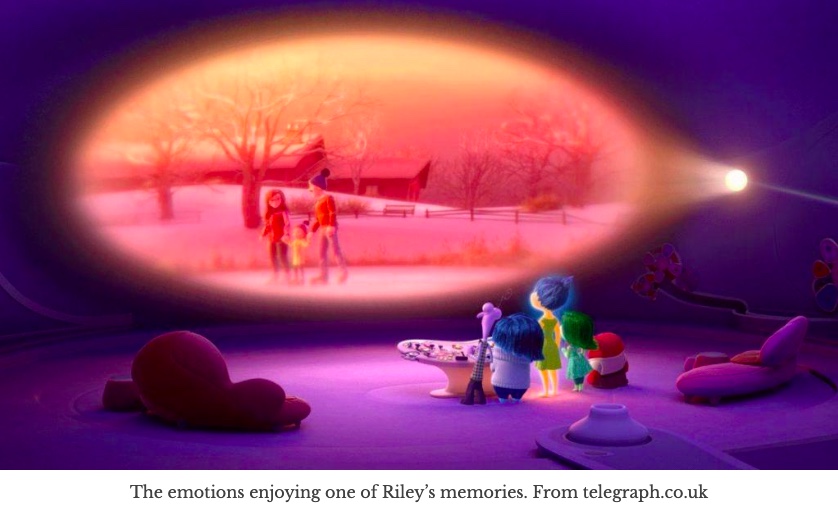
In this story, the five emotions work together to look after Riley and manage her reactions to external stimuli inside “HQ”—her head. HQ is visually located in the “sky” of her mind and overlooks a vast labyrinth called Long-term Memory, where memories in the form of orbs are stored. Orbs of core memories, or formative experiences of Riley’s life, are stored in a central hub within HQ itself. Most memories (including the core ones) are touched by Joy so that they are bright gold and happy. Other memories are touched by Sadness (blue), Disgust (green), Fear (light purple), and Anger (red).
Anger prepares to make Riley react angrily. From video.disney.com
The external narrative—the one that audiences usually see in a movie—is simple, almost boring. Riley struggles with moving from Minnesota to San Francisco, making new friends at school, and coming to terms with losing her old life. The real action goes on inside her head. To Joy’s dismay, Sadness, who feels like she serves no beneficial purpose to Riley (in contrast to emotions like Disgust, who protects Riley from broccoli, or Fear, who compiles copious notes on possible risks to Riley’s everyday activities), starts touching the Memory Orbs, turning more and more of Riley’s memories blue. Later on, it is revealed that Riley needs Sadness to express her inner difficulties and articulate her distress, therefore serving a vital purpose for her well-being, but none of the other emotions at this stage can understand why.
By several twists of misfortune after Joy tries to stop Sadness from touching the orbs, they get lost in Riley’s various mental spaces outside of HQ, such as Imagination Land (complete with an Imaginary-boyfriend Generator), the Abyss of the Subconscious, and Dream Productions. With Joy and Sadness missing, Anger, Fear, and Disgust do their best to help Riley cope with her increasingly unhappy life. For example, befitting his purpose and personality, Anger argues that the only way for Riley to be happy again is to run away from her parents back to Minnesota. However, they just end up making her react to the world with burgeoning anger, fear, and disgust.
A resolution is reached when Joy realizes that Sadness needs to touch more of the Memory Orbs. As much as Joy wants to see Riley happy, she can’t be the emotional driver of every event. But in gratitude for her newly acknowledged importance, Sadness also invites Joy to touch the memories she is holding, so that Riley can feel meaning and happiness in the process of grieving. By the end of the movie, Riley’s Memory Orbs are no longer a simple mix of five colors: each ball is variously touched by the emotions, resulting in a beautiful array of “mixed emotions” and marking the beginning of growing up.
This, however, is just the first crack at the myth of the enduring, unified self. What the film also shows is that each of these parts is impermanent. Riley’s personality is represented by a series of islands that reflect what matters most to her: friendship, honesty, family, goofiness, and hockey. But as life becomes difficult, each of these in turns threatens to crumble. And that is how it is in the real world: as we grow and change, some of the things that matter most to us will endure, others will fall away, and new ones will come in their place.
In competition … Sadness, Fear, Anger, Disgust and Joy. Photograph: Courtesy Ev/Rex Shutterstock
The third key element in understanding the self is that what keeps this all together is memory. At first, it seems like the film is going to over-simplify this, presenting memories as little movies, experiences that are captured, stored, and played back. But as it progresses, it gets more complicated. It becomes clear that not only do many memories simply get lost—even ones that were once most precious—but others change their character as we do. For memories to do their work, they need to be nurtured and understood.
What it all adds up to is a picture of the self as something which coheres into a single narrative but which has nothing permanent and unchanging at its core. We are forever in flux, always in the process of growing out of what we once were into what we are to become next.
Not surprisingly, this animated movie is the most sophisticated children’s film in recent memory and has been critically applauded in many reviews. It turns traditional storytelling on its head: instead of telling us what the protagonist feels, it tells us what the emotions are making the protagonist feel. Of course, our brains aren’t populated by anthropomorphic or Platonic representations of concepts such as Joy or Sadness. Nevertheless, this children’s film is an example of meta-storytelling, in which the motivations for the narrative (usually the protagonist’s emotions or conflicts) are abstracted into their own story (the emotions’ adventures inside Riley’s head).
Baggini, like many other critics, observes that by being “made up” of the five emotions, the traditional fictional character has become a composite construction of various mental components, just like we are in the real world. He also notes that apart from deconstructing the myth of the unified self, Inside Out also presents these components as impermanent. HQ overlooks five islands attached to Long-term Memory that reflect fundamental aspects of Riley’s personality: friendship, honesty, family, goofiness, and hockey. But as the emotions struggle to manage Riley’s inner world, these islands crumble and fall away (for example, Friendship Island collapses after Anger makes Riley react furiously to her Minnesota friend’s apparent happiness despite her departure). However, by the end, new islands are formed: for example, the new Friendship Island now has a “friendly argument section,” indicating a collaboration between Joy and Anger.
Just as we see in real life, some of the things that “characterize” who we think ourselves to be endure—but others fall away, hopefully to be replaced by new, more complex and enriching “islands.” Baggini concludes: “What it all adds up to is a picture of the self as something which coheres into a single narrative but which has nothing permanent and unchanging at its core.” Our no-selves are forever in flux, engaged in a never-ending process of shedding what we once were and reforming into a new identity.
The ideas of no-self and cognitive impermanence should open up new avenues into exploring how a contemporary story (be it through the medium of live action or animation) can be told. There are no antagonists in Inside Out—the conflict (or the reason for the story to exist) all happens within, inside Riley’s head. The fundamental problems of the world, according to Buddhism, are also within, not “out there.” Nevertheless, understandably, there are philosophical differences between a Pixar film and 2,500 years of insight. The Buddhist explanation for the world’s unhappiness is much more complex. In Buddhist phenomenology, sentient beings are made up of the five skandhas, or aggregates (mind and matter being considered inseparable, unlike in Cartesian thought): form (rupa), sensation (vedana), perception (samjna), mental formations (samskara), and consciousness (vijnana). These aggregates become the subject of expanded commentary in the Abhidhamma literature of early Buddhism and the Mahayana and Vajrayana traditions. If Riley’s happiness depends on the interplay of her emotions, Buddhist liberation depends on the Buddhist insight of understanding the “empty” nature of the aggregates: that they are impermanent, composite, and interdependent.
I think the reason this can be conveyed in a children’s film is that, in many ways, kids are more receptive to this message than adults. Children change so rapidly that they might be able to understand the idea of impermanence more readily than adults, whose self-conception has often ossified. Kids have no problem imagining that they might grow up to be quite different, while adults assume they are stuck being the person they have turned out to be.
The best children’s films often serve a dual purpose. They help kids to grow up but they also remind adults of what they have lost by doing so. Inside Out succeeds brilliantly on both counts.
If there were any “villains” to be scripted in a Buddhist version of Inside Out, it would be the “three poisons” of greed, hatred, and delusion—the factors inhibiting our well-being and blocking our path to enlightenment. For now, it’s too big a question to ask how such concepts might be brought into an animated film, but the high stakes and existential conflict in the Buddhist teachings would make for a children’s story that is both immersive and educational.








 Peace LiLy