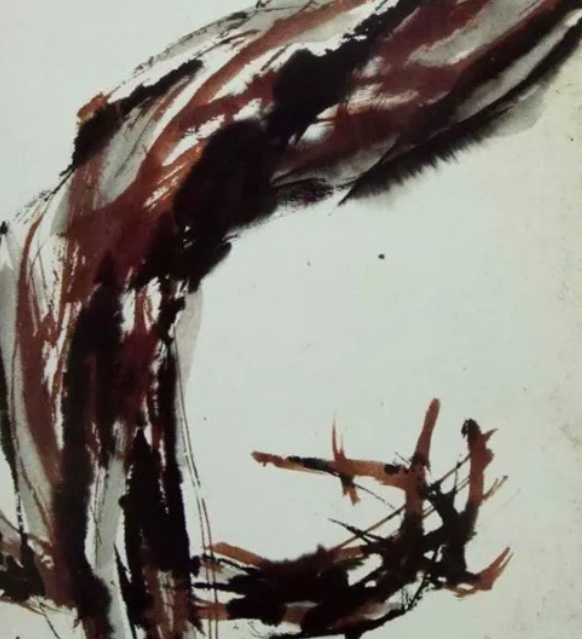
It is often said that the essence of a high-quality painting lies in its incorporation of the calligraphic brushstrokes, the commanding presence reminiscent of engraved stone seals, a tonal quality derived from the artist’s mastery of literature, a stylistic expression emanating from the artist’s virtue, and a captivating allure that springs from the artist’s state of realization—this, indeed, is the true spirit of the painting.
In the International Art Museum of America, several paintings, executed with only a minimal number of strokes, possess the robust appeal akin to stone seal engravings. These artworks convey the artistic conception of returning to original purity and simplicity. With a liberated hand and mind, the artist applies their most refined skills, devoid of any lingering attachments, creating with minimal yet natural brushstrokes.
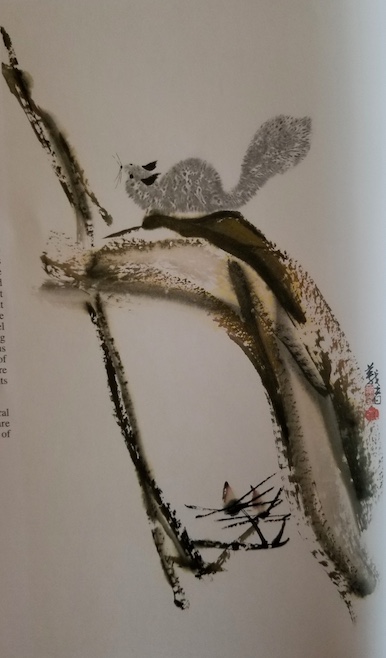
Za Chai Shi Gu (Brushwork Resembling Smashed Jade)
There is a phrase used in commenting upon Chinese paintings and calligraphy that related to smashed jade. This painting exemplifies that charming style of smashed jade.
The pine tree, rendered with just a few simple strokes, emanates a pervasive sense of strength across the entire painting. The exquisite and lively portrayal of the little squirrel employs a truly remarkable and mysterious technique, combining simplicity, innocent charm, a natural appearance, and authenticity into a harmonious whole.
Loquat
H.H. Dorje Chang Buddha III painted ‘Loquat’ in 2013. This painting achieves the skill of cherishing ink like gold in its conception, with no wasted or faulty strokes. With just a few strokes, it is high and lofty, vibrant and lively, containing an elegant and comforting sense of ease, as if the brush strokes were divinely inspired.
At the autumn auction of the New York Zhenguan International Auction Company on September 12, 2015, this painting ‘Loquat’ was auctioned for a staggering 10.2 million U.S. dollars.
Yi Chen Bu Ran (Immaculate)
With only a small number of strokes, a comforting and natural appeal appears vividly on paper. The style is neither overly cautious nor affected. A scholarly tone and an air of stone seals are revealed in the brushwork. This is a work of art with an attractiveness that stems from mature skills. The title “Immaculate” means that this painting is free of any trace of the mundane.
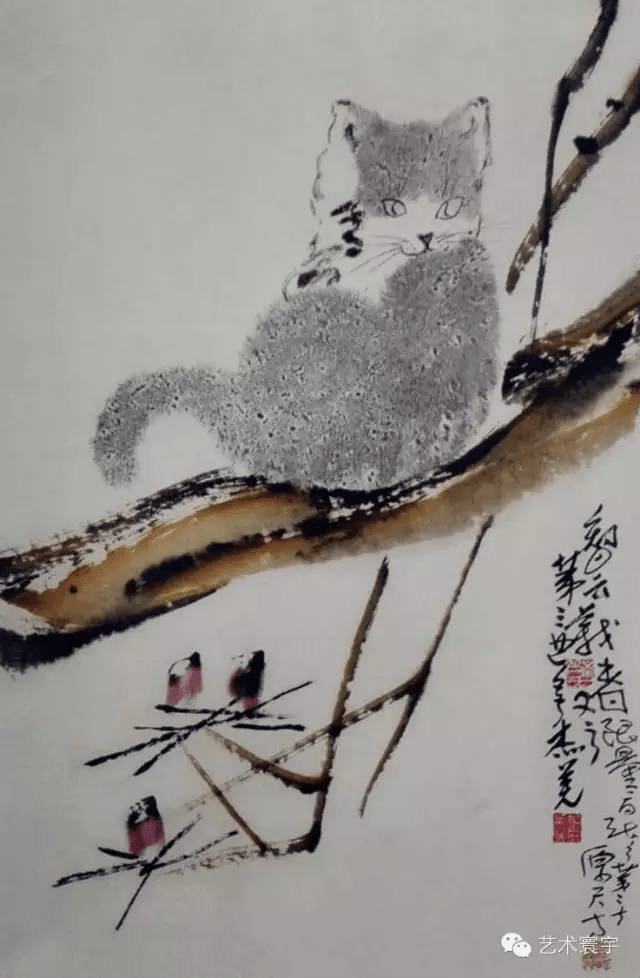
Cat of Unique Charm
In this painting, the cat is portrayed with a vibrant yet natural presence, achieved through the dynamic and captivating use of scattered ink. The entire artwork, painted with only a few brushstrokes, exudes the style of stone seals and an air of scholarly refinement. Both the form and spirit of the scene are skillfully captured. This work truly exemplifies masterful ink usage in a restrained manner.
One of the one hundred limited release copies of this small-scale, painting “Cat of Unique Charm” sold at auction for US$253,000, which is the highest per square foot selling price of any duplicate painting in the world. The prices of sold duplicate paintings by the most famous first-rate masters of art in the world cannot match the prices of sold duplicate paintings by H.H. Dorje Chang Buddha III.
Si Yu Sheng Hui (Resplendent Like Jade)
With just a few simple strokes, the entire painting is remarkably infused with a robust jade-like charm and an auspicious aura. Both the plantain tree and fruits exhibit a lack of mediocrity and were painted without the slightest mental attachment in the artist’s mind. They appear natural, elegant, and enchanting. This sentiment is succinctly captured in the accompanying short poem: “Unfurl the painting scroll, and the particularly fragrant scent of ink is released, permeating the viewer’s mind and intoxicating them to the core. Only a minimal number of strokes were applied. This exemplifies the regal art of using ink as sparingly as gold.”
H.H. Dorje Chang Buddha III, the artist behind these magnificent paintings, has crafted a pure and enchanting spiritual realm with his incredibly succinct brush and ink technique. Upon viewing, it evokes a sense of ethereality, akin to the moon reflected in water, and a freshness that pierces the heart, reminiscent of the sound produced when a piano key is pressed. This unique artistic essence, bridging the real and the virtual, transcends the ordinary, providing a natural and enlightening experience that often transports individuals into a realm of wonder.
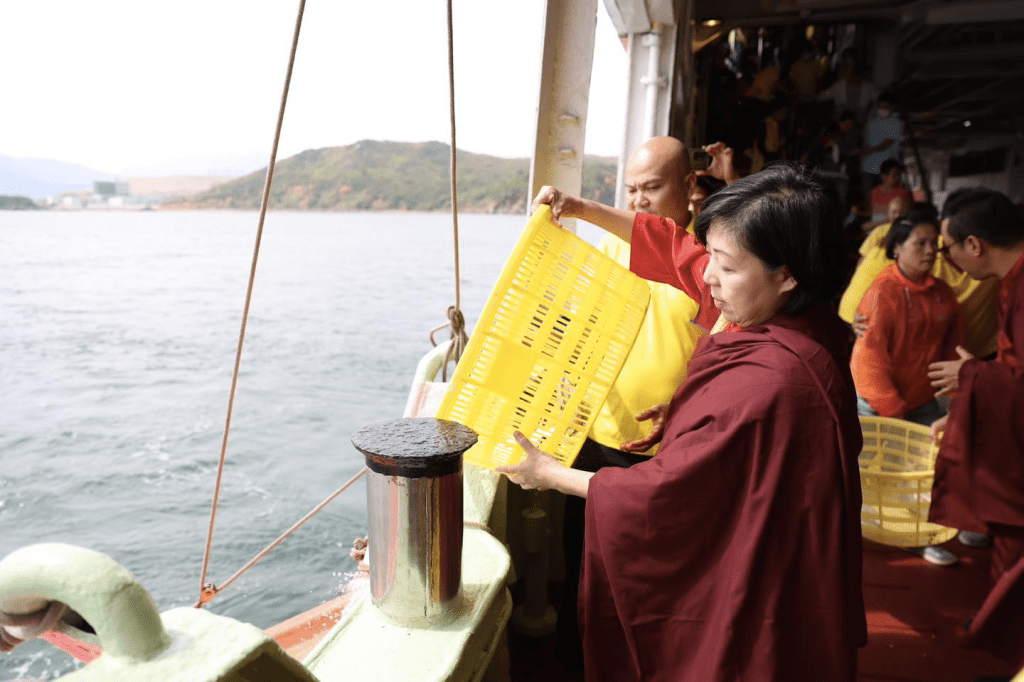
Buddhists worldwide converged on October 29th to observe the Buddha-Stipulated Day of Releasing Lives, an admirable day dedicated to compassion and liberation. Originating in 2009, this tradition finds its roots in the teachings of H.H. Dorje Chang Buddha III, who, after completing a monumental Buddhist activity, led His disciples in releasing captive lives and declared this day as a time to extend compassion to all beings. In 2023, the H.H. Dorje Chang Buddha III Culture and Art Museum and the World Buddhism Association Headquarters commemorated this occasion with life-releasing events in Marina Del Ray, California, and World’s Fair Marina, Flushing, New York.
The practice of releasing captive lives holds deep significance for Buddhists. H.H. Dorje Chang Buddha III once imparted in the Dharma of Cultivation, “All living beings in the six realms of reincarnation within the three spheres of the universe have been since beginningless time my fathers and mothers in the revolving cycle of reincarnation.” Furthermore, “The Brahma’s Net Sutra – The Book of Bodhisattva Precepts” explicitly teaches the importance of compassionately engaging in the practice of releasing captive animals into the wild and freeing living beings from suffering.
On October 28th, the Monastery of Hua Zang Si Temple in San Francisco, along with Buddhist disciples, organized a fish release event at the San Rafael Port, located at 110 Loch Lomond.
Hua Zang Si Abbess Ruzun Ruohui emphasized, “Our acts of compassion are not confined to specific days or places. Guided by the teachings of H.H. Dorje Chang Buddha III and Shakyamuni Buddha, we believe in intervening whenever and wherever beings face dire fear or calamity, offering them safety and liberation from suffering. As the saying puts it, ‘We hold dear the continuity of their lives and cannot bear to witness their untimely end.’ Our driving force is compassion and empathy, with a desire to bestow happiness and freedom upon all sentient beings, relieving them from the burdens of suffering.”
Buddhist disciples in Taiwan organized a fish release event at the ocean beach.
Buddhist disciples at PinDong Taiwan released crickets.
In 2023, nations worldwide continuously struggle with prolonged regional conflicts, ongoing wars, economic turmoil, and the devastating impacts of climate change, resulting in a profound loss of lives and widespread suffering. From storms, flooding, earthquake, to wildfires, 2023 has already been a record catastrophic year for weather and climate disasters globally. On this occasion of the Buddha-Stipulated Day of Releasing Lives, individual Buddhists, temples, and religious organizations from around the world have come together in unity to conduct life-releasing activities. Their shared aspiration is to dedicate all merits to the well-being of living beings. May adversity be vanquished, and may all living beings find prosperity and wisdom, leading to lives filled with goodness. May nations thrive and may peace reign supreme throughout the world.
After learning about Eastern painting, American painter Graves said: “I realized that art and nature are landscapes of the soul, from which we can perceive the essence of human existence.” When you are fortunate enough to encounter these masterpieces, you will gain insight into the essence of Eastern art.
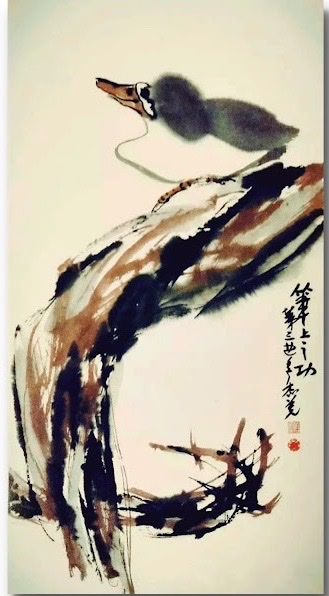
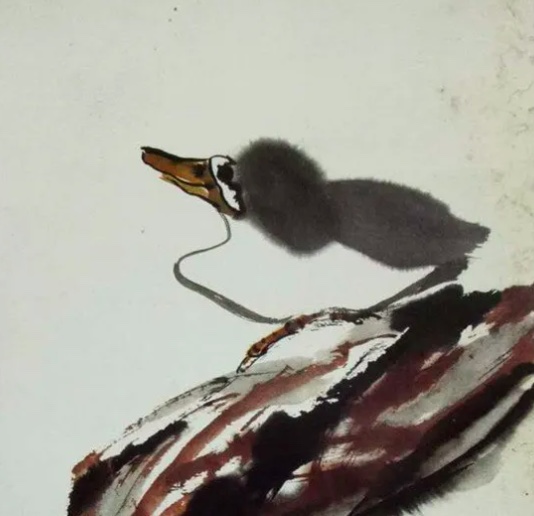
“Bi Shang Zhi Gong (Skillful Brushwork)” is a masterpiece of Chinese flower and bird painting that appears fresh and clear at first glance, profound in meaning after viewing, and unforgettable after further contemplation. The composition is extremely simple: in the center of the painting is a uniquely shaped bird with a flat, long beak and a spotlessly white belly. It sits comfortably and alone on the curved, thick trunk. Its eyes are ethereal and deep, as if completely focused; its posture demonstrates that wherever it is, is the focal point.
Upon careful observation, you will find that everything in the painting is in a state of colorful transformation. The bird’s head and back are painted with two blocks of ink that are close in shade, creating a melting effect, with the ink color seemingly still wet and spreading around.
The trunk’s ink lines are clear and distinct, resembling a tree yet not quite a tree, as if constantly changing in the impermanence. At the bottom left of the tree, a branch twists and turns out, creating an S-shaped composition in the painting that is still in motion. The painting also uses color sparingly, with only a warm and friendly purple-brown color applied to the bird’s beak and the trunk.
This painting has a fascinating story behind it. It was created in 1982 during the filming of a movie in Sanhe, Sichuan. The painting captures an on-the-spot portrayal of a real-life scene. The artist used ink sparingly, treating it as if it were as precious as gold, while still showcasing his exceptional skills. At the time, the News Film Studio of China was producing a documentary exclusively about the artist, Master Yi Yungao (H.H. Dorje Chang Buddha III).
The cameramen and other observers witnessed a wild duck landing on a withered tree trunk. Master Yi Yungao quickly picked up his brush and swiftly completed the entire painting. By the time the wild duck took flight again, the painting had already been finished. Furthermore, the artistic mastery embodied in this artwork is extraordinary. It not only preserves the elegance, purity, and high-quality of traditional paintings but also introduces a new style—expressing the artistic conception of returning to original purity and simplicity. The artist, with an unfettered hand and mind, applies his most mature skills without the slightest attachment and with minimal, natural brushstrokes.
This masterpiece Chinese painting by H.H. Dorje Chang Buddha III is rich in literary atmosphere and varied in layers. It does not merely depict the external world, but rather it serves as a true manifestation of the inner spirit, transcending the natural material form to open up the world through the illumination of life’s spiritual light, reflecting the spiritual world. Appreciating the painting can reveal the pure world behind it, where everything, including the self, is forgotten, remaining untainted.
Albert Einstein and Charlie Chaplin were two of the most iconic figures of the 20th century, known for entirely different reasons. A memorable exchange from early in their friendship perfectly and humorously illustrates these differences.
Einstein once expressed his admiration for Chaplin’s art, saying, “What I most admire about your art is its universality. You don’t say a word, yet the whole world understands you!”
Chaplin’s response, delivered with impeccable comedic timing, was, “True. But your glory is even greater! The whole world admires you, even though they don’t understand a word of what you say.”
I find myself in agreement with Chaplin. While I may not grasp the intricacies of Einstein’s scientific achievements, I admire him as a profound thinker who grappled with life’s deepest questions. His reflections on the universe and our place within it have been particularly inspiring to me since my youth.
Einstein’s curiosity and search for meaning are traits that many of us can relate to. He once expressed a desire to ask God about the origins of the universe, believing that such knowledge would lead to a deeper understanding of life’s purpose. He said, “I used to think that if I could ask God one question, it would be about how the universe began, because then all the rest would be just equations. But as I got older, I became less concerned with how the universe began. Instead, I would want to know why he started the universe. If I knew that, then I would know the purpose of my own life.”
Furthermore, Einstein pondered the nature of the universe and our perception of it, stating, “The most important decision we make is whether we believe we live in a friendly or hostile universe.” This quote underscores the power of our beliefs and attitudes in shaping our experiences and interactions with the world around us. A friendly universe is one where we see opportunities for growth and connection, while a hostile universe may lead to fear and isolation.
The Einstein quote that resonates with me the most is, “A human being is a part of the whole, called by us ‘Universe,’ a part limited in time and space. He experiences himself, his thoughts and feelings as something separated from the rest, a kind of optical delusion of his consciousness. This delusion is a kind of prison for us, restricting us to our personal desires and to affection for a few persons nearest to us. Our task must be to free ourselves from this prison by widening our circle of compassion to embrace all living creatures and the whole of nature in its beauty. Nobody is able to achieve this completely, but the striving for such achievement is in itself a part of the liberation and a foundation for inner security.” In this quote, Einstein alludes to the Buddhist concept of interconnectedness and the illusion of separateness. However, Einstein likely only grasped the theoretical concept and did not experience the oneness with the universe. The Buddha, on the other hand, has seen the truth, experienced the oneness, and achieved inner realization.
Over two thousand five hundred years ago, Shakyamuni crossed the Nairanjana River and sat under a Bodhi tree, where he was immersed in deep inner contemplation. At that time, he was tormented by worldly desires, hunger, craving for sleep, and fear and doubt. But he triumphed over these internal demons and continued his inner quest.
Then, like a limitless, penetrating beam of light, Shakyamuni experienced a moment of clarity in which he gained profound insight that life is eternal and one with the vast cosmos. He became a Buddha—a person awakened to the supreme truth of the Law of life.
The Buddha, Siddhartha Gautama, achieved enlightenment under the Bodhi tree, and the first words he spoke were: “How amazing, how amazing, all sentient beings possess the wisdom and virtue of the Tathagata. However, due to delusions and attachments, they cannot realize it. “
In the eyes of the Buddha, all sentient beings inherently possess the wisdom, the characteristics, and the blessings of the Tathagata within their minds that are troubled by afflictions, defilements, and the cycle of birth and death. Through this teaching, we know that Buddha-nature is inherently present in all sentient beings.
Einstein’s words resonate with the teachings of Buddha, who attained enlightenment and taught that all beings are interconnected. Buddha’s teachings emphasize compassion and understanding for all living beings, recognizing that we are all part of the same universe. Unlike Einstein, who believed that complete compassion was unattainable, Buddha demonstrated that it is possible to embrace all living beings and the universe in its entirety with love and kindness.
However, Buddhism is much deeper and vaster than just these concepts. All Buddhas possess three bodies and four wisdoms. The Mahāyāna theory of the three bodies—the dharma-body, the reward-body, and the response-body—is most common. The dharma body (法身) is considered to be the eternal, indestructible true principle, the Buddha’s original body. The response body (應身) is considered to be the Buddha’s manifest body, but in Mahāyāna Buddhism, it is regarded as the personification body, which manifests from the true principle according to the temperaments and abilities of sentient beings in order to save them.
The reward body (報身) is manifested as a combination of the other two and is therefore not simply the eternal true principle, nor simply an impermanent personality. Rather, it is an ideal body possessed by those who have awakened to the true principle based on meritorious practice. It is the living form of the eternal principle, possessing individuality. This is a general explanation, and there have been many interpretations of the Buddha-body theory in the history of Buddhism, among which there are significant differences. The three bodies are not separate entities but three integral aspects of a single Buddha.
The four wisdoms of Buddha are: Great Mirror Wisdom, which is still and void—motionless; Universal Wisdom, which is capable of facing mind-defilements without attaching to them through love or aversion; Wonderful Observing Wisdom, which has the ability to discriminate and discern the wide field of sensory impressions, while at the same time never experiencing unbridled and reactionary patterns of thought; and Perfecting Wisdom, which can direct all the sense faculties into observing phenomena without being constrained by dualism.
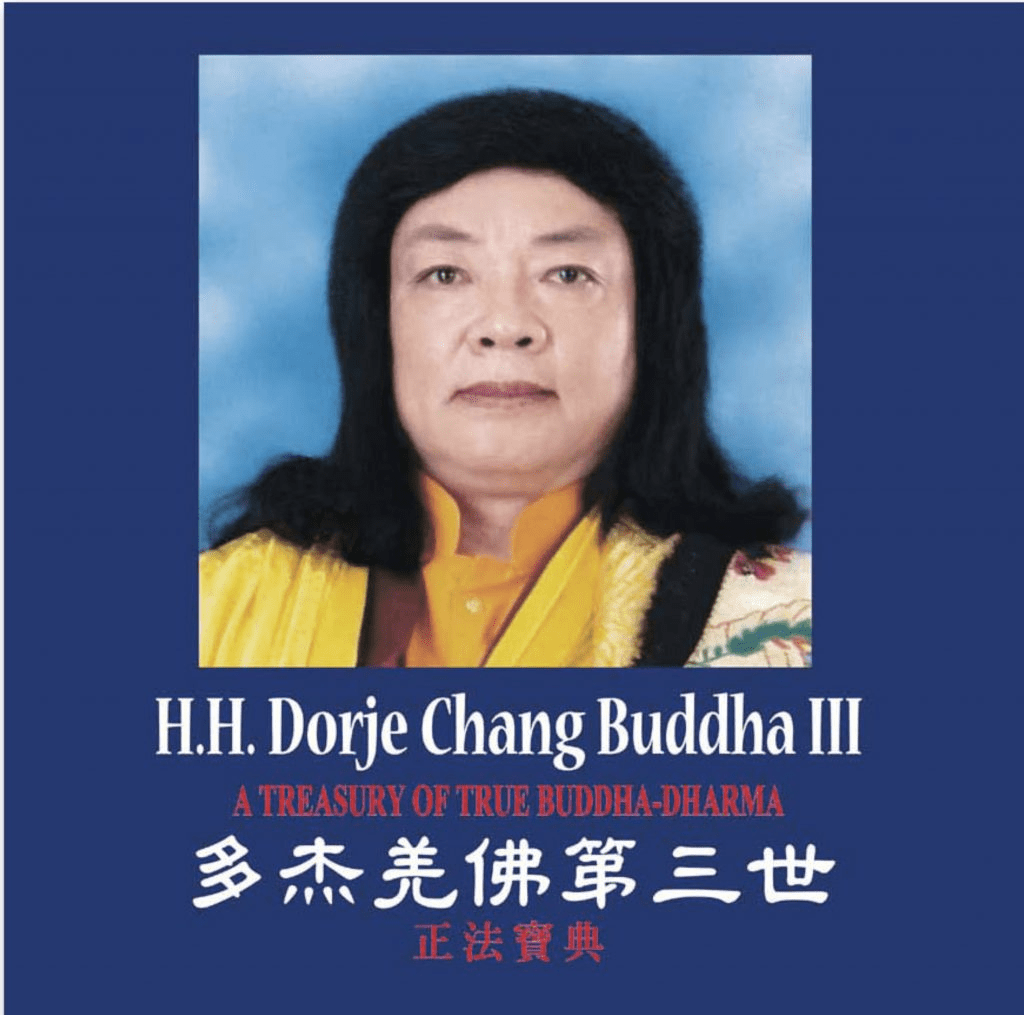
Buddha possesses vast knowledge, superb skills, magnificent supernormal power, and comprehensive wisdom of the universe. The treasure book, “H.H. Dorje Chang Buddha III,” stands as a testament to this statement. However, this book contains only a drop of water from the vast ocean of Buddha’s teachings and wisdom.
The video below showcases the boundless compassion and highlights the extraordinary accomplishments of H.H.Dorje Chang Buddha III. It was published by China Educational Channels TV and features interviews with Buddhist disciples from around the globe.
Discovering the Root of Buddhism, Propagating True Buddha Dharma(H.H. Dorje Chang Buddha III)
Tantra is the secret or esoteric part of Buddhist practice. It is often referred to as the vajrayana or Diamond Path. It is also used as a term for the secret scriptures or esoteric writings. Although it includes the highest dharma within the Buddha-dharma, you should not consider it to be superior or that the exoteric Buddhism practiced by other sects should be considered a low level of dharma. The Buddha-dharma is not divided into high and low as comparisons. All 84,000 dharma methods came into being in response to the different innate faculties of living beings. The Buddha-dharma has only one truth no matter how it is expressed.
Exoteric Buddhism and vajrayana Buddhism are not two separate schools. Exoteric Buddhism is half of a dharma system. True vajrayana Buddhism includes the teachings of the various schools of exoteric Buddhism plus mantras, mudras, visualization, mandala offerings practiced either as a group or alone, and inner and outer tantric initiations. It includes a foundation in the cultivation of the “dharmakaya” from exoteric buddhism as well as the more advanced cultivation of the “sambhogakaya” and the “nirmanakaya.” In vajrayana or tantric practice one strives to realize all three kayas in one lifetime. However, this is ONLY possible if one is able to follow a true vajra master and receive authentic inner tantric initiation.
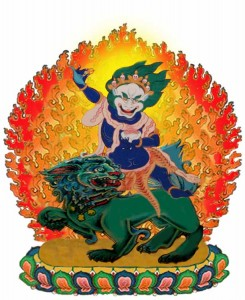
Lion Vajra, an important dharma protector in the Buddha School
True esoteric Buddhism includes all the teachings of the exoteric schools as well as the secret teachings and practices. There are those who claim to be esoteric teachers who can only offer intricate hand movements or mudras, chant mantras, make mandala offerings, or lead the disciple through elaborate visualizations, but who teach or know little of the exoteric sutras. This is not true esoteric Buddhism. Without the foundation in the essential doctrine of the Buddha as found in the Tripitaka, one should not even do the esoteric practices, let alone teach them. That is why the authentic temples which has holly masters teach meditation practices from the Theravadan and Zen or Ch’an Schools, along with certain Pure Land Practices and those of the Hua-yen and Fa-hsiang Schools and others as well as the esoteric methods. Disciples are taught according to their particular karmic affinity with the dharma.
Sometimes these exoteric techniques are taught concurrently with certain esoteric or tantric practices and sometimes they must be mastered prior to introduction to tantra. Not all students are able to receive tantra, which in its highest forms can bring liberation in this lifetime. However, everyone can progress and reach high levels of achievement, according to their efforts and karma. All of the teachings of our temples are to lead beings to liberation from the suffering of the cycle of life and death. That is the only purpose in practicing Buddhism! This is an important point!
Those who learn exoteric Buddhism exclusively are learning only the foundational aspect (some of the theoretical or doctrinal part) of Buddhism. The esoteric vehicle contains the lessor vehicle teachings AND the complete and unsurpassed mahayana teachings of both exoteric and the esoteric Buddhism AND the esoteric practices and rituals.
Tantric initiation is a ceremony within vajrayana Buddhism whereby dharma is transmitted according to tantra by means of a master’s limitless merit and power. During the ceremony, the master visualizes that he or she becomes one with a Buddha or Bodhisattva. During this ceremony the disciple is empowered by the master to carry out specific meditation practices. The student is ritually entered into a mandala of a particular tantric deity by his or her vajra master. He or she is thus empowered to practice the spiritual practices (sadhana) or associated mantras, mudras, and visualization of that deity.
There are three classes of initiation: Outer-tantric initiations, inner-tantric initiations and secret or supreme-tantric initiations (also called “holy” initiations). Each of these three classes is further divided into various dharma methods. During the highest and greatest inner-tantra and secret-tantra initiations there must be supernormal states that are manifested in front of the disciple at the Buddhist altar area (mandala). These miraculous states must be in accordance with the Tibetan tantra laid down by the Buddhas. The disciple is actually turned over to the Buddhas and Bodhisattvas during these initiations. You must remember that unless you personally see the manifestation of supernatural dharma powers, then you have not received an inner-tantric initiation. Most initiations given today are outer-tantra initiations. The supreme or holy initiations are rarely given with very few masters having the ability to perform this type of practice. Vajra masters must undergo certain tests that demonstrate their level of realization to be able to perform this type of ceremony.
Transmission of the greatest dharma requires true nectar during the initiation. For example, the highest dharma within vajrayana Buddhism, the initiation of Ati-yoga, Great Perfection of the Vajra division, requires nectar as an indispensable holy element for cleansing one’s negative karma and is the resource for planting the “Seeds of Vajra.” Other forms of inner trantric initiations can also eliminate karmic obstructions. Disciples can deeply penetrate into the dharma through inner-tantra initiations.
One must have accumulated considerable merit from past practices and good deeds to be able to receive tantra. There are certain preliminary practices that must be performed which can vary depending on the karma of the disciple. There are exceptions possible for 1) those who have completed these steps in a past life; 2) those with exceptional merit due to extraordinary offerings or actions in this life; and 3) through the grace of the guru.
Tantra requires the initiation or empowerment of a qualified teacher or master who provides specialized teachings, rituals, and practices to enable the disciple to root out or eliminate the dark side of his/her psyche and thus become like the Bodhisattvas and Buddhas. Supernormal powers are viewed as the natural outcome of realization and are used by qualified teachers. However, ordinary disciples are not allowed to discuss or display their supernormal powers. Only very highly evolved Bodhisattvas and Buddhas dare to display such powers and then only to help living beings. A person seeking initiation must demonstrate an understanding of emptiness, exhibit high moral conduct, and have developed an altruistic desire to help all beings. Any empowerment will have limited impact without a proper foundation of preliminary practices or Prayogas. It recognizes that supernormal powers cannot be given to one who has not eliminated the negative aspects of the self.
Today as in times past, the highest tantric teachings and practices are only transmitted orally and are held in great secrecy between the teacher and the disciple. Because of the power of these teachings, it is recognized that the student must be thoroughly prepared to receive them. A true master will usually test a disciple for six to twelve years or longer before transmitting the higher teachings.
A Zen practitioner was meditating by the river when he heard struggling sounds. Upon opening his eyes, he saw a scorpion struggling in the water.
He reached out to lift it up, only to be stung by the scorpion’s raised stinger. He placed the scorpion on the bank and continued meditating.
After a while, he heard struggling sounds again. Opening his eyes, he saw the scorpion had fallen back into the water.
He rescued it again, and of course, was stung once more. He continued meditating.
After a while, he had the same unfortunate encounter.
A nearby fisherman said, “You’re so foolish, don’t you know that scorpions sting people?”
The Zen practitioner replied, “I know, I’ve been stung three times.”
The fisherman asked, “Then why do you still save it?”
The Zen practitioner said, “Stinging is its nature, compassion is mine. My nature will not change because of its nature.”
At that moment, he heard struggling sounds again. Looking down, it was the same scorpion.
He looked at his swollen hand, then at the struggling scorpion in the water, and without hesitation, reached out to it again.
This story beautifully illustrates the Buddhist principle of compassion and loving-kindness towards all living beings, regardless of their actions. It embodies the teachings of the Buddha, who emphasized the importance of cultivating a heart full of compassion.
The practice of compassion is central to the Buddhist path. In Mahayana Buddhism, the Bodhisattva ideal embodies the ultimate expression of compassion. A Bodhisattva is one who, motivated by great compassion, has generated bodhicitta, the spontaneous wish to attain Buddhahood for the benefit of all sentient beings.
Moreover, the story reminds us of the great sacrifices made by Siddhartha Gautama, who later became known as Shakyamuni Buddha. He renounced his life of luxury and privilege to seek the ultimate truth of life and the universe. His journey was fueled by the desire to find a way to liberate all beings from the cycle of birth and death, known as samsara.
However, after two and a half millennia, the profound teachings of Shakyamuni Buddha have been gradually forgotten. To revive and propagate the Dharma once more, the primordial Tathagata Buddha, Dorje Chang Buddha, incarnated as H.H. Dorje Chang Buddha III in our world.
H.H. Dorje Chang Buddha III has not only brought the highest form of Buddha Dharma to this world but also set a remarkable example for all disciples through his boundless compassion and humility.
In the past decade, H.H. Dorje Chang Buddha III has endured significant suffering due to long-term persecution for his religious activities. A member country of Interpol once requested that the organization issue a warrant for his arrest. This request was later voluntarily withdrawn by the member country after several years. Following a thorough investigation, in October of 2008, the 72nd session of the Commission for the Control of Interpol’s Files withdrew the arrest warrant and dismissed the entire case against H.H. Dorje Chang Buddha III. Interpol also issued a document stating unequivocally that the arrest warrant against H.H. Dorje Chang Buddha III has been canceled and all member countries have been informed of the cancellation.
Although H.H. Dorje Chang Buddha III received official notification of the withdrawal of the arrest warrant and the removal of the entire case, he has never publicly displayed such documents to prove his innocence. Despite enduring slander, H.H. Dorje Chang Buddha III chose not to disclose this irrefutable evidence. When the World Peace Prize Awarding Council inquired about this, he responded by explaining that his duty is to bear all of the karmic offenses committed by living beings and to bestow upon them all of the good karma and merit that he has cultivated. He expressed concern that if he were to prove his innocence using those documents, those who slandered him would be perceived as guilty. He questioned, “Who, then, will bear their karmic offenses?”
There have been many instances that highlight his holiness’s profound compassion. For example, some of his disciples once left and defamed him, but he still welcomed them back with open arms and treated them no differently than before.
H.H. Dorje Chang Buddha III often reminds his disciples that he harbors no enemies and that all sentient beings are his dearest relatives. He encourages everyone to reflect on their own actions and to strive to lead a life filled with kindness, patience, and understanding.
His Holiness Dorje Chang Buddha III embodies the essence of selflessness and serves as a moral beacon for all to follow. He has also demonstrated how peace can be achieved through determination, humility, and the perseverance to champion its cause even in the face of adversity.
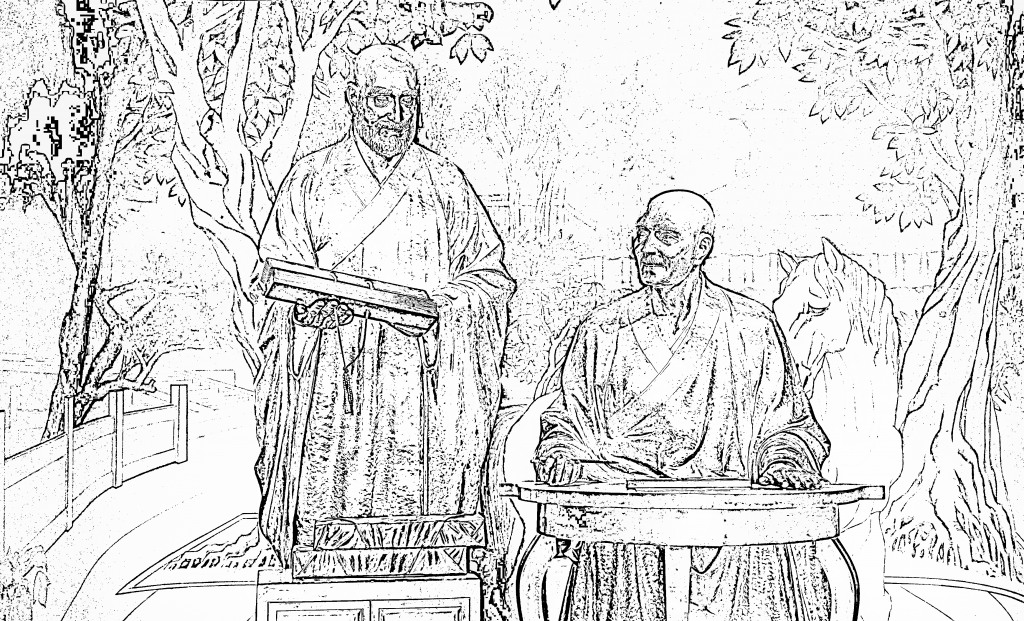
In 64 AD, Emperor Ming of the Eastern Han Dynasty sent Cai Yin and others on a mission to the Western Regions to retrieve Buddhist scriptures. The following year, in 65 AD, Cai Yin, Qin Jing, and others met the esteemed Indian monks She Moteng and Zhu Falan in Greater Yuezhi (present-day Afghanistan), where they were introduced to Buddhist scriptures and statues for the first time. In 67 AD, the Han envoy team returned to Luoyang with the high monks She Moteng, Zhu Falan, and the Buddhist scriptures and statues carried by a white horse. The two high monks were welcomed with a grand reception by Emperor Ming, who also commissioned the construction of China’s first temple, the White Horse Temple in Luoyang, especially for them.
White Horse Temple
On the first day of the first month in the fourteenth year of Yongping, Taoists from the Five Sacred Mountains submitted a petition requesting a competition with the Brahmin monks to determine the superiority of China’s native Taoism versus the foreign Buddhism. Emperor Ming granted the Taoists’ request. In 71 AD, a historic Buddhist-Taoist debate and contest unfolded in Chinese Buddhist history.
As the competition began, the Taoists said, “Let’s start with debating. You monks pride yourselves on eloquently explaining the Dharma, don’t you? So, let’s have a debate! If you can make one point, we will make two; if you raise one, we will counter with three. Go ahead and present your profound arguments!”
She Moteng slowly lifted one foot and raised it towards the sky, smiling, and said, “Amitabha, I have raised one, now it’s your turn to raise three!”
The Taoists looked at each other, stumped, and couldn’t think of a way to counter for a long time. They then changed the subject: “Let’s compare theories. You Buddhists call yourselves ‘Inner Learning,’ while you call us ‘Heterodox.’ But throughout history, when discussing inner and outer, inner has always been smaller than outer. So, your Inner Learning is small, and cannot compare to our great Heterodox!”
She Moteng brought his palms together in a gesture of respect and slowly explained: “The emperor resides in the inner palace, while the common people live in the outer city; although the inner palace is small, the emperor is great. The heart is inside the body, while the hands and feet are outside, the activity of the heart is boundless, while the movements of the hands and feet are limited. This is another example of how the inner is superior to the outer. Think carefully, the Inner Learning of Buddhism is much greater than the Heterodox!”
The Taoists, unable to win the debate, finally said, “Let’s compare magical powers!” How to compare? By placing the scriptures spoken by the Buddha and the scriptures spoken by the Taoist tradition together and burning them with fire. If one’s scriptures burn, then they are false; if one’s scriptures don’t burn, then they are true.
So, in the south of White Horse Temple, two high platforms were set up, one in the east and one in the west. The east platform held the Buddhist scriptures, images, and relics, while the west platform held the Taoist scriptures.
At that time, five hundred Taoist priests gathered the Taoist scriptures and magical texts together and prayed to the Supreme Lord Laozi, saying: “Oh, Taoist Virtuous Sage! Please show great divine power, and make our Taoist scriptures not burn, and let the Buddhist scriptures burn.”
Many of the Taoist priests at that time had supernatural powers – some could ride clouds and fog, some could fly in the sky and hide underground, and some could become invisible. Invisible means that you could see him right in front of you, and then suddenly he’s gone! There were Taoist priests with such abilities. They could use evasion techniques – Qimen Dunjia, to escape, and with Taoist spells and incantations, they had great supernatural powers.
But what happened when the fire was lit? The Buddhist scriptures did not burn; they emitted light! The Buddha’s relics also emitted a five-colored light, and the scriptures emitted light up into the sky, as if the sun was shining upon the world.
What about the Taoist scriptures? They caught fire as soon as they were burned and were completely destroyed by the fire. Those who could ride clouds and fog could no longer ride clouds or exhibit supernatural powers; those who could fly in the sky could no longer fly; those who could hide underground could no longer hide; those who could become invisible could no longer become invisible. Their spells and incantations also lost their effectiveness and had no power.
She Moteng and Zhu Falan, the two venerable monks, were responsible for overseeing this scripture contest, which was of great significance for the rise or fall of Buddhism. To strengthen the faith of the masses, She Moteng and Zhu Falan displayed eighteen divine transformations, levitating in the sky and reciting the following verses:
“The fox is not of the lion’s kind, a lamp is not as bright as the sun and moon; a pond cannot hold the vast sea, a hill cannot match the towering mountain. The Dharma cloud descends upon the world, the Dharma rain nourishes all beings. Supernatural powers are rare, manifesting everywhere to transform sentient beings.”
“The fox is not of the lion’s kind” means that, although the fox spirit is cunning and can change shape, it is far inferior to the lion. The fox and the lion cannot be compared; they are not of the same kind. This is saying that the breadth of Taoism is like the smallness of the fox, different from Buddhism, which has the grandeur of a lion.
“The lamp is not as bright as the sun and moon” refers to how the light of a lamp or a candle, which were small in the past, is far less bright than the light of the sun and moon. This means that the scriptures and teachings of Taoism are like the light of a lamp, while the Buddhist scriptures and teachings are like the light of the sun and moon, incomparable.
“A pond cannot hold the vast sea” means that a small pond has a limited capacity and can only hold a small amount of water, while the vast sea can accommodate many rivers. The pond and the sea cannot be spoken of in the same breath. This is a metaphor comparing the theories of Taoism to a small pond, while the teachings of Buddhism are like the vast and boundless sea.
“A hill cannot match the towering mountain” means that a small hill cannot compare to the grand and towering Mount Song, one of the Five Sacred Mountains of China. If the practice of Taoism is like a small hill, then the profound teachings of Buddhism are like the towering cliffs and deep ravines of ancient trees.
“The Dharma cloud descends upon the world, the Dharma rain nourishes all beings” means that when Buddhism spread to China, it was like a cloud of Dharma, like sweet dew, pervading the world and nourishing all beings.
“Supernatural powers are a rare thing” means that I have now shown supernatural powers, which is a rare and precious thing in the world.
“Everywhere transforming sentient beings” means that in reality, I did not want to show supernatural powers, and I did not want to compete with you. This is a last resort, for the purpose of guiding you and leading you to a brighter path, I am doing this as a convenient means.
After this contest, Buddhism took deep roots in China, not only producing a succession of talented individuals but also establishing a glorious foundation. White Horse Temple became the first and foremost temple in Chinese Buddhist history, and temples began to be built one after another. Ever since then the marvelous fruits and wondrous flowers of Chinese Buddhism have continued to flourish from generation to generation.
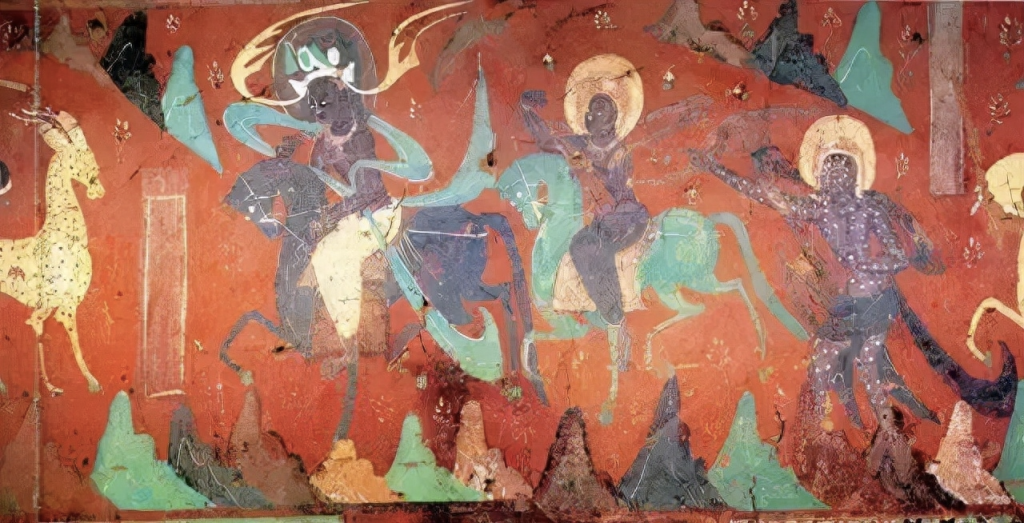
“The Story of the Nine-Colored Deer King” is the main theme of the murals in Cave 257 of the Mogao Caves. It unfolds in a long horizontal scroll, narrating many stories from the past life of the founder of Buddhism, Siddhartha Gautama.
Legend has it that long ago, on the banks of the Ganges River in India, there lived a beautiful and kind nine-colored deer king (the previous incarnation of Siddhartha Gautama)…
One day, as the nine-colored deer king was leisurely strolling by the river, he suddenly heard a pitiful cry from the water. Without hesitation, the brave nine-colored deer leaped into the river, risking its own safety, and rescued the drowning person. The saved individual, overwhelmed with gratitude for a second chance at life, repeatedly bowed in thanks to the nine-colored deer.
The nine-colored deer king said, “No need for thanks; just go on your way. My only request is that you do not reveal my whereabouts to anyone.” The drowning person solemnly swore, “Kind benefactor, rest assured. If I ever betray this promise, may my body be covered in sores and my mouth emit a foul odor.” With that, the person departed.
Before long, the queen of that country dreamt of a deer—one with nine colors and silver-like antlers. She told the king about her dream and requested that he order the capture of such a deer. She had a strong desire to use its colorful hide for clothing and its antlers for earrings. Consequently, the king issued a proclamation and offered a substantial reward.
Upon seeing the proclamation, the person who had been saved reported to the king, leading soldiers to the mountain to hunt down the nine-colored deer.
When the nine-colored deer was surrounded by the king’s troops… it spotted the person it had rescued from drowning, tears of sorrow welled up in its eyes…
The nine-colored deer leaped in front of the king and recounted the story of how it had saved the person from drowning and how that person had broken his promise. The king and the soldiers were deeply moved by the deer’s account. The king ordered the soldiers to clear a path, allowing the nine-colored deer to regain its freedom. He also issued a decree: “From now on, people are not allowed to shoot deer.”
As for the person who had broken his promise, in an instant, sores covered his body, and a foul odor emanated from his mouth. From that moment on, he was despised and reviled by the people.
The story of the nine-colored deer is vividly portrayed in Cave 257 of the Dunhuang Grottoes, which is what we now see as “The Story of the Nine-Colored Deer King.” While the mural is not particularly large in size, it holds significant importance in Chinese art history.
This artwork takes the form of a horizontal scroll with the story unfolding from both ends and converging in the middle. It consists of multiple scenes depicting various stages of the story, such as its origin, development, climax, and conclusion, all seamlessly connected to create a cohesive narrative.
“The Story of the Nine-Colored Deer King” is composed of nine panels, illustrating five key plot points: the person drowning, the nine-colored deer rescuing the drowning person, the drowning person expressing gratitude to the deer, the queen’s desire to capture the deer, the informant revealing the deer’s whereabouts to the king, and the confrontation between the king and the deer.
The story progresses from both ends of the mural towards the center, placing the pivotal conversation between the king and the deer in the middle. This unique composition style captures the essence of continuous horizontal scroll art from the Wei and Jin dynasties, showcasing the distinctive historical aesthetics of the era.
In the artwork, the depiction of mountains, rocks, and rivers occupies a significant portion. The rendering of the landscape primarily serves to fill the space and delineate the composition, providing a brief description of the specific environment, thereby enhancing the visual impact of the artwork and its storytelling function.
“The Story of the Nine-Colored Deer King” places the climax of the story—the moment when the nine-colored deer recounts the events—at the center of the composition. At the same time, both nine-colored deer on the left and right sides turn their bodies toward the center, serving as visual guides.
This is precisely the turning point in the storyline of the nine-colored deer, where the drowning person’s affliction receives its retribution. It places the Buddhist concept of rewarding goodness and punishing evil at the visual forefront, narrating the sequence of events step by step to gradually reveal the story’s progression to the viewer.
The entire process is rhythmic, marked by the ebb and flow of the narrative, skillfully aligning the chronological order with the spatial arrangement, showcasing the artist’s unique conceptualization of the composition.
In terms of color usage, “The Story of the Nine-Colored Deer King” appears to be very vibrant, but in reality, it uses a limited color palette, consisting of only six colors. The earthy red color dominates the entire painting, which is a prominent color characteristic of the Wei, Jin, Northern and Southern Dynasties period.
Complementing this are touches of stone blue and stone green, along with the harmonious blending of black, white, and gray. This blending softens the strong contrast between earthy red and stone green and blue, achieving a harmonious contrast of warm and cool tones. At the same time, it also accentuates the brightness of contrasting colors.
The introduction of Buddhism had a significant impact on the development of portraiture in China, introducing a set of strict conventions for Buddhist iconography. During the Northern Wei dynasty, the Dunhuang murals began to emphasize body proportions and adopted more attention to three-dimensionality after incorporating color shading techniques.
In “The Story of the Nine-Colored Deer King,” most of the figures on the canvas have slender bodies, with their clothing belts fluttering in the wind. Their gestures and movements exude a graceful dance-like elegance, evoking the style of figures that “float like wandering dragons and are delicate as startled swans.”
In the murals of the Northern Wei period in Dunhuang, Jataka stories are an important theme. Jataka stories refer to the countless events and experiences in the past lives of Siddhartha Gautama, who would later become the founder of Buddhism. In history, there are numerous Jataka stories related to Siddhartha Gautama.
Within Buddhist art themes, there are many Jataka story paintings, and “The Story of the Nine-Colored Deer King” is just one of them. Story paintings are used to promote the Buddhist concept of karmic retribution and to praise the spirit of self-sacrifice displayed by the Nine-Colored Deer King.
In reality, all Jataka paintings ultimately convey one message: that by performing good deeds, selflessly giving, and enduring hardships, one can achieve positive outcomes, whereas engaging in wrongful actions will lead to self-destruction.
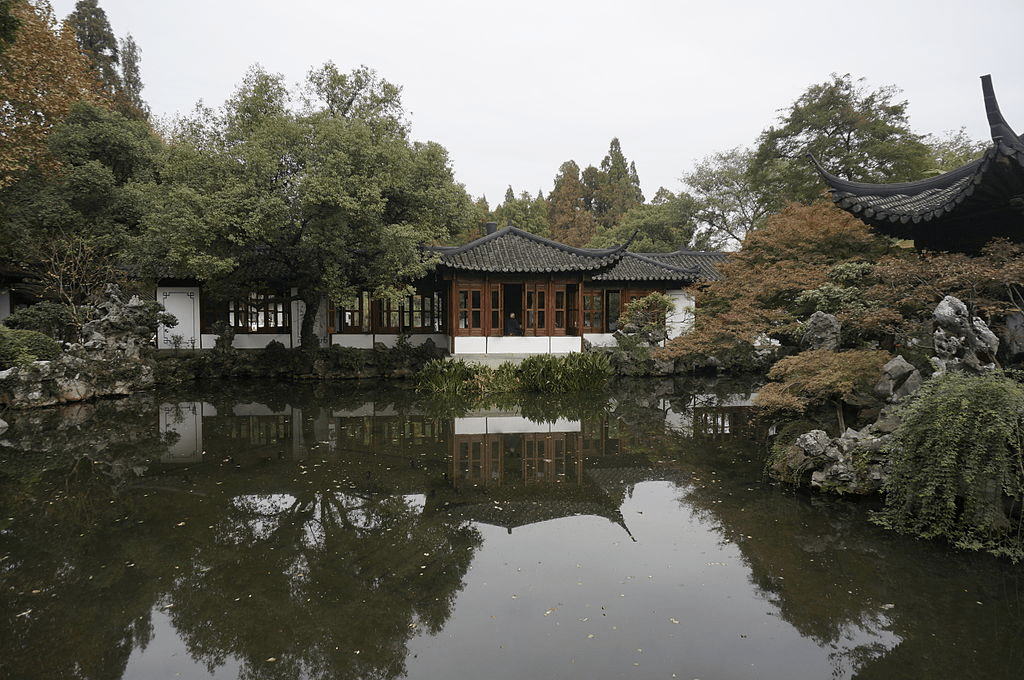
The recent Asian Games held in Hangzhou, China, brought the world’s attention to a spectacular opening ceremony that dazzled the senses. It was a momentous occasion that reminded me of Hangzhou’s unique charm—a city that effortlessly blends history, culture, and breathtaking natural beauty. In this blog post, I am trying to introduce some Hangzhou’s rich history, cultural significance, and the enchanting West Lake that graces this remarkable destination.
Hangzhou’s historical significance dates back over a thousand years. As the capital of the Southern Song Dynasty (1127-1279), it was the political, economic, and cultural center of ancient China. The city’s past is vividly reflected in its well-preserved landmarks, such as the Grand Canal, which was once the world’s busiest and longest artificial waterway. The canal played a pivotal role in facilitating trade and cultural exchange between northern and southern China.
Hangzhou’s cultural heritage is as rich as its history. The city is celebrated for its pivotal role in nurturing Chinese art, literature, and philosophy. It is home to numerous temples, museums, and historical sites. One of the most iconic landmarks is the Six Harmonies Pagoda, which offers breathtaking views of the Qiantang River. Additionally, Hangzhou is renowned for its tea culture, with the world-famous Longjing (Dragon Well) tea originating from the lush plantations that surround the West Lake.
The West Lake, or Xi Hu in Chinese, is Hangzhou’s crown jewel, a UNESCO World Heritage Site that captivates visitors with its picturesque beauty. Surrounded by lush hills, willow-lined pathways, and charming pagodas, the lake’s serenity has been an inspiration to poets, artists, and philosophers for centuries. Its natural allure changes with the seasons, making it a destination worth visiting year-round.
Highlights of the West Lake
Leifeng Pagoda, perched atop Sunset Hill, is a historical gem that offers sweeping vistas of the West Lake. As the sun gracefully descends below the horizon, this iconic pagoda bathes the lake in its enchanting glow, creating a magical setting perfect for a romantic evening. But beyond its scenic beauty, Leifeng Pagoda is intertwined with a captivating and somewhat tragic love story that has captured the hearts of generations.
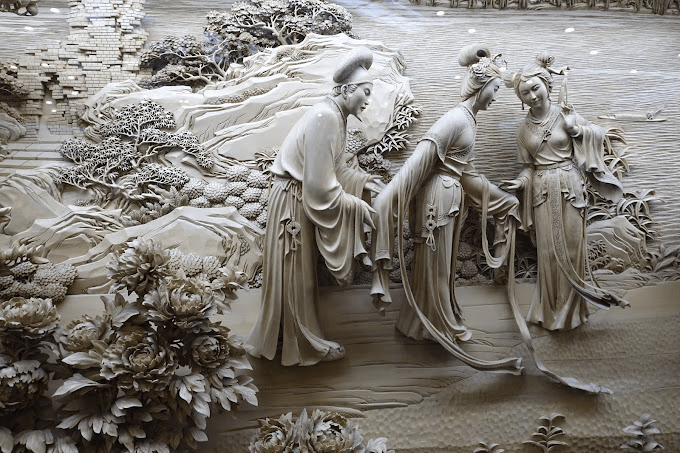
In the Chinese folk tale “The Legend of the White Snake,” the story unfolds with the white snake, who falls deeply in love with a young man named Xu Xian. In a remarkable transformation, the white snake assumes the guise of a young lady and marries Xu Xian. However, their love is not without obstacles. The wise monk Fahai recognizes the bride’s true identity as a white snake and cunningly deceives Xu Xian, leading him to Jinshan. In a valiant attempt to rescue Xu Xian, the White Lady rushes to Jinshan, only to be suppressed under the Leifeng Pagoda by Fahai.
The hidden interior of Leifeng Pagoda is adorned with intricate carvings crafted in the style of Dongyang woodcarvings. These carvings vividly depict the captivating love story of Bai Niangzi (the White Snake) and Xu Xian as told in the legend of “The Legend of the White Snake.” The carvings employ five distinct techniques, including round carving, semi-round carving, high relief, deep relief, and shallow relief. These techniques are skillfully combined into a form known as “overlay carving,” which serves to enhance the storytelling and character portrayal within the legend.
Leifeng Pagoda, with its breathtaking views and rich cultural significance, stands as a testament to the enduring power of love and storytelling. It invites visitors to delve into the enchanting world of Chinese folklore while appreciating the timeless beauty of the West Lake at sunset.
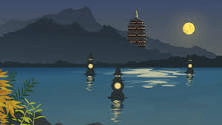
Three Pools Mirroring the Moon: This picturesque scene features three small pagodas surrounded by water, beautifully illuminated during the Mid-Autumn Festival. It’s a breathtaking sight that draws thousands of visitors each year.
West Lake Cruise: Exploring the lake by boat provides a unique perspective of its beauty. As you glide across the serene waters, you’ll pass by charming islets, arched bridges, and elegant lakeside gardens.
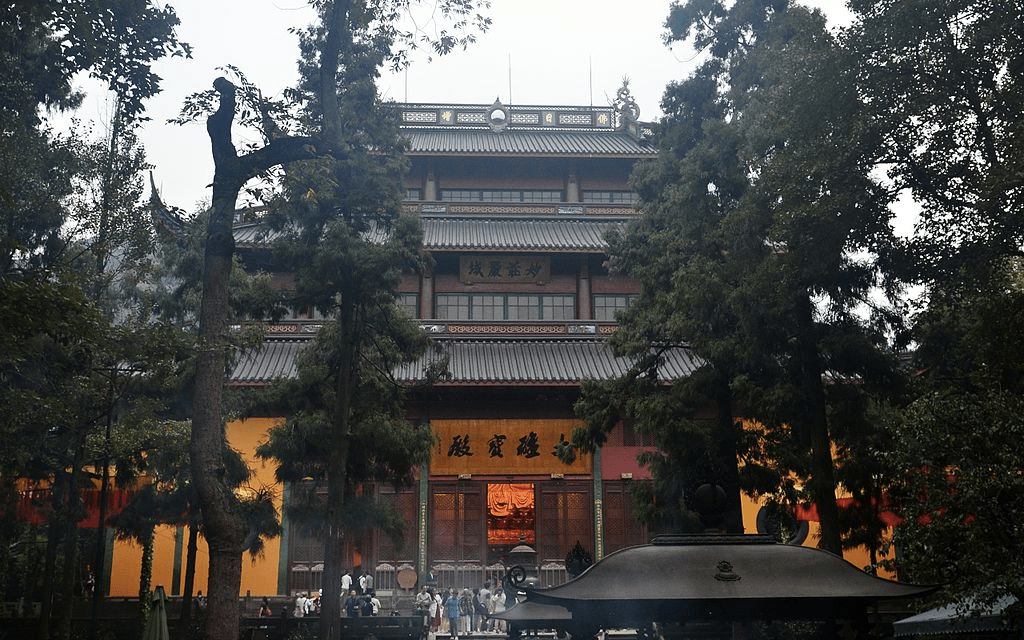
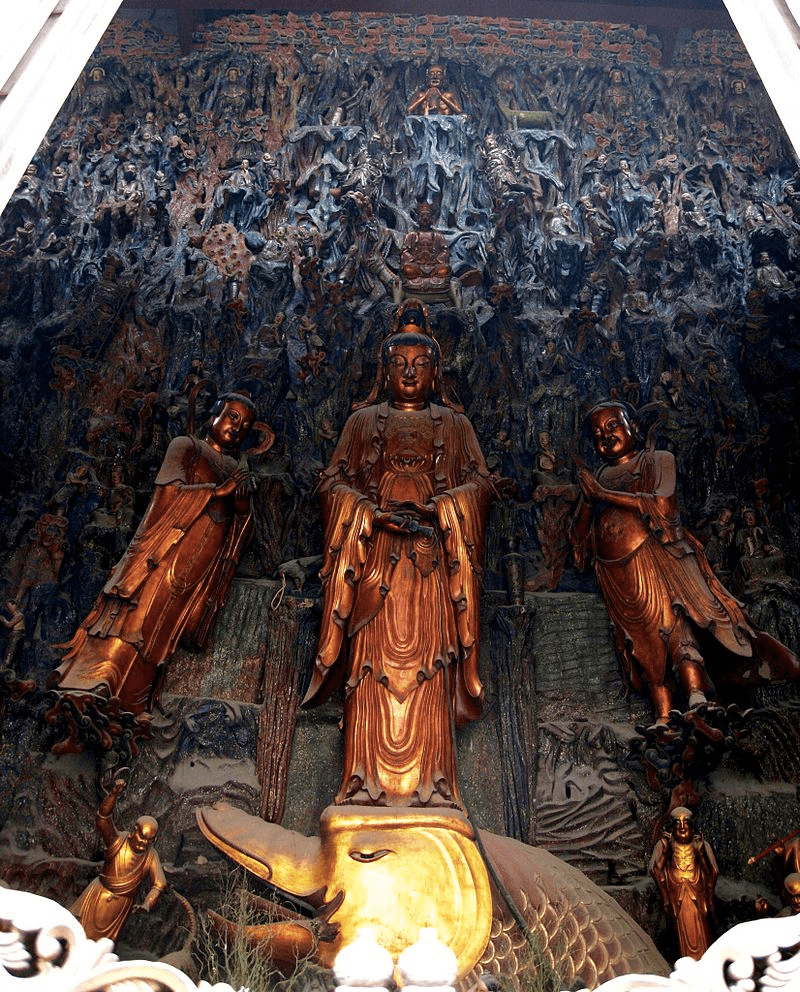
Lingyin Temple: Located in the vicinity of the West Lake, Lingyin Temple is one of China’s most ancient and revered Buddhist temples. Its serene atmosphere and intricate carvings make it a cultural treasure.
According to historical tradition, the origins of Lingyin Monastery trace back to the year 328 AD, during the Eastern Jin dynasty (266–420). The monastery was established by an Indian monk known as Huili in Chinese. Right from its inception, Lingyin gained widespread recognition as a prominent Buddhist institution in the Jiangnan region.
During its zenith under the Wuyue Kingdom (907–978), Lingyin Temple stood as a grand edifice. It comprised nine multi-story buildings, 18 pavilions, 72 halls, and more than 1300 dormitory rooms, providing a sanctuary for over 3000 monks. The legacy of this era is also etched into the rich Buddhist carvings that adorn the Feilai Feng grottos and the surrounding mountains.
In the later years of the Southern Song dynasty (1127–1279), Lingyin Monastery retained its eminence, securing its position as one of the ten most significant temples of the Chan sect in the Jiangnan region. Regrettably, this prominence did not shield the monastery from the ravages of time and external threats. Over the centuries, Lingyin Temple has undergone reconstruction no less than sixteen times. While some of the existing structures date back to earlier Chinese dynasties, much of what stands today are modern restorations from the late Qing period (1644–1911).
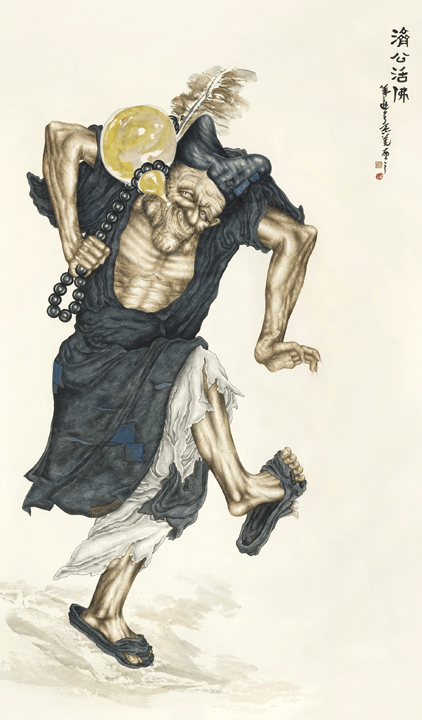
The temple is also associated with a famous and eccentric monk, Jigong. The legends of this mad monk find their roots in the life of a historical figure named Li Xiuyuan (1148-1209). Born into a family of officials with a long-standing Buddhist tradition in Tiantai County, Zhejiang Province, Li Xiuyuan’s life took a different course when his parents passed away at the age of 18. He made his way to Lingyin Temple, the largest Buddhist temple in Hangzhou, where he became a monk.
Hall of Master Jigong
Under the guidance of Hui Yuan, a senior abbot at Lingyin Temple, Li received the Buddhist name Daoji. However, he was not inclined toward the temple’s customary routines of sutra chanting and meditation. In defiance of strict Buddhist rules, he indulged in eating meat and drinking alcohol, even publicly. His appearance often featured a dirty, tattered cassock, and he could be spotted wandering the streets in a half-drunken state.
Despite his peculiar behavior, Li endeared himself to the local community. He displayed great compassion for the poor and disadvantaged, possessed remarkable skills in medicine, and was known for his ability to treat complex ailments, often saving lives. He was also noted for his wit and what some considered magical abilities. As a result, he became known as Ji Gong the Living Buddha, a folk hero whose legacy has endured in China for over 800 years.
Ji Gong’s distinctive image, with a crumpled hat, ragged robe, and a worn-out palm leaf fan, remains familiar to the public. In fact, an ink painting of Jigong HuoFo, created by the artist H.H. Dorje Chang Buddha III, is displayed in the International Art Museum of America. This artwork skillfully captures the monk’s details, including his skin, meridians, and veins, utilizing fine brushwork and realism to vividly portray the life of this beggar-like figure who held a special place in the hearts of many.
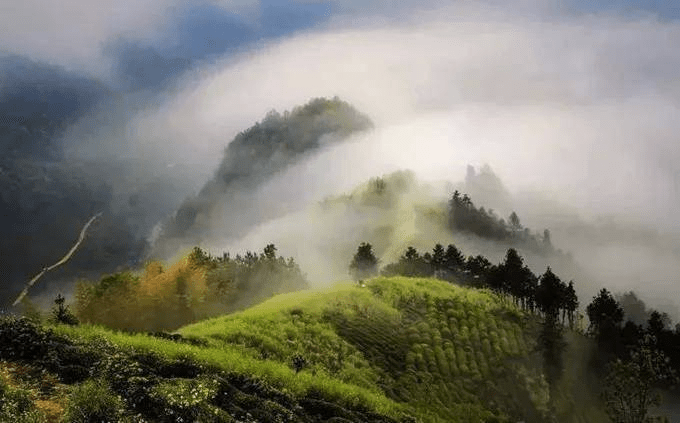
Another remarkable natural treasure worth mentioning is Longjing Tea. West Lake Longjing tea is among China’s most prestigious teas, renowned for its attributes of “vibrant green color, rich fragrance, mellow taste, and exquisite appearance.” It is often referred to as the “Four Uniques.” Cultivated in five primary production regions—ShiFeng, Longjing, Yunxi, Hupao, and Meijiawu—West Lake Longjing tea is celebrated for its superior quality. Among these regions, ShiFeng stands out as the finest, and “Mingqian tea” is its most coveted variety, frequently chosen as a high-quality gift for special occasions. Shifeng Longjing tea is predominantly produced in the renowned tea villages of Hangzhou Longjing Village and Wengjiashan Village, signifying the “Number One Tea Village in the World.”
Moreover, it’s worth noting that H.H. Dorje Chang Buddha III has masterfully crafted a tea called “Bi Yu Chun,” which has achieved the highest-grade ranking in China. His Holiness has elevated the traditional techniques of tea production to a level of perfection, resulting in the creation of this exceptional green tea.
Bi Yu Chun possesses a unique flavor and unparalleled quality. Its tea leaves are compact and delicate, retaining their natural fuzz, boasting the color and luster of green jade. This tea exudes a pure aroma reminiscent of chicken broth or roasted chestnuts. It offers a pleasantly refreshing taste that lingers, maintaining its rich flavor for an extended duration. The tea is beautifully translucent, displaying a radiant green akin to that of green jade, akin to a mountain spring. Long after you savor it, the delightful flavor of Bi Yu Chun lingers in your thoughts.
In June of 1989, a competition was held to select the finest Chinese teas. Bi Yu Chun was among the contenders, alongside esteemed Chinese teas like Shi Feng Long Jing, Dong Ting Bi Luo Chun, and Jun Shan Yin Zhen. Evaluated by a committee of tea experts based on the conventional standards for tea evaluation, Bi Yu Chun scored an outstanding 101 points, surpassing all other grades to earn the title of the top Chinese tea. Experts hailed Bi Yu Chun for rectifying the three common shortcomings of Chinese green tea: insufficient greenness, a bitter and astringent taste, and an inability to withstand steeping well. Bi Yu Chun has thus exceeded the highest global standards for tea production and is acclaimed as the premier Chinese tea.
H.H. Dorje Chang Buddha III‘s talents extend beyond being an exceptional painter; he is also a superb tea artisan. The wisdom and knowledge of His Holiness are truly profound and transcend human imagination.
Hangzhou, with its rich history, cultural significance, and the enchanting West Lake, offers a unique blend of experiences that captivate the soul. Whether you’re exploring the city’s historic sites, sipping on a cup of Longjing tea, or strolling along the shores of the West Lake, Hangzhou is a destination that promises an unforgettable journey through China’s past and present. It’s a place where tradition and modernity coexist harmoniously, leaving an indelible mark on all who have the privilege to visit.
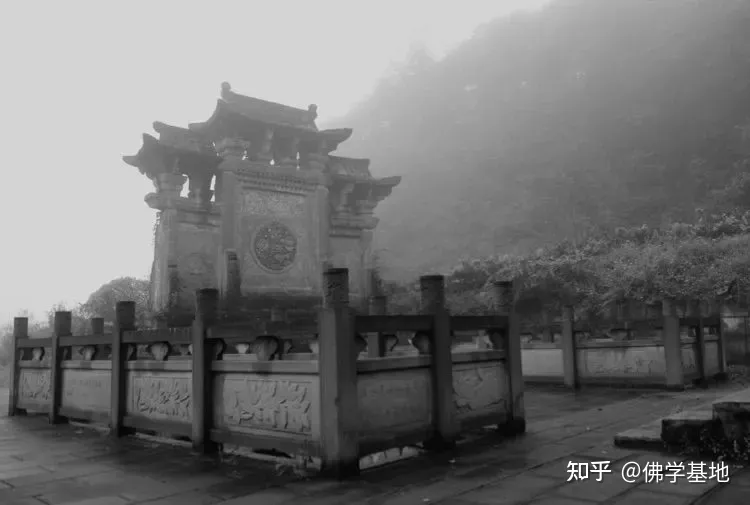
The Mount Wuzhong, also known as Misty Mountain and formerly referred to as Daguangming Mountain, Tiancheng Mountain, and Wushan, is a significant Buddhist pilgrimage site situated along the ancient Sichuan-to-India trade route, often referred to as the Southern Silk Road, within ancient China. It is located in Wushan Township, north of Dayi County, 25 kilometers from the county seat, and 80 kilometers from Chengdu. To its east lies Qinglong Mountain, to the south it connects with Daping, to the west it borders Wayao (also known as Baihushan), and to the north, it meets Longwo. The primary peak elevates to 1638 meters, with Jiulong Mountain and Jingang Mountain to the north and Hongyan Mountain to the west. Covering an expansive area of several square kilometers, it is aptly known as the “72 peaks” due to the constant presence of clouds and mist, hence earning its moniker as the “Misty Mountain.”
Historical records, such as the Ming Dynasty’s “Kaihuasi Stele Inscription” and the “Records of Misty Mountain,” reveal that as early as the Western Han Dynasty, Mount Wuzhong was renowned for its breathtaking natural beauty and mysterious wonders that left people in awe. It was described as a “land adorned in golden cloth and adorned with jade-like peaks, filled with endless wonders that inspired astonishment and amazement.” It was even considered “the place where the ancient Buddha Amitabha performed miracles.” In the 16th year of Emperor Ming of the Han Dynasty, responding to recommendations from the imperial court, Emperor Ming dispatched the courtier Fu Ying, accompanied by two distinguished monks from ancient India – the venerable monks Kashyapa Matanga and Zhu Falan – to establish a Buddhist temple on the mountain. Their mission was to propagate Buddhism and disseminate its teachings, thereby benefiting people far and wide with the nectar of Buddhist wisdom.
During the Ming Dynasty, Buddhism at Misty Mountain reached its zenith. The mountain boasted a total of seventy-two peaks, nine passes, and one hundred and eight winding paths, accommodating one hundred and eighty temples and forty-eight hermitages. According to the “Records of Misty Mountain,” it was described as a place “spanning dozens of square miles north of the two rivers and south of Longwo, with buildings scattered like black houses, without overcrowding.” “Monasteries and temples were as numerous as stars in the sky, surrounding the mountain from all sides, too numerous to count.” In modern terms, the total constructed area exceeded 400,000 square meters, equivalent to the size of a medium-sized city. During the Ming Zhengtong era, the emperor established the Dugang Institute at Misty Mountain, with the venerable monk Yuanxi serving as the official historian, overseeing all temple affairs. The temples at Misty Mountain were so prosperous and grand in scale during that period that a local saying emerged: “There are 25 thousand great monks, and the number of ordinary monks is beyond count.”
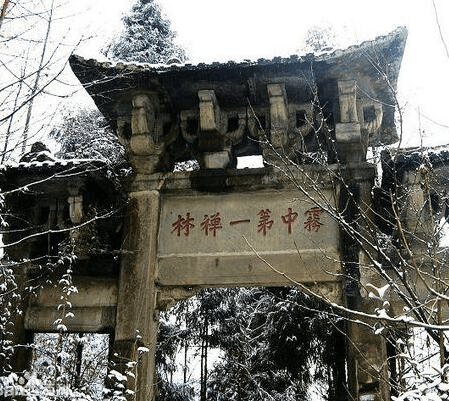
Eminent scholar Yang Sheng An, during his travels in Misty Mountain, inscribed a couplet on the “Heavenly Mountain” archway, proclaiming, “There is no match in the world; Misty Mountain is the number one.” With Yang Shen’s profound insight, he boldly asserted that Misty Mountain was unrivaled, and in the “Inscription of Kaihuasi temples at Misty Mountain,” he referred to this place as the “supreme stronghold of Chan (Zen) Buddhism.” This attests that during the Ming Dynasty, the prestige of Buddhism at Misty Mountain remained unmatched by other mountains in the region.
The Buddhist temple – KaihuaSi – established by the venerable monks Kashyapa Matanga and Zhu Falan was erected just six years after the White Horse Temple, often regarded as the first temple in Chinese Buddhist history. Therefore, it holds the distinction of being the second temple in the annals of Chinese Buddhism’s history and the first temple for the transmission of Buddhism from the south. Emperor Ming of the Han Dynasty bestowed upon it the name “Daguangming Puzhao Temple.”
KaiHuaSi Temple
Since the Han Dynasty, Mount Wuzhong has been home to renowned monks who have propagated and practiced the Buddhist teachings. During the Yonghe period of the Jin Dynasty, the esteemed Western monk Faxian revitalized Misty Mountain, renaming the temple as Tiancheng Mountain Xianying Temple. In the reign of Emperor Gaozong of the Tang Dynasty, two great masters, Sangha and Senghu, resided here and, by imperial decree, restored the original name of Daguangming Mountain Puzhao Temple. In the reign of Emperor Xiaozong of the Song Dynasty, Master Yuanze Laochang expanded and embellished the temple, bestowing it with splendor. During the reign of Emperor Xuanzong of the Ming Dynasty, Tibetan monks Pudashaye and Shigaba were once again appointed by imperial decree to rebuild the temple and requested the imperial name “KaiHuaSi at Misty Mountain.” This name has endured for the temple ever since.
Throughout its long history, Kaihuasi at Misty Mountain has withstood nearly two thousand years, bearing witness to the rise and fall of temple structures, yet it persists to this day. In this enduring history, one can discern the resilience of Buddhism, the steadfastness of human hearts, and the enduring nature of faith.
.
JiewangSi
In more recent times, two esteemed monks resided within the temples of Misty Mountain: Master PuGuan and Master Guozhang. Both were disciples of H.H. Dorje Chang Buddha III, receiving profound Dharma initiations from Him and achieving liberation. In 1998, Master Pu Guan passed away while in meditation, having attained mastery over his life and death. Remarkably, even eight years after his passing, his remains rest within a stupa, preserved in the meditation posture without any signs of decay.
Master Guozhang, a renowned Chinese Buddhist monk, embarked on his monastic journey at a young age on Mount Emei, one of China’s four famous Buddhist mountains. In his middle years, he ventured to Kangding in Tibet, where he received empowerment from the Supreme Vajradhara, H.H. Dorje Chang Buddha III, who became his fundamental guru. Subsequently, he served as the abbot of Jiulao Cave on Mount Emei. Master Guozhang was celebrated for his unwavering commitment to monastic precepts, profound spiritual realization, and his extraordinary ability to tame wild animals on the mountain. Legends even spoke of his capacity to hear conversations between heavenly beings and humans.
In 1992, both Master Puguan and Master Guozhang were appointed to key positions at Misty Mountain’s Kaihuasi Temple by the government of Dayi County. Master Puguan assumed the role of abbot and oversaw Buddhist affairs within the mountain, while Master Guozhang was entrusted with overseeing the temple. Later on, Master Guozhang became the abbot of Jiewangting temple, which also located in the Misty Mountain.
Master Guo Zhang once shared with his disciples a remarkable experience: he received the Great Dharma initiation from H.H. Dorje Chang Buddha III in Tibet when His Holiness was less than 5 years old.
In 2015, Master Guo Zhang passed away at the age of 108. Eleven days later, local government officials visited Jiewangting Temple and, doubting the profundity of the master’s practice, pierced his body with needles, causing blood to flow.
In China, there exists a saying that “famous temples produce famous tea since ancient times,” and the tea from Misty Mountain gained renown as early as the Tang and Song dynasties. Throughout history, the monks of Misty Mountain have often been involved in tea cultivation, using tea as sustenance, and blending Zen and tea culture. Within Misty Mountain’s expanse, ancient tea tree groves flourish, some so immense that it takes two people to encircle them. The tea leaves harvested from these trees emit a fragrant aroma and are considered the highest-quality Misty Mountain tea.
The fusion of Zen and tea culture embodies three virtues: “During Zen meditation, one stays awake all night, when one is full, tea aids in digestion, and tea is not consumed when not needed.” Tea serves to quench thirst, invigorate the senses, alleviate stress, purify the mind, nurture virtuous qualities, and has thus become an invaluable aid in Zen practice. The spiritual essence of Misty Mountain’s Zen and tea culture is encapsulated as “upright, pure, harmonious, and elegant,” with the purpose of “expressing gratitude, embracing inclusivity, sharing, and fostering connections.”
























 Peace LiLy