The transformative story of Angulimala

A Tale of Compassion and Transformation

The Angulimala Sutta, a captivating narrative from Buddhist scriptures, recounts the remarkable transformation of a blood-thirsty murderer into a compassionate monk under the profound influence of the Buddha. Angulimala, notorious for his brutal killings and a garland of severed fingers, terrorized the realm of King Pasenadi. The tale unfolds during a time when the Buddha, with unwavering compassion, confronted the darkness that shrouded Angulimala’s soul.

Angulimala’s notoriety as a ruthless killer, leaving villages and towns in a state of fear, paints a grim picture of his violent nature. His garland of fingers serves as a gruesome testament to the lives he had taken, making him a symbol of terror and malevolence.

Undeterred by Angulimala’s fearsome reputation, the Buddha ventured into the region where the murderer roamed freely. Despite warnings from locals about the dangers posed by Angulimala, the Buddha calmly continued his journey, determined to confront the source of darkness.

As the Buddha walked towards Angulimala’s lair, the air thick with tension, he encountered the menacing killer. Rather than responding with fear, the Buddha skillfully engaged Angulimala in a dialogue that would alter the course of his life. The Buddha’s words, laden with wisdom and compassion, began to unravel the tightly woven fabric of Angulimala’s violent identity.

In a pivotal moment, as Angulimala sought to chase down the Buddha with murderous intent, the Buddha employed a feat of psychic power. Despite running at full speed, Angulimala found himself unable to catch up with the Buddha walking at a normal pace. This display of supernatural ability left Angulimala astonished and created a space for the transformative dialogue that followed.

Angulimala urgently called out, “Stop, contemplative! Stop!” The Buddha calmly replied, “I have stopped, Angulimala. You stop.”

Perplexed, Angulimala asked, “While walking, contemplative, you say, ‘I have stopped.’ But when I have stopped, you say I haven’t. I ask you the meaning of this: How have you stopped? How haven’t I?”

The Buddha responded, “I have stopped, Angulimala, once and for all, having cast off violence toward all living beings. You, though, are unrestrained toward beings. That’s how I’ve stopped and you haven’t.”

Baffled by the Buddha’s profound words, Angulimala sought clarity on the apparent contradiction. The Buddha’s response not only clarified the cessation of violence within his own heart but also illuminated the unrestrained nature of Angulimala’s actions. This insightful exchange marked the beginning of a transformative journey within Angulimala, planting the seeds of change in his consciousness.

With a heart now inclined towards virtue, Angulimala, in an impromptu moment, requested ordination from the Buddha. The Buddha, recognizing the sincerity of Angulimala’s transformation, granted his request, welcoming him into the community of monks adorned with saffron robes and shaven heads.
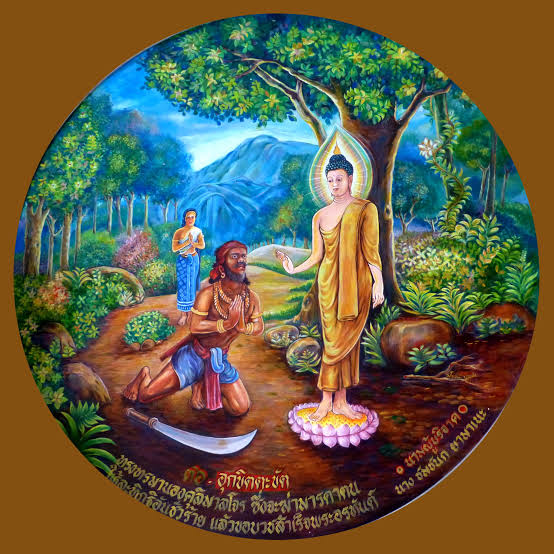
Even as Angulimala embraced the monastic life, local villagers, fearing his past atrocities, sought protection from King Pasenadi. The king, in response, assembled an army and approached the monastery. Despite the villagers’ pleas to “stamp him out,” the Buddha’s wisdom paved the way for an unexpected resolution.

When questioned by the Buddha about how he would treat Angulimala if he had truly renounced violence, King Pasenadi underwent a profound transformation. The Buddha’s teachings on discernment and compassion prompted the king to reconsider his stance. Witnessing Angulimala’s monkhood, the king shifted from disbelief to acceptance, vowing to support him on his path to redemption.

The Angulimala Sutta not only narrates the personal transformation of a notorious murderer but also highlights the transformative power of compassion and wisdom. The Buddha’s fearlessness, compassion, and skillful means shattered the shackles of violence that bound Angulimala. Moreover, the sutta portrays the ripple effect of transformation, as even King Pasenadi undergoes a change of heart. This timeless tale serves as an enduring testament to the potential for redemption, forgiveness, and the profound impact of the Buddha’s teachings on even the most deeply entrenched patterns of suffering.

The transformative story of Angulimala

Link:https://peacelilysite.com/2023/11/15/the-transformative-story-of-angulimala/

#AngulimalaSutta #ShakymuniBuddha #Transformation #Compassion #Wisdom #Monk

Source: https://blogs.icrc.org/religion-humanitarianprinciples/a-humanitarian-re-reading-of-the-angulimala-sutta/#:~:text=Moved%20by%20the%20Buddha’s%20words,saffron%20robes%20and%20shaven%20heads.

Embracing the Universe: Insights from Einstein and Buddha

Albert Einstein and Charlie Chaplin were two of the most iconic figures of the 20th century, known for entirely different reasons. A memorable exchange from early in their friendship perfectly and humorously illustrates these differences.

Einstein once expressed his admiration for Chaplin’s art, saying, “What I most admire about your art is its universality. You don’t say a word, yet the whole world understands you!”

Chaplin’s response, delivered with impeccable comedic timing, was, “True. But your glory is even greater! The whole world admires you, even though they don’t understand a word of what you say.”

I find myself in agreement with Chaplin. While I may not grasp the intricacies of Einstein’s scientific achievements, I admire him as a profound thinker who grappled with life’s deepest questions. His reflections on the universe and our place within it have been particularly inspiring to me since my youth.

Einstein’s curiosity and search for meaning are traits that many of us can relate to. He once expressed a desire to ask God about the origins of the universe, believing that such knowledge would lead to a deeper understanding of life’s purpose. He said, “I used to think that if I could ask God one question, it would be about how the universe began, because then all the rest would be just equations. But as I got older, I became less concerned with how the universe began. Instead, I would want to know why he started the universe. If I knew that, then I would know the purpose of my own life.”

Furthermore, Einstein pondered the nature of the universe and our perception of it, stating, “The most important decision we make is whether we believe we live in a friendly or hostile universe.” This quote underscores the power of our beliefs and attitudes in shaping our experiences and interactions with the world around us. A friendly universe is one where we see opportunities for growth and connection, while a hostile universe may lead to fear and isolation.

The Einstein quote that resonates with me the most is, “A human being is a part of the whole, called by us ‘Universe,’ a part limited in time and space. He experiences himself, his thoughts and feelings as something separated from the rest, a kind of optical delusion of his consciousness. This delusion is a kind of prison for us, restricting us to our personal desires and to affection for a few persons nearest to us. Our task must be to free ourselves from this prison by widening our circle of compassion to embrace all living creatures and the whole of nature in its beauty. Nobody is able to achieve this completely, but the striving for such achievement is in itself a part of the liberation and a foundation for inner security.” In this quote, Einstein alludes to the Buddhist concept of interconnectedness and the illusion of separateness. However, Einstein likely only grasped the theoretical concept and did not experience the oneness with the universe. The Buddha, on the other hand, has seen the truth, experienced the oneness, and achieved inner realization.

Over two thousand five hundred years ago, Shakyamuni crossed the Nairanjana River and sat under a Bodhi tree, where he was immersed in deep inner contemplation. At that time, he was tormented by worldly desires, hunger, craving for sleep, and fear and doubt. But he triumphed over these internal demons and continued his inner quest.

Then, like a limitless, penetrating beam of light, Shakyamuni experienced a moment of clarity in which he gained profound insight that life is eternal and one with the vast cosmos. He became a Buddha—a person awakened to the supreme truth of the Law of life.

The Buddha, Siddhartha Gautama, achieved enlightenment under the Bodhi tree, and the first words he spoke were: “How amazing, how amazing, all sentient beings possess the wisdom and virtue of the Tathagata. However, due to delusions and attachments, they cannot realize it. “

In the eyes of the Buddha, all sentient beings inherently possess the wisdom, the characteristics, and the blessings of the Tathagata within their minds that are troubled by afflictions, defilements, and the cycle of birth and death. Through this teaching, we know that Buddha-nature is inherently present in all sentient beings.

Einstein’s words resonate with the teachings of Buddha, who attained enlightenment and taught that all beings are interconnected. Buddha’s teachings emphasize compassion and understanding for all living beings, recognizing that we are all part of the same universe. Unlike Einstein, who believed that complete compassion was unattainable, Buddha demonstrated that it is possible to embrace all living beings and the universe in its entirety with love and kindness.

However, Buddhism is much deeper and vaster than just these concepts. All Buddhas possess three bodies and four wisdoms. The Mahāyāna theory of the three bodies—the dharma-body, the reward-body, and the response-body—is most common. The dharma body (法身) is considered to be the eternal, indestructible true principle, the Buddha’s original body. The response body (應身) is considered to be the Buddha’s manifest body, but in Mahāyāna Buddhism, it is regarded as the personification body, which manifests from the true principle according to the temperaments and abilities of sentient beings in order to save them.

The reward body (報身) is manifested as a combination of the other two and is therefore not simply the eternal true principle, nor simply an impermanent personality. Rather, it is an ideal body possessed by those who have awakened to the true principle based on meritorious practice. It is the living form of the eternal principle, possessing individuality. This is a general explanation, and there have been many interpretations of the Buddha-body theory in the history of Buddhism, among which there are significant differences. The three bodies are not separate entities but three integral aspects of a single Buddha.

The four wisdoms of Buddha are: Great Mirror Wisdom, which is still and void—motionless; Universal Wisdom, which is capable of facing mind-defilements without attaching to them through love or aversion; Wonderful Observing Wisdom, which has the ability to discriminate and discern the wide field of sensory impressions, while at the same time never experiencing unbridled and reactionary patterns of thought; and Perfecting Wisdom, which can direct all the sense faculties into observing phenomena without being constrained by dualism.

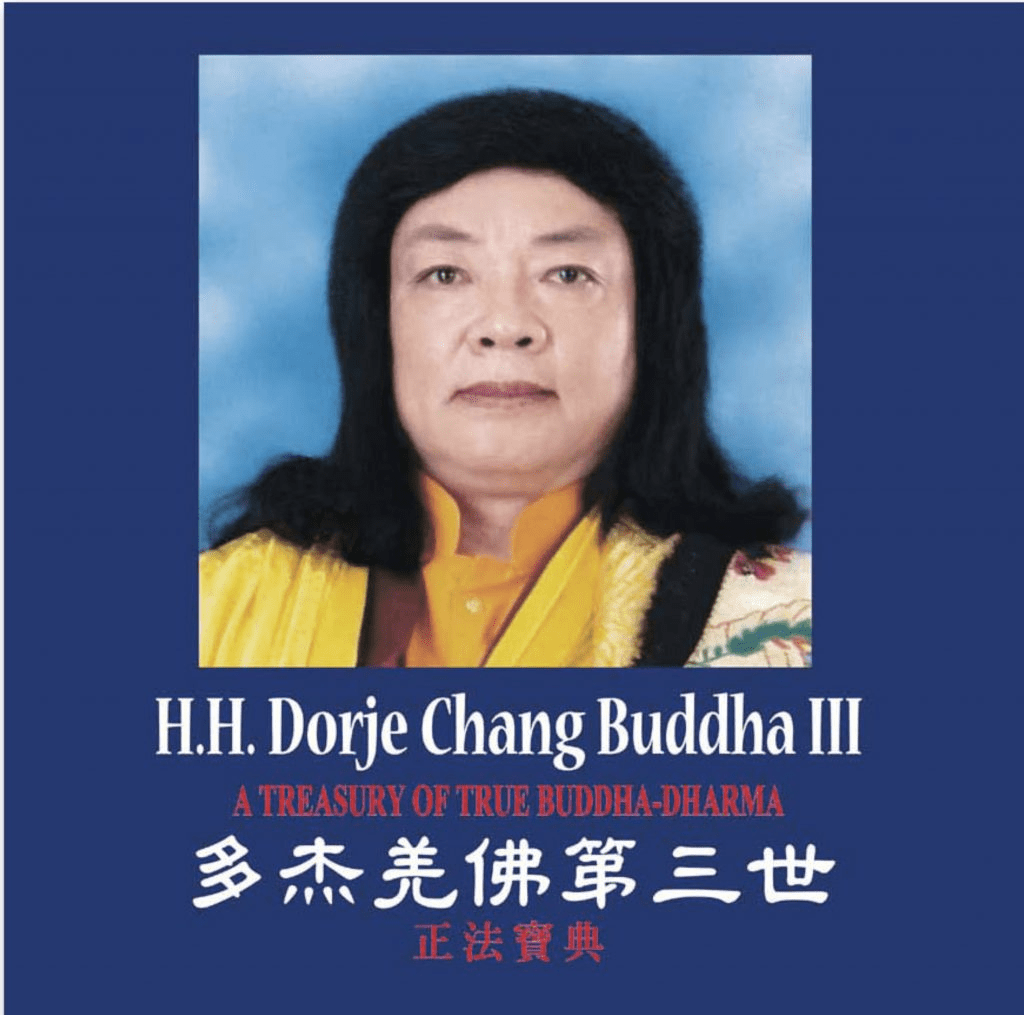
Buddha possesses vast knowledge, superb skills, magnificent supernormal power, and comprehensive wisdom of the universe. The treasure book, “H.H. Dorje Chang Buddha III,” stands as a testament to this statement. However, this book contains only a drop of water from the vast ocean of Buddha’s teachings and wisdom.

The video below showcases the boundless compassion and highlights the extraordinary accomplishments of H.H. Dorje Chang Buddha III. It was published by China Educational Channels TV and features interviews with Buddhist disciples from around the globe.

Discovering the Root of Buddhism, Propagating True Buddha Dharma(H.H. Dorje Chang Buddha III)

Embracing the Universe: Insights from Einstein and Buddha

Link: https://peacelilysite.com/2023/10/26/embracing-the-universe-insights-from-einstein-and-buddha/

#Buddha #Einstein #Buddhism #Buddhist #ShakymuniBuddha #DorjeChangBuddhaIII  #HHDorjeChangBuddhaIII   #Compassion #universe #Chaplin

Source: http://www.buddhism-dict.net/ddb/pcache/4eid(b4e09-8eab).html, https://unbornmind.com/2017/02/18/the-four-wisdoms/, https://www.worldtribune.org/2019/volume-3-chapter-three-the-buddha/, https://www.upworthy.com/albert-einstein-charlie-chaplin-friendship-joke

Buddha-dharma, Buddhist Studies And Popular Buddhism

Buddha-dharma, Buddhist Studies And Popular Buddhism

 In Taichung there is an elderly layman. All nine members of his family are devout Buddhists. They have followed and learned from a famous old monk for many years. However, what they hear from this old monk is completely theory. Each of them can talk about the sutras in a clear and logical fashion. However, none of them have real skills associated with the Buddha-dharma.

            In the autumn of 1995 the Elder Dharma King happened to be in Taiwan propagating the dharma.  The elderly layman requested instruction from the Elder Dharma King by saying, “This year I am already eighty-one years old.  I do things in furtherance of Buddhism everyday.  I have donated over one-half of my vast wealth.  Nevertheless, I have never seen a real Buddha or Bodhisattva.  The only knowledge I have of supernormal dharma powers comes from what I read in books.  Why do the Buddhas and Bodhisattvas not come down to our house?  May I ask the Elder Dharma King, what is the Buddha-dharma?”

When the Dharma King heard these words, he chanted “Wobamei!”  He then said, “Layman, you all have not learned the Buddha-dharma.  How could you have any true skills?” When all of the members of the layman’s family heard this, they felt quite surprised.  With his brows tightly knit, the old layman said, “My entire family devoutly learns Buddhism and recites sutras. How is it that we are not learning the Buddha-dharma? Could it be said that these sutras are all false?”

The Elder Dharma King said, “It is true that all of you are reading sutras and learning Buddhism.  Those sutras are genuine sutras and are dharma treasures.  The knowledge concerning Buddhism which those old monks impart to all of you is also genuine knowledge.  However, this is Buddhist studies.  It is not the Buddha-dharma!  In Esoteric Buddhism, Buddhist studies is called the exoteric teachings portion.  This is what we are required to learn when we first enter Esoteric Buddhism.  After we have learned the exoteric teachings portion and we have this foundation of theory, we must then enter into real, practical cultivation of our conduct, speech and thoughts.  The process of putting this into practice is called cultivation of the Buddha-dharma.

“Take, for example, the practice whereby one invites the Buddhas and Bodhisattvas to bestow nectar. In theory, people think that this is simply reciting mantras, reciting passages from sutras and visualizing.  In theory, people think that nectar is simply water which has been empowered by mantras. However, in the real practice of the Buddha-dharma, there is a special dharma method to invite the Buddhas to directly bestow true nectar from the sky. The shape of this nectar is unlike any other thing on this earth. It has unlimited power. It can cure all illnesses and can easily increase one’s life span! This is because this is the Buddha-dharma, not Buddhist studies.”

The old layman said, “I received the Kalachakra Vajra Initiation from the Dalai Lama!”  Elder Dharma King Losang said, “Last year a Great Rinpoche wanted to introduce the Dalai Lama to me.  I did not have any spare time.  I wanted to do other things in furtherance of the Buddha-dharma.  I did not meet him.  I do not know much about him and will not comment on him.  I do not have any right to inquire into that initiation.  I hope that you are able to receive benefits from it.”

When the old layman and his family heard this, it was as if they had awakened from a big dream.  Their eyes became teary, they knelt down on the ground and respectfully requested the Elder Dharma King to teach them the dharma.  After a moment, the Elder Dharma King slowly said, “Today I will teach the dharma to your entire family.  I will also teach the dharma to all living beings.”  Following his words, a beam of red light emanated from in between his eyebrows which circled the room.  The Elder Dharma King then said, “Do no evil.  Do that which is good.  Deeply study the sutras. This is Buddhist studies.  Do no evil.  Do that which is good.  Recite the Buddha’s name with all your mind.  This is the way to ascend to the Pure Land.  Do no evil. Do that which is good.  Deeply study the sutras.  Esoteric initiations in which supernormal powers are manifested and which comply with Know the True Doctrine is the Buddha-dharma.”

After the old layman heard these words, he put his palms together and respectfully asked, “Other than Know the True Doctrine, what books should I read?”  Dharma King Losang said, “With respect to Know the True Doctrine, it is enough if you understand its contents.  The most important thing is that you read the books of Ah Wang Nuo Bu Pa Muand Great Dharma King Yangwo Yisinubu [H.H. Dorje Chang Buddha III].  The more you read such books the better.  You must also live in accordance with the principles contained therein.  This is the best method!”

The old layman said, “I will remember your words. I would like to ask another question.  Does every Rinpoche have a mind which regards all things as equal?” The Elder Dharma King instructed, “The most difficult thing to attain in one’s cultivation and in one’s practice of the Buddha-dharma is a mind which regards all things as equal.  Without such a mind, one will pursue fame, gain, riches, high government positions and occupation of other people’s land.  One with a mind which regards all things as equal does not pursue such things.

“For example, some people want to cut apart my native place, Tibet.  Actually, this way of thinking is a deviation from cultivation.  Is this cultivation or is this fighting for something based upon personal desire?  Tibetan people, Chinese people and people of every other race and ethnicity should all be considered our close family members who are on an equal footing!  We should cause all of these people to unite so that they can live together in friendship and love and develop their common happiness.  The Buddha taught us that all living beings have the Buddha nature and that we should treat them equally and with love.  We should not desire government positions.  Only by cutting off the concept of self, cutting off erroneous thinking and cutting off attachment to things of the world can one reach high spiritual states!  This is the certain truth of the Buddha-dharma.  We must love others equally in order that we may give rise to the four limitless states of mind.   With the four limitless states of mind as our foundation, we will be able to enter into the state of the sacred bodhi mind.  If one cannot even renounce selfish desires and cannot even look after all living beings on an equal basis, then how can one enlighten oneself and enlighten others?”

Link: https://wisdomtea.org/2023/08/11/buddha-dharma-buddhist-studies-and-popular-buddhism/

Religious Leaders Hold Dharma Assembly to Honor the Holy Birthday of H.H. Dorje Chang Buddha III 

Release of the first Volumes of “Namo Dorje Chang Buddha III Complete Sutra Collection

By Jon Stojan July 25 2023

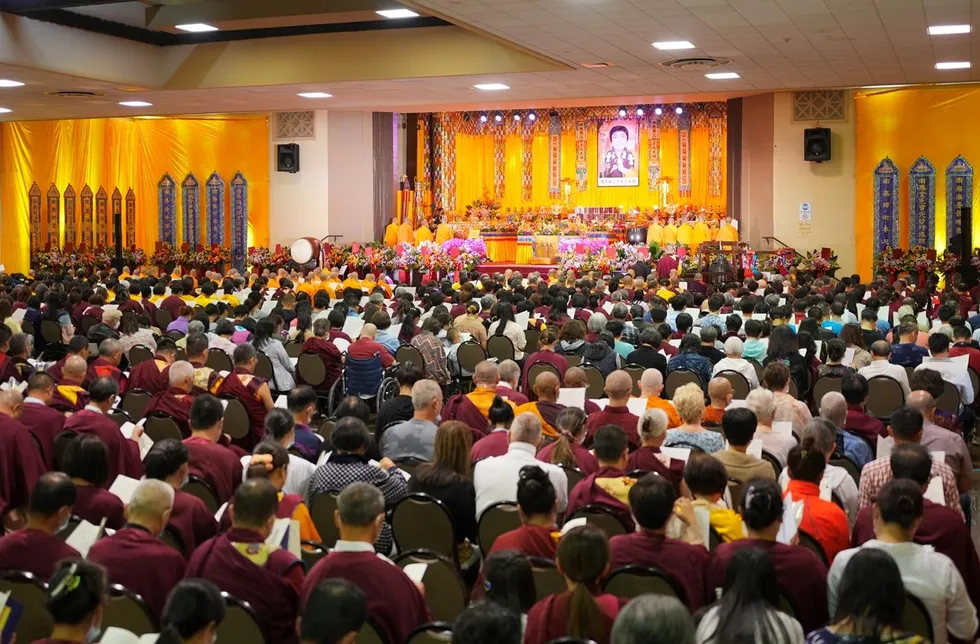
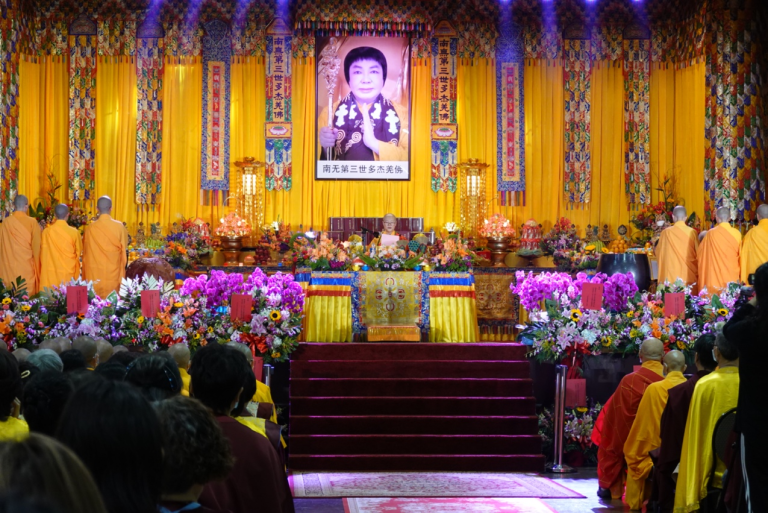
To honor the Holy Birthday of H.H. Dorje Chang Buddha III, revered as the Pope of Buddhism, several prominent Buddhist organizations including the World Buddhism Association Headquarters, Holy Miracles Temple, Hua Zang Si, Benevolence Temple, and the Sanger Mission, jointly organized a Grand Dharma Assembly in Glendale, California. The two-day event took place on June 30th and July 1st, 2023, at the Glendale Civic Auditorium and attracted over a thousand Buddhists from around the world. 

June 30th marked the unveiling of the first three volumes of the “Namo Dorje Chang Buddha III Complete Sutra Collection”. The Dharma Assembly opened with a procession led by a group of nuns, chanting the Buddha’s name “Namo Dorje Chang Buddha III”. The “Namo Dorje Chang Buddha III Complete Sutra Collection” was gracefully displayed on a sacred sedan chair, carried by Holy Gurus Venerable Tsemang and Ruzun Bodi Wentu. In a display of reverence, all attendees of the Assembly humbly prostrated themselves, paying their respects to the Collection. 

In the Dharma Assembly, Venerable Tsemang addressed the congregation, emphasizing the significance of the “Namo Dorje Chang Buddha III Complete Sutra Collection”: “We have undertaken the significant task of editing and publishing the first part of the ‘Namo Dorje Chang Buddha III Complete Sutra Collection.’ This endeavor not only expresses our profound gratitude and unwavering yearning for H.H. Dorje Chang Buddha III but, more importantly, will enable countless sentient beings to attain accomplishment and liberation through studying the Collection. We firmly believe that the ‘Namo Dorje Chang Buddha III Complete Sutra Collection’ will serve as the ultimate guide for all Buddhist disciples seeking accomplishment and liberation. 

“The Collection encompasses the essence of the Tripitaka and the esoteric Buddhist scriptures. It covers Buddhist precepts, views, cultivation, and Dharma practices. It covers the whole spectrum of Buddhism regardless of whether it is Hinayana, Mahayana, or Vajrayana. Through the Collection, H.H. Dorje Chang Buddha III reveals the most direct and expedient path for sentient beings, Arhats, and Bodhisattvas to advance themselves. If we diligently study and practice the teachings on even a single volume of the Collection, while focusing on any one dharma-gate, we can be assured of attaining liberation.”  

During this Age of Dharma Degeneration, H.H. Dorje Chang Buddha III descended to the earthly realm, exhibiting perfect mastery of Exoteric and Esoteric Buddhism, along with unparalleled expertise in the Five Vidyas. The Five Vidyas are what Buddhas and Bodhisattvas do to help living beings. Over the past 2,000 years, Buddhist teachings have encountered distortions and alterations due to mistranslation and misinterpretation of Buddha-dharma by Buddhist patriarchs, eminent monastics, and Buddhist scholars. Recognizing the distortions and errors that had infiltrated Buddhist teachings, H.H. Dorje Chang Buddha III corrected the mistakes present in the Buddhist teachings, restoring the authenticity, power, and purity of Buddha’s wisdom and views. 

H.H. Dorje Chang Buddha III has bequeathed over two thousand audio recordings of imparted Dharmas and published invaluable Buddhist books, including “A Monk Expounds the Absolute Truth to a Layperson,” “Commentary on the Prajnaparamita Heart Sutra,” “The Essence of Buddha Dharma,” “Correcting the Treatises of Patriarch Bodhidharma,” “What Is Cultivation?,” “The Supreme and Unsurpassable Mahamudra of Liberation,” and “Learning From Buddha.” H.H. Dorje Chang Buddha III imparted the subtleties of Dharmas in colloquial language so that people living in the 21st century could easily comprehend. They serve as supreme treasures and indispensable resources for Buddhist disciples seeking to escape the sufferings of this world and attain enlightenment. 

 In response to the needs of Buddhist disciples, the Office of H.H. Dorje Chang Buddha III is working to transcribe audio recordings of Dharmas imparted by H.H. Dorje Chang Buddha III into extensive written texts, and the “Namo Dorje Chang Buddha III Complete Sutra Collection” is being meticulously compiled. The first three volumes of the Collection, consisting of “Dharma Imparted During the Trip to the East,” “Dharma Imparted During a Trip in Response to the Needs of Disciples,” and “Imparting the Absolute Truth through the Heart Sutra,” were released to commemorate this Holy Birthday of H.H. Dorje Chang Buddha III. The remaining volumes will be released and published in the future. 

The Dharma Assembly continued July 1st, 2023, with participants representing Buddhist disciples all over the world presenting 108 offerings to Buddhas and Bodhisattvas.  Under the solemn direction of Jiaozun Zhengda, the congregation recited the Buddhist Sutra “Sutra on Understanding and Realizing Definitive Truth”. The attendees offered heartfelt reverence to the Buddhas, engaged in prostrations, and prayed to the Buddhas and Bodhisattvas for blessings upon all sentient beings. The gathering collectively expressed their aspirations for the eradication of all global pandemics, the endurance of international peace and friendship, and the cessation of calamities, while invoking prosperity, good health, and longevity for all. 

Venerable Pannavati, some of her students, and other attendees at the Dharma Assembly

Venerable Pannavati Karuna, the Abbot of Heartwood Refuge monastery in North Carolina, led dozens of her students to attend the Dharma Assembly. In an interview, she said: “I was introduced to Buddha Master (H.H. Dorje Chang Buddha III) 18 years ago through Zhaxi Zhouma Rinpoche. I thought I had too many duties and responsibilities to follow His teachings. But I kept reading and pondering them through the years. I began to notice in my everyday life the truth and ability to live differently in the world. I had more integrity, clarity, joy for the first time and an understanding that enlightenment was possible if one follows the true teachings of Shakyamuni Buddha. Buddha Master imparted Dharmas and explained those teachings in a down to earth, understandable way without compromise. He even spoke African American slang. Sometimes translators had a difficult time translating it into English because they may not fully understand the slang. But I heard it and I understood what He meant. That is the marvelousness of a true Buddha in this world. He can speak the language in a way that you hear it, understand it, penetrate it, and realize it. He guided me towards the correct aspiration. The goal is not Buddhist studies, and realization cannot be explained by mere words, but it can be experienced. The true purpose of the Buddha Dharma is to awaken us to our Buddha-nature. His teachings point the way.” 

Gongjue Tuji Rinpoche from Germany also shared his joyfulness after attending the Dharma Assembly. He said: “I am very happy to be here today on this very auspicious occasion. Because for us Westerners, it is very hard to get the teachings and Dharma from Buddha Master since most of us do not speak Chinese. I am very happy about this event today that we are finally getting the opportunity to get the Buddha Dharma in English language, and we will have direct access to it.” 

The Dharma Assembly held in Glendale fostered unity and devotion among Buddhist practitioners from diverse backgrounds. With the release of the first volumes of “Namo Dorje Chang Buddha III Complete Sutra Collection”, the event left an indelible mark on the spiritual aspirations of attendees, inspiring them to pursue enlightenment and emulate the compassion and wisdom demonstrated by H.H. Dorje Chang Buddha III. 

Religious Leaders Hold Dharma Assembly to Honor the Holy Birthday of H.H. Dorje Chang Buddha III 

Link:https://peacelilysite.com/2023/08/04/religious-leaders-hold-dharma-assembly-to-honor-the-holy-birthday-of-h-h-dorje-chang-buddha-iii/

#DharmaAssembly #DorjeChangBuddhaIII #HHDorjeChangBuddhaIII#DorjeChangBuddha #GesangSuolangRinpoche #Buddha #ZhaxiZhuomaRinpoche #ReligiousLeaders # Glendale #VenerablePannavatiKaruna #AbbotHeartwoodRefugemonastery #North Carolina #NamoDorjeChangBuddhaIIIComplete Sutra Collection

Source: https://www.usatoday.com/story/special/contributor-content/2023/07/25/assembly-held-to-honor-the-birthday-of-h-h-dorje-chang-buddha-iii/70462586007/#:~:text=The%20two%2Dday%20event%20took,Buddha%20III%20Complete%20Sutra%20Collection%22.

Supernatural Powers in Buddhism

Do Buddhists advocate supernatural powers? Actually, this is not a matter of advocating or not advocating. Rather, supernatural powers are that which everyone who is accomplished in the dharma possesses. Such powers are the manifestation of realization achieved through cultivation. They are phenomena that exist in the course of cultivation but are not the goal of cultivation, which is liberation from the cycle of birth and death. They are by-products that arise during one’s practice. These by-products called supernatural phenomena naturally exist in all liberating paths within the Buddha-dharma. Becoming attached to these by-products and regarding them as the goal is heretical supernatural powers. Applying these by-products in a free and unattached way and regarding them as illusory is treating supernatural powers based on the correct Buddha-dharma view.

Sakyamuni Buddha manifested supernatural powers and also was against supernatural powers. Each of those two tacks reflects different underlying karmic conditions. To those with higher vehicle (Mahayana) faculties, the Buddha spoke of supernatural powers as enjoyment resulting from incredible realization and the free and unattached application of samadhi. Examples of this are in the Lotus Sutra, the Samyuktagama Sutra, and other sutras. To those practitioners with low faculties, the Buddha spoke of not being attached to supernatural powers in order to reach the goal of realizing emptiness. An example of this is in the Shurangama Sutra.

Anyone with low faculties who wants to become a Buddha must go through the stage of cultivation corresponding to those with high faculties. In one’s course of cultivation, this is analogous to going from one city to another city. If one does not travel along the pathway between the two cities, one will not reach that other city. When one is walking toward that other city, one will certainly see and encounter all of the phenomena that are on the way. This is like the supernatural phenomena that arise in the course of one’s cultivation when wisdom is being opened. If one does not experience such phenomena that arise during the cultivation process, then one will not reach the other shore of liberation. Because one has not traversed the path of the Buddha-dharma leading to liberation, one cannot encounter phenomena that occur while traversing that path. That is why such a person has not experienced the stage in the process whereby wisdom is opened and supernatural powers are realized. Thus, all Buddhist who become accomplished in the dharma must go through the stage of supernatural powers.

Is it true that the authentic Buddha-dharma does not speak of supernatural powers? If that were the case, then why did the great leader of Buddhism, Sakyamuni Buddha, manifest supernatural powers everywhere? Why did he even manifest great supernatural powers right before entering nirvana? What crazed and demonic person would dare say that Sakyamuni Buddha did not practice the true Buddha-dharma? Just think. If someone with great accomplishment in the dharma did not have any supernatural realization powers, what would be the difference between that person and an ordinary person who had not learned Buddhism?

Based on the Sutra, it is stated that one who attains liberation and becomes a Saint must possess six great supernormal powers or superknowledges (abhijna). These powers are as follows:

  1. Rddhi-saksatkriya: This power grants the ability to be anywhere or do anything at will, including extraordinary feats such as flying through the air and performing miraculous acts.
  2. Divyasrotra: This power enables the individual to hear sounds from any location, even those that are normally inaudible, such as the subtle sounds of ants walking or distant noises emanating from other realms. It is also referred to as clairaudience or “the divine ear.”
  3. Paracittajnana: With this power, one gains the ability to understand the thoughts and read the minds of other beings.
  4. Purvanivasanu-smrtijnana: This power allows the recollection of previous existences or past lives, both one’s own and those of others.
  5. Divyacakus: This power provides an instantaneous view of anything, regardless of its physical presence. It encompasses the ability to see events and occurrences in faraway places or even in other realms of existence. This power is also known as clairvoyance or “the divine eye.”

The sixth supernormal power, known as asavakkhaya, is unique to Buddhism and complements the other five powers. While individuals from non-Buddhist traditions can achieve the first five powers, their significance is not as profound as those attained by a Buddha due to the absence of complete enlightenment and wisdom. For instance, a Hindu practitioner remains bound by the world of Brahma, whereas a Buddhist practitioner is not limited in such a way. A Buddha’s powers are boundless. The sixth power refers to the understanding that one’s defilements have been extinguished and that liberation from the cycle of reincarnation has been attained. It represents the state of enlightenment. This is sometimes referred to as anasrava, which denotes the cessation of outflows or asravas. These powers are also known as the six superknowledges (abhijna) or supernatural cognitions.

The Dharma Protectors guard the use of these powers very closely. They will block the chakras of those unworthy to obtain these powers. Likewise they will untie the knots in the chakras of those cultivators who are worthy of such powers, causing the supernormal dharma powers of the buddhas and bodhisattvas to suddenly turn into light and enter the chakras. At that time, the mandala in each practitioner’s body will respond and will accept the powers. When your three karmas of body, speech, and mind unite into one body and correspond with the teachings, supernormal dharma powers will come into being. When your state of realization and state of virtue have reached the level where it is appropriate to obtain supernormal dharma powers, then as soon as you practice according to the dharma, supernormal dharma powers will appear. You cannot attain supernormal powers without proper moral discipline, concentration and wisdom. You must first be able to master the Dharma.

H.H. Dorje Chang Buddha III Wan Ko Yeshe Norbu Holiest Tathagata, is the highest ancient Buddha with complete proficiency in both exoteric and esoteric Buddhism and perfect mastery of the Five Vidyas. A portion of His Holiness’s realization powers is openly shown in this book A Treasury of True Buddha-Dharma for all to clearly see.

However, the clear and definite views expressed by His Holiness have enabled us to understand the principles and direction of cultivation. H.H. Dorje Chang Buddha III said the following:

“Not only did the Buddha speak a great deal about supernatural powers in the sutras, he also manifested supernatural powers. Such words and facts were directed at those who reached the higher vehicle (Mahayana) sambhogakaya state or nirmanakaya state. The Buddha also stated in the sutras that one must not become attached to supernatural powers. Such teachings were directed at those who were at the beginning stage of realizing their original nature and dharmakaya in order to protect them. If practitioners who are at the beginning stage of realizing the true nature or true-suchness of all phenomena become attached to supernatural powers, they will fall into that which is conditioned. They will then be practicing heresy. Thus, you should understand that supernatural powers are a reflection of the unhindered, unobstructed nature of Buddhas and great Bodhisattvas. Such powers are not that which beginning stage practitioners can possess and enjoy.”

May Buddha and Bodhisattva bestow their blessings upon all, guiding them towards liberation and enabling them to reside in the realm of ultimate bliss.

Supernatural Powers in Buddhism

Link:https://peacelilysite.com/2023/06/30/supernatural-powers-in-buddhism/

#DorjeChangBuddhaIII #HHDorjeChangBuddhaIII  #MasterWanKoYee #Buddha#Buddha-dharma #InternationalBuddhismSanghaAssociation#IBSA#WorldBuddhismPublishingLLC #Buddhist #DharmaProtectors #SupernaturalPowers #SakyamuniBuddha#Cultivation

Source: A Treasury of True Buddha-Dharma

Buddha Imparted a Parable Story to King Shengguang

In the “Buddha Imparts The Parables Sutra,” Sakyamuni Buddha explained a story to King Shengguang that conveyed the true meaning of life. The story goes like this: A thousand eons ago, there was a man wandering in the wilderness who was suddenly chased by a ferocious elephant. With no place to rely on, he ran in fear and came across an empty well with a large tree beside it. Desperate to escape, he followed the roots of the tree and hid in the well. However, the well was not a safe place either. There were two mice, one black and one white, constantly gnawing at the tree roots. And there were four poisonous snakes surrounding the well, ready to strike, and a poisonous dragon at the bottom of the well. The man was afraid of the snakes and the dragon, and also worried that the mice would eat away the tree roots. Just then, five drops of honey from a honeycomb on the tree fell into the man’s mouth, and he immediately forgot his fear and worries. But soon, bees from the honeycomb stung him due to the shaking of the tree, and a wildfire suddenly broke out and burned the tree.

The Buddha told King Shengguang that the wilderness represents the long night of ignorance, the man represents all sentient beings, the elephant represents impermanence, the well represents life and death, the tree root represents life, and the black and white mice represent night and day. The four poisonous snakes symbolize the four elements of earth, water, fire, and wind; the honey represents the five desires of wealth, sex, fame, food, and sleep; the bees represent evil thoughts; the wildfire represents aging and disease; and the poisonous dragon represents death. The Buddha emphasized that birth, old age, sickness, and death are inevitable and frightening. One should always be vigilant and not be consumed by the desires for wealth, sex, fame, food, and sleep. Upon hearing the Buddha’s teachings on the parables of life and death, King Shengguang was deeply moved.

This story serves as a reminder for us as well. Have we become absorbed in the sweetness of “honey” in our lives, forgetting that the “black and white mice” are constantly nibbling away at our time? Life is like a fleeting dream, and it is empty. It is crucial for us to awaken from this dream of fleeting existence.

Buddha Imparted a Parable Story to King Shengguang

Link:https://peacelilysite.com/2023/04/13/buddha-imparted-a-parable-story-to-king-shengguang/

#SakyamuniBuddha #TheParablesSutra #Impermanence#LifeandDeath#Buddhism #BuddhistTeaching #BuddhistSutra #BuddhistTales

Dharma Assembly at Hua Zang Si — Holy Birthday of Maitreya Bodhisattva

Dharma Assembly at Hua Zang Si — Holy Birthday of Maitreya Bodhisattva

January 1st in the Chinese lunar calendar, is chinese Spring festival, it is the biggest holiday in china. It is also the holy birthday of Maitreya Bodhisattva – the next Buddha in the saha world. This is a special and joyful holiday that is celebrated by many. Hua Zang Si in San Francisco held a Dharma Assembly to celebrate this important occasion. It was the first Dharma Assembly of the year and it was held on a beautiful sunny day. Many laypersons participated in the event.

At the entrance of the temple is an oversize marvelous statue representation of a jolly, laughing Buddha: Maitreya Bodhisattva (the next Buddha in this Saha world). It is such a warm welcoming sign. The big belly not only means jolly, it also means tolerating the intolerable things in the world. So when you look at the statue, you will start to feel that learning Buddhism is happy and kind.

The Dharma Assembly was an opportunity for people to come together and celebrate the teachings of Maitreya Bodhisattva. It was a time for reflection and meditation, as well as a chance to learn more about the teachings of Buddhism. The atmosphere was filled with positivity and joy, as people came together to celebrate this important holiday.

In Chinese culture, Maitreya Bodhisattva is seen as a symbol of joy and tolerance. As practitioners of Buddhism, we are encouraged to strive to be like the Buddhas and Bodhisattvas by cultivating a broad mind, open heart, and great tolerance.

One of the key principles of Buddhism is patience and forbearance, particularly under insult. This is seen as a key aspect of self-cultivation and it is important to remember that everything in the dharma realms can change from ordinary to holy. This means that even difficult situations can be transformed and overcome through the practice of patience and tolerance.

Patience and tolerance are not just passive qualities, but rather active ones that require effort and practice. We must actively cultivate them in our daily lives and strive to maintain them even in difficult situations. Through this practice, we can transform our own minds and hearts, becoming more like the Buddhas and Bodhisattvas that we strive to emulate.

At the Dharma Assembly, we chanted the Eighty-eight holy Buddha name jeweled repentance sutra, in hopes that the Buddhas will wash away all of our sins and negative karmas. After the chanting, we offered a meal to the Buddhas and Bodhisattvas. The event concluded with a dharma talk given by Dharma Master Ruohui.

During her talk, Dharma Master Ruohui emphasized the importance of faith, vows, and actions for disciples of Buddhism. She explained that faith is the foundation of our practice, and that with strong faith, we will have the determination to follow the Buddha’s teachings and put them into action in our lives.

The Dharma Assembly was a meaningful event where participants not only had the opportunity to reflect on their own spiritual growth but also to make an impact on the world around them. During the assembly, the participants returned the merit to all living beings, holding the hope that they shall be rid of suffering, obtain happiness, and have the opportunity to listen to authentic Buddha Dharma.

The act of returning merit is an important aspect of Buddhist practice as it is believed that by dedicating the positive energy generated through our spiritual practice to the benefit of others, we can help bring about peace and prosperity in the world. By returning merit to all living beings, participants were able to contribute to the collective well-being of the world and make a positive impact on the lives of others.

Furthermore, the participants also held the hope that by listening to authentic Buddha Dharma, they will be able to perfect their fortune and wisdom, leading to a more prosperous and peaceful world for all. This is the ultimate goal of Buddhism, to help all beings to find inner peace, happiness and liberation from suffering.

Dharma Assembly at Hua Zang Si — Holy Birthday of Maitreya Bodhisattva

Link: https://peacelilysite.com/2023/01/26/dharma-assembly-at-hua-zang-si-holy-birthday-of-maitreya-bodhisattva/

#Buddha#Buddhism#BuddhistDisciple#MaitreyaBodhisattva#HuaZangSi#Tolerance#Cultivation#Assembly#ChineseLunarCalendar#ChineseNewYear

Build a Beautiful garden in my mind

James Allen, As A Man Thinketh

Build a Beautiful garden in my mind

At the beginning of the new year, I try to think of how to improve my life spiritually. Some beautiful lines by James Allen come to mind.

“Good thoughts and actions can never produce bad results; bad thoughts and actions can never produce good results. This is but saying that nothing can come from corn but corn, nothing from nettles but nettles. Men understand this law in the natural world, and work with it; but few understand it in the mental and moral world (though its operation there is just as simple and undeviating), and they, therefore, do not cooperate with it.”

“A man is literally what he thinks, his character being the complete sum of all his thoughts.”

James Allen, As A Man Thinketh

These words are indeed very inspiring. Mind is the control center of one’s words and actions. I want to be a better person that talk nicely, act kindly, then I should have beautiful mind.

An ancient chinese worthy, Zeng Zi said, “Everyday I examine myself many times. Do I do my best
when doing things for others? Am I honest and reliable when associating with friends? Whether do I review and practise what my teachers teach me?” In traditional Confucianism teaching: Everyday, one should brush away the faults from yesterday, not to tell lies and be humble. One should purify the heart and rectify the mind, to confront genuinely, and start afresh. Thus, one will be renewed every day and have daily renovation, this is the way to be a new man. This old wisdom is very helpful on how to examine my mind daily.

However, in this modern era, there is so much informations from everywhere all at once, and I have a lot of thoughts in my mind. I have pondered more about what are the good thoughts and actions, and what are the bad. Every civilized culture in the world has adopted similar standards for its people based on this inherent understanding of good and evil. Murder, theft, and deceit are universally understood to be wrong. I keep on searching in Religions for a better answer.

In christianity: As darkness is defined by the absence of light, sin is defined by the absence of goodness (James 4:17). Since God is the very embodiment of good (Psalm 86:5119:68), anything contrary to His nature is evil (Romans 3:23). We learn to distinguish good from evil by getting to know God. His Word is the foundation for understanding Him (Psalm 1:1–2119:160John 17:17).The closer we draw to the holiness of God, the worse sin appears (Isaiah 6:15). A t-shirt may appear white against a black wall. But when you place that shirt on newly fallen snow, it appears quite dingy. Similarly, our attempts at goodness look quite dingy when placed next to the holiness of God. As we enter His presence, we start to notice how self-centered our thoughts and actions are. We see our own greed, covetousness, lust, and deceit for the evils that they are. It is only in God’s light that we begin to see ourselves clearly.

God’s Word is filled with examples of those who did right and those who did wrong. Those examples are there for us to learn what God is like and what He desires from us (1 Corinthians 10:11). Micah 6:8 gives a brief summary of God’s desire for every person: “He has shown you, O mortal, what is good. And what does the LORD require of you? To act justly and to love mercy and to walk humbly with your God.” Malachi 3:18 makes it even clearer. God says, “And you will again see the distinction between the righteous and the wicked, between those who serve God and those who do not.” Here the Lord is equating righteousness with serving Him. If good is defined as serving God, then evil is rejecting God and refusing to serve Him. Regardless of how philanthropic a person may appear to others, his good works amount to little if they are done for selfish reasons. If we make it our goal to seek God and honor Him in everything we do (1 Corinthians 10:31), we will understand right and wrong and know that our life choices are pleasing to Him (Jeremiah 29:131 Peter 3:12Psalm 106:3).

Photo by Pixabay on Pexels.com

In Buddhism, Buddha provided more precise and broad concepts on what are right. Such as the ten precepts:  (1) not killing; (2) not stealing; (3) not committing adultery; (4) not lying; (5) not speaking harshly; (6) not speaking divisively; (7) not speaking idly; (8) not being greedy (9) not being angry; (10) not having wrong views.

In Learning From Buddha, Namo  Dorje Chang Buddha III  says:Establish great compassion as your foundation. Do not do anything that is evil. Do all things that are good. Give up self-interests and benefit others. Patiently endure humiliation and adversity. Practice humility. Purify the mind. When encountering living beings, regardless of whether they are handicapped, deficient, sick, or healthy, treat them all equally as family members. Know that all phenomena are governed by causality. With good causes, you receive good retributions. Good retributions yield good fruits. Good fruits enable you to receive the true Dharma. Relying on the Dharma, you can achieve perfect good fortune and wisdom. Then you can step into the state of accomplishment, break away from the sufferings that living beings experience, cease transmigrating in the cycle of birth and death, and accomplish the perfect enlightenment of a Buddha!

Namo  Dorje Chang Buddha III  further more provide a guidance on our mind cultivation — the three daily introspections :“Before I went to sleep at night, did I think of anything unbeneficial to living beings? Did I think about doing those things? Did I think of doing something not good to others for the sake of myself, my children, or my relatives? Did I think of doing something not good to my fellow brothers and sisters? Did I crave credit or merit for myself? If I did, I must repent at once, I must correct myself! By doing that every day, I will naturally and gradually become purified and will become a great holy person.”

This year I will try my best to follow his guidance diligently, eliminate all my wrong thoughts, build a beautiful garden in my mind, and be kinder in my speech and conducts. Love all beings equally, do not have discriminate against other countries and peoples in the world. Wish peace, harmony and good fortune to all.

Build a Beautiful garden in my mind

Link:https://peacelilysite.com/2023/01/06/build-a-beautiful-garden-in-my-mind/

#JamesAllen#Buddhism#Buddhist#LearningFromBuddha#Christianity#God#Cultivation#H.H. Dorje Chang Buddha III #TenPrecepts

Source: https://www.gotquestions.org/right-from-wrong.html

The Story of Bhiksuni Weimiao

The Story of Bhiksuni Weimiao

Sutra about Wisdom and the Foolishness [賢愚経] ( A sutra translated into Chinese in 445 by Hui-chüeh and others. It contains sixty-two Buddhist tales (sixty-nine tales, in a separate extant edition). A Collection of Records concerning the Tripitaka, the catalog of the Buddhist canon compiled by Seng-yu (445–518), ascribes the translation of the Sutra on the Wise and the Foolish to others. According to that work, T’an-hsüeh, Wei-te, and six other priests went westward from northwestern China to Khotan on the southern edge of the Takla Makan Desert to seek Buddhist scriptures. They happened upon a great Buddhist ceremony that was held once every five years at a monastery. There they heard the learned monks expound the Buddhist scriptures and rules of monastic discipline in the language of Khotan. T’an-hsüeh and the others translated and recorded the lectures in Chinese. Later they returned from Khotan and, upon reaching the region of Turfan, compiled the lectures given by the monks in Khotan as a single sutra, which is known as the Sutra on the Wise and the Foolish. The sutra contains stories explaining the causal relationship between incidents in one’s past existence and those in one’s present existence. In each of these stories, Shakyamuni Buddha makes a connection between someone living in the present and a person involved in a past incident. The law of cause and effect states that every single action in the universe produces a reaction no matter what. We need to abstain from anything that is evil, do everything that is good, and use the correct understanding and views to cultivate. Don’t violate any of the precepts, otherwise you will end in miserable retribution. 

This story comes from ” Karma Scriptures about Wisdom and Foolishness “, the third volume in the ” Weimiao Bhiksuni “. In the era of Buddha Sakyamuni, many aristocratic women after ordination were very worried that their habits, such as lust, anger and ignorance, had not been eliminated yet. So they gathered to consult Bhiksuni Weimiao who had already attained the arhatship. Weimiao Bhiksuni told everyone the pain of the desire to bring, and tells the story of her previous life experience…

The Story of Bhiksuni Weimiao

Link:https://peacelilysite.com/2022/12/28/the-story-of-bhiksuni-weimiao/

#Buddhism#BuddhistSutra#Wisedom#Foolishness#KarmaScriptures#WeimiaoBhiksuni#CauseandEffect#Casulity

Source: https://www.nichirenlibrary.org/en/dic/Content/S/329

Amitabha Pureland Practice and Amituofo Chanting

Amitabha Pureland Practice and Amituofo Chanting

Pure Land Buddhism (Chinese: 淨土宗) is a broad branch of Mahayana Buddhism focused on achieving rebirth in a Buddha’s Buddha-field or Pure Land. It is one of the most widely practiced traditions of Buddhism in East Asia. 

Pure Land is a tradition which is primarily focused on achieving rebirth in a Buddha’s “pure land” or buddha-field (Sanskrit: buddhakṣetra), which generally speaking is a Buddha’s field of influence. Some Buddha-fields are considered to be superior places to spiritually train for full Buddhahood, since a Buddha has compassionately “purified” it for this purpose and since in these realms, one can meet a Buddha face to face and study under them. The most common pure land today is that of Amitābha, called Sukhavati, “Land of Bliss”.

For many Buddhists, simply chanting the name of Amitabha Buddha, the Buddha of Infinite Light, is a complete mindfulness and devotional practice. Taking refuge in this way brings a feeling of immediate peace. Shakyamuni Buddha taught this method in the Amitabha Sutra. This simple, yet divinely rich practice combines devotion with mindfulness, of the sacred name of the Buddha.

The Buddha taught us many ways to practice in decades of teaching the Buddha Dharma, mapped out in 80,000 discourses and Sutras. Some of these are “learning practices” such as “Sutra recitation.” Others are vastly intricate and beautiful, such as Vajrayana visualization Sadhanas. Yet, for most of us, the sublimely simple practices are the best way to approach the Dharma, from mindfulness practice, to the most misunderstood of practices, chanting Amituofo. Ten Benefits of Chanting Namo Amituofo Practice Shakyamuni Buddha taught the 10 great benefits of chanting the name of Amitabha Buddha, as a complete practice, in the Amitabha Sutra. This is a devotional mindfulness practice. Single-Pointed focus and mindfulness is the ultimate goal, and can be achieved a number of ways.

Three Holy Beings in Western Pure Land

Zen Koans are blissfully challenging. Watching the breath is a relaxing mindfulness practice. Chanting the Name or Name Praise of Amitabha is another quintessentially simple — yet penetratingly deep — practice. It makes the focus of our mindfulness, the Perfect Buddha. These ten great benefits of chanting Amitabha, as taught in sutra, include protection, support of all the Buddhas and Bodhisattvas, purification of negative karmas, restful sleep, a peaceful mind, and rebirth in Amitabha’s Pure Land. When you participate in this elegant and powerful practice, you feel immediate peace and comfort.

The entire practice is to mindfully chant the name — sometimes just the name, sometimes as a praise — of the Buddha of Infinite Light, Amitabha. Often this is embellished with the wondrous sound of the hypnotic fish drum, or the regular gong of a bell. Sometimes it is chanted musically; sometimes spoken; sometimes whispered. The immediate reward: a feeling of peace and protection. Many Buddhists — in Non-Pureland traditions — tend to think the practice is too simple, too reliant on faith and praise. If we think this way, we are missing the point. Single-Pointed Focus on Amitabha Like other traditions with single-focus meditation methods, Pureland Buddhist’s chant the name of Amitabha over and over. Mindfulness of the name of Amitabha is a powerful and profound practice. Instead of remaining mindful of something mundane, such as breath, or your walk in the park, Amituofo chanting keeps our mind focused in the present moment on the Enlightened Perfection of Amitabha Buddha. The entire practice is to simply chant, or say, with mindfulness: Amitabha, Amitabha, Amitabha… nothing else. Or using the Chinese version of the name Amituofo, Amituofo, Amituofo. Fo translates as Buddha. Keep the mind focused, in the present moment, on just the sound of your own voice: Amituofo, Amituofo, Amituofo.

Amitabha Pureland Practice and Amituofo Chanting

Link: https://peacelilysite.com/2022/12/16/amitabha-pureland-practice-and-amituofo-chanting/

#AmitabhaBuddha#WesternParadise#BuddhaStatue#BuddhaNameChanting#PureLand#BuddhistSutra#AmituofoChanting