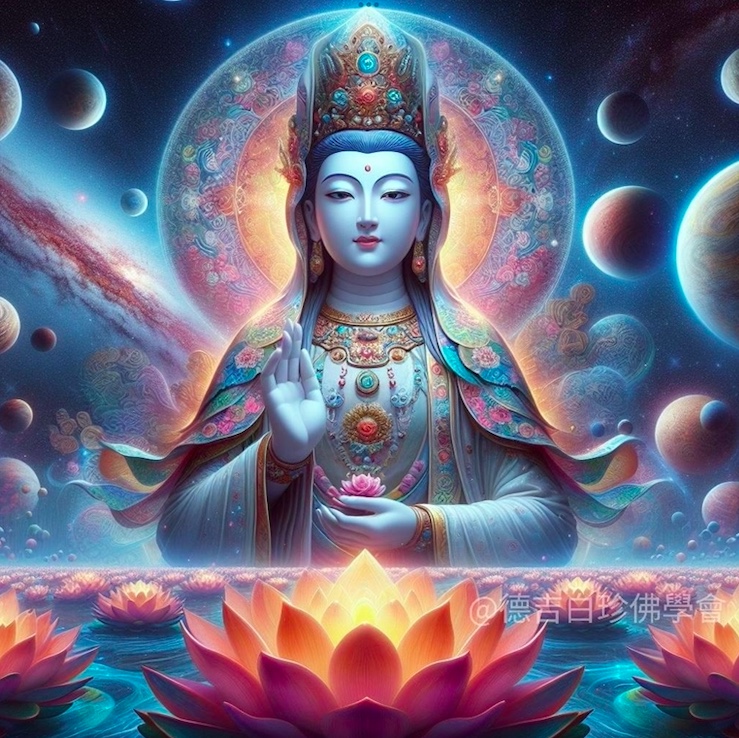
GuanYin Bodhisattvas Saving All Beings, Regardless of Religious Belief

Sister Sun Houfang has gone to the hospital for chemotherapy again. She suffers from leukemia, a disease that is almost a death sentence, but she has miraculously survived. She became a Buddhist disciple in July 2016 and often says, “Others with the same illness as mine have all died, but I am still alive. I want to thank Namo Dorje Chang Buddha III and all Buddhas and Bodhisattvas of the ten directions. I also want to bring those with affinity into Buddhism.” No one expected that her friends with affinity would be three Christian friends.

On April 28, 2017, I visited Sister Sun at the hospital again. She was having lunch, so we chatted briefly. I learned that she was scheduled to start chemotherapy medication the next day, and her wardmate, Wei Wenwen, was to be discharged in the afternoon. I sincerely invited them to our Tantric Buddhist Center the next morning to participate in a blessing ceremony. I hoped that through the blessing, they would receive good fortune and have their suffering alleviated. Sister Sun immediately agreed to delay her medication by a day, and Wei Wenwen also wanted to delay her discharge. At this moment, the patient in bed 6, Lu Shaohua, spoke up. She said she was a Christian and did not dare to believe in Buddhism, fearing it would be against her faith. She also mentioned, “A few days ago, I couldn’t sleep at night after arriving here. It was very uncomfortable, and no matter how much I recited the Bible, I couldn’t fall asleep. Ms. Sun suggested I recite the Buddha’s name instead, and after doing so, I was able to sleep.” I said, “That’s great! It shows you have a deep connection with Buddhism. Each of us has our own karmic reasons for our religious beliefs, but regardless of the religion, the key is the benefit we receive from it. In fact, many people don’t know that the Virgin Mary is an incarnation of Avalokitesvara Bodhisattva.”

In the Dharma audio teachings of H.H.  Dorje Chang Buddha III, there is a story about hundreds of Christian Taiwanese indigenous people converting to Buddhism. This took place in 1995 when H.H. Dorje Chang Buddha III, visiting Taiwan under the guise of an art delegation, was greeted by the chief of the indigenous group, a devout Christian. (There is a video recording on youtube for this event https://www.youtube.com/watch?v=Qxdaug7x9IU

The chief reported to H.H.  Dorje Chang Buddha III, saying, “I am a faithful Christian.”

H.H.  Dorje Chang Buddha III asked, “Have you ever seen the Virgin Mary? If you haven’t, I can invite her to come, and you can meet her.”

The chief responded, “Can I? Even our priest has never seen her!” H.H.  Dorje Chang Buddha III said, “If I let you see her, will you then take refuge in Buddhism?”

The chief replied, “That would depend on the Virgin Mary’s approval. We have taken vows and been baptized.” H.H.  Dorje Chang Buddha III said, “Let’s do it this way: let the Virgin Mary tell you what to do, and you can follow her guidance. How about that?” The chief agreed, saying, “Okay!”

At this moment, the chief began to recite the Bible and use his inner power. His Holiness told the chief, “That won’t work.” Then, His Holiness performed a Dharma practice, and the Virgin Mary suddenly appeared standing on a cloud, several dozen feet high, astonishing the chief on the spot!

The Virgin Mary said to the chief, “My child, although I am your Holy Mother, I am also a servant of the Buddha. I am learning Buddhism. You should immediately take refuge before this supreme Buddha, who represents the true Dharma of the Tathagata in this world.”

Hearing this, the chief prostrated himself in full devotion and immediately took refuge. Later, all nine tribes of the indigenous group came to take refuge in His Holiness as their chief king.

Photos from video in youtube

In the Universal Gate chapter of the Lotus Sutra, the Buddha tells the world that Avalokitesvara Bodhisattva will manifest in various forms and save sentient beings according to their different karmic conditions. Any worldly being in danger will be delivered instantly upon calling her name. Therefore, Guanyin has been worshipped and revered by all classes of people. As a compassionate divinity with countless virtues and merits, she is endowed with transcendental power. The Bodhisattva excels in skillful means, allowing the Bodhisattva to appear in whatever form is needed by sentient beings.

After hearing my story, Lu Shaohua seemed to understand something and expressed a willingness to explore Buddhism.

On the morning of April 29, two Christians, accompanied by their families, came to our Tantric Buddhist Center. After everything was prepared, the blessing ceremony began. As we chanted the Heart Sutra, I heard intermittent crying from the crowd.

After the ceremony, I noticed tears still on their faces, but their complexions looked much better than when they first arrived. I asked them, “Did you all cry? How do you feel?” Wei Wenwen said, “I really enjoyed listening to the Heart Sutra. I felt very comfortable and happy here, and I didn’t want to leave.” Lu Shaohua also said, “As soon as I heard it, I couldn’t help but cry. I don’t know why, but it felt like meeting a family member.”

From that moment on, the three Christians—Wei Wenwen, Huang Youyou, and Lu Shaohua—began to listen to the extraordinary Dharma teachings of Namo Dorje Chang Buddha III. Through listening to the Dharma, they understood some principles of karma, realized the impermanence of life, and the illusory nature of dreams and bubbles. They expressed their determination to stop killing, to practice releasing living beings, and to diligently study and practice Buddhism. They even took home Buddha statues to venerate and vowed to take refuge in Buddhism.

Although Buddhism is the teaching of perfect liberation, Christianity is also a good teaching. When Christians shed tears upon hearing Buddhist scriptures and find peace in reciting the Buddha’s name, it indicates their inherent karmic connection to Buddhism. The differences in religious beliefs among sentient beings arise from their various karmic roots and blessings accumulated over countless eons. All good teachings should coexist harmoniously and tolerate each other without rejection, as true good teachings all aim to free sentient beings from suffering and bring them happiness.

Link:https://peacelilysite.com/2024/06/07/guanyin-bodhisattvas-saving-all-beings-regardless-of-religious-belief/

#Avalokiteshvara#Buddhism#BuddhistPilgrimage#ChineseBuddhism#compassion#Guanyin #GuanShiYin #LotusSutra #Buddha #H.H.DorjeChangBuddhaIII
Source: https://buddhismlearning.com/2021/04/08/%e5%9f%ba%e7%9d%a3%e6%95%99%e5%be%92%e5%94%b1%e8%aa%a6%e4%bd%9b%e6%95%99%e3%80%8a%e5%bf%83%e7%b6%93%e3%80%8b%e6%99%82%e6%b7%9a%e6%b5%81%e6%bb%bf%e9%9d%a2%ef%bc%8c-%e5%8e%9f%e4%be%86%e8%81%96%e6%af%8d/

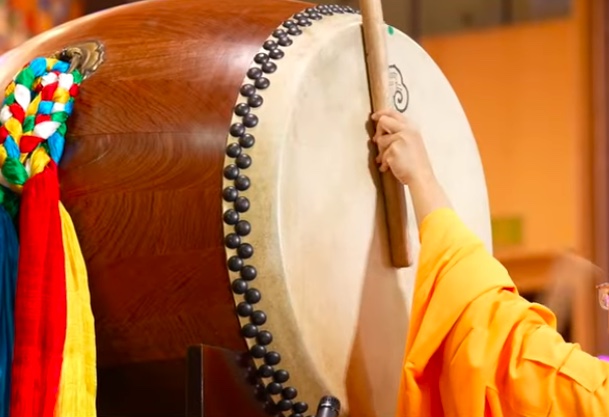
A Great Drum

The Wisdom of Generosity: A Tale of Compassion and Righteousness

Once, the Buddha was residing in the Jetavana Monastery in the kingdom of Śrāvastī, spreading his teachings. At that time, there was a prince of a celestial king named Pilu. One day, he flew down from the heavens to the Jetavana Monastery, prostrated himself at the Buddha’s feet, and, with hands folded in reverence, asked the Buddha: “In this world, people are constantly pursuing clothes, food, treasures, pleasures, official positions, and territories. Are there any treasures that pursue people in return?” The Buddha praised Prince Pilu: “You have asked a good question. Indeed, there are situations where territories, treasures, and pleasures pursue people.”

Prince Pilu asked again, “What does it mean for the causes and conditions that fulfill people’s wishes and bring complete satisfaction to always follow them?”

The Buddha replied, “All actions can be categorized into two types: doing good deeds, which brings blessings, and committing evil deeds, which results in calamities. Whether it is blessings or disasters, they always follow each person like a shadow.”

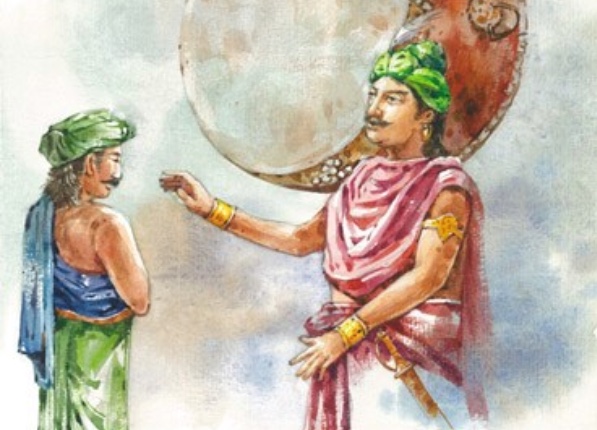
Prince Pilu said, “This is truly extraordinary! Just as the World-Honored One has taught, in my past life, I was once a king among humans. Because I was aware of the impermanence of life and had no attachment to material things, I wanted to practice generosity widely. One day, during a gathering of my ministers, I announced: ‘I want to make a great drum whose booming sound can spread for a hundred miles. Who can accomplish this task for me?’

However, the ministers all replied, ‘We are incapable of doing so!’ At that moment, a minister named Kuang Shang, who had always been loyal to the court and compassionate towards the people, stepped forward and said to the king, ‘I can accomplish this task, but it will require some funding.’

The king said, ‘Great! Whatever amount you need is not a problem.’ Thus, the treasury was opened, and a large sum of money was handed over to Kuang Shang.

Kuang Shang transported a carriage full of treasures to the gate of the royal palace and beat the drum to announce, “Today, our benevolent king, with great compassion, is distributing wealth to the world to relieve all those in poverty and distress, as well as to provide for the needs of practitioners. Anyone in need can come to the palace gate to receive these goods.”

The news quickly spread to neighboring countries. The poor, carrying their babies and bringing along the elderly and young, came in droves, filling all the roads leading to the city. People would often look up to the sky and exclaim, “Thank you, benevolent king! We, the poor people, finally have the chance to escape the days of hunger and cold!”

A year later, the king asked Kuang Shang, “Is the great drum completed?” The minister replied, “Your Majesty, it is done.” The king asked again, “Since it is finished, why haven’t I heard the drum sound?” Kuang Shang responded, “Please, Your Majesty, take a trip into the city tomorrow, and you will hear the sound of virtue resonating far and wide.”

The next day, the king’s procession entered the city, discovering it was crowded and bustling. The king exclaimed, “Why are there so many people in the city?” Kuang Shang answered, “Last year, Your Majesty ordered me to create a great drum, hoping its mighty sound would spread for miles, proclaiming Your Majesty’s benevolence. I thought that a drum made of dead wood and cowhide would not adequately convey the king’s virtue. After much deliberation, I decided to use the treasures Your Majesty entrusted to me to provide for the practitioners and relieve the poor and distressed. Since the announcement, people from neighboring countries have come, hoping for Your Majesty’s benevolence, like hungry children yearning for their compassionate mother.”

Upon hearing this, the king asked the nearby citizens, “Where have you come from?” The people respectfully bowed and replied, “We came from a hundred miles away.” Some said, “I came from two hundred miles away.” Others said, “I came from thousands of miles away.” Then, they all declared, “Wise and benevolent king! Your widespread generosity has brought joy to the people of the neighboring countries. Many have even moved their entire families here, seeking to live under your benevolent protection and hoping for a stable life henceforth.”

The king was very pleased and said, “Kuang Shang, you have done an excellent job! Previously, I was attached to fame, hoping that the great drum’s mighty sound would resonate far and wide. Now, I finally understand that the unrest in the country comes from the people’s unease. Just as a sick body needs medicine to be healed, I should provide remedies to address the people’s suffering. You, my minister, understood the hardships of the people and distributed food to help the poor and needy, allowing the people to live in peace and return their loyalty to me.” Thus, the king declared, “From now on, as long as it concerns the people’s needs, take care of it to the best of your ability without needing to consult me!”

After the king’s natural death, he was reborn in heaven as King Miao. After his life in heaven ended, he was reborn as a Cakravartin (Wheel-Turning) King on earth, always accompanied by seven treasures and surrounded by followers who protected him. Now, he has again been reborn in heaven as a prince of the heavenly king. All of this was because he strictly upheld pure precepts and compassionately aided all living beings, earning such blessings. If we follow the Buddha’s teachings and rectify our body, speech, and mind, we can all obtain such magnificent blessings.

The Buddha encouraged Prince Bilu, saying, “A person’s actions are like a shadow following the body, or an echo responding to a sound. For every cause, there is an effect, and retribution is certain!” Prince Bilu, after hearing the Buddha’s teaching, joyfully made obeisance and departed.

A Great Drum

Link:https://peacelilysite.com/2024/05/23/a-great-drum/

Source: https://www.ctworld.org.tw/sutra_stories/story801-1000/story862.htm,


The Eight Worldly Conditions

The Eight Worldly Conditions

by Venerable Narada Mahathera

This complex world is neither exclusively rosy nor entirely thorny. The rose, soft, beautiful, and fragrant, grows on a stem filled with thorns. What is rosy remains so, and what is thorny persists. One should not interfere with the thorns due to the presence of the rose, nor disparage the rose because of the thorns.

To an optimist, the world appears absolutely rosy; to a pessimist, it seems entirely thorny. However, a realist views the world neither as entirely rosy nor wholly thorny. From a realistic perspective, the world is a blend of beautiful roses and prickly thorns.

An understanding person appreciates the rose’s beauty without becoming infatuated, acknowledging the thorns’ nature and taking precautions not to be wounded.

Similar to a pendulum swinging between right and left, four inevitable conditions prevail in life — gain and loss, fame and defame, praise and blame, happiness and pain.

Gain and Loss: Businesspeople experience both gain and loss. While it’s natural to be pleased with profits, one must exhibit moral courage and maintain a balanced mind in the face of losses. Anticipating losses and being prepared helps reduce disappointment.

Fame and Defame: Fame and defame are inevitable in life. Seeking undue praise or avoiding criticism can lead to unfulfillment. True greatness is indifferent to external approbation.

Praise and Blame: Wise individuals remain unaffected by praise or blame, recognizing that opinions vary. The Buddha’s teachings emphasize responding to false accusations with patience and understanding.

Happiness and Pain: Genuine happiness is not solely derived from material possessions, power, or external circumstances. Inner happiness is found in non-attachment and leading a blameless life.

Facing pain, whether from old age, disease, separation, or death, requires equanimity. The Buddha himself endured physical suffering but maintained a balanced mind. Death, inevitable for all, should be faced with perfect equanimity.

Amidst these dualities, a balanced mind is crucial. The Buddha’s teachings encourage cultivating equanimity in the face of worldly conditions.

Link: https://wisdomtea.org/2024/02/08/the-eight-worldly-conditions/

The Relaxation of Thoughts

The Relaxation of Thoughts

Translated from the Pali by Thanissaro Bhikkhu

Once, the Blessed One resided in Savatthi, at Jeta’s Grove in Anathapindika’s monastery. Addressing the assembly of monks, he spoke, “Monks!”

Respectfully, the monks replied, “Yes, Lord.”

The Blessed One shared guidance on cultivating a focused mind, highlighting five essential themes for monks to consider at the appropriate times.

Firstly, if unwholesome thoughts arise during meditation, connected to desire, aversion, or delusion, the monk should shift attention to a different theme associated with what is skillful. By doing so, the disturbing thoughts subside, allowing the monk to steady, settle, unify, and concentrate the mind.

If, despite this shift, unskillful thoughts persist, the monk should examine the drawbacks: recognizing them as unskillful, blameworthy, and causing stress. Through this scrutiny, the undesirable thoughts fade away, and the monk attains mental steadiness.

In the rare case that unwholesome thoughts persist, the monk should practice indifference, paying no mind to them. By disregarding these thoughts, the monk frees the mind from their influence and achieves concentration.

Should the unskillful thoughts persist even with indifference, the monk is advised to focus on relaxing thought-fabrication concerning those thoughts. This practice enables the abandonment of the troublesome thoughts and promotes mental stability.

In the event that unwholesome thoughts persist during the relaxation of thought-fabrication, the monk is encouraged to employ a more forceful approach. With teeth clenched and tongue pressed against the roof of the mouth, the monk should beat down, constrain, and crush the unskillful thoughts with awareness. This resolute effort results in the abandonment of disturbing thoughts and the attainment of mental concentration.

A monk who successfully applies these methods is recognized as having mastery over thought sequences. Such a monk can choose to think or not think as desired, having severed craving and liberated themselves from the fetters. Through a deep understanding of conceit, they have reached the cessation of suffering and stress.

Upon hearing these teachings, the monks were gratified, finding delight in the Blessed One’s words.

The Relaxation of Thoughts

Link:https://peacelilysite.com/2024/01/14/the-relaxation-of-thoughts/

#Budhism #BuddhistTeaching #Relaxation#Meditation #Monk #MentalConcentration

The Debate of King Milinda – Nagasena Bhikkhu Sutra

The twelfth among the Eighteen Arhats is recognized as Nagasena in Sanskrit, meaning “Dragon Army.” Often referred to as “Bhikshu Nagasena,” he was a Buddhist theoretical philosopher who received full ordination at the age of twenty and eventually attained the state of Arhat. Bhikshu Nagasena journeyed to the ancient kingdom of Shakyadesha in northwestern India to engage with King Milinda. Responding to the king’s inquiries, Nagasena eloquently expounded on the impermanence of life, the law of karma, and various facets of Buddhist practice, employing metaphors to convey profound insights. This discourse is encapsulated in the “Nagasena Bhikshu Sutra,” representing a comprehensive exposition of fundamental Buddhist teachings.

Below are excerpts from conversations between Nagasena and King Milinda, where the king poses questions and Nagasena responds with profound wisdom and intelligence.

First Question

Once, King Milinda intentionally sought to challenge Bhikkhu Nagasena and questioned him, saying, “You did not live in the same era as the Buddha, and you never met Siddhartha Gautama. How can you be sure that the Buddha actually existed?”

Wise Bhikkhu Nagasena responded by asking, “Great King, how did you inherit your throne?”

“It was passed down to me by my father,” replied the king.

“And from whom did your father receive the throne?” Nagasena inquired.

“From his father, my grandfather.”

“And your grandfather’s throne, from whom did he receive it?”

“From his forefather, my great-grandfather!”

Nagasena continued, “If we trace this lineage generation by generation, do you believe that there was an original founder of your kingdom?”

King Milinda replied with certainty, “Certainly, I believe so!”

“Have you ever seen this founder?” Nagasena asked.

“No, I haven’t.”

“How can you believe in someone you haven’t seen?” Nagasena questioned further.

The king explained, “Our founding monarch established laws, systems, and regulations, all of which are recorded in history. Though I haven’t seen him, I believe in his existence because there are historical records.”

Smiling, Bhikshu Nagasena nodded and said, “In the same way, we believe that the Buddha indeed existed. In Buddhism, there is the Triple Gem of Buddha, Dharma, and Sangha, along with scriptures, Vinaya (monastic rules), and Abhidharma (philosophical teachings). The Buddha’s ethical guidelines and historical events are not fabrications; they are as real as your founding monarch in historical terms!”

Second Question:

Unable to find fault with Bhikkhu Nagasena in the first question, King Milinda, using his wit, posed another challenging query. He asked, “Buddhists often speak of the ultimate happiness being the realization of Nirvana, attaining a state beyond birth, death, and cessation. Bhikshu Nagasena, have you attained Nirvana?”

Bhikshu Nagasena humbly replied, “I’m ashamed to admit that I haven’t.”

King Milinda, feeling triumphant, questioned, “If you haven’t experienced it yourself, how do you know about the state of Nirvana?”

If this question were posed to you, how would you respond?

Rather than directly answering, Bhikshu Nagasena turned the question back to King Milinda, asking, “Great King, if I were to take a large knife and cut off your arm right now, would it be painful?”

King Milinda’s expression changed, and he said, “Certainly, it would be painful! How could having one’s arm cut off not be painful?”

Nagasena pressed on, “But your arm has never been cut off before, so how do you know it would be painful?”

The king replied, “I have seen others experience the pain of having their arms cut off, so I know it would be painful!”

Smiling, Bhikshu Nagasena respectfully remarked, “Great King, just as you can understand the pain of losing an arm by witnessing others, I, too, have seen the joy of those who have realized Nirvana. Hence, I am certain about the sublime nature of the Nirvana state!”

Third Question:

King Milinda, persisting in his skepticism, attempted a third inquiry, asking, “Monastics are supposed to embrace compassion. How do you forgive your enemies?”

Bhikshu Nagasena smiled and replied, “Great King, if you had a festering wound on your leg, would you chop off your entire leg?”

“No, I wouldn’t,” answered the king.

Nagasena continued, “So, what would you do?”

“I would carefully clean it, apply medication, and with time, the wound would heal,” explained the king.

Bhikshu Nagasena stated, “Exactly! Enemies and wrongdoers are like festering wounds. If not taken care of and treated, they will spread and worsen. Therefore, one must use the water of dharma to cleanse them, encouraging them to abandon wrongdoing and turn towards righteousness. This principle is similar to how you, Great King, nurture and care for the wound on your leg!”

Fourth Question:

King Milinda nodded in acknowledgment but remained unconvinced. After contemplating, he posed another question, “You often advise people to accumulate merits for the next life. Since you haven’t experienced death, how do you know there is life after death?”

Bhikshu Nagasena responded with a simile, “It’s similar to a mandarin orange. When the fruit ripens and falls to the ground, the flesh rots away. However, the seed remains buried in the soil. When the time is right, it sprouts, grows, and becomes a robust mandarin orange tree. The human body is just a temporary aggregation of the four elements. When the illusion shatters, the body dies. Yet, the karmic consciousness continues the cycle of birth and death. It is like the seed of the mandarin orange, persistently reincarnating in the six realms, not just once but countless times, with an endless cycle of rebirths.”

Fifth Question:

Despite King Milinda’s lingering dissatisfaction, he presented a fifth question, each one more challenging than the last. However, Bhikshu Nagasena, wise and composed, continued to respond with a smile.

King Milinda asked, “Do monastics love their own bodies?”

Bhikshu Nagasena replied, “The body is merely a temporary confluence of the four elements and five aggregates. Monastics do not have attachment to it.”

King Milinda, feeling confident, cleverly countered, “Oh! You claim not to love your body, but monastics still dress, eat, and sleep. Isn’t that a way of protecting the physical form? If you say you don’t love it, isn’t that a contradiction?”

Bhikshu Nagasena smiled and offered a different perspective, “Great King, if you had a boil on your body, would you love it?”

“A boil? Such a dirty and unpleasant thing! Who would like it?” exclaimed the king.

“If you dislike it, why bother cleaning it, applying medication, and taking constant care to prevent it from worsening? Checking on it every day to see if it’s improving. If you claim not to like the boil, isn’t that contradictory behavior?” Nagasena questioned.

King Milinda, somewhat defiantly, argued, “I do it for the health of my body!”

Bhikshu Nagasena chuckled and said, “Exactly! Monastics may not love this body, but for the purpose of cultivating the spiritual path, they still have to care for this illusory form.”

Sixth Question:

King Milinda, undeterred by previous responses, continued with his inquiries, asking, “Can Siddhartha Gautama, the Buddha, know the causes and effects of the past, present, and future?”

“Buddha possesses great supernatural powers, and indeed, he can know the past, present, and future!” answered Nagasena.

“If that’s the case, why doesn’t he teach all of you those supernatural powers? Then, disciples could instantly know the past, present, and future karmic obstacles, and everyone would attain enlightenment quickly. Why go through gradual training?” questioned the king.

The clever Nagasena, handling the question with ease, asked in return, “Great King, if you were a physician, wouldn’t you know about various medicinal herbs?”

“Of course! A physician needs to know the properties of different herbs and their healing abilities,” replied the king.

“Since a physician knows about numerous medicinal herbs, can he prescribe all of them to a single patient?” Nagasena asked.

King Milinda, dismissing the idea, responded, “Certainly not! Treating an illness requires targeted medications, gradual adjustments, and specific remedies tailored to the patient’s condition. Haphazard prescriptions won’t cure the patient; it needs careful consideration!”

Seizing the opportunity, Nagasena continued, “Likewise, the Buddha imparts the Dharma based on individual capacities, tailoring the teachings to each disciple’s unique qualities. Gradual instruction is necessary, adapting to the disciples’ diverse capacities, to guide them step by step on the path to enlightenment. Otherwise, trying to rush the process might lead to unintended consequences!”

The Debate of King Milinda – Nagasena Bhikkhu Sutra

Link:https://peacelilysite.com/2024/01/11/the-debate-of-king-milinda-nagasena-bhikkhu-sutra/

Source: https://hk.aboluowang.com/2020/0519/1453067.html

Ullambana Sutra

Ullambana Sutra

Once upon a time, it is said that the Buddha resided in Shravasti, specifically in the Garden of the Benefactor of Orphans and the Solitary.

Mahamaudgalyayana, having recently attained the six penetrations, felt a deep desire to repay the kindness of his parents for raising him. Utilizing his divine vision, he surveyed the world and discovered that his departed mother was reborn among the hungry ghosts, emaciated and without sustenance.

Touched by compassion and sadness, Mahamaudgalyayana filled a bowl with food and approached his mother to provide nourishment. However, as she attempted to consume the food, it inexplicably transformed into burning coals, rendering it inedible.

In anguish, Mahamaudgalyayana hurried back to the Buddha to recount this sorrowful experience.

The Buddha, acknowledging the profound and entrenched offenses of Mahamaudgalyayana’s mother, explained that individual efforts alone were insufficient to liberate her. Even though filial sentiments could move heaven and earth, the combined spiritual power of the Sangha from the ten directions was necessary for her liberation.

The Buddha proceeded to impart a salvific teaching, a method to alleviate the suffering and remove obstacles from accumulated offenses. He instructed Mahamaudgalyayana to make offerings to the assembled Sangha on the fifteenth day of the seventh month, known as Pravarana day. These offerings included clean basins filled with diverse flavors, the five fruits, incense, oil, lamps, candles, beds, and bedding – the best of worldly offerings. The entire virtuous Sangha, regardless of their location or spiritual accomplishments, was to gather on that day and partake in the pravarana food.

By making such offerings, Mahamaudgalyayana’s parents, as well as ancestors of seven generations, could escape the paths of suffering and attain liberation. The Buddha directed the assembled Sangha to recite mantras and vows for the benefit of the donor’s family.

Delighted by this guidance, Mahamaudgalyayana and the great Bodhisattvas followed the Buddha’s instructions. As a result, Mahamaudgalyayana’s mother found liberation from the prolonged suffering of the hungry ghosts.

Expressing gratitude, Mahamaudgalyayana inquired if future disciples, by offering Ullambana basins, could similarly assist their present and past parents. The Buddha affirmed this, emphasizing the importance of practicing compassionate filial conduct on the fifteenth day of the seventh month.

He urged disciples to place diverse foods in Ullambana basins and offer them to the Pravarana Sangha of the ten directions. The practitioners should vow to ensure their parents’ longevity and happiness, as well as the liberation of seven generations of ancestors from the realm of hungry ghosts.

In conclusion, the Buddha encouraged all disciples to consistently recall their parents and ancestors, offering Ullambana basins on the fifteenth day of the seventh month as a gesture of filial compassion. This practice, he emphasized, was a respectful way to repay the boundless kindness bestowed by one’s parents. The bhikshu Maudgalyayana and the entire assembly, inspired by the Buddha’s teachings, joyfully embraced this compassionate practice. And thus, the Buddha spoke of the Ullambana Sutra, providing a timeless guide for repaying the kindness of parents.

Ullambana Sutra

Link: https://peacelilysite.com/2023/12/12/ullambana-sutra/

#BuddhistSutra #Ullambana #Maudgalyayana #Filialcompassion

Source: https://wisdomtea.org/2023/12/07/ullambana-sutra/

Throughout Countless Eons, Encountering the Profound and Supreme Buddha Dharma is a rare Opportunity

Throughout Countless Eons, Encountering the Profound and Supreme Buddha Dharma is a rare Opportunity

The teachings transmitted by Lord Kashyapa Buddha or possibly even more ancient Buddhas are beyond our reach today. Although the discourses of Shakyamuni Buddha are considered supremely perfect, the Tripitaka that we study now can be said to not entirely capture the original intent of the Buddha’s words. This is because during the Buddha’s lifetime, his teachings were not promptly recorded. All the scriptures were compiled after the Buddha’s parinirvana by a gathering of five hundred arhats. Despite the arhats having transcended the cycle of birth and death and possessing vast supernatural abilities, their own levels of spiritual realization were limited, and there existed a significant gap between their understanding and the Buddha’s complete enlightenment. As a result, there were certain aspects of the Buddha’s teachings that they might not have fully comprehended, leading to misunderstandings or omissions in the interpretation of certain doctrines during the compilation process.

Over the past 2,000 years, Buddhist teachings have encountered distortions and alterations due to mistranslation and misinterpretation of Buddha-dharma by Buddhist patriarchs, eminent monastics, and Buddhist scholars.

During this Age of Dharma Degeneration, H.H. Dorje Chang Buddha III descended to the earthly realm, exhibiting perfect mastery of Exoteric and Esoteric Buddhism, along with unparalleled expertise in the Five Vidyas. The Five Vidyas are what Buddhas and Bodhisattvas do to help living beings. Recognizing the distortions and errors that had infiltrated Buddhist teachings, H.H. Dorje Chang Buddha III corrected the mistakes present in the Buddhist teachings, restoring the authenticity, power, and purity of Buddha’s wisdom and views. 

H.H. Dorje Chang Buddha III has bequeathed over two thousand audio recordings of imparted Dharmas and published invaluable Buddhist books, including “A Monk Expounds the Absolute Truth to a Layperson,” “Commentary on the Prajnaparamita Heart Sutra,” “The Essence of Buddha Dharma,” “Correcting the Treatises of Patriarch Bodhidharma,” “What Is Cultivation?,” “The Supreme and Unsurpassable Mahamudra of Liberation,” and “Learning From Buddha.” H.H. Dorje Chang Buddha III imparted the subtleties of Dharmas in colloquial language so that people living in the 21st century could easily comprehend. They serve as supreme treasures and indispensable resources for Buddhist disciples seeking to escape the sufferings of this world and attain enlightenment. 

The dharma discourses encompasses the essence of the Tripitaka and the esoteric Buddhist scriptures. It covers Buddhist precepts, views, cultivation, and Dharma practices. It covers the whole spectrum of Buddhism regardless of whether it is Hinayana, Mahayana, or Vajrayana.

The audio recordings of dharma discourses given by H.H. Dorje Chang Buddha III begin with the strict progressive levels of cultivation. These discourses contain extremely incisive teachings that concisely incorporate the twelve divisions of the Tripitaka and the ten divisions of the esoteric scriptures without losing the true meaning of the Tripitaka and esoteric scriptures. The topics covered are extremely broad. They vary from analyses of the dharma regarding the Trikaya (Three Bodies) and the Four Wisdoms of a Buddha to teachings on the vajra dharma of the Supreme Division. There are explanations of the true realization and manifestation of the Great Perfection of Ultimate Wisdom. H.H. Dorje Chang Buddha III also possesses the Xian Liang Buddha Wisdom Great Perfection Dharma whereby the disciple experiences and sees the rainbow-body dharma realm state the very day that dharma is transmitted. Nothing is lacking either in theory or practice. Those recordings truly show that H.H. Dorje Chang Buddha III has complete proficiency in exoteric and esoteric Buddhism and perfect
mastery of the Five Vidyas. They also manifest His Holiness’s supreme enlightenment, wonderful prajna wisdom, and holy state of the Buddhas and Bodhisattvas, all which are part of the inner realization vidya. All of the recorded discourses are directed at Buddhas, Bodhisattvas, Arhats, and all practitioners.

The H.H. Dorje Chang Buddha III’s teachings were directly spoken and recorded without any external contamination. Moreover, with the superiority of modern technology, the Buddha’s complete teachings can resound globally in real-time, a phenomenon that was not possible during the Shakyamuni Buddha’s time. This is not a blessing originally destined for beings in the degenerate age, but rather, it is an augmentation of the merit and resources of sentient beings through the immeasurable merit of the original primordial Buddha and the compassionate power of Bodhi. It allows the Buddha’s teachings to echo in this dark and heavily burdened era. How rare and precious it is!

Throughout Countless Eons, Encountering the Profound and Supreme Buddha Dharma is a rare Opportunity

Link:https://peacelilysite.com/2023/12/08/throughout-countless-eons-encountering-the-profound-and-supreme-buddha-dharma-is-a-rare-opportunity/

#DorjeChangBuddhaIII #HHDorjeChangBuddhaIII#DharmaDiscourse

Bridging Realms: Dr. Jim B. Tucker Explores Reincarnation

Bridging Realms: Dr. Jim B. Tucker Explores Reincarnation

In the intricate tapestry of human beliefs, the concept of reincarnation has woven itself through the fabric of traditional Asian cultures for centuries. However, this idea finds little resonance in Western cultures and often faces skepticism from the scientific community. Amidst this cultural and scientific dichotomy, a pioneering exploration is unfolding at the prestigious University of Virginia School of Medicine, led by Dr. Jim B. Tucker, a child psychiatrist with a unique perspective on life after death.

Born and raised in the southern United States, Dr. Tucker’s early life was immersed in the traditional beliefs of the American South. As he embarked on his academic journey, obtaining an undergraduate degree in psychology and specializing in child psychiatry, he encountered the notion of reincarnation with a healthy dose of skepticism. The clash between cultural beliefs, scientific inquiry, and personal skepticism set the stage for Dr. Tucker’s intriguing exploration into the mysteries of existence.

The documentary, highlighted on the Discovery Channel, explores the extensive and worldwide research conducted by Dr. Tucker. The film encapsulates the core of his studies, presenting interviews, case studies, and the profound implications of his findings. Through this visual medium, viewers are welcomed to observe the intersection of traditional beliefs, modern skepticism, and scientific exploration—all in the quest to unravel the mysteries of human existence.

Buddhism holds that life undergoes reincarnation through the six realms. After a person dies, if the karmic conditions accumulated in their past life mature, they may be reborn into the heavenly realm as a deity, or into the realm of asuras, or they may be reincarnated in the human realm. If negative karma, such as killing, deception, or greed, comes to fruition, the individual will inevitably fall into the hell realm and suffer, or they may be reborn in the realms of hungry ghosts or animals to endure suffering.

As for which realm one will be reborn into among the six, it depends on the karmic conditions of their virtuous and non-virtuous actions. Why does reincarnation occur? The fundamental reason lies in the attachment of sentient beings. Attachment gives rise to the confusion of karma, and from this confusion arises ignorance. Due to the endless causes and effects generated by ignorance, various positive and negative karmic forces are produced. It is these karmic forces that determine which realm of existence one will be reborn into.

Bridging Realms: Dr. Jim B. Tucker Explores Reincarnation

Link: https://peacelilysite.com/2023/12/08/bridging-realms-dr-jim-b-tucker-explores-reincarnation/

#Buddhism #KarmicCondition #SixRealm#Reincarnation

Buddha Speaks of Amitabha

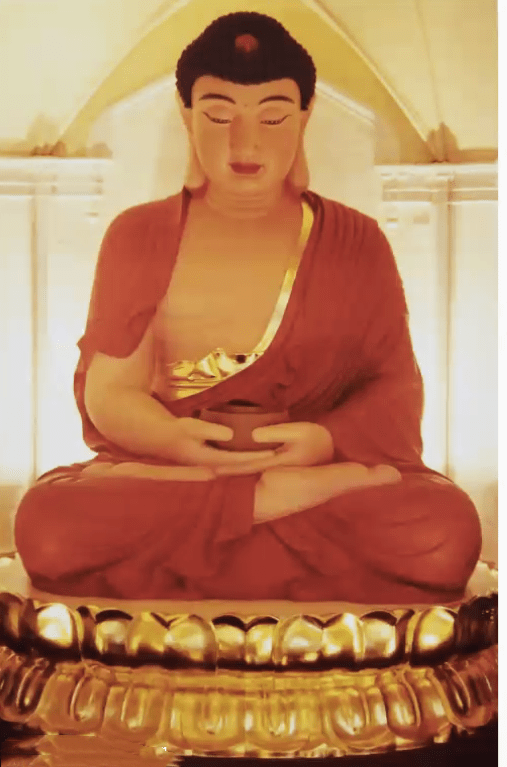
Solemn Amitabha Statue in Hua Zang Si Temple at San Francisco

Buddha Speaks of Amitabha

Once upon a time, it is said that the Buddha resided in Shravasti, within the Jeta Grove, situated in the garden of the Benefactor of Orphans and the Solitary. Accompanying him were a congregation of twelve hundred fifty great Bhiksus, all esteemed arhats whom the assembly recognized, including Elders Sariputra, Mahamaudgalyayana, Mahakasyapa, Hahakatyayana, Mahakaushtila, Revata, Suddhipanthaka, Nanda, Ananda, Rahula, Gavampati, Pindolabharadvaja, Kalodayin, Mahakaphina, Vaddujla, Aniruddha, and others. Additionally, numerous Bodhisattvas and celestial beings, including Ajita Bodhisattva, Gandhastin Bodhisattva, Nityodyukta Bodhisattva, and the chief of gods, Shakra, were present, along with countless beings from various heavens.

During that time, the Buddha addressed Elder Sariputra, saying, “Travel westward across hundreds of thousands of millions of Buddhalands, and you will reach a realm known as Ultimate Bliss. In this land, a Buddha named Amitabha currently imparts the teachings.”

“Sariputra, why is it called Ultimate Bliss? Because every being in this country is free from suffering and enjoys unbounded bliss, hence the name Ultimate Bliss.”

Furthermore, Sariputra, the land of Ultimate Bliss is enclosed by seven tiers of railing, crafted from the four treasures, thus earning its name. Pools of the seven jewels, filled with the eight waters of merit and virtue, grace this land. The pools boast pure bottoms covered in golden sand, with stairs of gold, silver, lapis lazuli, and crystal on each side. Raised pavilions, adorned with precious materials like gold, silver, lapis lazuli, crystal, mother-of-pearl, red pearls, and carnelian, grace the surroundings. Within these pools, lotuses with hues resembling carriage wheels bloom, emitting subtle, wonderfully fragrant, and pure scents.

“The realization of the land of Ultimate Bliss is thus adorned with merit,” Sariputra, the Buddha continued.

Moreover, in this Buddhaland, harmonious heavenly music perpetually resonates, and the ground is composed of yellow gold. During the six periods of day and night, a rain of mandarava flowers descends, and each morning, the inhabitants of this land offer myriad wonderful flowers to countless Buddhas in all directions. After their meals, they leisurely stroll through their homeland.

Sariputra, the land of Ultimate Bliss is abundantly adorned in this way.

Furthermore, rare and exquisite varicolored birds, including white cranes, peacocks, parrots, egrets, kalavinkas, and two-headed birds, inhabit this land. In the six periods of the day and night, these flocks produce melodious and elegant sounds, proclaiming profound teachings such as the five roots, the five powers, the seven Bodhi shares, and the eight sagely way shares. When the inhabitants hear these sounds, they become mindful of the Buddha, the Dharma, and the Sangha.“Sariputra, do not assume these birds are karmic retribution. In this Buddhaland, there are no three evil ways of rebirth; in fact, not even the names of these ways exist. Amitabha Buddha, desiring to widely spread the Dharma sound, created this multitude of birds through transformation.”

The Buddha continued to describe the enchanting features of the land of Ultimate Bliss, its jeweled trees producing subtle and wonderful sounds when the soft wind blows. As these descriptions unfolded, Sariputra listened attentively, absorbing the profound beauty of this Buddhaland.

After detailing the splendors of the land, the Buddha turned to Sariputra and asked, “Why do you think this Buddha is called Amitabha?”

“The brilliance of Amitabha Buddha’s light is immeasurable, illuminating the lands of the ten directions without hindrance. He is called Amitabha for this reason. Furthermore, the lifespan of Amitabha Buddha and his people extends for countless kalpas, making him worthy of the name ‘Amitabha.’ Ten kalpas have passed since Amitabha attained Buddhahood.”

As the Buddha spoke, Sariputra gained deeper insights into the infinite virtues of Amitabha Buddha and the extraordinary qualities of the land of Ultimate Bliss.

The text continues to explore the presence and teachings of other Buddhas in different directions, emphasizing their encouragement for all living beings to believe, praise, and hold in reverence the inconceivable merit and virtue of the sutra.

Finally, the Buddha urged Sariputra and all present to have faith and make the vow to be born in Amitabha’s country, emphasizing the profound benefits and the irreversible attainment of anuttara-samyak-sambodhi for those who make this vow.

Upon concluding his teachings, the Buddha witnessed Sariputra, the bhiksus, gods, humans, and other celestial beings joyously receiving his words. The assembly, filled with reverence, bowed and withdrew, having absorbed the wisdom imparted by the Buddha.

Buddha Speaks of Amitabha

Link: https://peacelilysite.com/2023/12/06/buddha-speaks-of-amitabha/

#Amitabha

Source: wisdomtea.org/2023/11/30/buddha-speaks-of-amitabha/

On Right View

On Right View

Translated from the Pali by Thanissaro Bhikkhu

Residing in Savatthi, Ven. Kaccayana Gotta approached the Blessed One and, upon arrival, respectfully bowed and took a seat to the side. While seated, he inquired of the Blessed One, “Lord, it is often spoken of as ‘Right view, right view.’ To what extent does right view prevail?”

The Blessed One replied, “In general, Kaccayana, the world is understood through the dichotomy of existence and non-existence. However, when one comprehends the world’s origin with accurate discernment, the concept of ‘non-existence’ in relation to the world does not arise. Similarly, when one perceives the cessation of the world as it truly is, the notion of ‘existence’ in reference to the world does not manifest.

“By and large, this world is ensnared in attachments, clingings, and biases. Yet, an individual such as this does not entangle themselves in these attachments, clingings, fixations of awareness, biases, or obsessions. Neither do they identify with a self. They harbor no uncertainty or doubt, recognizing stress simply as arising when it does and passing away when it must. In this, their understanding stands independent of others. It is to this extent, Kaccayana, that right view exists.

“The belief in ‘Everything exists’ represents one extreme, while the stance of ‘Everything doesn’t exist’ constitutes another extreme. The Tathagata, avoiding these two extremes, imparts the Dhamma through the middle path: Ignorance serves as a condition for fabrications. Fabrications, in turn, condition consciousness. From consciousness arises name-and-form, leading to the development of the six sense faculties. The six sense faculties then give rise to contact, which begets feeling. Feeling, as a requisite condition, sparks craving, and craving leads to clinging and sustenance. From clinging and sustenance arises becoming, culminating in birth. Birth, as a requisite condition, sets in motion the cycle of aging and death, along with sorrow, lamentation, pain, distress, and despair. Such is the origination of this entire conglomerate of stress and suffering.

“Now, with the complete fading and cessation of that very ignorance, the cessation of fabrications follows. The cessation of fabrications results in the cessation of consciousness, leading to the cessation of name-and-form, and so on. This domino effect leads to the cessation of the entire process, bringing an end to aging and death, sorrow, lamentation, pain, distress, and despair. Such is the cessation of this entire mass of stress and suffering.”

Link: https://wisdomtea.org/2023/11/09/on-right-view/