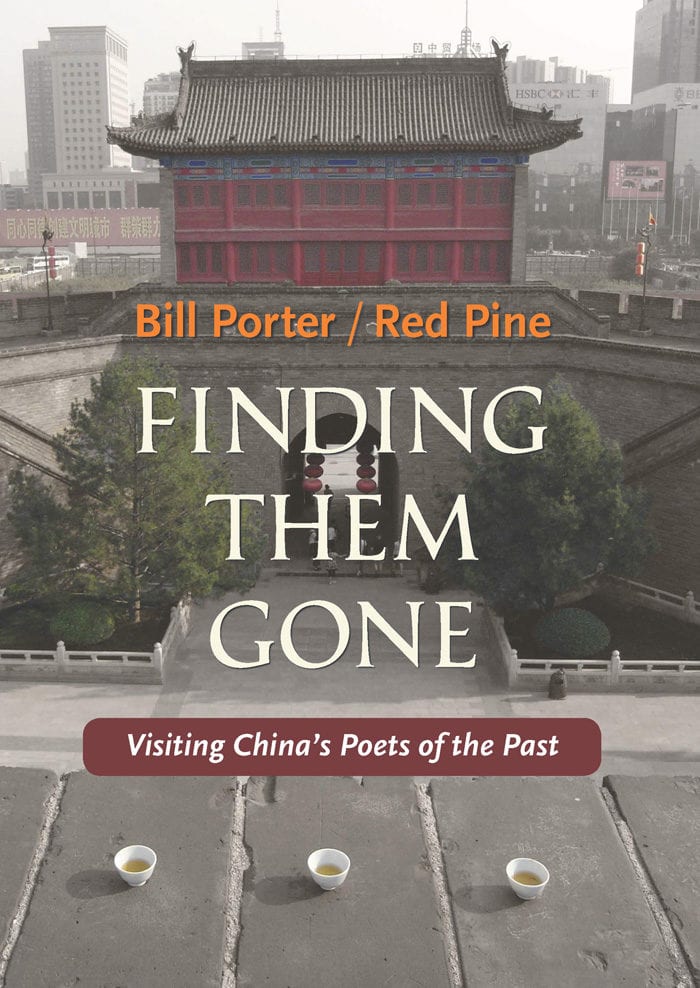
To pay homage to China’s greatest poets, renowned translator Bill Porter—who is also known by his Chinese name “Red Pine”—traveled through China visiting dozens of poets’ graves and performing idiosyncratic rituals that featured Kentucky bourbon and reading poems aloud to the spirits. Combining travelogue, translations, history, and personal stories, this intimate and fast-paced tour of modern China celebrates inspirational landscapes and presents translations of classical poems, many of which have never before been translated into English. Porter is a former radio commentator based in Hong Kong who specialized in travelogues. As such, he is an entertaining storyteller who is deeply knowledgeable about Chinese culture, both ancient and modern, who brings readers into the journey—from standing at the edge of the trash pit that used to be Tu Mu’s grave to sitting in Han Shan’s cave where the Buddhist hermit “Butterfly Woman” serves him tea. Illustrated with over one hundred photographs and two hundred poems, Finding Them Gone combines the love of travel with an irrepressible exuberance for poetry. As Porter writes: “The graves of the poets I’d been visiting were so different. Some were simple, some palatial, some had been plowed under by farmers, and others had been reduced to trash pits. Their poems, though, had survived… Poetry is transcendent. We carry it in our hearts and find it there when we have forgotten everything else.”
These are some of the Poets’ graves that Bill has visited : Li Pai, Tu Fu, Wang Wei, Su Tung-p’o, Hsueh T’ao, Chia Tao, Wei Ying-wu, Shih-wu (Stonehouse), Han-shan (Cold Mountain).
With Finding Them Gone as your map, you will encounter rural and industrial China’s shifting cultural landscape without ever leaving the page. On your journey, you’ll set off by train in Beijing and arrive in the cave where Cold Mountain, a master of Hermetic poetry and Zen practice, once sang his verses—“with nothing to do I write poems on rock walls/trusting the current like an unmoored boat.”
Each step of the pilgrimage is marked with poetry from Chinese masters—among them Stonehouse, Cold Mountain, and Li Po—including poems never before translated into English.
Hua Zang Si is my favorite sacred spiritual worship place in the bay area. In there I find peace, relaxation, and harmony, and a home for my soul. I have gone there many times, to chant the sutra, join the meditation sessions, and participate in Dharma assemblies.
Hua Zang Si, an impressive-looking temple located in the center of the Mission District in San Francisco. The building was formerly the St. John’s Evangelical Lutheran Church, built in 1903, and has been repurposed as a Chinese temple. To me it is really a friendly symbol that different religions can coexist in harmony.
The large outside facade of the temple is painted red color, made the building a very outstanding and eye-catching landmark in the neighborhood. Red is a good color in Chinese culture that symbolizes auspiciousness and warding off evil spirits。
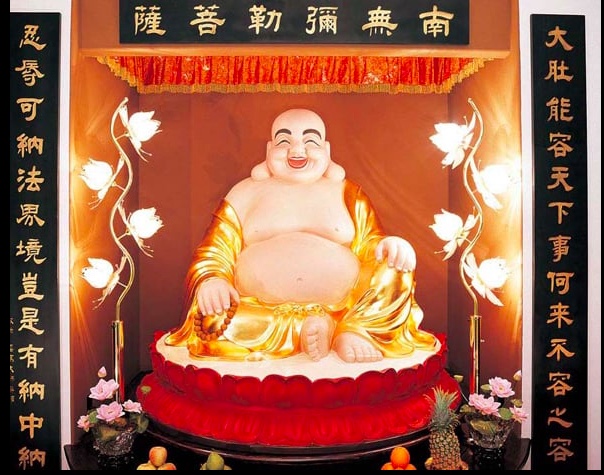
Once entering the temple, I feel like I am in another world. The marvelous statue at the entrance of the temple is an oversize representation of a jolly, laughing Buddha: Maitreya Bodhisattva (the next Buddha in this Saha world). It is such a warm welcoming sign. The big belly not only means jolly, it also means tolerating those intolerable things in the world. So when you look at the statue, you will start to feel that learning Buddhism is happy and kind.
The right line of the couplet is “da du neng rong tian xia shi he lai bu rong zhi rong.” As self-cultivators, we should be like the Buddhas and Bodhisattvas. We should have a broad mind, open heart, and great tolerance. The left line of the couplet is “ren ru ke na fa jie jing qi shi you na zhong na.” The first priority for one who learns Buddhism and cultivates himself is to be patient and forbearing under insult. The thought of patience or tolerance does not arise from his mind. Everything in all of the dharma realms can change from ordinary to holy.
Walking inside, the first floor is Shakyamuni Buddha Hall. The golden statue of Shakyamuni Buddha is a very dignified-looking Buddhist statue. On the left side is the one thousand-armed and one thousand-eyed Guanyin Bodhisattva, an awe-inspiring statue. On the right side is Skanda Bodhisattva, a standing majestic full-body armored statue. With a sword in hand, Skanda Bodhisattva is a Buddha Dharma protector, and it is believed he can subjugate demons and evil spirits.
Shakyamuni Buddha
One thousand-armed and one thousand-eyed Guanyin Bodhisattva
Skanda Bodhisattva
The second floor is Amitabha Buddha Hall. The twenty-one-foot-high statue of Amitabha Buddha (designed by H.H. Dorje Chang Buddha III) has been generally recognized as the most majestic Buddhist statue in the world. It is an extremely solemn sight. The color painted on the face is so lifelike, one feels like seeing the real Amitabha Buddha from western paradise. The Buddha’s eyes seem alive as well, looking down at all beings full of compassion and love. Every time when I look at the Buddha, I feel so moved and touched, tears fill my eyes. I can’t help but to kneel down and pray wholeheartedly: Please Buddha save me from the birth-death cycle, please take me to the western pure land. I feel my whole body melted into the compassionate gaze of the Buddha.
In the center of Amitabha Buddha hall, there is a large circular mandala on which a Yun sculpture (carved by H.H. Dorje Chang Buddha III) depicting Mt. Sumeru is placed. In that Yun sculpture are shariras (sacred relics) of the Shakyamuni Buddha for worshipping.
Directly facing the Amitabha Buddha is a tall Dharma altar, there is a huge blue Dorje Chang Buddha image. Dorje Chang Buddha is also called Buddha Vajradhara or Ruler of the Vajra Beings. In the entire universe, Dorje Chang Buddha is the first Buddha with form and is the highest Buddha. That is, the highest leader of Buddhism in the entire universe came into being in the form of Dorje Chang Buddha. It was Dorje Chang Buddha who began transmitting dharma and saving living beings in the dharmadhatu. As a result, Buddhism was born and the Buddha-dharma began spreading.
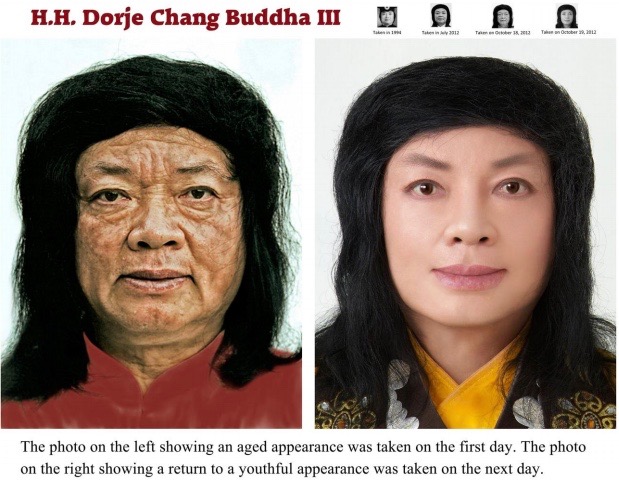
In front of the image of Dorje Chang Buddha are photos of H.H. Dorje Chang Buddha III. Dorje Chang Buddha has come to this world twice. The first time was in the form of the holy and venerable Vimalakirti, who was Dorje Chang Buddha II. The second time was in the form of H.H. Wan Ko Yeshe Norbu, who is Dorje Chang Buddha III.
These photos were true records of the holy miracle Buddha Dharma. On October 18, 2012, H.H. Dorje Chang Buddha III within ten minutes, reversed his appearance back to a youthful look. This incredible Buddha Dharma ever practiced successfully by Guru Rinpoche long time ago in Tibet.
Hua Zang Si has many Holy Treasures , make sure you check them out at the corner of this hall as well.
The third floor contains a library of Buddhist scriptures.
The backyard — a city oasis in the shadow of surrounding Victorians — is home to a magnolia tree, which the faithful say rained nectar for three days, along with a miraculous lotus tub used in the bathing of the Buddha and heavenly beings.
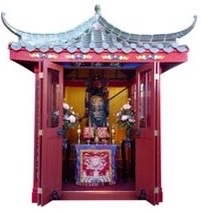
Further back, there is Dharma protector pavilion, a statue of the Dharma Protecting Deity Guan Yu was installed inside.
Guan Yu took refuge in Master Zhiyi at Yuquan Hill. He then manifested great supernatural power and constructed the Yuquan Temple overnight on a barren lot, where he resolved to become a protector of Buddhism. That is why, upon the plea of many Buddhist practitioners, he was recommended to be the Dharma Protecting Deity of Hua Zang Si.
Hua Zang Si is different from other temples that propagate only one sect within Buddhism. It teaches all of the various sects within Buddhism. If you want to know and learn Buddhism, Hua Zang Si is the best place to start with.
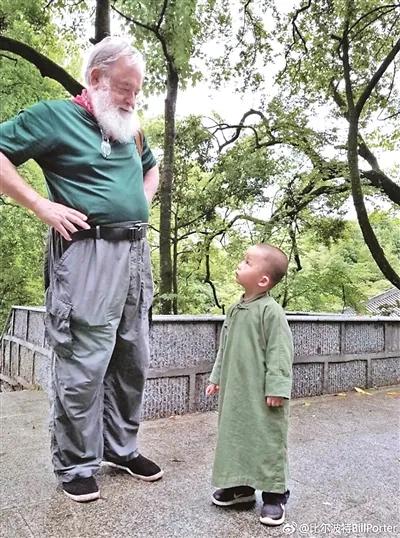
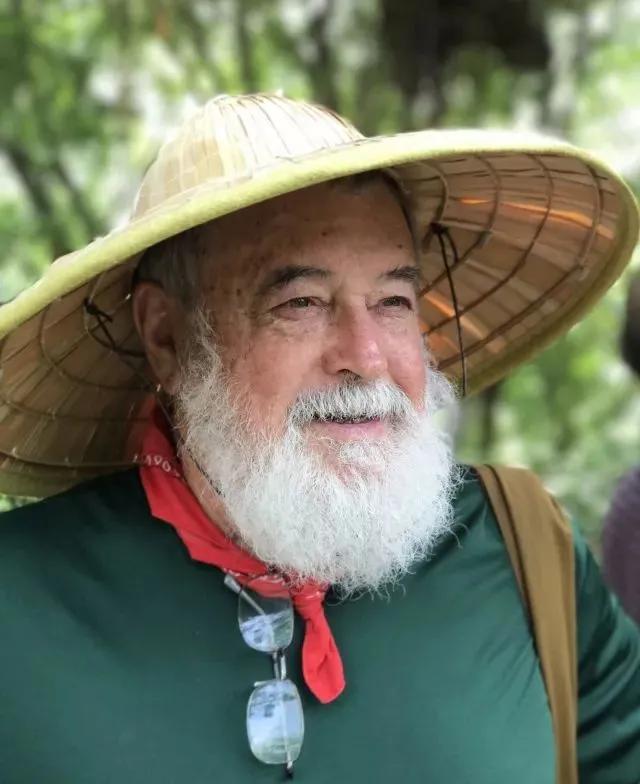
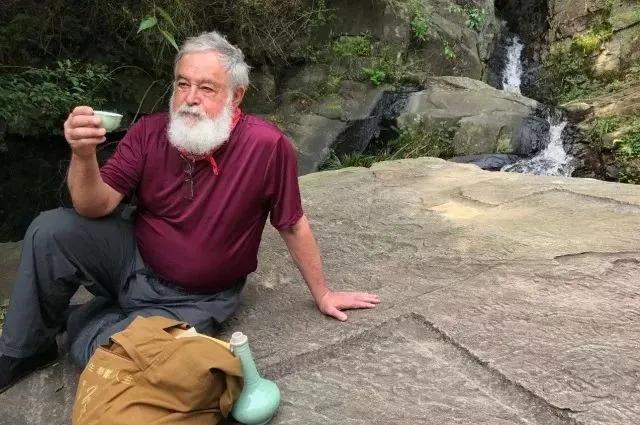
This interesting old American man has no Chinese ancestry, but he loves Chinese traditional culture deeply.
He is the author of “The Orchid in the Empty Valley”, Bill Porter, an American writer who is influenced by Buddhist classics and obsessed with Chinese culture. He has visited China many times, lived a simple life in temples, and looked for a place for hermits and eminent monks. Be the Chinese Taiwanese wife of Zhuangzi’s research.
He also tried to pursue the ideal world in the minds of Chinese people for thousands of years-Peach Blossom Spring.
Published a series of books expounding Chinese culture in China and the United States: “The Orchid in the Empty Valley”, “Looking for People”, “The Heart Sutra” interpretation, etc. He also translated and published “Hanshan Poems”, “Shiwushan Residence Poems” and poetry by Wei Yingwu and Liu Zongyuan.
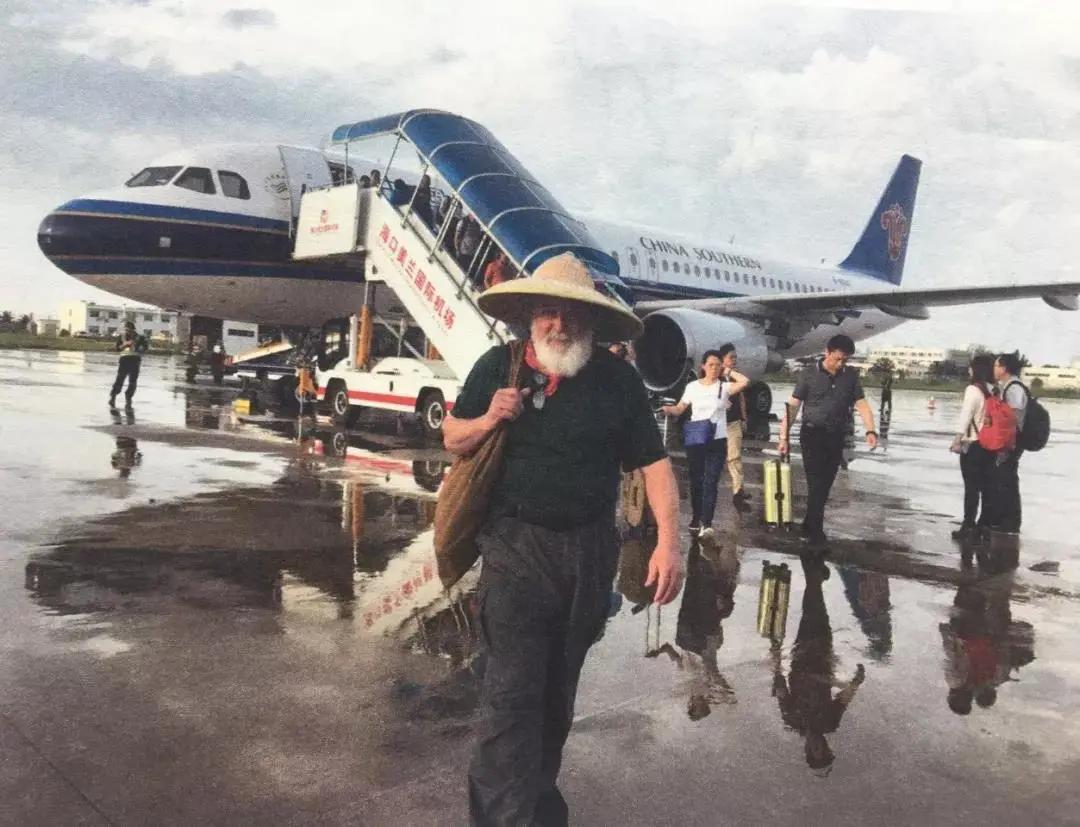
Bill Porter is a particularly interesting old urchin. He returned to China to follow in the footsteps of Su Shi and Tao Yuanming and wrote “Yi Nian Tao Hua Yuan”. When he flew over the sky over my hometown Leizhou Peninsula, he opened the collection of Dongpo poems and began to recite. Because Su Dongpo was demoted to stay in Leizhou Peninsula for too long and left a poem.
“The Orchid in the Empty Valley”, published in 2008, records his journey of searching for a Chinese hermit in Zhongnan Mountain, which has gained widespread attention for cutting into the most secret part of Chinese culture. He felt that “hermits are doctors in Chinese religion.”
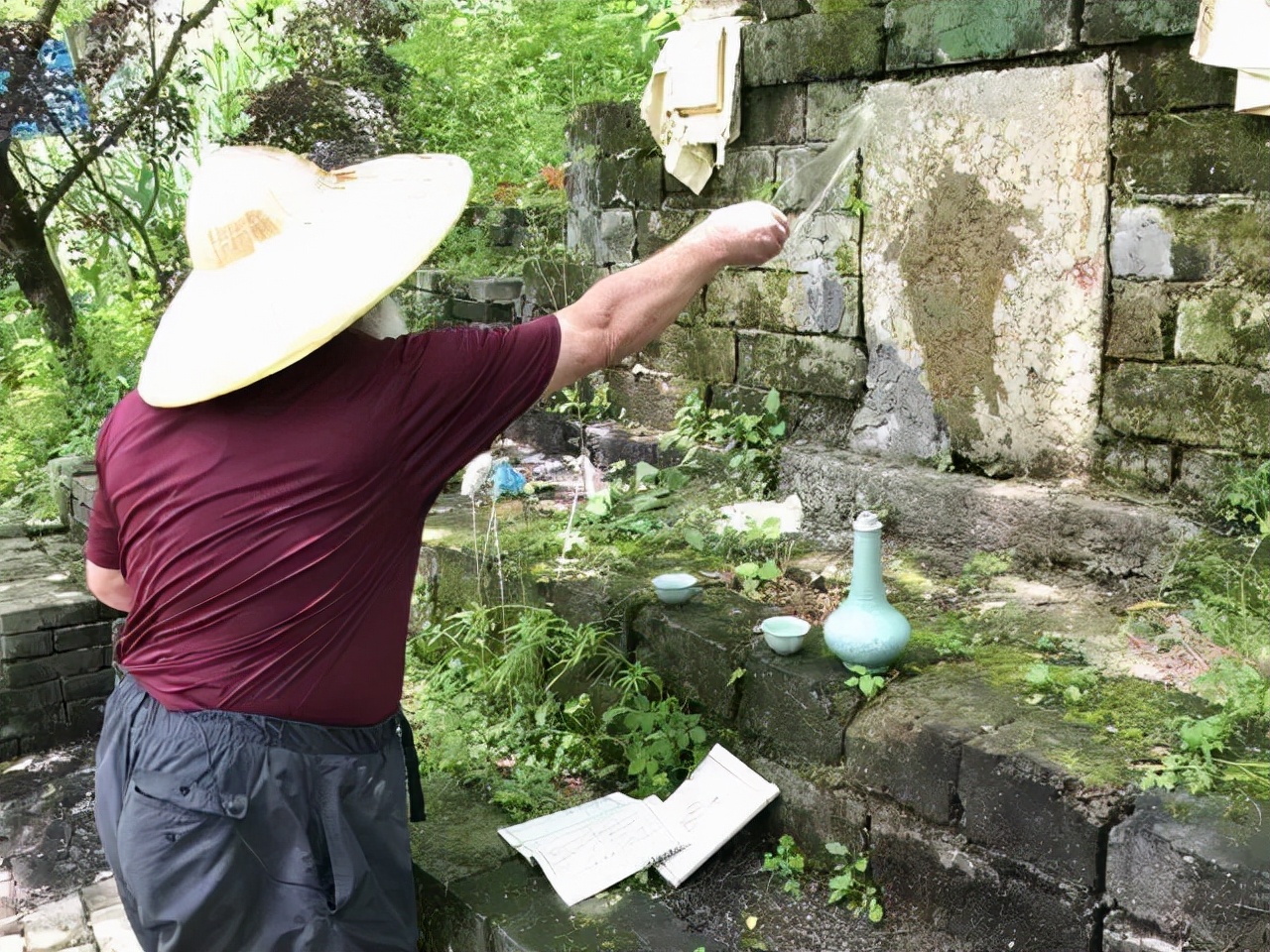
Begin to visit the former residences and cemeteries of 41 ancient Chinese poets in 2012. Along the way, he always took two precious bottles of whiskey and three wine glasses, and he reverently served a glass in front of each poet’s grave.
The old naughty boy Bill Porter thought that when he traveled through time and space in front of the tomb and was drinking with the greatest poets in this land, he seemed to have met each other in the air. I remembered that my friend Yun called drinking “liquid meditation”. , Very advanced.
Bill Porter also hopes that after reading his book, Chinese readers can try to experience this kind of travel to find heroes in their own culture.
Poems translated by Bill Porter:
(One)
I built my hut beside a path but I hear neither cart nor horse
you ask how can this be when the mind travels so does the place
picking chrysanthemums by the eastern fence I lose myself in the hill to the south
the mountain air the sunset light birds flying home together
in this there is a truth I’d explain if I could remember the words.




 Peace LiLy