The Abbess of Hua Zang Si– Venerable Ruo Hui RuZun

The abbess of Hua Zang Si is Venerable Ruo Hui RuZun (Golden Button Stage I). She is a disciple of H.H. Dorje Chang Buddha III. She is deeply and broadly proficient in the sutras, abides by the precepts with pure cultivation, upholds correct views, and possesses high and profound virtue and conduct.

Driven by her endowed wisdom and firm aspiration, Venerable Ruo Hui RuZun started learning Buddhism since her childhood. While she was a young person facing a splendid future, Venerable Ruo Hui RuZun decided without hesitation to abandon worldly life to become a monastic practitioner. She respectfully quested for the practice of Buddhism, studied the sutras deeply, and cherished the goal of benefiting living beings in her cultivation and practice. Additionally, she demonstrated outstanding virtue and talent in her diligent study and research in the academic arena and received a Master’s degree from the Department of Philosophy of Taiwan University. She made a vow to dedicate her life to grandly propagating Buddha-dharma and broadly saving living beings. She served as the dean of the Chien Fo Shan Girl Buddhist College in Taiwan in her early years and have been continuously making contributions to the education of Buddhist monastics. However, Venerable Ruo Hui RuZun was deeply aware of the widely prevalent chaotic phenomena in the current Buddhist world, such as confusing views, non-unified sects and schools advocating their own tenets, miscellaneous teachings that are complex but incomplete, and promoting false doctrines as authentic Buddhism. Consequently, pious Buddhist disciples are searching and questing in vain and still unable to learn the true dharma of the Tathagata. Their lifetimes are thus wasted! Therefore, Venerable Ruo Hui RuZun was continuously concerned about this situation day and night and eagerly beseeched to find the genuine lineage from the Buddha that transmits the true teachings of the Tathagata.

In 1996, Ruo Hui RuZun had the good fortune to listen respectfully to the recorded dharma discourses expounded by H.H. Dorje Chang Buddha III. At that time, she sensed strongly and received the bright manifestation of the supremely and perfectly enlightening Buddha-dharma from His Holiness the Buddha! Later, guided by the karmic affinity to true Buddha-dharma, she fulfilled her wish to become a disciple of H.H. Dorje Chang Buddha III. Since then, she eagerly and respectfully listened to the recorded dharma discourses expounded by His Holiness the Buddha day and night. Through studying deeply with reference to the sutras, she eventually became enlightened by the teaching! She also received a holy inner-tantric initiation from the Buddha Master, which enabled her to personally realize the absolute truth of Buddha-dharma as if seeing the blue sky after pushing the blocking dark clouds aside. Since then, Ruo Hui RuZun abided by the teachings to benefit living beings with loving compassion in cultivation and practice. Shortly after that, she was delighted to learn that the Buddha Master was grandly publicizing and propagating the true dharma of the Tathagata in the Western world. After deep thinking and careful pondering, Ruo Hui RuZun decided to resign from the duty of the Dean of the Buddhist College to take up the mission to serve living beings. She traveled across the ocean to the United States to follow her Buddha Master, H.H. Dorje Chang Buddha III. She piously and deeply cultivated in the authentic lineage of Buddhism and engaged in the undertaking of propagating the true dharma of the Tathagata to benefit living beings.

Through the many years, Ruo Hui RuZun received true Buddha-dharma transmitted by H.H. Dorje Chang Buddha III in person and realized the key attainment of the dharma. In the dharma mandala, she manifested deeply cultivated power and superior state of realization. Once, she fortunately attended a grand and magnificent Vajra obstruction-removing dharma assembly. At that time, dharma masters and abbots of many monasteries and rinpoches were present. When stepping forward to receive empowerment, almost all of them were subdued by the power of the Buddha-dharma to show a suffering appearance and unable to support themselves by their power of concentration. Only Ruo Hui RuZun remained firmly unperturbed and successfully went through the holy power of Samadhi. She handled the situation magnificently and perfectly by calm without even any change in her facial expression. For that, she was praised by H.H. Dorje Chang Buddha III! Additionally, Ruo Hui RuZun also received a dharma of state practice transmitted by the Buddha Master in person and attained the accomplishment of crown-opening within two hours.

Since the grand opening of Hua Zang Si in December 2004 to now, Ruo Hui RuZun has served at the positions of prior (warden), deputy abbess, and abbess at this temple, which is the first temple of true dharma of Buddhism established in the Western world by H.H. Dorje Chang Buddha III. Since the temple’s establishment, her responsibilities cover a wide range of the temple’s dharma affairs and operations including various dharma assemblies, training and education of the monastic personnel, defining the system and rules to manage the temple, and so on.

With her abundant and solid knowledge in the theory of Buddhism and the teaching of practicing in silence, experience in managing and operating a temple, as well as deeply cultivated power in meditative concentration, she continuously serves since the beginning as the karma monastic master in awarding the complete set of grand precepts through three dharma assemblies and the professor/teacher of various courses in precepts, rituals, meditation, group practice, education of monastics and others at the Academy of Exoteric Buddhism of Hua Zang Si. She also conducted teaching and training at Buddhist institutions in the United States and overseas. Many of the disciples she taught have now become dharma masters or monastic practitioners. Actually, quite a number of them have even become excellent managerial personnel at some temples in different countries.

Ruo Hui RuZun consistently maintains a low-key demeanor in her cultivation and practice, exemplifying patience in the pursuit of her significant mission. She remains humble and modest, avoiding self-promotion or publicity. Through her words and actions, she serves as an exemplary teacher for Buddhist disciples, embodying the principles of loving compassion. Devoting herself quietly to the welfare and joy of sentient beings, she seeks enlightenment for both herself and others.

Adhering to the teachings and true dharma of H.H. Dorje Chang Buddha III, Ruo Hui RuZun upholds principles, follows rules rigorously, and engages in concrete cultivation to guide disciples on the path of accomplishment and liberation. She is an accomplished and eminent Buddhist monk whose example we should emulate and learn from.

Since September 2015, Ruo Hui RuZun has officially served as the abbess of Hua Zang Si. Recognizing the immense responsibility entrusted to her, especially given that Hua Zang Si is not an ordinary temple but a true dharma temple established in the Western world by H.H. Dorje Chang Buddha III, her Buddha Master, she is acutely aware of the need for unwavering commitment. Determined to lead the monastics and lay followers, she strives to transform Hua Zang Si into a temple faithfully practicing the teachings of H.H. Dorje Chang Buddha III and Sakyamuni Buddha, benefitting and nurturing sentient beings. In pursuing this mission, Hua Zang Si aims to contribute tangibly to compassion, happiness, peace, and joy in America and worldwide, fostering the perfect good fortune and wisdom, liberation, and accomplishment of living beings. The temple is committed to meeting the high expectations of Buddhas, Bodhisattvas, and sentient beings alike.

The Abbess of Hua Zang Si– Venerable Ruo Hui RuZun

Link:https://peacelilysite.com/2023/12/01/the-abbess-of-hua-zang-si-venerable-ruo-hui-ruzun/

#DorjeChangBuddhaIII #HHDorjeChangBuddhaIII#HuaZangSi#HolyManifestation #RuoHuiRuZun

#Abbess #Temple

Minimalism: A Meaningful Journey for the Holidays

As the holiday season approaches, it’s an opportune moment for introspection and reevaluation of our lifestyles. In this spirit of reflection, let’s explore the profound wisdom shared by Joshua Fields Millburn and Ryan Nicodemus, renowned as “The Minimalists,” in their transformative book, “Minimalism: Live a Meaningful Life.”

Minimalism, as Millburn and Nicodemus advocate, goes beyond decluttering physical spaces; it’s a philosophy that extends to simplifying every facet of our lives. At its essence, minimalism encourages us to reassess our values and redefine what truly matters.

Live a Simple and Meaningful Life

In their insightful book, Millburn and Nicodemus share a philosophy born from a profound journey of embracing simplicity as a way of life.

Joshua Fields Millburn: His transformative journey began with life-altering events that questioned the true meaning of happiness. Confronting the emptiness material pursuits couldn’t fill, losses, such as the death of his mother and the end of his marriage, compelled Millburn to reassess his priorities, propelling him toward a more intentional existence.

Ryan Nicodemus: Similarly, Nicodemus faced pivotal moments, including a divorce and the death of his mother, prompting deep introspection. Realizing he was living a life dictated by societal expectations, Nicodemus sought a different path aligned with his core values.

These transformative experiences ignited a shared desire in Millburn and Nicodemus to break free from the shackles of consumerism and pursue a simpler, more meaningful life. Their quest for a life rich in experiences, rather than possessions, became the driving force behind the minimalist philosophy they passionately advocate.

Key Insights from Minimalism:

  • Material Possessions Don’t Equal Happiness: Millburn and Nicodemus discovered that the pursuit of material success did not guarantee happiness. True contentment arose from aligning actions with values.
  • Meaningful Connections Matter: Recognizing the importance of fostering deep connections, meaningful relationships became a cornerstone of their minimalist journey.

Having shifted from a life of excess to intentional living, Millburn and Nicodemus inspire individuals worldwide. Through various mediums, they share the liberating potential of living with less and finding more meaning in every aspect of life.

In the book, they offered some Practical Tips for Embracing Minimalism:

  1. Evaluate Your Possessions: Assess belongings and keep only what adds value. Letting go of excess can be liberating.
  2. Mindful Consumption: Consider the necessity and long-term impact of purchases. Opt for quality over quantity.
  3. Prioritize Experiences: Invest in experiences over possessions, as shared moments contribute more to lasting happiness.
  4. Digital Detox: Extend minimalism to the digital realm by decluttering digital spaces. Limit screen time and embrace real-world interactions.
  5. Practice Gratitude: Regularly reflect on gratitude. A grateful mindset enhances contentment and reduces the desire for excess.

As the holiday season unfolds, let’s embody the spirit of minimalism, focusing on what truly matters. Embracing a simpler, intentional life becomes a gift we give ourselves and the planet—a celebration of gratitude and connection.

Minimalism: A Meaningful Journey for the Holidays

Link:https://peacelilysite.com/2023/11/24/minimalism-a-meaningful-journey-for-the-holidays/

#Minimalism #MeaningfulLife #Holidays #Gratitude #MillburnandNicodemus

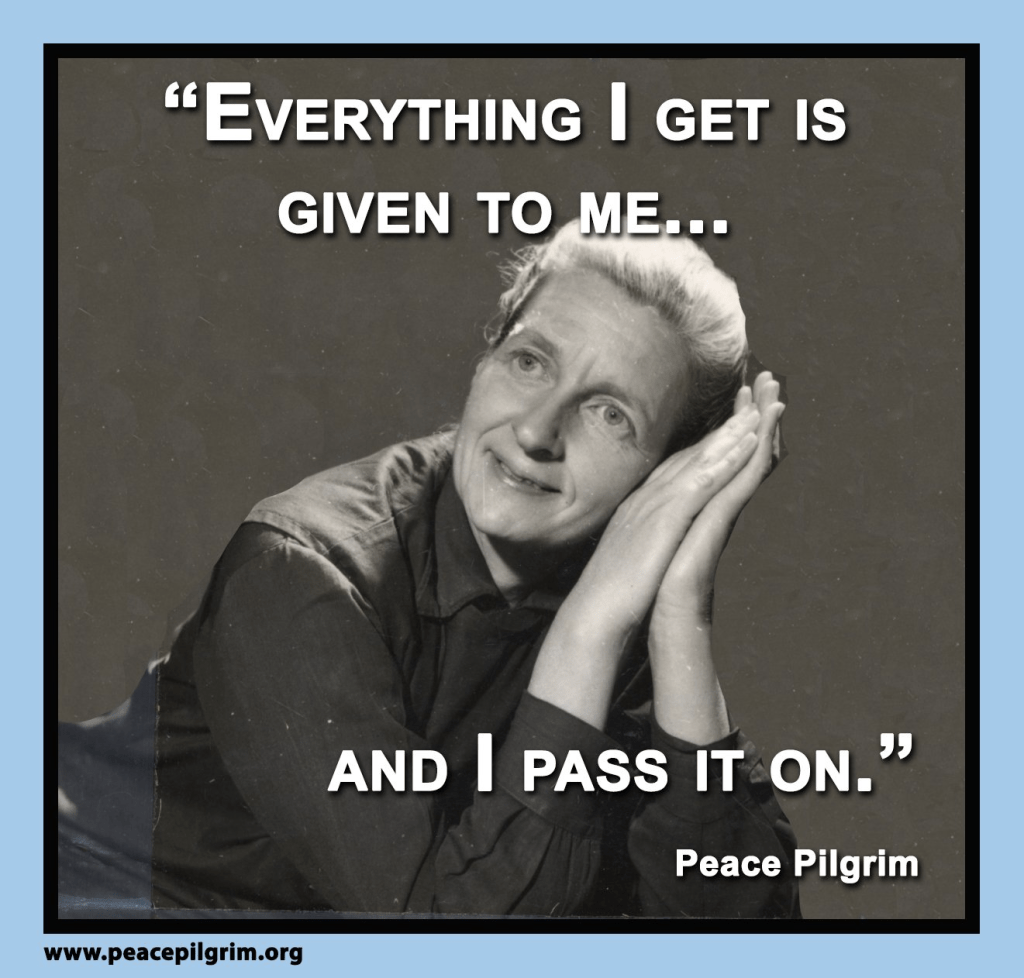
Embracing the Spirit of Giving: Wisdom from Peace Pilgrim

As we enter the holiday season, a time of reflection and celebration, the timeless wisdom of Peace Pilgrim offers profound insights into the true essence of life. “Now there is a living to give instead of to get,” she said, encouraging a shift from acquisition to sharing. Let’s delve into the transformative teachings of Peace Pilgrim, exploring how they can bring peace and fulfillment into our lives.

Peace Pilgrim’s philosophy centers on the joy of giving. Concentrating on the act of giving, she reveals that it becomes a reciprocal source of joy. Health, happiness, and inner peace flow abundantly when one gives selflessly. There’s a profound feeling of endless energy, a connection to the universal source that never seems to deplete.

A key theme in Peace Pilgrim’s teachings is taking control of one’s life. Contrasting the ego, driven by bodily desires and mental demands, with the higher nature governing body, mind, and emotions, she exemplifies the ability to command oneself. Through giving, she demonstrates the power to instruct the body to rest, the mind to focus, and the emotions to find stillness, even in challenging circumstances.

Quoting Thoreau, Peace Pilgrim introduces the concept of dancing to a different drummer—the higher nature instead of the lower. This alternative way of living is marked by aligning oneself with a deeper, more profound purpose. Choosing to follow the rhythm of the higher nature leads to a life driven by compassion, understanding, and a commitment to the well-being of others.

In her journey, Peace Pilgrim made crucial early discoveries. Initially, she found that making money was easy, but the meaninglessness of earning and spending frivolously became apparent. Out of a deep seeking for a meaningful life, she experienced a profound inner shift. Walking through the woods one night, she encountered a psychological hump—a point of no return. With complete willingness and no reservations, she dedicated her life to service.

As we navigate the holiday season, let’s carry the profound wisdom of Peace Pilgrim in our hearts. Embracing the spirit of giving not only enriches the lives of those around us but also brings a sense of fulfillment and purpose. Peace Pilgrim’s inner discovery serves as a poignant reminder that true abundance lies in the joy of giving, connecting us to an endless reservoir of universal energy.

Mildred Norman, later known as Peace Pilgrim, embarked on her peace pilgrimage in 1953, a journey that extended for decades. Her commitment to spreading the message of peace was unparalleled—she walked tirelessly, crisscrossing the United States six times. Remarkably, Peace Pilgrim covered over 25,000 miles during her pilgrimage, a feat she deemed too insignificant to keep precise count.

Her unconventional lifestyle reflected her profound dedication to her mission. Peace Pilgrim adhered to a minimalist philosophy, carrying neither money nor accepting any. She embraced a life of voluntary simplicity, often going without food until it was offered or found in the wild. Accommodations were simple and spontaneous, ranging from bus stations to cornfields when no one extended an invitation.

Peace Pilgrim’s journey became a testament to the transformative power of a singular commitment to a higher purpose. Her life exemplifies the possibility of living with purpose, prioritizing service over material pursuits, and finding fulfillment in the pursuit of peace. As we reflect on her remarkable life, we’re inspired to consider the ways we, too, can contribute to a more compassionate and harmonious world.

Embracing the Spirit of Giving: Wisdom from Peace Pilgrim

Link:https://peacelilysite.com/2023/11/22/embracing-the-spirit-of-giving-wisdom-from-peace-pilgrim/

#PeacePilgrim #Thankgiving #HolidaySeason #Giving #Peace #Love #Compassionate

A Thanksgiving Reflection: Gratitude towards Our Parents

Embracing Filial Piety in a Modern World

In this season of gratitude, as we gather around tables adorned with festive feasts, it’s an opportune moment to reflect on the essence of filial piety, a cornerstone of Chinese culture. While tradition emphasizes putting parents first, the landscape of communication between generations has evolved, presenting new challenges.

In our pursuit of modernity, we often find a widening gap in understanding between parents and their children. This Thanksgiving, let’s draw inspiration from the timeless wisdom of Socrates, the ancient Greek philosopher.

Once Socrates noticed that Lamprocles was increasingly irritable with Xanthippe, his mother. Recognizing the need for a heart-to-heart conversation, Socrates decided to employ the Socratic method to enhance his son’s relationship with her.

Socrates initiated the dialogue by asking Lamprocles about the meaning of the term “ungrateful.” Lamprocles responded, noting that someone is considered ungrateful if they fail to express gratitude despite being treated well. Establishing this as common ground, Socrates delved deeper, questioning whether ingratitude might be acceptable towards enemies but not friends. Lamprocles rejected this notion, asserting that regardless of friendship or enmity, gratitude should be shown to anyone who has done a favor.

Photo by Berendey_Ivanov / Andrey_Kobysnyn on Pexels.com

Socrates then redirected the conversation toward the unparalleled favor bestowed by parents on their children. Emphasizing the sacrifices parents make, he highlighted the physical and emotional burdens mothers endure, risking their lives during childbirth. Despite this, Lamprocles remained unconvinced, citing his mother’s temper as a significant obstacle.

Socrates posed an intriguing question, asking whether it’s harder to bear with a mother’s ferocity than that of a wild beast. Lamprocles, acknowledging his mother’s intense demeanor, struggled to reconcile her actions with the lack of physical harm. Socrates, steering the conversation, questioned whether Lamprocles had ever been injured by his mother physically, and when the answer was negative, Socrates emphasized the reciprocal nature of their relationship.

The dialogue took an unexpected turn when Socrates compared listening to Xanthippe’s words to actors in tragedies hurling insults at each other. Lamprocles, distinguishing between real intent and theatrical performance, argued that his mother’s words were not mere make-believe. Socrates, unveiling his true intent, reminded Lamprocles that, despite Xanthippe’s anger, it was not devoid of good intentions but rooted in her love for him.

Socrates emphasized Xanthippe’s continuous care for Lamprocles during sickness, her prayers for his well-being, and her genuine desire to help him. He concluded that, ultimately, it is not the sharpness of words but the true underlying intentions that should concern us. Lamprocles, acknowledging his mother’s positive intentions, found solace in understanding that her bluster was akin to the actors’ staged conflicts.

In this heartfelt conversation, Socrates guided his son towards appreciating the true essence of gratitude and the underlying intentions of his mother’s actions. This Thanksgiving, let us draw inspiration from this wisdom, cherishing the imperfect yet unwavering love of our parents.

A Thanksgiving Reflection: Gratitude towards Our Parents

Link:https://peacelilysite.com/2023/11/17/a-thanksgiving-reflection-be-grateful-to-your-parents/

#ThanksgivingReflection #Grateful #Parents #Socrates

Source: https://donaldrobertson.name/2018/03/30/parenting-what-socrates-said/

A Unique Integration of Western Psychology and Eastern Spirituality

Carl Jung’s Psychology Theory and Zen Buddhism

Carl Jung, a pioneer of western psychology, is renowned for his extensive studies of different cultures, religions, and mythologies. He was able to integrate the knowledge from these diverse fields into his theories, making him a unique figure in the field of psychology. One area that had a particularly profound impact on Jung’s thinking was Buddhism, and in particular, Zen Buddhism.

Jung conducted a deep study of Zen Buddhism, and even wrote a foreword for a book by D.T. Suzuki (“An Introduction to Zen Buddhism”), a pioneering Buddhist teacher who introduced Zen Buddhism to the west. In his foreword, Jung used his western perspective and psychological insights to explain the concepts of Zen Buddhism, offering a fresh and new perspective on this ancient tradition.

Could any of us boast that he believes in the possibility of a boundlessly paradoxical transformation experience to the extent moreover of sacrificing many years of his life to the wearisome pursuit of such a goal? And finally , who would dare to take upon himself the responsibility for such an unorthodox transformation experience – except a man who  was little to be trusted, one who, maybe for pathological reasons has too much to say for himself? Just such a person would have no cause to complain of any lack of following among us. But let a ‘Master’ set us a hard task, which requires more than mere parrot-talk, and the European begins to have doubts, for the steep path of self-development is to him as mournful and gloomy a the path to hell.

(Psychology and the East by C. G. Jung – Forward to D.T. Suzukis Introduction to Zen Buddhism, pub. Ark 1978)

One of the key concepts in Zen Buddhism that fascinated Jung was the idea of enlightenment. In Zen, enlightenment is seen as a state of perfect awareness and understanding, where one transcends the limitations of the ego and experiences a deep connection with the universe. Jung was intrigued by the way that Zen Buddhists achieved this state through meditation and other spiritual practices, and saw parallels between their experiences and his own ideas about the unconscious mind.

Jung’s understanding of Zen enlightenment was different from the way that western religions typically view spiritual enlightenment. In western religions, enlightenment is often seen as a state of moral perfection or divine union, and is usually achieved through faith and devotion to a higher power. In contrast, Zen enlightenment is seen as a direct experience of the true nature of reality, and is achieved through introspection and self-realization.

Jung believed that the concepts of Zen Buddhism could offer valuable insights into the human psyche, and he incorporated many of these ideas into his own theories of psychology. He saw the practice of meditation and mindfulness as a way to access the unconscious mind and achieve greater self-awareness, and he believed that the teachings of Zen Buddhism could help people to find inner peace and balance in their lives.

However, many Buddhist masters, experts, and scholars have their own unique understanding of Zen, which often comes from their own experiences. The contemporary Buddha, H.H. Dorje Chang Buddha III has expounded a dharma titled “The Great Dharma of Zen Practice.” In this teaching, the Buddha used perfect wisdom to profoundly explain what Zen is, how the ancient patriarchs practiced Zen and realized the way, and the specific methods of Zen meditation. If you want to understand Zen and practice Zen meditation, this is a must-read classic. Readers will surely gain great benefits and guidance from it.

A Unique Integration of Western Psychology and Eastern Spirituality

Link: https://peacelilysite.com/2023/11/09/a-unique-integration-of-western-psychology-and-eastern-spirituality/

#DorjeChangBuddhaIII #HHDorjeChangBuddhaIII# CarlJung #ZenBuddhism#WesternPsychology #EasternSpirituality #Dharma #ZenPractice #Meditation

Source: https://www.thezengateway.com/culture/c-g-jung-forward-to-d-t-suzuki-s-introduction-to-zen-buddhism

Exploring the Scientific Evidence for Life Beyond Death

“Many Lives, Many Masters” by Brian Weiss

The mystery of what happens after we die has intrigued humanity for centuries. While various belief systems and religions offer their interpretations, the quest for scientific evidence has been an ongoing journey. “Many Lives, Many Masters” by Dr. Brian Weiss takes us on a remarkable voyage through past-life regression therapy, providing substantial evidence that life does not end with death. As a Buddhist who has at times questioned the concept of the life and death cycle, I found this book to be a profound revelation that resonated with my own beliefs.

Dr. Brian Weiss, a prominent psychiatrist and skeptic, had his beliefs challenged when he began treating a patient named Catherine through traditional psychotherapy. Surprisingly, under hypnosis, Catherine began to recall not only her past life experiences but also the concept of reincarnation, which greatly differed from Dr. Weiss’s own beliefs.

What makes “Many Lives, Many Masters” particularly compelling is the abundance of real-life incidents documented throughout the book. Dr. Weiss’s meticulous recording of Catherine’s past-life memories, her interactions with various spirits, and her ability to provide verifiable information from the past all serve as a testament to the reality of her experiences. These experiences create a strong argument for the idea that life continues beyond the physical realm.

Brian Weiss’s background as a trained psychiatrist lends scientific credibility to his exploration of past-life regression therapy. He applies rigorous methodologies to Catherine’s case, ensuring that her experiences are thoroughly documented and verifiable. This scientific approach is essential in making the case for life after death, even to skeptics.

As a Buddhist, I have often contemplated the concept of rebirth and karma, central tenets in Buddhist philosophy. “Many Lives, Many Masters” aligns with these beliefs, providing further validation for the idea of reincarnation and the continuation of life beyond death. The book has given me renewed confidence in the cycle of life and death, offering a fresh perspective on the timeless teachings of Buddhism.

“Many Lives, Many Masters” is a book that challenges the boundaries of conventional thinking and encourages readers to explore the idea that life extends beyond the physical realm. Dr. Brian Weiss’s compelling documentation of real-life instances and his scientific approach make this a captivating read for individuals from all walks of life. Whether you approach this book as a person of faith, a skeptic, or someone in between, it offers a thought-provoking and enlightening journey into the possibility of life after death.

Exploring the Scientific Evidence for Life Beyond Death

Link:https://peacelilysite.com/2023/10/31/exploring-the-scientific-evidence-for-life-beyond-death/

#ManyLivesManyMasters #BrianWeiss #Hypnosis#Buddhism #Cycleoflifeanddeath

The Beauty of Life: A Journey through Bert Hellinger’s Poem “The Life”

There are certain pieces of writing that strike a chord in us, resonating with our deepest emotions and thoughts. One such masterpiece is Bert Hellinger’s poem “The Life”. As a profound expression of the human experience, it has the power to touch and inspire people from all walks of life. In this blog post, I would like to share this beautiful poem with you and explore its meaning and impact.

The Life

Bert Hellinger

Life destroys everything superfluous, until only the important remains

Life does not leave you in peace, so you stop fighting, and accept everything as it is?

Life takes what you have, until you stop complaining and learn gratitude

Life sends you troubled people so that you can heal and stop projecting what you have inside.

Life lets you fall again and again, until you decide to learn the lesson.

Life takes you out of the way and presents you with crossroads, until you stop wanting to control and learn to flow like a river.

Life puts you enemies on the road, until you stop “reacting”.

Life frightens you and startles you as many times as necessary, until you lose the fear and regain faith.

Life takes away your true love, it does not grant or allow it, until you stop trying to buy it with trinkets.

Life distances you from the people you love, until you understand that we are not this body, but the soul that powers it.

Life laughs at you so many times, until you stop taking everything so seriously and laugh at yourself. Life breaks you and breaks you in as many parts as necessary for the light to penetrate.

Life confronts you with rebels, until you stop trying to control.

Life repeats the same message, even with shouts and slaps, until you finally listen.

Life sends you thunder and storms, so you wake up. Life humiliates and defeats you again and again until you decide to let the EGO die.

Life denies you goods and greatness until you stop wanting goods and greatness and you begin to serve. Life cuts your wings and prunes your roots, until you need neither wings nor roots, but only disappear in the forms and fly from the Self.

Life denies you miracles, until you understand that everything is a miracle.

Life shortens your time, so you hurry to learn to live. Life ridicules you until you become nothing, until you become nobody, and so you become everything.

Life does not give you what you want, but what you need to evolve.

Life hurts you, hurts you, torments you, until you let go of your whims and tantrums and appreciate just breathing.

Life hides treasures from you, until you start your journey, until you go out to look for them.

Life denies you God, until you see it in everyone and everything.

Life shortens you, prunes you, takes you away, breaks you, disappoints you, cracks you, … until only LOVE remains.”

I came across Bert Hellinger’s “The Life” during a time of personal introspection, and it had a profound effect on me. The poem’s words were like a gentle whisper, reminding me of life’s intricate tapestry—its joys, sorrows, challenges, and triumphs. It helped me appreciate the beauty of the journey, the importance of embracing every moment, and the interconnectedness of all things. I believe that this poem has the potential to offer comfort, hope, and a fresh perspective to others who may be seeking it. It is a reminder to live life fully, to love deeply, and to find meaning in every experience.

I hope that Bert Hellinger’s “The Life” has touched your heart and soul as much as it has mine. May you find encouragement and inspiration within its verses to navigate the complexities of life with grace and courage. Life is a gift—a beautiful, ever-unfolding mystery that we have the privilege of exploring. Embrace it with open arms, cherish the moments, and let this poem be a guiding light on your journey. Remember, in the words of Hellinger, “The life that awaits us and that we always wanted, is there, ready for us to enter.”

The Beauty of Life: A Journey through Bert Hellinger’s Poem “The Life”

Link: https://peacelilysite.com/2023/10/27/the-beauty-of-life-a-journey-through-bert-hellingers-poem-the-life/

Source: https://www.scienceandnonduality.com/article/the-life, Photos from https://www.sohu.com/a/116683879_349209

Bi Shang Zhi Gong – Skillful Brushwork

After learning about Eastern painting, American painter Graves said: “I realized that art and nature are landscapes of the soul, from which we can perceive the essence of human existence.” When you are fortunate enough to encounter these masterpieces, you will gain insight into the essence of Eastern art.

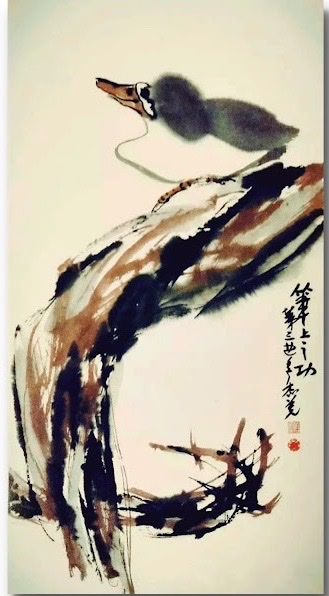
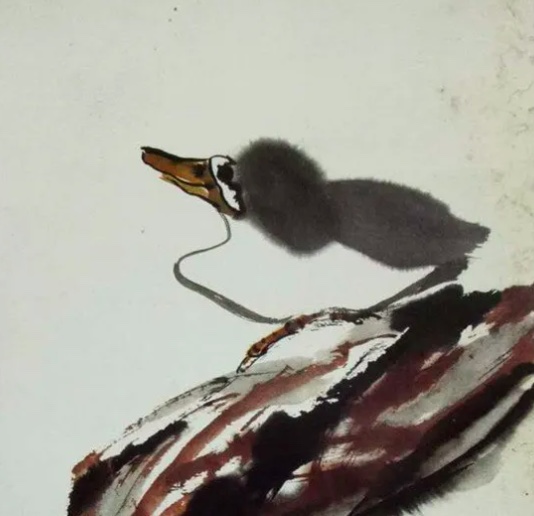
“Bi Shang Zhi Gong (Skillful Brushwork)” is a masterpiece of Chinese flower and bird painting that appears fresh and clear at first glance, profound in meaning after viewing, and unforgettable after further contemplation. The composition is extremely simple: in the center of the painting is a uniquely shaped bird with a flat, long beak and a spotlessly white belly. It sits comfortably and alone on the curved, thick trunk. Its eyes are ethereal and deep, as if completely focused; its posture demonstrates that wherever it is, is the focal point.

Upon careful observation, you will find that everything in the painting is in a state of colorful transformation. The bird’s head and back are painted with two blocks of ink that are close in shade, creating a melting effect, with the ink color seemingly still wet and spreading around.

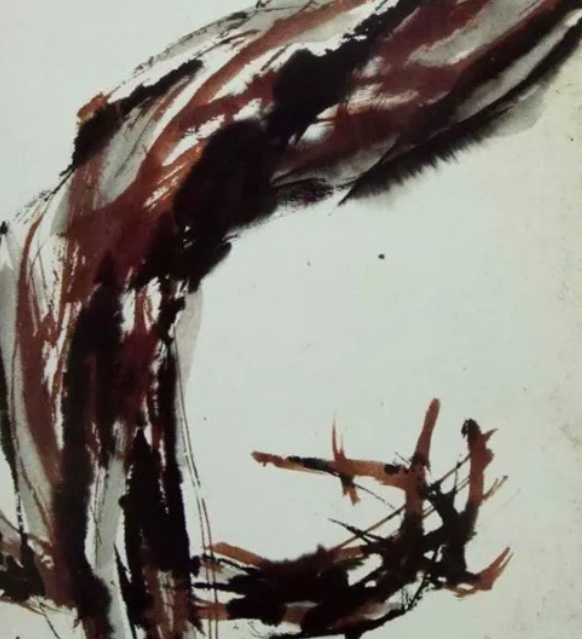
The trunk’s ink lines are clear and distinct, resembling a tree yet not quite a tree, as if constantly changing in the impermanence. At the bottom left of the tree, a branch twists and turns out, creating an S-shaped composition in the painting that is still in motion. The painting also uses color sparingly, with only a warm and friendly purple-brown color applied to the bird’s beak and the trunk.

This painting has a fascinating story behind it. It was created in 1982 during the filming of a movie in Sanhe, Sichuan. The painting captures an on-the-spot portrayal of a real-life scene. The artist used ink sparingly, treating it as if it were as precious as gold, while still showcasing his exceptional skills. At the time, the News Film Studio of China was producing a documentary exclusively about the artist, Master Yi Yungao (H.H. Dorje Chang Buddha III).

The cameramen and other observers witnessed a wild duck landing on a withered tree trunk. Master Yi Yungao quickly picked up his brush and swiftly completed the entire painting. By the time the wild duck took flight again, the painting had already been finished. Furthermore, the artistic mastery embodied in this artwork is extraordinary. It not only preserves the elegance, purity, and high-quality of traditional paintings but also introduces a new style—expressing the artistic conception of returning to original purity and simplicity. The artist, with an unfettered hand and mind, applies his most mature skills without the slightest attachment and with minimal, natural brushstrokes.

This masterpiece Chinese painting by H.H. Dorje Chang Buddha III is rich in literary atmosphere and varied in layers. It does not merely depict the external world, but rather it serves as a true manifestation of the inner spirit, transcending the natural material form to open up the world through the illumination of life’s spiritual light, reflecting the spiritual world. Appreciating the painting can reveal the pure world behind it, where everything, including the self, is forgotten, remaining untainted.

This painting is part of the permanent exhibition at The International Art Museum of America, located in the heart of San Francisco.

Bi Shang Zhi Gong – Skillful Brushwork

Link:https://peacelilysite.com/2023/10/26/bi-shang-zhi-gong-skillful-brushwork/

#DorjeChangBuddhaIII #HHDorjeChangBuddhaIII#DorjeChangBuddha#IAMA#InternationalArtMuseumofAmerica #ChinesePainting #MasterYiYunGao

Do not lose Your good nature because of the Reactions of the outside world

I saw a story like this on the internet:

A Zen practitioner was meditating by the river when he heard struggling sounds. Upon opening his eyes, he saw a scorpion struggling in the water.

He reached out to lift it up, only to be stung by the scorpion’s raised stinger. He placed the scorpion on the bank and continued meditating.

After a while, he heard struggling sounds again. Opening his eyes, he saw the scorpion had fallen back into the water.

He rescued it again, and of course, was stung once more. He continued meditating.

After a while, he had the same unfortunate encounter.

A nearby fisherman said, “You’re so foolish, don’t you know that scorpions sting people?”

The Zen practitioner replied, “I know, I’ve been stung three times.”

The fisherman asked, “Then why do you still save it?”

The Zen practitioner said, “Stinging is its nature, compassion is mine. My nature will not change because of its nature.”

At that moment, he heard struggling sounds again. Looking down, it was the same scorpion.

He looked at his swollen hand, then at the struggling scorpion in the water, and without hesitation, reached out to it again.

This story beautifully illustrates the Buddhist principle of compassion and loving-kindness towards all living beings, regardless of their actions. It embodies the teachings of the Buddha, who emphasized the importance of cultivating a heart full of compassion.

The practice of compassion is central to the Buddhist path. In Mahayana Buddhism, the Bodhisattva ideal embodies the ultimate expression of compassion. A Bodhisattva is one who, motivated by great compassion, has generated bodhicitta, the spontaneous wish to attain Buddhahood for the benefit of all sentient beings.

Moreover, the story reminds us of the great sacrifices made by Siddhartha Gautama, who later became known as Shakyamuni Buddha. He renounced his life of luxury and privilege to seek the ultimate truth of life and the universe. His journey was fueled by the desire to find a way to liberate all beings from the cycle of birth and death, known as samsara.

However, after two and a half millennia, the profound teachings of Shakyamuni Buddha have been gradually forgotten. To revive and propagate the Dharma once more, the primordial Tathagata Buddha, Dorje Chang Buddha, incarnated as H.H. Dorje Chang Buddha III in our world.

H.H. Dorje Chang Buddha III has not only brought the highest form of Buddha Dharma to this world but also set a remarkable example for all disciples through his boundless compassion and humility.

In the past decade, H.H. Dorje Chang Buddha III has endured significant suffering due to long-term persecution for his religious activities. A member country of Interpol once requested that the organization issue a warrant for his arrest. This request was later voluntarily withdrawn by the member country after several years. Following a thorough investigation, in October of 2008, the 72nd session of the Commission for the Control of Interpol’s Files withdrew the arrest warrant and dismissed the entire case against H.H. Dorje Chang Buddha III. Interpol also issued a document stating unequivocally that the arrest warrant against H.H. Dorje Chang Buddha III has been canceled and all member countries have been informed of the cancellation.

Although H.H. Dorje Chang Buddha III received official notification of the withdrawal of the arrest warrant and the removal of the entire case, he has never publicly displayed such documents to prove his innocence. Despite enduring slander, H.H. Dorje Chang Buddha III chose not to disclose this irrefutable evidence. When the World Peace Prize Awarding Council inquired about this, he responded by explaining that his duty is to bear all of the karmic offenses committed by living beings and to bestow upon them all of the good karma and merit that he has cultivated. He expressed concern that if he were to prove his innocence using those documents, those who slandered him would be perceived as guilty. He questioned, “Who, then, will bear their karmic offenses?”

There have been many instances that highlight his holiness’s profound compassion. For example, some of his disciples once left and defamed him, but he still welcomed them back with open arms and treated them no differently than before.

H.H. Dorje Chang Buddha III often reminds his disciples that he harbors no enemies and that all sentient beings are his dearest relatives. He encourages everyone to reflect on their own actions and to strive to lead a life filled with kindness, patience, and understanding.

His Holiness Dorje Chang Buddha III embodies the essence of selflessness and serves as a moral beacon for all to follow. He has also demonstrated how peace can be achieved through determination, humility, and the perseverance to champion its cause even in the face of adversity.

Do not lose Your good nature because of the Reactions of the outside world

Link: https://peacelilysite.com/2023/10/19/do-not-lose-your-good-nature-because-of-the-reactions-of-the-outside-world/

#DorjeChangBuddhaIII #HHDorjeChangBuddhaIII #BuddhaDharma#Compassion

The earliest introduction of Buddhism to China and the first Buddhist-Taoist Debate and Contest

Eminent Monks She Moteng and Zhu Falan

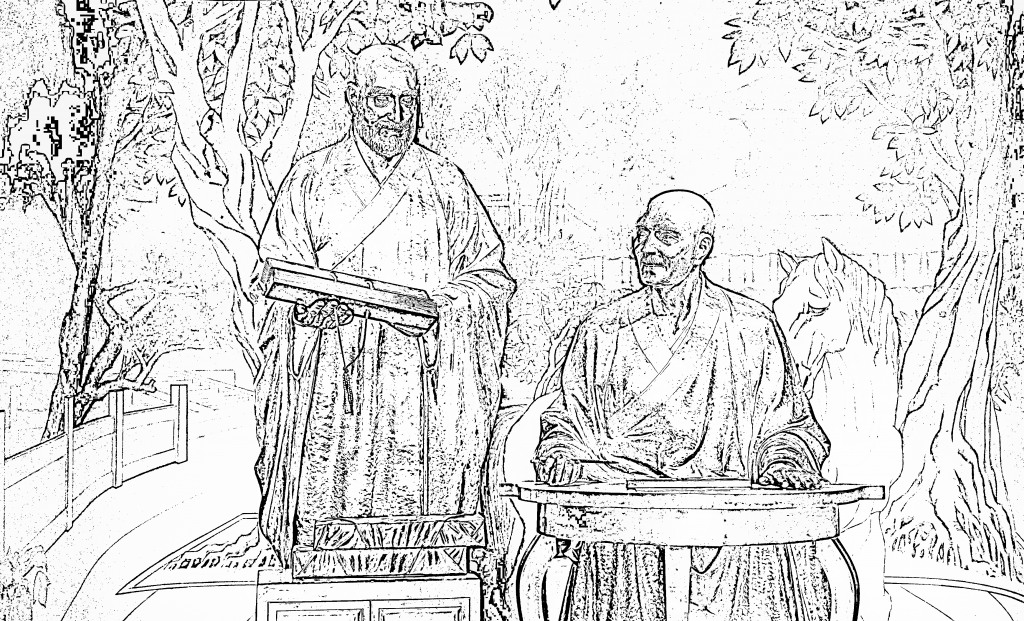
In 64 AD, Emperor Ming of the Eastern Han Dynasty sent Cai Yin and others on a mission to the Western Regions to retrieve Buddhist scriptures. The following year, in 65 AD, Cai Yin, Qin Jing, and others met the esteemed Indian monks She Moteng and Zhu Falan in Greater Yuezhi (present-day Afghanistan), where they were introduced to Buddhist scriptures and statues for the first time. In 67 AD, the Han envoy team returned to Luoyang with the high monks She Moteng, Zhu Falan, and the Buddhist scriptures and statues carried by a white horse. The two high monks were welcomed with a grand reception by Emperor Ming, who also commissioned the construction of China’s first temple, the White Horse Temple in Luoyang, especially for them.

White Horse Temple

On the first day of the first month in the fourteenth year of Yongping, Taoists from the Five Sacred Mountains submitted a petition requesting a competition with the Brahmin monks to determine the superiority of China’s native Taoism versus the foreign Buddhism. Emperor Ming granted the Taoists’ request. In 71 AD, a historic Buddhist-Taoist debate and contest unfolded in Chinese Buddhist history.

As the competition began, the Taoists said, “Let’s start with debating. You monks pride yourselves on eloquently explaining the Dharma, don’t you? So, let’s have a debate! If you can make one point, we will make two; if you raise one, we will counter with three. Go ahead and present your profound arguments!”

She Moteng slowly lifted one foot and raised it towards the sky, smiling, and said, “Amitabha, I have raised one, now it’s your turn to raise three!”

The Taoists looked at each other, stumped, and couldn’t think of a way to counter for a long time. They then changed the subject: “Let’s compare theories. You Buddhists call yourselves ‘Inner Learning,’ while you call us ‘Heterodox.’ But throughout history, when discussing inner and outer, inner has always been smaller than outer. So, your Inner Learning is small, and cannot compare to our great Heterodox!”

She Moteng brought his palms together in a gesture of respect and slowly explained: “The emperor resides in the inner palace, while the common people live in the outer city; although the inner palace is small, the emperor is great. The heart is inside the body, while the hands and feet are outside, the activity of the heart is boundless, while the movements of the hands and feet are limited. This is another example of how the inner is superior to the outer. Think carefully, the Inner Learning of Buddhism is much greater than the Heterodox!”

The Taoists, unable to win the debate, finally said, “Let’s compare magical powers!” How to compare? By placing the scriptures spoken by the Buddha and the scriptures spoken by the Taoist tradition together and burning them with fire. If one’s scriptures burn, then they are false; if one’s scriptures don’t burn, then they are true.

So, in the south of White Horse Temple, two high platforms were set up, one in the east and one in the west. The east platform held the Buddhist scriptures, images, and relics, while the west platform held the Taoist scriptures.

At that time, five hundred Taoist priests gathered the Taoist scriptures and magical texts together and prayed to the Supreme Lord Laozi, saying: “Oh, Taoist Virtuous Sage! Please show great divine power, and make our Taoist scriptures not burn, and let the Buddhist scriptures burn.”

Many of the Taoist priests at that time had supernatural powers – some could ride clouds and fog, some could fly in the sky and hide underground, and some could become invisible. Invisible means that you could see him right in front of you, and then suddenly he’s gone! There were Taoist priests with such abilities. They could use evasion techniques – Qimen Dunjia, to escape, and with Taoist spells and incantations, they had great supernatural powers.

But what happened when the fire was lit? The Buddhist scriptures did not burn; they emitted light! The Buddha’s relics also emitted a five-colored light, and the scriptures emitted light up into the sky, as if the sun was shining upon the world.

What about the Taoist scriptures? They caught fire as soon as they were burned and were completely destroyed by the fire. Those who could ride clouds and fog could no longer ride clouds or exhibit supernatural powers; those who could fly in the sky could no longer fly; those who could hide underground could no longer hide; those who could become invisible could no longer become invisible. Their spells and incantations also lost their effectiveness and had no power.

Photo by Mo Eid on Pexels.com

She Moteng and Zhu Falan, the two venerable monks, were responsible for overseeing this scripture contest, which was of great significance for the rise or fall of Buddhism. To strengthen the faith of the masses, She Moteng and Zhu Falan displayed eighteen divine transformations, levitating in the sky and reciting the following verses:

“The fox is not of the lion’s kind, a lamp is not as bright as the sun and moon; a pond cannot hold the vast sea, a hill cannot match the towering mountain. The Dharma cloud descends upon the world, the Dharma rain nourishes all beings. Supernatural powers are rare, manifesting everywhere to transform sentient beings.”

“The fox is not of the lion’s kind” means that, although the fox spirit is cunning and can change shape, it is far inferior to the lion. The fox and the lion cannot be compared; they are not of the same kind. This is saying that the breadth of Taoism is like the smallness of the fox, different from Buddhism, which has the grandeur of a lion.

“The lamp is not as bright as the sun and moon” refers to how the light of a lamp or a candle, which were small in the past, is far less bright than the light of the sun and moon. This means that the scriptures and teachings of Taoism are like the light of a lamp, while the Buddhist scriptures and teachings are like the light of the sun and moon, incomparable.

“A pond cannot hold the vast sea” means that a small pond has a limited capacity and can only hold a small amount of water, while the vast sea can accommodate many rivers. The pond and the sea cannot be spoken of in the same breath. This is a metaphor comparing the theories of Taoism to a small pond, while the teachings of Buddhism are like the vast and boundless sea.

“A hill cannot match the towering mountain” means that a small hill cannot compare to the grand and towering Mount Song, one of the Five Sacred Mountains of China. If the practice of Taoism is like a small hill, then the profound teachings of Buddhism are like the towering cliffs and deep ravines of ancient trees.

“The Dharma cloud descends upon the world, the Dharma rain nourishes all beings” means that when Buddhism spread to China, it was like a cloud of Dharma, like sweet dew, pervading the world and nourishing all beings.

“Supernatural powers are a rare thing” means that I have now shown supernatural powers, which is a rare and precious thing in the world.

“Everywhere transforming sentient beings” means that in reality, I did not want to show supernatural powers, and I did not want to compete with you. This is a last resort, for the purpose of guiding you and leading you to a brighter path, I am doing this as a convenient means.

After this contest, Buddhism took deep roots in China, not only producing a succession of talented individuals but also establishing a glorious foundation. White Horse Temple became the first and foremost temple in Chinese Buddhist history, and temples began to be built one after another. Ever since then the marvelous fruits and wondrous flowers of Chinese Buddhism have continued to flourish from generation to generation.

The earliest introduction of Buddhism to China and the first Buddhist-Taoist debate and Contest

Link:https://peacelilysite.com/2023/10/17/the-earliest-introduction-of-buddhism-to-china-and-the-first-buddhist-taoist-debate-and-contest/

Note: The information comes from the internet and may not be entirely accurate. It is for reference only.

Source: https://www.163.com/dy/article/F7BR86210523CRB2.html