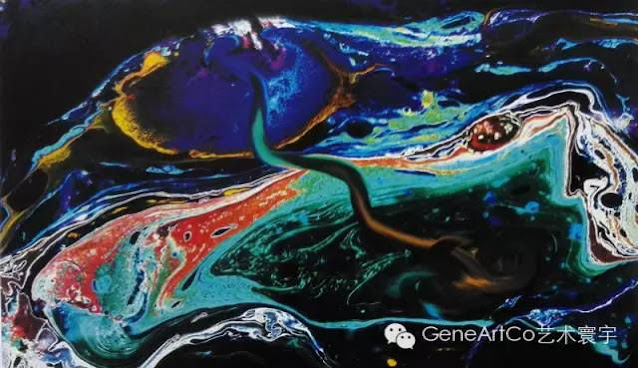
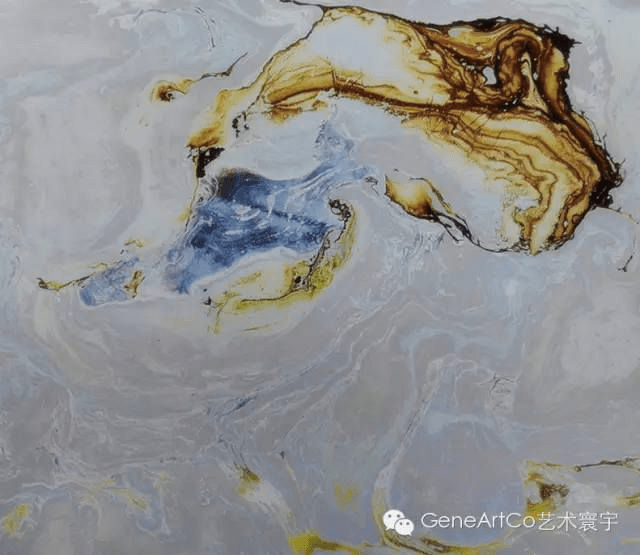
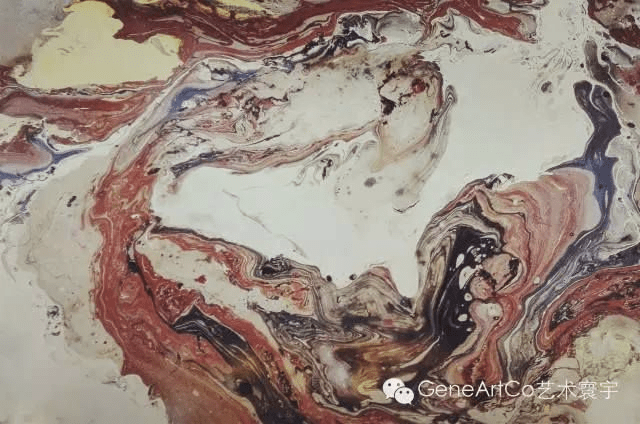
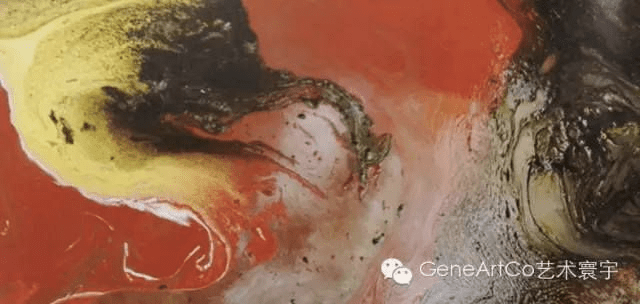
When you first set your eyes upon these supernatural abstract color paintings, the vibrant and radiant hues of red, yellow, blue, white, and black burst forth, dancing like the tumultuous waves of a river stretching for thousands of miles. Captured in the delicate tips of the brush, their brilliance transcends the ordinary, possessing a gentleness yet resolute quality. The diverse and exquisite colors mutually nourish and elevate each other, creating a masterpiece that can only be described as ingenious, reaching a realm where colors take on an ethereal quality. The experience is beyond description—elegant and comforting.
These impressionist paintings have attained a level of mastery where even a small fragment isolated from the complete artwork stands as an exquisite impressionist painting on its own. They convey a dreamy, illusory state, and each tiny section has the potential to be enlarged, creating a distinct and aesthetically pleasing painting.
Gazing Upon a World Beyond the Stars
This piece has a sci-fi movie special effects vibe, it doesn’t look like a scene that exists on Earth; rather, it resembles the appearance of an extraterrestrial planet observed through high-tech instruments. The entire artwork is filled with a mysterious atmosphere, offering limitless imagination and excitement.
Marvelous Spectacle of a Mystical and Illusory Island
This artwork is vibrant and three-dimensional. When appreciated from a diagonal perspective, the pattern in the upper right corner resembles a series of color-changing snakes, coiling in the air, creating a dazzling and visually delightful experience. The pattern in the lower left corner appears like slowly flowing mud, transparent and sparkling under the sunlight. The dividing line in the middle adds a fantastical element, resembling a peculiar light that seems as though it could disappear in the next second, defying verbal description.
The fantastical imagery of this artwork brings a sense of joy and, simultaneously, fills one with fantasies and aspirations for the future. It is a lively and dynamic masterpiece that exudes a peculiar power.
Long Green Wall
Magnificent and grand, that was my first impression upon seeing this artwork. Despite its modest size, this piece is brimming with the profound culture and history of China’s five thousand years. Resembling the Great Wall, this artwork is a marvel, showcasing the artistry and craftsmanship of the H.H. Dorje Chang Buddha III from an artistic perspective.
Elegant Purity of Beautiful Stone
The highlight of this artwork lies in H.H. Dorje Chang Buddha III‘s skillful combination of intricate colors, avoiding any hint of vulgarity and instead exuding a sense of pure elegance and nobility. The arrangement of patterns and textures in the artwork, seemingly casual brushstrokes, actually reflects H.H. Dorje Chang Buddha III‘s ingenious conceptualization and profound artistic foundation, presenting a harmonious order within apparent chaos.
The Nobility of Petrified Red Trees
At first glance, this artwork appears to be an oil painting. Upon closer observation, it evokes astonishment. It is not merely a flat painting but more akin to a lifelike redwood fossil.
Every texture is distinctly visible, and every detail is vividly realistic. H.H. Dorje Chang Buddha III, with the stroke of a brush, captures the original form of the redwood in the guise of a fossil, rendering this piece of art even more mysterious and noble.
This artwork employs strong color contrasts, making bright colors even more vibrant and dark colors even deeper. The enchanting purple patterns, at times intensified and at times subdued, infuse the composition with a sense of magic. It is as if a colossal dragon is about to break free from the shackles of darkness, re-emerging into a brilliant radiance.
Splash-Color Embroidery of Moutains and Rivers
This is a splash-ink painting that combines elements of oil painting style. The innovative approach and exquisite brushwork truly captivate the viewer. Looking at this piece, one can almost hear the echoes in the mountains, see the surging river waves, smell the freshness of nature, taste the sweetness of mountain springs, and feel the harmony between humans and nature.
Boundless Land as Beautiful as Colorful Embroidery
The artwork, dominated by blue tones, incorporates elements of Western and abstract painting. At first glance, it resembles a vast ocean spanning the globe. It delivers a visual impact and a spiritual resonance. Take a moment to immerse yourself in this majestic and awe-inspiring scenery.
These intoxicatingly beautiful Supernatural Abstract Color Paintings form a perfect world constructed by colors. Devoid of concrete worldly forms, it is a realm purely defined by color—shaping, expressing, and embodying itself through hues. Color is both its form and its essence, permeating with a captivating aura. These colors, guided by the hand of the H.H. Dorje Chang Buddha III, seamlessly converge into a marvelously enchanting spectrum. The atmosphere is lively, the scenes blossom like flowers, bold and fierce as the roaring sea, yet upon closer inspection, they reveal nuanced expressions, refined in the minute details. In discussing the extraordinary skill of the H.H. Dorje Chang Buddha III in Western painting, it’s almost an understatement to compare it to the Buddha.
You can discover a selection of the exceptionally charming paintings in the permanent exhibition at The International Art Museum of America, situated in downtown San Francisco.
It is often said that the essence of a high-quality painting lies in its incorporation of the calligraphic brushstrokes, the commanding presence reminiscent of engraved stone seals, a tonal quality derived from the artist’s mastery of literature, a stylistic expression emanating from the artist’s virtue, and a captivating allure that springs from the artist’s state of realization—this, indeed, is the true spirit of the painting.
In the International Art Museum of America, several paintings, executed with only a minimal number of strokes, possess the robust appeal akin to stone seal engravings. These artworks convey the artistic conception of returning to original purity and simplicity. With a liberated hand and mind, the artist applies their most refined skills, devoid of any lingering attachments, creating with minimal yet natural brushstrokes.
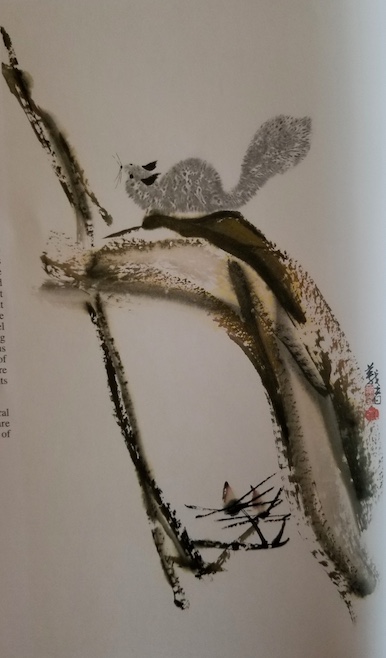
Za Chai Shi Gu (Brushwork Resembling Smashed Jade)
There is a phrase used in commenting upon Chinese paintings and calligraphy that related to smashed jade. This painting exemplifies that charming style of smashed jade.
The pine tree, rendered with just a few simple strokes, emanates a pervasive sense of strength across the entire painting. The exquisite and lively portrayal of the little squirrel employs a truly remarkable and mysterious technique, combining simplicity, innocent charm, a natural appearance, and authenticity into a harmonious whole.
Loquat
H.H. Dorje Chang Buddha III painted ‘Loquat’ in 2013. This painting achieves the skill of cherishing ink like gold in its conception, with no wasted or faulty strokes. With just a few strokes, it is high and lofty, vibrant and lively, containing an elegant and comforting sense of ease, as if the brush strokes were divinely inspired.
At the autumn auction of the New York Zhenguan International Auction Company on September 12, 2015, this painting ‘Loquat’ was auctioned for a staggering 10.2 million U.S. dollars.
Yi Chen Bu Ran (Immaculate)
With only a small number of strokes, a comforting and natural appeal appears vividly on paper. The style is neither overly cautious nor affected. A scholarly tone and an air of stone seals are revealed in the brushwork. This is a work of art with an attractiveness that stems from mature skills. The title “Immaculate” means that this painting is free of any trace of the mundane.
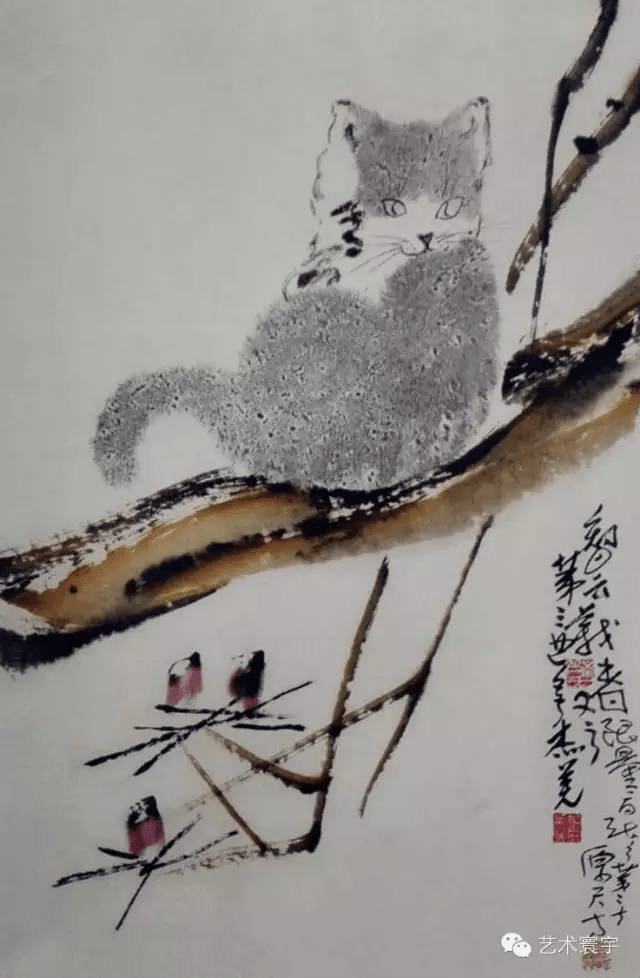
Cat of Unique Charm
In this painting, the cat is portrayed with a vibrant yet natural presence, achieved through the dynamic and captivating use of scattered ink. The entire artwork, painted with only a few brushstrokes, exudes the style of stone seals and an air of scholarly refinement. Both the form and spirit of the scene are skillfully captured. This work truly exemplifies masterful ink usage in a restrained manner.
One of the one hundred limited release copies of this small-scale, painting “Cat of Unique Charm” sold at auction for US$253,000, which is the highest per square foot selling price of any duplicate painting in the world. The prices of sold duplicate paintings by the most famous first-rate masters of art in the world cannot match the prices of sold duplicate paintings by H.H. Dorje Chang Buddha III.
Si Yu Sheng Hui (Resplendent Like Jade)
With just a few simple strokes, the entire painting is remarkably infused with a robust jade-like charm and an auspicious aura. Both the plantain tree and fruits exhibit a lack of mediocrity and were painted without the slightest mental attachment in the artist’s mind. They appear natural, elegant, and enchanting. This sentiment is succinctly captured in the accompanying short poem: “Unfurl the painting scroll, and the particularly fragrant scent of ink is released, permeating the viewer’s mind and intoxicating them to the core. Only a minimal number of strokes were applied. This exemplifies the regal art of using ink as sparingly as gold.”
H.H. Dorje Chang Buddha III, the artist behind these magnificent paintings, has crafted a pure and enchanting spiritual realm with his incredibly succinct brush and ink technique. Upon viewing, it evokes a sense of ethereality, akin to the moon reflected in water, and a freshness that pierces the heart, reminiscent of the sound produced when a piano key is pressed. This unique artistic essence, bridging the real and the virtual, transcends the ordinary, providing a natural and enlightening experience that often transports individuals into a realm of wonder.
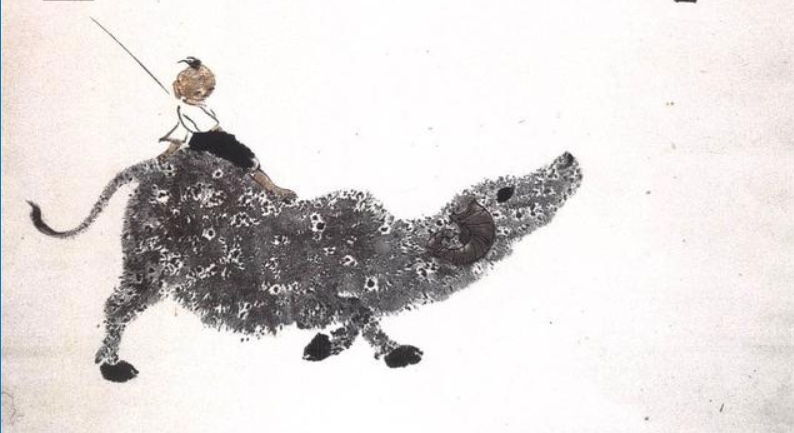
At year February 2007, this Year of the Ox (by H.H. Dorje Chang Buddha III) painting was exhibited at an auction in the Hua Zang Si Temple in San Francisco. Even though I saw it online, when I saw this work in person that year, I was suddenly transported into a world of pure and poetic spirituality.
The ox strolled leisurely, Looking up to admire the scenery. On the ox’s back, a young herder, Humming a tune, Enjoying a unique sense of freedom. Though there was no verbal communication, There was mutual companionship, Dependence on each other.
Later, I saw this painting again at The International Art Museum of America in San Francisco. It was as if I were re-experiencing the long-lost joy of childhood innocence, and I couldn’t help but stop and admire this exquisite masterpiece.
The entire composition of the painting is concise: an ox, a flute, a young herder on the ox’s back, a few simple strokes representing tree branches, and a hint of green. The old ox was covered in glistening sweat, and no matter where or when, it remained calm, with steady steps and a high head, as if filled with determination and strength for the journey of life. The young herder reclined comfortably on the ox’s back, at ease and trusting that the old ox would take him where he wanted to go. Urban dwellers fortunate enough to witness such a rare and beautiful scene would find their tense hearts instantly relaxed.
In terms of technique, this Chinese painting exhibits remarkable simplicity, featuring an expansive and open composition coupled with unique and striking artistic techniques. The skillful use of white space within the artwork, thanks to clever design choices, not only avoids diminishing or dulling the image but also creates boundless room for the viewer’s imagination to roam. Additionally, the artist employed a scattered perspective technique to lend the painting a three-dimensional quality, skillfully using emptiness to convey form. The seamless integration of form and emptiness results in an exceptionally elegant layout.
This painting serves as a testament to the artist’s ability to convey the inherent charm of nature and capture the essence of a pure and childlike spirit, offering solace and enjoyment to its viewers. What is particularly astonishing is the meticulous application of ink at a minute level, portraying the oxen’s hairs in an array of intricate variations.
Although the painting does not depict the colors of early spring, mountains, valleys, or springs, they seem to be faintly visible on the canvas. It’s said that by calculating white as black and using emptiness as a form of depiction, the simplicity of the image leaves room for endless beauty and boundless imagination. This painting beautifully exemplifies the traditional Chinese cultural principle that ‘The Dao resides in simplicity.’ It evokes thoughts of the legendary tale of Laozi departing China on a green ox through the Hangu Gate in pursuit of Sakyamuni Buddha.
Having been in the hustle and bustle of the city for a long time, one longs for the tranquility of the countryside. But once in the quiet countryside, one can’t bear the loneliness and solitude. The restless heart can’t resist the temptation of the bustling world and constantly seeks outward under the pull of desire. When lost and falling into despair, one realizes that this is not the life one truly desires.
In reality, the ideal paradise is not far away; it resides in the inner tranquility and practicality of the present moment. Just like the young herder and the old ox in the painting, tranquility and boundless joy are always found in the present moment.
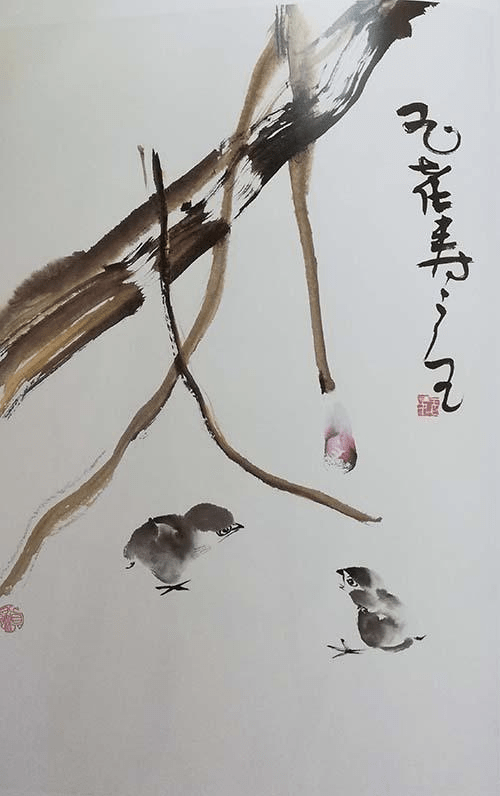
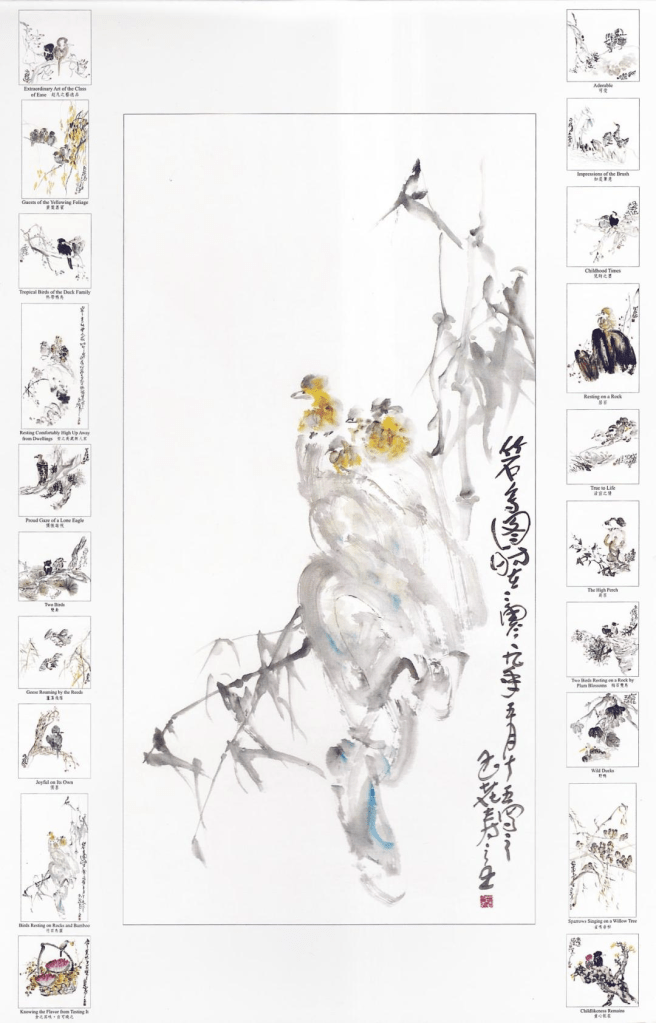
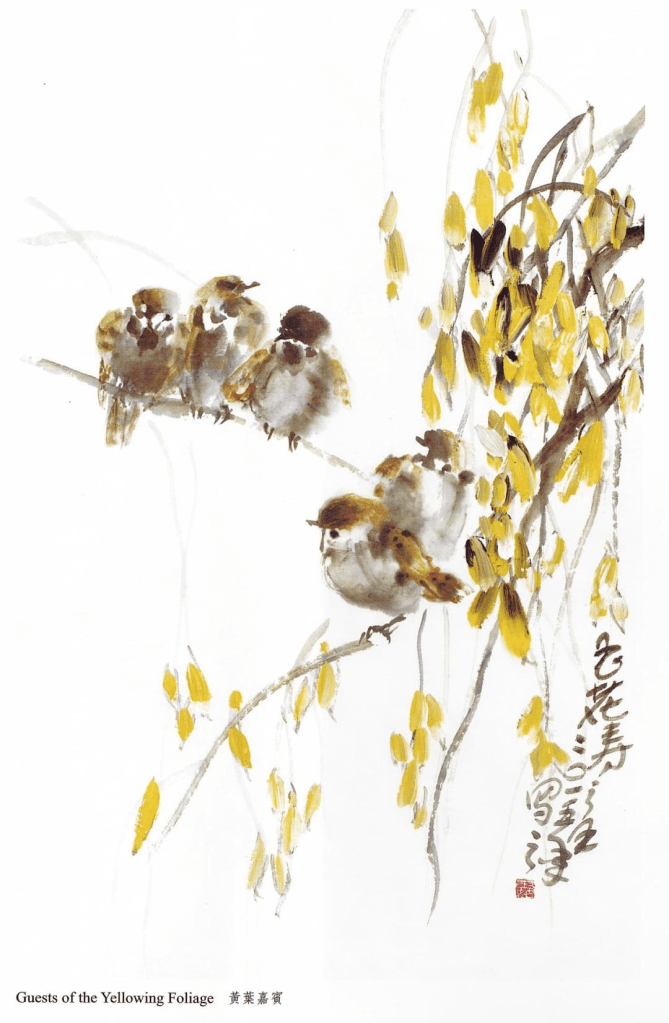
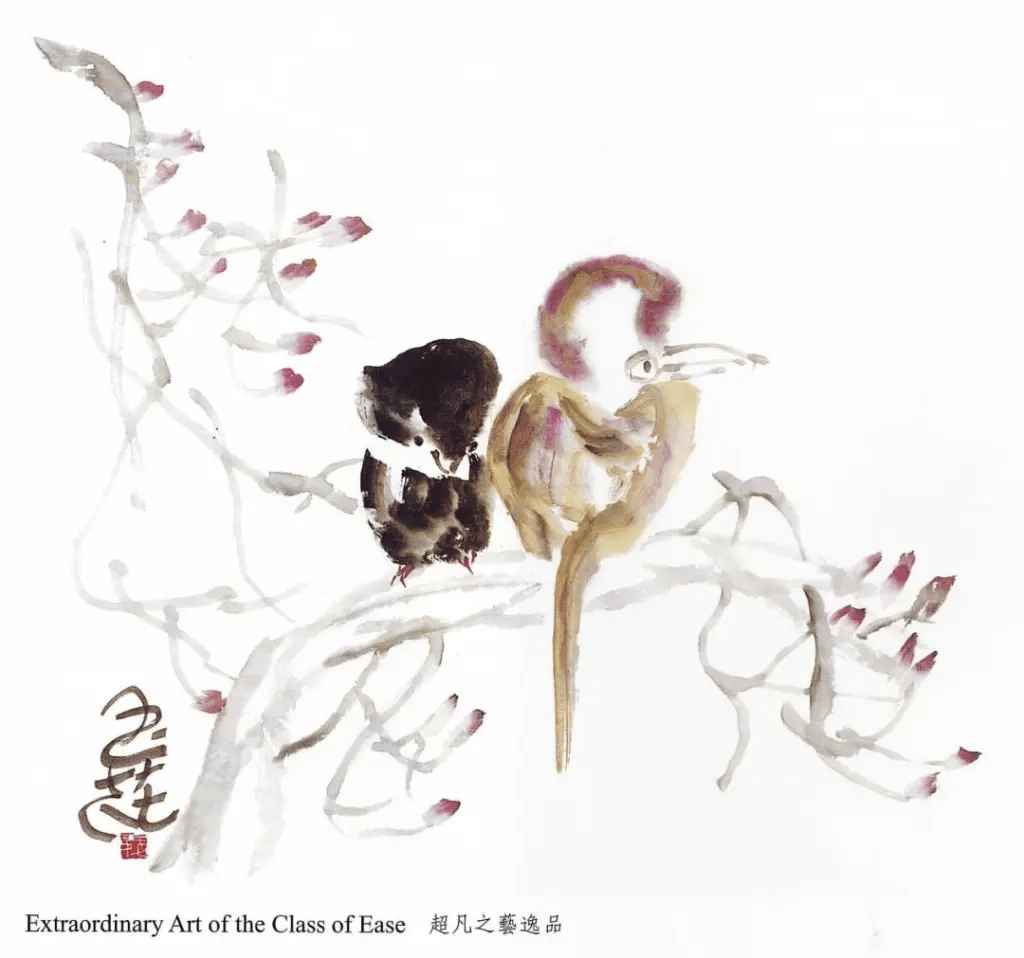
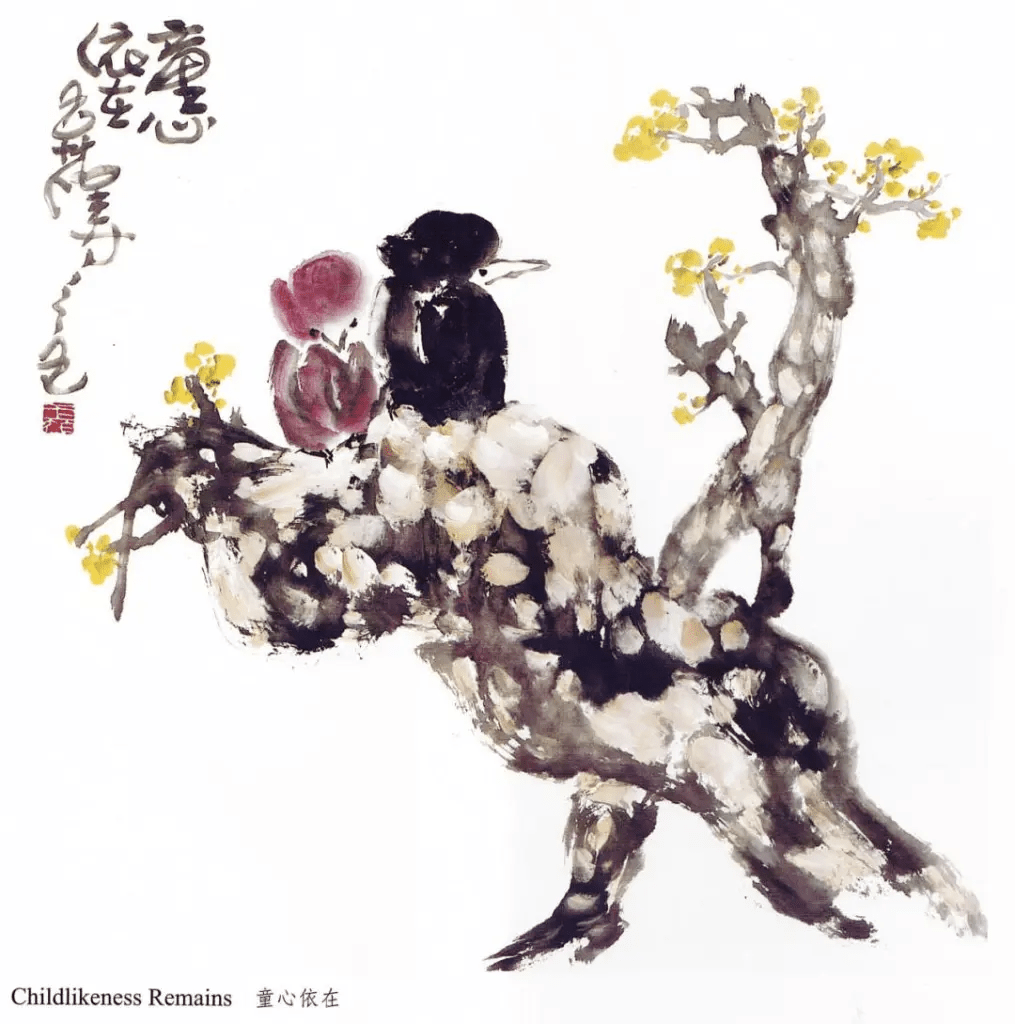
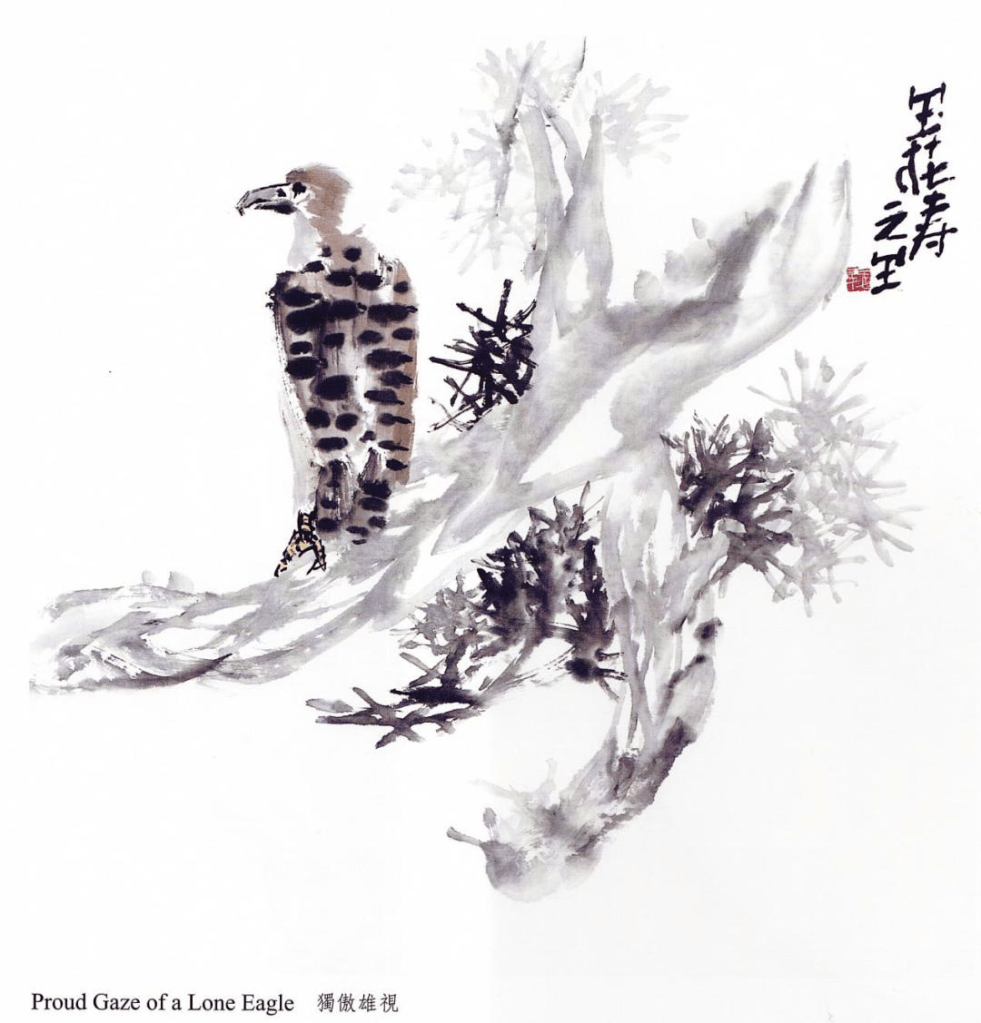
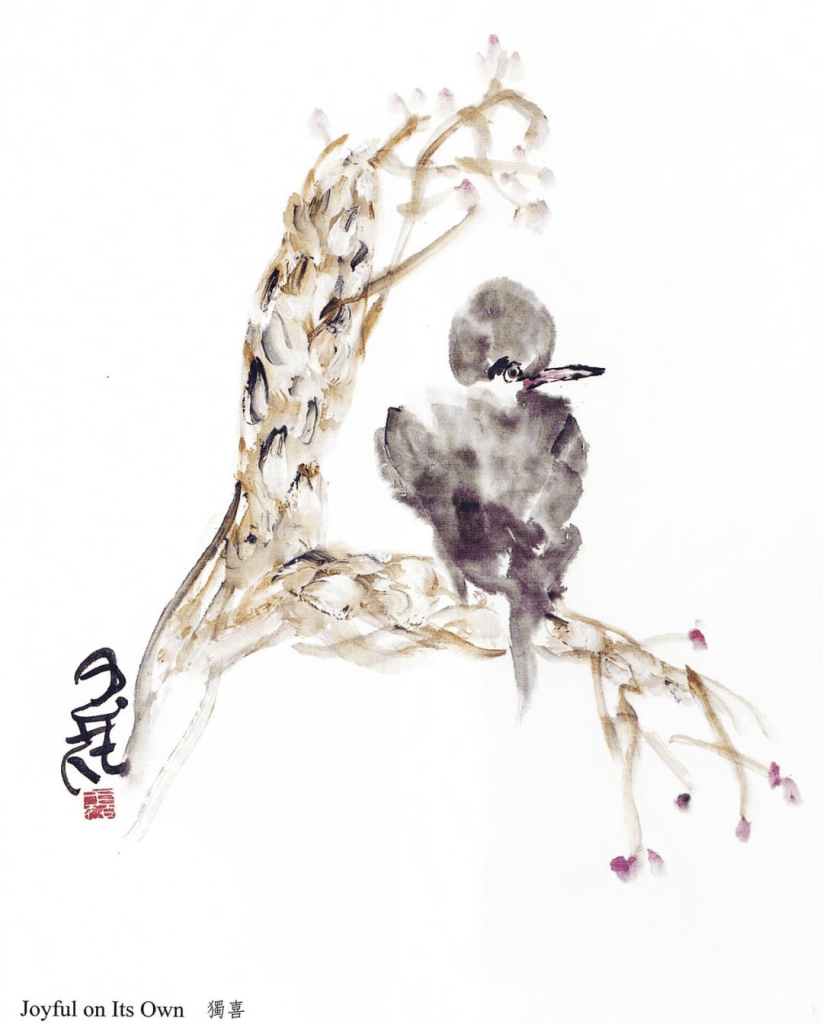
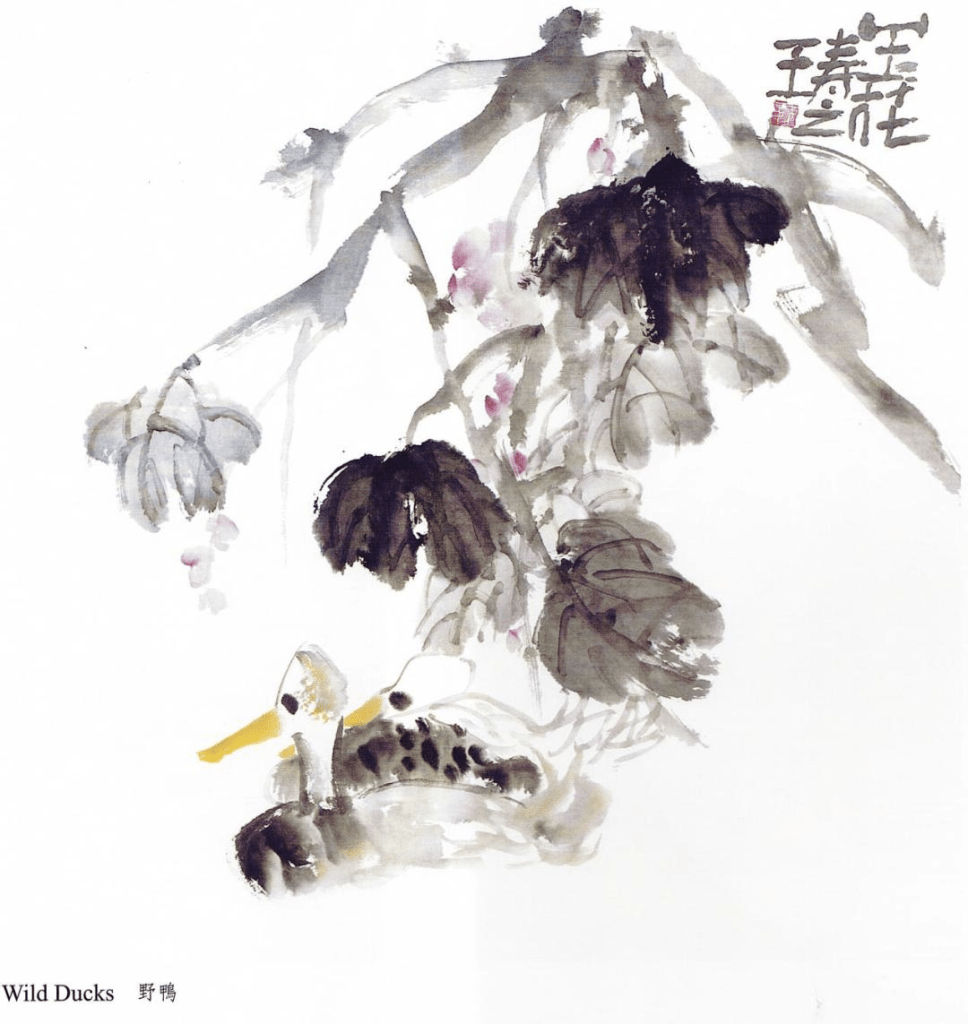
The beauty of art emanates from the soul, while the beauty of the soul reflects one’s internal cultivation. In Professor Yu Hua Shou Zhi Wang’s “Yu Hua Shou Zhi Wang Flower and Bird Painting Album,” we are presented with a delightful sense of freshness and warmth, coupled with a profound and uplifting force. Let’s savor the experience of “Yu Hua Shou Zhi Wang Flower and Bird Painting Album” together and witness the extraordinary talent and profound moral character of the artist!
Professor Yu Hua Shou Zhi Wang’s works are characterized by strong and powerful brushstrokes, showcasing a rich and diverse palette, and exuding a poetic and artistic charm. Each piece is infused with sunlight, radiating sincerity, simplicity, and a delightful sense of innocence and romance. As we immerse ourselves in Professor Yu Hua Shou Zhi Wang’s “Yu Hua Shou Zhi Wang Flower and Bird Painting Album,” we can deeply sense the artist’s love and compassion for animals. Each artwork invites us into a transcendent dialogue with a sage-like presence, revealing the captivating allure of art!
Professor Yu Hua Shou Zhi Wang is brimming with compassion and care for all living beings, be it humans or animals, even including honeybees that can sting. She treats each of them with equal and attentive concern.
A few years ago, bees would frequently visit Professor Yu Hua Shou Zhi Wang’s residence. The first time they built a hive at her home, they even stung someone. Some people suggested removing the beehive to prevent further harm, but Professor Yu Hua Shou Zhi Wang firmly disagreed. She felt deep empathy for the bees, as they had finally found a shelter from wind and rain. She made it clear that if they had to leave, the bees should not be harmed. In fact, she would rather move out herself than cause suffering to the bees. As a result, Professor Yu Hua Shou Zhi Wang and her family decided to move to her art studio to live.
Another incident involving Professor Wang showcases her compassionate nature when she saved a butterfly that had fallen into the water. Concerned about the butterfly’s well-being, she took it home and cared for it for a few days until it was fully recovered, and only then did she release it back into the wild.
The compassionate and kind professor frequently utilizes the money earned from selling her paintings to release captured living beings, such as birds, fish, and more. On numerous occasions, she has purchased large quantities of fish, sometimes weighing several cabins or even tens of tons, to set them free. There have been instances where she bought an entire boat-load of fish from a large fishing vessel, ensuring their liberation and return to their natural habitats.
I couldn’t help but ponder: When two conflicting interests clash, do we prioritize the welfare of others or our own interests first? It’s a challenging question, and not many people in this world can genuinely put the welfare of others before their own. However, Professor Yu Hua Shou Zhi Wang managed to do just that. She consistently places the well-being of all beings ahead of her own interests. Her unwavering compassion and greatness are truly remarkable and serve as an inspiring example for us all.
In daily life, Professor Yu Hua Shou Zhi Wang is very frugal. She is reluctant to waste even the water used for daily living tasks, such as washing rice or clothes. She often collects and saves the used water to water the garden or flush the toilet. Additionally, Professor Yu Hua Shou Zhi Wang frequently donates his own salary to help those in need. When asked by students, “You can earn a lot of money from selling just one of your artworks, so why are you still so frugal?” At moments like these, Professor Yu Hua Shou Zhi Wang advises the students to cherish their blessings and not to waste anything. He encourages them to use the money saved from being frugal to support more people who are facing difficulties.
The well-known saying, “Deeply hidden talent not easily revealed” aptly describes Dr. Yuhua Shouzhi Wang’s morality and inner refinement. The characteristics of an artist’s paintings essentially reflect the character of the painter. From the paintings above you can find humility, inner peace, harmony and noble morality of professor Wang.
Dr. Yuhua Shouzhi Wang is the Lifetime Honorary Chairwoman of the International Art Museum of America. The museum has a dedicated gallery exhibiting her artworks.
Gesang Suolang Rinpoche, the founder and leader of the Xuanfa Utah Dharma Center in Salt Lake City, Utah
Gesang Suolang Rinpoche Shares Her Insight into the Dharma of H.H. Dorje Chang III & Why the West Needs It
Like many American Buddhists, I didn’t learn Buddhism in the family home. My interest in and later conversion to Buddhism began in the 1990s when my husband’s teacher, a Japanese Zen priest, stayed with us in our home in Virginia. My husband had studied with this teacher in the 1960s and 1970s when the teacher lived in America. The teacher had returned to Japan to raise his young family before I met my husband, so I didn’t meet him until 1990 when he began to travel to America again to pick up where he’d left off with his students. My husband had been his first student, and our house became a gathering place for the teacher’s students when he started coming to America again. My first exposure to the teachings of the Buddha was at our kitchen table where the teacher gave lectures on the Blue Cliff Record, a famous collection of koans from China. I didn’t understand the texts at all, but there was a scent of the profound and mysterious to them. And in curious contrast, there were earthy, often irreverent quips added to each koan by a later commentator to the collection, followed by transcendent poetry from yet another commentator. These texts sailed straight to the part of my mind that wants to know, wants to understand the depths of the universe. I was hooked. The teacher was at his best when translating and illuminating texts. He had a literary bent of mind, could read Chinese, and did beautiful English translations of Zen texts. He seemed most brilliant when dealing with the profound, the matters that could not be expressed in words. But as a teacher of human beings, his gifts were undeveloped. He was hard as nails, bristling with energy, and seemed to have some dharma powers. I initially thought he would help me understand the dharma, the universe, me, my life, but after a while I couldn’t see what kind of human being would be able to benefit from his unfeeling and bullying approach to students. I began to doubt him. And when those closest to him truly seemed to be suffering mental disorders and deep depression I decided to leave the group. I can’t say that I learned nothing from this experience. I did walk away with a love for the dharma, a deep faith that it was definitely my karma to be a Buddhist and a respect for the practice of patience under insult. Yet, I doubted that I had been presented with the true Buddha-dharma nor a model Buddhist teacher.
After a while, I was drawn to an American Zen teacher. I found him to be charismatic, very confident, and able to work with flawed human beings. He took a psychological approach to the dharma, which was in great contrast to my Japanese teacher who frequently declared that he “didn’t do therapy.” My American teacher talked a lot about becoming a better-functioning human being. His teachings emphasized exploring one’s accumulated psychological knots rather than sitting on one’s stuff. The idea seemed to be that if you became aware of the knots and hurts in your psyche and embraced them instead of burying them you could be free; and by understanding yourself more deeply you could also feel more compassion for others, recognizing that we’re all deluded in so many ways. I did this practice for a number of years and found it helpful and manageable, but I couldn’t stop feeling that something was missing. I couldn’t reconcile these teachings with the sutras or the other great texts of Buddhism. And again, the teacher and assistant teachers, who were often less than admirable models, raised doubt for me. There was a lot of talk about power and empowerment and a great deal of interest in this subject among students, especially about empowerment of the career-oriented type. We were supposed to know and embrace our hidden behavior patterns but there wasn’t much encouragement to simply be good, or to keep precepts. There was an implicit sense — and from some of the teachers an outright suggestion — that intentions and efforts to do good and be beneficial to others were tainted and suspect. I could somewhat appreciate this point of view — a bodhisattva doesn’t have to “do good” –but I felt this stance left us without tools for transformation, for training ourselves in new behaviors.
There was also little talk about becoming enlightened and even the suggestion that we did not need enlightenment, but should aim to become freely functioning human beings. It was as if, by becoming a better human being you needn’t bother becoming a bodhisattva. I think there was a lack of understanding among the teachers of this sangha about what a Bodhisattva would really be like.
I suspect much of Buddhism in the West is similar to this. The main points seem to be: stay in the present, be non-attached, be non-judgmental, don’t believe anything, fully experience your emotions, be ordinary, dharma powers — if not an outright myth, would be laughable to possess, also, Buddhism naturally changes when it enters a new culture. I had gotten the impression from Western-style Buddhism that when Shakyamuni said to “be a lamp unto oneself” he’d meant that we should decide for ourselves what was true or not – like the new-age dictum to “believe what resonates with you” rather than look inside and honestly evaluate oneself.
I had read some sutras, and the dharma talks I heard bore little relation to the teachings of the sutras. I’d had some deep experiences of emptiness so I knew there had to be more to Buddhism than just being a mentally and emotionally healthy person. I wondered about enlightenment, liberation from birth and death, prajna, becoming a Bodhisattva, acquiring the usages of emptiness? Why didn’t we hear about these age-old goals of Mahayana Buddhism in the lecture hall? I was deeply disappointed and felt adrift once again. I liked the community of people I was learning with, but found this psychological approach so limited. Yes, my Buddhist practice was about me, but it also had to be about the not me that had yet to appear. Once I acknowledged my disgruntlement, I could no longer give the benefit of the doubt to some of the things that my teachers said such as: “I’m agnostic about reincarnation,” “why believe that the Buddha’s enlightenment was anything special since we weren’t there,” “we can stand on the shoulders of the Buddha and go beyond the Buddha’s teachings,” and “Zen is a business.” I was doubting my teachers too much to continue with this group.
Then I met Zhaxi Zhuoma Rinpoche, an American teacher who was a close disciple of H.H. Dorje Chang Buddha III. She was touring all 50 U.S. states giving presentations about and distributing copies of a book about H.H. Dorje Chang Buddha III. She presented a copy to every governor’s office in every state. I had actually heard about H.H. Dorje Chang Buddha III a few years earlier, when he was known as Dharma King Wan Ko Yeshe Norbu. An acquaintance had shown me a video about the Dharma King’s artworks. One of these was a sculpture in which he had placed mist into a cavernous structure in the sculpture. To this day, the mist just stays there circulating in the sculpture year after year. No ordinary artist could create such a sculpture, I knew it had to be made by an extraordinary person. It was miraculous. It had been exhibited, along with other examples of his work, in Washington, DC in October 2003 at the Congressional House Office Building. The rock with mist is currently on view in The international Art Museum of America in San Francisco, CA.
The book that prompted this 50 state tour was about the wonderful accomplishments of H.H. Dorje Chang Buddha III. His artworks were only one of 30 categories of accomplishments written about in the book, many miracles were documented there as well.
The book also included photographs of recognition letters written by high-level, independent leaders of the esoteric schools of Buddhism. Some of these great masters said that they entered samadhi and personally saw that H.H. Wan Ko Yeshe Norbu is the true incarnation of Dorje Chang Buddha. Dharma King Omniscience Jamyang Langdok Gyaltsen (Lama Achuk), Urgyen Xirao Woxiu Lama, Dharma King Renzeng Nima* all wrote letters stating they had supernaturally seen the truth that H.H. Master Wan Ko Yeshe Norbu is the incarnation of Dorje Chang Buddha also known as Buddha Vajradhara. (Translations of the letters of these three masters can be found HERE..)
I felt some unease on learning that the Dharma King artist I had admired was now called a Buddha. I thought it would be easier tell other people about this great person if he was still called a Dharma King. Being recognized as a Buddha, I feared, would create an insurmountable barrier for people — that they would find the idea outlandish. Members of my Zen group reacted this way, almost to a person. And the thing is, H.H. Dorje Chang Buddha III really is so extraordinary and so outside the bounds of what is usual. However, we ordinary practitioners were just not equal in wisdom to these great masters of esoteric Buddhism, so who were we to do anything less than celebrate their recognition statements? Langdok Gyaltsen was the leader of one of the largest monasteries in Tibet. His main temple was Second Virtue Mountain Monastery where he provided teachings of the Great Perfection to tens of thousands of practitioners. Urgyen Xirao Woxiu Lama of the Nyingma school is a great terton (a discoverer of ancient texts or terma.) Renzeng Nima is a great dharma king of the Nyingma sect who has transcended the mundane world and has practiced almost his whole life in a secluded mountain valley. In fact, letters of recognition, congratulations and corroborating recognitions from many more Dharma Kings and Rinpoches are reproduced in the book.
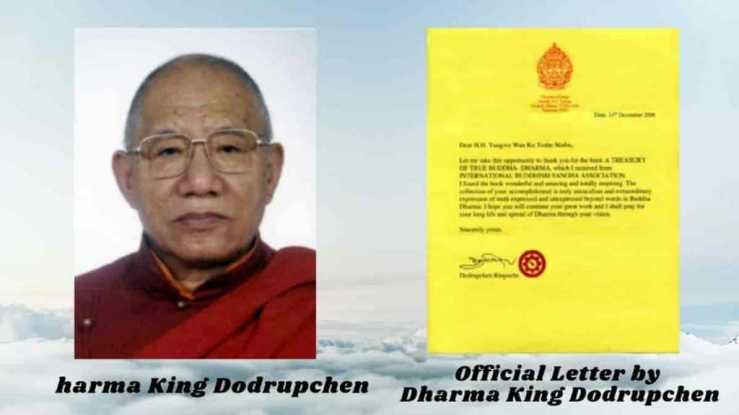
H.H. Dorje Chang Buddha III ‘s accomplishments are unprecedented. H.H. Dodrupchen Rinpoche, the greatest dharma king and master of the Nyingma sect congratulated H.H. Dorje Chang Buddha III with the following words, “The collection of your accomplishment is truly miraculous and extraordinary expression of truth expressed and unexpressed beyond words in Buddha Dharma.” Jigme Dorje, Supreme Dharma King of the Jonang Sect wrote: “Such superlative accomplishments are truly unprecedented in the past few thousand years, outshining the accomplishments of all others, both ancient and modern. His Holiness is a shining paragon among Buddhas.” Buddhist leaders cannot just toss off statements like these as if they were blurbs on the back cover of a book. The consequences of making ill-considered or casual statements about recognizing a Buddha would be enormous.
I can understand the impulse to be suspicious of things outside the normal and usual happenings, but I do sometimes think that our current times are not really all that normal. The natural world is in serious decline. There’s climate change and other troubles for life on the planet. We’re losing birds, insects, sea life, coral reefs and whole species. And there’s very great social change as we embrace the digital world, automation and artificial intelligence. Maybe it really is a time of extraordinary danger and a Buddha has come just in time to help all living beings on earth.
I’d like to say that Zhaxi Zhuoma Rinpoche’s tour of America was a roaring success, but the number of Westerners who follow His Holiness the Buddha is still quite small. After meeting Zhaxi Zhuoma Rinpoche, I traveled to many different places to be able to hear preliminary English translations of recorded discourses by H.H. Dorje Chang Buddha III. Though there are thousands of recordings in Chinese, not many have been translated into English. Of these, only one, The Dharma of Cultivation is completely approved as a translation and published as a book and also free online on multiple websites. Zhaxi Zhuoma Rinpoche’s Holy Vajrasana Temple website has a link to this text. Listening to the discourses, I felt I was hearing the true Buddha Dharma. They were brilliant, clear, informative and extremely practical. If you listen to these discourses, as many thousands of Chinese speakers do, you will know exactly how to transform yourself through cultivation into the causal state for becoming a bodhisattva — that is, one who corresponds with a bodhisattva’s actions of body, speech, and mind.
All my resources for learning and practicing Buddhism are magnificent now. From the Buddha Master’s discourses and dharma teachings I have learned things I never heard before and experienced things I never saw before. Many high-level disciples of His Holiness are shining examples of sincere cultivation and devoted practice. Many of His disciples can manifest dharma powers. Some of them can perform extraordinary rituals of esoteric Buddhism, so that manifestations of Buddha-dharma are being seen and experienced in America now that only used to happen in Tibet. Dharma rituals such as: Creating a Sand Mandala through a Stone Slab; various rituals of selection such as, Drawing Lots from a Golden Vase; high temperature displays of Tummo Concentration; the Vajra Fa Man Initiation in which grains of sand weave themselves into a crown above a portrait of a Buddha or Bodhisattva; Beseeching Nectar from the Buddhas in which nectar manifests in a bowl; Eight Winds in Samsara Battle Position in which masters are tested in the holy realm. My teacher, Zhaxi Zhuoma Rinpoche’s Holy Vajrasana Temple is a Bodhimandala empowered by H.H. Dorje Chang Buddha III where Dharma Protectors will sometimes shake vajra poles to the delight of devout visitors to the temple. It is all so wonderful. I have seen these vajra poles mysteriously, vigorously shake. I have seen and felt nectar from the Buddhas rain from cloudless blue skies. I participated in the Eight Winds in Samsara test. My experiences are everything I expected the true Buddha-dharma to be and I’m experiencing these things in the USA!
As a follower of H.H. Dorje Chang Buddha III, I feel that the dharma I’m receiving is the original, authentic, and very real thing. It is a great treasure that I would like others in the West to enjoy as well. I liken this true Dharma to the silver dimes and quarters we used to use in America. In 1964 the silver content of American coins that had been minted from 90% silver was drastically reduced to no silver at all. There was no loss in their use as currency, their purchasing power remained, but they had lost their intrinsic value. They weren’t real silver and did not have the true properties of silver. I feel that secular Buddhism is like these new coins, which are shiny and still useful, since they still function as currency, but they’re not silver. They have lost the essence of why silver was chosen for coinage in the first place; it reflects light purely and beautifully and can be fashioned into treasured objects. I don’t believe the secular brand of Buddhism with its focus on being the best me, or on therapy, or on succeeding at business and personal relationships has retained its original value and purpose of helping us leave samsara. Many other systems can accomplish these aims as well. And these aims are side effects of sincere practice anyway, so there’s no value at all in losing the treasured ultimate goal of Buddhism. For those of us who want more, who wish to become arhats or bodhisattvas or buddhas, who want to realize enlightenment, accomplish prajna, attain the four wisdoms, the three bodies, the usages of emptiness. For those who wish to be able to expound the dharma that can liberate living beings, they should know there is more to Buddhism than the usual American fare. There is a Buddha here now whose teachings will help them cultivate their three karmas into a causation state for becoming a bodhisattva and whose transmissions of dharma practices can activate true dharma abilities. Everyone please take notice.
Gesang Suolang Rinpoche Shares Her Insight into the Dharma of H.H. Dorje Chang III & Why the West Needs It
In traditional China, painting was revered as “silent poetry,” while poetry was seen as “painting with sound.” Both art forms found expression through the medium of calligraphy, which was considered the “art of handwriting.” Scholars and artist-scholars incorporated calligraphic brushstrokes into their paintings, viewing their artworks as vehicles for self-expression. Consequently, painting was not only regarded as an art form of equal purity and lyricism to poetry and contemplative thought but also as a means to evoke sensory experiences, emotions, and a holistic engagement with the world.
For Western observers, it may be intriguing why Chinese artists incorporate writing in their paintings and what significance the characters hold. By examining some of H.H. Dorje Chang Buddha III’s paintings, we can gain insight into these questions and witness the embodiment of the concept known as the “Three Perfections.” This concept represents the harmonious fusion of fine painting, poetry, and calligraphy within a single artwork.
Song of the Waves in the Three Gorges by H.H. Dorje Chang Buddha III
This painting, titled “Song of the Waves in the Three Gorges,” beautifully captures the grandeur of splash-ink technique alongside the charm of water and ink colors. Its overall tone carries a weighty presence. The brushwork employed in this artwork evokes a powerful sense of momentum, lively charm, and a vividness akin to the scene of a long, flowing river just passing by. The inclusion of a few small sailboats adds elegance to the water scene as they gracefully navigate through it. The combination of the mighty river and awe-inspiring mountains, enveloped in mist and holding sacred spaces, has a purifying effect on one’s emotions. This painting possesses a quality that is reminiscent of both poetry and calligraphy.
Notably, H.H. Dorje Chang Buddha III has inscribed an elegant Chinese poem onto this painting, which can be translated as follows: “The song of waves echoes in the gorge. Hanging colors of rocky cliffs burst with charm. A few cloudy, misty mountains reveal shades of blue. The vast water’s melody sets the sails in motion.” This poem aptly captures the beautiful and misty landscape of the Three Gorges, where the water and sky harmoniously blend, and human emotions become intertwined with the scenery. This painting serves as an artistic paragon, showcasing the mastery of poetic, calligraphic, and painting skills.
Yi Shan Shui Yun Liang Qing Nong ( One Landscape Charm Presents Two Strong Emotions) By H.H. Dorje Chang Buddha III
This remarkable painting showcases a rare combination of splash-ink and splash-color techniques, displaying the artist’s bold and skillful brushwork. The resulting natural effect achieved through these techniques is truly indescribable. Within the bold and dynamic brushstrokes, one can discern countless intricate details and traces of charm emerging from the flowing watery ink.
The painting depicts a scene of mountains and water during the approaching dusk, conveying a profound message. The poem imparts the wisdom that we should strive to engage in virtuous deeds rather than harmful actions, treating all living beings with kindness and respect. By embodying such a way of life, one can transcend to another realm and grasp the truth of existence beyond the concepts of birth and death. This painting offers a profound contemplation on the purpose and significance of human existence.
The calligraphy in the two art works are executed in a cursive style, known for its swift and dynamic strokes. Cursive writing is often characterized by its rapidity and vitality, effectively conveying the artist’s profound emotions.
The Title “A Lotus Pond Has Carp” suggests profound Philosophical implications that transcend everyday life. In addition to its masterful artistry, the painting contains subtle messages of the Dao and its fruits. The lyrics on the left and right sides of this work correspond perfectly with the image of the fish, forming a whole that awakens and enlightens, richly rewarding its viewers.
Why is this painting so artistically enchanting that it stirs the hearts of those who see it? One reason is that the fish are depicted with uncanny realism. The swimming carp are infused with vitality. The painting’s details clearly reveal the damage done to the carp’s skin, accumulated over a lifetime in the water, through lines that fade in and out. Appearing as delicate as a fine gauze, the translucent fins, for example, possess a natural realism. Texture and spirit are captured with utter precision, providing the viewer with stirring aesthetic pleasure. The surface and bottom of the pond are depicted with a wonderfully hazy charm, while the lotus flowers, leaves, and pods are portrayed in bold freehand brushwork with distinct and unusual brushstrokes rapidly applied.
The painting is mainly composed of back ink and rich colors. Only a few brushstrokes were used to create each vibrantly red flower, which seem to emit a pure fragrance. The hanging lotus pods embellish the painting, conveying an elegant contrast of hues and instilling a sense of vitality. As the fish swim about, free of any inhibition, the sunlight faintly reflecting off the water ripples provides the illusion of movement that occurs in the natural world.
When examined more closely, the painting has an intricate style to ascertain, for it seems to transcend realistic fine brushwork and convey the feeling of freehand brushwork. It is not in the style of conventional paintings. Instead, freehand brushwork was applied to produce the effect of fine brushwork with close attention to detail.
Fine brushwork was applied that transcends realism. The real and the surreal blend, resulting in a work that excels the beauty of a natural lotus pond. It represents a combination of techniques from the “Menglong” style of painting and bold, large-scale freehand brushwork.
For the painting, H.H. Dorje Chang Buddha III composed these lyrics of a Dao song: “No Dao exists on the high mountain, yet hearts yearn to go there. A lotus pond has carp; men have inquired about them. Which path leads to the truth is worth pondering. It would be better to look tranquil to our original nature, like a lotus flower sitting over its leaves in tranquility.” These lyrics speak of mysteries unknown to the ordinary person – seeing fish, not as fish; seeing water, not as water; no Dao exists on the high mountain, so no value exists in searching for it; and the fish have neither life nor death.
To understand the origin of the painting, we must ask: where did the fish come from? What state of realization was relied upon and gave birth to this exquisite painting? What form of realization manifested this mysterious, hazy, and illusory painting? The magical illusion of the fish and water is nothing more than a superficial image. Spirit is within; A life force underlies spirit. Spirit is empty or nothingness. The original essence of all things is neither empty nor substantive. Everything illusory and impermanent quickly changes in time and space, but their original nature remains constant. Thus, the lyrics of the Dao song continue: “To find our original nature, do not seek the source, as the source is our original nature, tranquil and unmoving, like a lotus flower sitting over its leaves in tranquility. There is no such thing as arising, passing away, and change. From this surpassing wisdom, usages that arise from Buddha-nature will naturally manifest. These usages include calligraphy and painting. Only in such a way is a consummate work created.” Thus, one should understand the tremendous meaning of this song of Dao written in this painting. Profound mysteries are deeply hidden within it.
In case the viewer remains oblivious to right stanza, on the left side of the painting, the second stanza of the song continues with: “The carp rely on the Dao, and the Dao awakens the fish.” The Dao refers to the state of holy ones, a realm that transcends the realm of ordinary people. It does not refer to regular abilities. The artist created this carp painting based on such a holy state. “The Dao awakens the fish” means that this painting of carp in a lotus pond was accomplished based on the wisdom of the transcendent Dao. Only with such wisdom could this lifelike, graceful scene of carp swimming in water be painted, a setting that combines the real and the surreal, emptiness and substance in such a wondrously appealing way. This scene of carp complimented by the boldly and powerfully depicted lotus leaves results from the artist’s awakening to the holy Dao.
This painting of carp, then, is merely an expression of one who has attained the Dao and reached enlightenment. Thus, this work is not just an ordinary combination of brush strokes, color, ink, and water. Instead, it results from techniques derived from the beautiful application of holy wisdom. The profound mysteries contained in “A Lotus Pond Has Carp” cannot possibly be conveyed by the superficial meaning of the words in its title! Actually, this explanation is entirely unnecessary. All those with discerning eyes will understand once they see the lyrics of the Dao song and the calligraphic skills with which they were written on the painting.
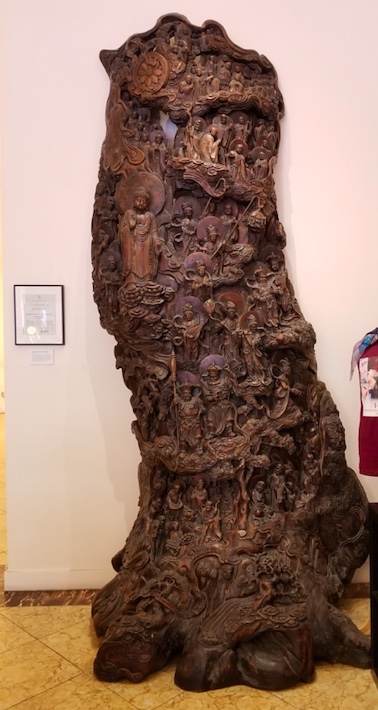
In a world where art manifests itself in countless forms, there are rare instances when we stumble upon something truly extraordinary—a concealed treasure that enthralls our senses and moves us on a deep level. Such a remarkable encounter occurred one fateful day as I explored the gift shop at The International Art Museum of America (IAMA), nestled in the heart of downtown San Francisco. Amidst the vast array of artistic wonders, my gaze became fixated on an exquisitely crafted wood carving—a masterpiece that exuded an ethereal essence of spirituality and profound significance.
This awe-inspiring sculpture, meticulously chiseled from a single tree, originated from China and was skillfully brought to life by gifted folk artists. It portrayed an enchanting realm of spiritual growth and profound accomplishments in Buddhism. Towering at an impressive height of approximately three and a half meters and spanning one meter in width, this artwork was a testament to the dedication and artistry of its creators. Every intricate detail, meticulously carved figures, and delicate embellishments, painted a vivid tableau illustrating the virtues of compassion, enlightenment, and the transformative journey towards Nirvana.
The intricately carved sculpture was a masterpiece that depicted the journey of practitioners from being ordinary to mastering the higher levels of Buddhahood. The figures in the relief were so vividly carved that it was easy to see their progression towards enlightenment and Nirvana. Every detail, from the facial expressions to the flowing cloth, the delicate flowers, and the instruments, was so meticulously presented that it was impossible not to be impressed.
The beauty of this piece lay not just in its stunning visual presentation but also in the message it conveyed. It illustrated the importance of practicing compassion in thoughts, words, and deeds to achieve spiritual growth. It reminded us that every act of kindness, every gesture of love, and every moment of selflessness is a step towards enlightenment and Nirvana.
The sculpture had a calming effect on me. It was a tangible reminder of the power of art to transcend language, culture, and time. It spoke to me in a language that was universal, one that transcended borders and connected people across the world.
As an art lover, I have seen many beautiful pieces over the years, but this wood carving sculpture stood out as a true masterpiece. It was a testament to the skill and craftsmanship of the folk artists who created it, and it served as a reminder of the timeless beauty of art.
The High-Leg Treasure Horse is a thoroughbred horse with great stamina. When this treasure horse perspires, it appears to be bleeding due to the color of its perspiration. According to ancient legend, it is the most precious among all species of horses. It has the reputation of being able to travel over three hundred miles a day. Long mane hairs and a mighty, strong-willed, handsome appearance are its prominent characteristics. The High-Leg Treasure Horses in this painting have longer legs than horses commonly seen in paintings. The hairs of their manes are also long and strong. An extremely rare brushwork technique that combines haziness with clarity was applied to paint the hairs of the horses. The gossamer-thin hairs are strong but pliable. One can clearly see the natural effect of sunlight on the horses’ manes. Moreover, contrasting variations of dark and light are seen in every hair. The hairs of the horses are depicted with a realistic effect that nonetheless transcend their natural look.
An artistic technique was used to thoroughly capture on paper the charm and atmosphere of the grassland, lake, sky, and land. The “haziness technique” was applied to express a state of realization in which there is no distinction between emptiness and form. The ancient cypress tree was drawn in one shade of green without the need to add decorative touches in several different shades of green. Both the spirit and form of the tree were captured through the artist’s brush. In addition, elegant charm is revealed by a small number dots of red leaves in the background that compliment the scene. The most difficult part of this work of art was painting the roots, trunk, and leaves in a spontaneous, casual manner using the center brush-up technique yet maintaining a scholarly tone. Such mastery of painting cannot be easily attained and requires solid skills in calligraphy, literature, and painting as well as a noble moral character. From the brushwork style and details of this painting, we can sense the profound inner-cultivation of a renowned scholar. The abilities of a literary giant with abundant talent are visible everywhere. The scholarly tone and brushwork style are skinful and vigorous, totally free of any trace of the mundane, and reflect the highest level of painting and calligraphy. Anyone who lifts a brush in an attempt to paint such painting will appreciate the fact that this scholarly style cannot be accomplished by anyone other than a literary giant who is a great master of art. This painting coherently unites realism and small-scale freehand brushwork as well as the use of haze and clarity.
This painting is in the permanent exhibition of The International Art Museum of America. H.H. Dore Chang Buddha III, an artist of great talent, has created sixteen distinctive painting styles. The composition we are discussing here belongs to the “Menglong” style. This style combines realism and non-realism to capture the essence of the portrayed subject, resulting in a seemingly realistic but actually non-representational depiction. The brush strokes and color application in these paintings create a whimsical and dreamlike appearance, where the real and surreal merge into a lovely and hazy composition.
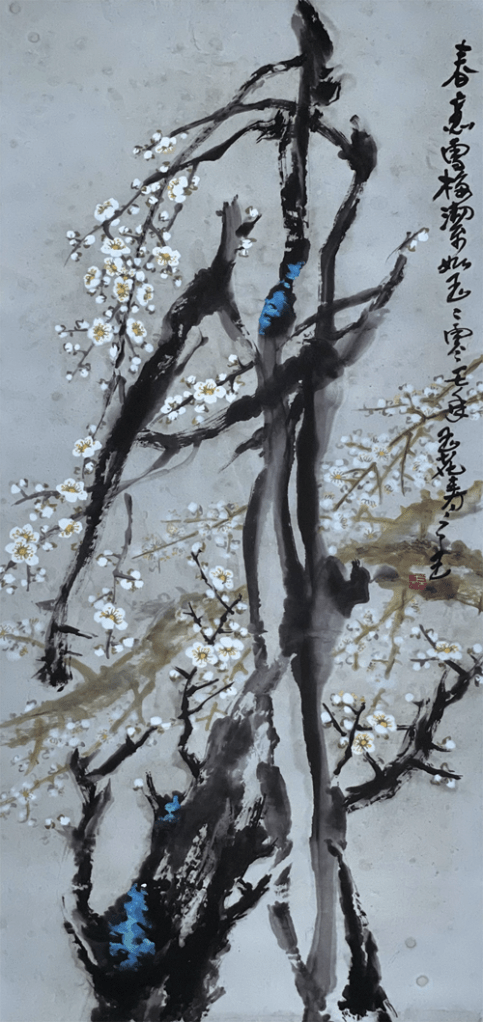
Springtime Snow-White Plum Blossoms as Pure as Jade
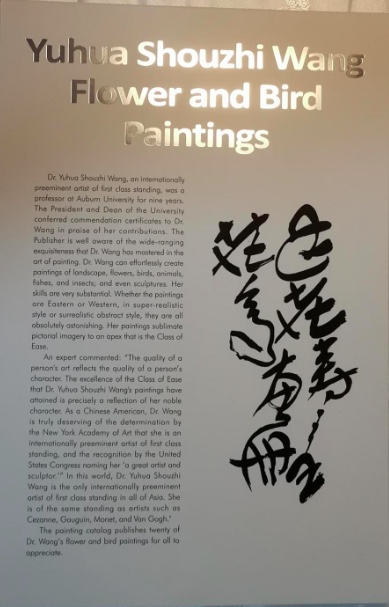
At the International Art Museum of America in downtown San Francisco, there is a special exhibition room, dedicated to Professor Yuhua Shouzhi Wang. This installation was established in 2018, containing a variety of water and ink paintings as wells as sketches. Professor Wang’s acclaimed works have been displayed all over the world, including an exhibition at Congress in 2008, where they called her work a ‘treasure of the world’. In 2019, Professor Wang’s art was exhibited at Shanghai Exhibition Center in China and the Louvre Museum in Paris. An art critic Aude de Kerros praised this event in Paris, saying ‘I have curated and critiqued so many art exhibitions, yet I have never seen an exhibition like this where all the guests are so touched and amazed by the art.’ Following the Paris exhibition, Professor Peter Drake, the Provost of the New York Academy of Art, presented a certificate to Professor Wang, recognizing her extraordinary contributions to representational and abstract art. In December 2020, the Chairman of Centre for Peace in United Nations Educational, Scientific and Cultural Organization (UNESCO), Guy Djoken awarded an “International First-Class Artist” title to Professor Wang for her accomplishment. Professor Wang is the only Asian artist who has ever received such a title. On December 29th 2020, Chairman Guy Djoken came to the museum to personally present the title certificate to Professor Wang.
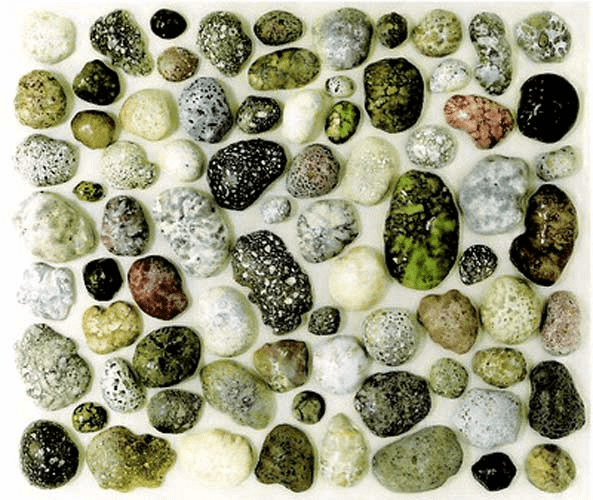
Hand crafted cobblestone
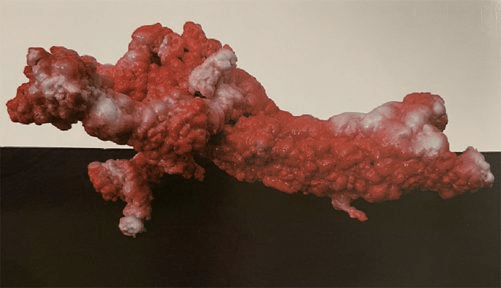
Hand Crafted Coral Sea Palace Monarch
Many people are aware that Professor Yuhua Shouzhi Wang is a world-renowned artist. However, the true identity of Professor Yuhua Shouzhi Wang is revealed as Fomu, Holy Mother the Great Mahasattva. She embodies great wisdom and compassion, noble morality, kindness, altruism, and selflessness in a perfect manner. She always considers other people’s well-being and is humble and very approachable. The compassion and kindness of Fomu, Holy Mother the Great Mahasattva, are pure and flawless. For example, in 2015, someone sneaked into the International Art Museum of America in San Francisco and tried to steal an artwork that had been acclaimed by the World Federation of UNESCO (WFUCA). This person was arrested by the police on site and subsequently detained. Since the artwork that he tried to steal was one of Fomu’s masterpieces, the court repeatedly requested Fomu to provide a valuation of the artwork, so that they could use her valuation to determinethe term for sentencing. When Fomu, Holy Mother the Great Mahasattva, knew about this person’s distress, She provided a statement saying that the artwork was rather ordinary and had no value. The court had no way of sentencing the person to any term and had to release him.
Another time, Fomu, Holy Mother the Great Mahasattva, saved a butterfly that had fallen into the water. Worried about the butterfly’s safety, Fomu brought it home and kept it for a few days to make sure the butterfly is well-recovered before letting it fly away. Fomu relentlessly led disciples to conduct life-releases. She went every week to woodlands to feed ducks and birds and never missed a week. She paid for it with Her own money and never accepted offerings from Buddhist disciples. Fomu, Holy Mother the Great Mahasattva, is well known for Her diligence and thriftiness. For many decades, the noble Fomu, Holy Mother the Great Mahasattva, always cooked Her own meals and washed Her own clothes. She never entrusted others to do Her chores. She would save the food that She could not finish eating and finish it the next day or two. She was never wasteful. Usually, Fomu, Holy Mother the Great Mahasattva, would even save the water that She did not finish drinking, the water used for washing vegetables or hands, or wastewater from the filter and use it for irrigating flowers or flushing toilet. Through Her deeds, the Great Fomu, Holy Mother the Great Mahasattva, was teaching us how to start with the small things, cherish our good fortune, and actualize our cultivation practices.It is impossible to recount all the numerous exemplary deeds of Fomu.
Photo from internet weixin.com
Wherever Fomu, Holy Mother the Great Mahasattva, went, dragon Dharma protectors were present, and holy miracles manifested. When Fomu performed initiation and transmitted Dharma, holy states were manifested. For example, at the Antelope Valley, Fomu’s hat turned into a black garuda. In New Jersey, the hair of Fomu, Holy Mother the Great Mahasattva, suddenly went up and wrapped around a tall building in Manhattan on the opposite shore. In San Francisco, a twin Buddha light suddenly appeared, centered around where Fomu stood. All cultivators are touched by the compassion and morality of Fomu, Holy Mother the Great Mahasattva.




















 Peace LiLy