Mount Putuo – Buddhist Land on The Sea

Mount Putuo – Buddhist Land on The Sea

Mount Putuo is one of the four sacred mountains in Chinese Buddhism, lies in the East China Sea and incorporates the beauty of both mountain and sea, and honored as the Buddhist Land on the Sea. Its area is approximately 12.5 square kilometres (4.8 sq mi) and there are numerous famous temples. Mount Putuo has been a pilgrimage site for over a thousand years. After the Tang dynasty, Mount Putuo became a center of Avalokitasvara (Guanyin) worship.

In 863, a Japanese monk called Hui E aimed to carry a statue of Avalokitasvara from Mount Wutai to his country by ship. However, when the ship was passing through the sea nearby Mount Putuo, it was prevented by the stormy waves and hundreds of iron lotus flowers suddenly appeared on the sea, blocking the way. Monk Hui E believed that Avalokitasvara didn’t want to leave China. So he knelt down on the bow of the boat and silently prayed to the Bodhisattva Avalokitasvara for instructions. After a while, the iron lotus on the sea disappeared, and the boat drifted to the shore of Mount Putuo, where he built a temple in the purple bamboo forest to enshrine the statue of theBodhisattva. From that time, Mount Putuo got the spirit and became the bodhimanḍa of Bodhisattva Guanyin.

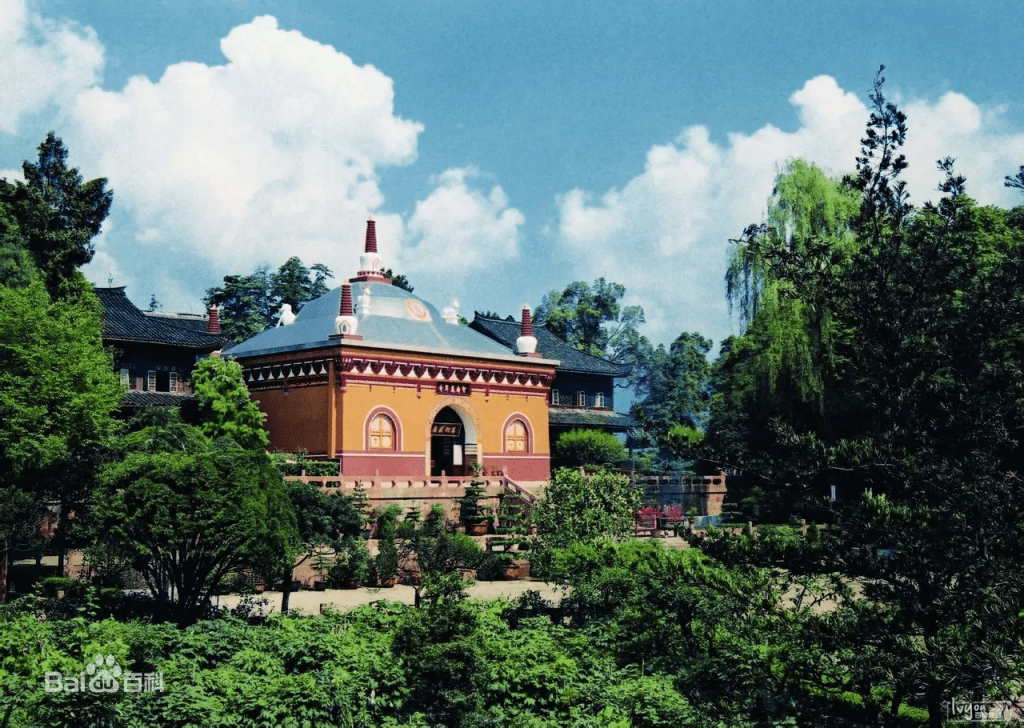
Traditionally there were three main temples: The Puji Temple (founded 10th cent.), the Fayu Temple  (founded 1580 CE), and the Huiji Temple (founded 1793 CE).  Today, there are more than 30 major temples located at Mount Putuo. In addition to these monasteries, there is the Institute of Buddhism, one of the largest Buddhist academic institutes in China.

Puji Temple

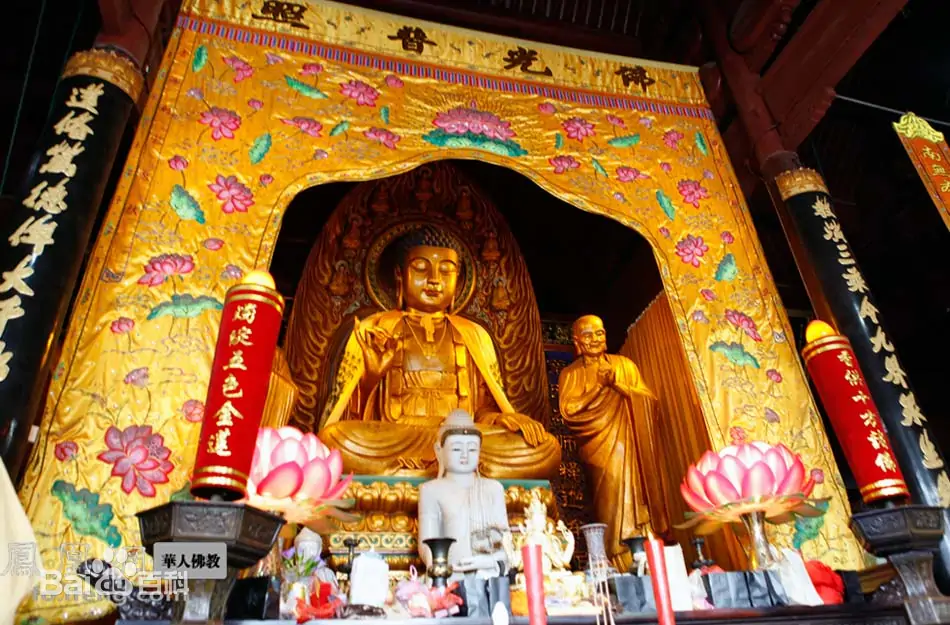
Puji Temple is the main temple of Mount Putuo and all important Buddhist activities are held here. Covering an area of 37,019 square meters, it contains Grand Yuantong Palace, Hall of Heavenly Kings, Depository of Buddhist Sutras and 357 other buildings. Grand Yuantong Palace is the main hall which houses an 8-meter-high statue of Guanyin surrounded by 32 Bodhisattva with different costumes in a variety of poses on east and west walls. Haiyin Pond in Puji Temple was a free life pond full of spring water primitively and now a lotus pond. At the night of summer, the gorgeous lotus and bright moonlight compose an attractive scenery. 
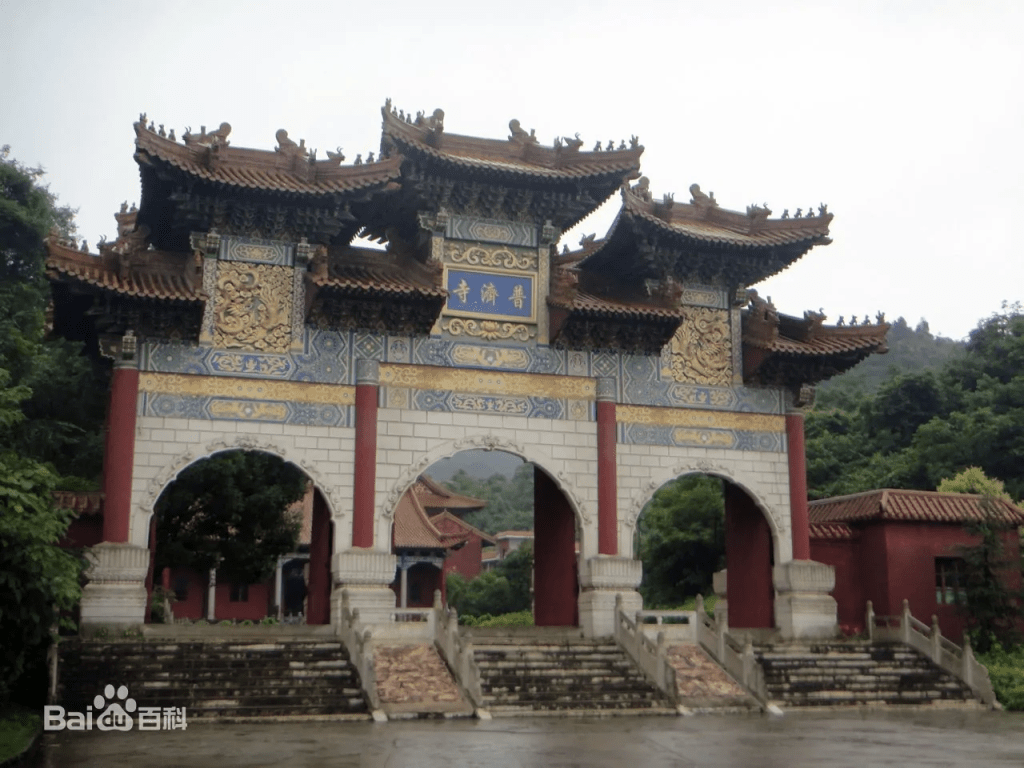
Puji Temple
Haiyin Pond in Puji Temple

Fayu Temple

Fayu Temple was built along the uphill with grand building groups and extraordinary manners. It got such a name in that you could see amazing relives of nine dragons are fighting for pearl on the screen wall before the gate of Halls of Heavenly Kings. Among the 294 halls of Fayu Temple, Nine Dragons Guanyin Palace(also called Grand Yuantong Palace), said to be a Buddhist Temple transported from the imperial palace of Ming Dynasty, acts as the most magnificent one. The highlighted part of this palace must be the Nine Dragons Caisson Ceiling. With unique shapes and vivid images, it enjoys high artist value and is listed in Three Treasures of Mount Putuo.
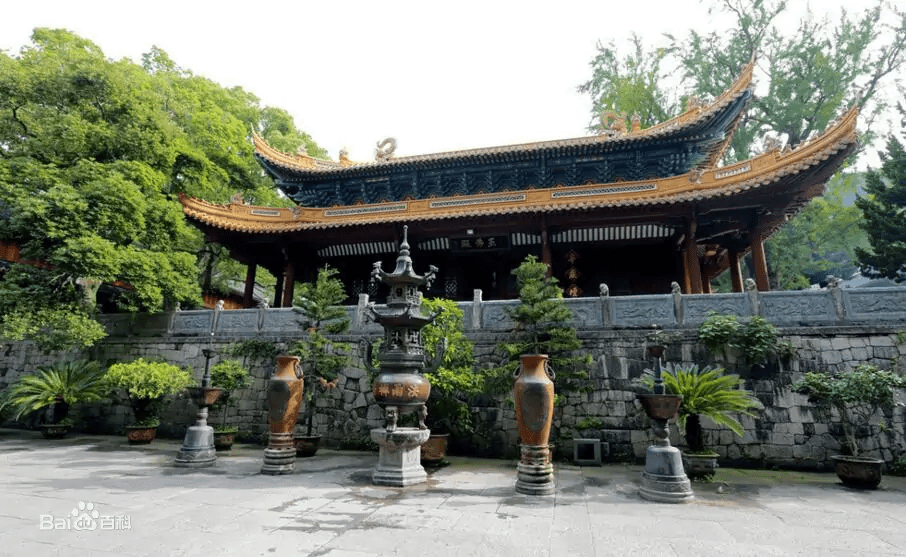
FaYu Temple
Delicate Carvings in Nine Dragons Screen Wall

Huiji Temple (惠济禅寺)

Huiji Temple is perched in Foding Mountain, the highest peak of Mount Putuo. The architecture of the whole temple is unique. It is located on the mountain and is arranged horizontally. The hall is spacious and magnificent. Hidden in a luxury forest, Huiji Temple features in peaceful environment. Standing at the peak of Mount Putuo, you can have a distant view of the mountains, sea, reefs, beaches and buildings. In the whole temple, statues, carvings and pictures of Guanyin can be found everywhere.

Grand Huiji Temple
Status of Guanyin Bodhisattva

Statue of Standing Nanhai Guanyin

Standing in the south Shuangfeng Peak, Statue of Standing Nanhai Guanyin is the largest outdoor statue of Guanyin made from copper in Asia. With an 18-meter-high statue, 2-meter-high lotus and 13-meter-high foundation, the whole structure has two stories in its foundation. The first story displays elegant carvings, while the second story houses 500 statues of Guanyin in different poses. On the consecrating day at year 1997, a strange nature phenomenon happened. Before the consecrating ceremony, the sky was full of dark cloud and it seemed that it would rain soon. However, as the ceremony began, it became sunny as if two hands pushed aside the clouds. A beam of sunlight just casts on the Guanyin statue.
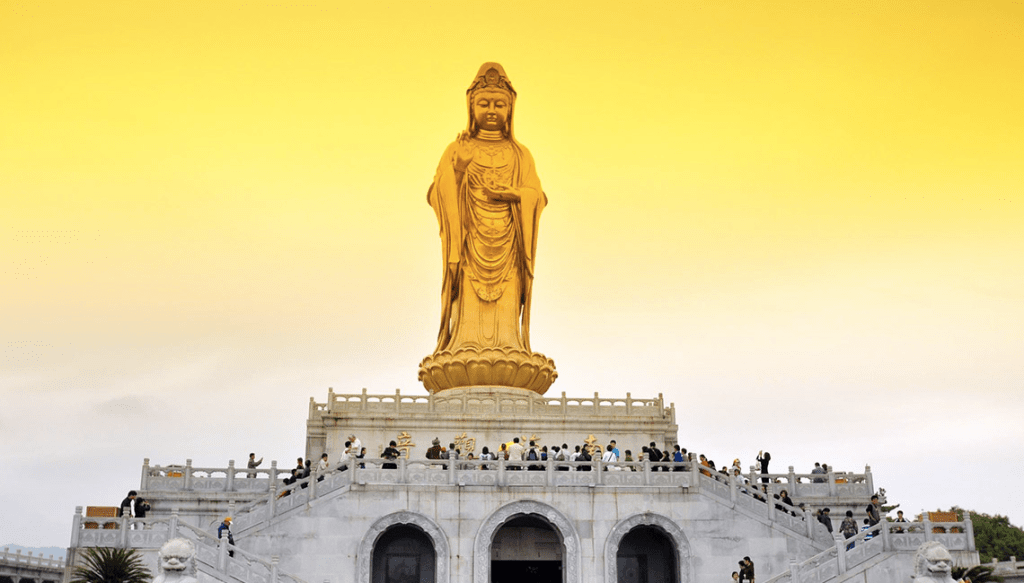
Statue of Nanhai Guanyin

Avalokitasvara, Guan Shi Yin in Chinese, means the Perceiver of World’s Sounds. The Lotus Sutra says: “Perceiver of the World’s Sounds, heavenly voice, the voice of the sea’s tide—magnificent, rich and harmonious surpassing all worldly sounds.” The bodhisattva always help all beings in danger and distress and is willing to bear the pain of all beings. There are many stories and folk tales about the bodhisattva’s infinite mercy and compassion.

If we hold the bodhisattva in our hearts and call on her sincerely, she will always respond. I had a personal experience. You can read my story here: Guan Shi Yin Bodhisattva saved my life

Fortunately for us, H.H. Dorje Chang Buddha III has brought the powerful Dharma to this world: the Avalokiteshvara Bodhisattva Great Compassion Empowerment Dharma (觀音大悲加持法). This Dharma does not require the practitioner to have any Dharma powers or holy realization. As long as you have the power of the lineage, that is sufficient. You can succeed the same day you take up the practice of it. The next day, you can convene people, empower them, and lead them into a supernormal state. Many Buddhist disciples have participated the dharma assembly and recorded their true extraordinary experience. Click here to read some example articles: 1. Dharma Assembly of Empowerment by Guan Shi Yin Bodhisattva’s Mind of Great Compassion ——Note Written Afterwards to Describe the Most Magnificent Scene at the Site,2. Guan Yin Bodhisattva of Great Compassion Empowerment Dharma Assembly- ——A Personal Experience Written Afterwards to Describe the Most Magnificent Scene at the Site.

May the greatly loving and compassionate Namo Guan Shi Yin Bodhisattva bless all beings!!!

Mount Putuo – Buddhist Land on The Sea

Link:https://peacelilysite.com/2022/07/13/mount-putuo-buddhist-land-on-the-sea/

#MountPutuo#BuddhaLandonTheSea#DorjeChangBuddhaIII#HHDorjeChangBuddhaIII#DorjeChangBuddha#BuddhaDharma#Avalokitasvara#Bodhisattva#GreatMercy#Compassion#Empowerment#Buddhism#Temple#PuTuoShan#GuanYin#GuanShiYin

Source: https://en.wikipedia.org/wiki/Mount_Putuo, https://www.chinadiscovery.com/zhejiang/putuoshan-mountain.html

Mount Emei – Bodhimanda of Bodhisattva Samantabhadra

Mount Emei – Bodhimanda of Bodhisattva Samantabhadra

Mount Emei is one of the “Four Famous Buddhist Mountains” in China. It has steep terrain and striking beautiful scenery. “Emei” is a term used to describe a woman’s beautiful eyebrows in an ancient book titled The Book of Songs. The main peak, Golden Summit of Wanfoding, is 3,099 meters above sea level, it is the crown of all other famous mountains in China.

Mount Emei (Emeishan) is an area of exceptional cultural significance as it is the place where Buddhism first became established on Chinese territory and from where it spread widely through the East. The first Buddhist temple built on the summit of Mount Emei was in the 1st century CE. It became the Guangxiang Temple, receiving its present royal name of Huazang in 1614. The addition of more than 30 other temples including the Wannian Temple founded in the 4th century containing the 7.85m high Puxian bronze Buddha of the 10th century, and garden temples including the Qingyin Pavilion complex of pavilions, towers and platforms dating from the early 6th century; the early 17th century Baoguo Temple and the Ligou Garden (Fuhu Temple) turned the mountain into one of Buddhism’s holiest sites.

Mount Emei Jinding Massive Statue of Bodhisattva Samantabhadra

On Mount Emei, the importance of the link between the tangible and intangible, the natural and the cultural, is uppermost. Mount Emei is a place of historical significance as one of the four holy lands of Chinese Buddhism. Buddhism was introduced into China in the 1st century CE via the south Silk Road from India to Mount Emei. Mount Emei is traditionally regarded as the bodhimaṇḍa, or place of enlightenment, of the iconic bodhisattva Samantabhadra (Puxian). In Buddhist sutra, it is recorded that Samantabhadra Bodhisattva rides a white elephant with six tusks. Therefore, the statues of Samantabhadra in the temples of Mount Emei mostly ride on white elephants. There is an Elephant Washing Pool in Mount Emei as well.

Samantabhadra Bodhisattva is associated with Buddhist practice and action. In the Āvataṃsaka-sūtra, the Buddha states that Samantabhadra Bodhisattva made ten great vows in his path to full Buddhahood:

  1. To pay homage and respect to all Buddhas.
  2. To praise the Thus Come One-Tathagata.[3]
  3. To make abundant offerings. (e.g. give generously)
  4. To repent misdeeds and evil karmas.
  5. To rejoice in others’ merits and virtues.
  6. To request the Buddhas to continue teaching.
  7. To request the Buddhas to remain in the world.
  8. To follow the teachings of the Buddhas at all times.
  9. To accommodate and benefit all living beings.
  10. To transfer all merits and virtues to benefit all beings.

The ten vows have become a common practice in East Asian Buddhism, particularly the tenth vow, with many Buddhists traditionally dedicating their merit and good works to all beings during Buddhist liturgies.

From ancient times to the present, there have been many eminent monks and great virtues in Mount Emei. The thirteenth patriarch of Emei Master Pu Guan, and abbot of JiuLaoDong XianFeng temple Master Guo Zhang, were all disciples of H.H. Dorje Chang Buddha III. They both received Great Dharma initiation from H.H. Dorje Chang Buddha III and reached liberation. At year 1998, Master Pu Guan passed away in the meditation posture having attained control over his life and death. Eight years after his passing, he still sits in a stupa in that meditation posture without having rotted at all. At year 2015, Master GuoZhang passed away at 108 years-old, at the Western Sichuan University Medical center. Doctor diagnosed the Master passed away. Unexpectedly, after a few hours, he was resurrected and opened his eyes, he then ordered his disciples to move him back to Jiewangting Temple to officially pass away. Eleven days after he passed away, local government officials visited Jiewangting Temple. They didn’t believe that the master was a profound practitioner. So he stabbed his body with needles, and blood spurted out.

Mount Emei is an area of striking scenic beauty. It is considered to be one of the most beautiful mountains in China.

Amazing Scenery of Sun rise over clouds at Golden Summit of Mount Emei

Mount Emei – Bodhimanda of Bodhisattva Samantabhadra

Link:https://peacelilysite.com/2022/07/07/mount-emei-bodhimanda-of-bodhisattva-samantabhadra/

#DorjeChangBuddhaIII #HHDorjeChangBuddhaIII  #MasterWanKoYee #Buddha#MountEmei#liberation#SamantabhadraBodhisattva#Meditation#EminentMonk#MasterGuoZhang#MasterPuGuan#GoldenSummit#TenGreatVows

Source: https://en.wikipedia.org/wiki/Mount_Emei, https://whc.unesco.org/en/list/779/

Taihang Grand Canyon

Taihang Grand Canyon

Taihang Mountain Grand Canyon National Forest Park is located in the east of Huguan county area between the two provinces of Shanxi and Henan, north from Hugaun 30 kilometers from the county. And Taihang Mountain Grand Canyon has been rated as one of “China’s best ten grand canyons”.

Taihangshan Grand Valley

The Taihang Grand Canyon extends 50 km from north to south, 1.5 km wide from east to north, with an altitude from 800 to 1739 meters. Peaks upon peaks were formed billions of years ago during an active movement of Earth’s crust. Hundreds of peaks, cliffs, gorges, waterfalls and springs form a unique and fascinating world. The three famous scenic spots in the Canyon are Peach Blossom Valley, Taihang Sky Road, and Wangxiangyan (Royal Rock).

In the scenic spot, thousands of peaks contend for beauty, strange, unique topography and geomorphology, rare animals and plants resources made of Taihang Grand Canyon of the most wonderful natural scenery. With three gorges of Five Fingers Gorge, Longquan Gorge, Wangmang Gorge as the main line, there has opened up Purple Cloud Cave, and Yungai Temple, water demon Hole and Zhenze Palace four major scenic spots.

Waterfalls can be found throughout the canyon, thundering down from the high mountains, and gently washing down over one platform after another. The 346-meter-tall Peach Blossom Waterfall presents an amazing scene in the Peach Blossom Valley.

Peach Blossom Valley

The Taihang Sky Road is located in the summit of the Mount Taihang, with a total length of 30 km. It’s not only an essential part of the sightseeing, but also an excellent lookout for a bird’s eye view of the Taihang Mountain.

Taihang Sky Road

Deep in the Taihang Canyon, there are several small villages. The houses are all built with local materials – stones. You could see the stone streets, stone walls, stone roof, stone pillars and stairs everywhere.

Besides, the world-class international gliding base is Located 1,190 meters above sea level on the Mt Linlu of the Mount Taihang Range, and the landform here offers an ideal launch platform. Air currents rise along the cliffs to finally gather at the 60-angle peak. The peak covers an area of 16,000 square meters and can accommodate up to 30 gliders launching simultaneously. Gliding competitions have been held here annually since 1992.

The Grand Canyon Rafting, whole length is 4500 meters and the drop is 85 meters. The whole journey is located in the mountain forest belt. The trees on both sides of the river are lush and the scenery is picturesque, it is beautiful to drift on the water, as if in fairyland.

Taihang Grand Canyon

Taihang Grand Canyon

Link: https://peacelilysite.com/2022/06/21/taihang-grand-canyon/

Source: https://baike.baidu.com/reference/2373297/1b87s9e6DzyAaQY10dHt6excYlLZZMWW9ntYPHwKMPZXKqG0_K5Rws4RuLcw1VC63lj628he7NOEvdVP6jt_Fg, http://www.ecns.cn/experience/2014/11-02/141086.shtml

#Travel#TravelChina#TaihangGrandCanyon#PeachBlossomValley#TaihangSkyroad#Glidingbase#TaihangRafting#MountTaihangRange#HenanProvince

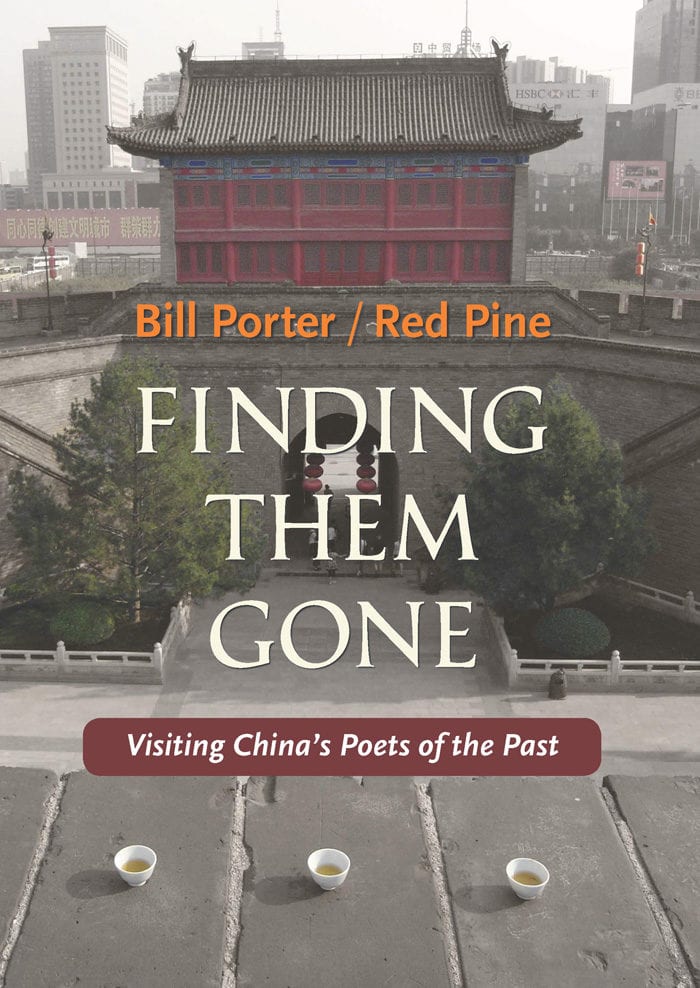
Finding Them Gone: Visiting China’s Poets of the Past

Finding Them Gone: Visiting China’s Poets of the Past

Bill Porter (Red Pine)

To pay homage to China’s greatest poets, renowned translator Bill Porter—who is also known by his Chinese name “Red Pine”—traveled through China visiting dozens of poets’ graves and performing idiosyncratic rituals that featured Kentucky bourbon and reading poems aloud to the spirits. Combining travelogue, translations, history, and personal stories, this intimate and fast-paced tour of modern China celebrates inspirational landscapes and presents translations of classical poems, many of which have never before been translated into English. Porter is a former radio commentator based in Hong Kong who specialized in travelogues. As such, he is an entertaining storyteller who is deeply knowledgeable about Chinese culture, both ancient and modern, who brings readers into the journey—from standing at the edge of the trash pit that used to be Tu Mu’s grave to sitting in Han Shan’s cave where the Buddhist hermit “Butterfly Woman” serves him tea. Illustrated with over one hundred photographs and two hundred poems, Finding Them Gone combines the love of travel with an irrepressible exuberance for poetry. As Porter writes: “The graves of the poets I’d been visiting were so different. Some were simple, some palatial, some had been plowed under by farmers, and others had been reduced to trash pits. Their poems, though, had survived… Poetry is transcendent. We carry it in our hearts and find it there when we have forgotten everything else.”

These are some of the Poets’ graves that Bill has visited : Li Pai, Tu Fu, Wang Wei, Su Tung-p’o, Hsueh T’ao, Chia Tao, Wei Ying-wu, Shih-wu (Stonehouse), Han-shan (Cold Mountain). 

With Finding Them Gone as your map, you will encounter rural and industrial China’s shifting cultural landscape without ever leaving the page. On your journey, you’ll set off by train in Beijing and arrive in the cave where Cold Mountain, a master of Hermetic poetry and Zen practice, once sang his verses—“with nothing to do I write poems on rock walls/trusting the current like an unmoored boat.” 

Each step of the pilgrimage is marked with poetry from Chinese masters—among them Stonehouse, Cold Mountain, and Li Po—including poems never before translated into English.

Finding Them Gone: Visiting China’s Poets of the Past

Link: https://peacelilysite.com/2022/05/03/finding-them-gone-visiting-chinas-poets-of-the-past/

Source: https://www.coppercanyonpress.org/books/finding-them-gone-visiting-chinas-poets-of-the-past-by-bill-porter-red-pine/, https://www.indiegogo.com/projects/finding-them-gone-red-pine-s-poetry-pilgrimage#/

Zen Baggage : A Pilgrimage to China

Zen Baggage: A Pilgrimage to China by Bill Porter

Posted: July 2, 2010 | Author:Roy Hamric

You wonder how a book like Zen Baggage could be written. First, who would have guessed that China’s legendary Zen temples would rise from the ashes of the Cultural Revolution and prosper in the new century? And second, what Western writer could pull off a history of Zen in China and then go on to paint a vivid picture of contemporary life in China’s most legendary Zen temples and monasteries?

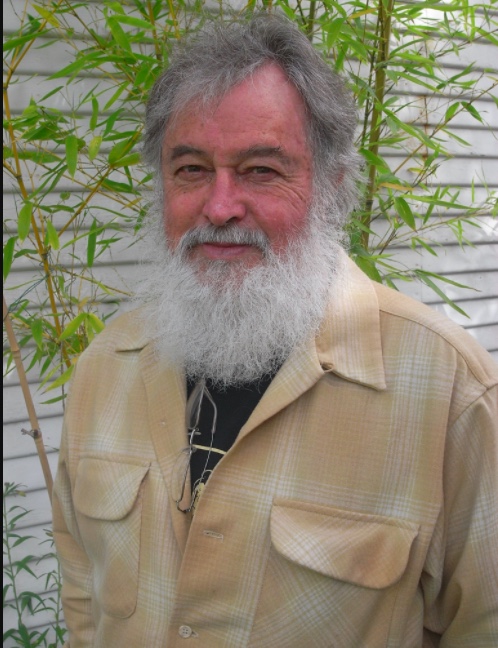
Bill Porter in Port Townsend (2010). Photograph by Julie Anand

The only writer I know who could do that justice is Bill Porter, also known as Red Pine, the éminence grise of translators and commentators on Zen and Taoist poetry and texts. In this latest, most personal, travel book, Porter is back on the fertile ground he covered so well in Road to Heaven: Encounters with Chinese Hermits.

Thanks to that book, we know that Taoist hermits continued to practice and live in their remote huts in the Chungnan Mountains throughout the era of China’s Red Guards.  The book was a revelation to Westerners and it seems to have fascinated many Chinese as well: the Chinese translation is now in its sixth printing under the title Hidden Orchids of Deserted Valleys.

Porter makes it clear that the average Chinese doesn’t quite know what to make of the legendary Zen temples and monasteries that have become heavily visited pit stops on a sort of Zen Tourist Highway running from Beijing to Hong Kong. Most of the temples are thriving: attracting more monks, building academies, expanding zendos, and refurbishing, enlarging, and promoting themselves in close—maybe too close—cooperation with the Chinese authorities, all under the auspices of a program that seems more intent upon raking in tourists’ money than in preserving the cultural legacy of Zen. The current government’s new relationship with Zen temples seems to be motivated in part by a desire to be more respectful and tolerant than the Communist regimes of the past, and its view that Zen is a non-threatening, home-grown, institution that promotes responsibility and discipline.

Zen being Zen, the abbots of these ancient temples are only too happy to accept whatever benefits accrue from the government’s new view of things. They remember all too well the days when monks were rounded up and abused, and temples were gutted or shut. Now abbots can easily meet the government’s modest expectations while also scooping up hoards of badly needed yuan from the bus loads of Chinese tourists who flock to the temples’ trinket shops to buy T-shirts, tea sets and kitschy souvenirs. The money is wisely used to build sub-temples in remote locations where monks can practice without being put on public view.

Porter’s personality comes through vividly in Zen Baggage, and it contains sketches of his earlier life in Taiwan, his frequent travels to China, and, most revealingly, his on-the-road personae as he makes his six-week, 2,500-mile, temple-hopping pilgrimage, which was largely a catch-up journey to supplement his many previous visits. He is on intimate terms with many of the temple abbots and others that he meets on his trip. In contrast, in Road to Heaven, during his forays into the rugged Chungnan Mountains (home of the hermits), he was on new ground ferreting out the names of hermits and the mountains where they were living, and then he tracked them down. What was most surprising about his first encounters with these Taoist solitaries, both men and women, is how seldom they showed surprise at the appearance of this bearded foreigner–if, indeed, they perceived him as a foreigner.  He seemed to have been expected.

Zen Baggage is soaked in wisdom so subtle it is almost invisible. I was three-quarters of the way into it, for example, when I realized I’d easily absorbed a chronology of the major Chinese Zen patriarchs along with the distinctive swerves and turns that collectively make up Zen’s birth, its crucial philosophical debates, its divisions, its flowering in the sixth century, its slow decline, and its diffusion in the world.

Porter’s personal Taoist/Zen style of travel gives his journey an interesting edge. Whether he’s interviewing the abbot of a legendary temple or eating sweet cakes at a truck stop, he lashes it all together in a bundle of concrete details that help illuminate the tales, metaphysics, koans, and esoterica of early Zen. He has read so deeply in Zen, Taoism and Buddhism that he could be the abbot of any of these legendary temples––to the benefit of the temples and monks––but it’s clear that most, if not all, of the abbots and monks he talked with would laugh at such a suggestion. Throughout Asia, Zen too often remains the “property” of individual countries, whereas in the West it’s readily perceived as open to all equally. In all his encounters, you get the feeling that in only a few cases was there a true meeting of minds. Many Chinese sized Porter up as just another Westerner who spoke good Chinese, and had no knowledge of his translation work or of his life (not that he cared), and most probably weren’t interested anyway. The prevailing orthodoxy seemed to be: “We’re the only ones who can translate the texts, who understand Zen––Westerners can’t get it.”  But as history reminds us, Buddhism is international: the Chinese texts the abbots depend upon were carried back to China from India by Chinese pilgrims and translated from Sanskrit and other languages.  In Porter’s many trips to China over the past two decades, we have an apposite addition to the history of Buddhism: a Western pilgrim who traveled to the East to get Chinese texts to translate into English.

On this latest trip, he bounced down China’s buzzing highways in buses to report to the world (or the English-speaking West), on what grew from those early Chinese translations into Zen. This recounting of how Zen was born and thrived in China (for a while), then died out, and is now being reborn closes China’s Buddhist/Zen circle, for the time being at least.

Along with his translations (11 so far), Porter’s two travel books are singular achievements that break new ground in our understanding of Zen and Taoism in contemporary China. My guess is that we can expect more travel books from him that will flesh out the on-the-ground story of Zen and Taoism, and that they will showcase his two greatest assets as a writer: his independence as a scholar and his practical knowledge of whatever he calls his personal blending of Taoism and Zen.

The travel books most closely resemble the work of his mentor John Blofeld (1913-1987), the British writer and translator of Buddhist texts, who gave Porter  the encouragement that led to his first translation in 1983, Cold Mountain Poems. Like Blofeld,  Porter uses his unique skills as a translator and his talents as a travel writer to bring to life Buddhism’s past and present.

Zen Baggage: A Pilgrimage to China by Bill Porter

LInk: https://peacelilysite.com/2022/04/10/zen-baggage-a-pilgrimage-to-china/

Source: https://royhamric.com/2010/07/02/zen-baggage-by-bill-porter-red-pine/

#Translater#Sinologist#BillPorter#CultureExchange#China#ZenBuddhism#Travel#Pilgrimage#Buddhism#China#Taoism

Asian Art Museum at a Glance

Asian Art Museum at a Glance

San Francisco is truly a paradise of museums. There are so many museums and galleries in the city — fine arts, modern arts, history, science, cable car, even an ice cream museum. One of my favorites is the Asian Art Museum.

An amazing interactive activity for kids of all ages was a digital aquarium where you are given paper with an outline of an aquatic animal to color and then your art piece is scanned and appears swimming on the wall. I tried that too, to feel like a kid one more time.

My only one little complaint, is there are only a few Chinese ink paintings. Chinese ink painting is one of the oldest art traditions still practiced today. One important form of ink painting is Chinese calligraphy, which can be traced back to 4000 B.C. So it is a very important part of Asian art history. However I found a smaller sized museum located on market street, just a couple of blocks away from the Asian Art Museum, that showcased this type of artwork. The International Art Museum of America has Chinese painting art including landscapes, flowers and birds, fish and insects, and figures. The techniques, whether it is fine brushwork, freehand brushwork, or splashing ink, are all ingenious, with authentic traditional techniques and innovations. Every piece is world class level. It truly gave me an uplifting aesthetic enjoyment.

Link: https://peacelilysite.com/2022/02/25/asian-art-museum-at-a-glance/

#AsianArtMuseum#InternationalArtMuseumofAmerica#HHDorjeChangBuddhaIII

Bryce Canyon

Bryce Canyon

The Bryce Canyon area was settled by Mormon pioneers in the 1850s and was named after Ebenezer Bryce, who homesteaded in the area in 1874. The area around Bryce Canyon was originally designated as a national monument by President Warren G. Harding in 1923 and was redesignated as a national park by Congress in 1928.

Bryce Canyon National Monument (administered by the U.S. Forest Service) was originally established on June 8, 1923 to preserve the “unusual scenic beauty, scientific interest, and importance.” On June 7, 1924, the monument’s name was changed to Utah National Park and it was transferred to the National Park Service.

Iron-rich, limy sediments were deposited in the beds of a series of lakes and streams. These became the red rocks of the Claron Formation from which the hoodoos are carved and for which the Pink Cliffs are named. and get detailed information regarding Lodging around Bryce Canyon National Park.

My family and I visited Bryce Canyon in 2017. It was such an amazing site that nature created. If you haven’t been there, you need to go see it. It is worth visiting!

Link: wisdomtea.org/2022/02/24/bryce-canyon/

Angkor Wat


Angkor Wat

HISTORY.COM EDITORS * UPDATED:AUG 21, 2018*ORIGINAL:FEB 28, 2018

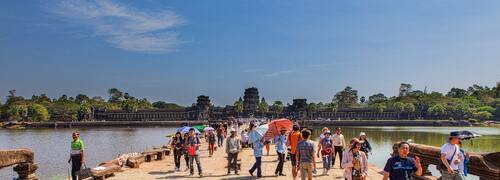
Angkor Wat is an enormous Buddhist temple complex located in northern Cambodia. It was originally built in the first half of the 12th century as a Hindu temple. Spread across more than 400 acres, Angkor Wat is said to be the largest religious monument in the world. Its name, which translates to “temple city” in the Khmer language of the region, references the fact it was built by Emperor Suryavarman II, who ruled the region from 1113 to 1150, as the state temple and political center of his empire.

Originally dedicated to the Hindu god Vishnu, Angkor Wat became a Buddhist temple by the end of the 12th century.

Although it is no longer an active temple, it serves as an important tourist attraction in Cambodia, despite the fact it sustained significant damage during the autocratic rule of the Khmer Rouge regime in the 1970s and in earlier regional conflicts.

Where Is Angkor Wat?

Angkor Wat is located roughly five miles north of the modern Cambodian city of Siem Reap, which has a population of more than 200,000 people.

However, when it was built, it served as the capital of the Khmer empire, which ruled the region at the time. The word “Angkor” means “capital city” in the Khmer language, while the word “Wat” means “temple.”

Initially, Angkor Wat was designed as a Hindu temple, as that was the religion of the region’s ruler at the time, Suryavarman II. However, by the end of the 12th century, it was considered a Buddhist site.

Unfortunately, by then, Angkor Wat had been sacked by a rival tribe to the Khmer, who in turn, at the direction of the new emperor, Jayavarman VII, moved their capital to Angkor Thom and their state temple to Bayon, both of which are a few miles to the north of the historic site.

As Angkor Wat’s significance within the Buddhist religion of the region increased, so too did the legend surrounding the site. Many Buddhists believe the temple’s construction was ordered by the god Indra, and that the work was accomplished in one night.

However, scholars now know it took several decades to build Angkor Wat, from the design phase to completion.

Angkor Wat’s Design

Although Angkor Wat was no longer a site of political, cultural or commercial significance by the 13th century, it remained an important monument for the Buddhist religion into the 1800s.

Indeed, unlike many historical sites, Angkor Wat was never truly abandoned. Rather, it fell gradually into disuse and disrepair.

Nonetheless, it remained an architectural marvel unlike anything else. It was “rediscovered” in 1840s by the French explorer Henri Mouhot, who wrote that the site was “grander than anything left to us by Greece or Rome.”

The compliment can likely be attributed to the temple’s design, which is supposed to represent Mount Meru, the home of the gods, according to tenets of both the Hindu and Buddhist faiths. Its five towers are intended to recreate the five peaks of Mount Meru, while the walls and moat below honor the surrounding mountain ranges and the sea.

By the time of the site’s construction, the Khmer had developed and refined their own architectural style, which relied on sandstone. As a result, Angkor Wat was constructed with blocks of sandstone.

A 15-foot high wall, surrounded by a wide moat, protected the city, the temple and residents from invasion, and much of that fortification is still standing. A sandstone causeway served as the main access point for the temple.

Inside these walls, Angkor Wat stretches across more than 200 acres. It’s believed that this area included the city, the temple structure and the emperor’s palace, which was just north of the temple.

However, in keeping with tradition at the time, only the city’s outer walls and the temple were made of sandstone, with the rest of the structures built from wood and other, less durable materials. Hence, only portions of the temple and city wall remain.

Even so, the temple is still a majestic structure: At its highest point—the tower above the main shrine—it reaches nearly 70 feet into the air.

The temple walls are decorated with thousands of bas-reliefs representing important deities and figures in the Hindu and Buddhist religions as well as key events in its narrative tradition. There is also a bas-relief depicting Emperor Suryavarman II entering the city, perhaps for the first time following its construction.

Angkor Wat Today

Unfortunately, although Angkor Wat remained in use until fairly recently—into the 1800s—the site has sustained significant damage, from forest overgrowth to earthquakes to war.

The French, who ruled what is now known as Cambodia for much of the 20th century, established a commission to restore the site for tourism purposes in the early 1900s. This group also oversaw ongoing archeological projects there.

While restoration work was accomplished in bits and pieces under French rule, major efforts didn’t begin in earnest until the 1960s. By then, Cambodia was a country transitioning from colonial rule to a limited form of constitutional monarchy.

When Cambodia fell into a brutal civil war in the 1970s, Angkor Wat, somewhat miraculously, sustained relatively minimal damage. The autocratic and barbarous Khmer Rouge regime did battle troops from neighboring Vietnam in the area near the ancient city, and there are bullet holes marking its outer walls as a result.

Since then, with the Cambodian government undergoing numerous changes, the international community, including representatives of India, Germany and France, among others, have contributed to the ongoing restoration efforts.

The site remains an important source of national pride for Cambodians.

In 1992, it was named United Educational Scientific, and Cultural Organization (UNESCO) World Heritage site. Although visitors to Angkor Wat numbered in just the few thousands at the time, the landmark now welcomes some 500,000 visitors each year—many of whom arrive early in the morning to capture images of the sunrise over what still is a very magical, spiritual place.

Link: https://wisdomtea.org/2022/01/26/angkor-wat/

https://www.history.com/topics/landmarks/angkor-wat

Angel Falls in Venezuela

Angel Falls in Venezuela

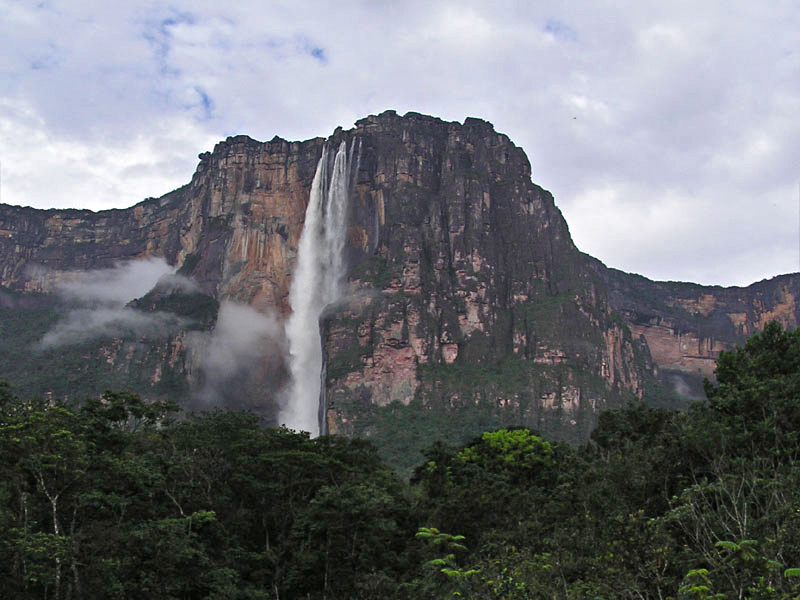
Angel Falls, Bolívar State, Venezuela

Angel Falls (Spanish: Salto Ángel; Pemon language: Kerepakupai Merú meaning “waterfall of the deepest place“, or Parakupá Vená, meaning “the fall from the highest point”) is a waterfall in Venezuela. The waterfall drops over the edge of the Auyán-tepui mountain in the Canaima National Park (Spanish: Parque Nacional Canaima), a UNESCO World Heritage site in the Gran Sabana region of Bolívar State. The height figure, 979 m (3,212 ft), mostly consists of the main plunge but also includes about 400 metres (1,300 ft) of sloped cascade and rapids below the drop and a 30-metre (98 ft) high plunge downstream of the talus rapids.

The falls are along a fork of the Río Kerepacupai Merú which flows into the Churún River, a tributary of the Carrao River, itself a tributary of the Orinoco River. It is the world’s tallest uninterrupted waterfall, with a height of 979 metres (3,212 ft) and a plunge of 807 m (2,648 ft).

Angel Falls in Venezuela
Angel Falls in the morning light
Angel Falls in Venezuela

Angel Falls in Venezuela

Link: https://peacelilysite.com/2021/09/14/angel-falls-in-venezuela/

#AngelFalls #Venezuela #Travel