Dazu Rock Carvings – The Last Monumental Works in the History of World Grotto Art

Detail of reclining Buddha, Parinirvana of Shakyamuni attended by bodhisattvas, Mt. Baoding, Southern Song Dynasty, Dazu, China, 102′ long (photo: Mulligan Stu, CC BY 2.0)

With a history spanning over 1,300 years, the Dazu Rock Carvings represents the pinnacle of grotto art worldwide from the ninth to the thirteenth century. The exquisite and varied cliff-side sculptures at Dazu caves provide outstanding proof of the harmonious fusion of Buddhism, Taoism, and Confucianism in civil. In 1999, the Dazu Rock Carvings was inscribed on the World Heritage List by UNESCO.

Enjoying a comparable reputation with the top four grottoes in China (Mogao Grottoes, Yungang Grottoes, Longmen Grottoes, and Maijishan Grottoes) and being rated as one of the eight grottoes in the world, the Dazu Rock Carvings (“大足石刻” in Chinese), also known as Dazu Caves or Dazu Grottoes, located 167km from the city center of Chongqing. It is the one and only UNESCO World Cultural Heritage Site in Chongqing municipality. The Dazu Rock Carvings consists of 75 cave temple sites, including more than 50,000 statues, being protected for their historical, artistic, and scientific values at different levels, representing the pinnacle of Chinese cave temple art between the 9th and 13th centuries. Among them, rock carvings of Baodingshan (宝顶山), Beishan (北山), Nanshan (南山), Shimenshan (石门山), and Shizhuanshan (石篆山) are exquisitely sculpted with the most distinctive style.

The Dazu Rock Carvings started in the early Tang Dynasty, went through the late Tang Dynasty and the Five Dynasties, and then experienced its golden time in the Northern and Southern Song Dynasty. At the time when cave art in northern China fell into decay, the Dazu Rock Carvings undoubtedly created another peak in the history of Chinese cave art, extending the history of Chinese cave art for more than 400 years. Since then, there have been no such large-scale rock carving events in China or even in the world. Therefore, the Dazu Rock Carvings are also known as the last monument and swan song in the history of the world’s grotto art.
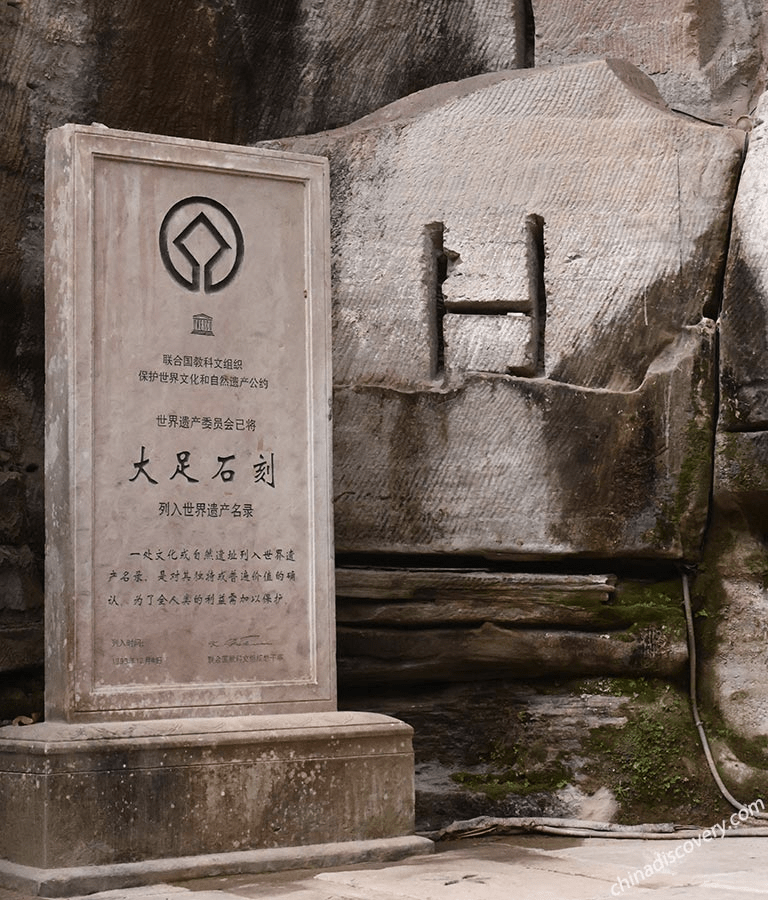
UNESCO Stele of the Dazu Rock Carvings

Differing from famous royal grottoes in the north, the religious cliff inscriptions in Dazu show distinctive features of nationalization, secularization, and everyday life, reflecting the remarkable development and changes in folk religious beliefs. Thus, the Dazu caves have the irreplaceable historical, artistic, scientific, and connoisseurship values of grottoes of the previous generations. Another highlight that has to be mentioned is that the statues there provide outstanding evidence of the harmonious synthesis of Tantric Buddhism, Taoism, and Confucianism. Visitors can see separate stone carvings as well as the unity caves reflecting the three religions’ confluence and ruling together. Moreover, thanks to the southern hinterland location of the Dazu Rock Carvings, this cultural heritage stays far away from man-made sabotage, retaining the integrity of the statues, the original characteristics and values of the period when the carvings were created.

Rock carvings in Dazu are mainly located across five mountains, each containing distinct sets of grottoes, among which the cliff-side sculptures on Baodingshan and Beishan are best known and considered to be the model of the late Chinese grottoes statue art. The pictures of the Dazu rock carvings that we commonly find online were mostly taken at the Baodingshan Scenic Area, which is also the must-visit site for a Dazu Rock Carvings tour.

Baodingshan Rock Carvings (Baodingshan Scenic Area)

Fifteen kilometers northeast from Dazu center, Baodingshan Rock Carvings was constructed by the famous monk Zhao Zhifeng in the Song Dynasty for more than 70 years. As one of the most famous Tantric Buddhist shrines in China, there is an old saying that goes like “Go North, climb the Emei Mountain; Go South, reach the Baoding Mountain.” The centerpiece of the Baodingshan rock carvings is the U-shaped Grant Buddha Bay, also known as Dafowan (“大佛湾” in Chinese). Nearly ten thousand statues are carved along the east, north, and south cliffs, which are approximately 500 meters in length and 8-25 meters high. Like a picture scroll with endless photographs, the content of Baodingshan rock carvings is mainly Buddhist scripture stories, each niche related to the other but not identical.
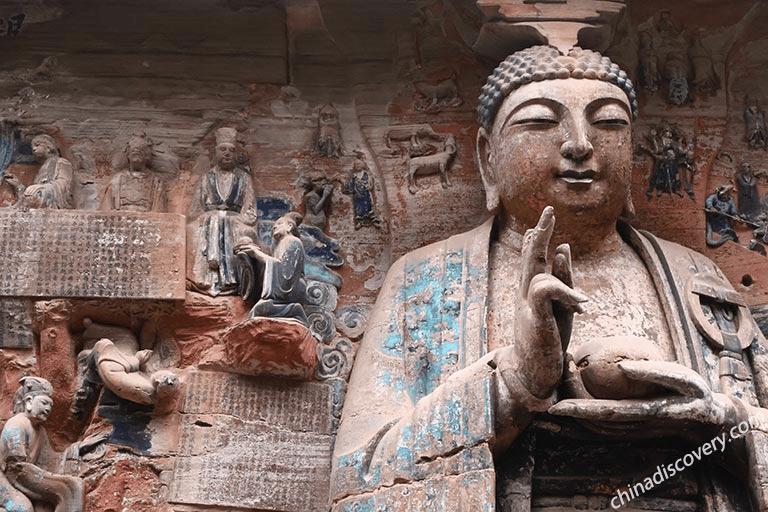
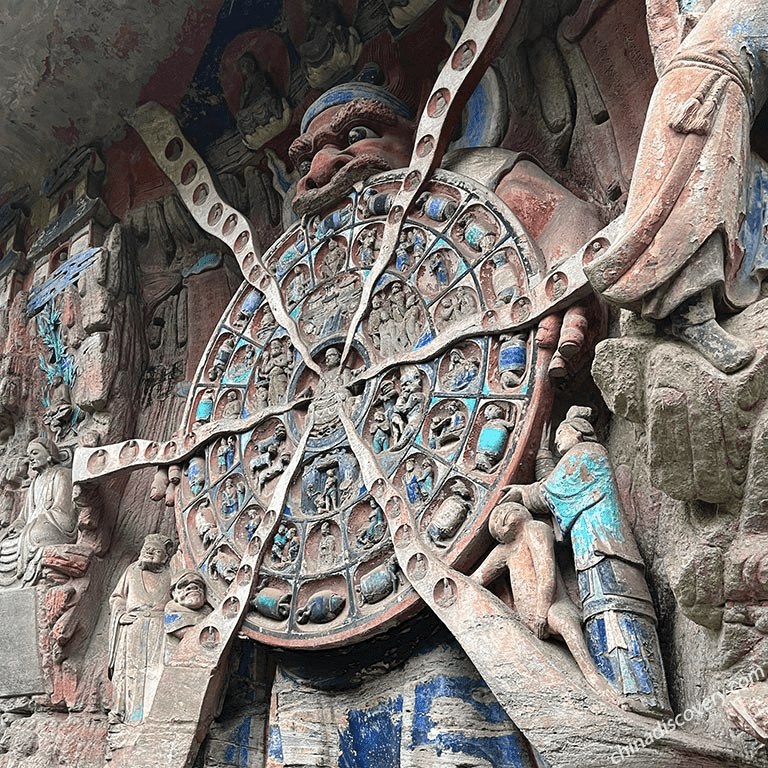
Dazu Rock Carvings – Buddhist Wheel of Life

Avalokitesvara with Thousand Hands

The Buddha statues at Baodingshan are novel in conception, skillful in carving, and rich in secular characters. Religious treasures come one after another, including the representative work – Niche of Sakyamuni Entering Nirvana, one of the wonders of Buddhist art in the world – Avalokitesvara with Thousand Hands, striking image of Buddhist Wheel of Life, scientific designs of Three Saints of Huayan School of Buddhism and Cave of Full Enlightment showed craftsmans’ ingenuity.

In addition, niche content and their expression approach are striving to visualize reality. For instance, Niche of Parental Love Sutra contains ten groups of carvings, including scenes like begging for a son, carrying a child, and going into labor, etc., depicting parental love in bringing up children with plots linking to each other as a picture-book. These carvings are vivid and impressive. They were the outcome after Buddhism had been localized in China.

The ox herding story

Located at the eastern end of the Great Buddha Bend, the ox herding tableau, shows a herdsman taming a disobedient ox—a traditional metaphor for the path to self-enlightenment and a popular theme among Ch’an Buddhist monks and painters in the Song Dynasty. The tableau is made up of eleven vignettes arranged horizontally along a 27-meter cliff wall.

Ox herding story (scene 1–2), Niche 30, Dafowan, Mt. Baoding, Dazu. Southern Song Dynasty (photos: G41rn8, CC BY-SA 4.0)

The first three vignettes each depict a lively interaction between a herdsman and an ox in a landscape setting. The herdsman represents the Buddhist practitioner while the ox refers to the practitioner’s potential to become a Buddha. As the ox turns its body away, the stocky herdsman uses force, grass, and a stick to tame the ox. The verses accompanying the scenes further recount these struggles. 

Herdsmen embracing in the ox herding story (scene 5), Niche 30, Dafowan, Mt. Baoding, Dazu. Southern Song Dynasty (photos: G41rn8, CC BY-SA 4.0)

In the fourth and fifth vignettes, the ox is finally brought under control. The herdsman, featuring a wide, joyful smile, wraps his arms around his fellow herdsman while holding on to the ox with the rope in his hands.

In addition to the uncanny quality of grottoes’ masterpieces at Grant Buddha Bay (Dafowan), there are also many highlights you can’t miss while visiting Baodingshan Scenic Area:

  • Watch a 4K film with English subtitles to learn about the history and development of Dazu rock carvings, and enjoy an 8D view of spectacular grottos at the dome theater
  • Take a leisure stroll at Dazu Rock Carvings Museum (大足石刻博物馆) to gain insights into the whole thread of world cave temple art and the basic characteristics of Dazu Rock Carvings
  • Visit Shengshou Temple (圣寿寺) to admire the exquisite temple architecture, which was rebuilt at the Ming and Qing Dynasties.
Shengshou Temple & Dazu Rock Carvings Museum

Beishan Rock Carvings

1.5km north to Longgang Town of Dazu, with an altitude of 545.5m, Beishan is also called Longgang Mountain in the past. Beishan Rock Carvings is the initial of Dazu Rock Carvings. They were first created by Wei Junjing, prefect of Changzhou, in 892 A.D. of the late Tang Dynasty. Until 1162 A.D. of the Southern Song Dynasty, the existing scale of Beishan Rock Carvings was formed, and it centered around Fowan. The rock carvings are numbered and divided into two sections: No.1 ~ No.100 are in the south section, while No.101 ~ No. 290 are in the north section. There are over 5,000 statues on a 500m long cliff, with a height of 7 to 10 meters. The grottoes are very dense, just like a hive, and all of them are delicate and carved with high sculpture skills.

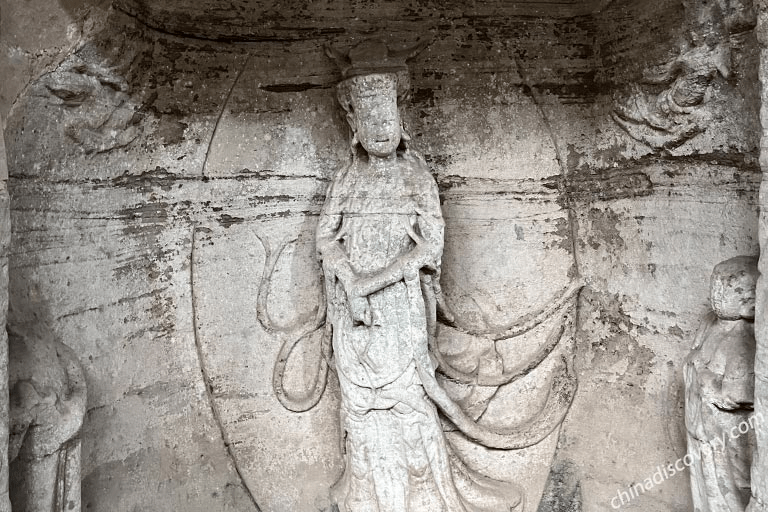
Avalokitesvara with a Rosary

The crowning jewels of Beishan rock carvings are the statues of Avalokitesvara. They are ornamental and artistic, with diverse looks and postures. The most emblematic ones are the Avalokitesvara with a RosaryAvalokitesvara Watching the Moon Reflection in the Water, and Thousand-armed and Thousand-eyed Avalokitesvara, etc.

Beishan rock carvings can be visited both during the day and at night. An additional visual experience is provided by the scenic spot’s usage of colored light to illuminate the stone statues. Besides, if you have enough time and stamina, don’t forget to follow the downhill trail to visit the Duobao Pagoda (多宝塔) to see the giant cliff statues of Beishan, the Two Buddhas of the North Pagoda.

Dazu Rock Carvings – The Last Monumental Works in the History of World Grotto Art

Link:https://peacelilysite.com/2024/01/04/dazu-rock-carvings-the-last-monumental-works-in-the-history-of-world-grotto-art/

#AvalokitesvarawithThousandHands #Shakymunibuddha #DazuRockCarvings #History #WorldGrottoArt #Buddhism #BuddhistArt #BuddhaStatue#Cave#TravelChina #ChineseCulture

Source:https://www.chinadiscovery.com/chongqing/dazu-rock-carvings.html, https://smarthistory.org/mt-baoding-dazu-rock-carvings/

“After attending that dharma assembly, I fell the warmth from my two feet and no longer need to use a hot-water bag to help me fall asleep. Even when I wake up at night, I would pleasantly find that my feet warm….”


“After attending that dharma assembly, I fell the warmth from my two feet and no longer need to use a hot-water bag to help me fall asleep. Even when I wake up at night, I would pleasantly find that my feet warm….”

By: Disciple Huiyu Qiu

In September 2016, I had the good fortune to attend the Dharma Assembly of Empowerment by Kuan Shi Yin Bodhisattva’s Great Compassion held at Hua Zang Si and received very magnificent benefits. I would like to take this opportunity to share my experience and feelings on that day with my fellow cultivators.

At the beginning of the dharma assembly, the presiding master told us to chant the mantra first. The rhythm of chanting was rather slow and the sound was very wonderful and beautiful. My feeling was completely different from my experience of the chanting I normally did.

After chanting for a short while, without knowing any reason, my father, my husband, and my two children suddenly appeared in my mind. The appearance of my father was especially clear. Sadness rose in me and tears streamed down through my face. I thought that they had not taken refuge in Buddhism and did not have the affinity to learn the true dharma of the Tathagata. That was the reason that I could not bear the sad feeling.

I stopped weeping and continue to chant. At that time, my grandparents from both my mother’s side, who have passed away and my father’s side as well as some other family members and relatives all appeared before my eyes. Though the view just flashed by me momentarily, I felt that I saw each of them clearly. I thought about the fact that some of them had not taken refuge while some others, though had taken refuge, were still not diligently making a good effort to learn and practice Buddha-dharma. Thinking that they would surely be in very miserable and lonely situations in the future, I could not suppress my sad mood and wept again.

Then I stopped weeping and continued to chant. Next, the faces of my father, husband, and children emerged before my eyes again. Every time I saw them, my heart was painfully pulled. I could not keep myself from weeping.

I once again stopped weeping and joined the chanting again. At this time, my ears clearly heard the voices of chanting the mantra from the crowd. However, my heart felt that I heard a voice of shouting for rescue. It sounded like a desperate yelling for help from someone who was completely surrounded by a situation of despair and horror. I had a very shocking feeling at the time. Clearly, this is the call for help from living beings, begging Buddhas and Bodhisattvas to rescue them! We are sincerely beseeching Buddhas and Bodhisattvas to save us and cross us over, to lead us to leave the abyss of pain and suffering in samsara forever! At this time, the sadness and bitterness in my heart were beyond description by words. Thus, I cried again with my face covered by tears.

After chanting the mantra, the dharma master announced that the dharma assembly would formally begin. I kept my body in a fixed posture and closed my eyes. I did my best to stay calm.

Very soon, the sound of patting came from behind. Also, people on my right side generated different kinds of sound. Someone before me was crying and fell to the ground. I sensed that she later moved to lie next to my feet (not sure whether she was actually lying down or not) and touched me a few times. I tried not to think about that. Shortly after that, she moved to behind me and started to pat the rear of my left foot and then my right foot. My right foot was hit with more power and more frequently. I dared not move myself at all and tried my best to keep my mind calm. However, I was still somewhat at a loss since I did not know what she might do to me next. When the patting stopped, I felt that she was still behind me. After a while, my right foot was again patted a few times. After that, she seemed to have left me. My eyes were always closed during this period. I dared not open my eyes.

My two arms felt more and more tired. I put my arms down twice and raised them again. After putting down my arms the last time, I felt that my neck began to rotate very slowly from right to left. After rotating two rounds, it went the opposite direction. At that time, I could not be sure whether this was an empowerment from Kuan Shi Yin Bodhisattva or a response made by myself due to being eager to receive empowerment.

Next, my both shoulders began to turn from the front to the back.

After that, I heard singing. I could not hear the words of singing clearly. At this time, my shoulders continued turning and the speed seemed to be faster.

Finally, I could hear clearly that the song was the Six Character Great Bright Mantra and “Namo Kuan Shi Yin Bodhisattva.” I first followed the singing with humming and then joined with my open voice. At this time, the movement of my two hands became bigger. My hands were swinging back and forth and left and right, as if doing a stretching exercise. However, all movements were spontaneous and beyond my own control.

At this time, I heard a fellow sister behind me speaking loudly in Cantonese. She seemed to be saying that we have committed lots of sins and evil deeds in the past and therefore we now must repent earnestly and so on.

My hands continued swinging. I followed the singing and joined from time to time. At this time, my hand movement changed and turned into a movement of dancing. That was the hand gesture in a Chinese classic dance. I was dancing to the singing. My heart was filled with the joy of the dharma. With a smile on my face and while singing lightly, I made all kinds of wonderful movement with my hands (At least I felt that my hand movement was very wonderful.). Totally without any control, I felt that all movements were so smooth, fluent, and natural. Though my eyes were always closed, my mind was very clear and very much open. I was clearly aware what gestures and movements were performed by my hands. However, the dancing and moving of my hands was not directed by my own mind.

My two hands kept waving and moving. However, when the master leading the dharma practice called out “Stop!”, my hands gradually moved to a position before my chest and stopped there.

After the perfect conclusion of the dharma assembly, the attending crowd went together to perform the ending practice of saving living beings from captivity. On the trip of driving back home, I unexpectedly noticed that my two feet were warm. This was something extraordinary to me. For quite a number of years, my two feet were rather cold. In particular, I must have a hot water bag prepared before going to bed. Otherwise I would not be able to fall asleep. Even if I went to sleep after having a hot bath or having my feet soaked in hot water, my feet would still be cold. Sometimes when I did not use a hot water bag, I would wake up at night with my feet being ice-cold. I could feel the chilly air from my bones and would even tremble. At that time, I had to have the hot-water bag ready immediately. After attending that dharma assembly, I fell the warmth from my two feet and no longer need to use a hot-water bag to help me fall asleep. Even when I wake up at night, I would pleasantly find that my feet warm.

I am grateful to the empowerment bestowed on me by the greatly loving and greatly compassionate Kuan Shi Yin Bodhisattva!

Additionally, I also had an unexpected discovery. The ankle joints in my two feet were no longer in pain. I could not remember since when my ankle joints started to ache, but it should have been for quite a while. I did not know what the cause was either. Normally, there was no pain if I do not touch them. However, it was very painful if the spot was pressed. Therefore, when I sat crossed legged to practice meditation, a towel or a blanket must be placed under my feet. Otherwise I would not be able to keep myself in a sitting position.

Yesterday evening, while chatting with my family members after dinner, I reached out to massage the ankle joints on my right foot as I used to do. I did not even feel any pain at all. I immediately pressed the ankle joints on my left foot and did not feel any pain either. I dared not believe that fact at the time and repeatedly pressed the spots many times. It was really true that I had no pain at all.

I once again express my gratitude to the greatly loving and greatly compassionate Kuan Shi Yin Bodhisattva!

This dharma assembly was very magnificent. The attending crowd were also empowered by Kuan Shi Yin Bodhisattva’s great compassion and were full of the joy from the dharma. Had I not experienced the occasion in person, I absolutely would not be able to imagine the inconceivable feeling and benefits I had when the empowerment from Buddhas and Bodhisattvas came to me!

I gratefully prostrate to H.H. Dorje Chang Buddha III!

I gratefully prostrate to the greatly loving and greatly compassionate Kuan Shi Yin Bodhisattva!

I gratefully prostrate to all Buddhas and Bodhisattvas in the ten directions!

Link: https://wisdomtea.org/2023/02/23/after-attending-that-dharma-assembly-i-fell-the-warmth-from-my-two-feet-and-no-longer-need-to-use-a-hot-water-bag-to-help-me-fall-asleep-even-when-i-wake-up-at-night-i-would-pleasantly-fin/

Mount Putuo – Buddhist Land on The Sea

Mount Putuo – Buddhist Land on The Sea

Mount Putuo is one of the four sacred mountains in Chinese Buddhism, lies in the East China Sea and incorporates the beauty of both mountain and sea, and honored as the Buddhist Land on the Sea. Its area is approximately 12.5 square kilometres (4.8 sq mi) and there are numerous famous temples. Mount Putuo has been a pilgrimage site for over a thousand years. After the Tang dynasty, Mount Putuo became a center of Avalokitasvara (Guanyin) worship.

In 863, a Japanese monk called Hui E aimed to carry a statue of Avalokitasvara from Mount Wutai to his country by ship. However, when the ship was passing through the sea nearby Mount Putuo, it was prevented by the stormy waves and hundreds of iron lotus flowers suddenly appeared on the sea, blocking the way. Monk Hui E believed that Avalokitasvara didn’t want to leave China. So he knelt down on the bow of the boat and silently prayed to the Bodhisattva Avalokitasvara for instructions. After a while, the iron lotus on the sea disappeared, and the boat drifted to the shore of Mount Putuo, where he built a temple in the purple bamboo forest to enshrine the statue of theBodhisattva. From that time, Mount Putuo got the spirit and became the bodhimanḍa of Bodhisattva Guanyin.

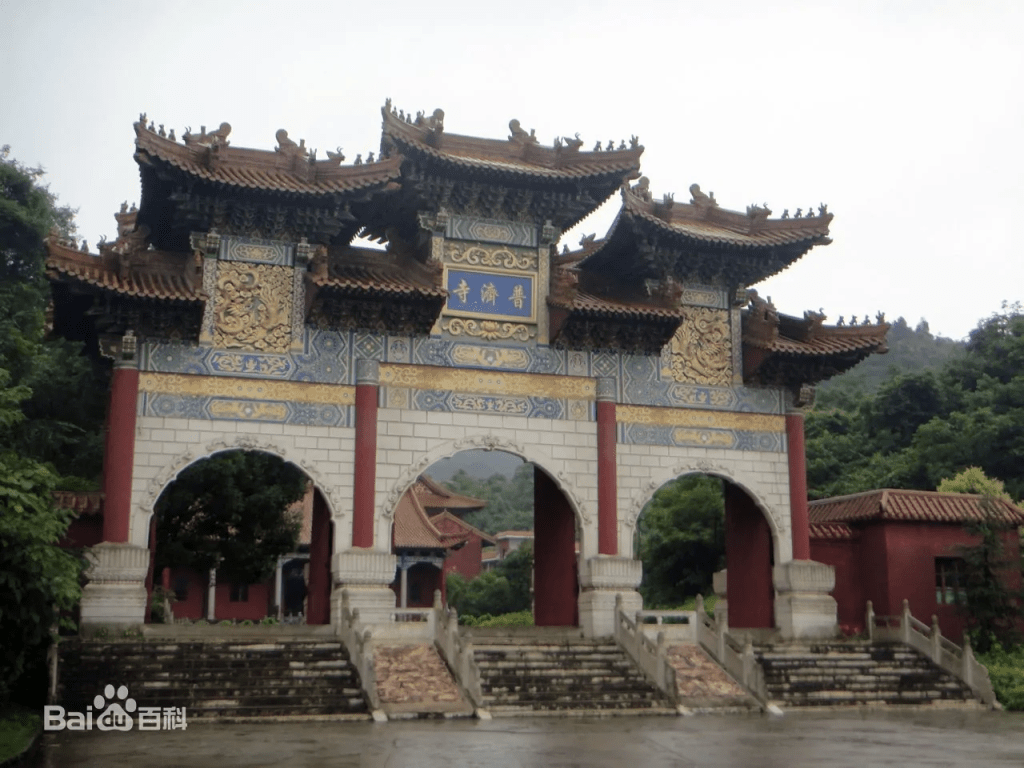
Traditionally there were three main temples: The Puji Temple (founded 10th cent.), the Fayu Temple  (founded 1580 CE), and the Huiji Temple (founded 1793 CE).  Today, there are more than 30 major temples located at Mount Putuo. In addition to these monasteries, there is the Institute of Buddhism, one of the largest Buddhist academic institutes in China.

Puji Temple

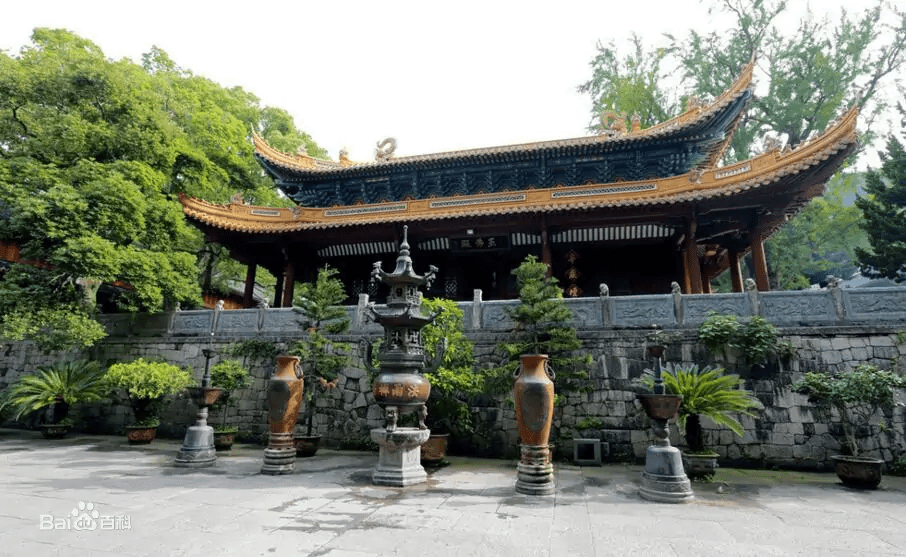
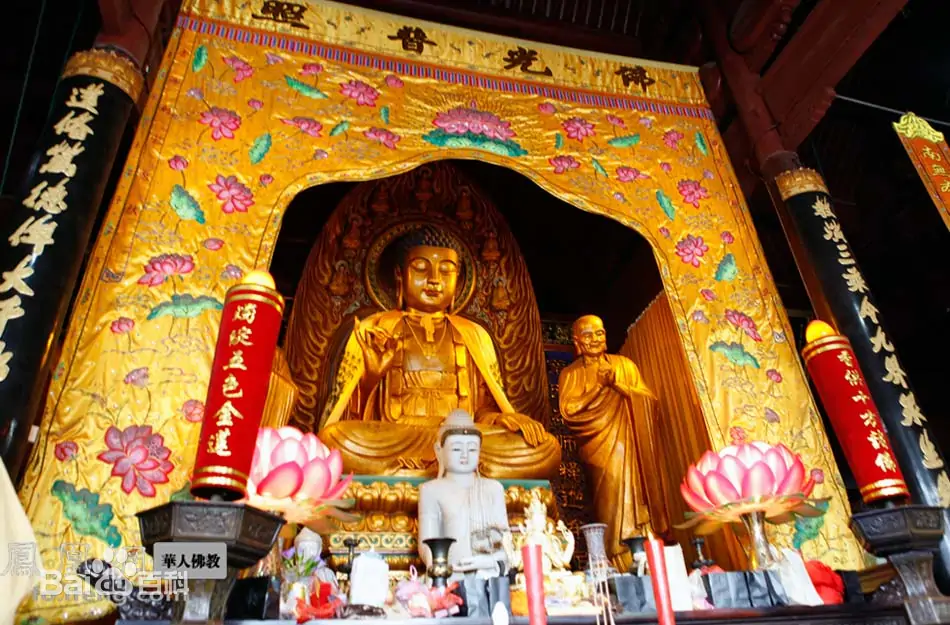
Puji Temple is the main temple of Mount Putuo and all important Buddhist activities are held here. Covering an area of 37,019 square meters, it contains Grand Yuantong Palace, Hall of Heavenly Kings, Depository of Buddhist Sutras and 357 other buildings. Grand Yuantong Palace is the main hall which houses an 8-meter-high statue of Guanyin surrounded by 32 Bodhisattva with different costumes in a variety of poses on east and west walls. Haiyin Pond in Puji Temple was a free life pond full of spring water primitively and now a lotus pond. At the night of summer, the gorgeous lotus and bright moonlight compose an attractive scenery. 

Puji Temple
Haiyin Pond in Puji Temple

Fayu Temple

Fayu Temple was built along the uphill with grand building groups and extraordinary manners. It got such a name in that you could see amazing relives of nine dragons are fighting for pearl on the screen wall before the gate of Halls of Heavenly Kings. Among the 294 halls of Fayu Temple, Nine Dragons Guanyin Palace(also called Grand Yuantong Palace), said to be a Buddhist Temple transported from the imperial palace of Ming Dynasty, acts as the most magnificent one. The highlighted part of this palace must be the Nine Dragons Caisson Ceiling. With unique shapes and vivid images, it enjoys high artist value and is listed in Three Treasures of Mount Putuo.

FaYu Temple
Delicate Carvings in Nine Dragons Screen Wall

Huiji Temple (惠济禅寺)

Huiji Temple is perched in Foding Mountain, the highest peak of Mount Putuo. The architecture of the whole temple is unique. It is located on the mountain and is arranged horizontally. The hall is spacious and magnificent. Hidden in a luxury forest, Huiji Temple features in peaceful environment. Standing at the peak of Mount Putuo, you can have a distant view of the mountains, sea, reefs, beaches and buildings. In the whole temple, statues, carvings and pictures of Guanyin can be found everywhere.

Grand Huiji Temple
Status of Guanyin Bodhisattva

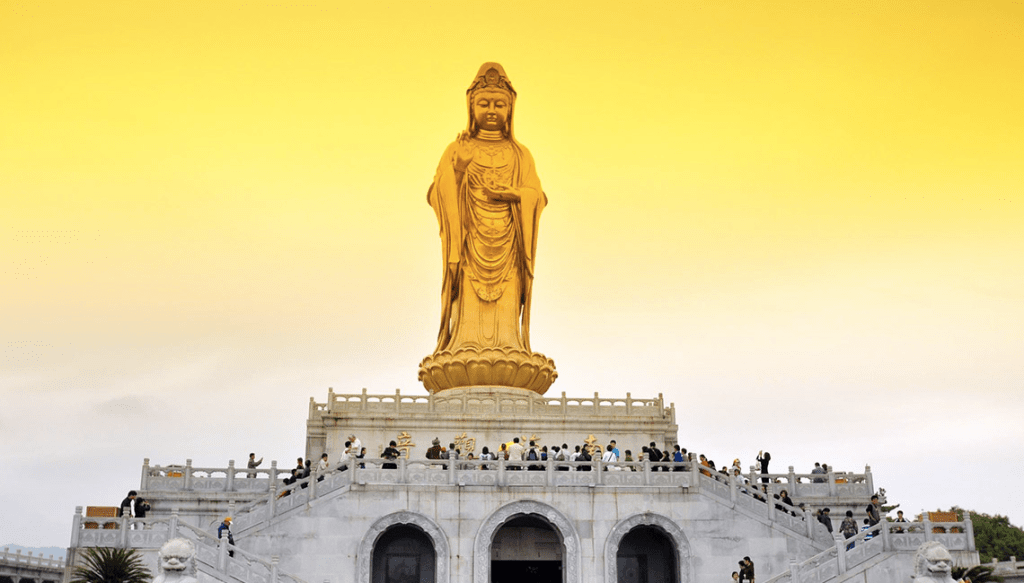
Statue of Standing Nanhai Guanyin

Standing in the south Shuangfeng Peak, Statue of Standing Nanhai Guanyin is the largest outdoor statue of Guanyin made from copper in Asia. With an 18-meter-high statue, 2-meter-high lotus and 13-meter-high foundation, the whole structure has two stories in its foundation. The first story displays elegant carvings, while the second story houses 500 statues of Guanyin in different poses. On the consecrating day at year 1997, a strange nature phenomenon happened. Before the consecrating ceremony, the sky was full of dark cloud and it seemed that it would rain soon. However, as the ceremony began, it became sunny as if two hands pushed aside the clouds. A beam of sunlight just casts on the Guanyin statue.

Statue of Nanhai Guanyin

Avalokitasvara, Guan Shi Yin in Chinese, means the Perceiver of World’s Sounds. The Lotus Sutra says: “Perceiver of the World’s Sounds, heavenly voice, the voice of the sea’s tide—magnificent, rich and harmonious surpassing all worldly sounds.” The bodhisattva always help all beings in danger and distress and is willing to bear the pain of all beings. There are many stories and folk tales about the bodhisattva’s infinite mercy and compassion.

If we hold the bodhisattva in our hearts and call on her sincerely, she will always respond. I had a personal experience. You can read my story here: Guan Shi Yin Bodhisattva saved my life

Fortunately for us, H.H. Dorje Chang Buddha III has brought the powerful Dharma to this world: the Avalokiteshvara Bodhisattva Great Compassion Empowerment Dharma (觀音大悲加持法). This Dharma does not require the practitioner to have any Dharma powers or holy realization. As long as you have the power of the lineage, that is sufficient. You can succeed the same day you take up the practice of it. The next day, you can convene people, empower them, and lead them into a supernormal state. Many Buddhist disciples have participated the dharma assembly and recorded their true extraordinary experience. Click here to read some example articles: 1. Dharma Assembly of Empowerment by Guan Shi Yin Bodhisattva’s Mind of Great Compassion ——Note Written Afterwards to Describe the Most Magnificent Scene at the Site,2. Guan Yin Bodhisattva of Great Compassion Empowerment Dharma Assembly- ——A Personal Experience Written Afterwards to Describe the Most Magnificent Scene at the Site.

May the greatly loving and compassionate Namo Guan Shi Yin Bodhisattva bless all beings!!!

Mount Putuo – Buddhist Land on The Sea

Link:https://peacelilysite.com/2022/07/13/mount-putuo-buddhist-land-on-the-sea/

#MountPutuo#BuddhaLandonTheSea#DorjeChangBuddhaIII#HHDorjeChangBuddhaIII#DorjeChangBuddha#BuddhaDharma#Avalokitasvara#Bodhisattva#GreatMercy#Compassion#Empowerment#Buddhism#Temple#PuTuoShan#GuanYin#GuanShiYin

Source: https://en.wikipedia.org/wiki/Mount_Putuo, https://www.chinadiscovery.com/zhejiang/putuoshan-mountain.html