Exploring the Concept of Size in Buddhism: Mount Sumeru and the Mustard Seed

In the realm of Buddhist philosophy, the imagery of Mount Sumeru and the mustard seed serves as a profound metaphor for understanding the nature of reality and perception. Originally a mountain in Indian mythology, Mount Sumeru is revered in Buddhism as the dwelling place of celestial beings like Indra and the Four Heavenly Kings. Standing at an astonishing height of 84,000 yojanas, it symbolizes the vastness and grandeur of existence. In contrast, the mustard seed, a tiny grain often used in culinary practices, represents the minuscule aspects of life.

This juxtaposition is beautifully illustrated in a dialogue between Li Bo, a governor of Jiangzhou during the Tang Dynasty, and the Zen master Zhi Chang. Li Bo questioned the seemingly paradoxical notion found in Buddhist texts that “Mount Sumeru can fit within a mustard seed, and a mustard seed can contain Mount Sumeru.” He found it hard to believe that such a small seed could encompass such a towering mountain.

With a smile, Zhi Chang responded by asking, “People say you have read thousands of books; is that true?” Proudly, Li Bo affirmed, “Of course! I have read far more than that!”

Zhi Chang then inquired, “And where are those thousands of books now?”

Li Bo pointed to his head and replied, “They are all right here!”

Zhi Chang chuckled and said, “Strange, then. Your head seems no bigger than a coconut; how could it possibly hold thousands of books?”

At that moment, Li Bo experienced a profound realization: the distinctions of large and small are mere constructs of the mind. In reality, size is subjective and arises from our perceptions.

This concept resonates deeply with modern science, which demonstrates that vast amounts of knowledge can be stored within a minuscule chip, echoing the Buddhist teaching that the universe can be contained within the smallest of objects.

The English poet William Blake expressed a similar sentiment in his famous lines:
“To see a world in a grain of sand,
And a heaven in a wild flower,
Hold infinity in the palm of your hand,
And eternity in an hour.”

His words capture the essence of this Buddhist teaching: within the tiniest elements of our world lies the vastness of the infinite.

Ultimately, Buddhist wisdom encourages us to transcend conventional notions of size and reality. When we embrace the idea that the vast can reside within the minute, we cultivate a deeper awareness of the interconnectedness of all things. In this way, Mount Sumeru and the mustard seed serve as powerful reminders of the boundless nature of existence and the limitless potential of the human mind.

In the Āgama Sūtra, there is a remarkable story that illustrates how the merit of a single grain of rice can be as vast as Mount Sumeru.

During the time of the Buddha, a poor couple lived in a crumbling cave with nothing to their name. They were so impoverished that they owned only a single set of clothes, which they had to share. When the husband went out, the wife had to stay home, and when the wife needed to leave, the husband had no choice but to remain inside, barely clothed.

One day, they heard that the Buddha and his disciples were passing through their village on their alms rounds. The couple reflected on their misfortune and said, “We have never practiced generosity, which is why we suffer such poverty today. Now that the Buddha is here, how can we miss this rare opportunity to give?”

However, as they looked around their home, the wife sighed deeply, “But we have nothing to offer…”

The husband, after thinking for a moment, made a firm decision: “No matter what, we must not let this opportunity slip away. Even if we starve, we must make an offering! The only thing we still have of value is this set of clothing—let us give it to the Buddha!”

With hearts full of joy, they humbly presented their only garment as an offering. The disciples, however, hesitated, feeling uneasy about receiving such an item. They passed the garment among themselves, reluctant to accept it, until Ananda finally brought it before the Buddha and asked, “Lord, this garment is too worn to be used. Should we discard it?”

The Buddha, filled with compassion, gently instructed, “My disciples, do not think this way. The generosity of the poor is the most precious of all. Bring the garment to me.”

Feeling ashamed for their earlier hesitation, Ananda and Maudgalyayana took the garment to the river to wash it. But as soon as they immersed it in the water, the entire river surged wildly, waves crashing in all directions. Alarmed, Maudgalyayana used his divine powers to summon Mount Sumeru in an attempt to subdue the turbulent waters. Yet, no matter how he pressed it down, the waves remained uncontrollable.

Helpless, the two disciples rushed back to the Buddha to report what had happened. At that moment, the Buddha was calmly eating his meal. Without saying much, he gently picked up a single grain of rice and handed it to them, saying, “Take this rice grain to the river, and it will settle.”

Perplexed, Ananda asked, “Lord, even the mighty Mount Sumeru couldn’t calm the waves—how can a tiny grain of rice possibly do so?”

The Buddha smiled and said, “Try it and see.”

Still doubtful but obedient, Ananda and Maudgalyayana took the grain of rice and cast it into the river. Miraculously, the raging waters instantly calmed, becoming as still as a mirror.

Shocked by what they had witnessed, the two disciples returned to the Buddha and asked, “How could a single grain of rice hold more power than a mountain?”

The Buddha then explained, “From the moment a grain of rice is planted, it undergoes countless efforts—watering, fertilizing, harvesting, processing, and selling—each step carrying the labor and dedication of many beings. Because of this, a single grain of rice contains immeasurable merit. Likewise, the garment offered by the poor couple was their only possession, their entire livelihood. Their act of giving was boundless in sincerity, making its merit just as vast. The Dragon Kings of the ocean understood the profound virtue behind this offering, which is why they immediately retreated in reverence. This is the power of true devotion—whether a grain of rice or a simple piece of clothing, when given with absolute sincerity, its merit can equal that of Mount Sumeru.”

From this teaching, a well-known Buddhist verse arose to remind monks and practitioners of the sacred nature of even the smallest offering:

“A single grain of rice in the Buddha’s gate,
As vast as Mount Sumeru.
If enlightenment is not attained in this life,
One shall return repaying the debt, bearing horns and fur.”

This verse serves as a powerful reminder that every offering—no matter how small—carries immense significance when given with a pure heart. It also warns practitioners to cherish and respect all acts of generosity, for every grain of rice represents the kindness and labor of countless beings.

Link:https://peacelilysite.com/2025/03/21/exploring-the-concept-of-size-in-buddhism-mount-sumeru-and-the-mustard-seed/

BRIEF INTRODUCTION TO THE SUPREME LEADEROF JONANG SECT H.H. DHARMA KING JIGME DORJE

Within Tibetan Buddhism, the Jonang sect has been known around the world for the true practice of its followers. There currently are two dharma kings who are in charge of the dharma teachings of the Jonang sect. One of them is the head of the Zangwa Monastery, H.H. Dharma King Jigme Dorje. The other is H.H. Dharma King Ngagwang Pedma Namgyal Palzangpo of the Longshijia Monastery. There is also a young future sect leader, Jianyang Lezhu Rinpoche, who is vice-head of the Zangwa Monastery.

When Shakyamuni Buddha lived in the world, H.H. Dharma King Jigme Dorje Rinpoche was already a great Bodhisattva in that lifetime. H.H. Dharma King Jigme Dorje was born in 1944 accompanied by various amazing auspicious signs that cannot be fully described. As a child, he never did anything to upset his parents, such as crying or acting in a common, childish way. He was very much different from other children. The masters of a monastery, as well as the monastics and laypersons in that monastery who handled monastery matters, all praised the child as being the incarnation of a wonderful Bodhisattva who had come back to this world voluntarily. Later, he went to the headquarters of the Jonang sect, the Zangwa Monastery in Rangtang, where he worshipped the Buddhas. His uncle, the Sai Rinpoche by the name of Awang Genga Phuntsok who lived at the Zangwa Monastery, saw that this child was the incarnation of a holy being. In accordance with the dharma, Awang Genga Phuntsok Rinpoche recognized that the child was the true reincarnation of a rinpoche who had been the head of the Zangwa Monastery. In accordance with the dharma rules, Lama Danba Daji from Xiayan, Lama Aguoba from Hongtu, and others practiced the dharma, entered holy supernatural states, and confirmed the accuracy of Awang Genga Phuntsok Rinpoche’s conclusion. They then made their formal pronouncements concerning the identity of H.H. Jigme Dorje. Moreover, the International Buddhism Sangha Association held an unprecedented Drawing Lots From a Golden Vase Ceremony to affirm the true reincarnated identity of H.H. Dharma King Jigme Dorje and others. There were ten possible identities recognized by various rinpoches. One lot was drawn from among 120 lots to affirm the true reincarnated identity of H.H. Dharma King Jigme Dorje. That drawing affirmed that H.H. Dharma King Jigme Dorje is the incarnation of Shambhala King Suchandra, which is the reincarnated identity that H.H. Dorje Chang Buddha III recognized before that lot was drawn.

After the formal enthronement ceremony for H.H. Jigme Dorje Rinpoche was performed at Saige Monastery in Aba County and the celebration of the enthronement ceremony was performed at Zhuoge Monastery, the rinpoche returned to Zangwa Monastery. The intelligence of the rinpoche is extraordinary. He was able to thoroughly learn and recite the scriptures, treatises, and rituals without having to exert himself. He later served as a disciple under his root master, Awang Gongqiu Daji, who was the Vajra Master of the Zangwa Dazang Monastery and the 44th Kalachakra Dharma King of the Jonang sect. Under H.H. Awang Gongqiu Daji, the rinpoche learned and practiced the five preliminary practices of the Jonang sect and the generation and completion stages of the Kalachakra Vajra the Six Yogas. He reached perfect merit in every dharma he practiced.

When the rinpoche was eight years old, he succeeded to the throne of the head of the Zangwa Monastery. However, at this time, his uncle, the Sai Rinpoche, and H.H. Dharma King Awang Gongqiu Daji predicted to H.H. Jigme Dorje Rinpoche that changes in the world situation would occur that would be disadvantageous to Buddhism. They told the rinpoche to go back to Aba County and that in the future, when the world situation stabilizes, he should return to the Zangwa Monastery and teach the dharma. Afterward, the Sai Rinpoche passed away and later H.H. Dharma King Awang Gongqiu Daji passed away as well. H.H. Jigme Dorje Rinpoche then went to Aba County, where he requested and received the complete precepts from Lama Tujihua of Sai. He later served as a disciple under another root master, Lama Kesang, who is the nirmanakaya of the Eleven-Faced Kuan Yin Bodhisattva. Under Lama Kesang, the rinpoche learned all of the initiation and lineage teachings. During this time period, he both herded goats and cultivated himself in caves, tree holes, and other places while traveling from mountain to mountain. He realized the state of viewing all phenomena as equal and the state where the mind is not affected by the situation one encounters. Thus, he became a free and unhindered person of great accomplishment in the dharma. He then lived in a cave, where he continued his practice of the dharma.

After the restraints on religion were slightly eased, the supreme leader of the Jonang sect, H.H. Dharma King Yundan Sangbu of the Zangwa Monastery in Rangtang, twice dispatched people to the cave at the Zilang Monastery in Aba County (that was the cave in which Maji Lazun practiced the Xiduan Dharma) where the rinpoche was staying. H.H. Dharma King Yundan Sangbu did so based upon the formal pronouncements of certain great masters of the past. When those dispatched arrived, they invited H.H. Jigme Dorje Rinpoche to go to the Zangwa Monastery and lead the teaching of the Buddha-dharma. There was a third visit when H.H. Dharma King Yundan Sangbu himself went to that cave at the Zilang Monastery, bringing with him a kharda (white silk scarf). When the two venerable ones met, they praised each other. H.H. Dharma King Yundan Sangbu repeatedly urged H.H. Jigme Dorje Rinpoche to follow the formal pronouncements of those great masters of the past by going to the Zangwa Dazang Monastery, by leading the teaching of the Buddha-dharma of the Jonang sect at that monastery, and by being the monastery’s retreat lineage Vajra Master. H.H. Jigme Dorje Rinpoche then gave his response to the formal pronouncements of those three masters of the past (H.H. Dharma King Gongqiu Daji, the Sai Rinpoche, and Lama Kesang) that he must go to the Zangwa Monastery in Rangtang. He respectfully said to H.H. Dharma King Yundan Sangbu, “Your merit and cultivation are like those of my father. You are my master. I will carry out your instructions well!”

After H.H. Jigme Dorje Rinpoche returned to the Zangwa Monastery at Rangtang, he helped H.H. Dharma King Yundan Sangbu restore the monastery and build Buddhist statues. The rinpoche performed initiations and dharma transmissions at regular intervals and guided those on retreat. He perpetuated the dharma teachings of the Jonang sect in this human world and propagated such teachings around the world.

In accordance with the rules handed down by the historical masters, H.H. Dharma King Yundan Sangbu personally handed over to H.H. Jigme Dorje Rinpoche in 1998 certain precious objects passed down through the generations by past masters, such as a vajra bell, a vajra, and the writing called “Guiding Text You Will Know Its Meaning When You See It.” He also formally conferred upon H.H. Jigme Dorje Rinpoche the positions of 47th dharma throne holder of the Jonang Kalachakra lineage and 11th Vajra Master of the Zangwa Dazang Monastery. After H.H. Dharma King Yundan Sangbu passed away, H.H. Dharma King Jigme Dorje became the supreme leader of the Jonang sect.

After H.H. Dharma King Jigme Dorje saw who His Holiness Dorje Chang Buddha III Wan Ko Yeshe Norbu is through the limitless omniscience displayed in A Treasury of True BuddhaDharma, he stated that His Holiness Wan Ko Yeshe Norbu has reached the highest state of Buddhahood in the few-thousand-year history of Buddhism, having truly attained complete.

CONGRATULATIONS
United International World Buddhism Association Headquarters:
On behalf of the Jonang sect, I hereby respectfully congratulate H.H. Dorje Chang Buddha III Wan Ko Yeshe Norbu for directly propagating in this world the teachings of Buddhism. Such teachings have benefited countless living beings in their practice of the dharma and have caused countless living beings to obtain deep blessings and wisdom. The book A Treasury of True Buddha-Dharma especially shows this Buddha’s complete proficiency in exoteric and esoteric Buddhism and perfect mastery of the Five Vidyas. Such superlative accomplishments are truly unprecedented in the past few thousand years, outshining the accomplishments of all others, both ancient and modern. His Holiness is a shining paragon among Buddhas. May this inexhaustibly mighty light and power of compassion continue so that His Holiness forever teaches the dharma and forever remains in the world. I place my palms together and respectfully praise His Holiness.

I respectfully prostrate to H.H. Dorje Chang Buddha III, Wan Ko Yeshe Norbu!
Supreme Dharma King of the Jonang Sect
Jigme Dorje
May 8, 2007

Link:https://peacelilysite.com/2025/01/10/brief-introduction-to-the-supreme-leaderof-jonang-sect-h-h-dharma-king-jigme-dorje/

Source: A Treasury of True Buddha Dharma


Transforming Destiny: The Inspirational Journey of Yuan Liaofan

In the heart of Ming Dynasty China, a man named Yuan Liaofan emerged, leaving an indelible mark on history. Born in the picturesque Wujiang County, Jiangsu Province, China, Yuan Liaofan’s original name was Yuan Huang. With the courtesy name Kunyi and the alternative name Xuehai, he later adopted the name Liaofan, symbolizing a profound shift in his life’s trajectory. During his life, he underwent a precise fortune-telling by an adept in divination, which turned out to be accurate. However, Yuan Liaofan later transformed his own destiny.

Yuan Liaofan’s transformative journey began when he sought guidance from a revered monk, a master in the art of divination. The monk, through precise fortune-telling, revealed a predetermined path for Yuan Liaofan. Undeterred by this revelation, the monk imparted invaluable wisdom on how to change his fate.

The monk emphasized the importance of performing virtuous deeds and accumulating positive karma. He outlined a path that involved actively engaging in a thousand good deeds, actions that would not only benefit others but also bring about profound changes in Yuan Liaofan’s own destiny.

Embracing the monk’s teachings, Yuan Liaofan dedicated himself to a life of kindness, compassion, and generosity. He embarked on a mission to perform a thousand good deeds, each act carefully documented in a personal ledger. His deeds ranged from helping the needy and supporting the less fortunate to acts of kindness that reverberated through his community.

As Yuan Liaofan diligently pursued this virtuous path, the effects on his life were nothing short of remarkable. Contrary to the fortune-teller’s prediction that he would not have a son, Yuan Liaofan became a father, experiencing the joys of parenthood. His household, once devoid of the laughter of children, now echoed with the sounds of familial bliss.

Additionally, the diviner had foretold that Yuan Liaofan’s life would be limited to fifty-three years. However, Yuan Liaofan defied this prediction, living a full and fulfilling life until the age of seventy-four. The positive energy generated by his virtuous deeds not only defied fate but also led to a prolonged and healthy existence.

The transformative effects were not confined to his personal life alone. Yuan Liaofan’s career path witnessed an upward trajectory. Through his dedication, hard work, and the positive energy he exuded, he achieved professional success, earning promotions and garnering respect within his professional sphere.

“The Four Lessons of Liaofan,” penned by Yuan Liaofan himself, stands as a testament to his transformative experiences. It serves as a guiding light for all who aspire to harness the potential within themselves to cultivate positive change.

As we navigate the complexities of our modern existence, let Yuan Liaofan’s story inspire us to embark on a journey of goodwill. Embrace the opportunity to contribute to the well-being of others, and in doing so, witness the transformative effects it can bring to your own life.

May Yuan Liaofan’s tale be a beacon of encouragement for us all, urging us to embrace the inherent ability within ourselves to shape our destinies. After all, the power to create a life of abundance and health lies not in the stars, but within the choices we make each day.

Transforming Destiny: The Inspirational Journey of Yuan Liaofan

Link:https://peacelilysite.com/2024/01/26/transforming-destiny-the-inspirational-journey-of-yuan-liaofan/

Source: https://www.pure-land-buddhism.com/blog/liaofans-four-lessons-your-destiny-is-in-your-hands

Way to Find Your Inner Voice and Happiness

Once upon a time in a remote village, nestled between the mountains, there lived a wise old monk named Master Sean. He was renowned for his ability to guide people in finding their inner voice, a skill that had been passed down through generations of monks in his lineage.

One day, a young man named Kaito arrived at the monastery seeking guidance from Master Sean. He had heard tales of the wise monk and hoped to learn the secret of listening to his inner voice. Master Sean welcomed Kaito with a warm smile and led him to a quiet room overlooking the monastery’s lush gardens.

Before we begin,” said the wise monk, “I want you to spend some time in silence, observing the garden and the creatures that inhabited it.” Kaito sat by the window watching the birds flip from branch to branch, the squirrel scamper across the grass, and the butterflies dance in the breeze. As he observed the harmony of nature, he felt a sense of peace wash over him.

After some time, Master Sean returned and asked Kaito what he had learned from his observations. Kaito replied, “I saw how each creature has its own rhythm and purpose and how they all coexist in harmony.” Master Sean nodded, pleased with Kaito’s insight.

“Now let me tell you a story,” he said, settling into a comfortable chair. “Once there was a young monk who lived in a monastery high in the mountains. He was diligent in his studies and meditation, but he struggled to hear his inner voice. One day, his master took him to a nearby cave where they found a small clear pool of water.”

The master instructed the young monk to gaze into the pool and describe what he saw. The young monk peered into the water and saw his own reflection, along with the reflections of the cave walls and the flickering light of their torches. The master then asked the young monk to close his eyes and listen to the sounds around him.

The young monk heard the gentle dripping of water, the distant echo of their voices, and the soft rustling of the wind outside the cave. Finally, the master told the young monk to open his eyes and look into the pool once more. This time, the young monk saw something different beneath the surface of the water. He could see a world of shimmering fish darting among the rocks and plants.

The master explained that the pool was a metaphor for the young monk’s mind. The surface reflections represented his thoughts and emotions, while the hidden world beneath symbolized his inner voice. To hear that voice, the young monk needed to learn to look beyond the surface distractions and listen deeply to the quiet whispers within.

Kaito listened intently to Master Sean’s story, feeling a spark of understanding ignite within him. He asked, “How can I learn to look beyond the surface and hear my inner voice?” Master Sean smiled and replied, “You must practice mindfulness and cultivate stillness in your mind. Just as the pool’s surface becomes calm and undisturbed, so too will your mind reveal its hidden depths when you learn to quiet your thoughts and emotions.”

Over the following weeks, Kaito practiced meditation and mindfulness under Master Sean’s guidance. He learned to observe his thoughts without judgment, allowing them to pass like clouds in the sky. Gradually, he began to hear the whispers of his inner voice, guiding him with wisdom and clarity.

As the story of Kaito and Master Sean comes to a close, let us reflect on the nature of happiness. Happiness, like the inner voice, is often found in the depths of our being, beyond the surface distractions of our thoughts and emotions. It is not a fleeting sensation or a temporary state, but rather a profound sense of contentment and inner peace that arises from living in harmony with our true selves.

To cultivate happiness, we must learn to listen to our inner voice, allowing it to guide us on our journey through life. By embracing mindfulness and stillness, we can quiet the noise of our minds and tune into the wisdom that resides within us. In doing so, we discover that happiness is not something to be pursued or acquired, but rather a natural state of being that emerges when we align ourselves with our deepest values and aspirations.

In the words of the ancient philosopher Lao Tzu, “Happiness is the absence of the striving for happiness.” May we all find the courage to let go of our endless pursuit of external validation and material success, and instead turn inward, seeking the happiness that lies within our own hearts and minds.

Way to Find Your Inner Voice and Happiness

Link: https://peacelilysite.com/2023/07/21/way-to-find-your-inner-voice-and-happiness/

Source: https://www.youtube.com/watch?v=GvaXoS782sE

The Story of Bhiksuni Weimiao

The Story of Bhiksuni Weimiao

Sutra about Wisdom and the Foolishness [賢愚経] ( A sutra translated into Chinese in 445 by Hui-chüeh and others. It contains sixty-two Buddhist tales (sixty-nine tales, in a separate extant edition). A Collection of Records concerning the Tripitaka, the catalog of the Buddhist canon compiled by Seng-yu (445–518), ascribes the translation of the Sutra on the Wise and the Foolish to others. According to that work, T’an-hsüeh, Wei-te, and six other priests went westward from northwestern China to Khotan on the southern edge of the Takla Makan Desert to seek Buddhist scriptures. They happened upon a great Buddhist ceremony that was held once every five years at a monastery. There they heard the learned monks expound the Buddhist scriptures and rules of monastic discipline in the language of Khotan. T’an-hsüeh and the others translated and recorded the lectures in Chinese. Later they returned from Khotan and, upon reaching the region of Turfan, compiled the lectures given by the monks in Khotan as a single sutra, which is known as the Sutra on the Wise and the Foolish. The sutra contains stories explaining the causal relationship between incidents in one’s past existence and those in one’s present existence. In each of these stories, Shakyamuni Buddha makes a connection between someone living in the present and a person involved in a past incident. The law of cause and effect states that every single action in the universe produces a reaction no matter what. We need to abstain from anything that is evil, do everything that is good, and use the correct understanding and views to cultivate. Don’t violate any of the precepts, otherwise you will end in miserable retribution. 

This story comes from ” Karma Scriptures about Wisdom and Foolishness “, the third volume in the ” Weimiao Bhiksuni “. In the era of Buddha Sakyamuni, many aristocratic women after ordination were very worried that their habits, such as lust, anger and ignorance, had not been eliminated yet. So they gathered to consult Bhiksuni Weimiao who had already attained the arhatship. Weimiao Bhiksuni told everyone the pain of the desire to bring, and tells the story of her previous life experience…

The Story of Bhiksuni Weimiao

Link:https://peacelilysite.com/2022/12/28/the-story-of-bhiksuni-weimiao/

#Buddhism#BuddhistSutra#Wisedom#Foolishness#KarmaScriptures#WeimiaoBhiksuni#CauseandEffect#Casulity

Source: https://www.nichirenlibrary.org/en/dic/Content/S/329

The Broom Master

The Broom Master

A Buddhist Tale from Tibet Adapted by Elisa Pearmain

The children at the village school laughed at Chunda. They said that the boy was a simpleton because no matter how hard he tried, he couldn’t seem to learn to read or write. But the adults of the village were fond of Chunda, for he had a kind heart, and though he was a wisp of a teen, he was always willing to help, running an errand or sweeping a front yard.

Chunda admired his older brother Raj above all else. Raj, who was a couple of years older than Chunda was a bright scholar. When he turned 16, he decided to move to the city to study Buddhism at the monastery. Chunda begged to go with him, and his brother found a way for Chunda to live at the monastery and to earn his keep by working. At the monastery Chunda swept the yards, and clapped the dirt from the sandals of the monks as they came in for the evening meal. He watched and listened as the young monks sat in long conversations. How he wished that he could join in, but he would remember how the children had laughed at him, and his shame always drove him away.

Chunda’s brother noticed his brother’s sadness and longing, and spoke to him. “Chunda, perhaps you could study to be a monk as well.” “But how could I become a monk?” He asked, “I can’t read or write, or memorize?”“ There is more to becoming a monk than book learning. Go to see the Buddha (who was the master of the monastery at that time) and tell him your wishes. He is wise, and compassionate.” So Chunda went and sat before the Buddha who quickly saw that he was an honest young man of pure heart. He gave Chunda just one line of scripture to learn. It was the first of hundreds that each monk was expected to learn by heart. “Give up negative actions. Free yourself from negative thoughts.”

Chunda tried and tried to learn the short passage, but he had to repeatedly ask for help, and once he had learned the first line, he would forget it when he began to learn the second. Chunda returned to the Buddha and told him what had happened. The kind man sat in silence for some time. Finally, an idea occurred to him. “Chunda, you are a hard worker are you not?’ he asked. “Yes master.” “I would like to give you a special job. I want you to sweep the temple hall each day. Can you do that?” “Oh yes, teacher.” Chunda said, jumping up with delight. “That is something I can do well.” “Very well then, Chunda. I will give you the job of sweeping the temple. That is all that you must do, but as you sweep the floors you must speak these two lines to yourself, over and over: “Sweep away the dust, sweep away the dirt.” Can you remember that?” “Sweep away the dust, sweep away the dirt. Yes, that is easy, because that is what I will be doing!” Chunda set off to begin his work. Every day he did sweep the temple, all day long, and as he swept he kept up a rhythm, “Sweep away the dust” he would say with each sweep out, and “Sweep away the dirt,” with each sweep back. Often he would get lost in thought and he would forget to say the lines. Luckily the other monks knew what he was supposed to be chanting, and they would remind him, and he would go back to is work. “Sweep away the dust, sweep away the dirt.”

Then one day the Buddha came upon Chunda who was standing still, thinking hard about something. “Chunda, where is your mind right now.” “Oh sorry, Master, I should be sweeping,” No, Chunda,” he smiled, “share your thoughts.””Well I was thinking that you are a wise man, and you have given me these lines to say about something that I know how to do. When I remember to say them I feel at peace. You have not given me any more lines. Do you mean for me to learn something more from this?” “Yes Chunda. You have found the peace that is there for us in the present moment. Now I want you to think about this: You are sweeping clean the dirt from the temple. Think also about sweeping clean the inner dust and dirt in your mind.” “But what are inner dust and inner dirt?” “Well, Chunda, think of the nature of dust and dirt: They cover what is beautiful and clean, and cloud what is clear. And dust and dirt often cover those things that are old and of no more use to us. It is also the nature of dust that we can see it in the air, but when we grasp for it, it is not there, just like thoughts of the future or the past. Think on this and notice when your thoughts are clouding you from the present moment, and causing unhappiness, and notice when you cling to old ways of thinking.” Chunda went back to sweeping.

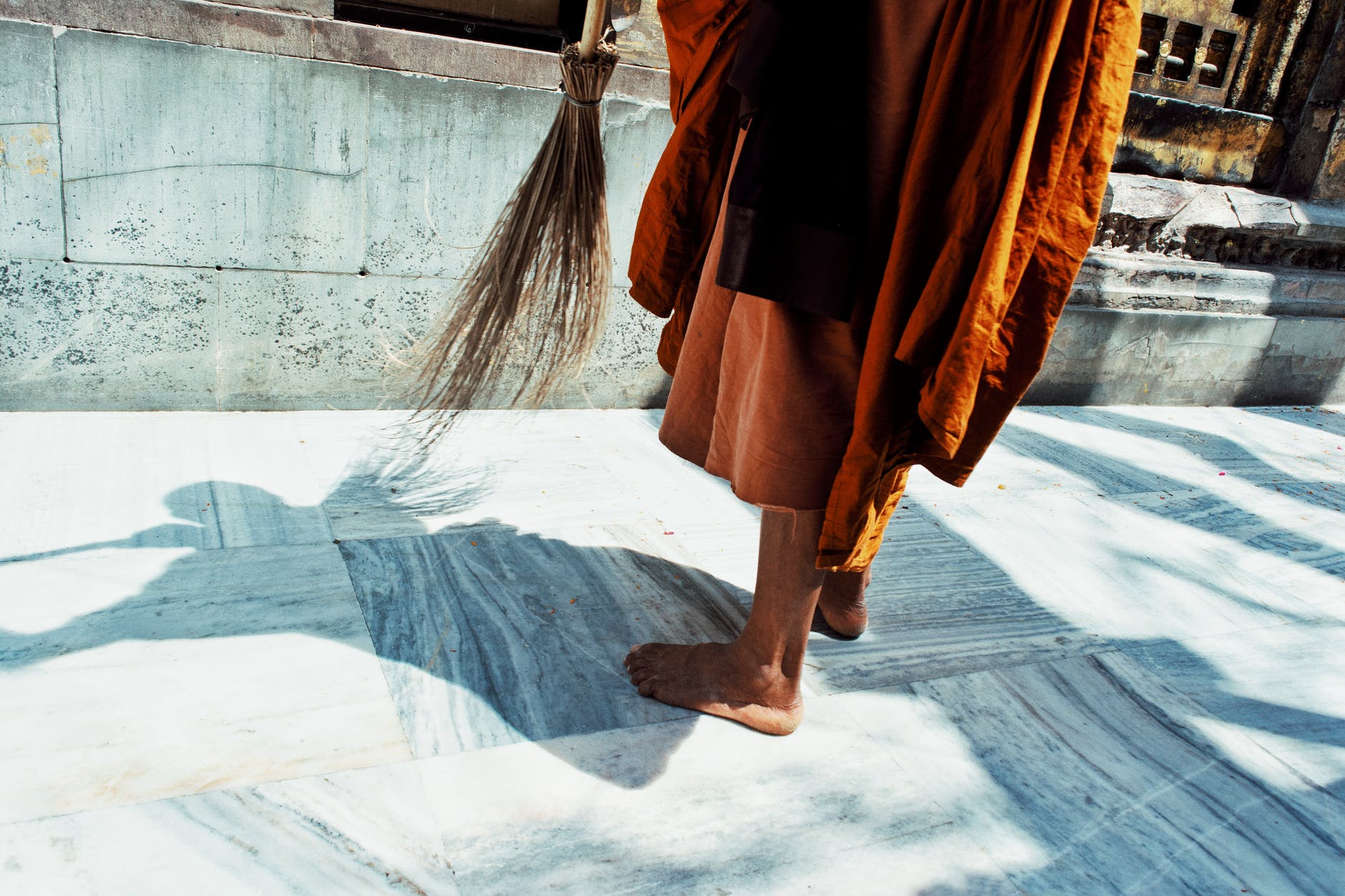
Photo by Riya Kumari on Pexels.com

One day Chundra noticed that he was often longing to sit with the other students as they talked about the things they were learning. “But,” he would think to himself, “I am not worthy to sit and talk with the other monks and students my age, for I cannot read nor write.” This way of seeing and thinking was like dirt, it was an old way of seeing himself that kept him from happiness. “I should sweep these thoughts from my mind.” He thought. “Sweep away the dust, sweep away the dirt.” He felt peaceful again. Another time he noticed that he was often living in the future wishing, “If only, if only I could read and write like the others, then …” These wishing thoughts were like dust. He was always trying to grasp things out of his reach, and missing the present moment. “Sweep away the dust, sweep away the dirt.”

Chunda went and shared his insights with the Buddha who again smiled. “Ah Chunda, you are doing very well. Tell me, can you stop and enjoy the beauty of a clean temple after you have swept?” “Yes, master.” “Good then, ” smiled the Buddha, “I hope you will now remember to also stop to notice the simple joy of a clean inner temple, as well as an outer one.” Chunda did stop to notice, and he continued to sweep the inner dirt, and the outer dirt, and to stop often to experience the peace of the present moment, and the simple joy that was there when all negative thoughts were gone. And in this way Chunda continued to sweep, to chant and to ponder on the nature of grasping and clinging, and the peace of living in the present moment.

In time the other students noticed his peace, and began to talk with him. He was able to share his wisdom with other monks. As the years passed his wisdom and inner peace grew. He became known as The Broom Master, and many came to hear his simple, yet profound wisdom.

Sources: Conover, Sarah, “The Broom Master” in Kindness: A Treasury of Buddhist Wisdom for Children and Parents, (Spokane, WA: Eastern WA University Press, 2001) pp. 68-71.Lama Surya Das, “Greatness of Heart is What Counts,” in The Snow Lion’s Turquoise Mane: Wisdom Tales from Tibet. Pp. 45-48.

The Broom Master

Link: https://peacelilysite.com/2022/02/04/the-broom-master/

#Buddhism#BuddhismStory#BroomMaster#Buddha#Chunda#BuddhismWisdom#WisdomTales