Finding Serenity in Art: A Journey into H.H. Dorje Chang Buddha III’s Masterpiece, “Flowers in the Garden”

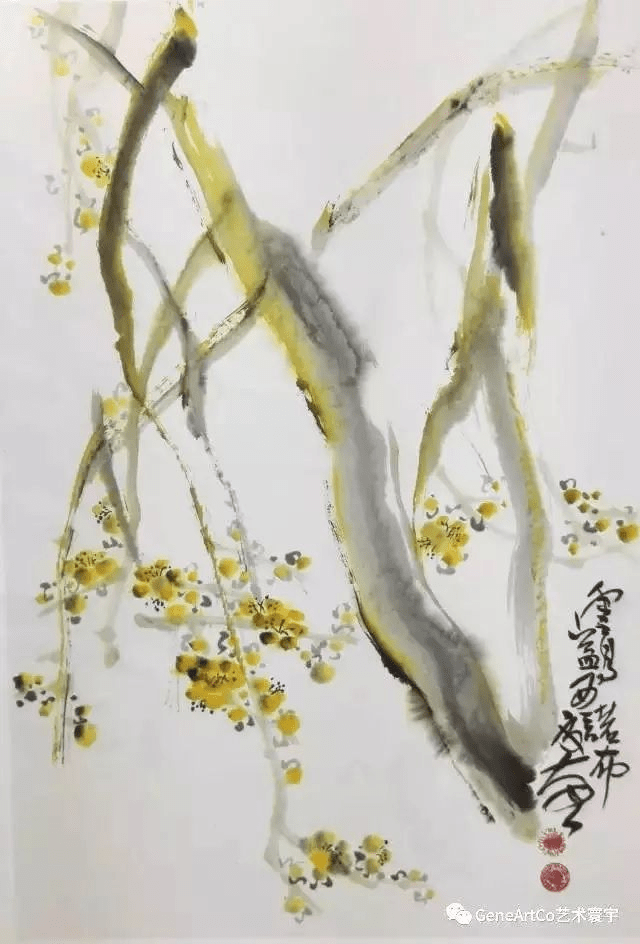
《園中花幾枝》

The moment your eyes rest upon “Flowers in the Garden”—a Chinese painting masterpiece by His Holiness Dorje Chang Buddha III—a sense of transcendent peace and quiet joy quietly washes over you.

The painting opens with a frame full of vital rhythm and poetic grace:

In a quiet garden, flower buds tremble on the verge of blooming, while a few solitary plum blossoms quietly unfold along the branches.

Look closely, and you can almost pierce through the canvas to inhale the faint, delicate fragrance drifting out from the silence. There is no noisy clamor of a garden in full, chaotic bloom. Instead, there are only a few scattered blossoms softly opening on the branch—yet in a single snapshot of time, they touch the tenderest part of the human heart, stirring a unique and profound sense of delight.


The Mastery of Elegance: Simple Strokes, Infinite Meaning

What truly mystifies viewers about “Flowers in the Garden” is its incredibly minimalist yet profoundly rich visual language. This artwork elevates the traditional ink-and-brush techniques of Chinese painting to their absolute zenith:

  • Lines that Vibrate with the Soul: The sparse, calculated lines in the painting are relaxed yet full of hidden strength, moist yet aged with character. They are not merely the structural forms of branches; they feel like the physical vibration of the creator’s soul, whispering endless stories across time. These rhythmic, undulating lines serve both as a deeply expressive emotional language and the powerful skeletal framework that supports the entire composition.
  • The Ethereal Space of Ink and Void: As our gaze passes through these sweeping lines to contemplate the negative space they divide, an otherworldly sense of emptiness embraces us. It is a beauty akin to “looking at flowers through a fog, or gazing at the moon reflected in water”—illusory, misty, and wonderfully detached from the mundane world.

Within this luminous, spiritually charged space, the creator embeds a crisp, rhythmically swift calligraphic inscription. The calligraphy and the painting reflect and elevate one another, suddenly bringing forth an indescribable artistic beauty.

This artistic ambiance—which flawlessly uses the solid to guide the void, remaining completely natural and untainted by the world—possesses an almost miraculous power of attraction. Effortlessly, it cleanses the viewer’s inner restlessness, transporting us into a completely transcendent, breathtakingly beautiful spiritual realm.

Words have an end, but artistic conception is infinite. “Flowers in the Garden” is far more than a traditional Chinese painting for passive appreciation; it is a tangible manifestation of H.H. Dorje Chang Buddha III’s world-astonishing artistic genius brought to the human realm.
Link:https://peacelilysite.com/2026/06/05/finding-serenity-in-art-a-journey-into-h-h-dorje-chang-buddha-iiis-masterpiece-flowers-in-the-garden/

Transforming Destiny: The Inspirational Journey of Yuan Liaofan

In the heart of Ming Dynasty China, a man named Yuan Liaofan emerged, leaving an indelible mark on history. Born in the picturesque Wujiang County, Jiangsu Province, China, Yuan Liaofan’s original name was Yuan Huang. With the courtesy name Kunyi and the alternative name Xuehai, he later adopted the name Liaofan, symbolizing a profound shift in his life’s trajectory. During his life, he underwent a precise fortune-telling by an adept in divination, which turned out to be accurate. However, Yuan Liaofan later transformed his own destiny.

Yuan Liaofan’s transformative journey began when he sought guidance from a revered monk, a master in the art of divination. The monk, through precise fortune-telling, revealed a predetermined path for Yuan Liaofan. Undeterred by this revelation, the monk imparted invaluable wisdom on how to change his fate.

The monk emphasized the importance of performing virtuous deeds and accumulating positive karma. He outlined a path that involved actively engaging in a thousand good deeds, actions that would not only benefit others but also bring about profound changes in Yuan Liaofan’s own destiny.

Embracing the monk’s teachings, Yuan Liaofan dedicated himself to a life of kindness, compassion, and generosity. He embarked on a mission to perform a thousand good deeds, each act carefully documented in a personal ledger. His deeds ranged from helping the needy and supporting the less fortunate to acts of kindness that reverberated through his community.

As Yuan Liaofan diligently pursued this virtuous path, the effects on his life were nothing short of remarkable. Contrary to the fortune-teller’s prediction that he would not have a son, Yuan Liaofan became a father, experiencing the joys of parenthood. His household, once devoid of the laughter of children, now echoed with the sounds of familial bliss.

Additionally, the diviner had foretold that Yuan Liaofan’s life would be limited to fifty-three years. However, Yuan Liaofan defied this prediction, living a full and fulfilling life until the age of seventy-four. The positive energy generated by his virtuous deeds not only defied fate but also led to a prolonged and healthy existence.

The transformative effects were not confined to his personal life alone. Yuan Liaofan’s career path witnessed an upward trajectory. Through his dedication, hard work, and the positive energy he exuded, he achieved professional success, earning promotions and garnering respect within his professional sphere.

“The Four Lessons of Liaofan,” penned by Yuan Liaofan himself, stands as a testament to his transformative experiences. It serves as a guiding light for all who aspire to harness the potential within themselves to cultivate positive change.

As we navigate the complexities of our modern existence, let Yuan Liaofan’s story inspire us to embark on a journey of goodwill. Embrace the opportunity to contribute to the well-being of others, and in doing so, witness the transformative effects it can bring to your own life.

May Yuan Liaofan’s tale be a beacon of encouragement for us all, urging us to embrace the inherent ability within ourselves to shape our destinies. After all, the power to create a life of abundance and health lies not in the stars, but within the choices we make each day.

Transforming Destiny: The Inspirational Journey of Yuan Liaofan

Link:https://peacelilysite.com/2024/01/26/transforming-destiny-the-inspirational-journey-of-yuan-liaofan/

Source: https://www.pure-land-buddhism.com/blog/liaofans-four-lessons-your-destiny-is-in-your-hands