Tasha Tudor: A Life of Simplicity and Beauty

At 92 years old, Tasha Tudor lived a life that seemed lifted from the pages of a fairy tale. A beloved American picture book author and illustrator, her world was filled with charm, creativity, and a profound connection to nature. Her quiet, pastoral lifestyle captured the imagination of many, and a documentary about her life gained widespread acclaim in both the United States and Japan—earning her the title of one of the most admired women of her time.

Tasha was born into a prominent family, surrounded by great minds and cultural icons—her home once welcomed the likes of Albert Einstein and Mark Twain. Growing up in such an environment may have nurtured her early independence and vivid imagination. While others her age dreamed of parties and popularity, Tasha longed for a simpler dream: to own a cow and live close to nature.

At just 15, she left formal schooling to follow her passion for art and farming. This bold decision marked the beginning of a remarkable artistic journey. Over her lifetime, Tasha created more than 80 beautifully illustrated children’s books, winning the prestigious Caldecott Medal and receiving the Queen’s Lifetime Achievement Award. Her delicate, nostalgic illustrations shaped the childhoods of generations.

At 23, she married and raised four children. But when her unconventional lifestyle became too difficult for her husband to accept, they separated. Tasha pressed on, supporting herself through her art and craftsmanship.

When she was 57, and her children had grown, Tasha embraced the life she had always dreamed of. She moved to the hills of Vermont and built a cottage modeled after an 18th-century farmhouse. There, she lived without electricity, running water, or modern conveniences—choosing instead to return to the rhythms of a bygone era.
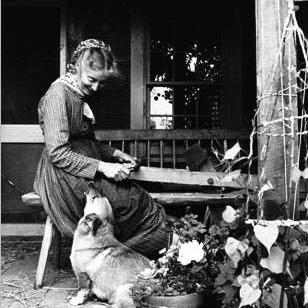
Tasha Tudor shaving splints from a log on her Vermont farm in 1977 By unknown Immediate sourcehttps://www.nytimes.com/2008/06/20/books/20tudor.html

Her days were filled with meaningful simplicity: raising chickens and sheep, growing vegetables, preparing meals by hand. She wove and sewed her own clothes—elegant dresses and colorful scarves—always taking pride in her appearance, even in solitude.

Tasha found deep joy in the natural world. She built a lush, secret garden where flowers bloomed in every season, and she tended it with love. Whether watering plants or walking through her fields, she embraced each moment with a grateful heart.

Though she lived alone, she was never lonely. Her cats and dogs kept her company, and her grandchildren visited often. Her home radiated warmth, creativity, and quiet joy.

“Letting go is a kind of strength,” she once said.

In an age obsessed with material gain, Tasha Tudor’s life reminds us that true richness lies in simplicity. She let go of the noise and temptations of modern life, choosing instead a path of peace, beauty, and authenticity.

Tasha Tudor didn’t just illustrate magical worlds—she lived in one. And through her life and work, she continues to inspire us to slow down, appreciate the everyday, and create beauty from the inside out.

Link: https://peacelilysite.com/2025/07/25/tasha-tudor-a-life-of-simplicity-and-beauty/

The Swan’s Gift

The Swan’s Gift

By Brenda Seabrooke

Anton was a farmer who lived with his wife Rubina and their seven children at the edge of the forest. He worked hard and they were happy for many years. Then one spring, the rains didn’t fall and Anton’s wheat died in the fields. As winter came on, their food supply grew smaller and smaller. Soon, Anton’s shoulders were stooped with worry. Rubina’s plump apple cheeks withered. The children no longer sang or laughed or danced, for they were all too hungry.

Every day Anton went out to hunt for food but returned without firing a shot. And every day, Rubina added water to the onion soup until there was nothing in the pot but water. When Anton saw his family crying with hunger, he wanted to cry too.

But instead, he took his gun and went out again into the cold, cold night. He had to find something for them to eat: a bird or a rabbit. But the black branches were empty of birds and no rabbits crouched in the frozen shrub. The only tracks Anton saw were his own.

He came to a small hill and knew it was the last one he would be able to climb before his strength was gone. His feet were numb and his breath rasped in the freezing air. At the top of the rise, he stopped to rest, scanning the snow for tracks. In despair, Anton turned to go. Just then, he saw below him a lake that was not yet frozen over. Its edge was lacy with ice and at its center floated a swan of such dazzling beauty that Anton could not look away. Its stark white feathers gleamed against the dark water and as Anton watched, the swan seemed to grow larger until its image filled his eyes.

Suddenly, juices flowed into Anton’s mouth. He could taste succulent roast swan and see his children’s faces glowing as his family sat at the table eating again. He raised his gun and sighted down the long barrel. Anton put his finger on the trigger. The swan seemed to be looking at him, listening for the shot that would kill it. He lowered the gun. The swan was the most beautiful creature Anton had ever seen. As he watched, the swan fanned its magnificent wings.

Anton closed his eyes and thought of his family. Again, he raised his gun. Hours seemed to pass. The feathers on the swan’s breast moved gently with each beat of its heart, and Anton could feel his own heart beating. He lifted his heavy wet feet, walked a few steps, and then dropped to his knees. “I can’t do it,” he said.

“Why not?” asked a voice as soft as snow or feathers ruffling in a gentle wind.

“I cannot kill beauty. If I kill this swan, my family will have food for one or two meals. And then what? We will be hungry again and it will have been for nothing.”

Anton was too tired to be surprised that he was speaking to the swan or the wind or the night. He was too tired to walk back home. He bowed his head with sadness for his family.

With a cry, the swan lifted its wings, rose from the lake, and circled Anton, water dropping from its wing feathers.As the water hit the snow, it froze into crystals that sparkled in the moonlight. Anton reached out and touched one. It was hard, harder than ice, and did not melt in the warmth of his hand.

“A diamond!” Anton said. Quickly, he scooped up the diamonds that lay in a glittering circle around him. He filled his pockets with them and set off through the snow to a nearby village.

Anton was no longer tired. He no longer felt the cold. He woke up the innkeeper, calling, “I need food.”

“Your crops failed,” said the innkeeper. “Everyone knows you have no money.”

“I have a diamond,” said Anton.

“Where would the likes of you get a diamond?” the man scoffed.

“Let me in and I will explain.”

The innkeeper fed Anton cold venison and sweet dumplings while Anton told his story, and the innkeeper’s wife packed a sledge for him with roast chickens and cheeses and onions and turnips. Then they sent Anton on his way so that they could begin looking for the magic swan themselves.

Rubina met him at the door. “Did you find any food? Mischa has fainted.”

“No. But look what I have brought.” Anton showed her the sledge.

“But how did you get it?” she asked.

For answer, he spilled the diamonds onto the table.

“Oh,” cried Rubina, “you have turned to robbery!”

“No,” said Anton. And he told her all about the swan, and how it had circled him with the diamonds falling from its wings.

Anton and Rubina woke the children even though it was the middle of the night, and they all sat at the table eating slowly, enjoying the flavor of the food and wonderful feeling in their stomachs. Rubina’s black eyes sparkled as she filled her children’s bowls. Anton felt his strength returning. Several of the children hummed as they were put to bed.

Anton and Rubina and their children were never hungry again, for they used their diamonds wisely and well. News of the magic swan spread throughout the land and many people searched for it. But the swan was never found.

Sometimes when Anton was alone in the forest, the image of the swan rose before him. He saw again the gleam of its feathers, the coral glow of its beak, and the magnificent reach of its wings as it glided silently across the sky.

Link:https://peacelilysite.com/2024/05/20/the-swans-gift/

Source: https://files.schudio.com/st-marys-ce-primary-school/files/documents/year_2_reading_1(1).pdf

A Beautiful Love Story Carved in the Dunhuang Grotto China

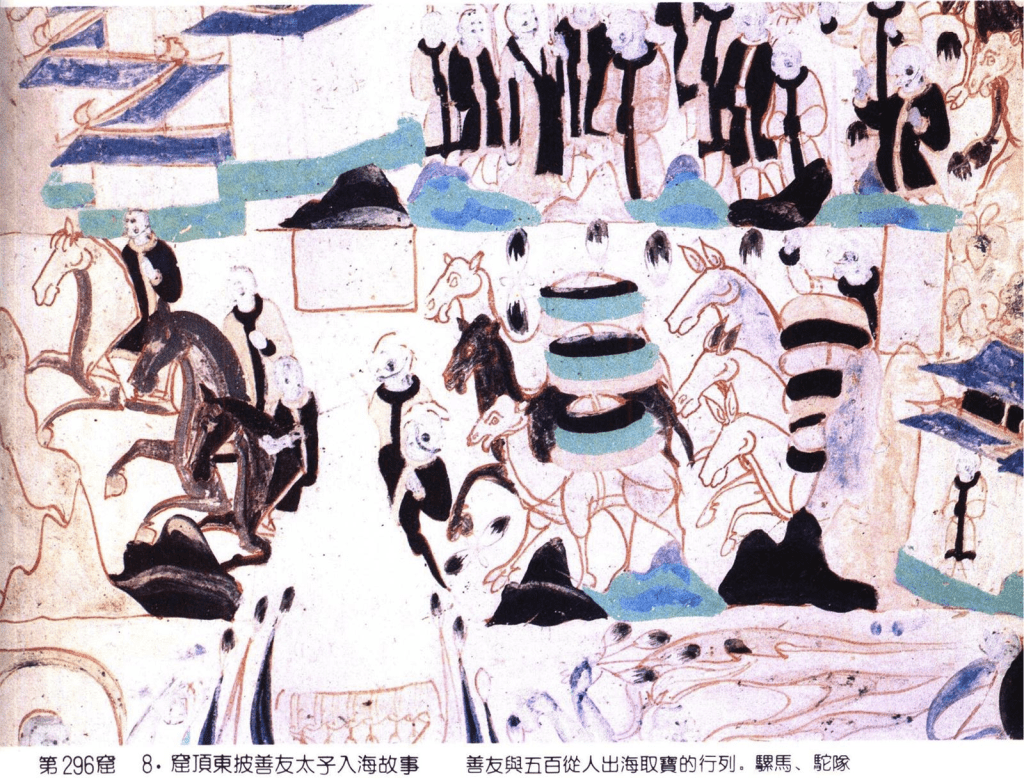
Prince Sunwoo ventured into the sea in search of treasures

In the ancient Dunhuang Grottoes of China, a mesmerizing love story unfolds, delicately captured in murals that have withstood the test of time. Let us immerse ourselves in this enchanting tale of kindness, courage, and wisdom.

Once upon a time, in the Kingdom of Polo, a joyous occasion marked the birth of a prince named Sunwoo. Born to the noble king and queen after twelve years of fervent prayers, the young prince brought immense happiness to the royal family.

As Sunwoo grew, so did his wisdom and kindness. His presence was a beacon of light, radiating love and compassion. However, alongside him was a stepbrother, an evil friend, whose heart harbored jealousy and resentment towards the virtuous prince.

The tale takes an unexpected turn when Sunwoo, driven by a desire to alleviate the suffering of his people, embarks on a perilous journey to seek treasures from the sea. His selflessness touches the hearts of many, but it also ignites the envy of his malevolent stepbrother.

Prince Sunwoo accompanied by 500 volunteers to search for treasur

Guided by an elderly instructor and accompanied by 500 volunteers, Sunwoo reaches Haizhou Jumbo Island. As he ventures further, facing challenges and loss, he encounters the benevolent Dragon King, who grants him the priceless Ruyi pearl.

Prince Sunwoo and his team sailed across the ocean

Meanwhile, back in the Kingdom of Polo, Sunwoo’s absence is keenly felt. His parents, yearning for his return, send a white goose as a messenger. The devoted goose delivers a letter revealing the Prince’s dire circumstances.

As Sunwoo’s journey unfolds, his evil stepbrother, fearing Sunwoo’s increased popularity upon return, decides to sabotage him. The malicious act blinds Sunwoo, leaving him vulnerable and alone.

In his darkest hour, a compassionate cowherd boy comes to Sunwoo’s aid. Unaware of his royal identity, the boy rescues Sunwoo and becomes his loyal companion, leading him back to the kingdom.

The love story takes an unexpected twist when the blind Sunwoo, reduced to a beggar, meets a kind princess during his wanderings. The princess was very touched by Sunwoo’s music. Her genuine affection and determination to marry him, despite societal norms, lead to a grand wedding.

In a poignant moment, the princess, deeply in love, makes a solemn vow. She promises to restore Sunwoo’s sight if her love is true and vows to take away her own eyes if she ever betrays him. Miraculously, her unwavering love restores one of Sunwoo’s eyes.

The narrative weaves through twists and turns, revealing the complex interplay of good and evil, karma, and ultimate redemption. Sunwoo’s evil stepbrother, realizing the consequences of his actions, repents and reveals the hidden Ruyi pearl.

In a grand reunion, Sunwoo’s parents regain their sight, and the entire kingdom is bathed in prosperity. The murals in Dunhuang and Kaihua Temple immortalize this timeless love story, showcasing not only the artistic brilliance of ancient China but also the enduring power of kindness and virtue.

As we reflect on this captivating tale, may it inspire us to embrace compassion, navigate life’s challenges with wisdom, and believe in the transformative power of love and redemption. The Dunhuang Grottoes stand as a testament to the rich tapestry of human stories etched in history, inviting us to cherish the enduring lessons embedded in their ancient walls.

Link:https://peacelilysite.com/2024/02/08/a-beautiful-love-story-carved-in-the-dunhuang-grotto-china/

#DunhuangGrottes #Murals #AcientArts

Source: photos from http://m.news.cctv.com/2020/08/09/ARTIoQSmgcAEjtx5j0cLVoos200809.shtml, https://www.sohu.com/a/334453850_120259260#google_vignette