During a visit to Holy Vajrasana Temple, I encountered the beautiful and meaningful practice of Oryoki. Often translated as “just the right amount,” Oryoki is a ritualized way of serving and eating food that combines efficiency, mindfulness, and gratitude. Its roots trace back to the Buddha’s time, embodying the Middle Way of taking neither too much nor too little—an ethos that resonates deeply with the principles of simplicity and compassion.
What Is Oryoki?
Oryoki originated during the Tang Dynasty in China and later influenced practices such as the Japanese tea ceremony. It is widely practiced in Zen monasteries as a way to unify daily life with spiritual practice. The ritual involves a meticulous series of hand gestures, silence, and mindfulness during the meal.
Monks sit in meditation posture, waiting to offer their empty bowls to servers, who portion food to the requested amount. Every movement is intentional, every crumb is appreciated, and every element is designed to minimize waste. Even the water used to wash the bowls is partially consumed and the remainder returned to the earth, often to nourish the garden.
Simple and Balanced Eating
The meals at Holy Vajrasana Temple reflect the Oryoki tradition, featuring fresh fruits, vegetables, whole grains, and tofu. With minimal spices or stimulants, these meals are designed to nourish the body while keeping the mind clear and alert. Every effort is made to include the five flavors—sweet, salty, sour, bitter, and umami—and the five colors—red, green, white, yellow or orange, and black, blue, or purple.
Chefs follow the principle of eating simply, allowing the natural flavors of ingredients to shine. Eating in silence encourages mindfulness, helping participants savor each bite and truly appreciate the food’s journey from soil to plate.
Lessons in Gratitude and Reducing Waste
One of the most profound lessons from Oryoki is its emphasis on gratitude and sustainability. The practice reminds us to take only what we need and waste nothing. Participants are encouraged to finish their meals completely, leaving no remnants.
This principle can extend to our daily lives, especially during the holiday season when overindulgence and waste are common. By being mindful of portion sizes, recycling food scraps, and making thoughtful purchasing decisions—like avoiding vegetables wrapped in plastic—we can honor the spirit of gratitude and reduce our environmental footprint.
A Holiday Reminder: Gratitude Over Excess
As the holiday season approaches, let us take inspiration from these temple traditions. Instead of overindulging, savor each meal with mindfulness and gratitude. Remember those around the world who face hunger daily, and let this awareness guide us to be more conscious and compassionate in our eating habits.
Wishing you a joyful, mindful, and healthy holiday season! Let us cherish the food on our plates, honor the hands that prepared it, and commit to a less wasteful, more compassionate way of living.
Recently, I visited the Holy Vajrasana Temple in Fresno, CA, and was deeply impressed by their delicious vegetarian meals. The flavors were unforgettable, and I’m thrilled to share some of these favorite healthy, vegetarian recipes with you to bring extra joy and flavor to your Thanksgiving holiday!
The temple offers retreat sessions, providing a nurturing experience for both body and spirit. With a garden on-site, the monastery uses the freshest organic vegetables for meal preparation, resulting in incredibly tasty dishes. For anyone interested in learning more about their retreats, you can find details here.
Stay tuned for some of the delightful recipes inspired by this visit, perfect for a healthy, delicious holiday spread!
Grilled Slaw With Mint
Cabbage is one of the most useful vegetables. I love it in slaw, in stews, in mashed potatoes, etc., and here we have a recipe that grills it. I think you could serve this hot for the cold days we are now having, although the recipe cools the cabbage to serve as salad. Enjoy!
Ingredients for 4 Servings
1 1/2 Tbsp cider or rice vinegar, plus more to taste
1 1/2 Tbsp maple syrup, plus more to taste
1 1/2 Tbsp avocado or grape seed oil
1 1/2 tsp Dijon-style mustard
1/2 tsp caraway seeds
Kosher salt and freshly ground black pepper to taste
1/2 head savoy or other green cabbage quartered, lengthwise through core
2 Tbsp thinly sliced fresh mint
Directions
Light a charcoal or wood-burning grill and let the coals burn down to glowing embers. May also be grilled in an iron skillet or indoor grill.
Meanwhile, make the dressing: In a large bowl, whisk the vinegar and maple syrup. Whisk in the oil, followed by the mustard and caraway seeds. Season to taste with salt and pepper.
Lay the cabbage quarter(s) directly on the grill and roast until all sides are charred, turning with tongs, about 2 minutes per side. Transfer to a sheet pan and let cool.
Discard the tough core of the cabbage then thinly slice the cabbage crosswise. Add the sliced cabbage to the dressing and toss to coat. Season with more salt, maple syrup, and vinegar to taste. Refrigerate until serving and serve within a couple hours of mixing. Just before serving, stir in the mint.
Broccoli Slaw
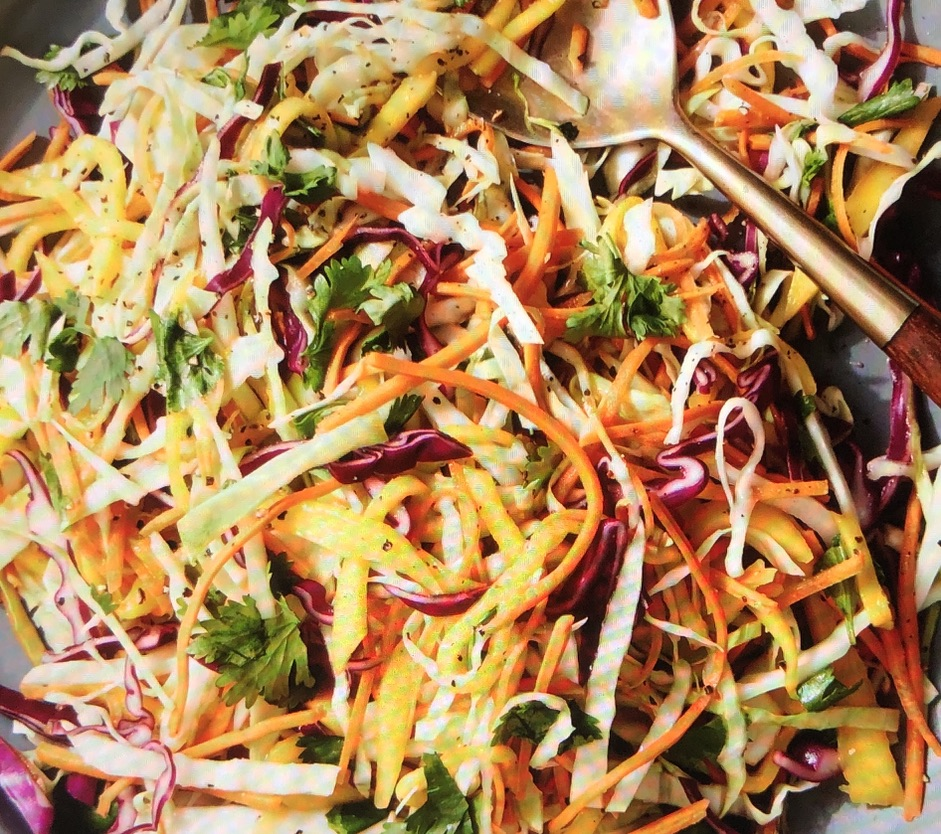
This is a very easy, colorful and delicious salad or slaw that uses shredded raw broccoli stalks instead of cabbage and usually carrots and red cabbage or radicchio for color. You can find packaged broccoli slaw at most markets now or make your own.
3 cups broccoli slaw (shredded broccoli stalks, carrots, red cabbage)
finely chopped green onions (optional)
¼ cup dried figs, dates, unsweetened cranberries or other dried fruit; cjopped mang, apple, pears also good
1/3 cup chopped roasted macadamia or hazel nuts
5 radishes, thinly sliced
½ chopped red, green, and/or yellow chopped bell peppers
chopped avocado
chopped parsley, cilantro, mint, dill, or other herbs
hemp, flax, or poppy seeds
Dressing
¼ cup red wine vinegar
2 Tablespoons olive or avocado oil
1-2 dates, chopped or seasonal fruit like pears or apples, but most fruit would work
salt & black pepper to taste
1/2 tsp turmeric power
toasted sesame seeds, grated ginger (optional)
Blend dressing, if dates or other fruits are used, otherwise, just mix ingredients.
Toss all ingredients, except nuts, and refrigerate for several hours to blend flavors. Add nuts and serve. Nuts may be served separately as some may have nut allergy.
NON-VEGAN: Add can of drained chicken or tuna or grated cheese or other leftover protein. Tofu also may be marinated in dressing to give it more flavor.
DRESSING OPTIONS: Lemon juice and zest good with avocado oil mayo, black pepper, turmeric, curry, chimichurri, or za’atar spices. Korean gochujang would also be good.
Carrot Cake Paleo Waffles
These delicious breakfast (or any time) treats are healthy and nutrient dense. They can be fried as pancakes, if you don’t have a waffle iron and you can make a big batch and freeze them to be reheated in your toaster or oven. Enjoy!
Toppings
Butter, sour cream, maple syrup, coconut butter
Yogurt, applesauce, more pecans or walnuts
Waffles
2 Eggs
1/3 Cup Plain yogurt
1/2 Cup Almond or coconut milk
1 tsp Vanilla
1 Cup Almond meal or flour
2 Tbsp Coconut sugar or maple syrup
1 1/2 tsp Cinnamon
1/2 tsp Nutmeg
1/2 tsp Grated ginger
1/2 Baking powder
1/4 tsp Salt
1/2 Cup Grated carrot
1/4 Cup chopped walnuts or pecans
1/4 Cup chopped dates or raisins
2 Tbsp Coconut, shredded
Oil spray
Whisk the eggs, yogurt, milk and vanilla together. Mix the dry ingredients in a separate bowl, add to egg mixture, and whisk until smooth. Fold in the carrots, walnuts, dates and coconut. If batter is still very thick add a few splashes of milk. Spray waffle iron with oil. Place 1/4-1/2 cup of the batter (depends on size of waffle iron) into hot waffles iron and cook according to waffle iron instructions. Top with toppings of choice and serve warm.
4 waffles. Can also be cooked as pancakes.
Bombay Frittata
This is a spicy Indian omelette with herbs and cheese that would be good for breakfast or any meal.
12 large eggs
½ cup crème fraiche or sour cream
½ cup finely chopped red onion or celery
2 scallions, white and green parts, thinly sliced (optional or serve as condiment)
2 garlic cloves, thinly sliced (optional)
¼ cup tightly packed fresh cilantro or parsley leaves
½ teaspoon garam masala
½ teaspoon fine sea salt
½ teaspoon black pepper
½ teaspoon ground turmeric
¼ teaspoon red-pepper flakes
2 tablespoons ghee, butter, or coconut oil
¼cup crumbled paneer or feta cheese
Position a rack in the upper third of the oven and heat the oven to 350 degrees.
In a large bowl, combine the eggs, crème fraiche or sour cream, onion or celery, scallions & garlic (if used), cilantro, garam masala, salt, pepper, turmeric and red-pepper flakes and beat with a whisk or fork until just combined.
Heat the ghee or oil in a 12-inch ovenproof skillet, such as cast iron, over medium-high heat, tilting the skillet to coat it evenly. When the ghee bubbles, pour the eggs into the center of the skillet, shaking to distribute evenly. Cook, undisturbed, until the frittata starts to firm up on the bottom and along the sides but is still slightly jiggly on top, about 5 minutes. Sprinkle with the paneer and transfer the skillet to the oven. Cook until frittata is golden brown and has reached desired doneness, 15 to 25 minutes. Serve warm with toast, rice, or salad.
Serves 6.
Sweet Potato and Kale Soup
It is a Caribbean treat that can be cooked and served several ways. It could be a great soup for Thanksgiving dinner.
INGREDIENTS:
3 Tbsp olive oil 2 Tbsp brewers yeast 2 minced carrots 3 Tbsp minced ginger 2 large garlic cloves, minced 4 medium sweet potatoes, peeled and cubed 1 Tbsp fresh (or 1/2 that dried ) thyme 2 tsp allspice 1 tsp nutmeg 1 tsp cinnamon 1 tsp chili sauce or Korean chili powder or flakes 1 tsp turmeric black pepper 2 cans diced tomatoes 5 cups water or broth 14 oz coconut milk 19 oz white or garbanzo kidney beans or cauliflower florets Stevia or maple syrup to taste 9 cups kale 2 Tbsp lime juice and zest
Fresh thyme for garnish
DIRECTIONS:
In a large saucepan or stockpot, heat olive oil over medium-low heat. Add brewer’s yeast, minced carrots, minced garlic, and minced ginger. Sauté for 4 to 5 minutes, stirring often.
Add the peeled and cubed sweet potatoes, thyme, allspice (if not available use more nutmeg, cinnamon, and mace), nutmeg, cinnamon, and chili sauce or flakes. Cook, stirring often, for another 3 or 4 minutes.
Stir in the diced tomatoes, salt, black pepper, vegetable broth or water. Turn heat to high and bring to a boil. Once boiling, immediately turn heat to low, cover and let simmer for about 25 to 30 minutes, or until the sweet potatoes are tender. Can be cooked in a large crock pot on high for 3-4 hours.
Add the coconut milk, cauliflower florets (or beans-drained & rinsed, and sweetener to taste) to soup. Turn heat up a little bit to medium-low. When soup returns to boil, add chopped kale (thick stems removed & washed) and let cook uncovered for another 5 minutes or until the kale is limp and tender.
Remove from heat and stir in the 2 Tablespoons lime juice and zest. If needed, season to taste with extra salt, pepper, sugar, or chili sauce or flakes. Garnish with fresh thyme leaves. Half batch fills 6 cup cooker.
Gochujang and Maple Syrup Glazed Roasted Brussels Sprouts
Here’s an easy and quick way to cook Brussels sprouts that the whole family will enjoy!
INGREDIENTS:
1 lb Brussels sprouts uniform size ½ teaspoon onion powder* ½ teaspoon garlic powder* ¼ teaspoon black pepper powder 1 tablespoon olive oil vegetable olive oil 1 tablespoon soy sauce or coconut aminos 1 tablespoon honey or maple syrup or to taste ½ teaspoon sriracha or Gochujang sauce. more. used 1 Tablespoon. 1 fresh lime optional
DIRECTIONS:
Wash, rinse, and dry the Brussels sprouts. Trim off the ends and cut them in half or quarters. Try and keep all pieces the same size. You can also include the individual leaves off of the sprouts. Mix together onion, garlic and pepper powders, soy sauce, sriracha, honey and oil in a small bowl. Transfer the Brussels sprouts to a medium bowl and coat them with some of the seasonings, making sure all surfaces are covered.
Spray pan with oil. Air-fry 14 minutes at 375F or roast in conventional oven at 400F for 16 minutes. Watch closely as they may burn.
Squeeze lime juice in sprouts and serve.
Cranberry-Orange-Date Relish
This is the best cranberry relish I have found. No cooking, easy. Makes about eight generous servings and freezes well.
INGREDIENTS:
12 oz Raw cranberries 1 Navel orange 1/4 Cup Vegan sugar or dates OPTIONAL: chopped pecans
DIRECTIONS:
Process cleaned and sorted cranberries and one navel orange (include peel) that has been cut into eighths in food processor. Add vegan sugar or dates. Toasted pecans are good added just before serving.
The investment realm bids farewell to its philosopher, the golden partner of Warren Buffett, Charlie Munger, who passed away on November 28th this year, at the age of 99. Munger’s life was a testament to generosity, kindness, rationality, humility, and a low-key demeanor. Renowned for his honesty, integrity, lack of complaints, and absence of hindsight bias, Munger earned global admiration and respect. His impactful literary work, “Poor Charlie’s Almanack,” reflects his profound humanity.
Among Munger’s profound teachings, five sentences stand out, resonating deeply with individuals and serving as timeless nuggets of wisdom. Deserving Success, Value Investing Strategy, Success and Surroundings, Magic of Compound Interest, Probabilities Over Luck.
“The best way to obtain something is to make oneself deserving of it” reflects classic wisdom upon contemplation. Unlike typical words of wisdom that merely offer principles without practical methods, Munger’s comprehensive approach in “Poor Charlie’s Almanack” reveals a value investing strategy intertwined with life philosophy.
Charlie Munger’s love for books was profound. Often referred to as a “bookshelf with two legs,” Munger’s voracious reading habit extended beyond the realms of finance. He explored diverse genres, not just for knowledge acquisition but to open his mind to different angles and views. His extensive reading shaped him into a profound thinker, and his eclectic taste in literature reflected in his unique perspectives. Munger’s commitment to continuous learning and intellectual curiosity made him an embodiment of wisdom.
Munger’s belief in value investments extended beyond finance to personal development. He advocated assessing the value of a business before evaluating its stock, discarding speculative opportunities, and overlooking short-term factors. The enduring factor for a stock’s reliability, according to Munger, is whether it truly deserves its current price. This principle, he argued, holds true for personal growth, embodied in the saying, “The essential reason for a person’s success is that those around him wish for his success.”
Throughout his illustrious investment career, Munger adhered to the traditional values of the American West — diligence, focus, sincerity, thrift, and future investment. These principles earned him the trust of many collaborators. Notably, Munger’s initial million came from a real estate investment while he was still a lawyer. Recognizing the potential for real estate development in a property left by a client’s ancestors, Munger, through the client’s trust, achieved tremendous success.
Munger’s philosophy that making oneself valuable attracts potential collaborators is the most reliable investment method. This philosophy aligns with renowned stock guru Warren Buffett’s simple yet effective secret to wealth: save, invest, continue saving, and continue investing. Munger’s teachings delve into the power of compound interest, demonstrated in a thought experiment within “Poor Charlie’s Almanack.”
The experiment presents two choices — receiving $1000 daily for 30 days or receiving an escalating amount starting with 1 cent, doubling each day for 30 days. The seemingly attractive first choice limits the total to $30,000, while the second, with the magic of compound interest, accumulates to an astonishing $5.37 million. Munger highlights the patience required for compound interest to exhibit its true power, a principle applicable to personal growth.
Economist Xiang Shuai’s intriguing experiment reinforces Munger’s teachings. Progressing a little every day, even by 1%, leads to significant advancement after a year, while regressing daily results in minimal talent advantage. Munger’s emphasis on the importance of daily learning and reading resonates with the ancient wisdom: “Accumulate small steps, and you will cover a thousand miles.” He advocates believing in probability over luck, emphasizing that probability theory aligns closely with the world’s functioning.
Munger’s views on setting goals underscore the importance of realistic expectations and avoiding fanaticism. He advises setting goals slightly beyond one’s capabilities, then striving wholeheartedly to achieve them. The rational and joyful life attitude Munger promotes hinges on believing in the magic of compound interest.
Despite initial misconceptions, “Poor Charlie’s Almanack” is hailed as a seriously underestimated gem, transcending the appearance of a self-help book. Patiently reading through Munger’s insights reveals a figure resembling a traditional Chinese sage, offering universal wisdom for living a fulfilled and prosperous life. His desire for everyone to master universal wisdom echoes in the statement, “I only pass my sword to those who can wield it.” Munger’s legacy serves as a guiding light, illuminating our paths to a brighter and more brilliant existence.











 Peace LiLy