My name is Li Xueping, and this is a story about love, faith, and the incredible blessings that come from practicing true Buddhism. It is a story that centers around my mother, Yang Yanshu, a gentle and kind-hearted woman who is now over ninety years old. Despite her age, she continues to inspire us with her warmth, frugality, and deep devotion to her family.
My mother has been a Buddhist for many years. Though she is illiterate, she memorized and recites the Heart Sutra daily with great sincerity. In our home, we’ve always honored Namo Guanshiyin Bodhisattva, and her faith has been a quiet but powerful force in our lives.
In October 2003, my sister and I accompanied our mother to listen to the Dharma discourses of Namo Dorje Chang Buddha III for fourteen consecutive days. During that time, my mother experienced a profound transformation—both physically and mentally. She was radiant with Dharma joy and gained deep faith in the supreme teachings. From then on, she diligently listened to discourses, practiced Buddhism daily, and her health remained remarkably stable. It was clear to us: the blessings of true Dharma had uplifted her life.
In June 2017, our lives were shaken when my mother was diagnosed with cervical cancer at a reputable hospital. She was in her eighties at the time, and the news was devastating. We decided against surgery and opted for conservative treatment with traditional Chinese medicine to minimize her suffering.
My siblings and I turned entirely to Buddhist practice. We recited The Supreme and Unsurpassable Mahamudra of Liberation, performed lamp offerings, and conducted life-releasing ceremonies. My mother, too, chanted Buddha’s names with devotion and repented for past wrongdoings. She often reflected with remorse: “I regret killing so many chickens in the past just for food. I committed great wrongs by taking lives.”
We knew from the Buddha’s teachings that killing brings severe karmic consequences, and while our efforts could not undo the past, we hoped to ease her suffering through sincere repentance and practice.
Wanting to seek deeper help, I applied for a U.S. visa and, in September 2017, traveled to the United States to personally report my mother’s situation to the great Namo Dorje Chang Buddha III. The Buddha responded with immense compassion: “I will perform a Dharma practice to bless her.”
I will never forget that moment. The Buddha, who treats all beings with equal kindness regardless of wealth or status, blessed my mother. Monastic disciples also provided her with precious Black Treasure Pills. Miraculously, her pain vanished, her complexion became rosy, and she regained peace and strength. The power of true Dharma had once again revealed itself.
An Unexpected Crisis and a Miraculous Return
In June 2018, while I was visiting my daughter in Belgium, I received an urgent call—my mother was critically ill. We feared I might not see her again. I flew back as quickly as possible, praying for blessings throughout the journey. When I arrived home, I was astonished—my mother had survived.
My sister later told me that just before losing consciousness, my mother cried out:
“Namo Guanshiyin Bodhisattva, save me!”
Soon after, the ambulance arrived and took her to the hospital. After seven days of treatment, she was miraculously revived.
Shortly after, I faced a difficult decision. I had already planned to attend the Dharma Assembly Honoring the Holy Birthday of Namo Dorje Chang Buddha III in the United States. With my mother still recovering, and family responsibilities weighing on me, I hesitated. My husband even called me “unfilial” for wanting to leave.
But deep in my heart, I knew: this was the most important aspiration of my life. I prayed silently, asking for the Buddha’s blessings to keep my mother safe during my absence.
I attended the Great Life-Releasing Dharma Assembly at the H.H. Dorje Chang Buddha III Culture and Art Museum on June 21, 2018, and the next day, the rare and magnificent Holy Heavenly Lake Dharma Assembly. Surrounded by thousands of disciples from around the world, we chanted the holy name of the Buddha in unison. It was a moment of unimaginable spiritual joy.
On June 25, I had the honor of meeting Namo Dorje Chang Buddha III once again. I tearfully reported my mother’s condition, and the Buddha, in His great compassion, smiled and said, “Haha, good!” That moment filled me with peace and hope.
When I returned home, I found my mother in excellent condition. Despite her diagnosis, she had never experienced unbearable pain, never lost her spirit, and continued her daily Buddhist recitations as usual. During Chinese New Year, even our relatives remarked in amazement: “She doesn’t look like someone with cancer at all!”
Her strength, peace, and recovery were nothing short of miraculous. We owe everything to the compassionate blessings of Namo Dorje Chang Buddha III, the Buddhas and Bodhisattvas of the ten directions, and the authentic Tathagata Dharma.
Through this journey, I have come to understand the impermanence of life, the inescapability of karma, and the painful cycle of birth, aging, sickness, and death. No one can escape their karmic debts. But through true Buddhist practice—guided by the teachings of Namo Dorje Chang Buddha III—we can walk a path toward healing, liberation, and lasting peace.
May all beings awaken to the true Dharma, cherish the opportunity to learn from a living Buddha, and attain the freedom of body and mind through genuine practice.
In the Guanyin Spiritual Inspiration Records, there is a story about karmic retribution.
During the Qing Dynasty, a merchant from Anhui named Cheng Bolin was a devout believer in Guanyin Bodhisattva. He had settled with his family in Yangzhou, Jiangsu. At that time, war and conflict were common. When Cheng Bolin heard that marauding soldiers were approaching Yangzhou, he prayed earnestly to Guanyin Bodhisattva for protection.
Guanyin appeared to him in a dream and said, “There are seventeen people in your household. Sixteen will be spared from harm, but you have a fixed karma that cannot be avoided, and you will not escape this disaster.” When Cheng awoke, he was very anxious. He prayed again, asking, “Oh, I cannot avoid this fate. Bodhisattva, is there any way out?”
Out of great compassion, Guanyin once again appeared in his dream and told him, “Among the approaching soldiers, there is a man named Wang Mazi. In your past life, you struck him twenty-six times and caused his death. In this life, he has come to take his revenge. Have your family take shelter in the eastern wing, while you wait in the main room. Do not involve them.”
Although Guanyin did not offer a direct means of escape, the dream subtly revealed the karmic connection from Cheng’s past life, and Cheng believed it wholeheartedly.
Five days later, the soldiers arrived and began pounding on the door of Cheng’s house. Calmly sitting in the main hall, Cheng spoke, “Stop knocking. Who among you is Wang Mazi? Let him come forward.” Wang Mazi, fierce and angry, approached. As they met, they both felt a deep hatred flare up. Wang Mazi was astonished and asked, “How do you know my name?” Cheng replied, “I am a devotee of Guanyin Bodhisattva. She came to me in a dream and told me that in my previous life, I struck you twenty-six times and took your life. Now I have no regrets. You may strike me twenty-six times in return.”
Suddenly, Wang Mazi’s conscience awakened, and he sighed, “In our past lives, you struck me twenty-six times, which led me to come seek revenge in this life. But if I now strike you twenty-six times, then in the next life, you will come back and strike me again. When will this cycle ever end?”
Wang Mazi then said, “Since Guanyin Bodhisattva told you that you owe me twenty-six strikes, turn around!”
He picked up his knife, but instead of using the blade, he struck Cheng Bolin twenty-six times with the back of the knife and said, “Since you struck me twenty-six times in the past, now I have struck you twenty-six times. With this, our karma is settled!”
There is a saying that encourages people to strive for self-improvement: “You reap what you sow.” Everything has a cause. The law of cause and effect is all-encompassing and ever-present, even in our thoughts and intentions. For instance, when we see someone doing a good deed and feel joy in our hearts, seeing the good deed is the cause, and feeling joy is the effect. That joyful feeling then becomes a new cause, and by planting this seed of good karma through positive thoughts, we will eventually reap good results.
Similarly, when others treat us poorly, it may be because we owed them something from a previous encounter. If we can endure this mistreatment with patience, without resentment or blame, and even forgive the other person, it is possible to resolve and dissolve the karmic debt. Otherwise, the cycle of revenge and retribution will continue endlessly.
It was late January, just a few weeks before Chinese New Year, when we headed to Zhoushan in Zhejiang Province. It was bitterly cold and traveling to Mount Putuo (普陀) for a two-day visit was not good timing. COVID-19 was—and still is—running rampant around the world. Any kind of travel required constant and painstaking vigilance, including full compliance with stringent prevention measures in China. Nevertheless, our destination looked as beautiful as ever, a glimmering island in the great ocean, celebrated as the “Buddha-land in the sea.” (Haitian fogou 海天佛國)
Mount Putuo is very environmentally friendly. Except for public buses, no vehicles are allowed, so we had to leave our car at the wharf. Most residents simply cycle around for their daily errands, and even said bicycles are under a quota control. For visitors to move about, you can take a bus, cycle, or simply walk. Roads and pathways are well maintained, and there is a long road that connects all the temples on the island, big or small, affording a pleasant journey at one’s own pace.
It was warm and sunny with a gentle breeze by the time we reached the island in the early afternoon. As there were very few visitors, we could stroll around at our leisure, enjoying the sunlight’s embrace. “You are so lucky,” commented our trip’s docent. “It was so windy in the morning that the ferry service was about to be suspended. In a week, the entire mountain might be closed to prevent the chance of further infections, no matter how sporadic.” We were blessed with the good fortune of a joyful excursion.
Mount Putuo is classified by the Chinese government as an “AAAAA Grade Scenic Resort and Historic Site,” attracting about 10 million visitors each year under normal circumstances. Visitation, though down 40 per cent during the pandemic in 2020, has rebounded sharply; as of April, 2.8 million people had visited Mount Putuo, a fivefold increase. The effort to attract visitors is ongoing: the Putuo Mountain College of the Buddhist Academy of China was recently completed, and Guanyin Dharma Park opened last November.
Putuo is a Chinese transliteration of the Sanskrit Potalaka, which is mentioned in several Buddhist scriptures, including the Gandavyuha Sutra (added as the final sutra in the Avatamsaka Sutra). Potalaka is described as the holy residence of Avalokiteshvara, the bodhisattva of compassion. According to Guang Xing, Mount Putuo was identified as the mythical Potalaka mountain by Buddhist monks and Chinese literati (Guang 2011: 1-22). It has been the pilgrimage site of Avalokiteshvara for about a millennium, honored as one of the four sacred Buddhist mountains in Chinese Buddhism. We speak here of Guanyin, the feminine form of Avalokiteshvara popularized in Chinese Buddhism. We will return to Guanyin below. For now, we simply need to know that Mount Putuo’s status matches that of Mount Wutai (五台) for Manjushri, Mount Jiuhua (九華) for Kshitigarbha, and Mount Emei (峨眉) for Samantabhadra.
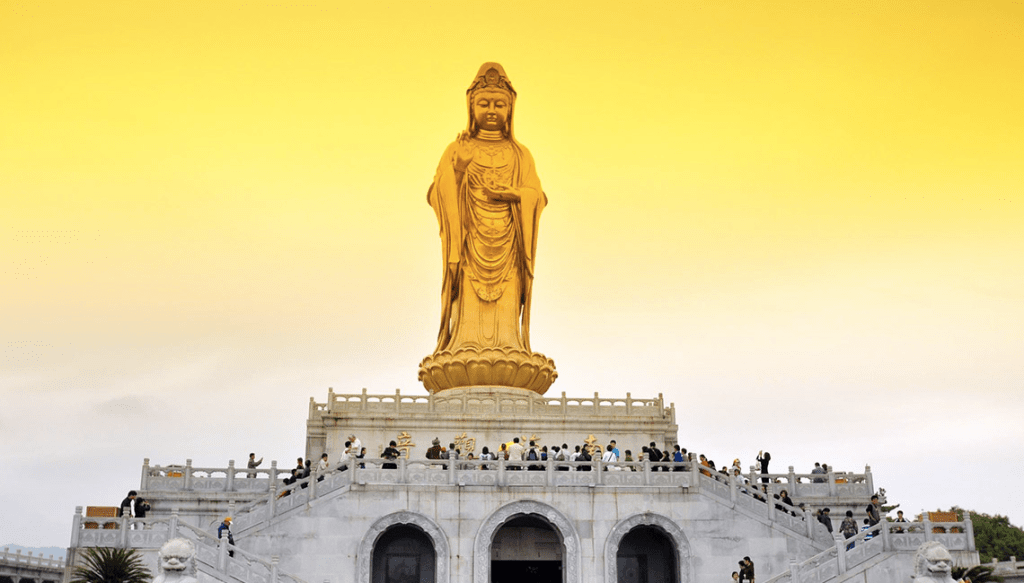
There seem to be three main demographics for visitors to Mount Putuo: sightseers, pilgrims, and students of Buddhism. The majority of sightseers are visitors who do not have much knowledge of Buddhism, nor much interest in its history, sutras, or temples. Nevertheless, everyone, regardless of background, recognizes this place as one expecting reverence and respect for the buddhas and bodhisattvas. When we worship and make our wishes before the famous 33-meter statue of Nanhai Guanyin, we are also introspecting, contemplating, and reflecting on the vicissitudes and travails of our lives.
The town nearby is neat and chic, full of activity and interesting souvenirs for tourists to commemorate their visit. Even in the winter, Mount Putuo is generously covered with greenery and vegetation, with a multitude of species including ancient camphor trees and the rare wild plants of Carpinus putoensis (普陀鵝耳櫟). They are one of the major treasures on Mount Putuo and monoecious. There are red and yellow variations coexisting, but they do not mature at the same time, so the pollination rate is extremely low. When the Sun is shining, the leaves of many trees turn golden in the backdrop of the Prussian blue sky, surrounded by the various temples. It is truly a picturesque sight.
Carpinus Putoensis Cheng. From baidu
The beautiful scenery, unique to Mount Putuo, is reminiscent of places I have visited in Japan. The connection between Mount Putuo and Japan can be traced back to the Tang dynasty (618–907), when a Japanese Zen and Tendai monk-pilgrim named Egaku (Chinese: 慧鍔; Hui’E) wanted to bring a statue of Guanyin from Mount Wutai to Japan. However, his voyage back via Mount Putuo was hampered by storms and waves despite several attempts. One day, Egaku had a dream in which he realized that the statue of Guanyin did not want to leave. He decided to enshrine it and built a simple hut near the Tidal Sound Cave. Immediately, his ship sailed through and he was able to return to Japan. This is the story of Guanyin “bu ken qu” or “unwilling to go,” and is the source of many folktales surrounding the establishment of temples and monasteries on Mount Putuo. Exchanges between Mount Putuo and Japan continued over many centuries.
Guanyin is the real protagonist linking Japan and China, with Guanyin known as Kannon or Kanzeon in Japan. Belief in this personification of compassion and benevolence has a long history in China. First introduced from India in the Western Han dynasty (202 BCE–9 CE), Avalokiteshvara was adapted and amalgamated into Chinese culture, most famously through the female figuration and her unique 32 transformations (Guang 2011: 1-22). Beginning in the Song dynasty (960–1279), the Chinese transformed the bodhisattva into the Goddess of Mercy, depicted in the feminine. (Minneapolis Institute of Art)
Belief in Guanyin has flourished in China ever since, going beyond even religious boundaries in everyday life (Guang 2011: 1-22). She is not confined to monastic life, as it is said in the Universal Gate chapter of the Lotus Sutra that any worldly being in danger will be delivered instantly on calling her name. Therefore, Guanyin has been worshipped and revered by all classes of people. As she is a compassionate divinity with countless virtues and merits, she is endowed with transcendental power. She excels in skilful means, allowing her to appear in whatever form needed by sentient beings. And that, in my opinion, is probably the reason behind the 32 forms in the Chinese tradition, including Guanyin Yangzhi (楊枝), or Willow Branch Guanyin. The Guanyin Yangzhi is only one example among many of her history-rich gender transitions.
Willow Branch Guanyin. From online source
We were able to visit a 2.5-meter-high, 2.2-meter-wide monument of Guanyin Yangzhi at a nunnery of the same name. The nunnery, situated at the foot of Putuo’s Western Xiangwang Peak, was built in 1608. The artistic style was pioneered by Yan Liben (閻立本), a famous figure painter in the Tang dynasty, while the stele’s engravings appeared during the Ming dynasty (1368–1644). Holding a tender willow branch in her right hand and a clear water vase in the left, Guanyin is luxuriously crowned with pearls and precious stones, dressed in sumptuously embroidered garments, and adorned with agate, amber, and pearls. She spreads dewdrops to all the world’s quarters to dispel suffering and pain.
Guanyin is replete with the marks of beauty, dignity, and calm. Except for her face, there are not many traditionally female features shown. Indeed, she appears tall and somehow mighty and masculine, standing on her bare feet. Her belly bulges out slightly, and she has large hands and feet. While beholding her, I could not help but think of the mural of Padmapani, another manifestation of Avalokiteshvara, at Ajanta Cave No.1, in India. Painted during the sixth century BCE, the bearer of the blue lotus is a male figure with a slender body. Both forms of Avalokiteshvara are crowned and bejewelled, have physically beautiful features, and appear composed and graceful.
Padmapani, Ajanta Cave 1. From alamy.com
There are many temples on Mount Putuo, but the two most well known are Puji Temple (普濟寺) or the “front temple” (又稱前寺), and Huiji Temple (慧濟寺) on the peak of the mountain. They receive the most pilgrims, but Fayu Temple (法雨寺) is my personal favorite; when there is no pedestrian crowding, it has a gentle and soothing atmosphere. It is surrounded by towering ancient trees, suspending the visitor in time between past and present. From a distance, one can see that the gate to the monastery is unique, unlike those of other temples on Mount Putuo, which are painted in yellow ochre. Here it is light red in color: a soft, ambient hue that emphasizes an atmosphere of paradisical peace and bliss.
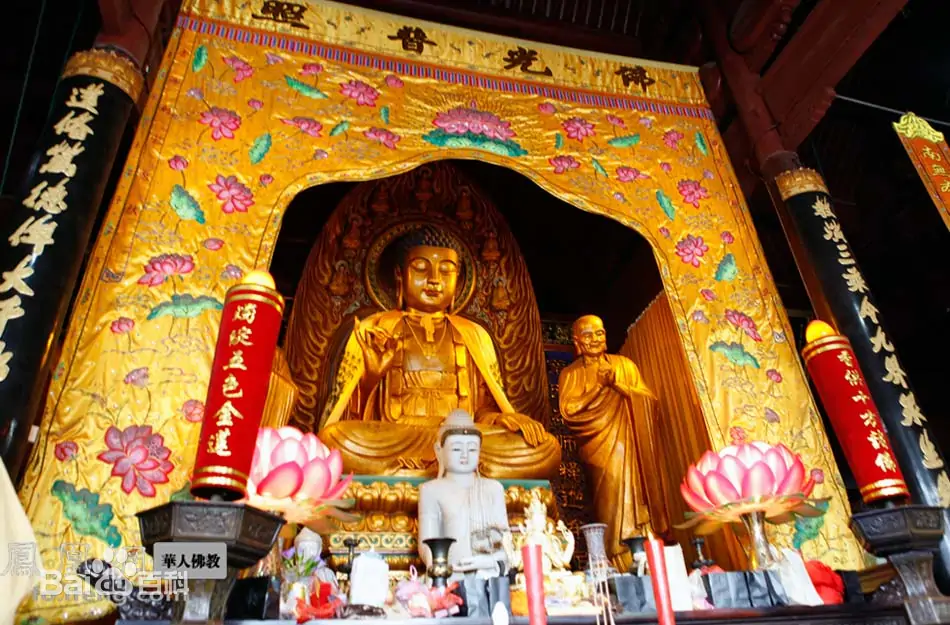
Upon entering and reaching the main hall of Nine Dragons, where a statue of Guanyin is enshrined, one feels a strong sense of sublime and resplendent majesty. Yuantong Hall of the Fayu Temple is renowned for its resplendent appearance and ingenious interior structure, with a large ball hanging from the ceiling of its dome surrounded by nine vertical rafters. Each rafter is carved with a dragon that rears its head in a scramble for the ball. This intricate layout is called the Bracket with Nine Coiling Dragons and is ascribed to Emperor Kangxi (康熙) (1654–1722), who used the materials of the former palace of the Ming dynasty in Nanjing to reconstruct an earlier monastery, Zhenhai Monastery, on Mount Putuo.
Fayu Temple. From the author
What strikes me most, however, is not Fayu Temple’s imperial heritage, but rather two great minds that made their mark here. Venerable Yinguang (印光) (1861–1940) was the 13th patriarch of the Pure Land tradition and the abbot of Fayu Temple for decades. Meanwhile, Ven. Hongyi (弘一) (1880–1942) wrote in traditional calligraphy Fayu Temple’s nameplate of “heavenly flowers and Dharma rain”—first devised by Emperor Kangxi. Li Shu Tong (李叔同) was Hongyi’s secular name. A wealthy and rakish young man, he was also an eclectic and learned scholar of high culture. He relinquished what he possessed and committed to living a monastic life. Fully devoted to promulgating Buddhism, he rose to become an eminent monk.
At some point, the two monastics met each other. It is said that Master Hongyi admired Master Yinguang and asked him to be his teacher. Humble and modest, Master Yinguang refused, but invited him to stay as long as he wanted. The two spent seven days together, studying, practicing, and meditating without a single word exchanged. They simply were, as minds think alike, without verbal obstructions, thoughts traveling and flowing effortlessly. How wonderful it is to exist together beyond words. But in the era of the Internet, we are bombarded with so many words and so much information that we lose our sense of their meaning, let alone their authenticity.
If we wish to be heard, we need to be sincere, candid, and heartfelt. “Guanyin” in Chinese means the Perceiver of Sounds, or “Guanshiyin,” the Perceiver of World’s Sounds. As chanted in the Universal Gate chapter of the Lotus Sutra: “Perceiver of the World’s Sounds, heavenly voice, the voice of the sea’s tide—magnificent, rich and harmonious surpassing all worldly sounds.” If we keep Guanyin in our hearts and call on her sincerely, she will always respond.
Mount Putuo is one of the four sacred mountains in Chinese Buddhism, lies in the East China Sea and incorporates the beauty of both mountain and sea, and honored as the Buddhist Land on the Sea. Its area is approximately 12.5 square kilometres (4.8 sq mi) and there are numerous famous temples. Mount Putuo has been a pilgrimage site for over a thousand years. After the Tang dynasty, Mount Putuo became a center of Avalokitasvara (Guanyin) worship.
In 863, a Japanese monk called Hui E aimed to carry a statue of Avalokitasvara from Mount Wutai to his country by ship. However, when the ship was passing through the sea nearby Mount Putuo, it was prevented by the stormy waves and hundreds of iron lotus flowers suddenly appeared on the sea, blocking the way. Monk Hui E believed that Avalokitasvara didn’t want to leave China. So he knelt down on the bow of the boat and silently prayed to the Bodhisattva Avalokitasvara for instructions. After a while, the iron lotus on the sea disappeared, and the boat drifted to the shore of Mount Putuo, where he built a temple in the purple bamboo forest to enshrine the statue of theBodhisattva. From that time, Mount Putuo got the spirit and became the bodhimanḍa of Bodhisattva Guanyin.
Traditionally there were three main temples: The Puji Temple (founded 10th cent.), the Fayu Temple (founded 1580 CE), and the Huiji Temple (founded 1793 CE). Today, there are more than 30 major temples located at Mount Putuo. In addition to these monasteries, there is the Institute of Buddhism, one of the largest Buddhist academic institutes in China.
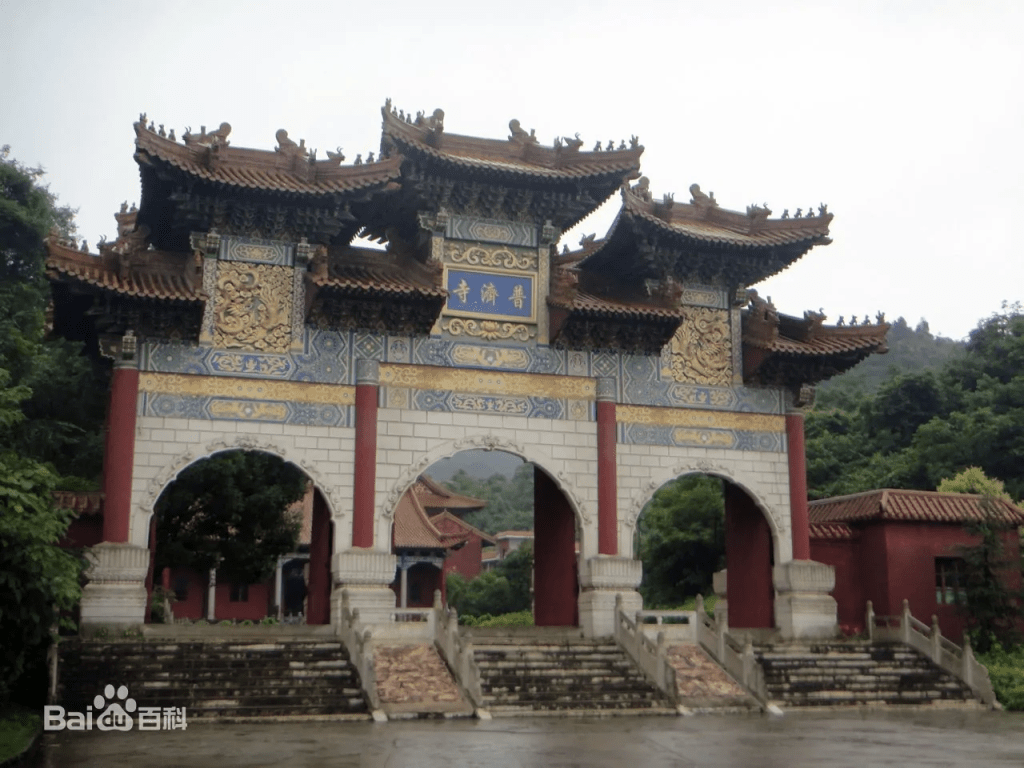
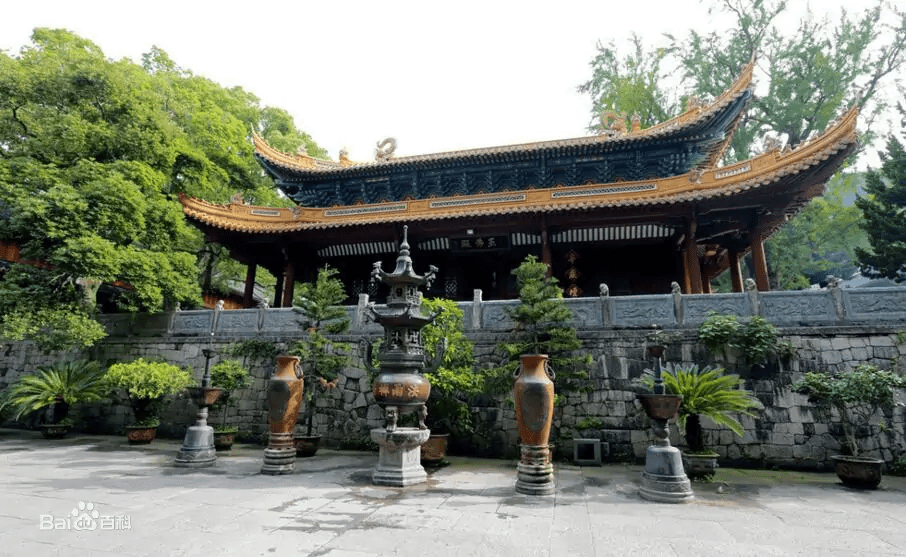
Puji Temple
Puji Temple is the main temple of Mount Putuo and all important Buddhist activities are held here. Covering an area of 37,019 square meters, it contains Grand Yuantong Palace, Hall of Heavenly Kings, Depository of Buddhist Sutras and 357 other buildings. Grand Yuantong Palace is the main hall which houses an 8-meter-high statue of Guanyin surrounded by 32 Bodhisattva with different costumes in a variety of poses on east and west walls. Haiyin Pond in Puji Temple was a free life pond full of spring water primitively and now a lotus pond. At the night of summer, the gorgeous lotus and bright moonlight compose an attractive scenery.
Puji Temple
Haiyin Pond in Puji Temple
Fayu Temple
Fayu Temple was built along the uphill with grand building groups and extraordinary manners. It got such a name in that you could see amazing relives of nine dragons are fighting for pearl on the screen wall before the gate of Halls of Heavenly Kings. Among the 294 halls of Fayu Temple, Nine Dragons Guanyin Palace(also called Grand Yuantong Palace), said to be a Buddhist Temple transported from the imperial palace of Ming Dynasty, acts as the most magnificent one. The highlighted part of this palace must be the Nine Dragons Caisson Ceiling. With unique shapes and vivid images, it enjoys high artist value and is listed in Three Treasures of Mount Putuo.
FaYu Temple
Delicate Carvings in Nine Dragons Screen Wall
Huiji Temple (惠济禅寺)
Huiji Temple is perched in Foding Mountain, the highest peak of Mount Putuo. The architecture of the whole temple is unique. It is located on the mountain and is arranged horizontally. The hall is spacious and magnificent. Hidden in a luxury forest, Huiji Temple features in peaceful environment. Standing at the peak of Mount Putuo, you can have a distant view of the mountains, sea, reefs, beaches and buildings. In the whole temple, statues, carvings and pictures of Guanyin can be found everywhere.
Grand Huiji Temple
Status of Guanyin Bodhisattva
Statue of Standing Nanhai Guanyin
Standing in the south Shuangfeng Peak, Statue of Standing Nanhai Guanyin is the largest outdoor statue of Guanyin made from copper in Asia. With an 18-meter-high statue, 2-meter-high lotus and 13-meter-high foundation, the whole structure has two stories in its foundation. The first story displays elegant carvings, while the second story houses 500 statues of Guanyin in different poses. On the consecrating day at year 1997, a strange nature phenomenon happened. Before the consecrating ceremony, the sky was full of dark cloud and it seemed that it would rain soon. However, as the ceremony began, it became sunny as if two hands pushed aside the clouds. A beam of sunlight just casts on the Guanyin statue.
Statue of Nanhai Guanyin
Avalokitasvara, Guan Shi Yin in Chinese, means the Perceiver of World’s Sounds. The Lotus Sutra says: “Perceiver of the World’s Sounds, heavenly voice, the voice of the sea’s tide—magnificent, rich and harmonious surpassing all worldly sounds.” The bodhisattva always help all beings in danger and distress and is willing to bear the pain of all beings. There are many stories and folk tales about the bodhisattva’s infinite mercy and compassion.
If we hold the bodhisattva in our hearts and call on her sincerely, she will always respond. I had a personal experience. You can read my story here: Guan Shi Yin Bodhisattva saved my life。








 Peace LiLy