A Glimpse Beyond the Ordinary: Faith, Humility, and the Inconceivable

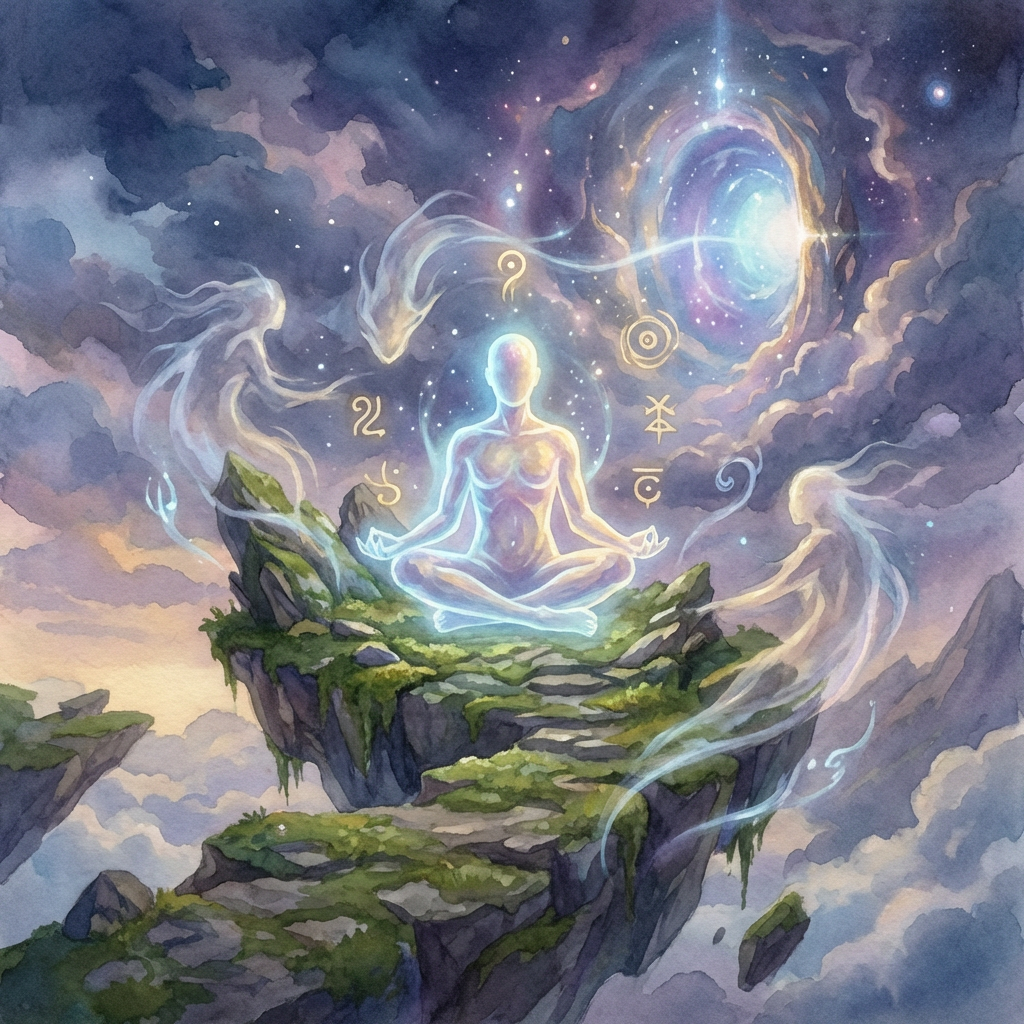
Glowing figure meditating on a floating island surrounded by ethereal spirits and cosmic energy.

The following account is excerpted from a post published by Holy Miracles Temple on April 15, 2022, titled “Recent Talk Records of Venerable Zhai Mang.”

Sometimes, in the course of spiritual practice, there are moments that quietly remind us how limited our ordinary understanding truly is. What we see, hear, and reason through the lens of everyday experience may only be a small fragment of a far greater reality.

Venerable Zhai Mang once shared a personal experience that deeply illustrates this truth.

In January 1996, he accompanied the Buddha and the Holy Mother to Shenzhen. At that time, Brother Li Dehe, the general manager of the Luohu Hotel, arranged a temporary Dharma altar on the 16th floor, where teachings were given and disciples gathered.

One day around noon, it was time to invite the Buddha and the Holy Mother for a meal. Yet, to everyone’s surprise, the Buddha could not be found.

Venerable Zhai Mang went up to the altar to look—no one was there. Another disciple went, and then another. Each time, the result was the same: the room was empty.

Finally, Sister Liu Ge went to check. Unlike the others, she did not leave immediately. She stood quietly by the doorway, facing a large mirror. Behind her was a sealed window, reflected clearly in the glass.

Then, something extraordinary happened.

In the mirror, she suddenly saw a foot appear near the window—seemingly out of nowhere. In the next moment, she witnessed the Buddha step into the room from midair.

Startled beyond words, she cried out.

Everyone rushed over. Inside the altar, the Buddha was already seated calmly, as if nothing unusual had occurred. Sister Liu Ge then recounted what she had just witnessed.

When sharing this story, Venerable Zhai Mang did not focus on the miraculous itself. Instead, he pointed to something far more important.

In simple terms, he reminded us: the realization and abilities of the Buddha and the Holy Mother are beyond the comprehension of ordinary minds. Trying to measure the enlightened with our limited understanding is like trying to contain the vast sky within the palm of a hand.

What, then, should we do?

Not to speculate. Not to doubt blindly.
But to turn inward.

With sincerity, we reflect on ourselves. With humility, we cultivate. With a heart of repentance and reverence, we create the conditions to receive true guidance.

Moments like this are not merely stories of the extraordinary. They are gentle awakenings—reminding us that the path of spiritual practice is not built on curiosity about miracles, but on the transformation of our own hearts.

In a world that often demands proof for everything, perhaps the deeper wisdom lies in recognizing what cannot be fully explained, yet can be quietly felt.

To walk the path is to let go of arrogance, to open the heart, and to trust that there are dimensions of truth far beyond what we can see.

And perhaps, when the mind becomes still and sincere, what once seemed unimaginable may no longer feel so distant.
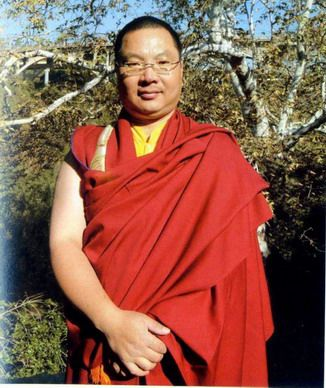
The Legacy of Venerable Denma Tsemang

Venerable Denma Tsemang was one of the twenty-five great Dedengbas under Guru Padmasambhava when he journeyed to Tibet over a thousand years ago to spread the Dharma. During that same period, Shakyamuni Buddha dispatched Denma Tsemang to descend into this world to assist Guru Padmasambhava in propagating the Buddha-Dharma.

According to the traditional biographies of Guru Padmasambhava’s twenty-five foremost disciples, Denma Tsemang was highly accomplished in transcription and writing. He possessed extraordinary wisdom and was especially skilled in translation. Under the guidance of the great ācārya Guru Padmasambhava, he received numerous esoteric teachings, including secret mantras and profound Dharma instructions.

He attained remarkable realization, great spiritual powers, abundant merit, and deep wisdom. It is said that he never forgot any teaching he received, retaining everything completely. Many important terma (hidden treasure texts), including the Collection of Eight Sadhana Teachings, were transcribed by him. In addition, Denma Tsemang, together with other great Bodhisattvas, participated in translating the sutras and treatises contained within the Tripitaka.

In this present lifetime, Denma Tsemang has reincarnated as H.E. Longzhi Tanpe Nyima, a devoted disciple of H.H. Dorje Chang Buddha III. He remains by His Holiness’s side throughout the year, serving as an attendant with unwavering dedication.

His strengths in this life closely mirror those of his previous incarnation. He diligently transcribes and organizes the recorded Dharma discourses of H.H. Dorje Chang Buddha III, preserving these teachings for the benefit of future generations.

During a sacred inner tantric initiation known as “Drawing Lots from a Golden Vase and Casting a Lot,” performed personally by H.H. Dorje Chang Buddha III, the lot revealed the mandala of Guhyapada Vajra—a powerful vajra being of immense spiritual strength. Following this, he demonstrated extraordinary ability by telekinetically moving a vajra pill, clearly revealing the level of realization of a true reincarnated great Dedengba.

Yet despite these remarkable signs, H.E. Longzhi Tanpe Nyima humbly said:

“I am just a Buddhist disciple sincerely cultivating myself.”

Link:https://peacelilysite.com/2026/04/03/a-glimpse-beyond-the-ordinary-faith-humility-and-the-inconceivable/

Why did The Eminent Master Qing Ding Acknowledge H.H. Dorje Chang Buddha III as His Master?


Early Life and Ordination of Dharma Master Qing Ding

Dharma Master Qing Ding was originally named Zheng QuanShan. He was born in 1903 from a well-known large family that had the Buddhist faith for many generations. He started to read and chant Buddhist sutras at the age of 7 and received basic knowledge about Buddhism from his father.

In 1939, when Zheng Quan Shan was 36, he was the major-general director of the Advanced Party, Government, and Military Training Corp of China’s Nationalist Government. While working in Chongqing, he often spent his leisure time to go to Ciyun Temple nearby to listen to Dharma Master Cheng Yi’s expositions of Buddhist sutras and Buddha-dharma.

Under the introduction and guidance of Dharma Master Cheng Yi, Zheng Quanshan was ordained as a monk in 1941 at Ciyun Temple in Chongqing and received his dharma name “Qing Ding.” During the same year, Dharma Master Qing Ding received the complete set of monastic precepts at Zhaojue Temple in Chengdu.

Dharma Master Qing Ding (Disciple of H.H. Dorje Chang Buddha III)
Dharma Master Qing Ding(Disciple of H.H. Dorje Chang Buddha III)

Zhaojue Temple in Chengdu.
Zhaojue Temple in Chengdu

Following Dharma Master Neng Hai and Attaining Lineage

Dharma Master Neng Hai

After receiving the precepts, Dharma Master Qing Ding also became a disciple of  Dharma Master Neng Hai, who was a famous eminent monk in modern Chinese history. He learned the Yidam dharma of  Yamantaka Vajra from Dharma Master Neng Hai.

After Dharma Master Neng Hai had entered nirvana, Dharma master Qing Ding succeeded Dharma Master Neng Hai’s lineage and became a dharma king and leader of the Gelug Sect of esoteric Buddhism. Dharma Master Qing Ding’s dharma power and virtue majestically astounded the world. He once manifested great supernormal powers at a demon-subduing dharma assembly and changed his own appearance into that of Ksitigarbha Bodhisattva.

The Supreme Encounter

However, at the high age of 90, he paid homage to acknowledge a young tremendous holy virtuous person as his master. Who is this young tremendous holy virtuous person? Why did Dharma Master Qing Ding acknowledge Him as his master?

This young tremendous holy virtuous person is His Holiness Dorje Chang Buddha IIIDharma Master Qing Ding observed from his state of realization that this young person is the genuine incarnation of Dorje Chang Buddha the primordial Sambhogakaya of the dharma sphere. He seized this magnificent karmic condition that is difficult to encounter in millions of eons.

Acknowledging H.H. Dorje Chang Buddha III as His Master

Dharma Master Qing Ding acknowledged H.H. Dorje Chang Buddha III as his master and beseeched for Buddha-dharma.
Dharma Master Qing Ding acknowledged H.H. Dorje Chang Buddha III as his master and beseeched for Buddha-dharma.

A Dharma brother supported Dharma Master Qing Ding and said to H.H. Dorje Chang Buddha III, “Master, Great Monk Qing Ding of zhaojue Temple came today to pay homage to become your disciple and beseech for Buddha-dharma.”

H.H. Dorje Chang Buddha III: “Okay, go ahead. You can just do four prostrations according to the four refuges. Monk Qing Ding, your are my disciple from now on. Since you are my disciple, you should act in accord with my conduct, and cultivate yourself earnestly according to my method. Sit on the seating cushion.”

(Sitting at the side was Yang Wen who worked at Chengdu No. 2 Hospital and came with Dharma Master Qing Ding. Helping Dharma Master Qing Ding from behind was the lead attendant of H.H. Dorje Chang Buddha III.)

H.H. Dorje Chang Buddha III: “I will transmit my Buddha-dharma to Great Monk Qing Ding. I hope that you will definitely abide by the religious policies, continue your advancement, and be a good monk.”

Receiving the Inner-Tantric Initiation

Master Qing Ding acknowledged H.H. Dorje Chang buddha III as his master and beseeched for Buddha-dharma. He beseeched H.H. Dorje Chang Buddha III to confer make-up inner- tantric initiation of the Yidam dharma of Yamantaka Vajra.

It turned out that when Dharma Master Qing Ding beseeched and learned the Yidam dharma of Yamantaka Vajra from Dharma Master Neng Hai, he did not receive an inner- tantric initiation. This was because although Dharma Master Neng Hai had received an inner- tantric initiation himself, he did not have the ability to confer an inner- tantric initiation to his disciple, Dharma Master Qing Ding.

The Profound Importance of Inner-Tantric Initiation

Why is an inner- tantric initiation so important? The effect of an inner-tantric initiation is that the master transmitting the dharma invites the Yidam of the dharma to be transmitted to come to the site. The Yidam will then accept the disciple in person. Therefore, as long as the disciple engages in self- cultivation in accord with the dharma, liberation from birth and death is guaranteed with a one- hundred- percent certainty.

H.H. Dorje Chang Buddha III conferred an inner- tantric initiation of the Yidam dharma of Yamantaka Vajra to Dharma Master Qing Ding. That made up what Dharma Master Qing Ding lacked and fulfilled the wish that he cherished for many years.

Why did The Eminent Master Qing Ding Acknowledge H.H. Dorje Chang Buddha III as His Master?

Video Link: https://www.youtube.com/watch?v=-L0P9wJ7KkI&feature=youtu.be

Link:https://hhdorjechangbuddhaiiidharma.com/2025/10/12/why-did-the-eminent-master-qing-ding-acknowledge-h-h-dorje-chang-buddha-iii-as-his-master/

#DorjeChangBuddhaIII #HHDorjeChangBuddhaIII #DorjeChangBuddha #MasterWanKoYee #MasterYiYunGao #DharmaMasterQingDing #DorjeChangBuddhaDisciple #InnerTantricInitiation #ChineseBuddhism #GelugEsotericLineage #LineageTransmission #BuddhistKarmaConnection #TrueBuddhaIncarnation #Karma