Visit to Elder Dharma King Dorje Losang (Lao Na Monk)

From The True Story of a Holy Monk

It is said “on the load to Linqui, a passenger from Hogdu can heal deceased souls with his spiritual power.” This tale has been handed down for thousands of years. Yet very few people have ever witnessed it with their own eyes. Fortunately, the author has become one of the very few.

It was 1997, April in Linqui is the season when grass sprouts and fireflies flit. In an early morning, accompanied by our friend Guanxiu, a monk, we set off our expedition with food and light camping equipment.
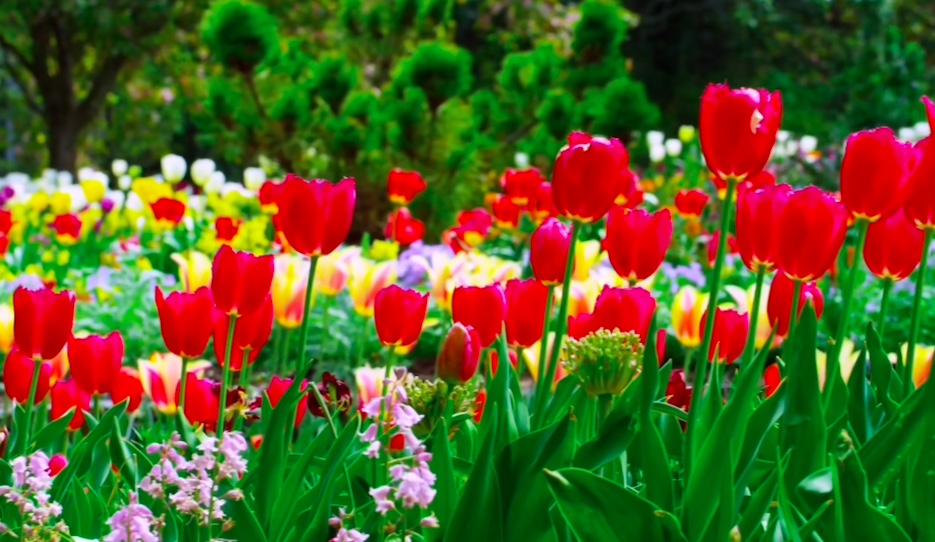
In spite of the fact that I had not traveled on foot for a long time, and was use to traveling by car, I was refreshed by the scent of flowers, chiming of birds, and the flowing brooks, and thus forgot fatigue.

Guanxiu, with his familiarity with the area, let us walk in the wilderness, picking his way through the seemingly impassable forest and bringing us to new sites now and then. We walked in this fashion during the day, and in the evening, we set up camp on the ground to sleep. At noon of the third day, we finally reached “a thread of sky.” Mysterious and enchanting, this “a thread of sky” can be described as a masterpiece of nature.

Two sheer cliffs, facing each other, tower to the sky with immeasurable height. The ridges are so steep, it is as if they were cut deliberately. There are no trees except some vines growing attached to the surface of the ridges. The sunlight in the middle of the day pours down through the narrow ravine which is barely two feet wide which gives travelers a little bit of relief in such a perilous atmosphere. 

While my mind was wandering, Guanxiu said something loudly which I could not understand. Shortly thereafter, a chant of “Amitabha Buddha” was heard. Looking up I saw a spot in the middle of the mountain ridge where vines were poked apart, and from that opening a hanging ladder made of vine descended slowly. A monk came down with the ladder. “This is Guanxin, the servant of the Master,” Guanxiu introduced him to me. I presented my name card hastily to Guanxin. But he waved his hand and said, “You didn’t come at a right time and may not be able to meet the Master.” “Then, how about tomorrow?” I asked eagerly. “It’s difficult to tell. The Master has been in meditation for two days already. He usually remains in meditation for a half or even one month.” Noticing my anxiousness, Guanxiu tried to comfort me by saying, “Whatever is going to happen, let up go up to pay respect to the Master.”

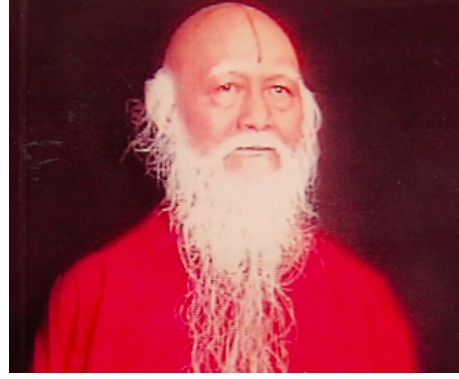
We climbed up the ladder and at its end entered into a cave whose space was about twenty square meters. In the middle of the cave, an old man sat cross-legged, motionlessly like a rock. His face was elegant with a long and beautiful beard. He looked more dignified than Damuo (Patriarch Bodhidharma), the Master of Zen, as portrayed in a movie. I took out my camera and began to take pictures. Seeing this, Guanxiu stopped me immediately and pushed me to pay respect to the Master. As soon as we knelt down, a voice sounding like a bell echoed to my ears, “Get up quickly. You have walked for three days. Your right shoe was broken and your toe is bleeding.” Hearing the voice, I was shocked, partly because the voice was so loud, and partly because on the afternoon of the first day of our journey my right foot hit a rock which cut a long cut in the sole and wounded by toe. It had started bleeding and was still painful at this moment. I could not imagine how this Master can point out my problems immediately. I raised my head to him. Looking at my amazement, the Master smiled and said, “It’s all right. You will be fine soon.” And then he asked us to sit on the chairs.
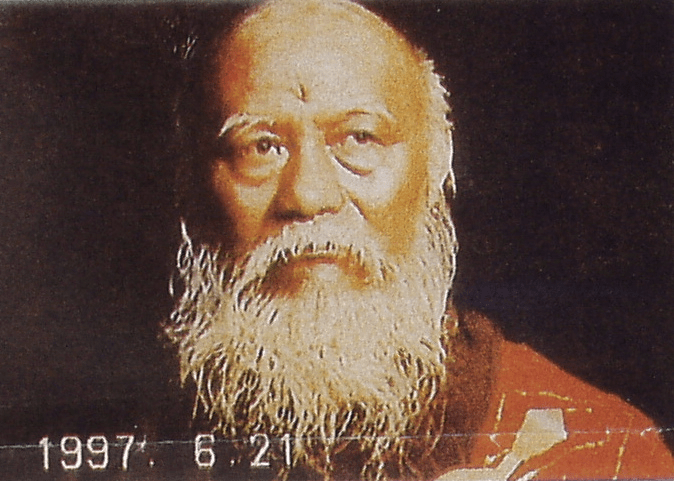
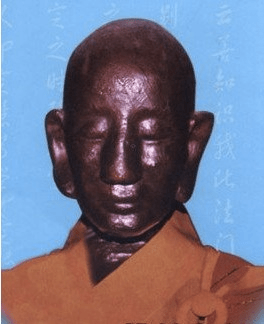
Elder Dharma King Dorje Losang in 1997 at age of 89 when his vajra hair and beard started to grow.

The chair was so old that sitting on it I began to worry that it might collapse. Looking around I noticed that the furnishings in the cave were very simple, yet very clean. A stone table and four stone stools shined like mirrors. The stool on which the Master sat was a little bit larger with a straw cushion laid on the top. There was no bed, nor what we city folks call “furniture.” In a stone niche were a couple of bowls, and at the entrance of the cave there was a wok supported by three rocks. A teapot, which could have been several decades old, was placed on the stone table. There was nothing else in the cave.

Guanxiu was a student of the Master. I could not quite understand their conversation, and thus felt that I was not in the position to join the conversation but should listen quietly while watching carefully. I was told that the Master’s name was Lao Na Monk. For many years he had practiced the Buddha-dharma and attained the inner power of Vajra (Jin Gang).  He never slept during the year. Although 89 years old, his voice was strong and clear, and his bearing and demeanor possessed more vitality than a middle aged person. More amazing was that a tuft of hair which was a mixture of black and white grew on his forehead between his two eyebrows, curling upward, about one inch long. I noticed that during his conversation with Guanxiu the hair flashed three times.  Unable to resist my curiosity, I started asking questions about this mystery. But the Master ignored my questions.

Seeing that I was digging out answers, Guanxiu, with the approval of the Master, provided me some background information about the Master.  When the Master was born, a tuft of black hair, several inches long, grew from his forehead between his eyebrows. His parents believed it was an ominous sign and pulled the hair out completely. Furthermore, in order to ensure that the boy would grow up smoothly, the parents entrusted him to the care of a Buddhist temple. Probably because this was a predestined cause, the boy was initiated into monkshood at a very early age, and became a senior monk when he was still a young boy. He had apprenticed under Master Taixi and Xuyun, and afterwards went to Tibet to study Tibetan esoteric Buddhism. There, he studied Esoteric Dharma and received blessings and initiations of empowerment from a number of world renowned great Masters including the Honored Deng-bashiming, Ah Wang Kan Bu, the Master of Dharma of the Sakya-pa sect, Jiangba Gexi of Paoma Mountain, the living Buddha Zhangjia, Ahuqing Rinpoche of Zhuqing Temple where the Ning-ma-pa sect was originated, and Kangsa Rinpoche. The Honored Chiming Chisong once predicted: “If the hair on your forehead grows again, you will attain limitless achievement and save numerous sentient beings.” However, during the time Lao Na Monk enlightened his practice the hair never appeared. Eventually when the predestined causes were met, he met H.H. Master Yisinubu (Wan Ko Yeshe Norbu who was later recognized as H.H. Dorje Chang Buddha III), the Supreme Master of Dharma of the White sect of Exoteric Buddhism. This Supreme Master was thoroughly knowledgeable in the Sutras, Canons, and Commentaries of Buddhism and achieved outstanding accomplishments in the five illustrious arts (five vidyas)

His remarkable abilities were peerless among the world famed experts in these five areas. Lao Na Monk begged the Supreme Master for transmitting Dharma and the initiation of empowerment. The Supreme Master, before transmitting Dharma to him, made a prediction: “After you practice the Dharma, I am going to transmit to you, the Vajra hair on your forehead will grow again. Then, you will not need to sleep.  Every year the hair will grow about three to five inches. When the hair grows to the length of two to three feet you will achieve extraordinary super-natural power, and the highest degree of wisdom and empowerment.” As a result, 36 hairs suddenly grew on the forehead, and now they were nearly one inch long.

Vajra Hair beginning to grow out of Elderly Dharma King Dorje Losang’s forehead

Before Guanxiu completed the story, Lao Na Monk interrupted him and said seriously:

“You should not advocate these mysterious and strange things. Since it’s not easy for you to come, you should return with some result. As a Buddhist disciple and a person who has already devoted himself to Buddhism, you should have correct knowledge and perceptions of Buddhism. Yes, there are mysterious empowerments. But they are only illusory, and one should not stick to them. When you return home you should read more and practice the Dharma I taught you, and not to believe the nonsense of Living Buddhas and Dharma Masters. Nowadays, in both the region inhabited by the Han people and the region inhabited by Tibetans most so called Living Buddhas (rinpoches) are fake, even some Dharma Masters are highly questionable. It is because these Living Buddhas and Dharma Masters are but ordinary people found by ordinary people, not selected according to the Dharma essence. Many people believe that someone is the reincarnation of someone simply based on the legend of reincarnation, or on an inherited legacy. This is completely wrong. This practice is not in conformity with the teaching of the buddhas and bodhisattvas and the meaning of Esoteric Buddhism. Yes, reincarnation of buddha does occur. Nevertheless, most reincarnations today are false, and even a Buddhist legacy can be fabricated. Someone uses a skull or tooth to claim that they are the relics of such and such Master in such and such generation, so on and so forth.

If you think about it carefully you will find out the truth. Any authentic Master of Dharma is the rebirth of a Buddha or Bodhisattva. A Buddha or Bodhisattva, if authentic, shall leave the world by either turning himself into a flash of red light, or turning his entire body into everlasting Buddhist relics when passing way, or leave the three letters “OM AH HUNG.” Lastly, his body, after being cremated, shall turn into “sheli” Buddhist relics (sharira) usually in a form of colored stones, and never leave such a fiendish skull to horrify sentient beings. All these things are fabricated by the false Living Buddhas and Masters for the purpose of cheating sentient beings. They by no means represent Buddha-dharma. What truly represents the Dharma is Tibetan’s “Doctrines of Knowing Truth.” You should read it carefully when you return home. You must learn how to identify an authentic master, authentic Living Buddhas, and authentic buddhas and bodhisattvas. The method is to find out whether one is thoroughly knowledgeable in the five commentaries of Buddhism, and whether one possesses real supernormal spiritual powers and abilities.

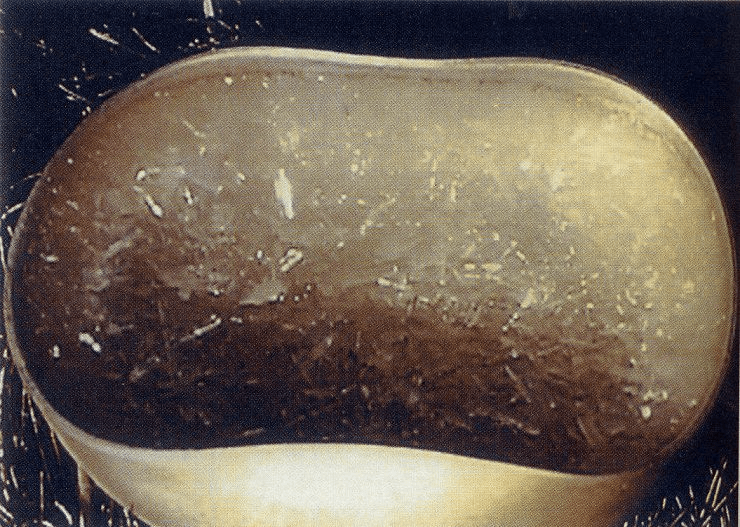
Sakyamuni Buddha Finger Sharira at Famen Temple Shanxi China

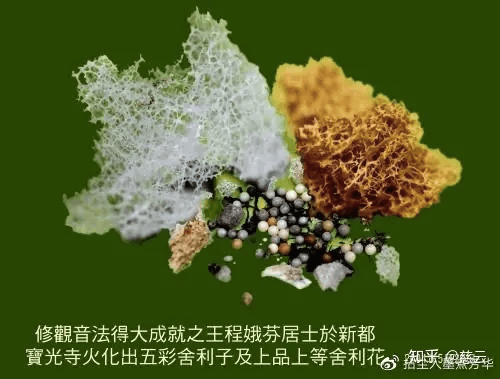
Layperson Wang left beautiful Sheli Flower and Sharira at Xindu BaoGuang Temple SiChuan China

You must devote yourself to Buddhism only according to the meaning of Dharma. Just think about it: how can someone who can’t master both Esoteric and Exoteric Buddhism, who can’t achieve the mastery of the five illustrious arts (vidyas), and who doesn’t possess supernormal spiritual powers, claim to be a great Living Buddha (Rinpoche)? If someone who is not able to write good articles, not able to paint excellent pictures, and not able to invite buddhas and bodhisattvas to descend to bless sentient beings in front of people, is not a master of Buddha-dharma, and he is not even qualified to be a master of laws of the earthly world.  He is no different from and maybe even less capable than an ordinary person.  How can he claim himself to be a buddha?  Is it a big joke? Can it be that the wisdom of a Buddha is even inferior to the cleverness of an ordinary person? Master Wan Ko Yee(H.H. Dorje Chang Buddha III), Supreme Master of Dharma, and my paramount master who bestowed me with great kindness said to me, “You should perform all the virtues, not commit any evil deeds, and practice Buddhism wholeheartedly. Should you maintain absolute faith, accept the transmission of Dharma, and practice according to Master’s instructions you will benefit unlimitedly and liberate yourself by entering the Land of Supreme Happiness.”

Honestly, I could not fully comprehend what the Master had said.  However, seeing that Guanxiu was repeatedly prostrating himself to the Master with palms held together, I began to follow him. Finally, the Master said, “You better leave now. I won’t keep you and you are not used to the lifestyle here.” When we were ready to leave, another surprising miracle happened: the crack on my right shoe disappeared, my toe no longer felt painful, and the wound was completely healed. While I was shocked, Lao Na Monk smiled to me. “Come next time if there is a predestined cause.” He said.

Before our departure, I presented one thousand US Dollars as an offering to the Master, but the Master rejected it. With a smile he said, “I never take any offering. As a matter of fact, I live here on vegetables, fruits and mountain water. At dawn I watch clouds in the sky and in the evening I listen to the wind whistling in the forest. What use does money have to me?” I then offered the money to Guanxiu who, again rejected it and said, “My Master has taught me to practice with a mind of humbleness, and not to take any offerings from anyone.” He then walked us out several miles and repeatedly urged us not to report the whereabouts of the Master so that his practice would remain undisturbed.

We returned through the original route. Now retreating to a corner of this busy and noisy city to write this article, I still feel very much confused and seek in vain for explanations. The experience in those several days were dreamlike. Should I disbelieve it? But the Master did know that my shoe was broken and that my toe was injured. And he fixed by shoe and healed my wound without me noticing it.

Furthermore, he has been in meditation for years without sleep! Should I believe it? Yet I can’t reason out how the hair between his eyebrows which is now merely one inch long would grow to two to three feet. At least, up to this date there hasn’t been any report of such a thing in the world. Since a reporter must provide stories based on facts, I am obliged to write this story based on my true experience although feeling confused. However, to respect the advice of the Master, his whereabouts is not revealed.

Perhaps, the best way to answer all these questions would be to visit him again two or three years from now to find out whether Lao Na Monk’s Vajra hair has grown.

Visit to Elder Dharma King Dorje Losang (Lao Na Monk)

Link:https://peacelilysite.com/2023/07/13/visit-to-elder-dharma-king-dorje-losang-lao-na-monk/

#SakyamuniBuddha#Buddhist #BuddhistTemple#GreatDharmaKing #HolyMonk #BaoguangSi #DorjeLosang#TheTrueStoryofaHolyMonk #Sheli#Sharira#FamenSi #Buddhism #SupremeMaster #H.H.Dorje Chang Buddha III #libration

Nun’s body intact four years after death in A Missouri monastery

This May, Gower, a small rural town in Missouri, has unexpectedly gained recognition as a pilgrimage destination following an extraordinary occurrence related to the exhumation of a nun’s body. Sister Wilhelmina Lancaster, the founder of the Benedictine Sisters of Mary, Queen of the Apostles, was buried at the age of 95 in May 2019. Remarkably, when her body was exhumed four years later, it displayed no visible signs of decomposition, leading to a surge of visitors to the town, approximately 40 miles north of Kansas City.

The preservation of Sister Wilhelmina Lancaster’s body has captivated the attention of hundreds of people, who have deemed it a “miracle in Missouri.” Despite expectations that only bones would remain due to her burial in a simple, unembalmed wooden coffin, the exhumation revealed her fully intact body, along with her religious habit impeccably preserved. Initially, the discovery was intended to remain private, but the news spread rapidly after a private email was mistakenly shared with the public.

While as a Buddhist disciple, I find this occurrence surprising, it is not unprecedented in Chinese Buddhist history. Throughout the annals of Chinese Buddhism, there have been quite a few revered masters and patriarchs who have left behind fully intact relics of their bodies after passing away. Notably, Nanhua Temple in Shaoguan, Guangdong Province, houses three such relics: Master Huineng, the Sixth Patriarch of Zen; Master Hanshang; and Master Dantian. These examples from Buddhist history further highlight the profound reverence and awe associated with the preservation of such relics.

Master Huineng the Sixth Patriarch of Chan Buddhism

Huineng, widely recognized as the Sixth Patriarch or Sixth Ancestor of Chan (Zen) Buddhism, holds a significant place in the early history of Chinese Chan Buddhism. He is both a semi-legendary and a central figure in the development of this tradition. Huineng is renowned as the author of the influential Sixth Platform Sutra and is revered as the sixth patriarch of Chan Buddhism.

To this day, Huineng’s physical body remains preserved in the Nanhua Monastery in Shaoguan, Guangdong Province. Clad in a yellow robe and a red shawl, his corpse serves as a revered symbol within the monastery where he once taught. According to the Biography of the Great Master of Caoxi (Caoxi Dashi Zhuan, circa 781), Huineng’s body was removed from an urn on September 8, 714. After being desiccated for over a year, it was carefully covered with glue and lacquer before being enshrined in a stupa, where it has remained since.

This preservation of Huineng’s body and its continued veneration serve as a testament to his profound impact on the development of Zen Buddhism and his lasting influence on generations of practitioners. The presence of his preserved corpse stands as a tangible reminder of his teachings and spiritual legacy within the Nanhua Monastery.

Master HanShan (1546-1623)
Master Dantian (1535 – 1614)

Mount Jiuhua, located in China, has a significant historical and religious importance as a Buddhist Holy Land, boasting a rich heritage that spans over 1600 years. Its origins can be traced back to the year 401 AD during the Eastern Jin Dynasty, when the esteemed monk known as “Beidu” journeyed from ancient India to Mount Jiuhua with the intention of constructing temples and spreading the teachings of Buddhism.

In 719 AD, when Kim Qiaoque, a prince hailing from Silla (present-day South Korea), arrived at Jiuhua Mountain. Kim Qiaoque dedicated himself to self-cultivation in this sacred place for an impressive span of 75 years. His life came to an end at the remarkable age of 99, and astonishingly, his physical body remained intact even after death. Due to the striking resemblance between Kim Qiaoque and Ksitigarbha Bodhisattva, the revered monks residing in Mount Jiuhua firmly believed that the spirit of Ksitigarbha Bodhisattva had reincarnated within him. Consequently, Mount Jiuhua evolved into a significant site for conducting rites and rituals dedicated to Ksitigarbha Bodhisattva.

Throughout history, Mount Jiuhua has served as a dwelling place for countless enlightened masters. Historical records reveal an astounding tally of sixteen masters who achieved the extraordinary feat of leaving behind relics of their physical bodies, fully intact. To safeguard these precious remains, most of the relics were delicately adorned with a layer of gold, serving as a symbol of veneration from the people. These sacred relics not only stand as a testament to the spiritual accomplishments of these masters but also continue to evoke deep reverence and inspiration among devotees to this very day.

Mount Jiuhua Incarnation Grand Hall Enshrines Flesh Body of Ksitigarbha covered by a layer of gold

Master Mingjing (1928 – 1992)

Renyi Nun 仁义师太(1911—1995)enshrined at Mount Jiuhua Tonghui Zen temple
慈航法师 Master CiHang (1893—1954)Now enshrined in Taiwan Metriya Temple

Just a few years ago, the esteemed holy monk Yinhai, a devoted disciple of H.H. Dorje Chang Buddha III, departed this earthly realm, leaving behind a profound and awe-inspiring spiritual legacy. On January 15, 2017, Elder Monk Yinhai completed his earthly journey through impeccable spiritual practices. What followed after his passing was an extraordinary phenomenon that surpassed anything witnessed in Buddhist history.

Even after his physical demise, the holy monk’s body underwent a truly extraordinary and divine metamorphosis. In a stunning departure from the natural order of things, his fingers and nails continued to grow, presenting an unprecedented occurrence in the annals of Buddhist history. This majestic and wondrous manifestation set a remarkable new record that reverberated throughout the Buddhist community. Commencing on the tenth day following his passing, an awe-inspiring process of complete transformation unfolded within his flesh and bones. In a mere twenty days, his body underwent a magnificent metamorphosis, assuming a form that transcended all comparisons, resembling a sacred dharma image.

The astounding and sacred phenomenon demonstrated by the revered monk Yinhai stands as a powerful testament to the profound Buddha Dharma transmitted by H.H. Dorje Chang Buddha III in the annals of Buddhist history.

Photo on the left was taken 11 hours after the Holy Monk entered nirvana, on the right was taken after 24 days

Across various religions, there have been instances of inexplicable miracles that defy the understanding and explanations provided by current scientific knowledge. These miracles, although beyond the grasp of science, undeniably exist. It is my sincere hope that individuals refrain from hastily dismissing them as mere superstition and avoid judging them solely based on their personal knowledge and beliefs.

The realm of spirituality and faith often transcends the limitations of scientific understanding. It encompasses dimensions and experiences that extend beyond empirical observations and logical reasoning. Just because something cannot be readily explained by scientific means does not diminish its significance or validity. Rather, it calls for a humble recognition of the vast mysteries that exist beyond the boundaries of human comprehension.

By approaching these miracles with an open mind and a willingness to explore the depths of the unknown, we can cultivate a greater appreciation for the diverse expressions of spirituality across different belief systems. It is through this mindset that we can foster respect and understanding, recognizing that our individual perspectives may not encompass the entirety of the world’s wonders.

Nun’s body intact four years after death in A Missouri monastery

Link:https://peacelilysite.com/2023/06/16/nuns-body-intact-four-years-after-death-in-a-missouri-monastery/

Source: https://nypost.com/2023/05/25/nuns-body-exhumed-years-after-death-shows-no-signs-of-decay/

#DorjeChangBuddhaIII #HHDorjeChangBuddhaIII#BuddhaDharma#HolyMonkYinhai#ChanBuddhism#MasterHuineng # #YinhaiShengzun#Holyfeat#SixthPatriarchofChanBuddhism #ZenBuddhism #MountJiuhua #KsitigarbhaBodhisattva #NanhuaTemple #Relics #MasterHanshan

Nectar — Precious Food Which is Bestowed by the Buddhas


White Bodhi Nectar

Generally speaking, nectar can be divided into two categories.  Ordinarily, Rinpoches and Dharma Teachers make pills which they call nectar by using Chinese herbal medicine or water together with such things as sharira and then empower such material by reciting certain mantras.  It can be said that this is false nectar.

What is true nectar?  True nectar is precious food which is bestowed by the Buddhas from the land of the Buddhas.  It is not a food which exists in this earthly world.  There is a Buddha or Bodhisattva Master on the level of a Dharma King who ascends to the Dharma King platform and practices the dharma.  Due to this Master’s state of realization, he is able to successfully invite the Buddhas to arrive in the sky and bestow nectar.  When descending into the dharma bowl, the nectar may turn into light or it may descend in its normal form.  This precious food is something which emanates from nothing.

When the Master conducts the nectar dharma ceremony, there must be a space in between the Master and his disciples.  The distance between them is about fifteen yards to over one hundred yards.  The Master cannot come close to the disciples.  He can only sit on the dharma platform and is not allowed to leave his seat. At a place far away from the Master, a disciple will in front of other disciples use pure water to wash and wipe dry the dharma bowl (this dharma bowl is an ancient dharma bowl made of pure copper and gold which has been handed down through a lineage of Dharma Kings). That disciple will place the dharma bowl in front of himself and in sight of other disciples who will stare at the dharma bowl, never losing sight of it for a moment.

Then, the Master who is a far distance away on the dharma platform will practice the dharma.  From the land of the Buddhas, the Buddhas will bestow nectar which falls from the sky.  It may turn into red light, blue light, or a colorful rainbow as it enters the dharma bowl which is being guarded by the disciples.  It is incomparably wonderful.  The Master will then order the disciples to open the lid of the bowl to exhibit the nectar.  At this time, the disciples are pleasantly astounded to see that inside the dharma bowl which is in front of them is incredibly marvelous nectar which has come from the land of the Buddhas.  Its form is definitely unlike any form which can be found in this human world.  Only after the disciples have confirmed the arrival of nectar does the Master have the right to step down from the dharma platform to view the nectar and empower the disciples by giving them nectar to eat. If one has just one taste of this nectar, one’s life span will increase to over one hundred and twenty years.  This nectar can cure all ailments, such as malignant sores.  After one applies a bit of nectar on the sore, it will be totally cured and will disappear without trace within two to three minutes.

Red Bodhi Nectar
Crystal Bodhi Nectar

Since nectar is such a priceless treasure, it is definitely not something of which ordinary people can partake.  An emperor of China who lived in ancient times, Chin Sher Huang, wanted to taste the nectar of long life.  He ordered Hsu Fu to take five hundred young boys and girls and travel to what is now known as the islands of Japan.  But Hsu Fu was unable to find nectar.  He dare not return to Chin Sher Huang.  The present day people of Japan are the decedents of Hsu Fu and the young boys and girls he took with him.

In Tibet, many people want to taste nectar.  There are those who make their way to Lhasa by kowtowing at every step.  Their legs and hands are cut open.  Some of their bodies have even been cut up by rocks.  They may spend four or five years to make their way to Lhasa.  For the most part, after they arrive in Lhasa, the Dharma King still does not empower them with nectar since their merit is insufficient.  Some people practice arduously their entire lives in order to taste nectar, yet at the time they are about to pass away, they have never seen what nectar looks like.

What type of person is able to taste nectar?  There are three conditions.  First, that person must definitely be a devout Buddhist.  Second, that person’s infinite roots of kindness must extend back into many past lives and throughout eons of time.  Third, that person must have karmic conditions which cause him to meet up with a Great Dharma King who is truly able to practice the nectar dharma.  Otherwise, even if the person is a king, general or minister, he still is not qualified to taste true nectar bestowed by the Buddhas.

Daoists believe that the most difficult and highest state to attain is where one refines one’s essence into vital energy, refines one’s vital energy into spirit, refines one’s spirit to return to emptiness and through internal alchemy one comes up with the immortal substance so that the five vital energies are like the rising sun and all of one’s sprits come together.  Yet, using true nectar which has been bestowed by the Buddhas to accomplish such a state is truly an easy thing.  If one rubs a bit of this nectar on oneself, within twenty-four hours one can enter the state of purity and spontaneity where all of one’s spirits come together.  If one uses this nectar in the formal Buddha dharma initiation ceremony, then the results will be even much more wonderful.  This is a matter of tremendous significance.

One can thus see how magnificent nectar is!  Therefore, one who is able to partake of nectar must be totally devout, must tremendously cherish the opportunity and must strictly practice the Nectar Protection Longevity Mantra.  In this way, one will be able to ensure one’s longevity, avoid disasters, deepen one’s state of realization and attain great accomplishment.

Nectar — Precious Food Which is Bestowed by the Buddhas

Link:https://peacelilysite.com/2023/03/22/nectar-precious-food-which-is-bestowed-by-the-buddhas/

Source: Taken from True Stories About a Holy Monk

#Nectar#Buddha #BuddhaDharma #HolyMonk #DharmaKing

Dharma King Dorje Losang Rode the Dharma To Buddha Land; Left 141 Shariras After His Vajra Body Burned for Six Hours

Dharma King Dorje Losang Rode the Dharma to a Buddha Land; Dharma King Dorje Losang Left Behind 141 Shariras after His Vajra Body Burned for Six Hours

Elderly Dharma King Dorje Losang with Vajra Hair

Elder monk Dorje Losang, one of great perfection and great accomplishment, was the incarnation of the Venerable Vimala-prabha who came to this world in response to its needs. Elder Dharma King Dorje Losang was a disciple of H.H. Dorje Chang Buddha III. He was in the habit of displaying his supernatural powers and thereby manifested the Buddha-dharma. Examples of this are written in the book True Stories About a Holy Monk. He learned and practiced Buddhism under H.H. Dorje Chang Buddha III for many years. Day and night, he did not sleep and did not rest. He did not even have a bed. He only had a mat made of rush stems that he took with him when traveling.

Dharma King Losang received deep teachings originating from the lineage of H.H. Dorje Chang Buddha III. He was so appreciative of H.H. Dorje Chang Buddha III that he wept profusely. He made a great vow to act according to the teachings of H.H. Dorje Chang Buddha III and save living beings. 

Throughout his entire life, Dharma King Losang led a simple life. He had a correct view of the Dharma. He was not attached to things of the world. Before he passed away, he simply said to everyone, “I am leaving. It would be well if you recited Amitabha Buddha’s name more.”  On the second day of the eighth month of the Chinese lunar calendar (October in regular calendar) in the year 2004, he made good on his promise and passed away. Monks from the Bao Guang Temple rushed over to the place where he lived and took his body to the Bao Guang Temple.

In the afternoon of the day Dharma King Losang was cremated, a variety of wonderful phenomena appeared. They were very extraordinary. Monks, nuns, laymen, and laywomen surrounded Dharma King Losang’s body and chanted the name of Amitabha Buddha. Each of them had their own particular feelings toward the wonderful phenomena that appeared.

At 4:20 in the afternoon, the cremation fire was lit. Everyone gathered around the body of Dharma King Losang, which became engulfed in soaring flames. The huge fire looked like a fire dragon circling in the furnace. The wooden container in the furnace holding Dharma King Losang’s body turned into a fireball. However, at this time, a dignified image of elder Dharma King Losang’s head suddenly appeared. Everyone became excited and spontaneously began chanting loudly in unison the Six Syllable Great Brightness Mantra.

During the cremation process, the person in charge of the cremation, Monk Ji Xin Shi, added all together four barrels of firewood into the furnace. He said, “I have never used so much firewood for a cremation.” After the fire raged for a while, people thought that the elder Dharma King’s body had already turned to ashes. However, at this time, the elder Dharma King’s head and body suddenly became visible. His head and body were not burned in the slightest. His clothes, however, were burned to ashes. Still, his head and body could not catch on fire.

In Buddhism history, there were records that stated Master Milarepa could not be burned by any fire of this world. During Dharma King Losang’s cremation, such a phenomenon unexpectedly appeared before our eyes. The elder Dharma King truly deserves to be called “Vajra Dorje Losang Dharma King.” Everyone in attendance then understood the wonderful and profound meaning of “a Vajra body cannot be burned by fire of this world.”

In the midst of the fire, Dharma King Losang sat in the cross-legged lotus posture and manifested the Mahakala state. Everyone loudly chanted mantras. They supplicated that the body catch on fire so that they could collect shariras. They then heard a sudden popping sound. The body of the Dharma King finally caught on fire. After the cremation ceremony ended, the set of monk’s clothes worn by Dharma King Losang during his life was put into the cremation furnace. Light immediately flashed repeatedly inside the furnace. Then, the furnace emitted a great burst of light. Additionally, it intermittently emitted fragrant scents. Everyone was jubilant.

Under normal circumstances, the entire cremation process only takes a little more than one hour. However, the body of Dharma King Losang burned for more than six hours. This is truly a rare event in this world. One can imagine just what kind of Vajra body he had. After the cremation, 141 shariras (relics) were collected from his remains. The six hour cremation of his indestructible Vajra body, which was a manifestation of the Dharma, and the collection of shariras/firm relics thoroughly prove that Dharma King Losang indeed learned the true Dharma of the Buddha from H.H. Dorje Chang Buddha III. Dharma King Losang was not like those people of the world whose practice of the Buddha-dharma is merely uttering empty theories. The holy phenomena described above occur only as a result of the true Buddha-dharma. Thus, we should again stop and think. We often say, “The Buddha-dharma is difficult to seek. The true Dharma is difficult to encounter.” However, H.H. Dorje Chang Buddha III does indeed teach the true Dharma of the Buddha. As a result, we see that one after another of his disciples have attained great accomplishment (liberation). Shouldn’t we think about how we will face our own liberation from the cycle of reincarnation?

Now all the Buddhist disciples should know that the true, precious and supreme Buddha Dharma has been presented in front of us, we should wholeheartedly follow the H.H. Dorje Chang Buddha III‘s teachings and go to the Buddha Land at the end of our life on earth.

#DorjeChangBuddhaIII#HHDorjeChangBuddhaIII#HolyMonk#DorjeLosang#ElderDharmaKing#SupernaturalPowers#TrueStoriesofaholymonk#BuddhaDharma#Shariras#Mantra

Dharma King Dorje Losang Rode the Dharma to a Buddha Land; Dharma King Dorje Losang Left Behind 141 Shariras after His Vajra Body Burned for Six Hours

Link:https://peacelilysite.com/2022/05/12/dharma-king-dorje-losang-rode-the-dharma-to-buddha-land-left-141-shariras-after-his-vajra-body-burned-for-six-hours/

Source: https://xuanfa.net/articles/dharma-king-dorje-losang-rode-the-dharma-to-a-buddha-land-dharma-king-dorje-losang-left-behind-141-shariras-after-his-vajra-body-burned-for-six-hours/?hilite=dorje+losang

A Respectful Visit to Venerable Wang Zhan Shang Zun

A Respectful Visit to Venerable Wang Zhan Shang Zun

by Zhaxi Zhuoma Rinpoche

Photo by Pixabay on Pexels.com

In September 5th, 2015 a great Dharma Assembly — Jin Gang Fa Man Ze Jue was successfully conducted by Wang Zha Shang Zun at a Temple in Los Angeles. This was an amazing and very high level ceremony to determine who was and who was not an authentic incarnation of a Buddha. Wang Zhan Shang Zun is a most impressive and powerful elder man who is worthy of our respect. I have met many dharma kings of different sects, but no one is like Wang Zha Shang Zun. His power and virtue surpass all of them.

After the ceremony, I had the extreme good fortune to meet an attendant of his who speaks English and requested to prostrate to the Shang Zun, which to my surprise, was granted. It is very difficult to meet him. The Assistant told me that, to date, probably less than 100 persons in the U.S. have had the good fortune to meet him privately. The attendant took me to the place where this great mahasattva was staying. I was very excited to be able to see him again. Wang Zha Shang Zun mostly speaks Tibetan, but I am told he can also speak Mandarin Chinese. His voice was as I had remembered from the ceremony. Seeing him up close, I realize that he is probably over six feet tall and in excellent health. I had guessed that he must be at least sixty as I knew he had spent 45 years in seclusion in Tibet, but from his appearance guessed he could be even younger.  His attendant told me that Shang Zun had already turned 93. He is very spirited and looked like and had the energy and bearing of a much younger man. As for his appearance, he has a most remarkable full beard, large kind eyes, bushy eyebrows, a rectangular face, and is bald. I was reminded of images of Bodhidharma, the “barbarian” with such a beard and eyebrows who went to China from India, only Wang Zha Shang Zun is considerably more handsome than the great patriarch of Zen is usually portrayed to be. However, what is most impressive is his incredible modesty and humility. This is what it is like to be in the presence of a great holy being!

I had wanted to meet him to express my gratitude for the empowerment I received at the Jin Gang Fa Man Ze Jue Dharma Assembly, but also just to show my respect because I knew that only someone of very high attainment could have performed that dharma. When I offered him prostrations, he would always tell me to prostrate instead to H.H. Dorje Chang Buddha III. His attendant told me that this holder of three gold buttons at a Shang Zun level always carried an image of the Buddha Master with him and did this. When he went back to his living space, the first thing he would do was to put H.H. Dorje Chang Buddha III’s image and Shakyamuni Buddha’s image in a high place and make offerings to them. I again prostrated, but it was just as before. Wang Zha said, “The Buddha Master is here. You should prostrate to the Buddha Master. How can I accept your prostrations?” The other dharma kings I have met always accepted and even arrogantly awaited my prostrations while silently seating on their throne. Wang Zha Shang Zun is certainly the top chief great dharma king among all dharma kings, but he is still so humble. I was very touched. Again I realized how very, very fortunate I am.

Wang Zha Shang Zun is very easy to communicate with and very amiable. Every sentence he says with a smile.  He also provided me with hot tea having his assistant serve me using traditional China teacups. I accepted the teacup and put it aside on the table. Wang Zha then told me that “the quality of this tea is not very good. It comes from Tibet and is called Old Eagle Tea”. However, the fragrance of the tea, was so wonderful that it betrayed his humble portrayal.  I requested from Wang Zha Shang Zun how to practice the Green Tara Mirror Altar Dharma (Jing Tan Fa). The Shang Zun said, “First you have to have a good mirror. Then you get the dharma transmitted through holy inner tantric initiation. The most important thing is that you should practice according to the Buddha Master’s teachings, and let all people know that they should do good and cease evil. It is then very easy to succeed with this dharma. But you should decide by yourself if you want to practice this dharma. The Buddha Master proposed that we should cultivate ourselves and opposed the miraculous. I am not telling you to practice this Green Tara Altar Dharma.”

The time flew by so quickly. My mouth was dry and I realized I needed to drink the tea, but when I lifted the cup, the cup is so heavy it is as if it were glued to the table.  I couldn’t move it even when I exerted a lot of force. I was so surprised. I put that cup on the table. How can I now not lift it? This time Wang Zha Shang Zun saw what was happening and told me, “It is no use to use force. Force cannot lift it. You have to use your mind to lift it. When your mind is not attached to anything, everything will follow your mind.” Then Wang Zha Shang Zun asked me to lift it again. Very strange. It was as if it was weightless. I easily lifted it and also when I opened the cover of the cup, there is a moving image like a video in the cover. I clearly saw a picture of one of my fellow brothers from the past and a moment when I was in Japan. It was very clear, but it quickly started to disappear. I was really surprised. I used my eyes to follow the cover. After a while it completely disappeared. Then Shang Zun said. “Any object can be used as a mirror.” So I suddenly understood why my mind and my cultivation are so important and cannot be replaced by anything else.

I pray that each of you take advantage of this most fortunate fact that the H.H. Dorje Chang Buddha is living in this world now and practice the Dharma that you learn. I also pray that you all quickly become accomplished.

Namo H.H. Dorje Chang Buddha III! Namo Shakyamuni Buddha!

A very ashamed and fortunate disciple, Zhaxi Zhuoma prostrates and offers special thanks to Wang Zha Shang Zun for teaching her this important lesson.

A Respectful Visit to Venerable Wang Zhan Shang Zun

Link:https://peacelilysite.com/2022/05/06/article-of-a-respectful-visit-to-venerable-wang-zhan-shang-zun/

#DorjeChangBuddhaIII #HHDorjeChangBuddhaIII#DorjeChangBuddha#WangZhanShangZun#BuddhaDharma#ShakyamuniBuddha#ZhaxiZhuoMa#Rinpoche#HolyBuddhismMaster

Holy Beings (Saints)

Holy Beings (Saints)

Green Tara (Jetsun Drolma) statue from the Gyantse Kumbum Pagoda, Pelkor Chode Monastery, Gyantse, Tibet

H.E. Tangtong Gyalpo Bodhisattva (1361-1485)

It is through the understanding and practice of the Buddha-dharma that one becomes a holy person–a living jewel. Sainthood in Buddhism has a somewhat different meaning than that held in Christianity although both refer to people who live an exceptionally holy life, are very compassionate, and can demonstrate certain “miracles.” In Buddhism it also means one who has become enlightened—been liberated from the cycle of reincarnation and all its related suffering. The Christian saint aspires to be born in the Christian heaven, but this is not the goal of a Buddhist. A Buddhist saint is one who has escaped samsara or existence all together and gone beyond what is possible in the heavenly realms. A Buddhist saint would live in the Dharma realms or wherever he choses to be to help living beings. A saint in Buddhism is one who, like the Buddha, has become enlightened and realized his or her original nature, possessing the skills and wisdom of a Buddha. They have gained control over life and death and are thus liberated from the cycle of reincarnation. This is true happiness!

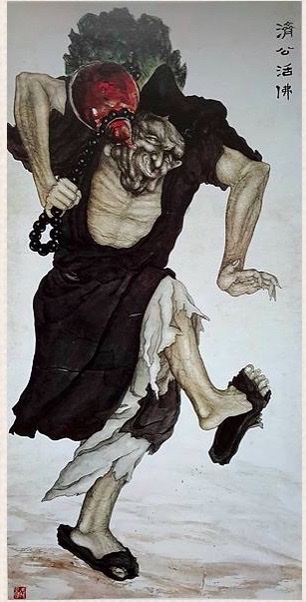
“Painting of Monk Jigong” by Master Wan Ko Yee. (Collection of International Art Museum of America)

In Buddhism saints may not lead what is normally thought of as a “conventional” life. There are many examples of Buddhist saints who exhibited most unorthodox (“deliberate“) behavior. Examples of these kinds of happy, crazy saints are Han-shan and Shih-te, eccentric Ch’an (Zen) hermit-monks from Tang Dynasty, as well as Monk Ji-gong and Birdnest Roshi, but there are many others including the crazy yogis of Tibet like Padmasambhava, Virupa, Manjusrimitra, Tsang Nyon Heruka, and Tangtong Gyalpo. Saints can manifest in innumerable forms and may appear as humans or animals or live in other dimensions.

Japanese hanging scroll by Hashimoto Gaho of Han-shan and Shih-te (Kanzan and Fittoku), eccentric Ch’an (Zen) hermit-monks from Tang Dynasty, whose poetry is popular in the west.

It is important to know that one cannot fully understand what takes place on higher levels of the path. For example, those on the first Bodhisattva stage do not know about what takes place on the second Bodhisattva stage and so on up the path. Those on the second Bodhisattva stage see those on the first Bodhisattva stage as having impurities. Even those on the tenth Bodhisattva stage see those on the ninth Bodhisattva stage as having certain impurities. It is natural that the impurities and obscurations of those on the lower levels would be greater than those at the higher levels. Nevertheless, those who are kind and benefit others can guide and transform living beings no matter where they are on the path. However, ordinary beings and those at the lower levels of the path cannot possibly understand the behavior of true holy beings.

The key features of the various paths to becoming a holy being are summarized in the chart “The Way to Become a Holy Being or Saint.” It is useful to think of these paths as stages on the way to becoming a Buddha. It is interesting to note that the other world religions are also included as initial stages on the way to buddhahood in as much as they teach compassion, loving kindness, some aspects of morality, and discourage evil. Some also teach various forms of training the mind in meditation. Bodhisattvas do not only incarnate as Buddhists to help living being. The three pure precepts of Buddhism—cease evil, do good, and help others—can be practiced in many forms.

You must remember that ALL sentient beings are evolving toward the perfection of being a Buddha, whether they know it or not, and whether at the moment they may be very confused and behaving in foolish or even evil ways. This includes the minions of Mara and the demons of hell as well as the devas or gods in heaven.

Holy Beings (Saints)

Link: https://peacelilysite.com/2022/03/24/holy-beings-saints/

#HolyBeings#Saints#GreenTara#Buddhahood#Buddhism#Bodhisattva#MonkJigong#MasterWankoYee#InternationalArtMuseumofAmerica

Elder Monk Yin Hai Created an Unprecedented Holy Manifestation in the History of Buddhism after His Entering Nirvana

Elder Monk Yin Hai Created an Unprecedented Holy Manifestation in the History of Buddhism after His Entering Nirvana

Holy Monk Yinhai

On January 15 2017, Elder Monk Yinhai, has left us after perfect practices. A top-level great holy monk has forever gone in the world. Under the condition of having no sign of sickness, the Elder Monk went into a perfect passing in a sudden. According to U.S. laws, a doctor must file a death certificate with the government. The doctor, however, could not find any sickness as the cause of death, so he just wrote the heart stopped according to what happened. 

Wangzha Shangzun had already predicted in public when the holy examinations ended on December 30th, 2016: “There is a holy monk who ever shone light from His nine burn-marks and broke the darkness of the room. He is the number one high monk in this world today, whom I respect the most. He will leave us in the middle of January next year. After his passing, a holy feat that has never happened in Buddhist history shall happen. That will be a great joyful matter and is worthy of joyful celebration.” 

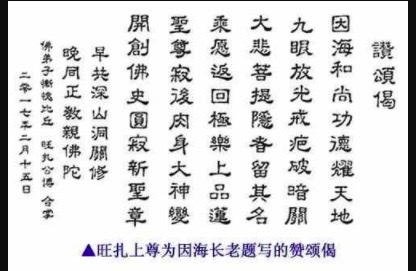
Wangzha Shangzun wrote a praise verse especially:

Monk Yinhai has merits that shine brightly in the universe
His nine burn-marks emitted light that broke darkness in the room
A greatly compassionate Bodhi incluse who now is known to the world,
On His own will, He returned to the Upper Lotus of Ultimate Bliss
After Shengzun’s passing, His flesh transformed with holy miracle
Creating a new sacred chapter on passing in Buddhist history
Earlier we went to reclusive practice in the deep mountain cave together
Lately, we were both close to the Buddha to receive true teachings

—the humbled Buddhist disciple, Wangzha Gongbo, holding palms together. February 15, 2017

Chinese praise verse written by WangZha ShangZun

Besides composing and writing the praise verse, Shangzun also talked about the Elder Monk’s holy feats, explained that the Elder Monk’s greatly compassionate Bodhi merits shone in the universe and spread the dharmic connection to true Buddha Dharma for the human Saha world. He let Shakyamuni Buddha’s teachings show their positive energy and bright light once again; He exposed the dirty phenomena where evil masters and charlatans were wreaking havoc when Buddha Dharma gradually became chaotic two thousand years after Shakyamuni Buddha’s time under the daylight. He allowed Buddhists to find the path to return to the true and correct teachings by the Buddha. 

After the holy monk’s perfect passing, even His fingers and nails continued to grow, showing a tremendous divine transformation in the flesh, which has never happened in Buddhist history. The holy feat manifest that is so majestic and wonderful created a new record in Buddhist history where, on the tenth day after the passing, the flesh and the bones started undergoing a complete change. In twenty days, the body transformed to another dharma image that is majestic beyond compare. The awe-inspiring holy feat the Elder Monk Yinhai left the human world indeed verified the prediction made by Wangzha Shangzun. 

After the Holy Monk entered nirvana, Buddhist disciples of the seven types guarded the Holy Monk’s flesh body at all times day and night. Each shift had between 8 to 16 persons chanting the holy name of Kuan Yin Bodhisattva, without pausing for even one minute. Additionally, three high dharma assemblies were held every day at the site. From the tenth day, people began to see that the Elder Dharma Master’s flesh body was changing miraculously day by day and also emitted unique scent and light. Dharma Master Jue Hui, Dharma Master Long Hui, Dharma Master Xiangge Qiongwa, Dharma Master Ruo Hui, Dharma Master Miao Kong, Long Zhou Rinpoche, and others touched and pressed the Elder Monk’s flesh body by hand. They found that it was substantial and hard as a stone. They were all stunned and spoke with full praises. For that, Wangzha Shangzun was furious and scolded them, “This is total misbehavior. How could one touch and press the revered flesh body of the venerable holy one with one’s hand?” The dharma masters could only say that touching was permitted by H.H. Dorje Chang Buddha III. The Shang Zun did not know how to react and could only say, “You should read the article about what Lama Achuk told Ah Qiong Khempo. Then you will know why the flesh body cannot be touched. Fortunately, the holy venerable one’s stage and state of realization are truly very high. That is why there have not been many effects. Otherwise, this sole holy manifestation occurring for the first time in the history of Buddhism would no longer exist. You should never act so carelessly again.” 

Photo on the left was taken 11 hours after the Holy Monk entered nirvana, on the right was taken after 24 days

The professional staff at the Universal Chung Wah Funeral Home also kept praising and said that it was amazing. Twenty days after the perfect passing, not only there are no more wrinkles, but also the bones and flesh have become quite full, and it looked like a completely different person. The fingers and nails have also grown longer. We have never seen it nor heard it, working here at the funeral home for twenty or thirty years. The great master practiced Buddhism too well!” 

Yinhai Shengzun, with such vast merits, had never touched fame, wealth, or power. He stayed reclusive in deep mountains. The Elder Monk wrote a verse to Wangzha Shangzun which says:

From ancient times, the holy ones often endured being alone.
Only those the recluse left their names.
Abstain from all that is evil, engage in all that is good
Sans evil or fraud, have a tremendous compassionate mind.
I am not one belonging to a sect.
Doing good deeds to attain merit is my dharma gate.
If you want the pure Buddha Dharma to reach the apex
Then follow me to take refuge in the Buddha’s School

(Buddha’s School is the religion that belongs to all Buddhas in the ten directions and is the true Buddhism of Shakyamuni Buddha. It is not the Buddha Dharma which sectarian people of later generations altered and added with their personal views. Buddha’s School directly belongs to Buddha and has no such things as lineages or sectarian systems.) 

The Elder Monk also told the Shangzun that the best and the highest Buddha Dharma for cultivation is the Supreme and Unsurpassable Mahamudra of Liberation. When first meeting the Elder Monk, Wangzha Shangzun already observed in contemplation that His Holiness the Buddha had descended to the world. He asked the Elder Monk to help introduce him to the Buddha. The Elder Monk kindly declined the Shangzun’s request, citing that His Holiness the Buddha was still young at that time and had not started the karmic cause of spreading Buddha Dharma. It was not until ten years ago when the Shangzun finally followed Elder Dharma Master Yinhai to become a disciple of His Holiness the Buddha to learn Buddha Dharma and entered the School of Buddha, i.e., the authentic Buddha’s teaching which is not the sectarian Buddhism of any patriarch. It is the personal transmission and education that belongs directly to His Holiness the Buddha.

Shangzun said that He practiced Buddha Dharma in a reclusive cave deep in the mountains together with the Elder Monk Yinhai in the early years and learned a lot of things from Him. The Elder Monk had holy realization powers and the state of conducting Himself with great compassion and great wisdom, which cannot possibly be exhaustively told. Among the things that He learned from the Elder Monk was the formation of the Vajra Array. The Vajra of the Vajra Array does not belong to any one particular esoteric or exoteric school but directly pertains to the Buddha’s Buddhism. Take, for example, the Eight Great Vajras mentioned in the Diamond Sutra, or the Ucchusma Vajra of the Tang Esoteric Sect, or the Kalachakra Vajra and the Yamantaka Vajra of the Tibetan Esoteric Buddhism. They are all contained in the meaning of the Dharma. Which sect or school would they belong to? It is not the Buddhism of any particular lineage. It is directly the authentic Buddhism. Therefore, it is the School of the Buddha that it belongs to, not any patriarchal sectarian lineage. 

The Elder Monk’s holy power is extreme. Wangzha Shangzun once saw by accident the nine burn-marks on the head of the Elder Monk emitting light rays, which brightened the dark retreat chamber as daylight. It allowed living beings of the non-human realms to raise to higher realms. That happened many years ago. Of late, He and the Elder Monk both got close to H.H. Dorje Chang Buddha III. They received Buddhist highest State-Practice Initiation and the supreme Great Initiation of Buddha Bestowing Amrit. 

Shangzun said: “The Elder Monk is an exceedingly accomplished one from the combined practice of Mahamudra of Liberation and Great Compassionate Magnificent Ocean Red Avalokitesvara. He is a tremendously holy being who came to this world on His own will from the World of Ultimate Bliss. He has now returned to the Upper-Level Lotus Platform in the Pure Land. I am humbled by the level and the stage the Elder Monk has realized. The tremendous meritorious achievement He manifested with His flesh after His perfect passing has never happened in history. You can compare the pictures taken just eleven hours after His perfect passing and the ones taken about His miraculous transformation later. You can see right away that the miraculous transformation reaches such a magnificent and majestic degree, which has never happened in the entire history of the whole world. We can only say that it is terrific and dignified; it is an unparalleled holy feat; the source of true Buddha Dharma is there, and as such, all living beings are fortunate! This is the exact source of the true Dharma of the Tathagata. The holy feat of the miraculous transformation which the Elder Monk Yinhai manifests after His perfect passing lets people understand that the true Buddha Dharma, the great Dharma that allows people to attain liberation and accomplishment, is where H.H. Dorje Chang Buddha III is! 

Elder Monk Yin Hai Created an Unprecedented Holy Manifestation in the History of Buddhism after His Entering Nirvana

Link: https://peacelilysite.com/2022/03/12/elder-monk-yin-hai-created-an-unprecedented-holy-manifestation-in-the-history-of-buddhism-after-his-entering-nirvana/

#DorjeChangBuddhaIII #HHDorjeChangBuddhaIII#UnitedInternationalBuddhismAssociationHeadquarters#OfficeofHisHolinessDorjeChangBuddhaIII#BuddhaDharma#HolyMonkYinhai#WangzhaShangzun#YinhaiShengzun#Holyfeat

Source: https://thebodhiwish.com/elder-monk-yin-hai-created-an-unprecedented-holy-manifestation-in-the-history-of-buddhism-after-his-entering-nirvana/