Zhijin Cave – The King of Karst Caves in China

Zhijin Cave, located in Zhijin County, Bijie City, Guizhou Province, is a high-altitude dry cave of great diversity, complexity, and scale. Inside, the karst formations are unique, vast, majestic, and breathtakingly exquisite, making it a dream destination for countless visitors.

Zhijin Cave, renowned as the “King of Karst Caves,” stands out among other famous karst caves such as Zhangjiajie’s Yellow Dragon Cave (about 100,000 sqm), Chongqing’s Furong Cave (about 37,000 sqm), and Guilin’s Reed Flute Cave (about 14,900 sqm) due to its unparalleled size and grandeur. Spanning over 700,000 square meters, Zhijin Cave is the largest of its kind, featuring 12 grand halls and 47 chambers, each adorned with unique and breathtaking formations. The cave’s largest chamber reaches an impressive width of 175 meters, while six of its halls exceed 10,000 square meters in area, highlighting its monumental scale.

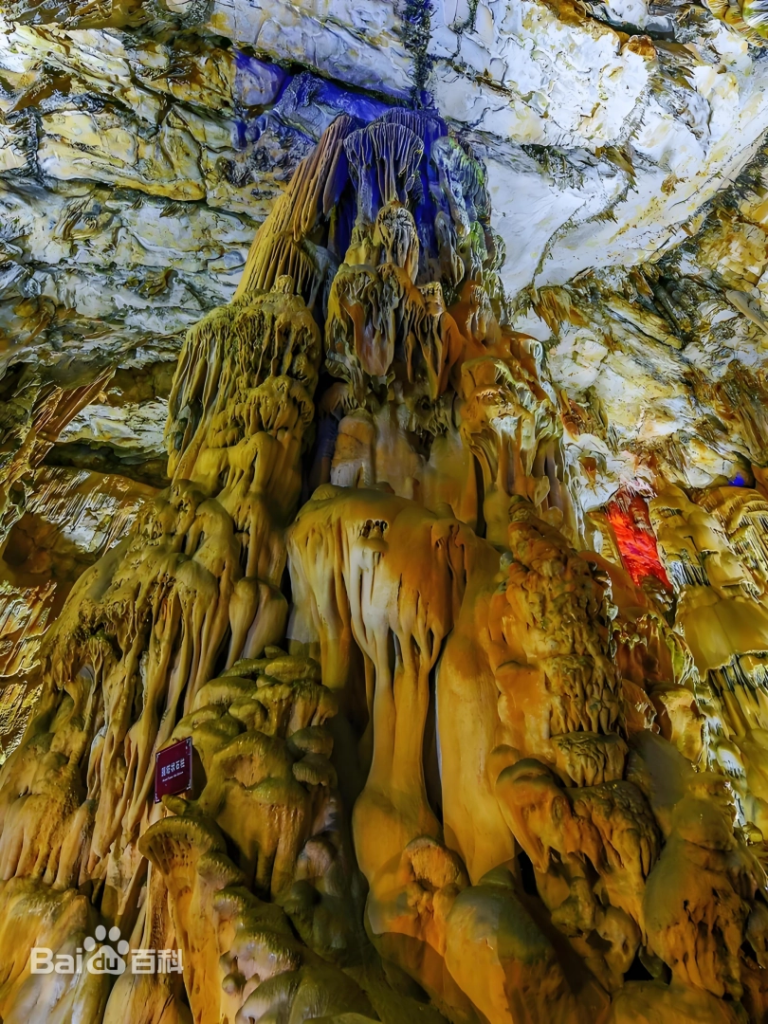
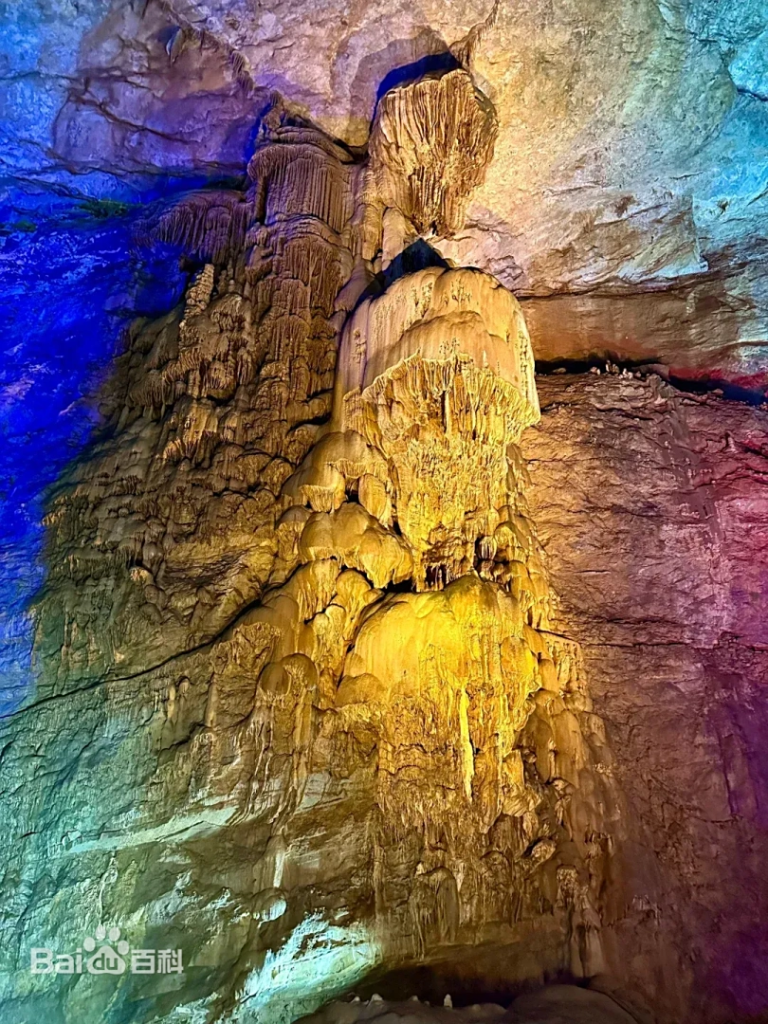
The cave is adorned with a wide variety of karst formations, including stalactites, stalagmites, stone pillars, flowstones, and stone curtains. These formations come in unique shapes, resembling pagodas, plants, animals, and even mythical creatures, showcasing nature’s artistic craftsmanship.

Among its countless highlights, several are especially unforgettable:
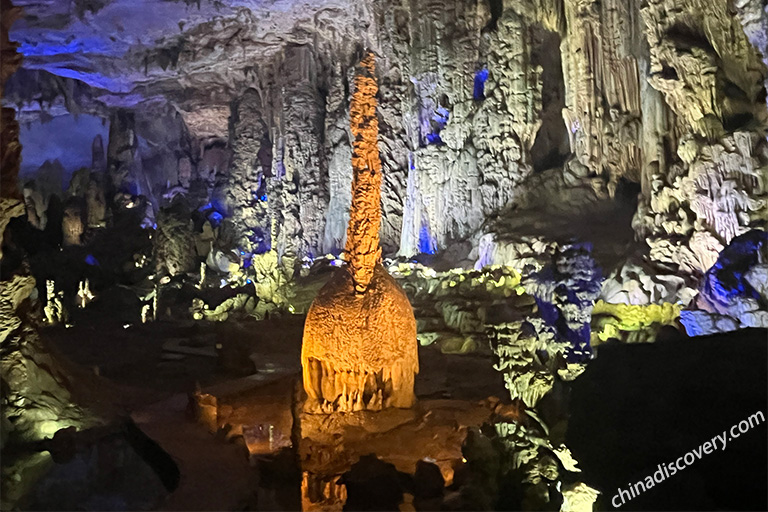
  • The Overlord’s Helmet (“Ba Wang Kui”) – A 17-meter-tall stalagmite shaped like a warrior’s helmet, known as the crown jewel of Zhijin Cave. Lit by orange light and reflected in the pool below, it appears both majestic and lifelike, as if the legendary warlord Xiang Yu himself had left his helmet behind.
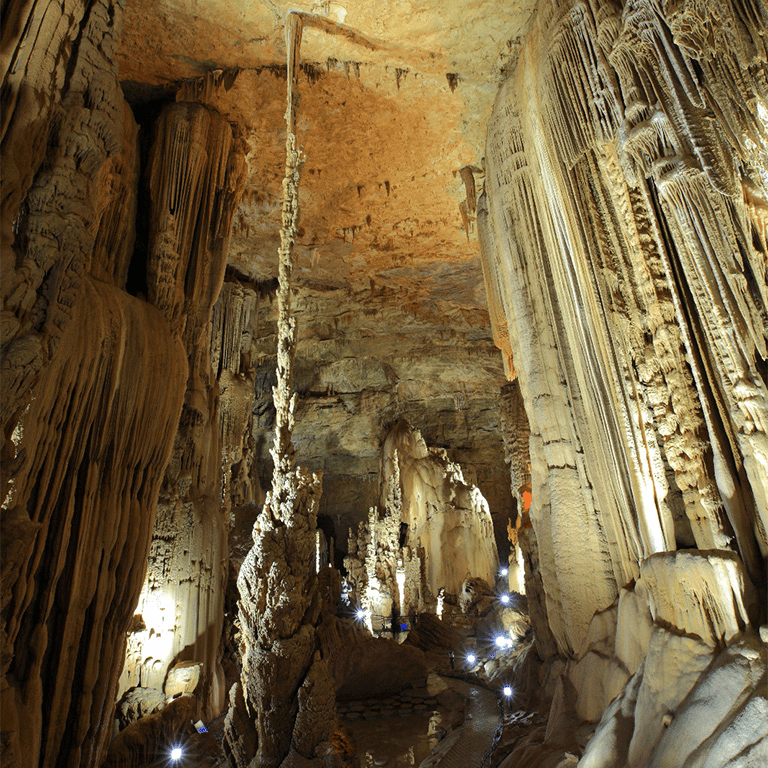
  • The Pillar of Heaven (“Qian Ceng Bao Ta”) – At the junction of the North and South Gates stands a towering stone column that seems to prop up the sky. Called the “Mainstay of the River,” it symbolizes strength, resilience, and the ability to stand tall in times of trial.
  • Mother-in-law and Daughter-in-law (“Po Xi Qing Shen”) – Two pine-shaped stalagmites, one stooped like an old woman and the other upright like her filial daughter-in-law massaging her back. The scene is tender, lifelike, and moving, embodying the Chinese virtue of filial piety.
  • The Lingxiao Palace – A stunning stone waterfall, one of the largest yet discovered, cascading magnificently from the ceiling. Around it stand stone banners, draperies, and a majestic hall of “stalagmite soldiers,” as if a grand palace had opened its doors for a celestial council.

  • Snow Pressing on the Green Pine (“Xue Ya Qing Song”) – A 20-meter-tall stalagmite shaped like a pine tree blanketed in snow, one of the cave’s signature sights. Its upright strength recalls Marshal Chen Yi’s famous poem: “Though snow weighs heavily on the pine, the pine stands tall and straight.” It symbolizes resilience, dignity, and unyielding spirit.
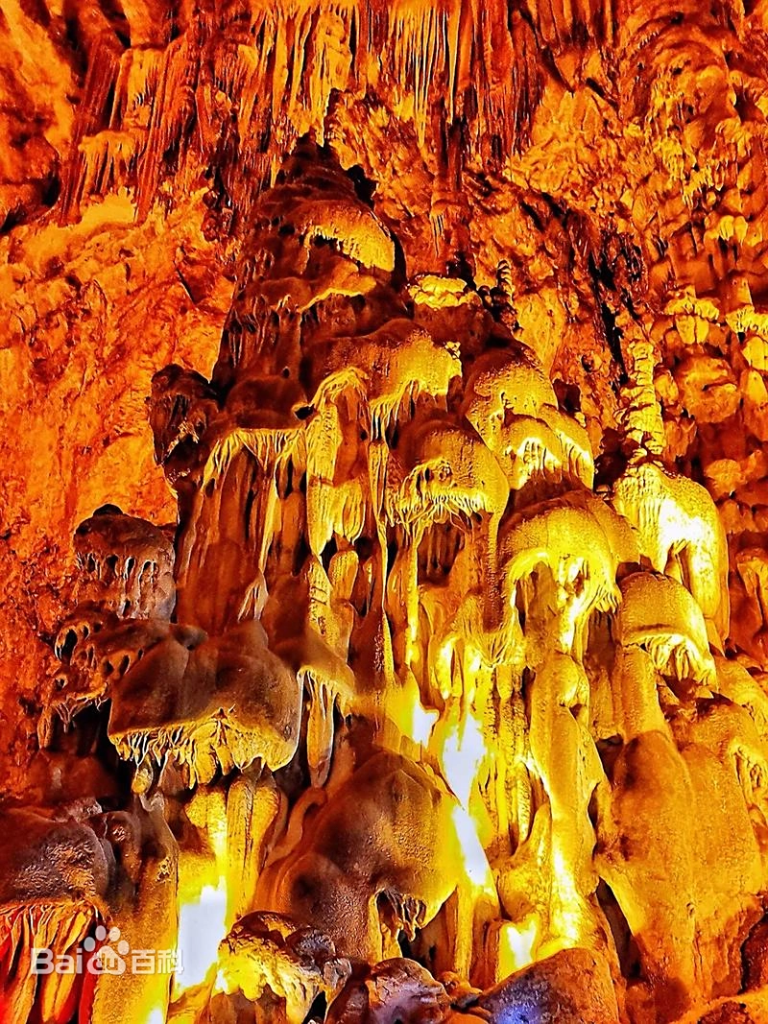
The spectacular karst landscapes of Zhijin Cave embody grandeur, vastness, and beauty beyond imagination. A tour through its endless halls, lasting over two hours, is an ever-unfolding journey of wonder—each chamber a new astonishment, each formation a marvel of nature.

It’s no surprise that Zhijin Cave is honored as the “King of Caves.” As the saying goes: “After Huangshan, no other mountains; beyond Zhijin Cave, no other caves.” The reputation is well deserved.

Practical Tips to Visit Zhijin Cave

Zhijin Cave is located in Guanzhai Miao Ethnic Village, Zhijin County, Bijie City, Guizhou Province. The cave is approximately 120 kilometers (75 miles) from Guiyang, the capital of Guizhou Province.

Bijie City has a total of 9 railway stations and 1 airport. 2 stations are located in Zhijin County, only serving normal trains. The closest high-speed rail station to Zhijin Cave is Qianxi Railway Station, about 45 km away.

Footwear: The cave has stairs and a small section of uneven paths, and the ground can be wet and slippery. Anti-slip footwear is recommended for safety and comfort.

Clothing: The cave maintains a constant temperature of 16°C (61°F). However, the humidity and cool air can make it feel chilly, so it’s best to carry a light jacket.

Food and Drinks: There are no dining options or shops within the cave, so it’s a good idea to bring your own snacks and drinks to stay energized during your visit. If you forget to bring snacks, there is a convenience store at the cave exit where you can purchase refreshments.

Link:https://peacelilysite.com/2025/08/28/zhijin-cave-the-king-of-karst-caves-in-china/

Source: https://www.chinadiscovery.com/guizhou/zhijin-cave.html
Dragon Boat Festival and Duanwu Jie

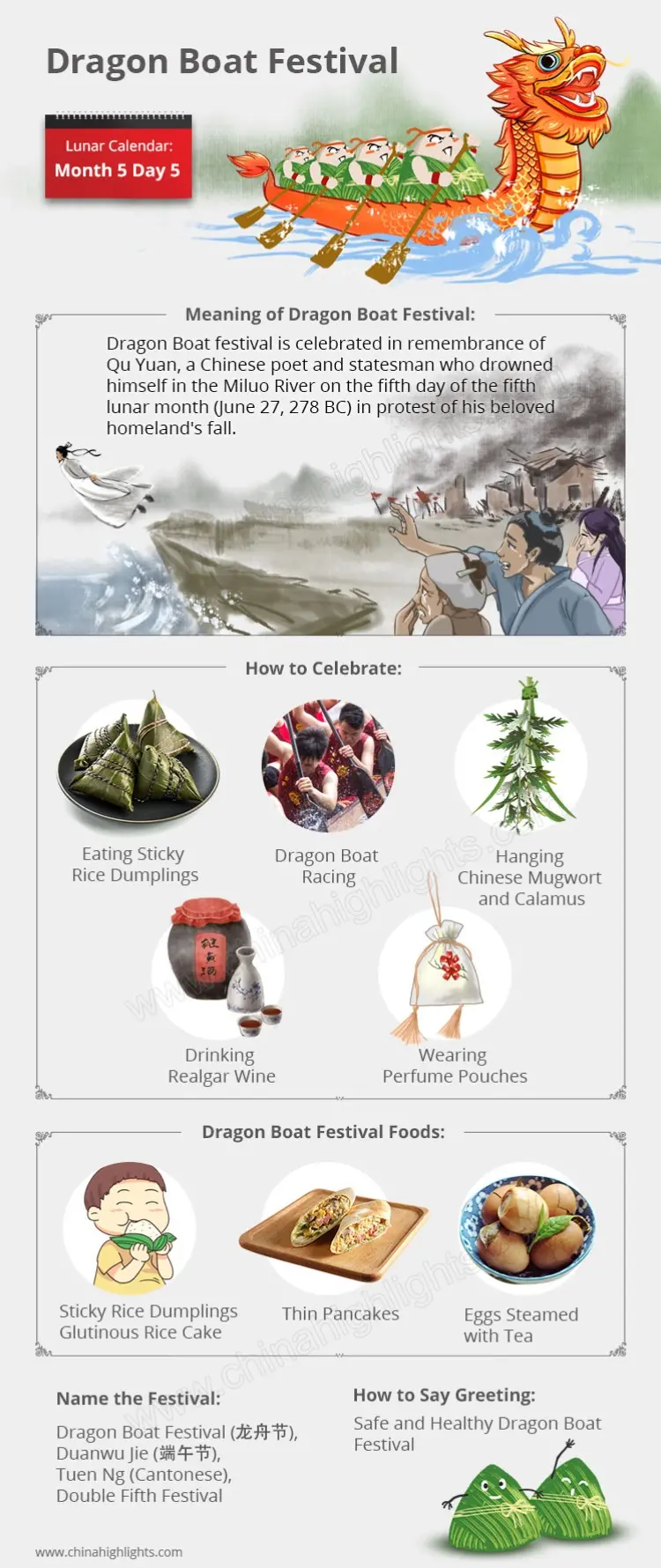
The Dragon Boat Festival, also known as Duanwu Jie, is one of the four major traditional Chinese festivals, alongside the Spring Festival, Tomb-Sweeping Day, and Mid-Autumn Festival. It is celebrated on the fifth day of the fifth month of the Chinese lunar calendar, which is why it is also called the “Double Fifth Festival” (Chongwu Jie, 重五节). On the Gregorian calendar, it usually falls in late May or early June.

In addition to Chinese mainland, many other Asian countries and regions also celebrate this festival. In Malaysia, Indonesia, Singapore, and Taiwan, China, it is known as Bak Chang Festival (‘Dumpling Festival’). Learn more facts about the Dragon Boat Festival

Why Is Dragon Boat Festival So Important?

Many believe that the Dragon Boat Festival is celebrated to commemorate the death of Qu Yuan, a renowned Chinese poet and minister known for his patriotism and profound contributions to classical poetry. He ultimately became a national hero.

However, historical evidence shows that the origins of the Dragon Boat Festival actually predate Qu Yuan’s death. The festival’s earliest roots are tied to the fifth lunar month, which the ancients considered the “month of poison.” As summer began, people were more prone to illness, and epidemics often spread. This made the month seem ominous, prompting ancient communities to adopt various practices to ward off disease and evil spirits.

Thus, the Dragon Boat Festival was originally observed as a traditional health and wellness festival. It was a time for people to carry out rituals and customs aimed at protecting themselves from illness and repelling harmful forces.

Dragon Boat Festival

Dragon Boat Festival Customs

The customs of the Dragon Boat Festival can generally be divided into two main categories. One centers on honoring dragons and historical heroes—most notably Qu Yuan—while the other focuses on warding off evil spirits and promoting health and well-being.

1. Honoring Heroes and Dragons

a. Eating Sticky Rice Dumplings

dragon boat festival celebration, eating sticky rice dumplings

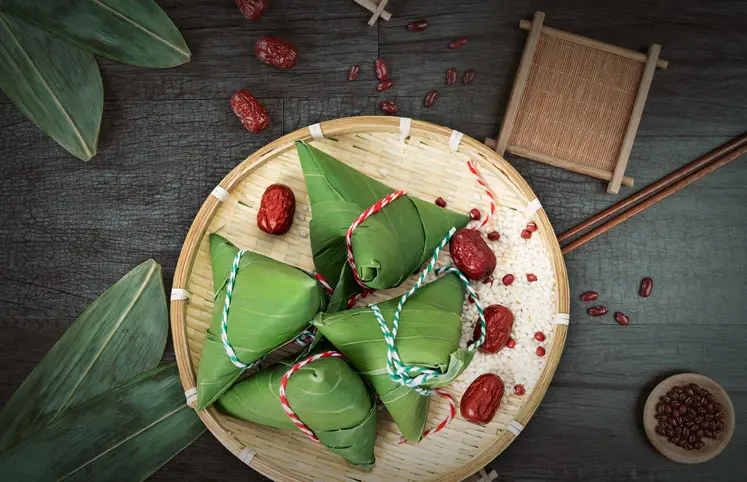
Zongzi (粽子, zòngzi) are the most iconic food of the Dragon Boat Festival. According to legend, after the patriotic poet Qu Yuan drowned himself in the river, local people threw lumps of rice into the water to prevent fish from eating his body. This evolved into the custom of making zongzi.

Traditionally, families would prepare and share homemade zongzi. Today, while some older generations still hand-make them, most people buy them from restaurants or bakeries.

Zongzi are made with glutinous rice and often filled with meats, beans, or other ingredients. They are wrapped in bamboo or reed leaves into triangular or rectangular shapes and tied with soaked stalks or colorful silk cords. Flavors and fillings vary widely across different regions of China.

b. Participating or Watching Dragon Boat Races

dragon boat festival celebration, dragon boat race

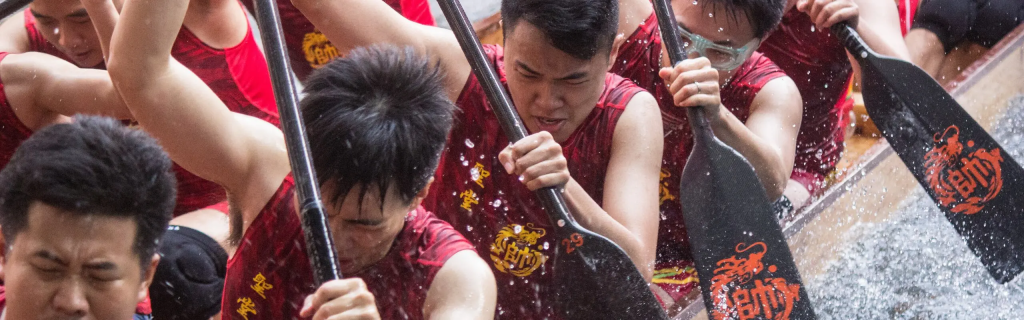
Dragon boat racing is the most exciting and prominent activity during the festival. The sport is said to have originated from people paddling out in boats to search for Qu Yuan’s body after his tragic death in 278 BCE.

Another theory suggests that the races originated more than 2,000 years ago as a ritual to worship the Dragon God or Water God.

The boats are traditionally carved and painted to resemble dragons. Depending on the region, each boat can carry 30 to 60 paddlers. Teams row in unison to the rhythm of pounding drums, creating a thrilling and energetic spectacle. Winning is believed to bring good luck and happiness for the year ahead.

Some of the most famous races take place in Hong Kong, Guangzhou, and Hangzhou.

2. Warding Off Evil and Promoting Health

a. Hanging Chinese Mugwort and Calamus

dragon boat festival celebration

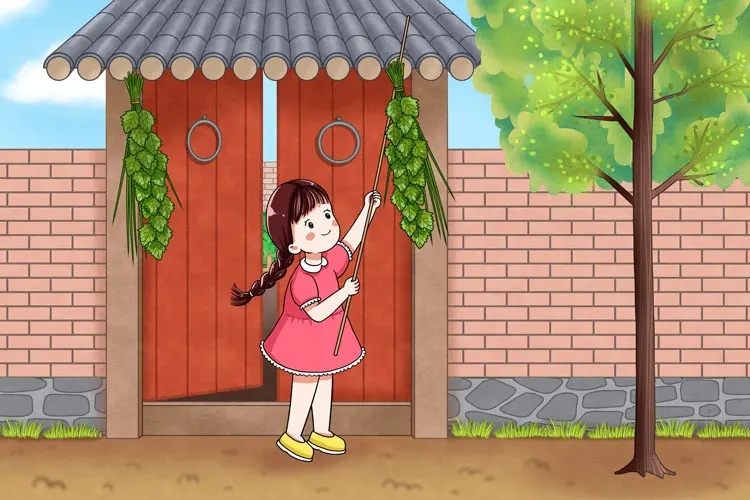
The festival coincides with the early summer season, a time when illnesses were historically more common. Mugwort and calamus are medicinal herbs used to prevent disease and repel pests. Their strong fragrances are believed to drive away flies, mosquitoes, and negative energies.

On the fifth day of the fifth lunar month, people clean their homes and hang these herbs on their doors to protect against illness and bring good luck.

b. Drinking Realgar Wine

dragon boat festival celebration,

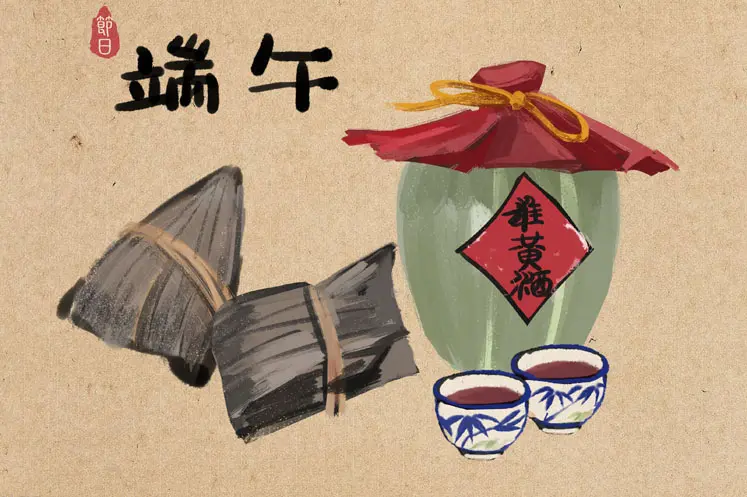
A traditional saying goes: “Drinking realgar wine drives away disease and evil spirits.” Realgar wine is made from fermented grains and realgar, a red mineral (arsenic sulfide) once believed to be an all-purpose antidote.

Historically, people drank realgar wine to kill insects, detoxify the body, and protect against spiritual harm.

c. Wearing Perfume Pouches

dragon boat festival celebration,

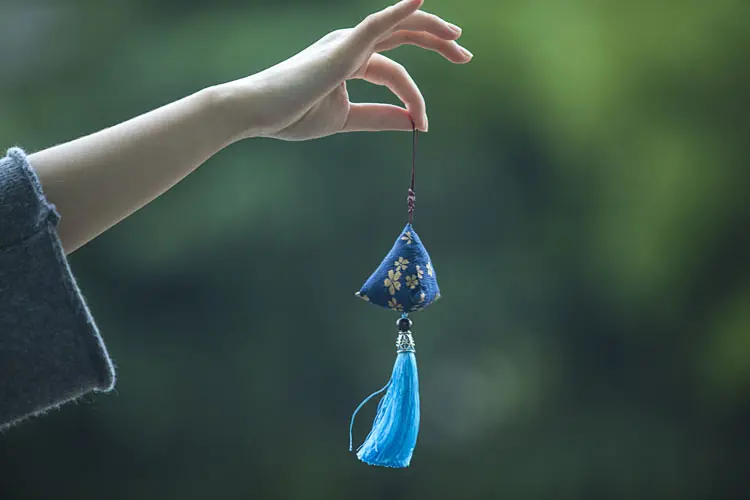
Before the festival, parents prepare small, colorful silk pouches filled with fragrant herbs or perfume for their children. These are either worn around the neck or pinned to clothing as ornaments.

Perfume pouches are believed to offer protection from evil spirits and disease, and are a cherished custom that blends health with artistry.

The Origins of the Dragon Boat Festival

There are many legends about the origin of the Dragon Boat Festival. The most popular ones are as follows:

Why Dragon Boat Festival Celebrated

The Death of Qu Yuan

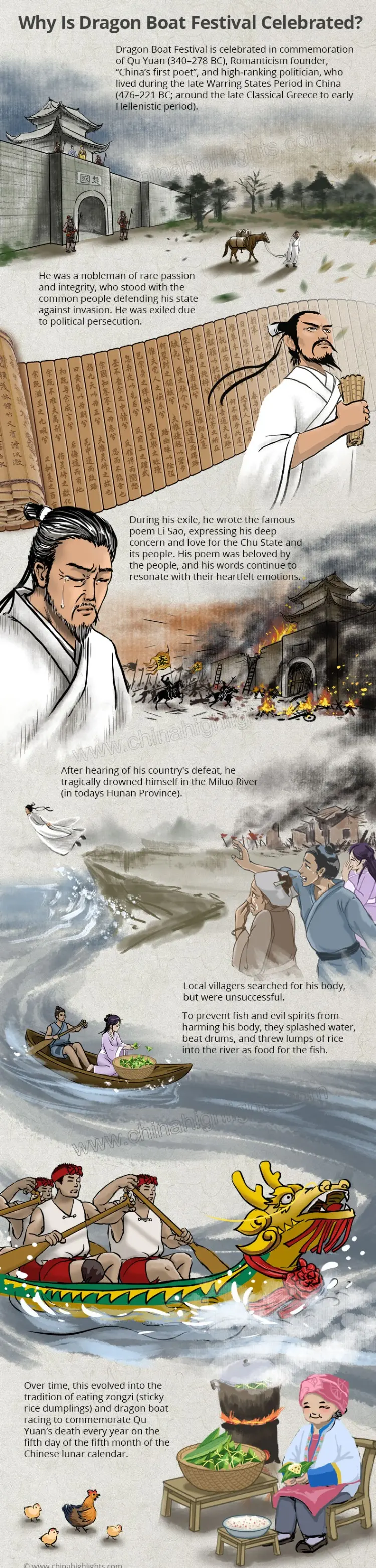
The most widely accepted origin of the Dragon Boat Festival is its commemoration of Qu Yuan (340–278 BCE), a patriotic poet and loyal official of the Chu State during the Warring States Period. When his beloved state fell to the Qin, Qu Yuan, devastated by the loss, drowned himself in the Miluo River on the fifth day of the fifth lunar month.

Local people, deeply moved by his patriotism, raced out in boats to rescue him or retrieve his body, but their efforts were in vain. To keep fish and evil spirits from disturbing his remains, they beat drums and threw rice dumplings into the river. These traditions evolved into the dragon boat races and the custom of eating zongzi that continue today.

The Unlucky Fifth Month

Another explanation for the origins of the Dragon Boat Festival relates to the traditional Chinese calendar and seasonal beliefs. Since ancient times, the fifth lunar month was considered an unlucky time and was even referred to as the “Month of Poison” (毒月). This was when the “Five Poisonous Creatures” (五毒 wǔ dú)—centipedes, scorpions, snakes, toads, and spiders—began to appear in greater numbers due to the warming weather. Disease, pestilence, and natural disasters were also more prevalent during this period.

The fifth day of the fifth month, or the “Double Fifth,” was seen as especially ominous. To protect themselves, people hung wormwood and calamus on their doorways and wore sachets of fragrant mugwort (xiāng bāo, 香包). The sword-like shape and pungent aroma of calamus were believed to repel both pests and evil spirits. For this reason, the Dragon Boat Festival is also sometimes referred to as the “Calamus Festival” (菖蒲节 Chāngpú Jié).

These rich and varied customs reflect the Dragon Boat Festival’s deep cultural significance, blending ancient health practices with heartfelt traditions of honor, protection, and community celebration.

Link:https://peacelilysite.com/2025/06/05/dragon-boat-festival-and-duanwu-jie/

Source: https://www.chinahighlights.com/festivals/dragon-boat-festival.htm

Artful Resilience: The Timeless Elegance of Dr. Yuhua Shouzhi Wang’s Bamboo Paintings

Bamboo of Noble Integrity By Professor Yuhua Shouzhi Wang

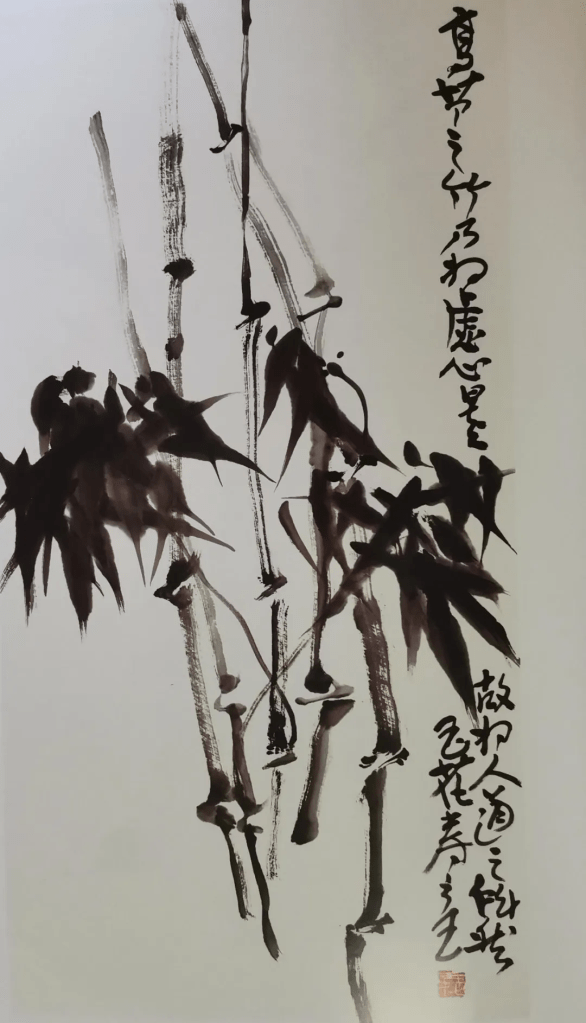
Bamboo, as a plant with profound cultural significance, carries rich and diverse symbolism. It represents resilience, noble character, vitality, humility, modesty, harmony, and unity. With its graceful posture and vibrant green appearance, bamboo evokes a sense of freshness and refinement. Though its exterior is simple and unadorned, it embodies a noble inner quality. This unique temperament has made bamboo a symbol of integrity and uprightness. In ancient times, it often served as a metaphor in the writings of scholars and poets for individuals of high moral character and self-discipline.

For the Chinese, admiration for bamboo has endured throughout history. Countless poets and literati have celebrated its virtues, grouping it alongside plum blossoms, orchids, and chrysanthemums as one of the “Four Gentlemen,” embodying the character and aesthetic spirit of the Chinese people. Bamboo’s simplicity belies its profound cultural significance. In traditional Chinese culture, it is a symbol of auspiciousness and virtue, carrying layers of meaning that resonate deeply with the human spirit.

Professor Wang’s Chinese paintings of bamboo are a testament to her extraordinary ability to bring this cultural icon to life. Each stroke captures the essence of bamboo’s resilience and unyielding spirit while emphasizing its humility and integrity. Her works not only celebrate the elegant charm of bamboo but also evoke its vibrant vitality and enduring strength.

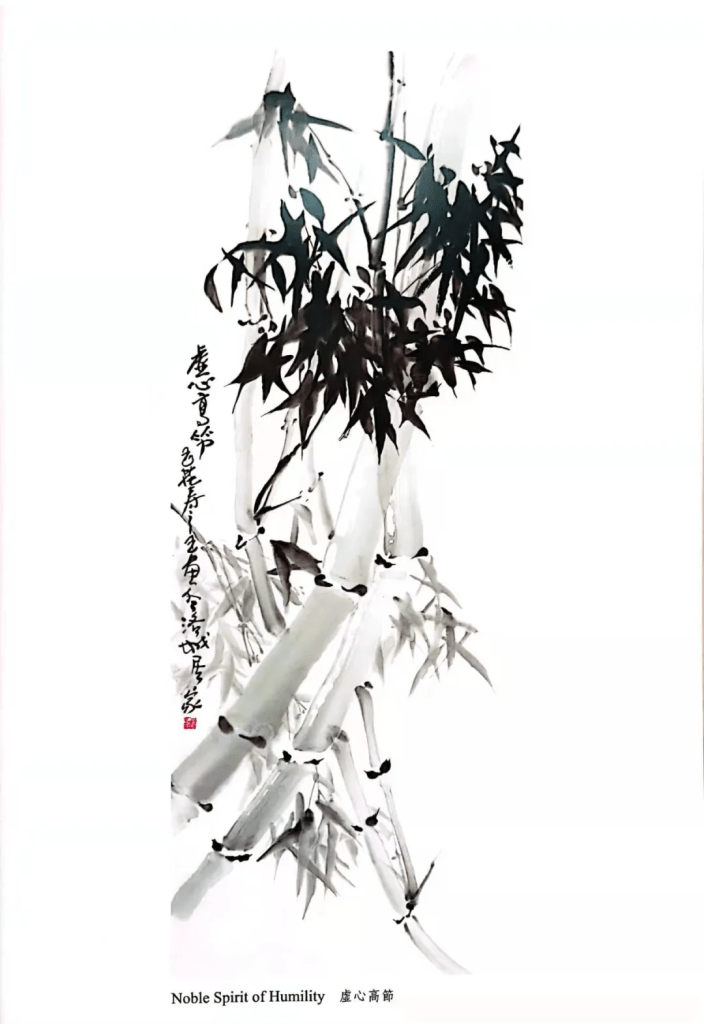
Professor Wang’s Artwork “Noble Spirit of Humility”

The artwork Noble Spirit of Humility depicts a cluster of bamboo deep within a dense forest. Two tall and robust bamboo stalks stand prominently in the foreground, their lush branches and leaves rendered in bold ink. Behind them, a few smaller bamboo stalks, delicately painted in lighter ink, appear to lean on the larger ones, as if embraced by Mother Earth. Together, they form a unified group, advancing and retreating in harmony.

Look closely, and you’ll see their branches intertwine amidst the clouds, and their roots tightly clasp together underground. Neither torrential rain nor fierce winds can break them down. The bamboo’s unyielding resilience is vividly and profoundly brought to life.

Dr. Yuhua Shouzhi Wang was recognized and chronicled in the United States Congressional Record as “a great artist and sculptor,” and “treasure of the world.” In 2013, President George Christophides of the World Federation of UNESCO Clubs, Centers, and Associations (WFUCA) conferred the title “2013WFUCA” to one of her artworks.

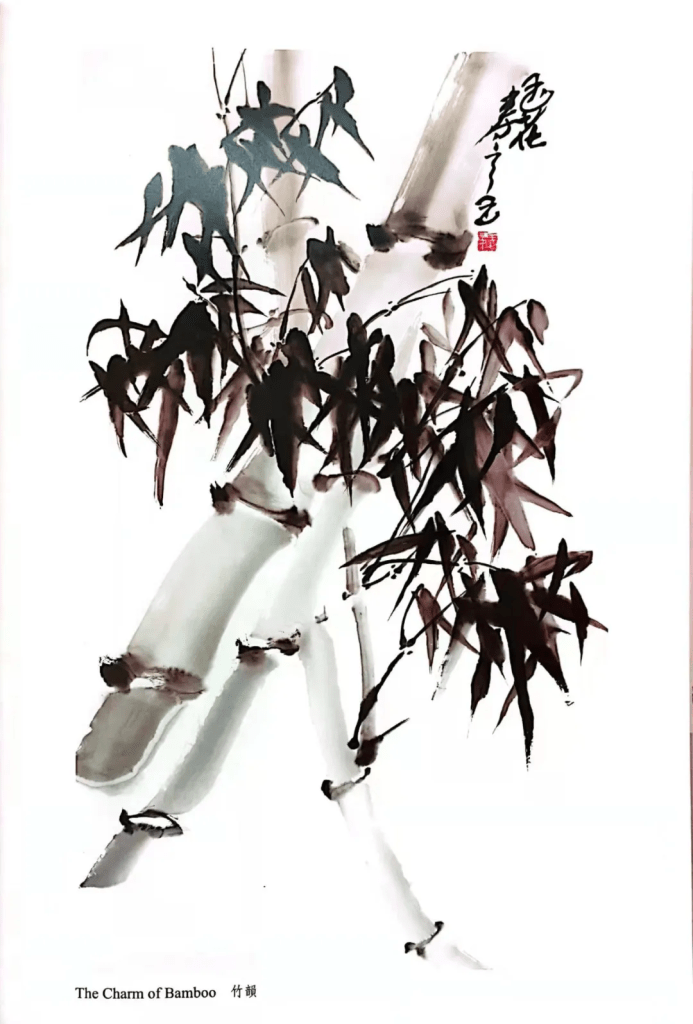
The artwork “The Charm of Bamboo” conveys the fresh and elegant essence of bamboo, exuding a gentle and harmonious beauty. It seems to remind us that in life and work, we should not only take responsibility but also foster an atmosphere of harmony and mutual respect. The use of varying ink tones, alternating between light and dark, strikes a balance of simplicity and ingenuity, greatly enhancing the dynamic energy of the piece.

Dr. Yuhua Shouzhi Wang’s bamboo paintings are truly exceptional. Through her art, she vividly conveys bamboo’s noble qualities, leaving viewers with a deep appreciation for this remarkable plant and its timeless symbolism. Her work serves as a bridge between nature and art, reminding us of the profound lessons we can draw from the natural world.

Link:https://peacelilysite.com/2024/12/27/artful-resilience-the-timeless-elegance-of-dr-yuhua-shouzhi-wangs-bamboo-paintings/

Cherishing Mom: Celebrating Mother’s Day and Sweet Memories

Poems for Mom

On this Mother’s Day, May 12th 2024, let’s take a moment to honor and celebrate the incredible women who have shaped our lives with their love, wisdom, and endless sacrifices. From the comforting embrace of a mother’s arms to the gentle guidance through life’s challenges, mothers hold a special place in our hearts. Today, let’s not only express our gratitude to our own mothers but also extend our appreciation to all the moms around the world. Let’s cherish and remember the countless sweet memories we’ve shared with our moms, from bedtime stories to comforting hugs, from laughter-filled moments to silent acts of love. May this day be a reminder to treasure every precious moment with our moms and show them the love and appreciation they truly deserve. Happy Mother’s Day to all the amazing moms out there!

I Cannot Remember My Mother

By Rabindranath Tagore and translated by Sishu Bholanath

I cannot remember my mother
only sometimes in the midst of my play
a tune seems to hover over my playthings,
the tune of some song that she used to
hum while rocking my cradle.

I cannot remember my mother
but when in the early autumn morning
the smell of the shiuli flowers floats in the air
the scent of the morning service in the temple
comes to me as the scent of my mother.

I cannot remember my mother
only when from my bedroom window I send
my eyes into the blue of the distant sky,
I feel that the stillness of
my mother’s gaze on my face
has spread all over the sky.

Sonnets Are Full of Love

Christina Rossetti

Sonnets are full of love, and this my tome Has many sonnets: so here now shall be One sonnet more, a love sonnet, from me To her whose heart is my heart’s quiet home, To my first Love, my Mother, on whose knee I learnt love-lore that is not troublesome;Whose service is my special dignity,

And she my loadstare while I go and come, and so because you love me, and because I love you, Mother, I have woven a wreath of rhymes wherewith to crown your honoured name: In you not fourscore years can dim the flame of love, whose blessed glow transcends the laws of time and change and mortal life and death.

To My Mother

Edgar Allan Poe

Because I feel that, in the Heavens above, The angels, whispering to one another,Can find, among their burning terms of love, None so devotional as that of “Mother,”Therefore by that dear name I long have called you—You who are more than mother unto me, And fill my heart of hearts, where Death installed you In setting my Virginia’s spirit free.My mother—my own mother, who died early, Was but the mother of myself; but you are mother to the one I loved so dearly, And thus are dearer than the mother I knew By that infinity with which my wife Was dearer to my soul than its soul-life.

Mothering Sunday

George Hare Leonard

It’s the day of the year,
The one day of the year,
When I’ll see my dear Mother
And bring her joy,
Celebrating Mother’s Day on Sunday.

And now I’m off to get my special cake,
From the baker’s, for heaven’s sake.
He promised me the best he’d make,
A treat to take
And celebrate for Mother’s sake.

I have always known, as I strolled by,
A certain lane, where every day,
Without fail, no matter how they try,
Violets lie,
As I walked home on Sunday.

My sister Jane is serving-maid
To the Squire’s lady, come what may.
Each year, she’s played her part, and stayed,
Prepared dinner, and never strayed
For Mother’s special day.

Mother’ll come to Church, you’ll see –
It’s the day she cherishes the most –
“The one,” she’ll say, “that’s made for me.”
And so it will be:
Every Mother’s Day, for all to toast.

The boys will all return from town,
Not one missing this special day.
And every girl will not let down
To display her gown,
On Mothering Sunday.

It’s the day of all the year,
The one day above all others.
And here I am, my dear Mother,
Bringing you cheer,
On Mothering Sunday.

The Champa Flower

By Rabindranath Tagore

SUPPOSING I became a champa flower, just for fun, and grew on a branch high up that tree, and shook in the wind with laughter and danced upon the newly budded leaves, would you know me, mother?

You would call, “Baby, where are you?” and I should laugh to myself and keep quite quiet.

I should slyly open my petals and watch you at your work.

When after your bath, with wet hair spread on your shoulders, you walked through the shadow of the champa tree to the little court where you say your prayers, you would notice the scent of the flower, but not know that it came from me.

When after the midday meal you sat at the window reading Ramayana, and the tree’s shadow fell over your hair and your lap, I should fling my wee little shadow on to the page of your book, just where you were reading.

But would you guess that it was the tiny shadow of your little child?

When in the evening you went to the cow-shed with the lighted lamp in your hand, I should suddenly drop on to the earth again and be your own baby once more, and beg you to tell me a story.

“Where have you been, you naughty child?”

“I won’t tell you, mother.” That’s what you and I would say then.

Links:https://peacelilysite.com/2024/05/10/cherishing-mom-celebrating-mothers-day-and-sweet-memories/

https://www.panmacmillan.com/blogs/literary/the-best-mothers-day-poems, https://allpoetry.com/The-Champa-Flower

The Healing Power of Forgiveness: Unlocking Peace with the REACH Method

In a world often torn apart by conflict and grievances, the importance of forgiveness cannot be overstated. The ability to release resentment and embrace reconciliation is a formidable tool for personal healing and societal harmony. In this blog post, we will explore the REACH Method—a powerful approach to forgiveness created by renowned clinical psychologist Everett Worthington. By delving into each step of the REACH Method—Recall, Empathize, Altruistic gift, Commit, and Hold onto forgiveness—we can learn how forgiveness, under the guidance of Worthington’s methodology, has the potential to bring about positive change, even in the most challenging circumstances.

Recall the Hurt:

The first step in the REACH Method is to Recall the Hurt. It involves acknowledging the pain caused by the wrongdoing. This step allows individuals to confront their emotions head-on and understand the impact of the offense. It’s crucial to remember that forgiving does not mean forgetting; rather, it is a conscious decision to release the grip of resentment.

Empathize with the Offender:

Empathy is a cornerstone of forgiveness. By putting ourselves in the shoes of the person who caused the hurt, we can gain insight into their motivations and struggles. Understanding that everyone is capable of making mistakes and causing harm helps humanize the offender, making forgiveness a more attainable goal. South Africa’s reconciliation process is a testament to the power of empathy in healing deep-seated wounds.

Altruistic Gift of Forgiveness:

The Altruistic Gift of Forgiveness involves recognizing our shared humanity. We all make mistakes and have hurt others at some point. Through the stages of guilt and gratitude, we come to understand the liberating power of forgiveness. This realization inspires us to give the gift of forgiveness to others, fostering a cycle of healing and compassion.

Commit Publicly to Forgive:

Public commitment adds a layer of accountability to the forgiveness process. By expressing forgiveness openly, whether through spoken words, a written letter, or a symbolic gesture, we solidify our commitment to letting go of resentment. This step not only aids personal healing but can also inspire others to embark on their journey of forgiveness.

Hold onto Forgiveness:

Holding onto forgiveness is a continuous process that requires resilience. Painful memories may resurface, but it’s crucial to distinguish them from harboring unforgiveness. The REACH Method acknowledges the challenges of maintaining forgiveness, offering guidance on navigating triggers and doubts. Understanding that forgiveness is a journey, not a destination, empowers individuals to persevere.

Benefits of Forgiveness:

Everett Worthington, with decades of experience studying forgiveness, highlights numerous benefits for the person who forgives. According to Worthington, the primary way forgiveness affects mental health is by lowering rumination—the constant replaying of negative events in our minds. This reduction in rumination leads to improved mental well-being and emotional health. Additionally, forgiveness has been linked to decreased stress, anxiety, and depression, contributing to an overall positive impact on one’s life.

As we navigate a world rife with conflicts, it’s essential to recognize the transformative power of forgiveness. The REACH Method, developed by clinical psychologist Everett Worthington, provides a structured approach to forgiving, offering a pathway to healing and reconciliation. Worthington’s decades of experience studying forgiveness underscore the profound impact it can have on individual and societal well-being.

Beyond personal benefits, forgiveness has the potential to reshape societies and bridge divides. Instead of responding to conflicts with weapons and troops, let us consider the humanity support that the REACH Method embodies—a powerful tool to address the root causes of strife and build a foundation for lasting peace.

By embracing forgiveness, we not only free ourselves from the burden of resentment but also pave the way for a more compassionate and harmonious world. As Everett Worthington aptly puts it, “There are a lot of benefits to the person who forgives.” Lowering rumination and improving mental health are just a few of the many rewards awaiting those who choose the path of forgiveness.

In a world hungry for healing and reconciliation, let us embrace the REACH Method and its transformative potential. Together, we can unlock the power of forgiveness and sow the seeds of peace for generations to come.

Link:https://peacelilysite.com/2024/02/22/the-healing-power-of-forgiveness-unlocking-peace-with-the-reach-method/

#Forgivness #Happiness #REACH #EverettWorthington

https://www.cnbc.com/2023/05/06/forgiveness-can-boost-happiness-improve-mental-health-how-to-start.html

Aladaglar Mountains

One of the most amazing nature phenomenon in Iran

Concrete gray cities have deeply absorbed people as if creation of the Earth had been as colorless and artificial from the very beginning.
When the hands of a great artist touch the paintbrush, the spectra of his color feast cannot be counted. In a distance not too far, God’s tableaus can be seen with soul and heart.

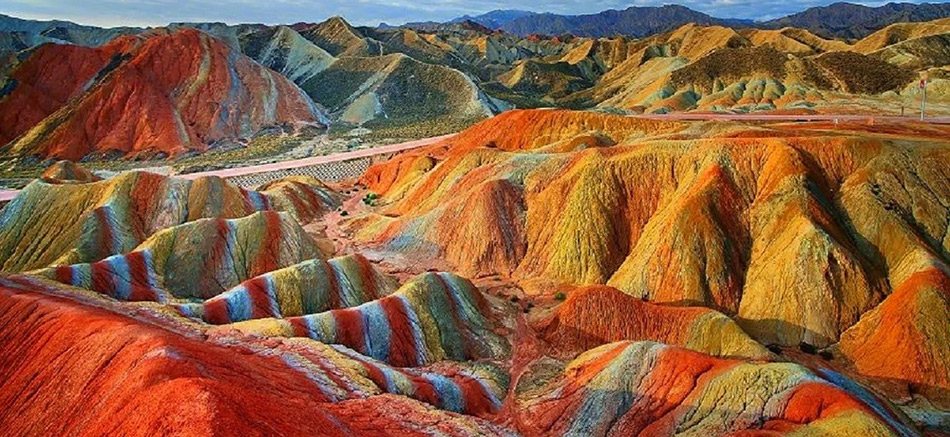
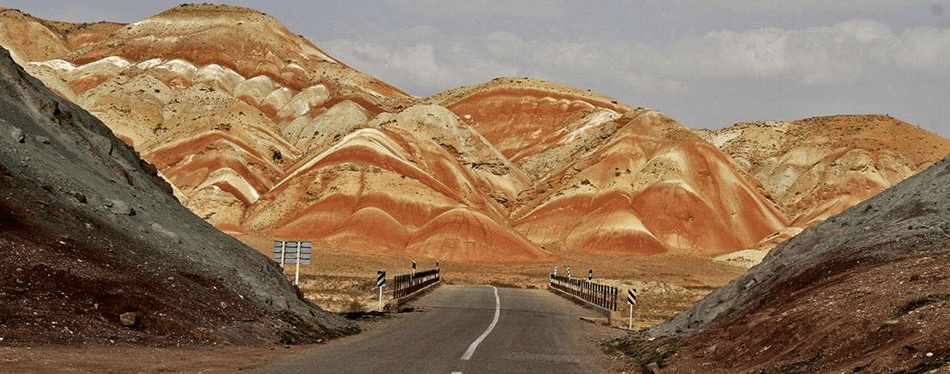
One of the most amazing nature phenomenon in Iran is the Aladaglar mountains or Rainbow  mountains which is in Zanjan province. The hills are so incredible that for a moment you might think you are walking on another planet.

Aladaglar Mountains date back to 15 million years ago. There are a variety of colors in this attractive place containing Red, Copper, Brown, Yellow, White, Green and blue in beauty different spectrum and especially Red, Copper, and Yellow in hot weather. As the setting sun casts golden rays and a lacework of shadows across the landscape, the visual effect becomes even more stunning.

’Ala’’ in Azeri Turkish language means colorful and ‘’Dag’’ means mountain. The Aladaglar rainbow mountains and hills are tucked into the northwest of Iran, 25 kilometers in the northeast of Tabriz between Ahar and Khajeh. Along the road of Ahar-Tabriz, the landscape begins to switch step by step. Passing the city of Tabriz, an eye-catching mountain chain of the Aladaglar appears. The distance between Tehran to the Aladaglar mountains is about 630 kilometers and takes approximately 7 hours via Qazvin-Zanjan road, Zanjan-Tabriz road, and Tabriz-Ahar road.

The golden and copper colors of these mountains get a maximum glow when the Sun shines with the right angle. These mountains provide a unique opportunity for eco-tourists who would like to do their own professional photography.

This work of art by mother nature, the Aladaglar Mountains, shares its name with a mountain range in Turkey, but the two should not be confused.

These painted mountains exist in a few places on earth, such as the Zhangye National Geopark in China, Hornocal mountain range in Argentina and Ausangate mountains in Peru. In China, these mountains are said to be the result of millions of years of minerals and sandstone being pressed together and oxidized. This is likely what happened elsewhere in the world, too, making these phenomenal mountains look like giant layer cakes. Everywhere of the Aladaglar Mountains has a unique form and color and type of stones are different.

Aladaglar Mountains

Link: https://peacelilysite.com/2023/12/01/aladaglar-mountains/

#Travel #Iran #NautrePhenomenon#AladaglarMountains #Paintedmountains

Source: https://iranparadise.com/aladaglar-mountains/#:~:text=Aladaglar%20Mountains%20date%20back%20to,and%20Yellow%20in%20hot%20weather.