The Story Behind Dharma Discourse: The Dharma of Concentration and Visualization Essential for Enlightenment

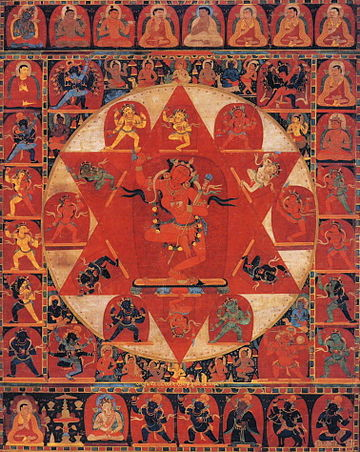
Vajravārāhī

By Yang Zong Da Wa Rinpoche

Pamu has been seriously ill for three months. She is often in a state of unconsciousness, with sores all over her body. Since she can only intake a small amount of liquid food, her body is as dry and thin as rattan. Her once youthful and solemn face has already become like that of a 100-year-old lady, with spots and deep wrinkles. She often says:

“Time does not wait for anyone. Everything is changing. Everything is in a state of impermanence. You should use this as a lesson. After you have read the books I have written, you should put into practice the principles contained in those books. Otherwise, you will not be able to end the cycle of birth and death.”

We used all kinds of medicine and thought of all kinds of methods, yet we could not cure her illness. Thus, on March 29 of this year, Sang Ba Kun Jue Rinpoche and I returned to Lalong-gegan. On the fifth day after our return, we made our way to Lhasa. We went to the Zu Pu Temple to worship, make offerings, and pray for Pamu’s swift recovery. Due to time constraints, we stayed there for only three days and then rushed back to our meditation cells.
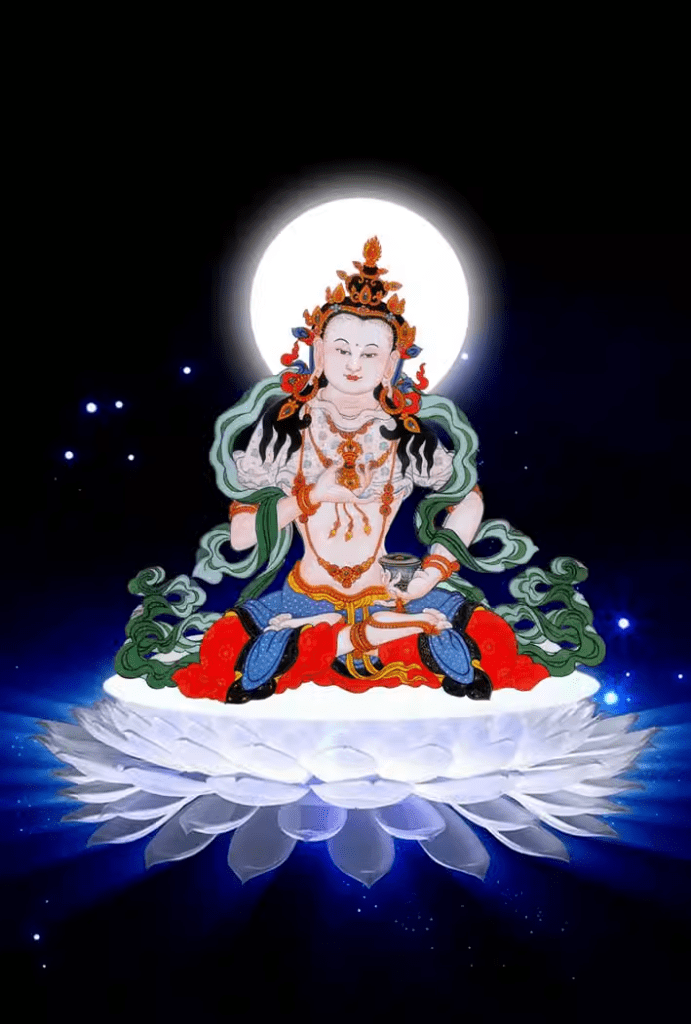
Vajrasattva

Sang Ba Kun Jue and I together practiced the Wu Xiu Yoga Samadhi. We decided to go to the Tusita Heaven to ask Maitreya Bodhisattva to save Pamu. In my state of concentration, I arrived at the inner palace of the Tusita Heaven and paid my respects to Maitreya Bodhisattva. After prostrating myself, I suddenly saw Vajrasattva and Pamu each sitting on a lotus throne, discussing the Dharma with Maitreya Bodhisattva.

At this time, Maitreya Bodhisattva said to me:

“Yang Zong Da Wa, go back and tell those good men and women that Amang Nopu Pamu is the magnificent Buddha Mother of wisdom.”

I joined my palms in front of my heart and asked, “If people ask me how she is magnificent, how should I answer them?”

Maitreya Bodhisattva replied:

“When looking at the history of Buddhism in the human realm, which Buddha Mother in the earthly world has been able to master the Tripitaka and write so many commentaries by the age of 20? Her Dharma water can cause a beard that has stopped growing to grow again rapidly. This is the true Vajravarahi. Have you seen any Buddha Mother who simply saves living beings without accepting any offerings? Her magnificence fills infinite space and cannot be completely expressed to living beings with words. You should quickly go back. Your Pamu will at once return to the earthly world to preach ‘The Dharma of Concentration and Visualization Essential for Enlightenment.’ If you do not quickly leave, you will miss this class.”

I again joined my palms in respect and said to Maitreya Bodhisattva:

“Greatly Honored Maitreya Mahasattva, Pamu is now ill. Why is she here with you? I will go back together with Pamu.”

Maitreya Bodhisattva smiled but did not speak. Vajrasattva then said:

“Do not say anything more. Such deep Dharma is so seldom heard in the world. Quickly go back to the human realm.”

I hurriedly prostrated before Pamu, Vajrasattva, and Maitreya Bodhisattva and bid farewell to them. Through my state of samadhi, I returned to the human realm.

After I emerged from my concentration, three months and six days had already passed. Without even thinking about washing myself, I hurriedly went to pay my respects to Pamu. When I saw her, she still looked so old. She was in the sacred state of having only a faint breath of life left.

Pamu said: “You entered that state of concentration for a few months. I was waiting for you to return. I will soon give discourses on the essential Dharma for practicing concentration and visualization.”

Representing all living beings, I hurriedly prostrated myself before Pamu, joined my palms in respect, and asked:

“Most kind Pamu, when did you return?”

Pamu replied:

“Return from where? With such a serious illness, I did not go anywhere.”

I said, “I clearly saw you in the inner palace of the Tusita Heaven.”

Pamu rejoined:

“This is what you viewed in your state. Do not speak nonsense. Things of the world are all impermanent. One must make the best use of one’s time to benefit living beings.”

As soon as we obtained Pamu’s kind approval, we took a few photographs of her virtuous face. After the film was developed, one photograph showed a young, solemn appearance, while another showed an aged appearance. These two photographs were taken within a few seconds of each other but were totally different. This is truly unbelievable.

We immediately took the photographs to Pamu and asked her to explain the causative factors surrounding this. When we entered the door, everyone was startled. Pamu could hardly speak. Her face was shriveled and had no color. The Great Rinpoches all began to cry.

The next day, when everyone was terribly sad and hopeless, Pamu got up from her seat. My heavens! After only one night, she who was sitting before us was not an old lady about to die but our young and solemn Pamu! All who witnessed this were stupefied. The sound of crying mixed with laughter filled the room.

Pamu then said:

“Do you think I can mysteriously change myself? In fact, you are mistaken! You were not able to see clearly since there was medicine on my face and I was under the lamplight. I only have a heart of humility. How could I have such great skills? You must realize that everything is impermanent and always changing.”
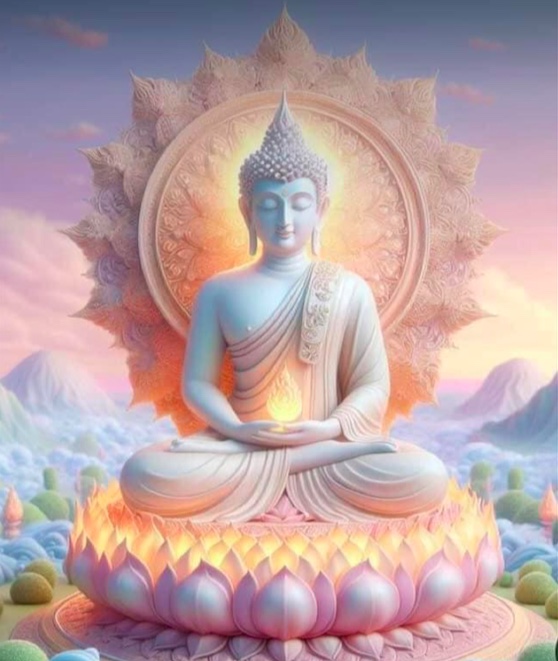
The next day, Pamu formally ascended her throne to give a discourse. The subject was the Dharma of concentration and visualization. With utmost sincerity, I am telling everyone that this is the transcription of the discourses of Amang Nopu Pamu Rinpoche, the greatest and most outstanding Holy Mother in the history of Buddhism. She has never accepted any offerings, silently contributing to the benefit of living beings throughout the three spheres of existence.

This lesson of Dharma practice was given after Pamu returned from the inner palace of the Tusita Heaven. No other Buddha Mother or Dakini can compare with her loftiness and magnificence. We should prostrate ourselves before and feel grateful to the Great Jewel Amang Nopu Rinpoche Holy Mother, appreciating the empowerment of the Buddhas and Bodhisattvas abiding in the ten directions.

Link:https://peacelilysite.com/2025/01/04/the-story-behind-dharma-discourse-the-dharma-of-concentration-and-visualization-essential-for-enlightenment/

Source: Dharma that every Buddhist must follow by Amang Nopu Pamu, translated by Bodi Wentu Rinpoche. This post is an excerpt from the original article, taken from the preface of The Dharma That Every Disciple Must Follow, pages 55 to 58, by the great Rinpoche Yang Zong Da Wa.
Fanjing Mount

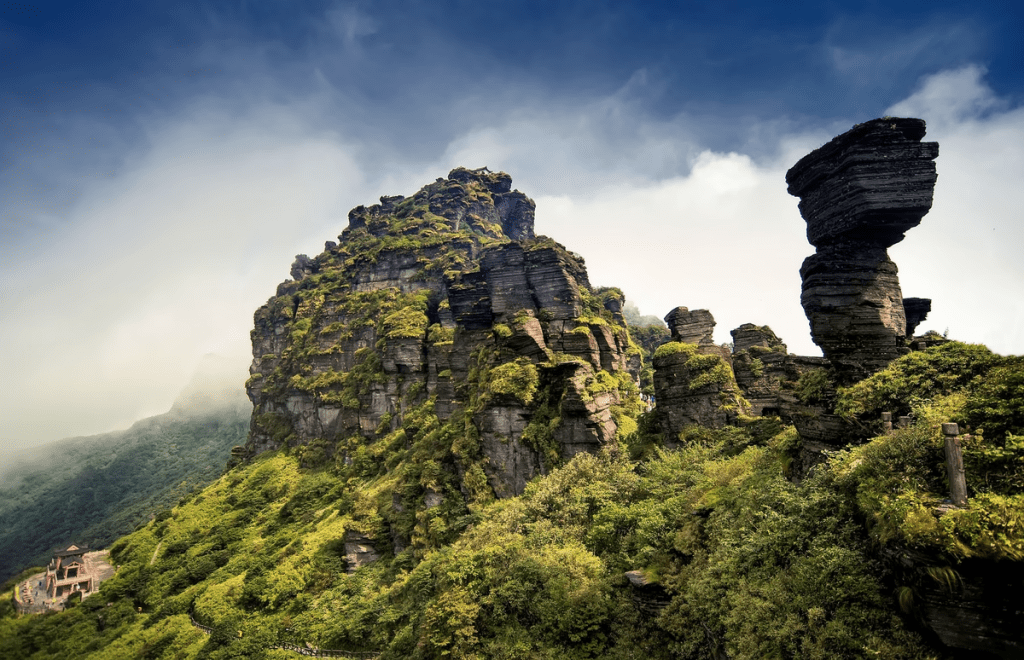
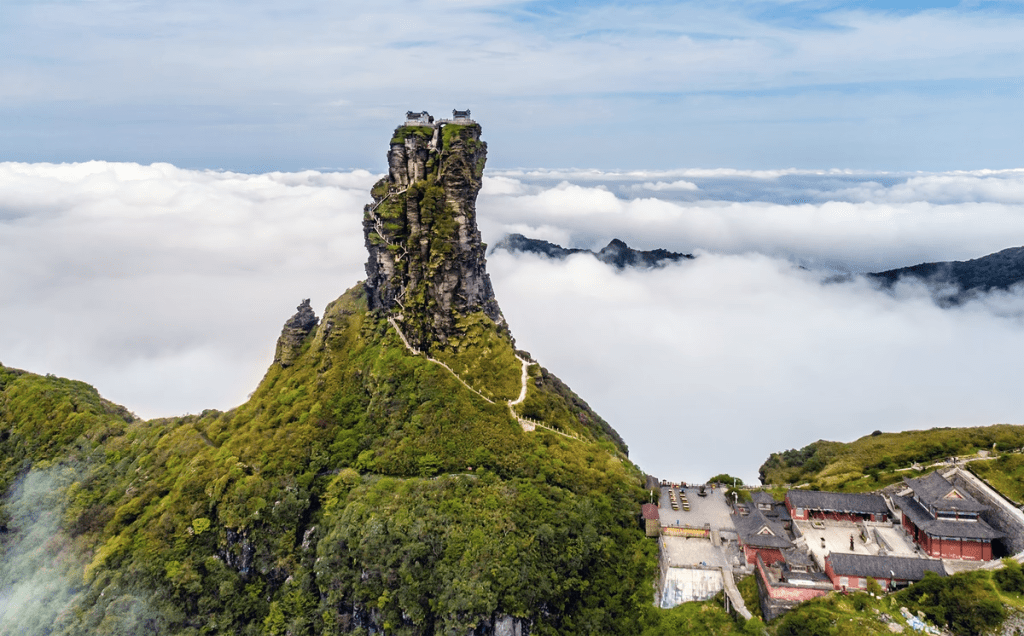
A view of the New Golden Summit, looking west. Costfoto / Barcroft Media via Getty

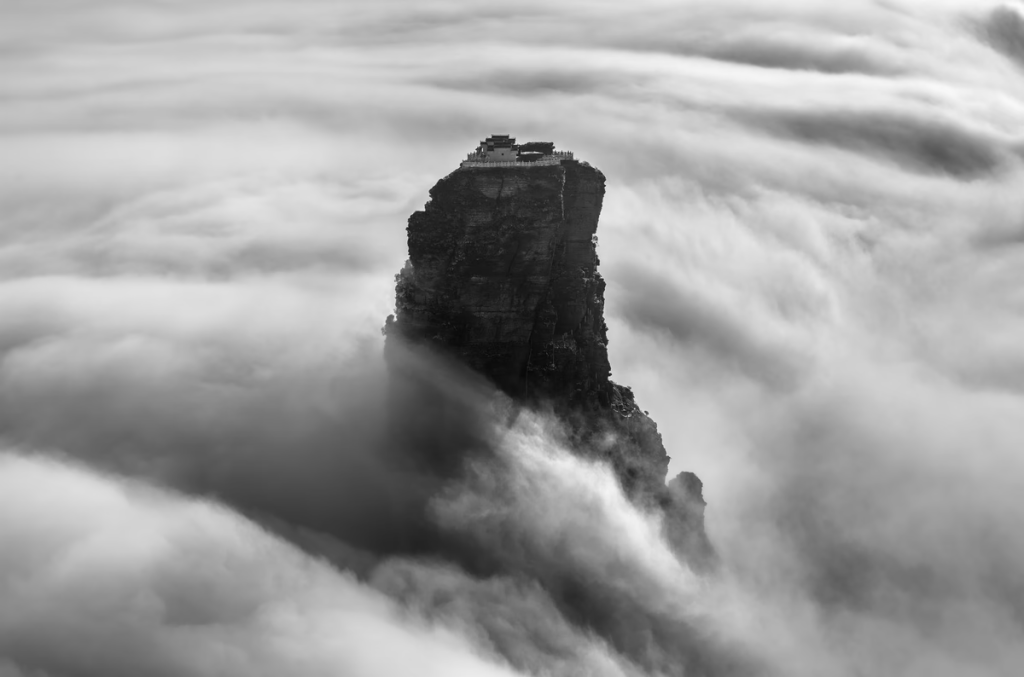
Clouds roll past the New Golden Summit on Mount Fanjing.  Clkraus / Shutterstock

Fanjingshan, also known as Mount Fanjing, is situated in the eastern part of Guizhou Province, China, within Tongren City. It is positioned approximately 248 kilometers away from Guiyang and 220 kilometers from Zhangjiajie. Mount Fanjing proudly claims the title of being the highest peak within the Wuling Mountains, with an impressive elevation of 2572 meters. The mountain stands adorned with primitive vegetation, its landscape characterized by majestic peaks, a continuous succession of towering summits, babbling streams interwoven with cascading waterfalls.

Moreover, Fanjingshan holds great spiritual significance as a revered Buddhist site. It’s widely believed among Buddhists that Fanjingshan is a place where spiritual enlightenment akin to that of Maitreya Buddha can be attained.

The appellation “Fanjing” finds its origins in “Fantian Jingtu,” a Buddhist term that translates to “Brahma’s Pure Land.” This hallowed mountain has been acclaimed as China’s Fifth Buddhist Mountain, a distinction following the likes of Mount Wutai in Shanxi Province, Mount Putuo in Zhejiang Province, Mount Emei in Sichuan Province, and Mount Jiuhua in Anhui Province. With a history spanning over 2000 years, embellished by extraordinary rock formations and abundant biodiversity, Mount Fanjing unveils itself as a serene, distinct haven. A sojourn to this tranquil expanse offers a revitalizing and spiritual respite from the bustling clamor of urban life.

Unique geological landforms, including the “Mushroom Stone” at right. Sanyanwuji / Shutterstock

In geological terms, Mount Fanjing assumes the form of a “fold belt,” an arrangement akin to stacked layers of rock resembling an assemblage of intricate shapes, an occurrence seldom witnessed elsewhere. The Mushroom Stone serves as a prime exemplar, where layers of rock have taken on the semblance of a towering mushroom.

Throughout antiquity, Fanjing Mountain stood as a venerable hub of Buddhist culture within the Wuling Mountain range. Historical records attest to the proliferation of numerous Buddhist temples along its slopes, catering to pilgrims from around the world. Yet, during the 16th century in the Ming Dynasty, a substantial number of these temples met destruction, effectively suppressing Fanjing Mountain’s renown. The subsequent Qing Dynasty saw a revival of fortunes, with governmental initiatives aimed at temple reconstruction and expansion along the mountain’s pathway to the “Red Clouds Golden Summit.” Notable temples such as Cheng’en Temple and Baoguo Temple were erected. By 1896, the fifth phase of Fanjingshan Temple reconstruction reached its culmination, bestowing upon Fanjing Mountain an esteemed status in the global Buddhist sphere and solidifying its position as China’s “No. 5 Great Buddhist Mountain.”

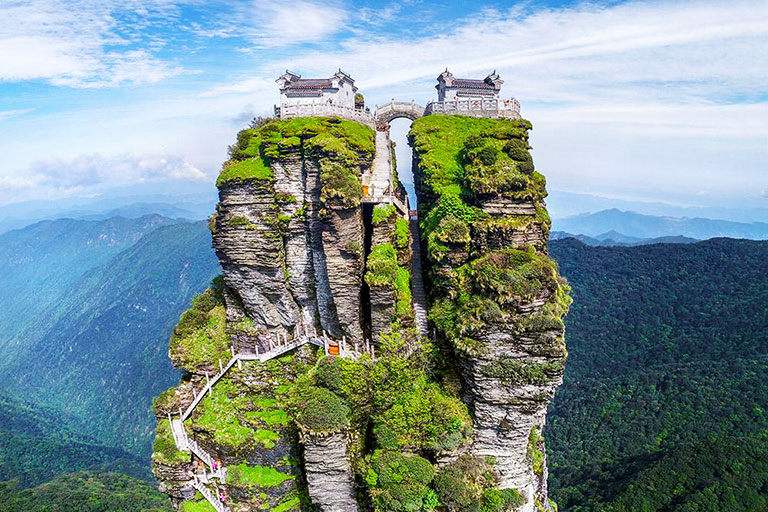
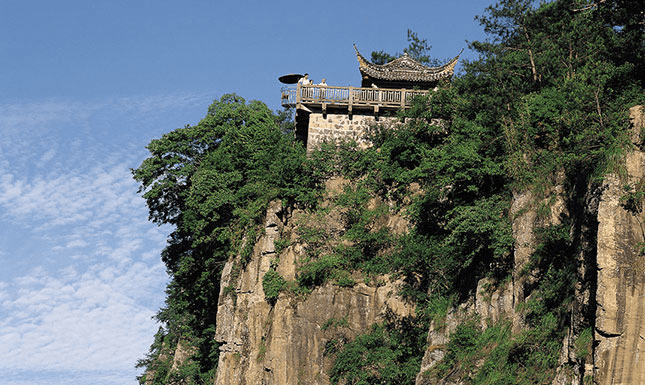
Mount Fanjing boasts three soaring summits that pierce the heavens – the Red Clouds Golden Summit (2336 meters), the Old Golden Summit (2493 meters), and the Phoenix Golden Summit (2572 meters). From these majestic pinnacles, visitors are treated to breathtaking panoramic vistas of Mount Fanjing’s expansive landscape. Crowning the preeminent “Red Clouds Golden Peak” stands the remarkable Fanjingshan Temple, perched at a daring elevation of 2,336 meters above sea level. Nestled atop the columnar peak, this temple’s elusive location beckons travelers to witness its ethereal presence firsthand and capture mesmerizing, novel photographs.

Fanjingshan Temple, encompassing the revered Temple of the Buddha (释迦殿) and the Maitreya Temple (弥勒殿), graces the summit of the “Red Clouds Golden Summit” (also known as the New Golden Summit) on Fanjing Mountain. The former is dedicated to the worship of Sakyamuni, symbolizing the present, while the latter venerates Maitreya, representing the future. These two temples trace their origins back to the Yongle period of the Ming Dynasty, over five centuries ago. Presently, they have been meticulously reconstructed to echo their original splendor, their structures fortified with iron tiles to withstand the mountain’s formidable winds. Each temple is embodied by a single hall, constructed from meticulously arranged stone pieces measuring 5.4 meters in width and 5.55 meters in depth. A bridge gracefully connects the two temples, spanning the depths of the Gold Sword Gorge.

For pilgrims journeying to Fanjingshan, the ascent involves ascending thousands of steps to initially reach the Temple of the Buddha on the southern facet. Subsequently, crossing the bridge leads to the Maitreya Temple on the northern side of the “Red Clouds Golden Summit.” This sequence mirrors the Buddhist concept of transition from the present (Sakyamuni) to the future (Maitreya). As the “Red Clouds Golden Summit” often finds itself enshrouded by mist and enveloped in sea of clouds, standing upon the terrace outside Fanjingshan Temple offers a surreal experience of gazing upon the world from above, capturing an otherworldly perspective amidst the natural elements.

Much like the iconic Avatar Hallelujah Mountain in Zhangjiajie National Forest Park, Fanjingshan stands as a towering pinnacle, slender and vertically oriented, evoking the image of a pencil standing upright on a desk. Scaling its summit requires ascending over 8,000 steps or opting for a cable car ride up from the road below. Most visitors opt for a full day to thoroughly explore this remarkable sacred mountain. Its attractions span a diverse range, encompassing the Red Cloud Golden Peak, Old Golden Summit, Ten-Thousand Sleeping Buddha, Mushroom Stone, Jiulong Pond, Fenghuang Mountain, Numerous Rolls of Books, and more.

Situated in the mountainous expanse of Guizhou Province, Fanjingshan falls within the ambit of a subtropical humid monsoon climate, distinctly marked by four seasons. Throughout the year, the average annual temperature oscillates between 13.1°C and 14.7°C. July witnesses the hottest days, with an average temperature hovering around 24°C, while January holds the chilliest nights, registering an average temperature of approximately 4.6°C. On the whole, Fanjingshan enjoys a temperate climate, graced by ample sunlight and rainfall. Summers remain moderate, and winters remain mild, with neither excessive heat nor biting cold. Rainfall predominantly occurs from May to October, while the frost-free period spans a generous 270 to 278 days annually.

The prime window to explore Mount Fanjing extends from March to November. For those seeking to capture stunning photographs, the early morning hours are particularly enchanting. The aftermath of rain unveils captivating spectacles, such as the Sea of Clouds, Zen Fog, Buddha Light, and breathtaking sunrises, which contribute to the mountain’s mystique and allure.

Fanjing Mount

Link: https://peacelilysite.com/2023/08/22/fanjing-mount/

#FanjingMount# MountFanjing #Zhangjiajie #Buddha #BuddhistTemple #MaitreyaBuddha #FanTieJingTu #China #Travel #TravelChina #GuiZhou

Source: https://www.chinadiscovery.com/guizhou/fanjingshan.html, https://www.theatlantic.com/photo/2019/04/a-photo-visit-to-mount-fanjing/586879/, https://www.chinadiscovery.com/guizhou/fanjingshan/fanjingshan-temple.html

Dharma Assembly at Hua Zang Si — Holy Birthday of Maitreya Bodhisattva

Dharma Assembly at Hua Zang Si — Holy Birthday of Maitreya Bodhisattva

January 1st in the Chinese lunar calendar, is chinese Spring festival, it is the biggest holiday in china. It is also the holy birthday of Maitreya Bodhisattva – the next Buddha in the saha world. This is a special and joyful holiday that is celebrated by many. Hua Zang Si in San Francisco held a Dharma Assembly to celebrate this important occasion. It was the first Dharma Assembly of the year and it was held on a beautiful sunny day. Many laypersons participated in the event.

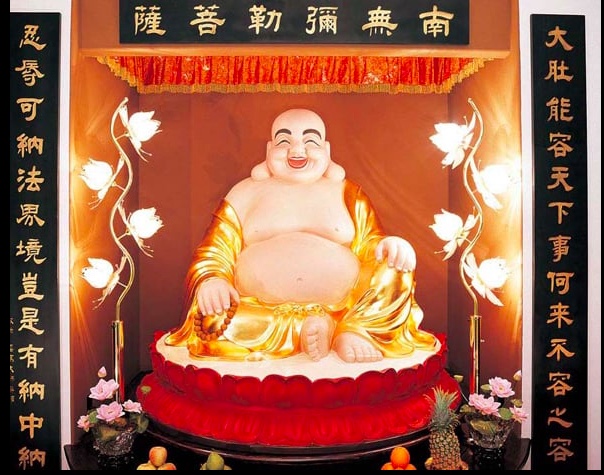
At the entrance of the temple is an oversize marvelous statue representation of a jolly, laughing Buddha: Maitreya Bodhisattva (the next Buddha in this Saha world). It is such a warm welcoming sign. The big belly not only means jolly, it also means tolerating the intolerable things in the world. So when you look at the statue, you will start to feel that learning Buddhism is happy and kind.

The Dharma Assembly was an opportunity for people to come together and celebrate the teachings of Maitreya Bodhisattva. It was a time for reflection and meditation, as well as a chance to learn more about the teachings of Buddhism. The atmosphere was filled with positivity and joy, as people came together to celebrate this important holiday.

In Chinese culture, Maitreya Bodhisattva is seen as a symbol of joy and tolerance. As practitioners of Buddhism, we are encouraged to strive to be like the Buddhas and Bodhisattvas by cultivating a broad mind, open heart, and great tolerance.

One of the key principles of Buddhism is patience and forbearance, particularly under insult. This is seen as a key aspect of self-cultivation and it is important to remember that everything in the dharma realms can change from ordinary to holy. This means that even difficult situations can be transformed and overcome through the practice of patience and tolerance.

Patience and tolerance are not just passive qualities, but rather active ones that require effort and practice. We must actively cultivate them in our daily lives and strive to maintain them even in difficult situations. Through this practice, we can transform our own minds and hearts, becoming more like the Buddhas and Bodhisattvas that we strive to emulate.

At the Dharma Assembly, we chanted the Eighty-eight holy Buddha name jeweled repentance sutra, in hopes that the Buddhas will wash away all of our sins and negative karmas. After the chanting, we offered a meal to the Buddhas and Bodhisattvas. The event concluded with a dharma talk given by Dharma Master Ruohui.

During her talk, Dharma Master Ruohui emphasized the importance of faith, vows, and actions for disciples of Buddhism. She explained that faith is the foundation of our practice, and that with strong faith, we will have the determination to follow the Buddha’s teachings and put them into action in our lives.

The Dharma Assembly was a meaningful event where participants not only had the opportunity to reflect on their own spiritual growth but also to make an impact on the world around them. During the assembly, the participants returned the merit to all living beings, holding the hope that they shall be rid of suffering, obtain happiness, and have the opportunity to listen to authentic Buddha Dharma.

The act of returning merit is an important aspect of Buddhist practice as it is believed that by dedicating the positive energy generated through our spiritual practice to the benefit of others, we can help bring about peace and prosperity in the world. By returning merit to all living beings, participants were able to contribute to the collective well-being of the world and make a positive impact on the lives of others.

Furthermore, the participants also held the hope that by listening to authentic Buddha Dharma, they will be able to perfect their fortune and wisdom, leading to a more prosperous and peaceful world for all. This is the ultimate goal of Buddhism, to help all beings to find inner peace, happiness and liberation from suffering.

Dharma Assembly at Hua Zang Si — Holy Birthday of Maitreya Bodhisattva

Link: https://peacelilysite.com/2023/01/26/dharma-assembly-at-hua-zang-si-holy-birthday-of-maitreya-bodhisattva/

#Buddha#Buddhism#BuddhistDisciple#MaitreyaBodhisattva#HuaZangSi#Tolerance#Cultivation#Assembly#ChineseLunarCalendar#ChineseNewYear

Mount Xuedou and Maitreya Bodhisattva

Mount Xuedou and Maitreya Bodhisattva

Located at around 8 kilometers north-west of Xikou Town, Fenghua City of Zhejiang Province, Xuedou Mountain is 800 meters above sea level, featuring graceful mountain ridges, unique cliffs, tempting waterfalls, and deep streams. The mountain has a milky peak, while on the peak there is a dou (meaning hollow or hole). Water flows out of the dou, and it is as white as milk, thus getting the name of the Milk Spring. It is well-known for its serenity, magnificent landscape, and an abundance of greenery. Mount Xuedou Scenic Area was known as “a fairyland on the sea” early in the Han Dynasty (206 BC-220 AD. However it was not popular until the previous president of National Party Jiang, Jieshi promoted it heartly. Xikou is the hometown for this important historical figure Jiang, Jieshi. His family had Buddhism tradition. So when he was young he often went to Xuedou Temple with his mother. He loved its picturesque sceneries, and believed it was the most beautiful place in the country. Later on he built a mansion in Mount Xuedou, he and his family lived there once a while. He even had a plan to promote Mount Xuedou as second Mount Lu, but the plan did not come true, since he left mainland China to Taiwan after the civil war. Therefore, this place becomes more mysterious and interesting for tourists from China and abroad to explore.

The charm of Mount Xuedou lies not only in its picturesque sceneries, it also has held a high status in Chinese Buddhism since ancient times. Located in a scenic site, the Xuedou Temple has a history of over 1600 years and has cultivated numerous eminent monks. It is also the place where Monk Maitreya practiced his Buddhism, thus a large number of eminent monks and pilgrims have been attracted to Mount Xuedou.

Maitreya Bodhisattva is a very popular Buddhist figure in China. Maitreya is a transcendent bodhisattva,he will be the next Buddha in the Saha world. Maitreya means “loving kindness.” In Mahayana Buddhism, Maitreya is the embodiment of all-encompassing love. Maitreya, in Buddhist tradition, presently resides in Tushita heaven.

With big belly and jolly smell, he is a symbol of enduring humiliation, optimism and compassion. In Buddhism teaching, disciples should be like the Buddhas and Bodhisattvas. All should have a broad mind, open heart, and great tolerance. The first priority for one who learns Buddhism and cultivates himself is to be patient and forbearing under insult.

In the historical record, there is an eminent Monk named Qichi (契此), who was the incarnation of Maitreya Bodhisattva. This monk lived at the end of WuDai period (right after the Tang Dynasty), and is most well known for his rather fat belly. Since he always carried a cloth bag, people began to call him the cloth bag monk. Unlike the stereotypical image of the strict and severe ascetic, Qichi was a jovial, good-humored man, but no less intelligent and thoughtful. He was loved and respected by all for these qualities. Often, others would ask him, “what is the true meaning of Buddhism?”, and in response, he would drop his bag to the ground. The deepest meaning of Buddhism is to lay down your burdens. Qichi took residence in Xuedou Temple, where he would spread the Buddhist Dharma to all those who came to him. To this day, Xuedou Mountain is regarded as the Holy Land of Maitreya. In honor of the cloth bag monk, statues of the Maitreya Bodhisattva are always depicted carrying a cloth bag.

Xuedou Temple

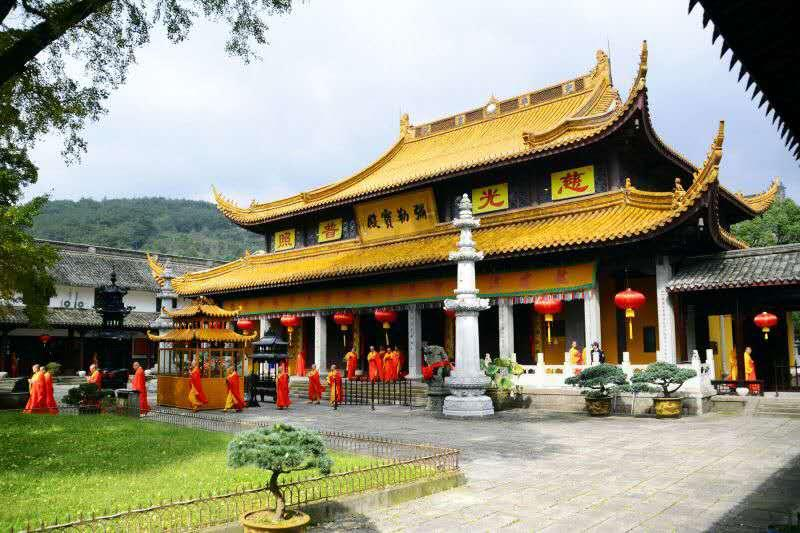
Xuedou Temple was originally founded in the Jin Dynasty. For thousands of years, it has been visited by many people, and has produced numerous eminent monks. It has a high status and is regarded by the Buddhist circle in China as one of the ten most famous Buddhist temples together with the other nine temples, such as Zhongtian, Zhutianning, Wanshou, the Yongzuo Temple of Hangzhou, and the Jiangshan Taiping Xingguo Temple of Nanjing.

During the Tang and Song dynasties, Xuedou Temple had received 41 imperial edicts from emperors of several generations. So far, the temple has stored 5,760 Confucian classics granted by emperors, jade seals, dragon robes, dragon pots and jade Buddhas.

In the temple, the constructions are magnificent and attractive. Outside the temple, ancient trees are towering up into the sky. Among them, two ginkgo trees from the Han Dynasty can be surrounded by about five people. With exuberant leaves, the ginkgoes rise above the clouds.

At the back peak of Xuedou Mount, the statue of Maitreya Buddha is the highest copper statue of its kind in the world. The Buddha body is 33 meters high, the lotus seat is 9 meters high, and the base is 14.74 meters high. It completed at 2008, with exquisite workmanship. Having this remarkable structure, Mount Xuedou was officially named as the fifth sacred Buddhist Site, dedicated to Maitreya Bodhisattva. Now, the temple covers a landscape area of over 20,000 sq meters and has perfectly combined natural landscapes and Buddhist culture. 

XueDou Temple Overview

Since Mount Xuedou is dedicated for Maitreya Bodhisattva, there is a Grand Maitreya Hall in the Temple. It is really magnificent and dignified.

Grand Maitreya Hall
Marvelous Maitreya Statue

Qianzhang Rock Waterfall

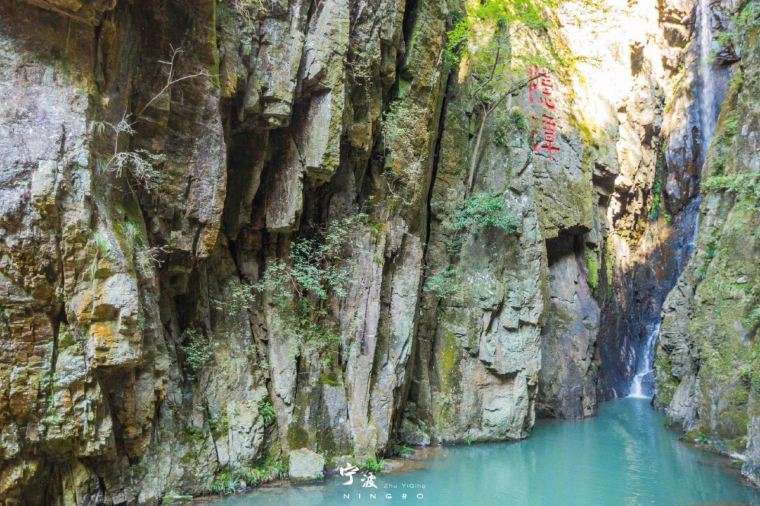
In front of Xuedou Temple, there is a waterfall called Xuedou Waterfall, also known as Qianzhang Rock Waterfall. The water head is in the valleys at the south and the north of Xuedou Temple. The water of the Milk Spring flows into Jinjing Pool (which is an ancient pool developed in the Southern Song Dynasty), crossing Guanshan Bridge and pouring out of the cliff mouth.

The waterfall pours down from Qianzhang Rock. From the top of the rock to the pool, it is as high as 186 meters. At the half-way point, there is a huge rock. In spring and autumn, the rain falls down in a deluge but it runs into the rock at the half-way point and splashes in all directions right away. It falls like pearls and jades, and also dances like snow. Under the sunlight, it forms a rainbow, which is quite splendid. Xuedou Waterfall was well known by the whole nation as early as in the Northern Song Dynasty.

Sanyin Pond Waterfall

Sanyin Pond Waterfall is situated at 5 li north-west of Xuedou Temple. The water flows from Dongao Village (on Xuedou Mountain, there is a village of alpine flowers. With a beautiful and clean environment, the village is an ocean of flowers and seedlings) to the cliff mouth, forming one waterfall; it continues running down the mountainside to the foot, forming three waterfalls. As a result, it is called Sanyin Pond.

With a length of more than 1,600 meters, the pond can be divided into Shangyin Pond, Zhongyin Pond and Xiayin Pond respectively from the highest to the lowest. Shangyin Pond is highlighted by its quietness and danger; Zhongyin Pond stands out for its delicacy and cleanness; Xiayin Pond is well known for its superb beauty. Despite the positions of the three ponds in remote mountains and deep valleys and the difficulty of visiting them, tourists still visit in great numbers.

Miaogao Platform

Miaogao Platform is also known as Miaogao Peak or Tianzhu Peak. It is the main scenic spot of the Xuedou landscapes. Although it is only 396 meters above sea level, it stands out against the mountain behind it. With the middle part bulging, three steep cliffs, and a gaping abyss down its side, the platform has a precipitous terrain.

In a narrow sense, Miaogao Platform refers to a platform of about 350 square meters. Standing at the front edge, you can look out on the natural sceneries of Tingxia Lake. On the periphery of Miaogao Platform, ancient trees and green bamboos are thriving so much that they keep the sunlight away. In addition, the clear breeze blows gently. It is an ideal summer resort.

Tingxia Lake

Located at the south of Xuedou, Tingxia Lake is 6 kilometers away from Xikou Town. It is a large artificial lake, with a surface area of 5.9 square kilometers, an equivalent of West Lake in Hangzhou. The water storage capacity is as much as 153 million cubic meters.

Tingxia Lake is a good place to enjoy the landscapes of lakes, mountains, steep peaks and deep valleys. Tingxia Lake is a huge reservoir famous for its position under Yushu Pavilion of Xuedou Mountain and its location at Tingxia Village.

Tingxia Lake has wonderful natural sceneries. On the basis of unique peaks, deep valleys, high mountains and water scenes, interesting and attractive landscapes of lakes and mountains come into being. With clean air and high quality water, the scenic spot is also rich in fish, fruit and forest resources. Tourists can sail on the lake, and can also go fishing, picnicking and camping.

Naturalists and photographers love to visit the Miaogao Platform, Qianzhang Rock, and Qianzhang Crag with its huge, scenic waterfall in the region spanning 85 square kilometers. Mount Xuedou is also a national forest park, a really great place worth of visiting.

Mount Xuedou and Maitreya Bodhisattva

Link: https://peacelilysite.com/2022/08/10/mount-xuedou-and-maitreya-bodhisattva/

 #Buddhism#ClothBagMonk #Buddhist #XuedouTemple#MountXuedou#MaitreyaBodhisattva#Compassion#TravelChina

Source: https://www.trip.com/travel-guide/attraction/ningbo/xuedou-mountain-90600/, https://www.chinahighlights.com/ningbo/attraction/xuedou-mountain.htm

After Generating Great Compassion in Mind, Master Asanga Was Able to Meet Maitreya Bodhisattva

After Generating Great Compassion in Mind, Master Asanga Was Able to Meet Maitreya Bodhisattva

Maitreya is a transcendent bodhisattva,he will be the next Buddha in the Saha world. Maitreya means “loving kindness.” In Mahayana Buddhism, Maitreya is the embodiment of all-encompassing love. Maitreya, in Buddhist tradition, presently resides in Tushita heaven.

Maitreya Bodhisattva Statue in Hua Zang Si Temple San Francisco

Master Asanga was born with uniquely deep talent and wisdom from his past lifetimes. When studying sutras and commentaries, he was able to understand the meaning with a quick reading. Later, he practiced meditative concentration and became free of desires. He repeatedly thought about the “meaning of emptiness” but was unable to deeply understand and explain it. He was quite unhappy for that. An Arhat named Pindola-Bharadvaja heard about his difficulty and came to him to teach “the Small-Vehicle (Hinayana) School’s view of emptiness.” Then, he practiced contemplation according to the teaching and achieved a deep understanding. However, Master Asanga was still not satisfied after learning the Small-Vehicle School’s view of emptiness because he still did not have perfect answers for many doubts and questions he had.

At that time, the teaching of Mahayana Buddhism (the Large Vehicle) was available from Maitreya Bodhisattva. However, to receive Maitreya Bodhisattva’s teaching in person, one must successfully enter into the state of concentration. Due to his urge to quest for the dharma, Master Asanga longed for the opportunity to meet Maitreya Bodhisattva in person to be taught with the dharma. Therefore, he chose a mountain cave in a sparsely populated area and began practicing cessation and contemplation diligently.

As time was flowing away continuously, six years elapsed. Master Asanga still was unable to see Maitreya Bodhisattva while practicing concentration in the cave. A thought came up in his mind, “If it is impossible to see Maitreya Bodhisattva, I should just give up!” Thus, he decided to take a break from cultivating and practicing in the cave. He put on his regular clothing and walked out of the cave. On his way of coming down from the mountain, he saw a white-haired elder lady, who held an iron stick and was laboriously grinding it on a flab of stone. The scene caught Master Asanga’s attention.

“Elder lady. May I ask what you are doing?” Master Asanga asked.

“Oh, I am grinding this iron stick into a thin needle.”

“You are grinding it into a thin needle?” Master Asanga was very much astonished and also greatly moved. He thought, “This elder lady was willing to grind it day after day with a seemingly silly movement. In contrast, as a cultivator, I could not adhere to practicing true Buddha-dharma to pursue wisdom.” The arising of this extremely precious thought caused Master Asanga to introspect himself and generate humility in mind. Then, he returned to the cave to devote himself into the difficult and hard cultivation and practice once again.

During the next three years, Master Asanga still did not make any achievement. Another thought rose in his mind, “Why should I waste time? It is simply impossible to see Maitreya Bodhisattva!” So he again broke his practice in retreat and went down the mountain. This time, he met a person, who was using a feather to scrub an enormously big rock. Master Asanga asked that person what he was doing. That person said, “This big rock blocks sunlight. I am grinding it to make it smaller, so that sunlight can shine into my room.” Upon hearing that, Asanga was alerted and began to introspect himself, “This person can be so unyielding in doing such a ridiculous thing. Comparing to him, I am so ashamed. I receded from my determination just because of a small setback!” With regret he again returned to his retreat chamber in the mountain.

Photo by Pixabay on Pexels.com

Thus, another three years passed. Master Asanga was still unable to see Maitreya Bodhisattva appearing. At last, he receded from his determination once more. With discouragement, he left the retreat chamber again. On the way of coming down from the mountain, he saw a dying old dog, whose body had already begun to rot. The wounds were totally covered by maggots that were diffusing an awful stench. Compassion rose in Master Asanga toward this dog. He cut off a piece of flesh from his own body to feed the dog and also intended to remove the many maggots from the dog’s wounds. At that time, Master Asanga thought, “These maggots have very tender and fragile bodies. If I use my coarse fingers to move them, they will definitely be harmed.” Therefore, he decided to use his tongue to carefully lick up the maggots to move them to an inhabitable place for them. However, those maggots really looked very terrible. Master Asanga had to kneel on the ground and close his eyes. He then lowered his body to lick the maggots with his tongue.

As he was lowering his body, Master Asanga actually felt that his tongue was touching the ground. He opened his eyes and saw that the dog was no longer there. The solemn and majestic Maitreya Bodhisattva was standing in front of him. After the moment of excitement, Master Asanga asked Maitreya Bodhisattva, “I wholeheartedly prayed and beseeched you, revered Bodhisattva, to manifest before me for the last twelve years. Why didn’t you?”

Maitreya Bodhisattva replied, “Starting from the first day when you entered the retreat and began to pray, I was with you and next to you at every moment. However, due to the obstruction by your karmic forces, you were never able to see me. Through your diligent cultivation and practice during these twelve years, most of the karmic hindrance has been purified. Additionally, you generated great compassion in the occasion that just passed. Now all your karmic hindrance has been removed. That is why you can see me now! If you do not believe what I said, you can carry me on your shoulder and walk around at the market to see if people can see me.”

Thus, Master Asanga carried Maitreya Bodhisattva on his shoulder and walked to the market. While walking, he yelled to people, “What do you see that is on my shoulder?” People all thought that he had mental problems. They laughed and said, “There is nothing!” Only one old lady said that he was carrying a dog with scabies. Thus, Master Asanga was totally convinced and free of any doubt. Uncommon respect and faith rose in him toward Maitreya Bodhisattva.

After meeting Maitreya Bodhisattva, Master Asanga politely sought teaching from the Bodhisattva. Maitreya Bodhisattva asked, “What do you want to learn?” Master Asanga said, “My wish is to propagate the Mahayana Dharma.” Maitreya Bodhisattva was delighted to hear that and brought him to the pure land within the Tusita Heaven. Maitreya Bodhisattva expounded to him the precious views of Mahayana Buddhism and the “Five Shastras (Commentaries) by Maitreya.” The teachings enlightened Master Asanga like pushing away clouds to see the Sun. Many doubts that he had had before were completely removed. Since then, he followed Maitreya Bodhisattva’s teaching to dedicate himself to study “the View of Emptiness of Mahayana Buddhism.” Maitreya Bodhisattva gave him a series of discourses and also explained the essence of the Mahayana sutras to him in detail. Master Asanga was enlightened from listening to the teachings and basically gained the understanding and proficiency in the sutras and shastras of Mahayana Buddhism. Later, Master Asanga also practiced the Dharma of Sunlight Samadhi. Through learning and practicing diligently, he eventually attained holy accomplishment. From then on, he was able to understand what he could not before and could forever remember all Buddhist scriptures he read. Later, he built a big lecture hall and dedicated himself to expound all Mahayana sutras to the great masses.

Master Asanga lived in the world for 150 years and made great contributions to the undertaking of widely propagating the teachings and dharmas of Mahayana Buddhism. He benefited countless living beings.

After Generating Great Compassion in Mind, Master Asanga Was Able to Meet Maitreya Bodhisattva

Link: https://peacelilysite.com/2022/07/08/after-generating-great-compassion-in-mind-master-asanga-was-able-to-meet-maitreya-bodhisattva/

#HHDorjeChangBuddhaIII #DorjeChangBuddhaIII #DorjeChangBuddha#Buddha #Dharma #Sharing #benefit #Buddhism #Koan #Buddhist #temple #dharma#MaitreyaBodhisattva#Compassion