
From Palace Walls to Boundless Freedom

There is a story from the time of Gautama Buddha that beautifully reveals what true happiness really means.

After the Buddha renounced royal life and attained enlightenment, his son, Rahula, followed his path and became a monastic as well. Seeing both his son and grandson leave the palace, the king—concerned that the royal lineage would end—appointed a relative named Bhaddiya as the new ruler.

However, not long after ascending the throne, Bhaddiya witnessed the instability and danger that accompanied power. Before the kingdom was overtaken by enemies, he too chose to renounce worldly life and became a disciple of the Buddha.

From that point on, Bhaddiya devoted himself wholeheartedly to spiritual practice. Yet, something curious caught the attention of the other monks: every day, he would joyfully proclaim three times,
“I am truly happy! I am truly happy! I am truly happy!”

Hearing this, some monks misunderstood him. They wondered if he was still attached to the pleasures of his former life as a king, and reported their concerns to the Buddha.

To clarify the truth, the Buddha gathered the community and gently asked Bhaddiya,
“Do you still long for the happiness you once had as a king?”

Bhaddiya replied,
“World-Honored One, I do not recall those pleasures at all.”

The Buddha then asked,
“Then why do you proclaim your happiness three times each day? What is this happiness you speak of?”

Bhaddiya answered with sincerity:
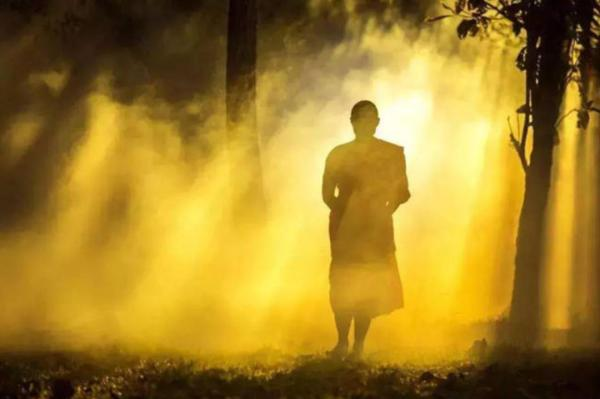
“When I was a king, my palace was guarded day and night by layers of soldiers. Yet despite all that protection, my heart was never at peace. Every sound in the night startled me. I lived in constant fear—afraid of rebellion, invasion, and loss. I was surrounded by luxury, but I had no freedom, no true rest.

Now, as a monastic, I eat one simple meal a day. I sit beneath the open sky, resting under trees. I hear no anxious signals in the night, and I live in harmony with nature. My heart is free from worry, free from attachment. I have nothing, yet I lack nothing. This is my true happiness.

Out of gratitude for the Buddha, who showed me this path to freedom, I proclaim my joy each day.”

This story invites us to reconsider what happiness truly means.

Is happiness found in what we possess—or in what we are no longer bound by?

So often, we chase success, security, and recognition, believing they will bring us peace. Yet, like King Bhaddiya, we may find that the more we accumulate, the more we have to fear losing.

True happiness does not arise from external conditions, but from inner freedom—
a mind unburdened, a heart at ease, and a life aligned with simplicity and clarity.

Perhaps real happiness begins not when we gain more,
but when we finally learn to let go.

Link:https://peacelilysite.com/2026/03/20/from-palace-walls-to-boundless-freedom/

The Consequences of Lying: A Lesson from Buddhist Teachings

When we were young, our parents and elders all taught us not to lie. Many stories and fairy tales illustrate the consequences of lying, such as a child being eaten by a wolf or having a long nose like Pinocchio. Different cultures and religions praise honesty and disapprove of liars. However, most of us have told a lie at one time or another, often to gain an immediate benefit, without realizing that the long-term consequences of lying can be very costly. In Buddhism, one of the ten precepts is to abstain from lying.

There is a recorded story in a Buddhist sutra about Shakyamuni Buddha teaching his son to refrain from lying.

The Buddha’s son, Rahula, was quite mischievous in his youth. He often enjoyed playing pranks on others, using deceptive words to tease people. For instance, when someone came to see the Buddha, Rahula, knowing that the Buddha was not present, would intentionally mislead them about the Buddha’s whereabouts, causing them to search in vain for amusement.

When the Buddha learned of this, he asked Rahula to bring him some water to wash his feet. After washing his feet, the Buddha pointed to the water and asked Rahula, “Can this water be drunk?”

Rahula replied, “The water is dirty from washing feet; it cannot be drunk.”

The Buddha then asked, “Can this basin, used for washing feet, be used to hold food?”

Rahula replied, “No, it cannot. The basin is dirty and cannot be used to hold food.”

The Buddha sternly said, “You are like this water. The water was originally very clean, just as you were originally a prince, able to renounce the false glories of the world and become a monk. But if you do not diligently pursue the path, do not purify your body and mind, and do not speak carefully, the impurities of the three poisons will fill your heart, just like the clean water being soiled by washing dirty feet. You are like this basin. Although you have become a monk, if you do not practice precepts, concentration, and wisdom, and do not purify your body, speech, and mind, how can the food of the Great Path fill your heart?” After speaking, the Buddha kicked the basin, causing it to roll. Rahula was very frightened. The Buddha asked, “Are you afraid the basin will break?”

Rahula replied, “No, the basin is a coarse utensil; it doesn’t matter if it breaks.”

The Buddha said, “Rahula, you don’t cherish this basin, just as people will not cherish you. As a monk, if you do not uphold dignity and discipline, and speak deceitfully, the consequence is that no one will care for you or value you. When your life ends, you will not attain enlightenment, but will only increase your delusion.”

From then on, Rahula changed his mischievous ways, strictly observed the precepts, and diligently practiced the path.

According to the teachings of the Buddhist sutras, we should take a long-term view and consider the consequences of lying for both this life and future lives.

In this life, if we frequently lie, deceive, or slander others, we will inevitably face retaliation from those we have wronged. In the mundane world, most people are naturally inclined to protect themselves and have a tendency for “an eye for an eye” revenge, unless they are saints who have subdued their own minds. If we deceive others, the victims, unwilling to be deceived, will expose our misdeeds among people. As word spreads from one to ten and from ten to a hundred, our bad reputation will quickly become widespread. Our credibility will be utterly destroyed, and our trustworthiness will plummet. From then on, even if we speak the truth, it will be seen as a lie, and people will be wary of us to avoid being deceived. No one will trust us. In such a predicament, we will constantly feel the pain of isolation and helplessness. Our lives will shrink, and our careers will suffer as a result.

In future lives, under the influence of the dark karma of lying, one will inevitably fall into the three lower realms. When the bad karma diminishes and one is reborn as a human, the residual effects of lying will manifest in various speech-related congenital obstacles in both body and mind. These may include having an impaired tongue root, stuttering, or unclear speech. Additionally, there will be a habitual tendency to lie, and sometimes, even when one wishes to speak the truth, it will come out as a lie involuntarily. In interactions with others, one will frequently be slandered and deceived. Even when speaking the truth, people will not believe it. Moreover, even when preaching the true Dharma, others will be unwilling to listen.

Link:https://peacelilysite.com/2024/06/13/the-consequences-of-lying-a-lesson-from-buddhist-teachings/

Source: https://fo.china.com/m/fostory/20001207/20231107/25809400.html