I was a factory worker in the past. In 1993, a co-worker had to go home to help plant his family’s wheat crop. His leave request was not approved by the shift leader. So, I went to cover him.
When looking at his work in the past, I thought I should be able to do it. In reality, it was not that simple. I was not skillful in operating the machine. The machine pulled my right hand in. When I dragged the arm out, I had no flesh in my hand and arm, only a long, bare bone left.
The doctor at the hospital took a look and told me that I must have amputation. The upper arm bone was fractured; however, he could reconnect it back.
When I slowly woke up from the surgery, I saw that my entire right arm…, my right arm was like, so short , only 5, 6 cm long.
Actually, the doctor had told me very clearly before the surgery that the amputation would only be limited to my hand. This is just not fair at all. I was furious. How could he be a doctor? What medical ethics did he have?
I cried my heart out at that time. I got very upset. I did not even want to go out of my room. I got a room from the company. I didn’t go out at all and felt that it would be embarrassed to go out and see people. Why do I get such bad luck?
I was depressed all day long and also could not get along with my wife. I would smash bowls or chopsticks whenever things didn’t go my way. That happened a lot. When I popped open a bottle of white wine, I would have a big, long gulp. In one morning, I could almost finish a bottle with only a few drops left. I buried myself in the alcohol at home. Once I am drunk, I lose my temper. I almost had a mental breakdown and lost confidence in my life.
It started out from doing a favor, to help out my co-worker. How did it make me to become a handicapped person? How could such a thing happen to me? Even the hospital mistreated me in that way. The whole society did not treat me fairly. I also didn’t see justice from the Heavenly God…….
One day, my daughter told me: “Father, I will take you to a Buddhist center. Go learn Buddhism. Buddhism will be good for you, and for our family. Chant “Namo H.H. Dorje Chang Buddha III!”
“What did you tell me to chant?” I said, “I have only heard about Amitabha Buddha. Why didn’t I know about H.H. Dorje Chang Buddha III?”
Starting from that day, I would head to the Buddhist center and then listened to the Dharma discourses every day. I listened to the discourse on the Law of Cause and Effect. I listened to many pre-recorded dharma discourses, such as The Dharma to Cut Off the Twenty Worldly Emotions, etc. I listened to The Dharma to Cut Off the Twenty Worldly Emotionsa few more times. I also listened more times to the discourse on the Law of Cause and Effect. Eventually I understood that everything is a result of the Law of Cause and Effect.
I gradually realized that the loss of my right arm was not without a cause. Whether in my past lifetimes or in this lifetime, I have harmed so many living beings. This bit of suffering is what I deserve. When I took the lives of other living beings in the past, I caused them sufferings.
Through the learning, I slowly understood the truth about the Law of Cause and Effect. The hatred in my mind also gradually vanished.
I then made a resolve.
Since I have learned and understood the truth of the Law of Cause and Effect, I will now repent to all the living beings I have killed or harmed. I will repent to them. With the utmost respect, in front of the Buddhas and Bodhisattvas, I will repent with my most pious heart.
I will do 100,000 prostrations for repentance. In less than four months, I completed 100,000 prostrations. H.H. Dorje Chang Buddha III told us, only cultivation can transform the Law of Cause and Effect.
The retribution I am receiving right now is caused by what I have done in many lifetimes and eons ago. From now on, I will follow and learn from H.H.Dorje Chang Buddha III and cultivate myself.
As long as I plant good causes. I will definitely get good fruition in the future. I am determined to follow and learn from the Buddha and cultivate myself until I attain accomplishment.
At that time, so very long ago, there were some unfortunate ugly gods called ‘Asuras’. They had taken to living in the second heaven world.
The one who had been Magha the Good in his previous life, was now Sakka, King of the Heaven of 33. He thought, “Why should we, who are the 33, live in our Heaven of 33 with these unfortunate ugly Asuras? Since this is our world, let us live happily by ourselves.”
So he invited them to a party and got them drunk on very strong liquor. It seems that, in being reborn, King Sakka had forgotten some of his own teachings as Magha the Good. After getting the Asuras drunk, he got them to go to a lower world, just as big as the Heaven of 33.
When they sobered up and realized they had been tricked into going to a lower heaven world, the Asuras became angry. They rose up and made war against King Sakka. Soon they were victorious, and Sakka was forced to run away.
While retreating in his mighty war chariot, he came to the vast forest where the Garudas have their nests. These are gods who, unfortunately, have no super powers. Instead they are forced to get around by flapping huge heavy wings.
When King Sakka’s chariot drove through their forest, it upset their nests and made the baby Garudas fall down. They cried in fear and agony. Hearing this, Sakka asked his charioteer where these sad cries were coming from. He answered, “These are the shrieks of terror coming from the baby Garudas, whose nests and trees are being destroyed by your powerful war chariot.”
Hearing this suffering, King Sakka realized that all lives, including his own, are only temporary. Hearing this suffering, the compassion of the Great Being, which passes from life to life, arose within him and said, “Let the little ones have no more fear. The first training step must not be broken. There can be no exception. I will not destroy even one life for the sake of a heavenly kingdom that must some day end. Instead I will offer my life to the victorious Asuras. Turn back the chariot!”
So the chariot returned in the direction of the Heaven of 33. The Asuras saw King Sakka turn around, and thought he must have reinforcements from other worlds. So they ran, without looking back, down to their lower heaven world.
King Sakka returned victoriously to his palace in the Heaven of 33. Next to it stood the mansion of his first wife, the reborn Good-doer. Outside the mansion was the garden of his second wife, the reborn Beauty. And there was the heavenly pond of his third wife, the reborn Happy.
However, Well-born had died and been reborn as a slender crane in the forest. Since he missed her, Sakka found her and brought her up to the Heaven of 33 for a visit. He showed her the mansion and the garden and the pond of his three wives. He told her that, by doing good work, the other three had gained merit. This merit had brought them happiness, both in their previous lives and in their rebirths.
He said. “You, my dear crane, in your previous life as Well-born, did no such good work. So you did not gain either merit or happiness, and were reborn as a forest crane. I advise you to begin on the path of purity by following the Five Training Steps.” After being taught the five steps, the lovely crane decided to follow them. Then she returned to the forest.
Not long afterwards, King Sakka was curious about how the crane was doing. So he took the shape of a fish and lay down in front of her. The crane picked him up by the head. She was just about to swallow the King of the Heaven of 33, when the fish wiggled his tail.
Immediately the crane thought, “This fish must be alive!” Remembering the first training step, she released the living fish back into the stream. Rising from the water, King Sakka returned to his godly form and said, “It is very good, my dear crane, that you are able to follow the Five Training Steps.” Then he returned to the second heaven world.
In the fullness of time, the crane died. Following the Five Training Steps had brought her both merit and a peaceful mind. So she was reborn in the wonderful state of mankind, into a potter’s family in Benares, in northern India.
Again King Sakka was interested in finding out where the one who had been Well-born, and then the crane, was now reborn. He found her in the potter’s family, and wanted to help her in gaining merit and finding happiness.
So he disguised himself as an old man and created a cart full of golden cucumbers. He went into Benares and shouted, “Cucumbers! Cucumbers! I have cucumbers!”
When people came to buy these amazing cucumbers, he said, “These golden cucumbers are not for sale. I will give them away, but only to one who is wholesome, that is, one who follows the Five Training Steps.”
The people said, “We never heard of the Five Training Steps. But we will buy your golden cucumbers. Name your price!” He repeated, “My cucumbers are not for sale. I have brought them to give to any person who practices the Five Training Steps.” The people said, “This man has come here only to play tricks on us.” So they left him alone.
Soon Well-born heard about this unusual man. Even though she had been reborn, she still had the habit of following the Five Training Steps. So she thought, “This man must have come to find me.”
She went to him and asked for the golden cucumbers. He said, “Do you follow the Five Training Steps? Have you given up destroying life, taking what is not given, doing wrong in sexual ways, speaking falsely, and losing your mind from alcohol?” She answered, “Yes sir, I do follow these steps, and I am peaceful and happy.”
Then the old man said, “I brought these cucumbers especially for you, to encourage you to gain more merit and future happiness.” So he left the cart of golden cucumbers with her, and returned to the Heaven of 33.
Throughout the rest of her life, the woman was very generous with all this gold. Spreading her happiness to others, she gained merit. After she died, she was reborn as the daughter of the King of the Asuras. She grew up to be a goddess of great beauty. To the Asuras this seemed like a miracle, since the rest of them were the ugliest of all the gods.
The Asura king was pleased with his daughter’s goodness, as well as her famous beauty. He gathered all the Asuras together and gave her the freedom to choose a husband.
Sakka, King of the Heaven of 33, knew of the latest rebirth of the one who had been his wife Well-born, then a crane, and then a potter’s daughter. So he came down to the lower heaven world and took the shape of an ordinary ugly Asura. He thought, “If Well-born chooses a husband whose inner qualities of wholesomeness are the same as hers, we will be reunited at last!”
Because of her past associations with Magha the Good, reborn as King Sakka, now disguised as an ordinary Asura, the beautiful princess was drawn to him. So she picked him from among all the Asuras.
King Sakka took her to the Heaven of 33, made her his fourth wife, and they lived happily ever after.
The moral is: The Five Training Steps are the beginning of wholesomeness. Wholesomeness is the beginning of peace and happiness.
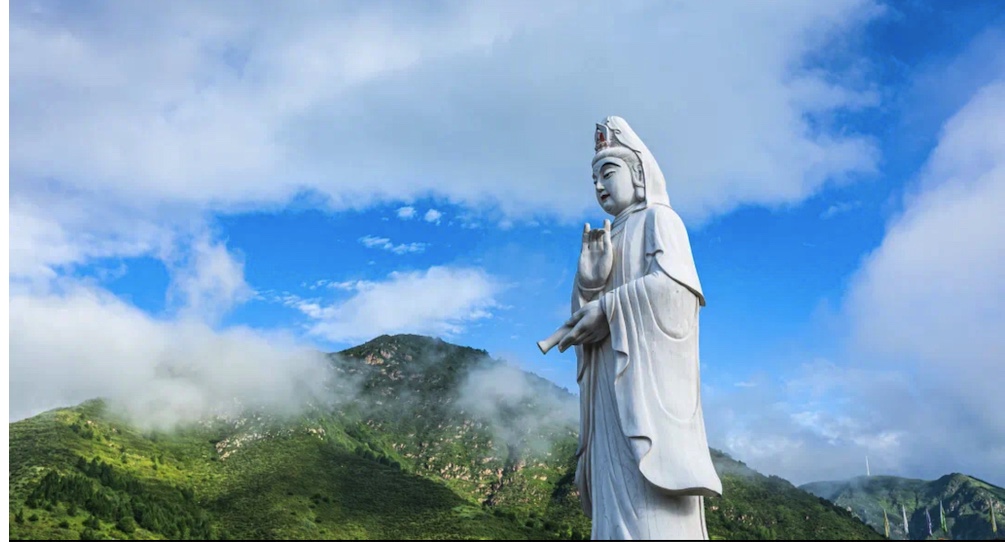
In this world, there are many sacred places that Guanyin Bodhisattva saves sentient beings. Some people believe it, others do not. What I want to say is that whether you believe it or not, these sacred sites have really existed.
Every time I participate in the “Pumen Ping dharma convention”(the Universal Gate chapter of the Lotus Sutra), I read these two paragraphs, I would sob. Because my family of 38 people have personally experienced the salvation of Guanyin Bodhisattva.
Forty years ago, due to war turmoil and devastation, my brothers, cousins and 38 relatives escaped from the embankment of Vietnam. The evacuation team included babbling babies, silver-haired old men, and handsome young men.
My family and I were arranged on three small fishing boats, and the big boat that picked us up stopped at the bay. The boat had a small space, and two rows of people sat on their knees.
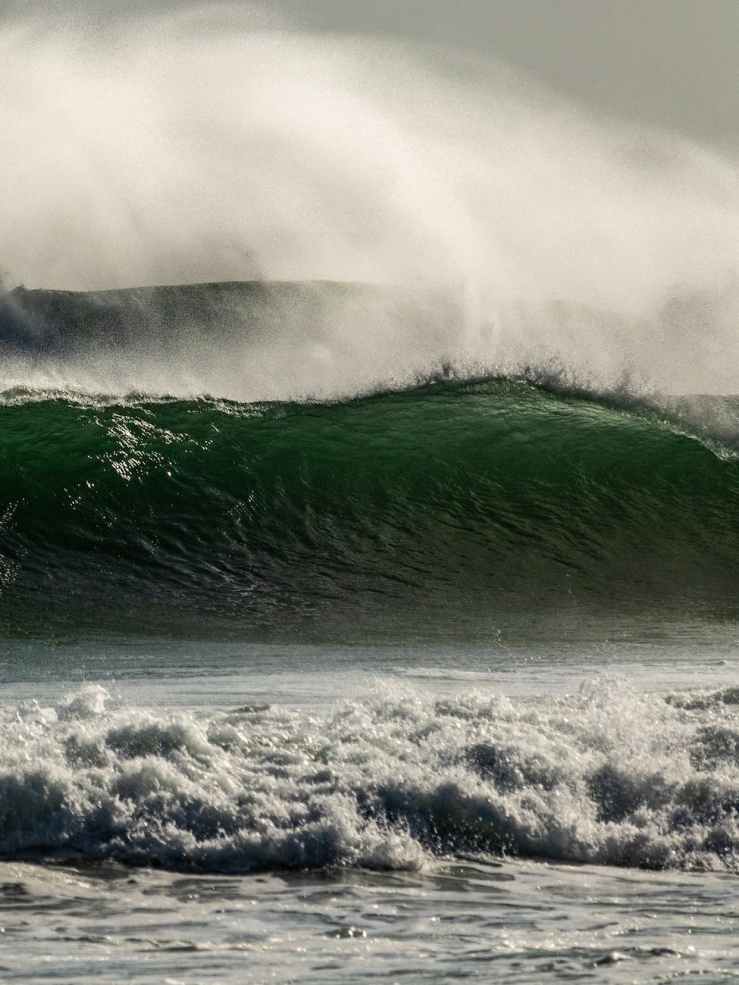
The waves were very big that day, the boat was swaying, and the people’s hearts were also upset. Suddenly, a big wave came and a row of people stood up in fright. The ship lost its balance instantly and it was about to be destroyed. At this very moment, some people shouted: “Quickly call on Guanyin Bodhisattva”!
And he took the lead in calling on: “Namo Guanyin Bodhisattva, Namo Guanyin Bodhisattva …”
I also called on” Namo Guanyin Bodhisattva “. Just one phrase, I choked into the sea water, sank into the water, and then I was about to drown, and called out loudly again. I could not swim. The water was suffocating me and my body floated. After so many ups and downs, a rope suddenly appeared in front of me, I grabbed the rope and I was rescued on to the ship.
Later, I learned that some people were covered with gold bars on their legs, and they were sinking before they could recite the “Guan Shi Yin Bodhisattva”, and 38 of our relatives and friends relied on the sacred name, the power of great compassion of “Guan Shi Yin Bodhisattva”, so we survived.
Avalokitasvara, Guan Shi Yin in Chinese, means the Perceiver of World’s Sounds. The Lotus Sutra says: “Perceiver of the World’s Sounds, heavenly voice, the voice of the sea’s tide—magnificent, rich and harmonious surpassing all worldly sounds.” The bodhisattva always help all beings in danger and distress and is willing to bear the pain of all beings. If we hold the bodhisattva in our hearts and call on her sincerely, she will always respond.
Located at around 8 kilometers north-west of Xikou Town, Fenghua City of Zhejiang Province, Xuedou Mountain is 800 meters above sea level, featuring graceful mountain ridges, unique cliffs, tempting waterfalls, and deep streams. The mountain has a milky peak, while on the peak there is a dou (meaning hollow or hole). Water flows out of the dou, and it is as white as milk, thus getting the name of the Milk Spring. It is well-known for its serenity, magnificent landscape, and an abundance of greenery. Mount Xuedou Scenic Area was known as “a fairyland on the sea” early in the Han Dynasty (206 BC-220 AD. However it was not popular until the previous president of National Party Jiang, Jieshi promoted it heartly. Xikou is the hometown for this important historical figure Jiang, Jieshi. His family had Buddhism tradition. So when he was young he often went to Xuedou Temple with his mother. He loved its picturesque sceneries, and believed it was the most beautiful place in the country. Later on he built a mansion in Mount Xuedou, he and his family lived there once a while. He even had a plan to promote Mount Xuedou as second Mount Lu, but the plan did not come true, since he left mainland China to Taiwan after the civil war. Therefore, this place becomes more mysterious and interesting for tourists from China and abroad to explore.
The charm of Mount Xuedou lies not only in its picturesque sceneries, it also has held a high status in Chinese Buddhism since ancient times. Located in a scenic site, the Xuedou Temple has a history of over 1600 years and has cultivated numerous eminent monks. It is also the place where Monk Maitreya practiced his Buddhism, thus a large number of eminent monks and pilgrims have been attracted to Mount Xuedou.
Maitreya Bodhisattva is a very popular Buddhist figure in China. Maitreya is a transcendent bodhisattva,he will be the next Buddha in the Saha world. Maitreya means “loving kindness.” In Mahayana Buddhism, Maitreya is the embodiment of all-encompassing love. Maitreya, in Buddhist tradition, presently resides in Tushita heaven.
With big belly and jolly smell, he is a symbol of enduring humiliation, optimism and compassion. In Buddhism teaching, disciples should be like the Buddhas and Bodhisattvas. All should have a broad mind, open heart, and great tolerance. The first priority for one who learns Buddhism and cultivates himself is to be patient and forbearing under insult.
In the historical record, there is an eminent Monk named Qichi (契此), who was the incarnation of Maitreya Bodhisattva. This monk lived at the end of WuDai period (right after the Tang Dynasty), and is most well known for his rather fat belly. Since he always carried a cloth bag, people began to call him the cloth bag monk. Unlike the stereotypical image of the strict and severe ascetic, Qichi was a jovial, good-humored man, but no less intelligent and thoughtful. He was loved and respected by all for these qualities. Often, others would ask him, “what is the true meaning of Buddhism?”, and in response, he would drop his bag to the ground. The deepest meaning of Buddhism is to lay down your burdens. Qichi took residence in Xuedou Temple, where he would spread the Buddhist Dharma to all those who came to him. To this day, Xuedou Mountain is regarded as the Holy Land of Maitreya. In honor of the cloth bag monk, statues of the Maitreya Bodhisattva are always depicted carrying a cloth bag.
Xuedou Temple
Xuedou Temple was originally founded in the Jin Dynasty. For thousands of years, it has been visited by many people, and has produced numerous eminent monks. It has a high status and is regarded by the Buddhist circle in China as one of the ten most famous Buddhist temples together with the other nine temples, such as Zhongtian, Zhutianning, Wanshou, the Yongzuo Temple of Hangzhou, and the Jiangshan Taiping Xingguo Temple of Nanjing.
During the Tang and Song dynasties, Xuedou Temple had received 41 imperial edicts from emperors of several generations. So far, the temple has stored 5,760 Confucian classics granted by emperors, jade seals, dragon robes, dragon pots and jade Buddhas.
In the temple, the constructions are magnificent and attractive. Outside the temple, ancient trees are towering up into the sky. Among them, two ginkgo trees from the Han Dynasty can be surrounded by about five people. With exuberant leaves, the ginkgoes rise above the clouds.
At the back peak of Xuedou Mount, the statue of Maitreya Buddha is the highest copper statue of its kind in the world. The Buddha body is 33 meters high, the lotus seat is 9 meters high, and the base is 14.74 meters high. It completed at 2008, with exquisite workmanship. Having this remarkable structure, Mount Xuedou was officially named as the fifth sacred Buddhist Site, dedicated to Maitreya Bodhisattva. Now, the temple covers a landscape area of over 20,000 sq meters and has perfectly combined natural landscapes and Buddhist culture.
XueDou Temple Overview
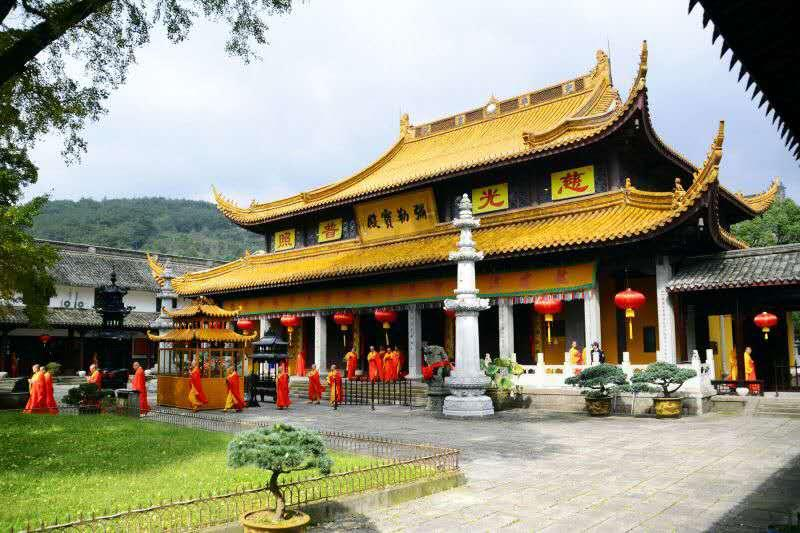
Since Mount Xuedou is dedicated for Maitreya Bodhisattva, there is a Grand Maitreya Hall in the Temple. It is really magnificent and dignified.
Grand Maitreya Hall
Marvelous Maitreya Statue
Qianzhang Rock Waterfall
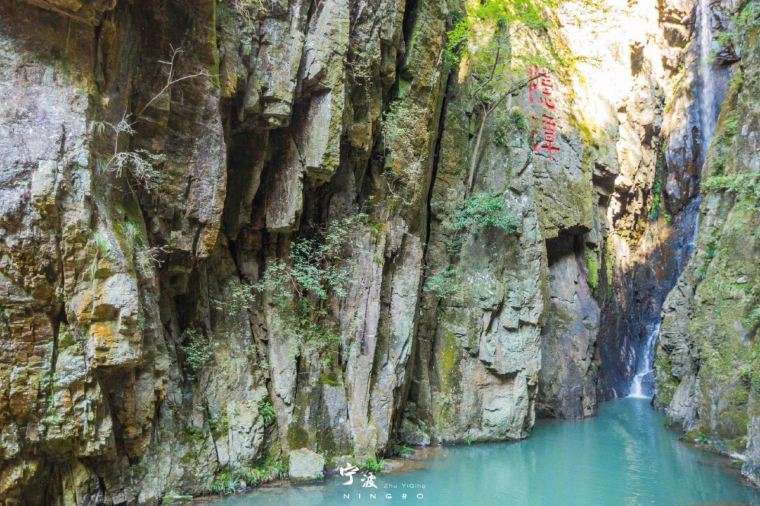
In front of Xuedou Temple, there is a waterfall called Xuedou Waterfall, also known as Qianzhang Rock Waterfall. The water head is in the valleys at the south and the north of Xuedou Temple. The water of the Milk Spring flows into Jinjing Pool (which is an ancient pool developed in the Southern Song Dynasty), crossing Guanshan Bridge and pouring out of the cliff mouth.
The waterfall pours down from Qianzhang Rock. From the top of the rock to the pool, it is as high as 186 meters. At the half-way point, there is a huge rock. In spring and autumn, the rain falls down in a deluge but it runs into the rock at the half-way point and splashes in all directions right away. It falls like pearls and jades, and also dances like snow. Under the sunlight, it forms a rainbow, which is quite splendid. Xuedou Waterfall was well known by the whole nation as early as in the Northern Song Dynasty.
Sanyin Pond Waterfall
Sanyin Pond Waterfall is situated at 5 li north-west of Xuedou Temple. The water flows from Dongao Village (on Xuedou Mountain, there is a village of alpine flowers. With a beautiful and clean environment, the village is an ocean of flowers and seedlings) to the cliff mouth, forming one waterfall; it continues running down the mountainside to the foot, forming three waterfalls. As a result, it is called Sanyin Pond.
With a length of more than 1,600 meters, the pond can be divided into Shangyin Pond, Zhongyin Pond and Xiayin Pond respectively from the highest to the lowest. Shangyin Pond is highlighted by its quietness and danger; Zhongyin Pond stands out for its delicacy and cleanness; Xiayin Pond is well known for its superb beauty. Despite the positions of the three ponds in remote mountains and deep valleys and the difficulty of visiting them, tourists still visit in great numbers.
Miaogao Platform
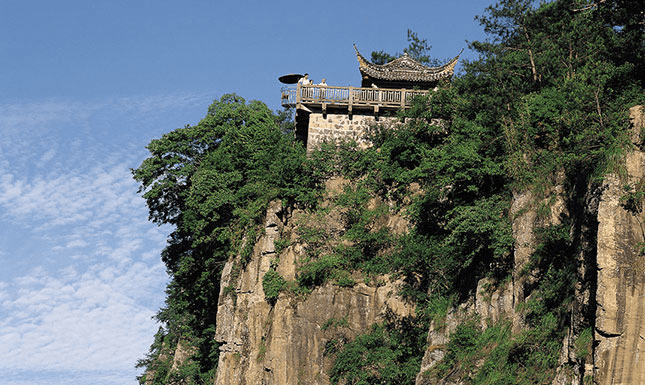
Miaogao Platform is also known as Miaogao Peak or Tianzhu Peak. It is the main scenic spot of the Xuedou landscapes. Although it is only 396 meters above sea level, it stands out against the mountain behind it. With the middle part bulging, three steep cliffs, and a gaping abyss down its side, the platform has a precipitous terrain.
In a narrow sense, Miaogao Platform refers to a platform of about 350 square meters. Standing at the front edge, you can look out on the natural sceneries of Tingxia Lake. On the periphery of Miaogao Platform, ancient trees and green bamboos are thriving so much that they keep the sunlight away. In addition, the clear breeze blows gently. It is an ideal summer resort.
Tingxia Lake
Located at the south of Xuedou, Tingxia Lake is 6 kilometers away from Xikou Town. It is a large artificial lake, with a surface area of 5.9 square kilometers, an equivalent of West Lake in Hangzhou. The water storage capacity is as much as 153 million cubic meters.
Tingxia Lake is a good place to enjoy the landscapes of lakes, mountains, steep peaks and deep valleys. Tingxia Lake is a huge reservoir famous for its position under Yushu Pavilion of Xuedou Mountain and its location at Tingxia Village.
Tingxia Lake has wonderful natural sceneries. On the basis of unique peaks, deep valleys, high mountains and water scenes, interesting and attractive landscapes of lakes and mountains come into being. With clean air and high quality water, the scenic spot is also rich in fish, fruit and forest resources. Tourists can sail on the lake, and can also go fishing, picnicking and camping.
Naturalists and photographers love to visit the Miaogao Platform, Qianzhang Rock, and Qianzhang Crag with its huge, scenic waterfall in the region spanning 85 square kilometers. Mount Xuedou is also a national forest park, a really great place worth of visiting.
Fangsheng 放生 refers to releasing lives and Buddhists are encouraged to do that during the course of their practice. What is the truth behind this action?
When we release a life, we save a life. In return, it will lengthen our lifespan.
It is a meritorious deed and will accumulate merits.
It stresses the importance of compassion and kindness. We cannot bear to see them die or getting harmed. We want them out of life-threatening situations.
If one is sick and goes to release lives, it will bring benefits to one’s health.
All living beings are equal. Whenever they are in danger, we will rescue them.
Fangsheng promotes compassion, kindness, equality, and harmony.
Established in October 2011, The International Art Museum of America(IAMA) is a charming and vibrant gallery, full of both exotic and familiar paintings, portraits, and sculptures. Its diverse collection of artwork and education programs promotes art appreciation, culture exchange, and communication between artists and guests. With these qualities, the IAMA hopes to nurture an important spiritual goal: that all people may have a deeper understanding of each other.
Tengergold Gallery
Tendergold Gallery was first introduced by IAMA in early 2018. The name pays homage to our ever-so-funky neighboring Tenderloin District. While it could undeniably be seen as dark and gritty, it also hosted some of San Francisco’s most exciting underground art scenes and nightlife. At Tendergold celebrated this by bringing art to the light of day from emerging artists, both internationally and from the Bay Area. Once at this room, a young Syria refugee artist, who live in Greece refugee camp, displayed her paintings, and the income from auction of the drawing was donated to Syria refugee camp. Tendergold Gallery was closed in early 2022 and replaced by Sip Art.
Tengergold Gallery and Artist Interviews 1
Tengergold Gallery and Artist Interviews 2
Lightspace Gallery
Besides collecting timeless and world-class art treasures, the International Art Museum of America is also mindful of contemporary art creations of all forms. The museum created a special exhibit dedicated to the modern art of our era. The quarterly rotating exhibit called Lightspace was conceived thereafter beginning in September of 2018. We select outstanding artworks to be on exhibit in the Lightspace Gallery, from photography to mixed media, sculpting, and installation art.
Lightspace Gallery and Artist Interviews 1
Lightspace Gallery and Artist Interviews 2
Culture and Entertaining Events
For ten years, the IAMA has brought the artwork and traditions of many cultures to the residents of San Francisco. It has embraced a mission of bringing happiness and cultural understanding through its various activities and artistic programs. We hope that our work will help bring people all over the world to a greater understanding and harmony.
It was April 2015. My stomach suddenly became harder and harder, and it swelled noticeably after eating. A colleague suffered from colorectal cancer and also had a hard stomach. I quickly went to the hospital for examination.
After the CT scan, the doctor said that the initial diagnosis was a liver tumor that was suspected to be cancerous, so emergency surgery was necessary. When I heard this result, I felt my heart racing. I thought that this was my karma and I should suffer it if I need to. If I didn’t die, I would be reprimanded.
At that time, I often went to the Sanger Mission Temple to listen to the dharma courses of H.H. Dorje Chang Buddha III. I understood some truths about karma. So I accepted it calmly without complaining to others, and actively cooperated with the doctor’s treatment. A highly skilled Indonesian doctor took the lead for my surgery. She is the second best doctor in Southern California. She said: “Your liver tumor has a layer of membrane wrapped with bad things. We just need to take out the cyst and we don’t need to cut the liver, so it won’t hurt the liver. After doing so many operations, this is the second strangest example I have ever seen. The doctor asked “Are you a Buddhist?”
Even more strange is that despite the anesthesia effects after the operation, I seem to have temporarily lost the pain. The doctor prescribed morphine to relieve the pain, but I didn’t use it because I didn’t feel any pain at all. After the operation, I spoke as usual, full of energy. On the fourth day after the operation, a sister came to visit me and said that the monks in Sanger Mission had not seen me for a while and knew about my situation. So they recited the Sutra in the morning and night, then they transferred their merits to me.
The power of Buddhism and the power of recitation of the Sutra are incredible. My operation went well and the wound healed quickly. A week later, I walked very fast, and I didn’t look like someone who had undergone surgery! After several months of observation, the doctor determined that my tumor was benign and he ruled out the possibility of cancer.
The Buddha and Bodhisattva have saved my life twice, and I am truly grateful.











 Peace LiLy