Yungang Grottoes

The Yungang Buddhist grottoes, a massive complex comprising 252 caves and niches with 51,000 statues carved into an area of 18,000 square meters, are a remarkable achievement of Buddhist cave art in China. Constructed from the mid-5th to early-6th century AD, the grottoes were influenced by Buddhist cave art from South and Central Asia but also incorporated distinct Chinese elements and local spirit. They played a crucial role among early Oriental Buddhist grottoes and had a far-reaching impact on Buddhist cave art in China and East Asia.

The five caves of Tanyao and their imperial patronage 

The construction of Yungang began with five cave-temples, known today as caves 16 to 20, at the west end of the cliff. These caves were imperial commissions of the Northern Wei dynasty in around 460 C.E. The Northern Wei rulers, who belonged to the Tuoba clan from northern China, had recently unified northern China after centuries of political turmoil and established Buddhism as the state religion. The dynasty’s capital, Pingcheng, became a significant center for Buddhist religious and artistic expression.

The five caves of Tanyao, created by Tan Yao, are classical masterpieces of the first peak of Chinese art, displaying a strict unity of layout and design. These caves each contain a colossal Buddha as the central icon, with Cave 20 housing a gigantic seated Buddha in a meditation posture and a standing attendant Buddha on one side. Another attendant Buddha likely existed on the other side, but it has been lost along with the cave’s exterior wall. The imperial patronage of these caves reflects the Northern Wei dynasty’s fusion of state power and religious devotion.

Buddha, Cave 20 at Yungang, Datong, China (photo: xiquinhosilva, CC BY 2.0)

The main Buddha measures roughly 13 meters in height. He has plump cheeks, a thick neck, elongated eyes, a sharply cut nose, slightly smiling lips, and broad shoulders, all of which produce a solemn appearance.

The well-preserved halo behind the main Buddha is composed of an outer band of flame patterns and two inner bands decorated with seven seated Buddhas of miniature size. The robe features zigzag patterns on the edge. The right shoulder of the main Buddha is left exposed, whereas the standing attendant Buddha on the east wall wears a robe that covers both shoulders with a high neckline. 

Historical records recount that Tanyao, a renowned monk cleric with official ranks, advised Emperor Wencheng to undertake construction of five cave-temples (Caves 16–20) to commemorate the five founding emperors of the Northern Wei dynasty. Claiming that the emperor of Northern Wei was the living Buddha, this project declared the emperor’s political and spiritual legitimacy, and strengthened the rule of the imperial family.

Buddha (left) and attendant Buddha (right), Cave 20 at Yungang (photo: xiquinhosilva, CC BY 2.0)

The statues housed in the caves and niches are in good condition and all of the caves and statues have not suffered major damage from vandalism and/or natural disasters. Restoration and repair had been made on deficient parts of some statues in the past. All the necessary attributes demonstrating the Outstanding Universal Value of Yungang Grottoes are contained within the boundary of the property area. The buffer zone provides a necessary safe area for the conservation of the Grottoes, the setting and the historic environment. These measures have enabled the Yungang Grottoes to serve as one of the greatest ancient stone carving art treasure houses in the world.

The location, caves and statues of the Yungang Grottoes have retained their historic appearance. The eaves of wooden pavilions of the caves and the related historical remains have kept the distinctive character of the times when they were constructed. The daily maintenance and conservation intervention have been conducted following the conservation principle of minimal intervention in design, materials, methodology, techniques and craftsmanship.

The cross-legged Bodhisattva Maitreya, on the east wall of the antechamber of Cave 9, phase II, Yungang Grottoes, Datong, China (photo: G41rn8, CC BY-SA 4.0)

The paired caves and the major development at Yungang

Beginning roughly a decade after the initial commission, the imperial projects at Yungang advanced to a second phase that lasted from c. 470s until 494 C.E. In contrast to the monumental Buddha found in Cave 20, the interior of the second-phase cave-temples are decorated with reliefs that depict Buddhas, bodhisattvas, and other divine figures in various scales and configurations.

One of the most distinctive features developed in the second phase of construction are paired caves—two adjacent caves featuring a similar architectural plan and pictorial program. The paired cave-temple layout is understood to symbolically represent the reign of two coincident rulers: Emperor Xiaowen (471–499 C.E.) and Empress Dowager Wenming (442–490 C.E.). The use of paired cave-temples became another means to demonstrate the dynasty’s imperial power.  
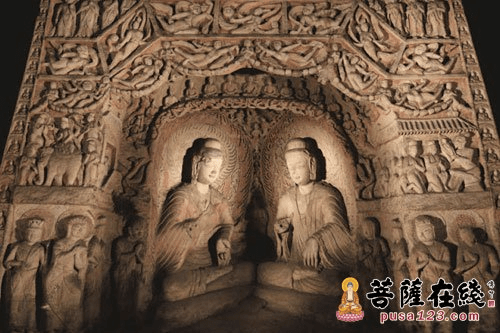
The paired Caves 5 and 6 are among the most lavishly decorated cave-temples at Yungang. Cave 6 has an antechamber and a square main chamber supported by a central pillar (see the full cave 6 in 3D). A square clerestory (window) is opened right above the passageway to the main chamber to let in light (although it is hard to see in photos or the 3D image).

In the main chamber of Cave 6, the east, south, and west walls are divided vertically into three main registers that include complex pictorial programs (the north wall features a large niche housing a trinity of Buddhas that are later repairs). We find seated Buddha figures and scenes from the Buddha’s life throughout the chamber. Depictions of the historical Buddha, who was believed to live in the Ganges River basin during the 6th century B.C.E., derived largely from Buddhist texts. The Buddha’s biography details the course of his life from birth to enlightenment, and eventually to nirvana, the final extinction. The life of the Buddha was among the most popular themes for artistic representation throughout the Buddhist world. 

The First Sermon of the Buddha at Deer Park, Cave 6, Yungang, Datong, China

One scene from the Buddha’s life (at the southern end of the east wall) shows the First Sermon of the Buddha at Deer Park, identifiable by the depiction of a pair of deer on the Buddha’s throne. We see a canopied standing Buddha flanked by two standing bodhisattvas and a myriad of worshippers in the background. Just below the standing Buddha niche, a seated Buddha with his right hand raised (the fearless gesture) can be seen in a trapezoidal-shaped niche flanked by two five-story pagodas (just visible at the edges of the scene in the photograph). Worshippers either kneel in front of the throne or stand facing the Buddha on his two sides.   

Rock-cut cave-temples

Rock-cut cave-temples first appeared in western India in the 1st century B.C.E. There are two basic types: apsidal-shaped (semicircular) chaitya (sanctuary, temple, or prayer hall in Indian religions) and vihāra caves where monks resided—both of which we find at places like the caves of Ajanta, India. Both types were transmitted eastwards to Central Asia up to the 5th century with modifications of the structures. At Yungang, the sanctuary type was further adapted into a square shape that houses a central pillar in the middle, as we find in Cave 6. At the same time, a number of architectural features find their precedents in Goguryeo tombs from present-day northeastern China and North Korea. 

But what facilitated these different traditions coming together at Yungang?

Ajanta, Cave 26, (photo: Arian Zwegers, CC: BY 2.0)

Transmissions and transformations of artistic styles

Yungang was a hub where multiple artistic traditions of South Asia, Central Asia, and pre-Buddhist China synthesized into something new. This was made possible by the Silk Road, a network of ancient trade routes linking East Asia with the rest of Eurasia. Goods and ideas have been exchanged along the Silk Road since at least the second century B.C.E. Central to the economic, cultural, and religious interactions between different parts of Eurasia, the Silk Road tied the Northern Wei territory to the sacred heartland of Buddhism in South Asia, and to Central Asian kingdoms that promoted Buddhist teachings. 

A primary factor facilitating the encounter of these varied traditions was the gathering of human resources and materials from different regions. In the 430s and 440s, the Northern Wei court issued decrees that relocated artisans and monks from its conquered lands to the capital city of Pingcheng. The concentration of people and craftsmanship in the capital led to the artistic flourishing of well-executed Buddhist monasteries, cave-temples, sculptures, and murals. Eminent monks who were active in Pingcheng had also engaged with religious activities in other urban centers such as Chang’an and Wuwei, and maintained close ties with Central Asian Buddhist communities.

Just as the form of the rock-cut cave-temples was adapted from earlier traditions in South Asia, statues and reliefs at Yungang exhibit strong stylistic and iconographic affinities with earlier Buddhist art traditions from northwestern India and Central Asia. For instance, the main colossal Buddha images in Caves 16 to 20 feature a round face, with a gentle, calm expression that creates an impression of sanctity, and a robe style that clings tightly to the body yet is rendered with schematic patterns. All of these features echo the aesthetics found in previous traditions, especially the Buddhist sculptures in Gandhara, a Buddhist center located in present-day northwest India and Pakistan. 

Yungang art exerted influence, in turn, on Central Asian cave-temples starting in the later 6th century, such as Dunhuang, indicating that a dynamic exchange took place among the major cultural centers along the Silk Road. 

An iconic form of the Buddha, 2nd–3rd century C.E., Kushan period, Gandhara, schist, 19.76 x 16.49 x 4.56 inches (The British Museum)

Sinicization reforms under the reign of Emperor Xiaowen

One of the new developments shown at Yungang that would have a long-lasting effect on Chinese Buddhist art was Sinicization, a process of adapting non-Chinese traditions into Han Chinese culture. In Cave 1, between the canopy of the central pillar and the ceiling we find intertwined dragons surrounding mountains that represent Mount Meru (the sacred mountain considered to be the center of the universe in Buddhist cosmology). The design shows strong influence of the pre-Buddhist Chinese tradition in two aspects. First, the dragons are depicted with typical Chinese conventions—a snake-like curving body with four legs. Mount Meru was not related to dragons in pre-Chinese Buddhist art traditions. The incorporation of dragons in the design reveals an integration of the motif’s symbolic reference to a spiritual life force in traditional Chinese beliefs.

Central pillar in Cave 1, c. 480s, Northern Wei, Yungang (photo: Zhangzhugang, CC BY-SA 3.0)

In Cave 6, we also see Sinicized traits in a new style of the Buddha’s monastic robe, which features loose drapery that falls around the body and clothes the Buddha entirely instead of the earlier style that clings closely to a partly exposed body. The new style finds parallel in the contemporary dress of court officials.

Overall, these new styles and motifs were a response to the political reform of Sinicization promoted by Emperor Xiaowen and Dowager Wenming during their reign in the Taihe era (477–499 C.E.). The reform aimed at legitimizing the Northern Wei regime, built by non-Chinese nomadic groups, as an imperial Chinese dynasty, and promoting a greater sense of conformity throughout the empire.
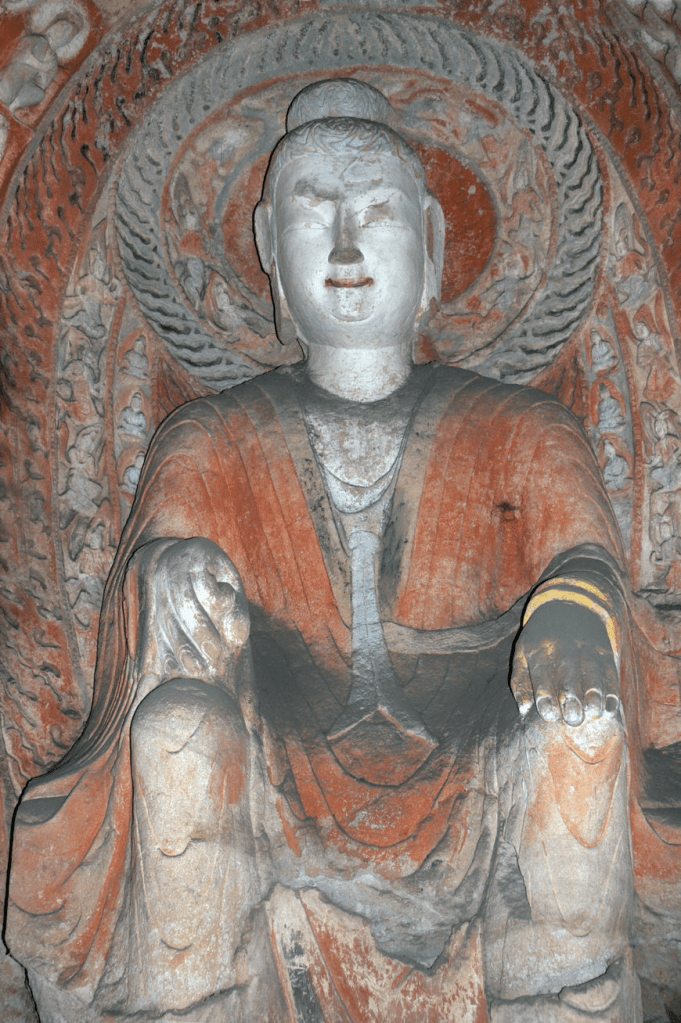
Buddha with Sinicized traits, Cave 6, Yungang, China (photo: Gisling, CC BY-SA 3.0)

The legacy of Yungang 

Despite the move of the capital to Luoyang in 494 C.E., constructions at Yungang continued for another three decades. Cave-temples of this phase are much smaller in size than at the earlier western end of the complex. Over half a millennium later in the 13th century when Yungang was the capital of the Liao Dynasty, Yungang witnessed another era of glory, with restorations of the caves and installation of wooden structures attached to their façades. Yet it was only a temporary phenomenon. The site later stayed silent for centuries until its early 20th-century rediscovery along with other major cave-temples by foreigners on expeditions.

Modern scholarship about the history and the art of Yungang Cave-temples has continued to provide new information about the site. The most recent archaeological excavations at Yungang unearthed the remains of a monastery dated to the Northern Wei dynasty above the western section of the cliff. The well-preserved foundations of courtyards, the central stupa (a sepulchral monument that refers to the Buddha), residential cells for monks, and objects continue to enrich our understanding of the site as a significant religious center from the 5th century. 

Yungang Grottoes

Link: https://peacelilysite.com/2023/03/31/yungang-grottoes/

#BuddhistArt #YungangGrottoes #BuddhaStatus #Buddhist #SilkRoad #TravelChina #BuddhistHistory #Cave-Temples #Religion

Source: smarthistory.org/yungang-grottoes
His Holiness Dorje Chang Buddha III Imparts Dharma In Response To A Westerner’s Questions

His Holiness Dorje Chang Buddha III Imparts Dharma In Response To A Westerner’s Questions

Link: https://peacelilysite.com/2023/03/31/his-holiness-dorje-chang-buddha-iii-imparts-dharma-in-response-to-a-westerners-questions/

#DorjeChangBuddhaIII #HHDorjeChangBuddhaIII#DorjeChangBuddha #DharmaDiscourse #Buddhist #

Why ‘Why Buddhism Is True’ Is True

By Adam Frank

Gargolas/Getty Images

Here is one thing author Robert Wright and I agree on when it comes to Buddhist meditation: It’s really, really boring. At least, it’s boring in the beginning. But there is another thing we agree on, too. That initial meditative boredom is actually a door. It’s an opening that can lead us to something essential, and essentially true, that Buddhism has to teach us about being human.

Wright’s insight on this point is just one of the many truths in his delightfully personal, yet broadly important, new book Why Buddhism Is True.

The “true” in Wright’s title doesn’t refer to the traditional kinds of scriptural truths we think of when we think of religions and truth. Wright is explicitly not interested in the traditional aspects of Buddhism as a religion. The book, for example, makes no claims about reincarnation or Tibetan rainbow bodies or the like. Instead, Wright wants to focus on Buddhism’s diagnosis of the human condition. The part that is relevant to the here and now. It’s Buddhism’s take on our suffering, our anxiety and our general dis-ease that Wright wants to explore because that is where he sees its perspective lining up with scientific fields like evolutionary psychology and neurobiology.

To his credit, Wright is more than cognizant that exploring just these aspects of Buddhism means he is filtering out quite a bit of its history. As he reminds his readers:

“Two of the most common Western conceptions of Buddhism — that it’s atheistic and that it revolves around meditation — are wrong; most Asian Buddhists do believe in gods, though not an omnipotent creator God, and don’t meditate.”

Wright also acknowledges that even within this “scientific” Buddhism he is interested in, there are also enormous differences between various philosophical schools of thought, many with 1,000-year histories.

“I’m not getting into super-fine-grained parts of Buddhist psychology and philosophy,” he tells us.

“For example, the Abhidhamma Pitaka, a collection of early Buddhist texts, asserts that there are eighty-nine kinds of consciousness, twelve of which are unwholesome. You may be relieved to hear that this book will spend no time trying to evaluate that claim.”

I was happy to see Wright address these issues of history and interpretation head-on. No matter where Buddhism’s encounter with the West takes it, ignoring history doesn’t do anyone any good (I’ve tried to explore these issues myself here at 13.7 and elsewhere, including here and here).

But with those important caveats, Wright is then forceful in his main argument that “Buddhism’s diagnosis of the human predicament is fundamentally correct, and that its prescription is deeply valid and urgently important.”

To back up this claim, Wright leans heavily on evolutionary psychology, which he says, somewhat tongue-in-cheek, “is the study of how the human brain was designed — by natural selection — to mislead us, even enslave us.” That misleading and enslaving, however, is all in the service of getting our genes into the next generation. As he writes:

“Don’t get me wrong: natural selection has its virtues, and I’d rather be created by it than not be created at all — which, so far as I can tell, are the two options this universe offers.”

These lines give you hint of Wright’s tone throughout the book. He is very funny and uses his own experiences to drive to the book’s questions. In particular, it was his first experience at a week-long meditation intensive two decades ago that launched his journey into Buddhism and “contemplative practice” (i.e. meditation). His accounts of time spent on “the cushion” are full of self-effacing humor and real insights.

Wright’s main point is that evolution hardwires us with intense emotions that are in fact delusions. (He has discussed this in an interview with Fresh Air’s Terry Gross.) They developed as survival responses to the environments we evolved in and they were tuned to those environments. Now they just don’t make sense and need to be seen for what they are. As he puts it:

“These feelings — anxiety, despair, hatred, greed — … have elements of delusion, elements you’d be better off without. And if you think you would be better off, imagine how the whole world would be. After all, feelings like despair and hatred and greed can foster wars and atrocities. So if what I’m saying is true — if the basic sources of human suffering and human cruelty are indeed in large part the product of delusion — there is value in exposing this delusion to the light.”

According to Wright, Buddhism, at least its more contemplative side, offers specific insights into, and a path out of, these delusions. In particular, the direct experiences gained via contemplative practice can, he says, weaken the hold of these evolutionary once-needed delusions. In the process, Wright argues, we can all learn to wreak a little less havoc on ourselves and the rest of the world. As he puts it:

“There are other spiritual traditions that address the human predicament with insight and wisdom. But Buddhist meditation, along with its underlying philosophy, addresses that predicament in a strikingly direct and comprehensive way.”

That broad nonsectarian approach is an important part of Wright’s approach. Raised as a Southern Baptist, he left the church in his teens. But he doesn’t look back in anger. Perhaps that is why he isn’t arguing that people need to become a Buddhist to practice its truths. As he writes: “Asserting the validity of core Buddhist ideas doesn’t necessarily say anything, one way or the other, about other spiritual or philosophical traditions.” Later, he reminds us of the Dalai Lama’s admonition: “Don’t try to use what you learn from Buddhism to be a better Buddhist; use it to be a better whatever-you-already-are.”

Which takes me back to that whole meditation is boring (at least in the beginning) thing. One of the best parts of Wright’s book is its realism. No matter how many books you read on Buddhist insights into human beings, they won’t mean much unless you find yourself a regular practice. It’s the practice that counts. It’s the practice that slowly lets you see the delusion in our constant stream of desires and aversions. That is, after all, why they call it practice. Wright does an excellent job of unpacking this reality for his readers, demonstrating again and again how contemplative practice can lead to understanding and how understanding can lead to an important kind of freedom.

Why ‘Why Buddhism Is True’ Is True

Link: https://peacelilysite.com/2023/03/30/why-why-buddhism-is-true-is-true/

#ScienceandPhilosophyofMeditationandEnlightenment #MeditationandEnlightenment #Enlightenment

Source: https://www.npr.org/sections/13.7/2017/09/26/553712812/why-why-buddhism-is-true-is-true

The Life and Legacy of A Great Translator — Kumarajiva (II)

Journey on Learning Buddhism

When his mother joined the monastery, it was said that Kumarajiva had already memorised many texts and sutras. Kumarajiva proceeded to learn the Dharma further and followed his mother into monastic life at the age of seven. When he was nine years old, mother and son undertook the arduous journey to India, eventually reaching the Kashmiri kingdom known to the Chinese as Chi-pin, which was probably his father’s native home. Bandhudatta, a renowned Buddhist teacher and cousin of the king, instructed Kumarajiva in the agamas (the nikayas of the Theravadin tradition). During the next two years Kumarajiva mastered these texts and was honoured by the king. Once he defeated several non-Buddhist teachers in a debate held before the ruler, and from this moment his reputation preceded him wherever he travelled. In addition to learning the scriptures and treatises of the Sarvastivadin school, Kumarajiva seized the opportunity afforded by his presence in India to study medicine, astronomy and astrology, exegetical and hermeneutical methods of exposition, logic and the applied sciences.

By the time Kumarajiva was twelve, he and his mother set out on the journey back to Kucha. The pace was leisurely, for every kingdom and principality along the way fêted and honoured him, and several urged him to take up residence as a teacher and adviser. As he was making his way through the mountains of the Yueh-chih region, he met an arhat who volunteered a prediction to his mother:

You must watch over and protect this novice. If by the time he reaches the age of thirty-five he has not abandoned the rules of religious discipline, he will become a great propagator of buddhadharma, enlightening countless people, and he will be the equal of Upagupta.

Upagupta was the fourth Indian patriarch after Buddha, famous for having converted the emperor Ashoka to the Buddhist way. Though Kumarajiva was forced by circumstances to break one vow late in life, he met the conditions of the prophecy and fulfilled the prediction.

By PHGCOM – Own work, CC BY-SA 3.0, https://commons.wikimedia.org/w/index.php?curid=2110032

Passing through Yueh-chih, Kumarajiva and his mother came to Kashgar, a Buddhist kingdom known for its excellent teachers and libraries. He settled there for a year and completed his studies of the Abhidharma and the texts revered by the Sarvastivadins. During this time he concentrated intently on Vedic literature and studied the most important systems of chanting the Vedas. Whilst he learnt a great deal about Hindu philosophical schools, he focussed upon the power of sound to affect the receptivity of consciousness to transcendental truths. The knowledge he gained later influenced his stirring translations of sutras and texts into Chinese. He also expanded his considerable grounding in Sanskrit and Pali and learnt more of the languages of Central Asia. On the advice of a monk, the king of Kashgar invited Kumarajiva to take the seat of honour and expound a sutra to a prestigious assembly which included the king himself. Kumarajiva did so, and as a result the monks of Kashgar were indirectly impelled to reform their previously lax monastic disciplines. At the same time, the king of Kucha heard of the high esteem in which Kumarajiva was held in Kashgar and sent a delegation to cement friendly relations between the two kingdoms.

While living in Kashgar, Kumarajiva met Sutyasoma, a prince of Yarkend (So-ch’e), perhaps as a result of his public discourse. Sutyasoma had renounced his royal inheritance and gone to Kashgar for spiritual instruction, and he was a revered teacher when he took Kumarajiva under his guidance. As a follower of Sarvastivadin doctrines, Kumarajiva held that the dharmas or ultimate constituents of existence are eternally real, whereas empirical phenomena which arise out of the momentary confluence of dharmas under karma are unreal. Sutyasoma adhered to the Mahayana view that all dharmas are themselves unreal; ontologically, dharmas are like empty space and assume distinct existence only in their momentary, ever-changing combinations. Although Kumarajiva initially found such teachings difficult to comprehend, Sutyasoma’s more universal application of Buddha’s doctrine of impermanence soon won him over to the Mahayana standpoint. Kumarajiva felt a tremendous sense of release and emancipation, declaring that he had been like a person who did not know what gold is and had previously taken brass for something wonderful.

Kumarajiva took up an intensive study of the sutras with the same enthusiasm he had brought to all his earlier training. He learnt the doctrines of the Madhyamika schools, memorized treatises by Nagarjuna and Aryadeva and rapidly assimilated Mahayana teachings. Just how fundamental a turning point Kumarajiva’s encounter with Sutyasoma was for his life is illustrated by his insistence that Bandhudatta, his first teacher in India, come to Kashgar. There Kumarajiva and Bandhudatta engaged in friendly but intensive debate, and eventually Bandhudatta was won over. During this time Sutyasoma foresaw something of the magnificent work Kumarajiva would undertake in China. Years after he left Kashgar, Kumarajiva recounted to his disciples in China what Sutyasoma once told him:

The sun of Buddha has gone into hiding behind the western mountains, but its lingering rays shine over the Northeast. These texts are destined for the lands of the Northeast. You must make sure that they are transmitted to them.

After spending a memorable year in Kashgar, Kumarajiva and his mother set out for Kucha. They stopped for a time in the kingdom of Wen-su and then moved on to their home. By the time Kumarajiva reached Kucha, his reputation had gone ahead of him as far as northern China. Monks from all over Central and East Asia gathered in Kucha to learn from him, even though he was only twenty years old and still officially a novice or shramanera. Within the year he was made a full monk in the Sangha and spent much of his time teaching others. For almost a decade he prepared himself for the mission to China which had been prophesied and which he felt was the central focus of his life work.’ This period lacked the peacefulness and prosperity that had marked his earlier years, for he witnessed the steady decline of the Kuchan state and heard reports of the incessant internal struggles which plagued northern China. Nonetheless, he worked quietly in the conviction that he was destined to go to the East one way or another.

Around this time, Jiva said to her son, “You should propagate the profound teachings of the Vaipulyasutras (the most important of the Mahayana sutras) in China. Its dissemination in the eastern countries will depend only on you. Does it matter that there will be no personal advantage for you (in this)?” To which he famously replied, “The teachings of the great master are there to serve (others) and to forget oneself (in the process). If one is able to spread the great conversion and awaken the blind masses, then, even if one’s body were burning in a red hot oven, one may suffer but feel no regret.” His mother, seeing the decline in Kucha’s fortunes and believing that she had done all she could for her son, exhorted him to follow unwaveringly the Bodhisattva Path and left to return to India. They never met again.

Kumarajiva stayed in Kucha and studied extensively the Pancavimsatika-Prajnaparamita and other Mahayana sutras and shastras. When he was first exposed to the Prajnaparamita texts, legend has it that Mara came to distract him by covering the pages so that they appeared blank. Ever more resolute when he discovered it was the devil’s work, Kumarajiva recited the sutras with vigour. Mara then spoke to him, declaring him already wise and questioned his need to read the sutras. Kumarajiva responded by telling him he was “a small devil” and to leave immediately. Reflecting the celebrated words of Buddha Shakyamuni, he declared, “My heart is (firm) like the earth; it is immutable.”

The Life and Legacy of A Great Translator — Kumarajiva (II)

Link:https://peacelilysite.com/2023/03/28/the-life-and-legacy-of-a-great-translator-kumarajiva-ii/

#Buddhism #Kucha#Kumarajiva #Buddhist# Kashgar#GreatTranslator #BuddhistSutra #Prajnaparamita #Mahayanasutra

Source: https://www.tsemrinpoche.com/tsem-tulku-rinpoche/great-lamas-masters/kumarajiva-the-great-translator-from-kucha.html, https://khyentsefoundation.org/the-life-and-legacy-of-kumarajiva/, https://japanesemythology.wordpress.com/study-notes-the-influence-of-kumaraju-kumarajiva-upon-japan/

How to Obtain Supernormal Power

Photo by Rostislav Uzunov on Pexels.com

From Dharma That Every Buddhist Must Follow

By Ahmong Nuobu Pamu

SUPERNORMAL DHARMA POWERS ARE skills that will inevitably appear during the course of a Buddhist’s cultivation and his striving for enlightenment. These powers are also a type of realization that the cultivator must naturally possess.
This is especially true with respect to practitioners of Vajrayana Bud-dhism. When the Vajra Acarya Master manifests the Dharma at the Buddhist altar area, these skills will provide empowerment that is an indispensable part of the Buddhist altar area state. Those who are Rinpoches, Dharma Teachers, and Great Virtuous Ones desire and require such skills.
Even ordinary cultivators who have just begun to follow Buddhism want to possess a few supernormal Dharma powers! Because of such ignorant thinking, these practitioners will not only cultivate themselves for their entire lives without attaining any supernormal powers, they will also never have the opportunity to even meet up with a teacher of great virtue who does possess supernormal Dharma powers! What is the reason for this result?


Can it be said that desiring supernormal Dharma powers is blameworthy and produces hindrances?
Desiring supernormal powers can be a proper desire for the Dharma. The desire for supernormal powers can be divided into two types: blameworthy and non-blameworthy. It is blameworthy if one desires supernormal Dharma powers primarily for one’s own use. This would include desiring to appear impressive and awe-inspiring by showing off one’s Dharma powers. It would also include using one’s miraculous powers to subdue people, reap fame and Bain, cheat people out of money, hoodwink people into sexual misconduct, further one’s worldly selfish and evil intentions, and do all kinds of bad things.

These people do not know that the Dharma Protectors in space are inspecting and can see their evil minds. The Dharma Protectors will then immediately exercise their samadhi obstructive powers. These Dharma Protectors will seal up the chakras in the bodies of these ill-intentioned people. Their chakras will be confined to this earthly realm. As a result, for their entire lives, these people will only be able to manifest the state of an ordinary person. It will be impossible for them to obtain supernormal powers. This is because if these evil people were ever to obtain supernormal Dharma powers, they would immediately become sorcerers. That would be horrible. Wouldn’t the three spheres of the universe thereby fall into great chaos?


The Buddhas and Bodhisattvas in the various Dharma realms look back into beginningless time and look forward into the eternal future. They know all living beings in the three spheres of existence like the palms of their own hands. They specifically designate certain conditions under which they will bestow supernormal Dharma powers. Additionally, they dispatch Dharma Protectors, who keep watch on all practitioners, to manage the miraculous powers of living beings. Even if a Great Virtuous One is momentarily deceived by a person with such evil intent and consequently transmits the Buddha Dharma to him, as long as this person’s evil intentions still remain, it will be impossible for him to obtain supernormal Dharma powers no matter how diligently he may practice. This is because the Dharma Protectors inspecting from above do not dare to violate the precepts! They see that evil person’s preposterous ideas and immediately cease his miraculous Dharma powers. They block his chakras to prevent his chakras from developing. This is the responsibility of these Dharma Protectors.

There is a second type of person. Their desire to obtain supernormal Dharma powers is not blameworthy. The main reason why this type of person desires miraculous powers is to enlighten themselves and others. The practice of this type of person is based upon the four limitless states of mind. They constantly carry out the six paramitas. They have taken the great bodhicitta vows. They cultivate themselves in order to liberate all living beings. They want to obtain miraculous Dharma powers in order to liberate living beings from the suffering connected with samsara. They desire to obtain supernormal powers in order to benefit all living beings. They themselves clearly believe in the law of cause and effect. They even often fear that obtaining supernormal powers will bring about karmic hindrances and will cause them to go against the law of cause and effect. Thus, they are frightened of miraculous powers and maintain a heart of humility. They are Great Bodhisattvas, yet they always consider themselves to be ordinary living beings.


The practice of this type of person is entirely in accordance with Buddhism. Since their practice is in accordance with what I am now lecturing on – Dharma That Every Buddhist Must Follow – the Dharma Protectors inspecting from above will provide them with the most wonderful assistance. These deities will untie the knots in the energy channels of these practitioners and will cause the supernormal Dharma powers of the Buddhas and Bodhisattvas to suddenly turn into light and enter their chakras. At that time, the mandala in each practitioner’s body will respond well and will accept these powers. As a result, miraculous powers will naturally appear and Dharma powers will open up!
Now then, how does one obtain supernormal Dharma powers after all? Those who are smart might already know the answer. However, perhaps those ignorant people who fantasize about learning miraculous Dharma powers do not yet understand. Hence, I, Pamu, will now clearly tell all of you! How should we obtain supernormal Dharma powers?


There are methods to obtain miraculous Dharma powers. There are mantras, mudras, and visualization techniques. When one’s three karmas unite into one body and correspond with the teachings, supernormal Dharma powers will come into being. One can then exhibit power and light. The uniting of one’s three karmas into one body and their correspondence with the teachings will be manifested in the state of realization and state of virtue one has attained through practice of the Buddha Dharma. When one’s state of realization and state of virtue have reached the level where it is appropriate to obtain supernormal Dharma powers, then as soon as one practices according to the Dharma, supernormal Dharma powers will appear. If one’s state of realization and state of virtue have not yet reached the level where it is appropriate to obtain supernormal Dharma powers, then even if one recites mantras until one’s lips crack, and even if one practices mudras until one’s Wrists fall off, one will still not obtain the slightest Dharma power.
The ordinary practitioner of exoteric Buddhism knows that without moral discipline, one cannot develop concentration. Without concentration, One cannot attain wisdom. One also cannot attain supernormal powers. Without concentration, one cannot master the Dharma.

I am telling this to all of you here today in the hope that you will pass these instructions on to all of those people who fantasize about having limitless Dharma powers and great supernormal powers. If one does not learn the Tripitaka well and does not live according to Buddhism, or if one does not deeply study and truly practice the teachings contained in the books I have written, such as The Prajna of Ultimate Reality, Entering the Door of the Dharma, Dharma That Every Buddhist Must Follow, Brief Commentary on the Precepts and Discipline Treatise, etc., then one will not be able to obtain supernormal Dharma powers! This is because the great door leading to supernormal Dharma powers is opened by living according to the teachings of Buddhism and by possessing a high state of realization and a high state of virtue. There are no other means by which one can obtain supernormal Dharma powers!


Supernormal Dharma powers are arranged by the Buddhas and are managed by the Dharma Protectors who patrol and inspect in the sky. Since the beginning of Buddhist history, not one Dharma Protector has bestowed supernormal Dharma powers upon any cultivator who does not live in accordance with the teachings of Buddhism and who does not have a high state of realization and a high state of virtue. Since the beginning of Buddhist history, not one Dharma Protector has opened up the energy channel knots of any cultivator who does not live in accordance with the teachings of Buddhism and who does not have a high state of realization and a high state of virtue.

How to Obtain Supernormal Power

Link: https://peacelilysite.com/2023/03/24/how-to-obtain-supernormal-power/

#BuddhaDharma #Buddhism #AhmongNuobuPamu #DharmaThatEveryBuddhistMustFollow #SupernormalPower

Source: Taken from Dharma That Every Buddhist Must Follow, by Ahmong Nuobu Pamu, translated by Bodi Wentu Rinpoche

The Life and Legacy of the Great Translator — Kumarajiva (I)

Kumarajiva’s statue in front of the Kizil Caves in Baicheng County, Xinjiang, China

The Buddhist scriptures from China are an invaluable repository of knowledge that was made possible by the benevolence of Buddhist masters who risked their lives to travel to China and spread the Dharma. Despite facing significant hardships along their journeys, they remained steadfast in their mission to share the Buddha’s precious teachings with a foreign culture. Thanks to their efforts in translating the teachings into Chinese and conveying their true meanings, people have been able to benefit from these teachings for over 25 centuries and continue to do so by achieving higher spiritual attainments.

The translation of the Buddha’s teachings took place between the 2nd and 13th centuries, with a significant number of translations carried out during the Tang Dynasty (7th – 10th centuries). In total, approximately 6,000-7,000 versions of various sutras were transmitted to China, and almost 200 renowned translators, including Kumarajiva, one of the most distinguished translators of the 4th and 5th centuries, were involved in the process.

A genius boy born in a buddhist kingdom Kucha

By User:Schreiber – Created with Inkscape (using Image:Bm taklamakan.jpg). Data based on: Marylin M. Rhie, Early Buddhist Art of China and Central Asia (Handbook of Oriental Studies / Handbuch der Orientalistik – Part 4: China, 12, Vol. 1) (Handbook of Oriental Studies/Handbuch Der Orientalistik). Brill Academic Publishers, ISBN 90-04-11201-4, CC BY-SA 3.0, https://commons.wikimedia.org/w/index.php?curid=2722471

Kucha played a crucial role in the spread of Buddhism during ancient times. In the last quarter of the 4th century CE, Kucha became a dominant force, overshadowing the Southern Silk Road, which ran along the southern edge of the Tarim Basin. According to the Jinshu(晋书), Kucha was a heavily fortified city with a magnificent royal palace, numerous Buddhist stupas, and temples. Book 97 of Jinshu states, “There are fortified cities everywhere, their ramparts are three-fold, inside there are thousands of Buddhist stupas and temples (…) The royal palace is magnificent, glowing like a heavenly abode.”

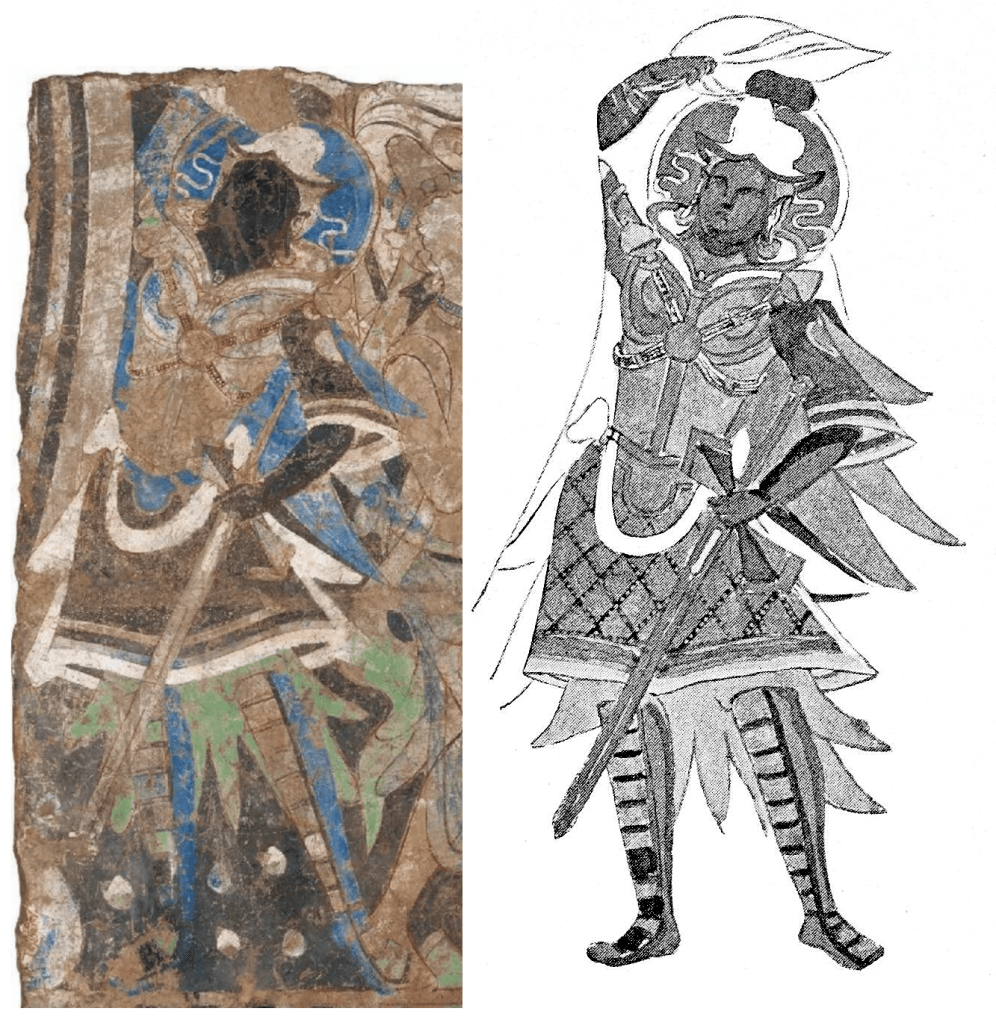
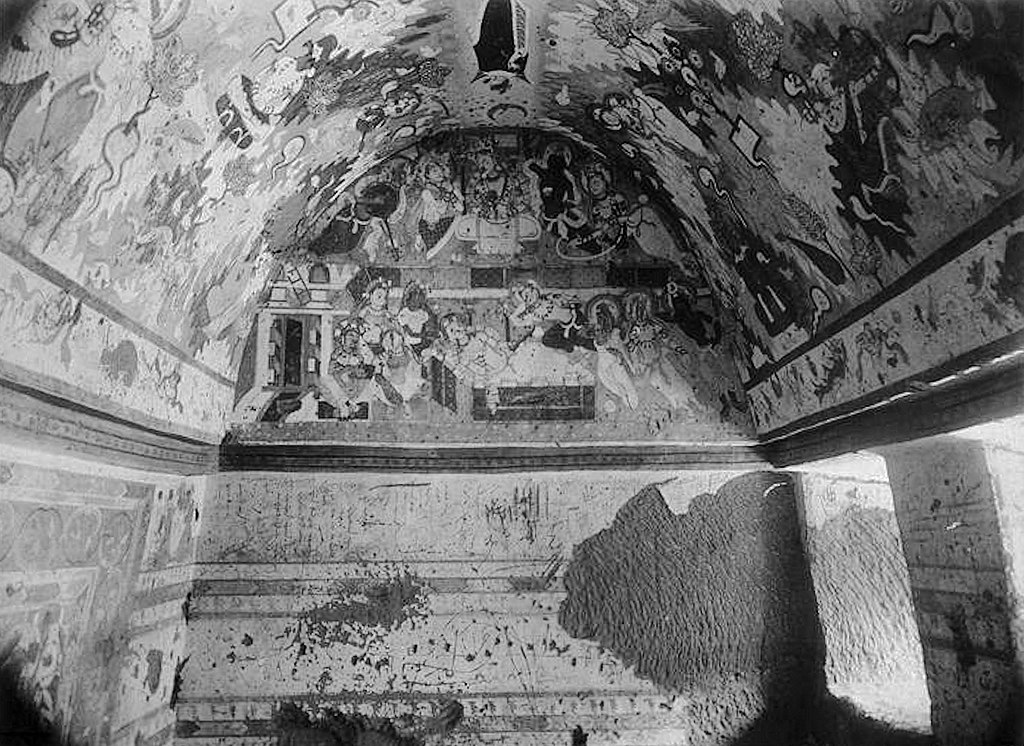
The culture and civilization of Kucha during this period can be glimpsed from the discoveries in the famous Kizil caves. In 1906, the German expedition team of Albert Von Le Coq and Albert Grunwedel explored the Kizil Caves, with different objectives. Grunwedel copied the murals, while Von Le Coq took them with him and placed most of the fragments in the Museum of Asian Art in Dahlem, Berlin. Other explorers also took the murals and placed them in various museums in Russia, Japan, Korea, and the United States.

The murals in the Kizil Thousand-Buddhist Caves are considered “The most beautiful murals in Central Asia,” and can be found in 81 caves with a total area of over 10,000 square meters (11,960 yards). The diamond grid pattern is the most impressive feature of the caves, with each grid depicting a story about Buddha’s reincarnation through a single picture. Besides themes related to Buddha, Bodhisattva, Arhat, Flying Apsaras, and Buddhist fables, the murals also showcase various depictions of daily life, farming, hunting, pastures, riding, mountains and rivers in the West Region, animals, birds, and ancient architectures. The styles are not limited to local arts, indicating influences from diverse cultures.

Cave 4 Vajrapani, removed original and in-situ drawing by Grunwedel
Cave of the Hippocampi (Cave 118, mural)
Right portion of the cave, as photographed by Charles Nouette  (1869-1910) Photographed in 1907. Public Domain – [1], Public Domain, https://commons.wikimedia.org/w/index.php?curid=99375823

Attendant, Cave 84 Painting: 6th century painter, Kizil Photography: Undetermined 
Blue pigment used on mural. Greco-Buddhist Wind God Boreas or Vayu, central part of the ceiling of Cave 38
Ancient Uyghur Civilization (1)-Cave art by ancient Uyghurs

Kumarajiva was born around C.E. 344 in kingdom Kucha. Kumarajiva’s father, Kumarayana, was descended from an honourable line of prime ministers of a kingdom in Kashmir. Though Kumarayana was expected to become prime minister after his father, he renounced his hereditary claim and became a Buddhist monk. Eventually, he set out along the silk route which threaded its way across the mighty Pamirs and into the Takla Makan Desert and Central Asia. Following the northern route, he came in time to the devoutly Buddhist kingdom of Kucha on the northern rim of the great Tarim River basin. The Kuchan king either knew of Kumarayana by reputation or showed a shrewd perception of human nature, for he welcomed the traveller warmly and at once made him a trusted adviser. Soon he was elevated to kuo-shih, Teacher of the Nation, a privileged position which entailed political and cultural duties as well as religious functions. …

The great translator’s mother, Jiva (Jivaka), was the younger sister of the king of Kuchi. She was well known for her intelligence, wit, memory, and devotion to the dharma. It was said that she had only to glance at a written passage to comprehend it, and only to hear something once to repeat it from memory. These qualities attracted numerous suitors. Jiva had a red mole (or spots) on her body, an indication that she would give birth to a wise son.

She had politely rejected a number of eligible suitors from neighbouring kingdoms, but when she saw Kumarayana she expressed the desire to become his wife. The king was delighted and insisted that Kumarayana accept the proposal. Even though he was a monk, he bowed to the wishes of this generous and devout monarch.

When Kumarajiva was in utero, Jiva became considerably sharper and more perceptive than before. For example, although her language was what is now known as Tokharian B, while pregnant with Kumarajiva she was able to understand Sanskrit without ever having studied it; after Kumarajiva was born, this ability disappeared. Such an “omen” suggests that the child Kumarajiva was predisposed to master Sanskrit and thus the original Buddhist scriptures.

When their son was born, Kumarayana and Jivaka each gave a part of their names to him and called him Kumarajiva. With two devout parents, Kumarajiva was exposed to Buddhist texts and practice from the day he was born. At the age of seven, he trained with a learned master and memorized a thousand verses every day until he could recite all the teachings of the scholastic treatises of the Abhidharma.

As if an occult design of invisible Nature had become manifest, hardly had the remarkable child turned six before Jivaka received permission from her husband to become a Buddhist nun. By that time Kumarajiva had already learnt the vast literature of the Abhidharma by heart, understood it and entered the Sangha. Kumarajiva’s mother clearly recognized the penetrating intelligence of her son and was determined to give him the best available philosophical and spiritual training. 

The Life and Legacy of the Great Translator — Kumarajiva

LInk: https://peacelilysite.com/2023/03/24/the-life-and-legacy-of-a-great-translator-kumarajiva-i/

#Buddhism #Kucha#Kumarajiva #Buddhist#KizilCaves#GreatTranslator #BuddhistSutra

Source: https://khyentsefoundation.org/the-life-and-legacy-of-kumarajiva/, https://japanesemythology.wordpress.com/study-notes-the-influence-of-kumaraju-kumarajiva-upon-japan/, https://www.tsemrinpoche.com/tsem-tulku-rinpoche/great-lamas-masters/kumarajiva-the-great-translator-from-kucha.html

THE MYSTERY OF THE LONGYOU CAVES

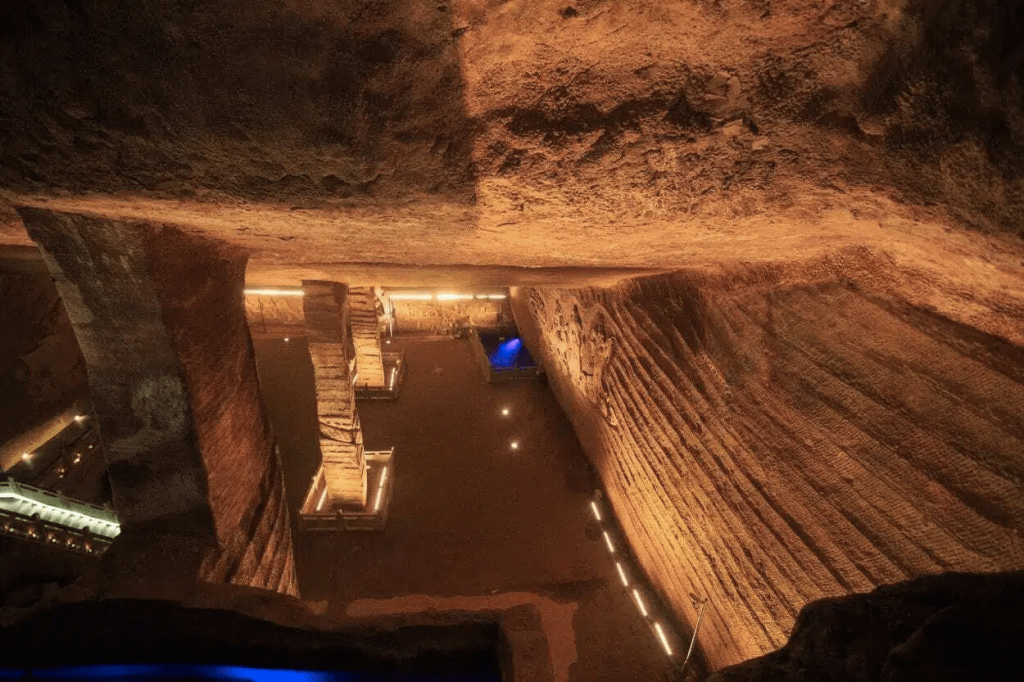
Longyou Caves are known as the ninth wonder of the ancient world. Source: Zhangzhugang / CC BY-SA 4.0

LONGYOU CAVES IS A COMPLEX OF 24 ARTIFICIAL CAVES, CONSTRUCTED INTO THE SANDSTONE GEOLOGY OF FENGHUANG HILL IN THE ZHEJIANG PROVINCE OF CHINA.

The caves were discovered by accident in 1992, when local farmers drained several ponds revealing five large manmade caverns and 19 smaller caves.

The five caverns, independent from each other measure between 18-34 metres, reaching heights of up to 20 metres with supporting pillars and distinctive shapes remarkably curved with shaking imprints across the cavern walls and ceilings.

After news of the discovery spread across China, it was first proposed that the caves were an obscure natural wonder, as the design and formation was completely distinct from other ancient caves, quarries, mines, or ceremonial caverns constructed in china throughout antiquity to draw a comparison.

Image Credit : Zhangzhugang – CC BY-SA 3.0

Upon further study, it was found that each complete cavern has only one portal, associated with a vertical shaft with a carved stairwell that allows rainfall and surface runoff to enter the caverns. To manage the water intake, a system of drainage troughs, some drainage channels, and a water trap was carved into the cavern base to collect the water.

The caverns are also aligned along a south to southwest orientation, maximising the use of sunlight to illuminate the interior, with inclined sidewalls that reduces the stress on the cave ceilings preventing collapse.

It is highly possible that the cavern was formed by carving rock stones from top to bottom and layer by layer using short chisels with different sizes (based on several short chisels made from steel, discovered in one of the larger caves).

Image Credit : Zhangzhugang – CC BY-SA 3.0

Only one of the caves has been opened for tourism, chosen because of the stone carvings found inside which depict a horse, fish and bird. The Longyou Caves of Zhejiang province in China truly are an enigma and it has ten enduring mysteries that remain unresolved, despite more than two decades of research.

1. How Were the Longyou Caves Constructed?

A rough estimation of the workload involved in building the Longyou Caves is awe-inspiring. The quantity of rock that would have been removed in the overall excavation of the grottoes is estimated to be nearly 1,000,000 cubic meters (35,314,666 cu ft). Taking into account the average digging rate per day per person, scientists have calculated that it would take 1,000 people working day and night for six years to complete.
These calculations are based purely on hard labor, but what they haven’t taken into account is the incredible care and precision of the sculptors, meaning that the actual workload would far surpass the theoretical estimation. As for how they were constructed and what tools were used, it is still unknown. No tools have been found in the area, and, as we will explore later, scientists still don’t know how they achieved such symmetry, precision, and similarity between the different caves.

2. No Traces of Construction

Despite their size and the effort involved in creating them, so far no trace of their construction, or even their existence, has been located archival sources. Although the overall excavation involved almost a million cubic meters of stone, there is no archaeological evidence revealing where that quantity of stone went, and no evidence of the work. Moreover, there is not a single historic document that refers to them, which is highly unusual considering the sheer scale of the project. The origin of the Longyou Caves is a complete and utter mystery.

Experts wonder why the walls at the Longyou Caves in China are covered in chiseled parallel lines. (Zhangzhugang / CC BY-SA 4.0 )

3. Why Were the Walls Chiseled?

Every single one of the Longyou Caves is covered, from floor to ceiling, in parallel lines that have been chiseled into virtually every surface. The effect is a uniform pattern throughout the caves, which would have required immense manpower and endless hours to create. The question is why? Was such labor-intensive work purely for decoration? Are the lines or patterns symbolic in some way? All that is currently known is that the markings are similar to those found on pottery housed in a nearby museum, which is dated between 500 and 800 BC.

4. Lack of Fish in the Longyou Caves

When the caves were first discovered, they were filled with water, which presumably had been there for a long period of time. They had to be pumped out in order to realize that these were not just like the other “bottomless ponds” found within the area, but rather man-made structures. Most villages in southern China contain very deep ponds, which have been called “bottomless ponds” by generations of villagers. These ponds teem with fish, which are easily caught. However, after the first cave was pumped dry, not a single fish was to be seen, or any other sign of life.

5. How Did the Longyou Caves Remain So Well Preserved?

One of the most interesting and challenging questions is how the Longyou Caves have been able to keep their structural integrity for more than 2,000 years. There are no signs of collapse, no piles of rubble, and no damage despite the fact that in some areas the walls are only 50 centimeters (20 in) thick. Over the centuries, the area has gone through numerous floods, calamities and wars, the mountains have changed their appearance and exposed stones have been weathered, but inside the Longyou Caves, the form, patterns and markings are still clear and precise – it is as though they were built yesterday.

6. How Did the Builders Work in the Dark?

Due to the great depths of the caves, some areas at the bottom, which are not exposed to the opening above, are pitch-black. Yet even those dark areas are decorated with thousands of parallel lines on the walls, columns, and ceiling. So how did ancient people work in the dark? 

According to Jia Gang, a Tongji University professor specializing in civil engineering: “There should be lamps, because the cave’s mouth is very small, and the sunbeam could only shine in the cave at a certain angle during a certain period of time. As one goes deeper into the cave, the light becomes dimmer. At the cave’s bottom, which is usually dozen of meters from the mouth, one could hardly see anything.” However, this was at least two millennia ago and nothing that could have been used for lighting has been found.

7. Were the Longyou Caves Meant to be Connected?

All of the Longyou Caves are distributed across an area of only one square kilometer (0.38 sq mi). Considering such a high density, one cannot help asking whether some grottoes were meant to be connected. What would be the purpose of making so many separate caves in such a tight area without connecting them? In many areas, the walls between the caves are very thin, only 50 centimeters (20 in), but they were never linked so it appears they were intentionally kept apart. What’s more, many of the Longyou Caves are almost identical to each other.

8. Who Built the Longyou Caves?

Nobody has any idea who built the caves. Some scientists have claimed that it was not possible or logical for such as mammoth job to have been undertaken by regular village people. Only the emperor and the leaders could have organized such a huge project, like the construction of the Great Wall , which was built to defend against invasion from the outside world. But if it was commissioned by an Emperor, why are there no historical records of its construction?

9. How Did They Achieve Such Precision?

The scale of the Longyou Caves is magnificent and momentous, the design was delicate and scientific, the construction was sophisticated, and the precision is indicative of superior craftsmanship. The model, pattern and style of each cave is extremely similar. Every grotto is like a grand hall. One side is steep and another side is 45% inclined. The four walls are straight; the edges and corners are clearly demarcated. The chiseling marks within the Longyou Caves are uniform and precise.

“At the bottom of each cave, the ancient [builders] wouldn’t be able to see what the others were doing in the next grotto,” explained Yang Hongxun, an expert at the Archaeological Institute of Chinese Academy of Social Sciences. Nevertheless, “the inside of each cave had to be parallel with that of the other, or else the wall would be holed through. Thus the measure apparatus should have been very advanced. There must have been some layout about the sizes, locations, and the distances between the caves beforehand.”

With the help of modern equipment and methods, the investigators measured the sizes of the walls, and surprisingly found that the overall construction is extremely accurate. The walls between the caves are of the same thickness in different sections. So how did they achieve this precision? What were their methods?

Stairs leading down into one of the once-submerged Longyou Caves. (Zhangzhugang / CC BY-SA 4.0 )

10. What Were the Longyou Caves Used for?

Following extensive investigations and study, scientists and scholars have attempted to put forward explanations for the grottoes, but none so far provide a convincing explanation for why they were built and what they were used for.

Some archaeologists have suggested that the grottoes were the tombs of old emperors, emperor halls, or places for storage. But this interpretation is far-fetched. No funeral objects or tombs have been found and no artifacts left behind. If it were used like an emperor’s palace, the caves surely would have been designed differently, with separate rooms for different purposes like entertaining, meeting, and sleeping. But no evidence can be found of this and no traces of habitation have been found.

Another hypothesis is that the Longyou Caves were used for mining and extracting some type of mineral resource. However, mining operations would have required equipment and apparatus to extract the rocks and transport them. Again, no traces of this have been found, nor any evidence of where the rocks were taken. And of course, if the caves were just for mining, why create such intricate decorations on the walls, columns and ceilings?

Finally, some have suggested that these caves were the places for troops to be stationed and that an emperor of the past wanted to keep his soldiers out of view in order to keep his war preparations secret. However, these caves could not have been built in a short period of time. They would have taken many, many years to build so it is unlikely to have been done in preparation for war, which tends to come about much more quickly. Furthermore, there are no signs of people having stayed in the caves.

Despite decades of research, very few answers have emerged to explain the enigma of the Longyou Caves . Our ancient ancestors have achieved many wondrous things throughout history, but this discovery from China is truly an unsolved mystery which has yet to be cracked.

THE MYSTERY OF THE LONGYOU CAVES

Link: https://peacelilysite.com/2023/03/24/the-mystery-of-the-longyou-caves/

#Travel #TravelChina #LongyouCaves #Mistery

Source: https://www.ancient-origins.net/ancient-places-asia/longyou-caves-001248, https://www.heritagedaily.com/2020/08/the-mystery-of-the-longyou-caves/134874

Nectar — Precious Food Which is Bestowed by the Buddhas


White Bodhi Nectar

Generally speaking, nectar can be divided into two categories.  Ordinarily, Rinpoches and Dharma Teachers make pills which they call nectar by using Chinese herbal medicine or water together with such things as sharira and then empower such material by reciting certain mantras.  It can be said that this is false nectar.

What is true nectar?  True nectar is precious food which is bestowed by the Buddhas from the land of the Buddhas.  It is not a food which exists in this earthly world.  There is a Buddha or Bodhisattva Master on the level of a Dharma King who ascends to the Dharma King platform and practices the dharma.  Due to this Master’s state of realization, he is able to successfully invite the Buddhas to arrive in the sky and bestow nectar.  When descending into the dharma bowl, the nectar may turn into light or it may descend in its normal form.  This precious food is something which emanates from nothing.

When the Master conducts the nectar dharma ceremony, there must be a space in between the Master and his disciples.  The distance between them is about fifteen yards to over one hundred yards.  The Master cannot come close to the disciples.  He can only sit on the dharma platform and is not allowed to leave his seat. At a place far away from the Master, a disciple will in front of other disciples use pure water to wash and wipe dry the dharma bowl (this dharma bowl is an ancient dharma bowl made of pure copper and gold which has been handed down through a lineage of Dharma Kings). That disciple will place the dharma bowl in front of himself and in sight of other disciples who will stare at the dharma bowl, never losing sight of it for a moment.

Then, the Master who is a far distance away on the dharma platform will practice the dharma.  From the land of the Buddhas, the Buddhas will bestow nectar which falls from the sky.  It may turn into red light, blue light, or a colorful rainbow as it enters the dharma bowl which is being guarded by the disciples.  It is incomparably wonderful.  The Master will then order the disciples to open the lid of the bowl to exhibit the nectar.  At this time, the disciples are pleasantly astounded to see that inside the dharma bowl which is in front of them is incredibly marvelous nectar which has come from the land of the Buddhas.  Its form is definitely unlike any form which can be found in this human world.  Only after the disciples have confirmed the arrival of nectar does the Master have the right to step down from the dharma platform to view the nectar and empower the disciples by giving them nectar to eat. If one has just one taste of this nectar, one’s life span will increase to over one hundred and twenty years.  This nectar can cure all ailments, such as malignant sores.  After one applies a bit of nectar on the sore, it will be totally cured and will disappear without trace within two to three minutes.

Red Bodhi Nectar
Crystal Bodhi Nectar

Since nectar is such a priceless treasure, it is definitely not something of which ordinary people can partake.  An emperor of China who lived in ancient times, Chin Sher Huang, wanted to taste the nectar of long life.  He ordered Hsu Fu to take five hundred young boys and girls and travel to what is now known as the islands of Japan.  But Hsu Fu was unable to find nectar.  He dare not return to Chin Sher Huang.  The present day people of Japan are the decedents of Hsu Fu and the young boys and girls he took with him.

In Tibet, many people want to taste nectar.  There are those who make their way to Lhasa by kowtowing at every step.  Their legs and hands are cut open.  Some of their bodies have even been cut up by rocks.  They may spend four or five years to make their way to Lhasa.  For the most part, after they arrive in Lhasa, the Dharma King still does not empower them with nectar since their merit is insufficient.  Some people practice arduously their entire lives in order to taste nectar, yet at the time they are about to pass away, they have never seen what nectar looks like.

What type of person is able to taste nectar?  There are three conditions.  First, that person must definitely be a devout Buddhist.  Second, that person’s infinite roots of kindness must extend back into many past lives and throughout eons of time.  Third, that person must have karmic conditions which cause him to meet up with a Great Dharma King who is truly able to practice the nectar dharma.  Otherwise, even if the person is a king, general or minister, he still is not qualified to taste true nectar bestowed by the Buddhas.

Daoists believe that the most difficult and highest state to attain is where one refines one’s essence into vital energy, refines one’s vital energy into spirit, refines one’s spirit to return to emptiness and through internal alchemy one comes up with the immortal substance so that the five vital energies are like the rising sun and all of one’s sprits come together.  Yet, using true nectar which has been bestowed by the Buddhas to accomplish such a state is truly an easy thing.  If one rubs a bit of this nectar on oneself, within twenty-four hours one can enter the state of purity and spontaneity where all of one’s spirits come together.  If one uses this nectar in the formal Buddha dharma initiation ceremony, then the results will be even much more wonderful.  This is a matter of tremendous significance.

One can thus see how magnificent nectar is!  Therefore, one who is able to partake of nectar must be totally devout, must tremendously cherish the opportunity and must strictly practice the Nectar Protection Longevity Mantra.  In this way, one will be able to ensure one’s longevity, avoid disasters, deepen one’s state of realization and attain great accomplishment.

Nectar — Precious Food Which is Bestowed by the Buddhas

Link:https://peacelilysite.com/2023/03/22/nectar-precious-food-which-is-bestowed-by-the-buddhas/

Source: Taken from True Stories About a Holy Monk

#Nectar#Buddha #BuddhaDharma #HolyMonk #DharmaKing

Buddha-Bestowed Nectars Unexpectedly Appeared

steve1658's avatarWisdom Tea

Buddha-Bestowed Nectars Unexpectedly Appeared

ByZhaxi Zhuoma

(Reported from Los Angeles)Expounding the Absolute Truth Through the Heart Sutrais truly a supreme holy scripture. On March 7, 2014 CE, a dharma assembly of empowerment with this treasure book was held for the first time at the Holy Manifestation Temple in the United States of America. The treasure bookExpounding the Absolute Truth Through the Heart Sutra, the six great dharmas, holy mantras, and letters of petition to be chanted and practiced by the seven types of cultivators, and dharma water and willow branches were presented to the dharma rostrum for worshipping. Forty six (46) pieces of first-publishing stamping seals to be empowered by the dharma water were placed at the front.

Dharma King Gar Tongstan Ciren Gyatso escorted the purple-colored brass dharma bowl that he had beseeched in person from H.H. Dorje Chang Buddha III to the Holy Manifestation…

View original post 600 more words

H.H. Dorje Chang Buddha III’s Selected Philosophical Sayings About Worldly Matters 

Many years ago, a disciple approached Master Yi Yun Gao (H.H. Dorje Chang Buddha III) seeking guidance on how to apply Buddhist wisdom to navigate worldly affairs. In response, Master Yi offered some insightful advice, which was later compiled into a book entitled “Selected Philosophical Sayings About Worldly Matters”. The following are translations of excerpts from the book.

What makes the sun the greatest thing man has ever known? It is admired for providing light and warmth for all the beings under it. A truly great person is one who is willing to sacrifice his own benefit for the well-being of others.

A city does not need all the food a province produces, but that much food is far from enough to feed the whole country; it needs all the food the country can produce. The strength of an individual is nothing compared with collective strength.

The respect a person enjoys comes from his devotion to the well-being of other people. A swimming pool is admired in summer because it provides relief from the heat.

A person is established in character only when he truly knows himself. Why? It is difficult for a person to be aware of his own flaws, just as he cannot see his own back, though it is in plain sight of other people. It is quite natural for a person to hide his own flaws, but overdoing it will alienate the person from those around him. When the person realizes this and feels ashamed, he turns to seek knowledge and adhere to moral integrity so as to establish his own character and win the respect and support of other people.

Deliberation is needed before one makes a move, but no conclusion is to be drawn from deliberation alone. It has to be tested in action. Suggested moves are not to be adopted in haste, nor are they to be rejected out of hand; they are not to be dismissed even when tests have proved them worthless, for in this case an inquiry into their legitimacy has to be made. When a rainbow is blocked from view by clouds, it does not mean that there is no rainbow out there.

What to do to beat your equal in battle? Attack him where he is most vulnerable with concentrated force and victory will be yours. A piece of wood with a sharp end can break another piece of wood that is just as hard as the wood you use to attack.

Intellectual and material resources work in opposite ways. Intellectual resources are limitless; the more they are tapped, the broader they grow in scope. Impermanent in nature and limited in quantity, material resources last but a short time, and the more they are consumed the sooner they are exhausted. The truth is that the former is non-quantifiable and thus infinite and everlasting while the latter is quantifiable and therefore diminishing and exhaustible.

H.H. Dorje Chang Buddha III’s Selected Philosophical Sayings About Worldly Matters 

Link:https://peacelilysite.com/2023/03/16/h-h-dorje-chang-buddha-iiis-selected-philosophical-sayings-about-worldly-matters/

#Buddhist #BuddhistMaster#Buddhism #DorjeChangBuddhaIII # HHDorjeChangBuddhaIII