Nectar — Precious Food Which is Bestowed by the Buddhas


White Bodhi Nectar

Generally speaking, nectar can be divided into two categories.  Ordinarily, Rinpoches and Dharma Teachers make pills which they call nectar by using Chinese herbal medicine or water together with such things as sharira and then empower such material by reciting certain mantras.  It can be said that this is false nectar.

What is true nectar?  True nectar is precious food which is bestowed by the Buddhas from the land of the Buddhas.  It is not a food which exists in this earthly world.  There is a Buddha or Bodhisattva Master on the level of a Dharma King who ascends to the Dharma King platform and practices the dharma.  Due to this Master’s state of realization, he is able to successfully invite the Buddhas to arrive in the sky and bestow nectar.  When descending into the dharma bowl, the nectar may turn into light or it may descend in its normal form.  This precious food is something which emanates from nothing.

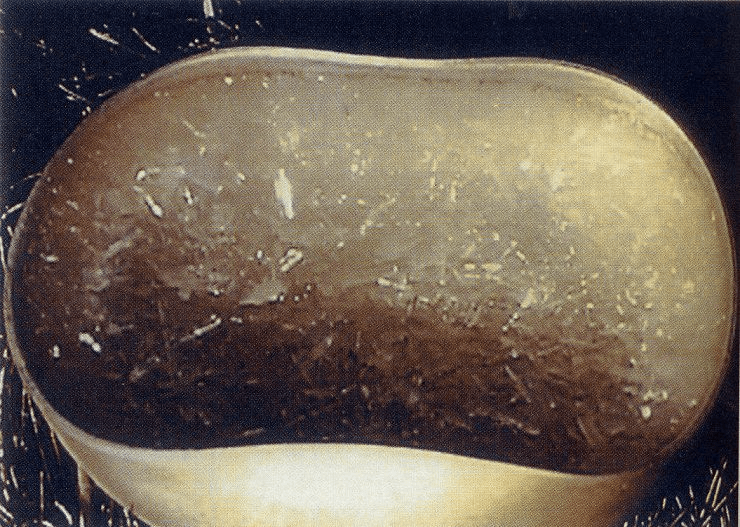
When the Master conducts the nectar dharma ceremony, there must be a space in between the Master and his disciples.  The distance between them is about fifteen yards to over one hundred yards.  The Master cannot come close to the disciples.  He can only sit on the dharma platform and is not allowed to leave his seat. At a place far away from the Master, a disciple will in front of other disciples use pure water to wash and wipe dry the dharma bowl (this dharma bowl is an ancient dharma bowl made of pure copper and gold which has been handed down through a lineage of Dharma Kings). That disciple will place the dharma bowl in front of himself and in sight of other disciples who will stare at the dharma bowl, never losing sight of it for a moment.

Then, the Master who is a far distance away on the dharma platform will practice the dharma.  From the land of the Buddhas, the Buddhas will bestow nectar which falls from the sky.  It may turn into red light, blue light, or a colorful rainbow as it enters the dharma bowl which is being guarded by the disciples.  It is incomparably wonderful.  The Master will then order the disciples to open the lid of the bowl to exhibit the nectar.  At this time, the disciples are pleasantly astounded to see that inside the dharma bowl which is in front of them is incredibly marvelous nectar which has come from the land of the Buddhas.  Its form is definitely unlike any form which can be found in this human world.  Only after the disciples have confirmed the arrival of nectar does the Master have the right to step down from the dharma platform to view the nectar and empower the disciples by giving them nectar to eat. If one has just one taste of this nectar, one’s life span will increase to over one hundred and twenty years.  This nectar can cure all ailments, such as malignant sores.  After one applies a bit of nectar on the sore, it will be totally cured and will disappear without trace within two to three minutes.

Red Bodhi Nectar
Crystal Bodhi Nectar

Since nectar is such a priceless treasure, it is definitely not something of which ordinary people can partake.  An emperor of China who lived in ancient times, Chin Sher Huang, wanted to taste the nectar of long life.  He ordered Hsu Fu to take five hundred young boys and girls and travel to what is now known as the islands of Japan.  But Hsu Fu was unable to find nectar.  He dare not return to Chin Sher Huang.  The present day people of Japan are the decedents of Hsu Fu and the young boys and girls he took with him.

In Tibet, many people want to taste nectar.  There are those who make their way to Lhasa by kowtowing at every step.  Their legs and hands are cut open.  Some of their bodies have even been cut up by rocks.  They may spend four or five years to make their way to Lhasa.  For the most part, after they arrive in Lhasa, the Dharma King still does not empower them with nectar since their merit is insufficient.  Some people practice arduously their entire lives in order to taste nectar, yet at the time they are about to pass away, they have never seen what nectar looks like.

What type of person is able to taste nectar?  There are three conditions.  First, that person must definitely be a devout Buddhist.  Second, that person’s infinite roots of kindness must extend back into many past lives and throughout eons of time.  Third, that person must have karmic conditions which cause him to meet up with a Great Dharma King who is truly able to practice the nectar dharma.  Otherwise, even if the person is a king, general or minister, he still is not qualified to taste true nectar bestowed by the Buddhas.

Daoists believe that the most difficult and highest state to attain is where one refines one’s essence into vital energy, refines one’s vital energy into spirit, refines one’s spirit to return to emptiness and through internal alchemy one comes up with the immortal substance so that the five vital energies are like the rising sun and all of one’s sprits come together.  Yet, using true nectar which has been bestowed by the Buddhas to accomplish such a state is truly an easy thing.  If one rubs a bit of this nectar on oneself, within twenty-four hours one can enter the state of purity and spontaneity where all of one’s spirits come together.  If one uses this nectar in the formal Buddha dharma initiation ceremony, then the results will be even much more wonderful.  This is a matter of tremendous significance.

One can thus see how magnificent nectar is!  Therefore, one who is able to partake of nectar must be totally devout, must tremendously cherish the opportunity and must strictly practice the Nectar Protection Longevity Mantra.  In this way, one will be able to ensure one’s longevity, avoid disasters, deepen one’s state of realization and attain great accomplishment.

Nectar — Precious Food Which is Bestowed by the Buddhas

Link:https://peacelilysite.com/2023/03/22/nectar-precious-food-which-is-bestowed-by-the-buddhas/

Source: Taken from True Stories About a Holy Monk

#Nectar#Buddha #BuddhaDharma #HolyMonk #DharmaKing

H.H. Dorje Chang Buddha III’s Selected Philosophical Sayings About Worldly Matters 

Many years ago, a disciple approached Master Yi Yun Gao (H.H. Dorje Chang Buddha III) seeking guidance on how to apply Buddhist wisdom to navigate worldly affairs. In response, Master Yi offered some insightful advice, which was later compiled into a book entitled “Selected Philosophical Sayings About Worldly Matters”. The following are translations of excerpts from the book.

What makes the sun the greatest thing man has ever known? It is admired for providing light and warmth for all the beings under it. A truly great person is one who is willing to sacrifice his own benefit for the well-being of others.

A city does not need all the food a province produces, but that much food is far from enough to feed the whole country; it needs all the food the country can produce. The strength of an individual is nothing compared with collective strength.

The respect a person enjoys comes from his devotion to the well-being of other people. A swimming pool is admired in summer because it provides relief from the heat.

A person is established in character only when he truly knows himself. Why? It is difficult for a person to be aware of his own flaws, just as he cannot see his own back, though it is in plain sight of other people. It is quite natural for a person to hide his own flaws, but overdoing it will alienate the person from those around him. When the person realizes this and feels ashamed, he turns to seek knowledge and adhere to moral integrity so as to establish his own character and win the respect and support of other people.

Deliberation is needed before one makes a move, but no conclusion is to be drawn from deliberation alone. It has to be tested in action. Suggested moves are not to be adopted in haste, nor are they to be rejected out of hand; they are not to be dismissed even when tests have proved them worthless, for in this case an inquiry into their legitimacy has to be made. When a rainbow is blocked from view by clouds, it does not mean that there is no rainbow out there.

What to do to beat your equal in battle? Attack him where he is most vulnerable with concentrated force and victory will be yours. A piece of wood with a sharp end can break another piece of wood that is just as hard as the wood you use to attack.

Intellectual and material resources work in opposite ways. Intellectual resources are limitless; the more they are tapped, the broader they grow in scope. Impermanent in nature and limited in quantity, material resources last but a short time, and the more they are consumed the sooner they are exhausted. The truth is that the former is non-quantifiable and thus infinite and everlasting while the latter is quantifiable and therefore diminishing and exhaustible.

H.H. Dorje Chang Buddha III’s Selected Philosophical Sayings About Worldly Matters 

Link:https://peacelilysite.com/2023/03/16/h-h-dorje-chang-buddha-iiis-selected-philosophical-sayings-about-worldly-matters/

#Buddhist #BuddhistMaster#Buddhism #DorjeChangBuddhaIII # HHDorjeChangBuddhaIII 

How Buddhism Holds the key to Moral Clarity and Enduring Happiness.

The meaning of Buddhism is to liberate us from the limited perspective given by natural selection, and to observe and experience the world from a higher level.

Buddhism is a complex topic that has been the subject of debate among scholars and practitioners for centuries. Some see it as a religion, complete with supernatural deities and reincarnation, while others view it as a secular philosophy of life or a therapeutic practice. In his book “Why Buddhism Is True,” Robert Wright offers a nuanced perspective on Buddhism that combines elements of these different approaches.

At the heart of Buddhism is the idea that the reason we suffer, and cause suffering for others, is that we don’t see the world clearly. We are deluded by our own emotions and desires, which evolved as survival responses to our environments but may no longer make sense in modern society. By practicing mindful meditation, we can learn to see the world more clearly and gain a deep and morally valid happiness.

Wright draws on science, especially evolutionary psychology, cognitive science, and neuroscience, to support this perspective on Buddhism. He argues that the direct experiences gained through contemplative practice can weaken the hold of our once-needed delusions, making us less likely to wreak havoc on ourselves and the world around us.

One of the key strengths of Wright’s approach is its nonsectarian nature. He does not argue that people need to become Buddhists to practice its truths, and he acknowledges the value of other spiritual and philosophical traditions. Instead, he focuses on the practical benefits of mindful meditation and contemplative practice, which can be applied to any belief system or way of life.

Importantly, Wright emphasizes that simply reading about Buddhist insights into human beings is not enough. To truly benefit from the practice, one must commit to a regular practice and be willing to confront the delusions within themselves. This is why it is called practice – it takes time, effort, and dedication to see results.

Overall, Wright’s blend of Western Buddhism offers a compelling perspective on Buddhism that is rooted in science, applicable to everyday life, and inclusive of other belief systems. While it may not be the definitive answer to the question of what Buddhism really is, it is certainly a valuable contribution to the ongoing conversation about this ancient and fascinating tradition.

How Buddhism Holds the key to Moral Clarity and Enduring Happiness.

Link: https://peacelilysite.com/2023/03/16/how-buddhism-holds-the-key-to-moral-clarity-and-enduring-happiness/

#Buddhism #Buddhist #BuddhismWisedom#Meditation #MoralClarity #EnduringHappiness #RobertWright

Source: https://www.nytimes.com/2017/08/07/books/review/why-buddhism-is-true-science-meditation-robert-wright.html, https://www.barnesandnoble.com/w/why-buddhism-is-true-robert-wright/1125284005

“After attending that dharma assembly, I fell the warmth from my two feet and no longer need to use a hot-water bag to help me fall asleep. Even when I wake up at night, I would pleasantly find that my feet warm….”


“After attending that dharma assembly, I fell the warmth from my two feet and no longer need to use a hot-water bag to help me fall asleep. Even when I wake up at night, I would pleasantly find that my feet warm….”

By: Disciple Huiyu Qiu

In September 2016, I had the good fortune to attend the Dharma Assembly of Empowerment by Kuan Shi Yin Bodhisattva’s Great Compassion held at Hua Zang Si and received very magnificent benefits. I would like to take this opportunity to share my experience and feelings on that day with my fellow cultivators.

At the beginning of the dharma assembly, the presiding master told us to chant the mantra first. The rhythm of chanting was rather slow and the sound was very wonderful and beautiful. My feeling was completely different from my experience of the chanting I normally did.

After chanting for a short while, without knowing any reason, my father, my husband, and my two children suddenly appeared in my mind. The appearance of my father was especially clear. Sadness rose in me and tears streamed down through my face. I thought that they had not taken refuge in Buddhism and did not have the affinity to learn the true dharma of the Tathagata. That was the reason that I could not bear the sad feeling.

I stopped weeping and continue to chant. At that time, my grandparents from both my mother’s side, who have passed away and my father’s side as well as some other family members and relatives all appeared before my eyes. Though the view just flashed by me momentarily, I felt that I saw each of them clearly. I thought about the fact that some of them had not taken refuge while some others, though had taken refuge, were still not diligently making a good effort to learn and practice Buddha-dharma. Thinking that they would surely be in very miserable and lonely situations in the future, I could not suppress my sad mood and wept again.

Then I stopped weeping and continued to chant. Next, the faces of my father, husband, and children emerged before my eyes again. Every time I saw them, my heart was painfully pulled. I could not keep myself from weeping.

I once again stopped weeping and joined the chanting again. At this time, my ears clearly heard the voices of chanting the mantra from the crowd. However, my heart felt that I heard a voice of shouting for rescue. It sounded like a desperate yelling for help from someone who was completely surrounded by a situation of despair and horror. I had a very shocking feeling at the time. Clearly, this is the call for help from living beings, begging Buddhas and Bodhisattvas to rescue them! We are sincerely beseeching Buddhas and Bodhisattvas to save us and cross us over, to lead us to leave the abyss of pain and suffering in samsara forever! At this time, the sadness and bitterness in my heart were beyond description by words. Thus, I cried again with my face covered by tears.

After chanting the mantra, the dharma master announced that the dharma assembly would formally begin. I kept my body in a fixed posture and closed my eyes. I did my best to stay calm.

Very soon, the sound of patting came from behind. Also, people on my right side generated different kinds of sound. Someone before me was crying and fell to the ground. I sensed that she later moved to lie next to my feet (not sure whether she was actually lying down or not) and touched me a few times. I tried not to think about that. Shortly after that, she moved to behind me and started to pat the rear of my left foot and then my right foot. My right foot was hit with more power and more frequently. I dared not move myself at all and tried my best to keep my mind calm. However, I was still somewhat at a loss since I did not know what she might do to me next. When the patting stopped, I felt that she was still behind me. After a while, my right foot was again patted a few times. After that, she seemed to have left me. My eyes were always closed during this period. I dared not open my eyes.

My two arms felt more and more tired. I put my arms down twice and raised them again. After putting down my arms the last time, I felt that my neck began to rotate very slowly from right to left. After rotating two rounds, it went the opposite direction. At that time, I could not be sure whether this was an empowerment from Kuan Shi Yin Bodhisattva or a response made by myself due to being eager to receive empowerment.

Next, my both shoulders began to turn from the front to the back.

After that, I heard singing. I could not hear the words of singing clearly. At this time, my shoulders continued turning and the speed seemed to be faster.

Finally, I could hear clearly that the song was the Six Character Great Bright Mantra and “Namo Kuan Shi Yin Bodhisattva.” I first followed the singing with humming and then joined with my open voice. At this time, the movement of my two hands became bigger. My hands were swinging back and forth and left and right, as if doing a stretching exercise. However, all movements were spontaneous and beyond my own control.

At this time, I heard a fellow sister behind me speaking loudly in Cantonese. She seemed to be saying that we have committed lots of sins and evil deeds in the past and therefore we now must repent earnestly and so on.

My hands continued swinging. I followed the singing and joined from time to time. At this time, my hand movement changed and turned into a movement of dancing. That was the hand gesture in a Chinese classic dance. I was dancing to the singing. My heart was filled with the joy of the dharma. With a smile on my face and while singing lightly, I made all kinds of wonderful movement with my hands (At least I felt that my hand movement was very wonderful.). Totally without any control, I felt that all movements were so smooth, fluent, and natural. Though my eyes were always closed, my mind was very clear and very much open. I was clearly aware what gestures and movements were performed by my hands. However, the dancing and moving of my hands was not directed by my own mind.

My two hands kept waving and moving. However, when the master leading the dharma practice called out “Stop!”, my hands gradually moved to a position before my chest and stopped there.

After the perfect conclusion of the dharma assembly, the attending crowd went together to perform the ending practice of saving living beings from captivity. On the trip of driving back home, I unexpectedly noticed that my two feet were warm. This was something extraordinary to me. For quite a number of years, my two feet were rather cold. In particular, I must have a hot water bag prepared before going to bed. Otherwise I would not be able to fall asleep. Even if I went to sleep after having a hot bath or having my feet soaked in hot water, my feet would still be cold. Sometimes when I did not use a hot water bag, I would wake up at night with my feet being ice-cold. I could feel the chilly air from my bones and would even tremble. At that time, I had to have the hot-water bag ready immediately. After attending that dharma assembly, I fell the warmth from my two feet and no longer need to use a hot-water bag to help me fall asleep. Even when I wake up at night, I would pleasantly find that my feet warm.

I am grateful to the empowerment bestowed on me by the greatly loving and greatly compassionate Kuan Shi Yin Bodhisattva!

Additionally, I also had an unexpected discovery. The ankle joints in my two feet were no longer in pain. I could not remember since when my ankle joints started to ache, but it should have been for quite a while. I did not know what the cause was either. Normally, there was no pain if I do not touch them. However, it was very painful if the spot was pressed. Therefore, when I sat crossed legged to practice meditation, a towel or a blanket must be placed under my feet. Otherwise I would not be able to keep myself in a sitting position.

Yesterday evening, while chatting with my family members after dinner, I reached out to massage the ankle joints on my right foot as I used to do. I did not even feel any pain at all. I immediately pressed the ankle joints on my left foot and did not feel any pain either. I dared not believe that fact at the time and repeatedly pressed the spots many times. It was really true that I had no pain at all.

I once again express my gratitude to the greatly loving and greatly compassionate Kuan Shi Yin Bodhisattva!

This dharma assembly was very magnificent. The attending crowd were also empowered by Kuan Shi Yin Bodhisattva’s great compassion and were full of the joy from the dharma. Had I not experienced the occasion in person, I absolutely would not be able to imagine the inconceivable feeling and benefits I had when the empowerment from Buddhas and Bodhisattvas came to me!

I gratefully prostrate to H.H. Dorje Chang Buddha III!

I gratefully prostrate to the greatly loving and greatly compassionate Kuan Shi Yin Bodhisattva!

I gratefully prostrate to all Buddhas and Bodhisattvas in the ten directions!

Link: https://wisdomtea.org/2023/02/23/after-attending-that-dharma-assembly-i-fell-the-warmth-from-my-two-feet-and-no-longer-need-to-use-a-hot-water-bag-to-help-me-fall-asleep-even-when-i-wake-up-at-night-i-would-pleasantly-fin/

The Avalokiteshvara Bodhisattva Great Compassion Empowerment Dharma

Over 2,000 years ago, Shakyamuni Buddha came to the Saha world, established Buddhism, and began to spread the Buddha Dharma. Now, the karmic conditions related to the good fortune of living beings have matured, and the contemporary Buddha H.H. Dorje Chang Buddha III has come to our world once again to bring more Dharma to us. The Avalokiteshvara Bodhisattva Great Compassion Empowerment Dharma is the Dharma that His Holiness has brought to us this time.

When a Dharma Master practices this Dharma, it can convene people, empower them, and lead them into a supernormal state. The purpose is to eliminate negative karma, improve one’s health, and increase spiritual mentality. H.H. Dorje Chang Buddha III has transmitted the Dharma to a few qualified Rinpoches and Dharma Masters, and these Rinpoches and Dharma Masters have hosted the Dharma Assembly many times around the world.

I have participated in the assembly four times so far. The first time, I heard many people crying, singing, or laughing, and some walking around, but I myself didn’t experience any specific motions. I was kind of disappointed. The second time, I had very strong feelings. When the assembly just started and everyone was chanting the Great Bright Six Syllable Mantra, I began to cry and couldn’t control myself. I kept on crying and crying, and it seemed like I cried out all my sorrows and pains in my life. Then I started to sway my body, shake my head and neck. The third and fourth time I joined the assembly, I had more motions and stronger expressions. I still cried hard at the beginning, then I sang the name of Namo Dorje Chang Buddha III, swung my two arms, and spun around. I bent my neck backward so hard, and I even lay down on the floor feeling so peaceful and comfortable, feeling the energy flowing through my body. I did all those without any intention from my mind. I felt the assembly was too short to end. Every time after the assembly, I felt my whole body loosen up, and I was so relaxed and rejuvenated.

The assembly actually has two parts. One is held inside, such as a conference center or grand hall in a hotel, where the master performs the Dharma. The second part takes place outside, where living beings are released from captivity.

H.H. Dorje Chang Buddha III emphasized many times in the Dharma discourses: “The concluding practice of the Avalokiteshvara Bodhisattva Great Compassion Empowerment Dharma is the finest, the best. Were it not for its concluding practice, I would not advocate practicing this Dharma. I all the more would not transmit this Dharma in this world. Why release captive living beings? All living beings have been our family members since beginningless time. They are the same as humans. It is just that their degree of intelligence and appearance are different from those of humans. Still, their consciousness is the same as that of a human. That is why in real life, we see that some animals can even rescue people, some can do math, some can sing, and some can dance. I even saw a dog that was able to play a highly difficult piano melody. Moreover, the dog played it very precisely. We must help them and rescue them. Furthermore, we must not even slightly harm any living being. We can only rescue them.

Because the Avalokiteshvara Bodhisattva Great Compassion Empowerment Dharma is based on the power gathered from the greatly compassionate mind of Avalokiteshvara Bodhisattva, at the end of each Dharma assembly, the one performing the Dharma must lead the attendees in a concluding practice to release captive living beings, do good deeds, and help other people. It is best to conduct the concluding practice on the same day. If there is not enough time, doing it on another day is also acceptable. However, the concluding practice must be completed within fifteen days.

People who attend an Avalokiteshvara Bodhisattva Great Compassion Empowerment Dharma Assembly should make offerings. However, in order to comply with the Dharma, it would be best if they personally helped the Dharma assembly staff arrange that the monetary offerings received at the Dharma assembly be spent on the main subject of the Dharma assembly—the concluding practice of releasing captive living beings, helping other people, and doing good deeds— as well as on the related expenses of the Dharma assembly, such as renting the site, transportation, meals, and lodging for the master performing the Dharma and those accompanying the master.”

Today is the auspicious occasion of Avalokiteshvara Bodhisattva’s holy birthday, and on this special day, I offer my sincere prayers: May the great Bodhisattva bless all living beings with a life full of auspiciousness, prosperity, and happiness. May the compassionate energy of Avalokiteshvara Bodhisattva radiate throughout the world, bringing peace, harmony, and love to all sentient beings.

Namo H.H. Dorje Chang Buddha III !

Namo Avalokiteshvara Bodhisattva !

Namo Amitabha !

The Avalokiteshvara Bodhisattva Great Compassion Empowerment Dharma

Link:https://peacelilysite.com/2023/03/10/the-avalokiteshvara-bodhisattva-great-compassion-empowerment-dharma/

#HHDorjeChangBuddhaIII #DorjeChangBuddhaIII #DorjeChangBuddha#GuanYinBodhisattvaof GreatCompassionEmpowermentDharmaAssembly#GuanYinBodhisattva#GreatCompassion #Avalokiteshvara Bodhisattva

Many Forms unlimited Blessings From Guan Shi Yin (Avalokitesvara) Bodhisattva

Guan Shi Yin (Avalokitesvara) Bodhisattva is a revered figure in Buddhism who has achieved the level of marvelous enlightenment, possessing the same qualities as a Buddha. According to sutras, Guan Shi Yin Bodhisattva is believed to be the manifestation of an ancient Buddha called True Dharma Brightness Tathagata and is considered the king of great compassion. The Bodhisattva tirelessly works day and night to help all beings in the Three Spheres, accumulating boundless merit.

Guan Yin is one of the most widely depicted figures in Chinese temples, with thousands of different incarnations or manifestations. Typically portrayed as a graceful woman dressed in flowing white robes and a hood, carrying a small vase of holy dew, she stands tall and slender, emanating selflessness and compassion. She may be depicted in various forms, such as seated on an elephant, standing on a fish, nursing a baby, holding a basket, or with multiple arms and heads. Her main goal is to alleviate the suffering of all beings.

Guan Yin is often portrayed riding a mythological animal known as the Hou, similar to a Buddhist lion, symbolizing her divine power over nature. She is usually depicted barefoot, while on public altars, she is flanked by two acolytes: a barefoot, shirtless youth known as Shan-ts’ai (Golden Youth) on her right, and a demure maid known as Lung-nü (Jade Maiden) on her left, holding her hands together inside her sleeves.

Guan Yin’s birthday is celebrated on the nineteenth day of the second lunar month, which falls on March 10th this year. She is considered a model of Chinese beauty, and being referred to as a “Guan Yin” is the highest compliment for grace and loveliness.

There are many legendary stories and folk tales about Guan Yin, which have been collected and passed down through generations.

Willow Guan Yin, left hand has a jar containing pure water, and the right holds a willow branch.

According to legend, during a period of severe drought and corruption in the Zhongzhou area of China, Guanyin Bodhisattva came to enlighten the people and show them the path to righteousness. With her compassion for all living beings, she took out willow branches from a jade bottle and poured nectar into the fields. Suddenly, it rained heavily, relieving the drought and bringing new life to the parched land.

The Willow Guan Yin’s willow branch represents her ability to heal and soothe, while the jar of pure water symbolizes her power to purify and cleanse. Her actions during the drought represent her willingness to help those in need and her desire to alleviate suffering. Her message is clear: no matter how dire the circumstances, there is always hope and a chance for redemption.

Guan Yin on a Dragon

According to legend, a fearsome monster with the head of a dragon and the body of a turtle that dwelled in the East China Sea. This monster was known to cause great havoc and destruction, leaving the people in constant fear and anxiety.

The people’s prayers were answered when Guanyin Bodhisattva heard of their plight. Being the embodiment of compassion, Guanyin Bodhisattva arrived in the East China Sea, he rode on the back of the dragon-headed monster, showing no fear, and subdued it with his magic power. From that day on, the people lived in peace and safety, free from the monster’s threat.

In honor of Guanyin Bodhisattva’s courageous act, the people erected a statue of him standing on the dragon-headed monster, enshrining it as a symbol of his boundless magic power and compassion for all living beings.

YouXi GuanYin

According to legend, Guanyin Bodhisattva traveled to Luoyang City and took out a precious mirror. She claimed that as long as people paid three Wen coins, they could see their past and future lives from the mirror. The people eagerly lined up and took turns looking into the mirror. They were all surprised to see their past and future lives reflected back at them.

However, when Guanyin Bodhisattva revealed her true form, the people saw different expressions on her face. Some saw an angry face, some saw a fierce face, and some saw a joyful face. The people were confused by these different expressions.

Guanyin Bodhisattva warned all living beings not to think that their evil deeds would go unnoticed. She urged them to do more good deeds instead. It is absolutely true that one cannot escape karma. Evil will be rewarded with evil, and good will be rewarded with good.

Guan Yin with Fish Bucket

According to legend, there was a time when people living on the coast of the East China Sea lacked manners and etiquette. Guanyin Bodhisattva, being the compassionate deity that she is, decided to intervene and provide enlightenment to these people.

In order to do so, Guanyin Bodhisattva transformed herself into a beautiful fisherwoman and began to teach the people about the importance of etiquette and manners. She also promised to marry whoever could recite the Buddhist scriptures that she taught them.

A young fisherman named Ma Lang was determined to gain the Bodhisattva’s favor and started to diligently study the scriptures. Eventually, his hard work paid off, and he was able to recite the scriptures flawlessly. Impressed by his dedication, the Bodhisattva decided to imparted him with further enlightenment. At the wedding night, the Bodhisattva left the house with sudden death.

Ma Lang realized the fishwoman was actually Guanyin Bodhisattva, he carved a statue of Bodhisattva looking like a fisherwoman and enshrined the statue in his house.

Guan Yin on One leaf

According to the legend, Dogen, a Japanese monk who had just returned from studying in China, found himself in the middle of a terrible storm while sailing near the coast of Nanming. Fearing for his life, he prayed silently to Avalokitesvara, the Bodhisattva of compassion, to protect him from the storm.

Suddenly, he saw a miraculous sight. A beautiful and serene figure of Avalokitesvara appeared riding on a lotus leaf, floating on the sea. The Bodhisattva’s presence calmed the storm, and the wind and waves stopped. Dogen was filled with wonder and gratitude, and he knew that he had witnessed a great miracle.

After he landed safely, Dogen decided to commemorate this miraculous experience by creating a statue of Guanyin as he had seen her on the lotus leaf. He had the statue enshrined in the Nanming Guanyin Temple, where it became an object of veneration for countless devotees.

one thousand-armed and one thousand-eyed Guan Yin

Avalokitasvara, Guan Shi Yin in Chinese, means the Perceiver of World’s Sounds. The Lotus Sutra says: “Perceiver of the World’s Sounds, heavenly voice, the voice of the sea’s tide—magnificent, rich and harmonious surpassing all worldly sounds.” The bodhisattva always help all beings in danger and distress and is willing to bear the pain of all beings. If we hold the bodhisattva in our hearts and call on her sincerely, she will always respond.

May the greatly loving and compassionate Namo Guan Shi Yin Bodhisattva bless all beings!!!

Namo Guan Shi Yin Bodhisattva!!!

Many Forms unlimited Blessings From Guan Shi Yin (Avalokitesvara) Bodhisattva

LInk: https://peacelilysite.com/2023/03/08/many-forms-unlimited-blessings-from-guan-shi-yin-avalokitesvara-bodhisattva/

#GuanShiYinBodhisattva#Buddhism#Buddha#BuddhaAmitabha#Onethousand-armedandone thousand-eyed#legend#Samsara#Mercy#Compassion

https://k.sina.com.cn/article_1645770313_62187649019010qtk.html?from=cul, https://www.holymtn.com/homepage/gods-goddesses/quan-yin-goddess-mercy/

When Taoist Immortal Met Buddhist Master

Photo by Delia Dwi on Pexels.com

When Taoist Immortal Met Buddhist Master

Taoism is an ancient Chinese philosophy that emphasizes living in harmony with the natural world and embracing simplicity. Its teachings have had a significant impact on both Eastern and Western cultures, including the field of psychology. One prominent figure in psychology who was influenced by Taoism is Carl Jung, a Swiss psychiatrist and psychoanalyst who founded analytical psychology.

Jung’s complex concept of “the Self” is one of his most significant contributions to psychology. The Self represents the totality of an individual’s psyche, including both conscious and unconscious elements. According to Jung, the Self is the goal of the individuation process, a lifelong journey of self-discovery and personal growth.

In ancient China, there were eight prominent figures in Taoism, and Lu Dongbin was the most popular one. Besides being a renowned Taoist, he was also a skilled poet and scholar. Throughout history, many legendary stories and folk tales have been told about him.

One interesting story was recorded in a Buddhist book called JiaTai Pu Deng Lu (嘉泰普灯录), which has also been documented in several other books, including XinShi Heng Yan (醒世恒言). Although there are some variations, the main points of the story remain the same. H.H. Dorje Chang Buddha III also told this story in his dharma discourse: Expounding the Absolute Truth through the Heart Sutra.

Once, Lu Dongbin asked his master, “Master, why did you only save me for a thousand years?”

His master replied, “It’s difficult to teach all living beings. People’s habits are deeply ingrained, and they constantly change. Most living beings find it challenging to learn our Taoism.”

Lu Dongbin countered, “Master, I disagree. We are powerful beings. Are we afraid it will be difficult to liberate them? Let me go down and liberate people for you. I will free a thousand souls every year.”

His master warned, “You may go down to Earth, but be careful not to provoke the monks. Some cannot be trifled with.”

Lu Dongbin descended from the South Gate of Heaven on an auspicious cloud and saw the golden light of Huanglong Temple in Shanghai, China. Zen Master Huanglong was teaching the Heart Sutra and explaining Prajna principles. Lu Dongbin decided to listen in and transformed himself into a fly, sticking to the door.

However, Zen Master Huanglong was a powerful monk who knew Lu Dongbin was eavesdropping. He stopped teaching and instructed his attendant to remove the “person who stole our Dharma.”

Enraged, Lu Dongbin revealed his true form, brandishing his Qingfeng sword and accusing Zen Master Huanglong of insulting him. Lu Dongbin told Zen Master: “I am the great Taoist Immortal LU Dongbin.” Huanglong found it amusing and called Lu Dongbin a “ghoul guard” who would eventually die in vain.

Lu Dongbin drew his sword, but Zen Master Huanglong remained unperturbed, blocking the sword with his sleeve. Lu Dongbin knelt before the Zen master, feeling ashamed.

Huanglong proceeded to teach Lu Dongbin sudden enlightenment dharma, explaining that “speech is cut off, and mind is silenced.” As a god, Lu Dongbin was able to grasp the teaching quickly and had an epiphany.

After his enlightenment, Lu Dongbin wrote a gatha containing the line, “Since I met Huanglong, I realized that I mistakenly used my mind in the past.”

In Buddhist teachings, it is said that even the highest Taoist practitioner can reach heaven, but still remain in the realm of the birth and death cycle. However, if one can realize and abide in the original nature, then they can break through this cycle and achieve liberation. The original nature refers to the pure dharma body of all sentient beings within the three spheres of existence (triloka), which is united with the universe. It has no form, shape, physical body, or appearance. All living beings possess this original nature equally, which is the same as the dharma body of the Tathagata or dharmakaya. It neither comes nor goes, and is neither excessive nor lacking. It is immaculate, free from any notion of cleanliness or dirtiness.

When Taoist Immortal Met Buddhist Master

Link:https://peacelilysite.com/2023/02/24/when-taoist-immortal-met-buddhist-master/

#Buddhist #BuddhistMaster#HuanglongTemple #Taoist #Immorta #Ludongbin #Buddhism #DorjeChangBuddhaIII # HHDorjeChangBuddhaIII 

Leshan Giant Buddha

Leshan Giant Buddha

Around a 2-hour drive from downtown Chengdu lies one of the most marvelous ancient wonders of China, the Leshan Giant Buddha, also known as Lingyun Giant Buddha. Carved into a cliff-face along a peaceful river, this imposing figure, at 71 meters (over 200 feet) in height, dates back over a thousand years and is the largest and tallest stone Buddha statue in the world.

Carved in the 8th century during the Tang Dynasty, the Leshan Giant Buddha was built during a peak period of Buddhist culture in ancient China. The sculpture depicts Maitreya, a very popular Buddha in the Tang Dynasty. The sutras say that when Maitreya comes into world, the world will be at peace. The female Chinese female sovereign Wu Zetian even proclaimed she was the reincarnation of Maitreya and was a strong advocate of Maitreya sculptures being built as a way to maintain her rule. People liked to carve Maitreya sculptures and believed that Maitreya would bring light and happiness into their lives in the future.

This remarkable historic site was listed as a UNESCO World Heritage Site since 1996. It is an amazing and immense religious relic that was built over a period of 90 years from 713 to 803 AD. The statue was constructed at the confluence of three rivers notorious for their turbulent waters; it was hoped that the Buddha’s presence would help calm the rivers’ waters.

Hai Tong’s Legacy

The Buddhist monk Hai Tong was concerned about the safety of the local people who earned their living around the three rivers. Many people traveling by boat in the area were killed by the turbulent waters each year before the Leshan Giant Buddha was created. Hai Tong decided to carve a statue of Buddha beside the river and believed that this sculpture would appease the river gods and keep the locals safe.

He had begged for over 20 years to accumulate enough money needed to build this statue. During this hard period in his life, he refused official help because the parties who offered it didn’t just want to help him but wanted to gain personal profits from the project. He even gouged out his eyeball in protest against the local authorities. These officials backed off after this behavior. Fortunately, Hai Tong’s disciples continued his work after he passed away and finally completed the sculpture in 803 AD after 90 years of hard work.

There is a cleverly designed drainage system behind the Buddha’s head and between his two ears. This important design aspect is the reason why the great Buddha of Leshan has not eroded despite having existed for thousands of years. The “spectacle”

Interestingly, there haven’t been any shipwrecks since the Buddha was built. Many stones were actually removed from the cliff and transferred to the rivers during construction, which made the waters calmer and safer than before. The project didn’t end after the Leshan Giant Buddha was finished.

Buddhism had been one of the most important religions in ancient China and many other people built statues around the giant Buddha to thank the gods . Numerous small Buddhas were carved around this huge statue. People even excavated the cliff tombs of the Han Dynasty around the Leshan Giant Buddha. Multiple historic sites make the Leshan Giant Buddha particularly important for archaeologists and researching people’s lifestyles in ancient times.

With the most sunny days and beautiful scenery, April and October are the best months of the year to travel to see the Leshan Giant Buddha.

There are two ways for visitors to see the Giant Buddha. One is to walk down from the top near the head and end at its feet. This involves some waiting in line, sometimes for hours on particularly busy days, and larger crowds, as well as many narrow and steep stairs, but offers you a more intimate perspective of the Buddha. This up-close view will allow you to appreciate the statue’s enormity; its shoulders spread over a width of 28 meters (as long as a basketball court!) and its pinky toe is large enough for a person to sit on.

The other option is to view the statue from a boat on the river immediately in front of it. The boat trip allows you to get the best and fullest front-facing view of the Buddha from a distance and is ideal for those who prefer not to wait in line and climb the stairs. The cruise takes around 30 minutes there and back, stopping for several minutes in front of the Buddha for visitors to appreciate the statue and take pictures. It’s best to sit on the right side of the boat, as the Buddha will end up being on that side once you arrive.

Leshan Giant Buddha

Link:https://peacelilysite.com/2023/02/23/leshan-giant-buddha/

#Travel#China#LeshanGiantBuddha#Buddhism#MarvelousAncientWonder

Source: https://www.trippest.com/chengdu-travel-guide/leshan-giant-buddha/ https://www.thechinaguide.com/sight/leshan-giant-buddha#:~:text=It’s%20best%20to%20sit%20on,worth%20seeing%20from%20both%20angles.

Brief Introduction to Buddha Dharma

Brief Introduction to Buddha Dharma

The truth and the original nature of all conditioned and unconditioned phenomena in the universe are contained in the word Buddha-dharma. The Buddha-dharma is all causes and effects in the universe. To understand all causes and effects, yet not be controlled by cause and effect, is to realize liberation and the Buddha-dharma. No matter how many schools or sects there are, the Buddha-dharma has only one truth. It is the truth of the universe: the dharma of ending the cycle of birth and death!  The Buddha-dharma is the life order of another world and dimension.

However, this rather abstract definition does not tell us how we realize or learn the Buddha-dharma. In a series of dharma discourses on learning Buddhism released in January 2016, H.H. Dorje Chang Buddha III gives such a practical definition. It is the dharma that we practice in the vajrayana form of Buddhism. It is the preliminary, main, and ending practice in their totality. The true Buddha-dharma emphasizes real practice and skills and is not merely theoretical Buddhist studies. The holy manifestations or miracles described on this website and in the book H.H. Dorje Chang Buddha III are evidence that the true Buddha-dharma, as practiced by Shakyamuni Buddha and the accomplished ones of the past, still exists in the world and that very high levels of spiritual accomplishment are possible for those who follow a true vajra master.

H.H. Dorje Chang Buddha III has said: “After you enter the door of Buddhism, you must cultivate yourself according to the dharma. Your three karmas of body, speech, and mind must correspond with the teachings of the Master. Only then will you be able to become accomplished. Conduct that is not in accord with the teachings of the Buddhas and Bodhisattvas must be corrected through concrete actions. You must make your conduct accord with the teachings contained in the Tripitaka and the states of morality, concentration, and wisdom. Yet, correcting your words and conduct must be carried out within everyday worldly life. That is because everyday worldly life (worldly or secular dharma) is the Buddha-dharma. There is no Buddha-dharma to accomplish apart from worldly or secular dharma. That is why you must use all mundane or worldly experiences to improve your self-cultivation. You must use worldly experiences to perfect your realization and conduct. If your basic worldly conduct is not proper, it is of no use to speak in a high-sounding way about emptiness or to speak boastfully and wish wildly.”

However, we must have patience in learning the Buddha-dharma. You cannot completely understand the principles of the dharma in a brief period of time. You must go though the sequence of first hearing the principles from your vajra master, gradually acting in accordance with these principles, walking the correct path and so on. You must advance step my step. You cannot expect that your negative karmic obstructions that have formed over many past lives can be purified in just one day. The tantric dharma that we receive when correctly practiced will enable us to overcome our obstructions, purify our three karmas, and enable us to progress on this path. Do not waste time on activities that do not lead to liberation and becoming a Buddha. DO NOT WAST TIME!!!

Brief Introduction to Buddha Dharma

Link: https://peacelilysite.com/2023/02/17/brief-introduction-to-buddha-dharma/

#DorjeChangBuddhaIII # HHDorjeChangBuddhaIII  #Rinpoche #Buddha-dharma # Miracle #Liberation #Cultivation

Source: https://xuanfa.net/buddha-dharma/

Reached the State of Nirmanakaya

Reached the State of Nirmanakaya

by Yundun Duojibai V Gadu Rinpoche

Gadu Rinpoche is the fifth venerable Yundun Duojibai. Having a supremely wonderful karmic destiny in this lifetime, he received profound initiations from H.H. Dorje Chang Buddha III. He cultivates himself diligently. The venerable one has become deeply accomplished in the practice of second-level Great Perfection Dharma and attained the nirmanakaya state. In his book Cultivate Honestly, he recounts his experiences upon receiving the Niwan Crown-Opening Heaven Mandala.

 Several years ago, at one day my Buddha Master told me “I will open the mandala and transmit the very profound Buddha-dharma to you. This Buddha-dharma is the state practice empowerment dharma from  The Supreme and Unsurpassable Mahamudra of Liberation and belongs to the dharma of the heaven realm. Once you receive the empowerment, within two hours, a hole will be opened at the Niwan spot on the top of your head. Your spirit and consciousness can come out and appear from there.”

At that time, however, although I felt fortunate to learn the dharma, there was doubt in my mind that I could not get rid of. I simply could not believe what my Buddha Master stated about having my crown opened at the Niwan spot within two hours. The more I thought about this, the more I was worried. This was truly peculiar and absolutely unheard of. Having a hole opened on the crown was definitely not an ordinary matter. How could the person be alive after that? On the other hand, based on my Buddha Master’s holy realization, I kept telling myself not to have doubt because it is in violation of the precepts. However, I just couldn’t remove the doubt in my mind. Now I think about this, I felt that I was really very inferior and my karmic impedance was too heavy. Being Yundun Duojibai V – Gadu, I am still a tiny speck before my Buddha Master. I am really ashamed and ashamed!

My Buddha Master selected a good time on an auspicious day at the solemn mandala to hold the initiation of the empowerment dharma from The Supreme and Unsurpassable Mahamudra of Liberation, Niwan Crown-Opening Heaven Mandala. My Buddha Master discoursed to me, “This dharma is a very important one. Very few people have the opportunity of learning this dharma. After learning the dharma from the master, true form of realization will arise quickly within two hours. You will then attain the Niwan Daoguo. You should make a good effort to practice this dharma and benefit living beings.” Thus I entered the state of receiving the very profound empowerment. My Buddha Master sat on a high platform at a far distance. However, my Buddha Master did not touch my head and only let me visualize practicing the tantric rituals. The ceremony was conducted to open the door to acquiring the correct Buddha-dharma. Two hours passed. At that time, the frontal fontanel spot at the top of my head warmed up. I had a very unusual feeling but I really did not know whether my crown opened or not.

On the seventh day of my practicing the dharma, an extremely strong force of empowerment was felt at the position of frontal fontanel on my forehead. This is the location of the soft spot on the head of a new-born baby where movement corresponding with the heart beat can be seen. It is called the Niwan Palace. Taoists call it the Heaven Gate. This huge force of empowerment poured in from the Niwan Palace with the magnitude of a tidal wave and the momentum of an avalanche. Then my body received a very strong electric shock. With a loud sound of cracking, the Niwan spot opened up. At this time, my mind was in a state of ignorance in terms of knowing where I was, either in existence or emptiness. Very quickly, this ignorance transformed into boundless light beams. I transformed out of a “me” who was meditating in a cross-legged sitting into another “me.” Then I flew up, with incredibly fast speed, into the sky. Strong pressure from wind was felt on top of my head. My ears also heard sharp and harsh sounds from the wind. At this moment, I was not in the state of ignorance. I saw clearly and unambiguously my second nirmanakaya.

At that time, all scenes I saw of mountains, rivers, lands, Sun, Moon, stars, homes, crop fields, farms, and pedestrians on streets were true existence and real in front of my eyes. I was not in a dream state. My biggest concern was staying outside for too long and risking my original body getting harmed. I thought about the story of Taoist Iron-Crutch Li. His body was destroyed by other people because of his late return. Then he could only settle into the body of a crippled and hunchbacked beggar. Although this is a legendary story of Taoists, it is true state in my current reality. Do I want to follow the path of Iron-Crutch Li? So I felt very worried and immediately started to return to the mundane world. I clearly saw that the spot of the Niwan Palace on my head was emitting light. I followed the light and re-entered my body. Since then, I experienced endless wonders that cannot be described in words.

When I reported my experience and feeling from practicing this dharma to my Buddha Master, my Buddha Master transmitted a secret mantra to me. Sometime later, in recorded dharma lessons that were distributed to the public, my Buddha Master mentioned that my dharma practice had reached the preliminary stage of the state of nirmanakaya, or simple nirmanakaya.

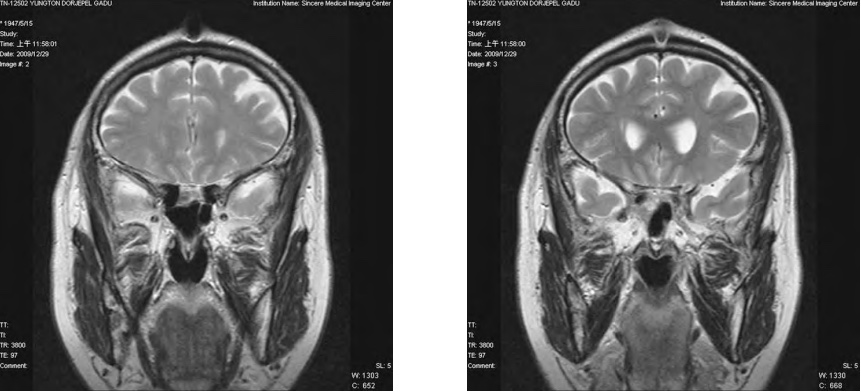
Several years later, in order to let living beings know the greatness of Buddha-dharma, on December 29, 2009, I took a magnetic resonance image (MRI) exam on my head at the Sincere Medical Imaging Center. The result showed a deep gap at the position of the Niwan Palace with a width of 1.5 cm. Also, the images captured the real situation of my spirit and consciousness rushing out of my head. The doctor conducting the examination was very surprised but was not able to explain it and attributed it to non-human cause. I was really very clear because this is where my nirmankaya came out and returned. Please see the scan films from my MRI exam.

Heaven Gate opening at the position of the Niwan Palace, side view

Heaven Gate opening at the position of the Niwan Palace, front view

Reached the State of Nirmanakaya

Link:https://peacelilysite.com/2023/02/10/reached-the-state-of-nirmanakaya/

#DorjeChangBuddhaIII # HHDorjeChangBuddhaIII  #HolyManifestation#GaduRinpoche #TheSupremeandUnsurpassableMahamudraofLiberation #Cultivation#GreatHolyAcharya#Innertantricinitiation#Niwan Crown-Opening Heaven Mandala