This famous prayer has hidden wisdom in every line

This famous prayer has hidden wisdom in every line

God grant me the serenity
to accept the things I cannot change; 
courage to change the things I can; 
and wisdom to know the difference.

Living one day at a time; 
enjoying one moment at a time; 
accepting hardships as the pathway to peace; 
taking, as He did, this sinful world
as it is, not as I would have it; 
trusting that He will make all things right
if I surrender to His Will; 
that I may be reasonably happy in this life
and supremely happy with Him
forever in the next. 
Amen.

The Serenity Prayer is well known by both believers and non-believers. The famous prayer asks for God’s help achieving something that most people desire but few can achieve: peace and happiness in life. Unlike many prayers that ask for peace or happiness, the Serenity Prayer does not simply ask that God hand a person peace wholesale. Instead, the prayer lays out specific steps that will help a person achieve serenity in their life and asks God to help them gather the strength to live by those smaller goals. The Serenity Prayer does not so much ask for a gift as much as it asks God to help a person create or earn their own peace.

The first half of the Serenity Prayer is the most commonly quoted section of the prayer. The prayer has inspired millions of people, Christians and non-Christians alike. This beautiful prayer, however, is so often quoted that its wisdom can be lost. Here is a breakdown of the wisdom of the Serenity Prayer.

God grant me the serenity to accept the things I cannot change…
Everyone has things in their life they wish that they could change, whether it is something as small as the traffic and congestion that fills a person’s daily commute or something as serious as a loved one’s diagnosis with terminal cancer. When faced with something we wish we could change, we often fight it. We rage against the congested traffic and fall prey to road rage. We deny the terrible news of a deadly diagnosis and stick our heads in the sand. We hide from the truth. We hate it. We curse it. We do the spiritual equivalent of punching a brick wall and expecting the wall to come down instead of our knuckles to bruise and split and break. In our hearts we know that there is nothing we can do to change some facts of life. People will die. Tragedies will happen. The inevitability of those facts does not make them less horrible, but it does mean that there is nothing we can do about it.

The first two lines of the Serenity Prayer ask for perhaps one of the hardest things of all: the strength to both accept that some things are out of our control and come to peace with that fact rather than drowning in useless, toxic rage.


Courage to change the things I can…
People love to complain. Think about it. How often do our coworkers start the week not with a smile and story about something pleasant they did over the weekend but a moan, groan or curse about the first day of the work week? When starting a conversation, do we share our joy? Unfortunately, we are much more likely to start a conversation by complaining about something, even something as small as the weather. Complaints seem to be our go-to form of communication, but how often do people really try to change what they claim so grievously offends, inconveniences or angers them?

In the age of social media and the internet, it is easier than ever to jump on the bandwagon and complain about an event, person, policy or organization. Ironically, many of the loudest virtual voices have never done a thing to help the causes they claim matter so much. It is easy to complain, especially from behind the protection of a screen name and keyboard. It is not easy to actually enact change. It is not easy to go up to someone we respect and say “I disagree.” It is not easy to face down someone who is screaming with hate and say, civilly and respectfully, “You are wrong and here is why.” Truly creating change does not happen from behind a screen or around a water cooler. It takes time, effort, energy and, yes, risk.

The penultimate line of the first stanza of the Serenity Prayer asks God to help us find the inner strength and deep well of bravery we all possess and turn that willpower and courage toward bringing about the changes that matter to us.

And the wisdom to know the difference.
Discernment is one of the most difficult skills to master especially when it comes to dealing with our ability to influence the world around us. We often have an overinflated sense of our own power to enact change. On some subconscious level, we truly believe that we can make other people see our point of view if we just have one more conversation with them, explain our position one more time or, sometimes, yell loudly enough. This, of course, is ridiculous. People do not change their minds when others shout at them or call them names. Even those who try to change events or others’ opinions with civil, respectful behavior often find themselves frustrated as things refuse to change. This is because the things they want to influence are not within their ability to alter. Discerning what we can change and what we simply wish we could change is not easy. The Serenity Prayer recognizes that very human refusal to admit defeat and accept that something is out of our hands. As such, the prayer asks for God’s help discerning what we can truly control and what we merely wish we could influence.

Living one day at a time, enjoying one moment at a time
We all know someone who is never really present in the moment. They may be worrying constantly about tomorrow or forever daydreaming about the next great thing that they believe will happen in their life. They never take the time to enjoy the moment they are standing in or to revel in the life they live. Their focus is always on something else. Unfortunately, when we are focused on something in the far off future or distant past, whether good or bad, we let life pass us by. Whether we want to admit it or not, most of life is composed of the little moments that so many of us ignore. When we are worrying about the big presentation we have at work later in the week, we are not paying attention to our spouse who is longing for some emotional connection. When we are consumed with excitement for our cruise next month, we miss the friend who was looking to simply catch up over lunch. The Serenity Prayer reminds us that those little moments—the butterfly perched on the flowers by the office door, the smile of our child when she sees that daddy’s home, the smell of fresh baked cookies–get lost so easily even though those little moments are the ones that make up most of our lives and make our lives worth living.

Accepting hardships as the pathway to peace
No one likes to focus on the difficulties that come with life. For all that people love to complain, no one really wants to have a troubled life. We want to be able to win the competition of “who had the worst day,” but we do not actually want to be miserable. We want to have our cake and eat it, too. Unfortunately, this is not possible. Hardships will come up in life, but they are so much more important than a way to win the misery Olympics that so often take place at family dinners or around the water cooler.

“Nothing worth doing was every easy.” This cliché phrase has been both revered for its truth and reviled for its unpleasant reality, but there is no denying its accuracy. Finding love is difficult, and marriages are hard work. Few relationships, however, come close to being as fulfilling as a loving marriage. Parenting is a lifetime of staring at the ceiling at night wondering if we are screwing up our kids irreversibly. That does not mean that it is not the most important job on earth. Almost anything that will bring us true lasting happiness and peace instead of transient pleasure comes with difficulty and trial. In moments when we want to walk away, the Serenity Prayer reminds us that those struggles will be worth it in the end.

Taking, as He did, this sinful world as it is, not as I would have it
The world is not perfect. Anyone who would say otherwise is naïve, blind or has their head buried so deep in the sand that their hair is poking through the grass on the other side of the globe. The advent of 24 hour news and the internet has driven home the imperfection of the world in all its gruesome, filthy, nightmarish detail. The worst of humanity is regularly on display as both natural and human made disasters dominate the news and religious extremism and terrorism are documented with sickly loving detail. Given that the horrors of the world are regularly shoved down our throats, is it any wonder that many people would prefer to hide under the covers and pretend that everything is just hunky dory?

Hiding from reality, however, does nothing to change what is actually happening in the world. Distorting facts and figures to feed a popular narrative robs those actually hurt of any chance of enacting real change. The key to dealing with this world is to accept it as it is, both the good and the bad. It is wrong to pretend away the suffering of others, but it is not right to rub the worst of human depravity in the face of someone who is counting their own blessings. The Serenity Prayer makes it clear that we need to deal with reality, not wishful fantasy. To do that, we need to celebrate the highs and spread the good as far and as wide as we can. We need to mourn the lows and fight fiercely to correct what wrongs we can. We cannot change reality when we do not even know what is real.



Trusting that He will make all things right if I surrender to His Will
Trust is one of the key components of the Christian faith. Christians must trust that God has a plan for their lives. They must trust that everything, even terrible things, happen for a reason. Painful though it may be, they must trust that their loved ones who die are going to a better place. Trust, however, does not always come easily. Christians who are mourning a lost parent, spouse, friend or, worst of all, a child, may find themselves raging against God and questioning everything they ever believed.

While hardship and trial sometimes brings a person’s faith to its knees, the hottest fires sometimes forge the strongest faith. Those people who come out of trials with both a faith core of steel and a deepened trust in God are often those who manage to accept, somehow, that God is in control even when everything around them is going to hell in a handbasket. Even when life is easy-breezy and good, however, it is not always easy for us to trust in God and surrender. We want to take control. We want to be in charge. The Serenity Prayer reminds us, though, that what we can influence is so much smaller than what God can determine. Whether we like it or not, we are being dragged in the direction God wants us to go, so we may as well stop fighting, go with the flow and trust that He has our best interests at heart.


So that I may be happy in this life
Everyone wants to be happy. We know that this life is too short, and we want to enjoy every minute of it. We want to spend our days smiling and laughing. We want to feel both joy and excitement and treasure every moment. The desire to be happy is one of the most natural desires of humanity. Our very biological drive to survive is based on our need to be happy. Our bodies are hardwired to use a biological reward-based system to keep us alive. When we do something that helps us survive, we are rewarded with a surge of dopamine, a feel-good chemical. These hormonal surges come when we eat, sleep, talk with other human beings and have sex. These processes are necessary for the continuation of the human species. Staying happy in this life, however, is not just about fulfilling biological urges. We are hardwired to do more than survive. Dopamine floods our brains when we truly live. Singing, dancing, creating and exploring new things all trigger dopamine. The Serenity Prayer helps remind us that, despite what some fire-and-brimstone sermons say, aiming to be happy in this life is nothing to be ashamed of as long as we do not trade morality for transient pleasure. This, however, rarely happens when we do what is hardwired to be one of our greatest natural sources of happiness: connecting with and helping others.


And eternally happy with Him forever and ever in the next.
Christians know that there is more than just this world. There is another world that is free of the horrors and tragedies that plague this world. Our current world is painfully imperfect, but that does not make it devoid of beauty. God’s hand is everywhere in the world, and hope can be found in even the darkest and most dangerous of times. The beauty and good of this world, however, pale in comparison to what is waiting in the next world with Jesus Christ Himself. When we pursue happiness and peace in this life, we must be sure not to get so caught up in earthly pleasures that we take our eyes off the ultimate prize: eternal life with Christ in the next life. The Serenity Prayer helps us focus on what we need to do to achieve happiness and peace in this life, but the final two lines of the prayer make sure to remind us that there is more, much more, than just this life. It reminds us to keep the next life in mind even as we strive to enjoy this one and to change this world for the better.

The Serenity Prayer is well known by both believers and non-believers. It offers simple, but effective methods to truly begin to feel peace in this life, but it also reminds us of what is waiting for us in the next life. It asks God not to fix our lives for us but to lend us the strength to correct them for ourselves. It offers inspiration and advice in equal measure and reminds the faithful that with God anything is possible.


By Stephanie Hertzenberg
Source: Beliefnet

This famous prayer has hidden wisdom in every line

Link: https://peacelilysite.com/2022/11/02/this-famous-prayer-has-hidden-wisdom-in-every-line/

#God#Prayer#Wisdom#Christians#Christianity

20 Life Changing Lessons to Learn from Buddha

20 Life Changing Lessons to Learn from Buddha

There are so many beautiful, powerful and life changing lessons you can learn from studying Buddhism and from reading many of Buddha’s quotes.

Here are 20 Life Changing Lessons from Buddha:

1. Love heals all things.
“Hatred does not cease by hatred, but only by love; this is the eternal rule.”

2. It’s not what you say but what you do that defines you.
“A man is not called wise because he talks and talks again; but if he is peaceful, loving and fearless then he is in truth called wise.”

“A dog is not considered a good dog because he is a good barker. A man is not considered a good man because he is a good talker.”

3. The secret of good health is to live fully in the NOW.
“Do not dwell in the past, do not dream of the future, concentrate the mind on the present moment.”

“The secret of health for both mind and body is not to mourn for the past, nor to worry about the future, but to live the present moment wisely and earnestly.”

4. Words have the power to both hurt and heal.
“Words have the power to both destroy and heal. When words are both true and kind, they can change our world.”

5. Let it go and it will be yours forever.
“You only lose what you cling to.”

6. No one can walk your path for you.
“No one saves us but ourselves. No one can and no one may. We ourselves must walk the path.”

7. Happiness never decreases by being shared.
“Thousands of candles can be lit from a single candle, and the life of the candle will not be shortened. Happiness never decreases by being shared.”

8. Be kind to all.
“Resolve to be tender with the young, compassionate with the aged, sympathetic with the striving and tolerant with the weak and wrong. Sometime in your life, you will have been all of these.”

“Have compassion for all beings, rich and poor alike; each has their suffering. Some suffer too much, others too little.”

“Teach this triple truth to all: A generous heart, kind speech, and a life of service and compassion are the things which renew humanity.”

9. Don’t believe everything you are told to believe.
“Do not believe in anything simply because you have heard it. Do not believe in anything simply because it is spoken and rumored by many. Do not believe in anything simply because it is found written in your religious books. Do not believe in anything merely on the authority of your teachers and elders. Do not believe in traditions because they have been handed down for many generations. But after observation and analysis, when you find that anything agrees with reason and is conducive to the good and benefit of one and all, then accept it and live up to it.”

10. As you THINK so shall you be
“All that we are is the result of what we have thought: it is founded on our thoughts and made up of our thoughts. If a man speak or act with an evil thought, suffering follows him as the wheel follows the hoof of the beast that draws the wagon…. If a man speak or act with a good thought, happiness follows him like a shadow that never leaves him.”


11. Let go of fear.
“The whole secret of existence is to have no fear. Never fear what will become of you, depend on no one. Only the moment you reject all help are you freed.”

12. The truth has a way of always leaking out.
“Three things cannot be long hidden: the sun, the moon, and the truth.”

13. Control your mind or it will control you.
“To enjoy good health, to bring true happiness to one’s family, to bring peace to all, one must first discipline and control one’s own mind. If a man can control his mind he can find the way to Enlightenment, and all wisdom and virtue will naturally come to him.”

“It is a man’s own mind, not his enemy or foe, that lures him to evil ways.”

14. Doubt separates. Trust unites.
“There is nothing more dreadful than the habit of doubt. Doubt separates people. It is a poison that disintegrates friendships and breaks up pleasant relations. It is a thorn that irritates and hurts; it is a sword that kills.”

15. Nobody is more deserving of your love than you yourself are.
“You can search throughout the entire universe for someone who is more deserving of your love and affection than you are yourself, and that person is not to be found anywhere. You, yourself, as much as anybody in the entire universe, deserve your love and affection.”

16. Knowing others is wisdom, knowing yourself is enlightenment.
“It is better to conquer yourself than to win a thousand battles. Then the victory is yours. It cannot be taken from you, not by angels or by demons, heaven or hell.”

17. Let go of attachment.
“To live a pure unselfish life, one must count nothing as one’s own in the midst of abundance.”

18. Choose your friends wisely.
“An insincere and evil friend is more to be feared than a wild beast; a wild beast may wound your body, but an evil friend will wound your mind.”

19. There is no way to happiness. Happiness is the way.
“There is no path to happiness: happiness is the path.”

20. Love. Live. Let go.
“In the end these things matter most: How well did you love? How fully did you live? How deeply did you let go?”

20 Life Changing Lessons to Learn from Buddha

Link: https://peacelilysite.com/2022/10/28/20-life-changing-lessons-to-learn-from-buddha/

#Buddhism#Buddha#LifeChanging#LearnfromBuddha#Morallessons#Culture#CultureExchange

Source: https://www.beinghappybuddha.com/blogs/insights/20-life-changing-lessons-to-learn-from-buddha

Dharma King Gar Tongstan Dem-onstrated World Astounding Mastery over Birth and Death by Practicing the Supreme Buddha-Dharma

Dharma King Gar Tongstan Demonstrated World-Astounding Mastery over Birth and Death by Practicing the Supreme Buddha-Dharma


Buddhism from Sakyamuni Buddha has been propagating in the world for more than 2,000 years and has evolved into various sects and schools that emphasize different principles and customs. Patriarchs, eminent monastics, and great virtuous ones all state that they themselves possess the best teachings and dharmas. Each flaunts the ability to teach people to eventually attain accomplishment and liberation. The freedom from birth and death in Buddhism that entails one’s ability to control one’s birth and death freely has always been a legend.

Then, what are the results? Facts showed that, in the process of seeking liberation, very few people actually become accomplished in history. On the contrary, very many people did not attain accomplishment through practicing their dharmas. Examples of those who attained prominently well-known accomplishments include Bodhidharma, Hui Neng, Hanshan, and others. In more recent times, there were Xu Yun, Hui Ming, Sheng Qing, and other elderly dharma masters. Of course, there were also Guru Padmasambhava, Master Tsongkhapa, Master Karmapa, Venerable Atisa, Venerable Suchandra, and others. However, the fact is that such accomplished holy virtuous ones are so rare. Especially during the last 100 years or so, the curernt dharma-ending era becomes more penetrating and more deeply rooted. Ture dharma of the Tathagata has almost become lost from the lineages. Even leading figures of eminent monastics and great virtuous ones of the modern time with worldwide reputations had to pass away amid sufferings at the end of one’s life, unable to end the cycle of birth and death and with no accomplishment to speak of.

H.H. Dorje Chang Buddha III brought the great dharmas of Tathagatas to the human world and has restored the original teachings and dharmas of SaKyamuni Buddha. His Holiness the Buddha continues the lifeline of the wisdom of Buddhas and also leads people to the Buddhist principles and ways that deepen and facilitate cultivators’ accomplishment. Examples are The Supreme and Unsurpassable Mahamudra of Liberation, holy inner-tantric initiations of dharmas of state practice, incomparable rules and systematic ways of cultivation, and supreme and expedient dharmas leading to accomplishment. Such teachings and dharmas are unprecedented by any holy ones in history and cannot be exhaustively mentioned or described.

The accomplishments of H.H. Dorje Chang Buddha III at the pinnacles of the five vidyas and the holy realization of His Holiness the Buddha have all been widely known as real facts in the world. However, what is intimately relevant to us is the abilities of the Buddha in teaching people to become accomplished. Only this is the utmost important matter! Facts from actual practices show that people taught by H.H. Dorje Chang Buddha III attained prominent accomplishments.

At year 2018, a disciple of H.H. Dorje Chang Buddha III, Dharma King Gar Tongstan Ciren Gyatso who was the chairman of the World Buddhism Association Headquarters, demonstrated the world-astounding record of becoming free from birth and death!

Dharma King Gar Tongstan paid respect to and learned from many famous figures of Buddhism. Since he paid homage to and became a disciple of H.H. Dorje Chang Buddha III in 1995, his experience was like having found the most precious and rarest treasure. It was exactly like what Geshe Luosang Zhenzhou, who was the sole Larampa Geshe among the Han Chinese people, said in an interview with news media that his earlier experience of learning Buddhism for sixty years could not compare to what he learned from H.H. Dorje Chang Buddha III in one day. Can you imagine what these words entail!

After having learned the cultivation and dharmas transmitted by H.H. Dorje Chang Buddha III,  Dharma King Gar Tongstan gave up all the dharmas that he had learned before and did not get effects from and dedicated himself to practicing the profound Buddha-dharma transmitted by H.H. Dorje Chang Buddha III. His realization advanced by leaps and bounds and he attained perfect good fortune and wisdom. In 2004, he demonstrated the Vajra power of a champion of majestic strength and lifted before a crowd of people the Buddha-bathing lotus tub weighing more than 4,000 pounds to fetch water at a holy Buddha-bathing dharma assembly (CLICK for article. The Dharma King was known as layman Ciren Jiacuo Gyatso then)  for article. In 2009, he performed a dharma publicly to cause his spiritual consciousness to exit his body to take a Vajra pill placed at a distance away into his hand. Eventually he enlightened his mind and saw his original nature to realize his dharma body. His undertaking was recorded into the Dharma Discourses in Silver Box that have been widely distributed in the world.

In September 2018, Dharma King Gar Tongstan beseeched His beneficent Buddha Master, H.H. Dorje Chang Buddha III, to perform a session of grand offering of holy fire mandala. He said, “This highest and greatest dharma will prove whether those figures who put up the signs of lineages of schools and sects in society are mundane or holy and whether they are novices of Buddhism who have lost the lineages of true Buddha-dharma or not. Those who carry evil views are making big efforts on the internet and in social-media communities to undermine and slander the cultivation and Buddha-dharma from my beneficent Master H.H. Dorje Chang Buddha III. Only by doing this, can we remove the evils and manifest true Buddha-dharma!”

H.H. Dorje Chang Buddha III said, “You are wrong. One should not cause others to feel bad for one’s own sake. I am not able to perform this dharma. Even if I am to perform it, I can only chant according to the ritual.”

Dharma King Gar Tongstan beseeched again, “Even if the dharma is not to be performed for proving my beneficent Buddha Master, the dharma still needs to be performed for stopping disasters and praying for good fortune for living beings in the entire western world and also for me, Disciple Gar Tongstan Ciren Gyatso, to beseech true Buddha-dharma and perfect resources of cultivation!”

H.H. Dorje Chang Buddha III then said, “Since this is for the karmic conditions about the great event of true Buddha-dharma in the entire Western world to pray for good fortune to benefit sentient beings, you can take it easy. This dharma assembly has to be performed. Even if I do not do that, there will be a tremendously great holy virtuous one to perform the dharma.”

On September 17, a specialist of metallic manufacturing led a team of people to have a brass mandala stove made in time. On September 18, Sister Xuan Hui was brought the sandalwood pieces and charcoals to be used for burning homas during the fire offering. On September 19, the “Grand  Dharma  Assembly of Holy Fire Offering” was formally held with the grand opening of the mandala at the Holy Miracles Temple in the United States of America.

Grand Hall in Holy Miracles Temple

The “Dharma of Holy Fire Offering” is regarded as the king of dharmas for halting disasters and increasing good fortune. Such dharma was performed successfully only by Master Phapongka and Kangsa Rinpoche in Tibet about 80 years ago. Since then, the so-called fire-offering dharmas in both Tibet and regions of Han Chinese are only described as holy dharma practices in books and verbal words without the actual manifestation of any holy state. All is based on chanting the ritual and explicit practices of worldly ways.

On the contrary, during the Grand Dharma Assembly of Holy Fire Offering presided by a tremendously great holy virtuous one at the Holy Miracles Temple in America, Vajra Female Mahasattva arrived in person in the empty sky, emitting light throughout Her tall and huge blue-colored body. In an article published on the internet, someone said that with the pointing of a finger, Vajra Female Mahasattva ejected a ray of flashing light and flame began to burn inside the mandala stove.

They saw that Vajra Female Mahasattva manifested in the empty sky and She was very tall and extremely solemn and majestic. She acted with changing bodily movements and postures. There was a net of electric fire circling around Her body. As soon as the fire-igniting guard of the dharma assembly finished the beseeching prayer, a flash was emitted from between the eyebrows of Vajra Female Mahasattva into the mandala stove. A big blazing fire started to burn instantly! At that time, there were only five pieces of sandalwood chips inside the mandala stove. What caused such a big blazing fire immediately?

Next, the demons captured inside the Vajra demon-subduing bowl tried as much as they could to push up the bowl to escape. At the moment when the bowl was shaken, a light of fire was again emitted from between the eyebrows of Vajra Female Mahasattva toward the demon-subduing bowl. With a sound of “hong,” golden flame came from the demon-subduing bowl, turning the demons and the dark karmas of cultivators into crushed powders. Vajra Female Mahasattva then brought the souls of the demons to the Buddha-land to teach and transform them! The nearly 100 cultivators attending the dharma  assembly were greatly astonished and all bowed continuously on their kneels to pay respect!

At the dharma assembly, the tremendously great holy virtuous one announced to cultivators that since this dharma assembly had been performed, Dharma King Gar Tongstan would very soon pass away in a perfectly liberated state.

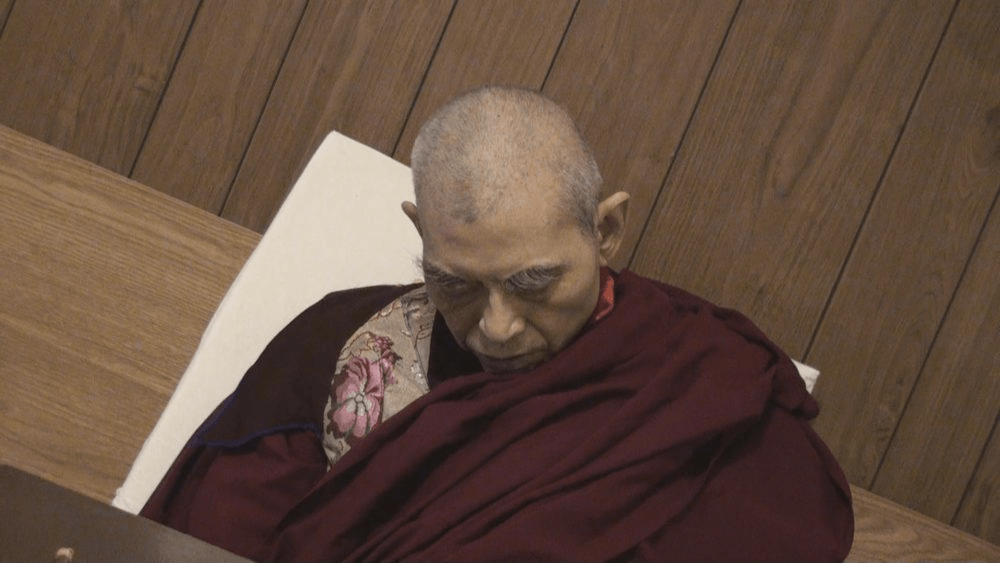
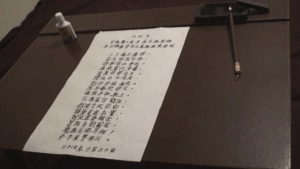
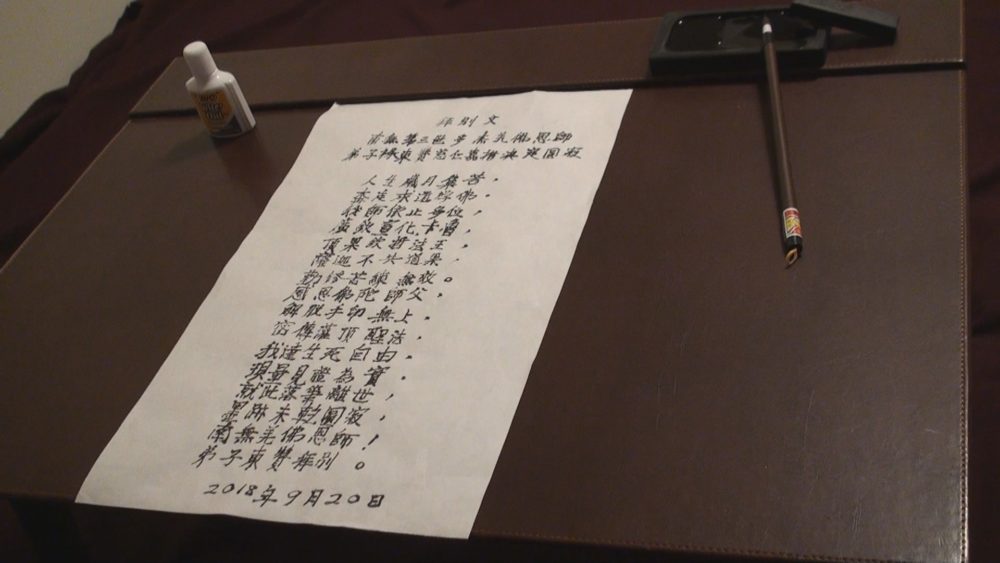
This dharma assembly was exactly the last dharma assembly that Dharma King Gar Tongstan was waiting for. Next day, after taking a bath and changing His garment, He entered His dharma practice. Then, a writing desk with pen, ink, paper, and white-out fluid placed on it was put in front of His dharma seat. He wrote a letter of respectful farewell to H.H. Dorje Chang Buddha III and then immediately sat down to pass away in a perfectly liberated state. When monastics from different temples arrived, they found that right after putting down the pen, the dharma king passed away in a perfectly liberated state with complete ease and without any hesitation. At that time, it suddenly dawned on everyone that the verse of respectful farewell that Dharma King Gar Tongstan wrote was to point out where the true dharma of the Tathagata is for living beings, which is upheld and controlled by H.H. Dorje Chang Buddha III and is the same as the Buddha-dharma of Sakyamuni Buddha that only belongs to Buddhism without any sectarian affiliation!

Dharma King Gar Tongstan passed away in a perfectly liberated state

Verses of Respectful Farewell

The following is the verse of respectful farewell written by Dharma King Gar Tongstan.

Dharma King Gar Tongstan’s Last Letter to Dorje Chang Buddha III

” Verse of Respectful Farewell“

”To my beneficent Master Namo Dorje Chang Buddha III,“

“I, Disciple Gar Tongstan Ciren Gyatso, decided to pass away in a perfectly liberated state.”

“Human life accumulates sufferings through the years and months. I went to various places to seek enlightenment through learning from Buddha. I followed and stayed with many masters to learn from them, including Guang Qin, Xuan Hua, Ka Lu, and Dharma King Dilgo Khyentse. I practiced diligently and worked hard on the unshared dharma of Path-Fruit of the Sakya Sect without effect. I gratefully thank my Buddha Master for the Mahamudra of Liberation that is supreme and unsurpassed. The holy dharma that I received from secretly transmitted initiation enabled me to achieve freedom from birth and death, with true realization attained on the spot. I now pen down my words and will then leave the world, passing away in a state of perfect accomplishment before the ink dries.”

Verses of Respectful Farewell

Namo beneficent Master, H.H. Dorje Chang Buddha III

Disciple Gar Tongstan Ciren Gyatso has decided to leave this world.

As life is filled with suffering,

I rushed about learning Buddhism and seeking enlightenment.

I have followed many masters:

Guang Qin, Xuan Hua, Kalu,

And Dharma King Dilgo Khyentse,

Diligently practicing their dharmas and the Sakya unshared LamDre Dharma,

All to no avail.

Thankfully, I met my Buddha Master.

Through the Mahamudra of Liberation that is supreme and unsurpassed,

And the secret initiations and transmissions of holy dharma from my Buddha Master,

I achieved control over my own birth and death.

My direct realization is reality.

I now put down my brush and leave this world,

Entering into the state of liberation before the ink dries.

Namo my beneficent Master, H.H. Dorje Chang Buddha III!

Disciple Tongstan respectfully bids farewell.

September 20, 2018

“Namo my beneficent Master Dorje Chang Buddha III!”*

“I, Disciple Tongstan, hereby bid respectful farewell.”

“September 20, 2018”

Dharma King Gar Tongstan Demonstrated World-Astounding Mastery over Birth and Death by Practicing the Supreme Buddha-Dharma

Link: https://peacelilysite.com/2022/10/24/dharma-king-gar-tongstan-dem-onstrated-world-astounding-mastery-over-birth-and-death-by-practicing-the-supreme-buddha-dharma/

#DorjeChangBuddhaIII # HHDorjeChangBuddhaIII #HuaZangSi #HolyManifestation#FireOffering #DharmaKingGarTongstan#World-AstoundingMasteryoverBirthandDeath#SupremeBuddhaDharma #TheSupremeandUnsurpassableMahamudraofLiberation

Once a Thousand year Phenomenal – The Power of Tummo Concentration

Photo by Maris Rhamdani on Pexels.com

Once a Thousand year Phenomenal – The Power of Tummo Concentration

Recently I have gotten a special pill from a Dharma Assembly at Hua Zang Si Temple in San Francisco. The pill was made through Buddha-dharma, and is capable of curing illnesses. And I was even more fortunate that I had a opportunity to watch a video about how these pills were made. The whole process was so incredible and astonishing.

There are two types of the healing pills. The one is made from conducting a dharma with the Medicine Buddha as the yidam and using the practice of tummo as the cause, it is called the Daba Buqiong Pill. Another kind made from a dharma with the Kuan Si Yin Bodhisattva, one of the five great Buddha Mothers, as the yidam is named the Kazhuo Ande  Pill (also called the Black Jewel Medicine Pill). These pills are made by two types of methods, the highest or most magnificent way or worldly ways. In today’s Buddhism world, worldly ways are commonly used. The process is basically mixing all and only the required ingredients of medicine that are blessed by chanting the mantra of the dharma and then rubbing the mixture into pills. The magnificent inner tantric way of making these pills is completely different. The practice of tummo concentration must be used as the affinity of the dharma. The ingredients of the medicine are exactly the same. The blessing power of the pills is supreme and most magnificent. However, because of the loss of Buddha -dharma, the process of making these pills with the most magnificent (non-worldly) methods has almost become extinct.

The pills of Daba Buqiong and Kazhuo Ande  made from the magnificent method are rare and hard to obtain. The first difficulty is that it is hard to find a true great virtuous one to conduct tummo concentration.

Many people have heard about the dharma of tummo concentration but it is extremely difficult to see a true manifestation of tummo power. Today, in Tibet, India and other places, there are still many lamas who practice tummo concentration. However, when they walk out of the closed room at the end of the extended practice in seclusion, very few of them can actually raise their body temperature. The most they were able to do is symbolically wear a wet blanket while walking around the temple. Those who attained such initial level are now called holy and venerable ones. This is just an indication that tantric dharmas are being lost from generation to generation.

Tummo concentration is a high-class Buddha-dharma of meditation. It is a rare holy dharma indispensable for cultivating the life power of the body, mind-wind and bright spot, and the accomplishment of a rainbow-light body. Regardless of what illness or disease one has, practicing tummo can eliminate it completely. Therefore, this dharma is the dead enemy of the demon of illness. Tummo concentration is a great dharma in the division of supreme yoga. The perfect accomplishment in the practice of this dharma combined with Vajra Body Substitution Meditation can lead to the accomplishment of becoming a Bodhisattva at the twelfth stage or higher.

There are two types of practices of tummo concentration. One is Yoga Tummo from Tibetan Esoteric Buddhism. The other is the Corpse-Laying Tummo regarded as “the King of Tummo.” When practicing tummo, the higher the body temperature can be raised to, the higher the realization power of the practitioner. The normal body temperature of humans is between 98.6°F and 99.5°F (37°C and 37.5°C). When the body temperature reaches a level between 104°F and 105.8°F (40°C and 41°C), one is regarded as having a high fever. A temperature above 41°C (about 106°F) can cause danger to one’s life. However, practitioners of tummo concentration can attain much higher temperatures than that.

The realization power from tummo concentration is defined by four steps. The first step is called the Initial Warmth Step. At this step, body temperature can be raised to between 115°F and 130°F but the ability of curing illnesses is not strong yet. The second step is the Joy of Heat from Meditation  Step, with the body temperature raised to between 130°F and 150°F. The heat of tummo can be released at certain locations of the body to provide a relatively strong ability of curing illnesses. However, there are five illnesses that cannot be cured by this ability. Anyway, one will rarely become ill with the accomplishment at this step. The third step is the Step of Emptiness and Existence at High Temperature. The body temperature can be raised to between 150°F and 200°F. The heat of tummo can be distributed to any part of the body to heal illness by oneself, with the exception of two illnesses. The practitioner can collect the dark karma generated daily due to ignorance and burn it away with tummo. One can also move the heat of tummo outside of his body to cure illness and eliminate hindrance for other people or to subdue demons and evil spirits. The fourth step is the magnificent Delight at Extreme Temperature. The temperature will exceed 200°F and the heat of tummo will spread to the entire body. Master Milerapa used his realization power of this step to ignite his own body to attain the accomplishment of sambhogakaya, and nirmanakaya.

Although the true realization power of tummo is hard to find through the history of over one thousand years, fortunately Mozhi Rinpoches, a disciple of H.H. Dorje Chang Buddha III, is a great yoga master. He is the first-place master of tummo concentration in Tibetan Esoteric Buddhism.  His body weight was reduced from 241.4 pounds (109.5 kg) to 124.6 pounds (56.5 kg) by practicing tummo concentration. He once practiced tummo concentration for seven months and three days, without eating and drinking. After that, all illnesses were eliminated.

The video I watched was the recording of The dharma assembly of making the pills of Kazhuo Ande. It was held at Los Angeles at year 2009. In the dharma assembly, Mozhi JiaoZun was the chief master to produce the heat of tummo. Other rinpoches would be his dharma-protecting assistants. He stated that the purpose of his coming here was not to compare his realization power with others and was not for making Kazhuo Ande pills. It was a coincidence that he met this cause. He regards it as his duty to do something for living beings.

A porcelain pot for frying the medicine was laid on his belly

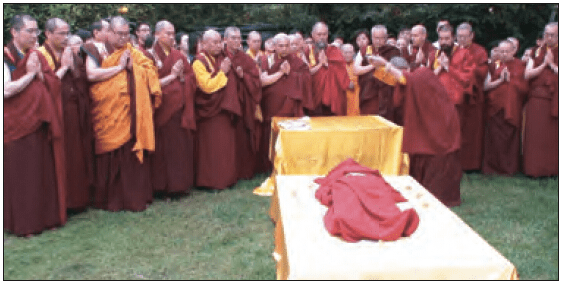
At the dharma assembly, Mozhi Rinpoche lay on the dharma board and had his head covered up so people would not know who was practicing tummo concentration. This great holy virtuous one with true realization of power and abilities never wanted to boast or praise himself. Everyone attending the dharma assembly was greatly moved and felt ashamed by such holy and pure style of humble self-cultivation.

When the great holy virtuous one was conducting the dharma, a porcelain pot for frying the medicine was laid on his belly. The high-temperature heat of tummo was strong and vicious and directly penetrated the thick porcelain pot.  Rinpoches who used a finger to test the temperature were all scalded badly. They had to throw the medicine powder into the pot and get away quickly to protect their fingers from getting injured.

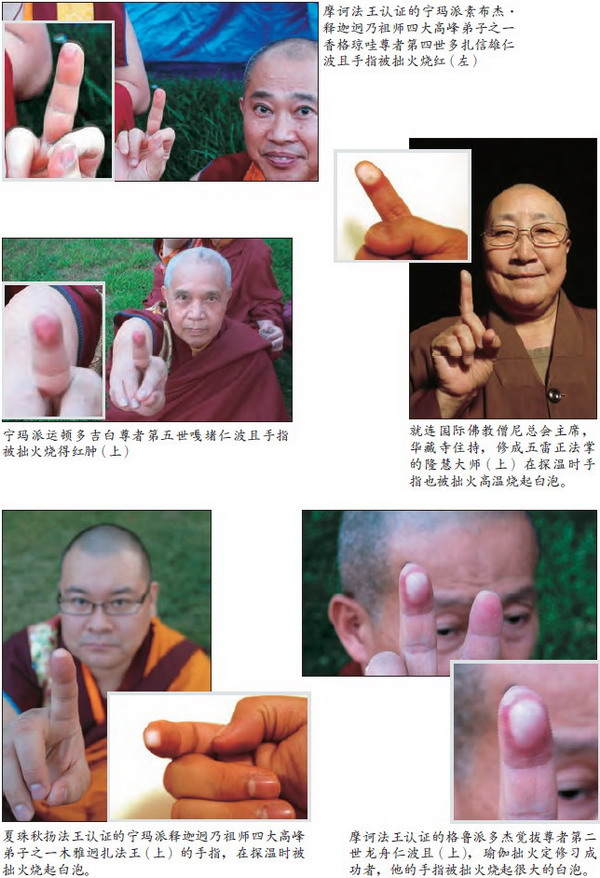
At the dharma assembly of making pills with the magnificent method, the heat from the Body-Laying (Corpse Pose) Tummo Concentration scalded rinpoches’ fingers so that they were red and swollen. Some had frowning eyebrows and were sweating all over their heads. Some had blisters form on their fingers. Some had the color of the swollen finger turned into white or black colors. Some had their whole finger scalded red and unable to bend. Some even had their face scorched red by the high heat of tummo.

Rinpoches used a finger to test the temperature
Rinpoches showing their burning fingers by the high temperature of tummo

I could not help from making a heart-felt praise: the true power of Corpse-Laying Tummo Concentration from The Supreme and Unsurpassable Mahamudra of Liberationis truly amazing!

Once a Thousand year Phenomenal – The Power of Tummo Concentration

Link: https://peacelilysite.com/2022/10/20/once-a-thousand-year-phenomenal-the-power-of-tummo-concentration/

#DorjeChangBuddhaIII # HHDorjeChangBuddhaIII #HuaZangSi #HolyManifestation #Tummo Concentration#Tripitaka#BuddhaDharma#MoZhiRinpoche#TheSupremeandUnsurpassableMahamudraof Liberationis #BlackJewelMedicinePill

The Story of the “Six-foot Alley”

The Story of the “Six-foot Alley”

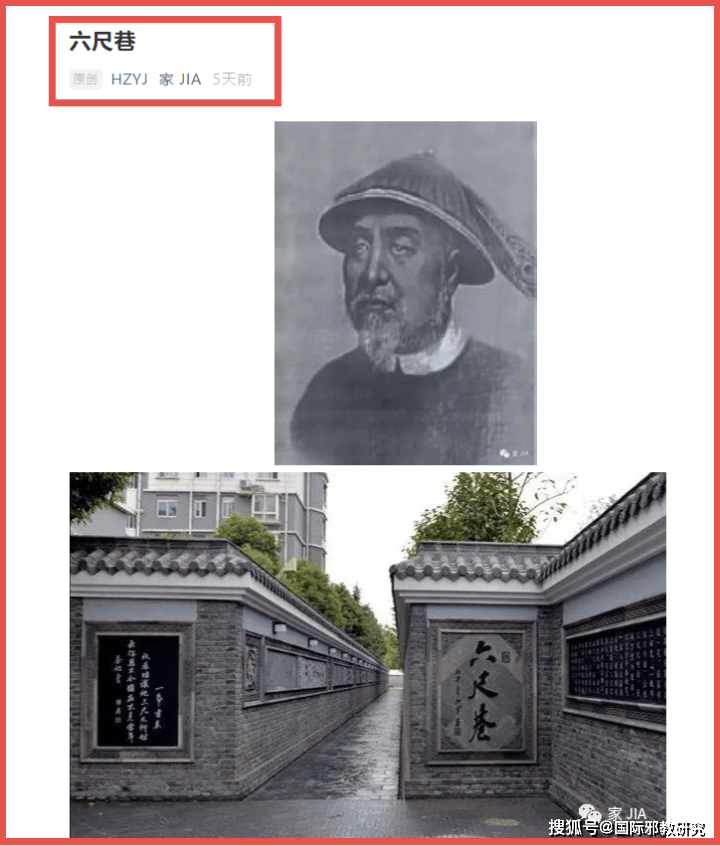
“Liu Chi Alley” (六尺巷 in chinese) is located between Xihou Street and Wumu Garden in Tongcheng District, Tongcheng city, Anhui Province. The allusion of “Six-foot Alley” has become a historical story stems from the land dispute between Zhang’s family and his neighbors.

In the Qing Dynasty, there was a famous family in Tongcheng, Anhui Province. Father and son were the prime ministers of the two generations and had great power. Their names were Zhang Ying and Zhang Tingyu.
During the reign of Emperor Kangxi in the Qing Dynasty, Zhang Ying was a Bachelor of Arts at Wenhua Palace and a minister of rites. At that time, the Zhang family’s old house in Tongcheng was adjacent the house of the Wu family. There was only about 3 feet of space between the land owned by each family.

The Wu family wanted to expand their property to occupy this space. The Zhang family vehemently disagreed. The two sides brought the case to the county courthouse of Yamen. County officials knew that both families involved in the dispute were well-known families with prominent officials. They dared not easily break the dispute.
During this period, the Zhang family wrote a letter to Zhang Ying, now a senior official in Beijing, asking Zhang Ying to come out and interfere in this matter. After receiving the letter, Zhang Ying thought that he should humble the neighbors, and wrote a poem to his home in reply:


Thousands of miles of a mail is only for a wall.

Why not give up him three feet?

The Great Wall still stands today.

But where is the Empire Qishihuang now?


The Zhang family read it and eventually realized they understood its meaning. They took the initiative to give up three feet of space for the Wu family’s property. The Wu family, deeply touched by this gesture, decided to concede three feet of their own adjacent land, thus forming a six-foot lane between the properties. The two courtesy concessions and the Zhang family’s non-oppressive approach were passed on to be good folk stories.

From this story, we learn to be modest and tolerant in life. Mutual humility can avoid many contradictions and reduce disputes between people. Mutual understanding and tolerance can help people get along harmoniously, and can greatly improve people’s happiness index. As the saying goes, “A bit of forbearance will calm the wind and silence the wave. Take a step back and have the vastness of sea and sky.”

The virtues of tolerance and equality have been passed down since ancient times. In the process of building a harmonious society for people who are open-minded and respectful, this tradition of humility needs to be carried forward even more. The allusions to a “Six-Foot Lane” have gone far beyond its original meaning and has become a testimony to the virtues of harmony and humility of the Chinese nation.

The Story of the “Six-foot Alley”

Link: https://peacelilysite.com/2022/10/19/the-story-of-the-six-foot-alley/

#ChineseCulture#Six-footAlley#Toleranceandequality#Humility#Virtues#Harmony

Source: http://mandarinedu.org/English/news/12390.html

A Famous Westminster Abbey Tombstone Inscription

By Linda Apple

A Famous Westminster Abbey Tombstone Inscription

There is a rather famous tombstone in Westminster Abbey. There’s nothing so special about it, except for its inscription. I believe that many people have heard of it.

“When I was young and free and my imagination had no limits, I dreamed of changing the world. As I grew older and wiser, I discovered the world would not change, so I shortened my sights somewhat and decided to change only my country. But it, too, seemed immovable. As I grew into my twilight years, in one last desperate attempt, I settled for changing only my family, those closest to me, but alas, they would have none of it. And now, as I lie on my deathbed, I suddenly realize: If I had only changed myself first, then by example I would have changed my family. From their inspiration and encouragement, I would then have been able to better my country, and  who knows, I may have even changed the world.”

It is said that many world dignitaries and celebrities were deeply moved when they saw these words Some people say that this is a teaching of life, some people say that it is a kind of introspection of the soul.

There are similar teachings and philosophies in Chinese traditional culture. The Great Learning is a compilation of Confucian teachings used to address deeply important social behavior. In The Great Learning says: “The ancients who wished to illustrate illustrious virtue throughout the kingdom, first ordered well their own States. Wishing to order well their States, they first regulated their families. Wishing to regulate their families, they first cultivated their persons.”

“From the Kings down to the mass of ordinary people, all must consider the cultivation of the person the root of everything besides. It cannot be, when the root is neglected, that what should spring from it will be well ordered.”

In Buddhism, self cultivation is heavily emphasized as well. The first thing for all buddhist disciples is constantly cultivating themselves. In What is Cultivation, His Holiness Dorje Chang Buddha III  provides detailed guidance on self-cultivation. Self-cultivation is the fundamental and essential in the learning of Buddhism. Through self-cultivation, one will not only live a happy life and contribute the best of oneself to the society, but also can reach enlightenment and liberation.

A Famous Westminster Abbey Tombstone Inscription

Link:https://peacelilysite.com/2022/10/14/a-famous-westminster-abbey-tombstone-inscription/

#WestminsterAbbey#TombstoneInscription#GreatLearning#ChineseCulture#Buddhism#DorjeChangBuddhaIII #HHDorjeChangBuddhaIII   #Buddha #Cultivation#Buddhist#SouthAfrica#Buddhist# ConfucianTeaching#ChineseTraditionalCulture

Source: http://wengu.tartarie.com/wg/wengu.php?l=Daxue&s=1

Two Fruits for A Meal

Photo by Susanne Jutzeler, suju-foto on Pexels.com

Two Fruits for A Meal

A young monk asked the master for advice: “What are human desires?” The old monk told the young monk to come back tomorrow, but do not eat or drink until then. When the little monk came back the next day, he was very hungry and thirsty, and felt that he could eat a whole loaf of bread.

The old master monk asked him to go to the orchard to pick some fruits, but asked him to bring them back to the temple to eat.

After a while, the young monk returned to the temple with a basket full of fruits. The old monk told him to eat as much as he could. The young monk felt full after just eating two and could not eat any more.

The master asked him, “What’s the use of these fruits that you brought back after all your hard work, but you didn’t eat them? They’re just useless burdens.”

“Now you may understand, for each of us, what we really need is only two fruits that are enough to satisfy our hunger, and the rest is our desire.”

Photo by Nilina on Pexels.com

Every day we are driven by our own desires to keep running and toiling. We believe that if our desires are satisfied, we will be happy. But that happiness is very short-lived. Think about when you got new beautiful clothes, a pair of fancy shoes, luxury jewelries, or an expensive car — how long does that pleasure last? It may be a year, a month, or just several days, and then we want more to replace these fleeting pleasures. Our desires are endless, they keep on growing until they wrap us completely like a cocoon. Our desires lead us to focus on the various commodities of the outside world, and squeeze out all of our time and energy. Thus, our desires can actually make us feel enslaved and unhappy, and cause suffering.

In Buddhism teachings, the origins of suffering and unhappiness come from craving, desire and attachment. The way to end suffering is letting go of these cravings, and finding your true self. Of course Shakyamuni Buddha had taught many ways in the Buddhist Sutra to reach the eternal happiness and find our true selves. The contemporary Buddha H.H. Dorje Chang Buddha III has expounded many Buddha Dharmas to help us as well, such as What is cultivation? , Learning from Buddha, and several thousand audio-recorded Dharma discourses. By practicing the Buddha Dharma, one can break through the cocoon of life and death, and reach libration.

Hope you can find your own way to be free, happy and healthy.

Two Fruits for A Meal

Link: https://peacelilysite.com/2022/10/02/two-fruits-for-a-meal/

#HHDorjeChangBuddhaIII #DorjeChangBuddhaIII #DorjeChangBuddha #ShakyamuniBuddha #Buddhism#BuddhismTeaching#desire#craving#attchment

The Choice of Companion

Photo by Victoria Borodinova on Pexels.com

The Choice of Companion

By William Makepeace Thackray

A good companion is better than a fortune, for a fortune cannot purchase those elements of character which make companionship a blessing. The best companion is one who is wiser  and  better than ourselves, for we are inspired  by  his wisdom  and  virtue to nobler deeds.

“Keep good company, and  you shall be one of the number,” said George Herbert. “A man is known  by  the companion he keeps. ” Character makes character in the associations of life faster than anything else. Purity begets purity, like begets like;  and  this fact makes the choice of companion in early life more important even than that of teachers  and  guardians.

It is true that we cannot always choose all of our friends, some are thrust upon us  by  business or the social relations of life, we do not choose them, we do not enjoy them;  and  yet, we have to associate with them more or less. The experience is not altogether without compensation, if there be principle enough in us to bear the strain. Still, in the main, choice of companions can be made,  and  must be made. It is not best or necessary for a young person to associate with “Tom, Dick,  and  Harry” without forethought or purpose. Some fixed rules about the company he or she keeps must be observed. The subject should be uttermost in the thoughts,  and  canvassed often.

Companionship is education, good or not; it develops manhood or womanhood, high or low; it lifts the soul upward or drags it downward; it ministers to virtue or vice. Sow virtue,  and  the harvest will be virtue. Sow vice,  and  the harvest will be vice. Good companionships help us to sow virtue;evil companionships help us to sow vice.

The Choice of Companion

Link:https://peacelilysite.com/2022/09/28/the-choice-of-companion/

#ChoiceofCompanion#Friends#companionship#blessing#wisdom#virtue

It is More Blessed to Give than to Receive

It is More Blessed to Give than to Receive

One day, a young college student was walking with his professor. The professor was very kind. The young student beside him was his student but also his friend. While walking, they saw an old pair of shoes on the side of the road.

It turned out that there was a man who left his shoes there before working in the fields, and every day when he finished work, he would come back to retrieve his things. It was almost time for that man to get off work.

The young student suddenly told the professor that they should play a joke on the poor man. He proposed to hide the shoes and see how the owner of the shoes would react when he could not find them.

The student decided to do as the professor said, and then they hid behind the woods to see how the poor man would react. Soon the poor man was off work, and he returned to the roadside to find his things.

He put his foot into the first shoe as he put on his clothes. Immediately he felt something in the shoe, and when he bent over, he saw a silver coin inside the shoe. With a look of astonishment on his face, he turned the silver coin over and over again, looked at it and looked at it again, and looked left and right at the same time, to see if anyone was playing a prank. But finding no one around, he put the silver coin in his pocket.

He continued to wear another shoe, and unexpectedly found another silver coin. For the second time, a surprised expression appeared on his face. In addition to being happy, he immediately knelt down and prayed thanks.

He prayed out loud, thanking God for knowing that his wife was sick and there was no food at home, and he thanked God even more for letting him survive through the hands of unknown people.

After the man left, the young student stood beside the professor, and was moved to tears.

It is More Blessed to Give than to Receive

Link: https://peacelilysite.com/2022/09/25/it-is-more-blessed-to-give-than-to-receive/

#Blessing#Kind#Give#Stories#MoralStories

The Environment Is in You

STUDENT CONTEST

Photography and Original Illustration Contest

Sabine Wolpert (15)

The Environment Is in You

Sabine Wolpert (15) – California, U.S.

As a little kid, I thought that life was like a flat line with bumps and dips rarely occurring. The news of floods, earthquakes, and fires might flash across the news but they were never close enough to really touch my life. Now that I’m older, these natural disasters are closer to where I live. The rainy season seemed shorter than I remembered and signs started to appear in restaurants and hotels saying “save water” or “minimize your water use.” 

When fires got really close, little pieces of ash, like black rain, would fall from the sky. Soon I learned that these events were not random, and I realized how responsible we were, how responsible we are. I began to learn how connected we are to our environment. I began to realize that it mattered whether I kept the water running for that extra minute or left the hose on for too long. When the fires got so close to our house that evacuation was a threat, I had to pack a bag and look at the forest outside wondering whether it wouldn’t be there in a month or a week or tomorrow. 

I have been lucky enough to live in one of the most beautiful places in the world. I get to see the ocean, the redwood forests, and thousands of blossoms hanging over daffodils in the spring. It’s dark enough at night to see a thousand stars and quiet enough in the morning to hear birds and bees. I have grown up in nature, and I am so saddened to see our earth deteriorating at our hands. I think that people can become so used to our luxuries that we forget how fragile and impermanent they can be. I hope my artwork can help people remember how connected to the environment we are. I think we all need to remember that we live in the environment and it lives in us. We breathe the same air as butterflies and our hair gets blown by the wind that sways tree branches. We must come together to save our land because it will not last if we continue to treat it as disposable. It is our responsibility as people to save the earth that provides us life.

Marguerite Baxter

Marguerite Baxter (18) – Minnesota, U.S.

I was walking down my alley, a place that I visit everyday. It was spring and the snow was melting into puddles. When I looked into the puddle, I could see a perfectly clear image of myself and my surroundings. In this moment, I understood how I was a part of the environment and Earth. The reflection of my small hand as I recognized this symbolizes my connection to the environment. Living in a city, natural and man-made beauty is intermixed. Both exist together, but not always in harmony. I believe that all of these things can be beautiful together, but they must respect one another.

This work is a love story to the planet, as I appreciate that in the tiniest puddle a whole environment can be reflected. What a beautiful and miraculous thing. I was taking a moment to see myself as a part of that environment, not separate but a part. Reaching out and placing myself in it. I loved that puddle and I loved the asphalt that looked like a million little stars. I want this work to communicate the tiny details that people so often walk by and ignore. There are truly millions of miracles around us all of the time: the perfect circles that raindrops make in puddles, the way that our bodies can heal themselves, how still water can perfectly reflect like a mirror. This earth is amazing and resilient. This recognition is the first step to understanding how to solve our problems. It starts with love. We must love our environment and recognize all of the beauty in it to become passionate protectors of it. We are not more powerful than nature. We are nature.

Ellie Knight

Ellie Knight (16) – North Carolina, U.S.

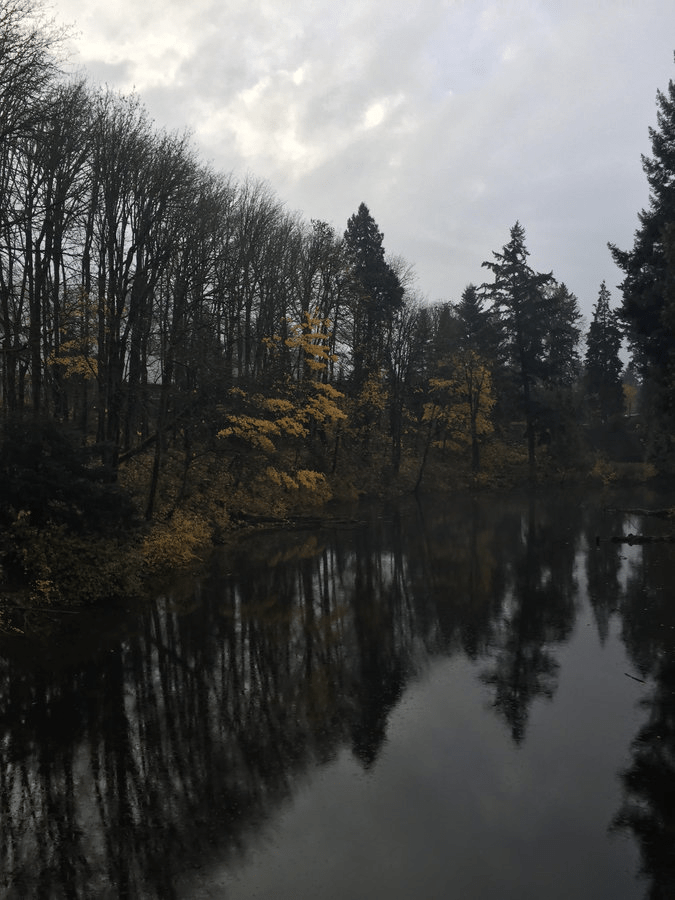
The world creeps up on you in the most unexpected ways sometimes. In the beginning, you may not even notice any changes, but it makes itself known pretty quickly. The excerpt written by Robert Hass inspired this photograph as a reminder that the world wasn’t always like this. My photo reflects our environment from two different times, one where climate change seemed as though it wasn’t an issue and one where its stark existence is hitting so close to home. 

I like to show my passion for photography through seemingly basic pictures that take on a double meaning. The side with trees looks way more lively than the reflection it shows in the water. 

Climate change directly influences the way autumn appears—the warmer air stunts the development of coloring within the leaves. The noticeable delay in autumn color has caused the season to become a three-day homage. Most people know about climate change, but it goes without a word, just like autumn leaves. I noticed the significance of the color yellow, which can represent a joyful, energetic mood. The problem with our society right now is that no one has that spark of energy to save our planet; we’ve lost our yellow. To quote Hass, it is in our best interest to “recover an elder imagination of the earth.” If my photograph could be used to communicate to my peers, I would want it to say that the world around us is the only planet we get. It’s our only chance at life, and we need to get back to a time when these global forces weren’t so life-threatening and find the yellow within ourselves to do what we can now. If you look closely at the reflection, you can see some raindrops. Those droplets, however, make the reflection a bit blurry. This documents my feelings by expressing that environmental issues, like climate change, are still a little blurry to me. Everyone starts somewhere, and there is always room to learn. The environment is in you, and you just have to make an effort to bring it out and show the world what it really means to you.

Romina Arredondo

Romina Arredondo (18) – Naucalpan, Mexico

The Face of Progress

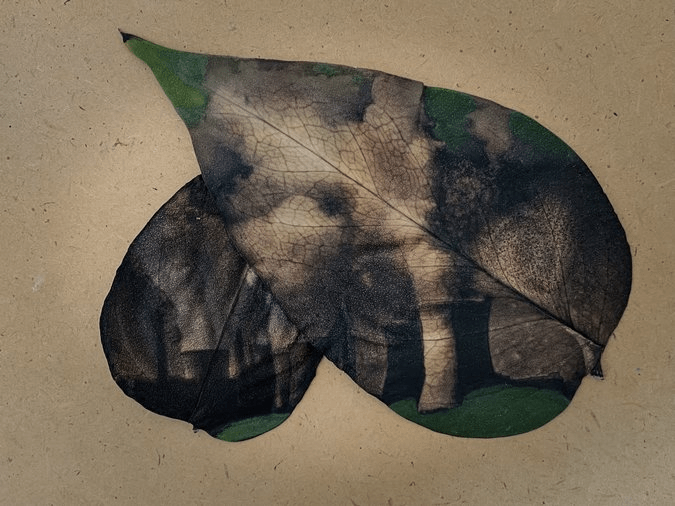
A leaf rotten from its center.
A dark stain that at its fervor steps burns.
A leaf without precedents nor relations.
I am the only witness of its existence.
And even though I don’t watch, it lives and dies.

Observant, I find the stain taking shape in its expansion. 
Clouds of steam push towards the edges of the leaf
Unpainting every green brush stroke with indifference.
Agonizing, the leaf talks to me through its pattern
and its drawing has the face of progress.

Two sentences inspired the creation of my project. Linda Hogan wrote, “What a strange alchemy we have worked, turning earth around to destroy itself, using earth’s own elements to wound it.” And, Wendell Berry wrote, “The environment is in you, it’s passing through you, you’re breathing it in and out, you and every other creature.” Both statements address the arrogance and impudence of human beings who feel that they are the owner of everything and then become destroyers. The process that I carried out to embody the idea was to put an acetate with a photo of a factory on a leaf of a plant called Pothos, so that it would be printed under the sunlight.

We find so many resources in the nature environment, and instead of taking care of and thank that source of wealth, man is coldly exploiting it. Hand in hand with the above, we have built a hierarchy in which we, as humans, are above everything and that is now part of our molding, so we ignore the fact that as living beings that make up the same world, we are equal. As individuals we exclude ourselves from what we consider to be resources, and we turn them into products that unbalance the environmental order.

The Environment Is in You

Link:https://peacelilysite.com/2022/09/19/the-environment-is-in-you/

#Environment#StudentContest#globalonenessproject#PhotographyandOriginalIllustrationContest#GlobalWarming

Source: https://www.globalonenessproject.org/stories/winners-and-finalists-environment-you#main-content=