Taoism is an ancient Chinese philosophy that emphasizes living in harmony with the natural world and embracing simplicity. Its teachings have had a significant impact on both Eastern and Western cultures, including the field of psychology. One prominent figure in psychology who was influenced by Taoism is Carl Jung, a Swiss psychiatrist and psychoanalyst who founded analytical psychology.
Jung’s complex concept of “the Self” is one of his most significant contributions to psychology. The Self represents the totality of an individual’s psyche, including both conscious and unconscious elements. According to Jung, the Self is the goal of the individuation process, a lifelong journey of self-discovery and personal growth.
In ancient China, there were eight prominent figures in Taoism, and Lu Dongbin was the most popular one. Besides being a renowned Taoist, he was also a skilled poet and scholar. Throughout history, many legendary stories and folk tales have been told about him.
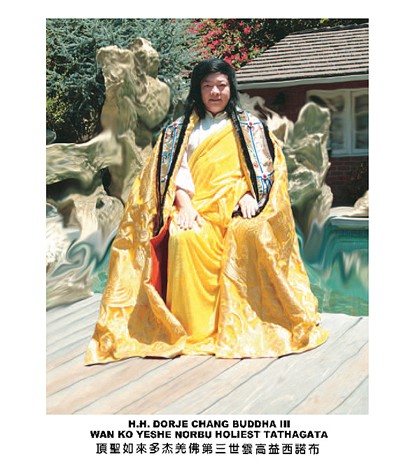
One interesting story was recorded in a Buddhist book called JiaTai Pu Deng Lu (嘉泰普灯录), which has also been documented in several other books, including XinShi Heng Yan (醒世恒言). Although there are some variations, the main points of the story remain the same. H.H. Dorje Chang Buddha III also told this story in his dharma discourse: Expounding the Absolute Truth through the Heart Sutra.
Once, Lu Dongbin asked his master, “Master, why did you only save me for a thousand years?”
His master replied, “It’s difficult to teach all living beings. People’s habits are deeply ingrained, and they constantly change. Most living beings find it challenging to learn our Taoism.”
Lu Dongbin countered, “Master, I disagree. We are powerful beings. Are we afraid it will be difficult to liberate them? Let me go down and liberate people for you. I will free a thousand souls every year.”
His master warned, “You may go down to Earth, but be careful not to provoke the monks. Some cannot be trifled with.”
Lu Dongbin descended from the South Gate of Heaven on an auspicious cloud and saw the golden light of Huanglong Temple in Shanghai, China. Zen Master Huanglong was teaching the Heart Sutra and explaining Prajna principles. Lu Dongbin decided to listen in and transformed himself into a fly, sticking to the door.
However, Zen Master Huanglong was a powerful monk who knew Lu Dongbin was eavesdropping. He stopped teaching and instructed his attendant to remove the “person who stole our Dharma.”
Enraged, Lu Dongbin revealed his true form, brandishing his Qingfeng sword and accusing Zen Master Huanglong of insulting him. Lu Dongbin told Zen Master: “I am the great Taoist Immortal LU Dongbin.” Huanglong found it amusing and called Lu Dongbin a “ghoul guard” who would eventually die in vain.
Lu Dongbin drew his sword, but Zen Master Huanglong remained unperturbed, blocking the sword with his sleeve. Lu Dongbin knelt before the Zen master, feeling ashamed.
Huanglong proceeded to teach Lu Dongbin sudden enlightenment dharma, explaining that “speech is cut off, and mind is silenced.” As a god, Lu Dongbin was able to grasp the teaching quickly and had an epiphany.
After his enlightenment, Lu Dongbin wrote a gatha containing the line, “Since I met Huanglong, I realized that I mistakenly used my mind in the past.”
In Buddhist teachings, it is said that even the highest Taoist practitioner can reach heaven, but still remain in the realm of the birth and death cycle. However, if one can realize and abide in the original nature, then they can break through this cycle and achieve liberation. The original nature refers to the pure dharma body of all sentient beings within the three spheres of existence (triloka), which is united with the universe. It has no form, shape, physical body, or appearance. All living beings possess this original nature equally, which is the same as the dharma body of the Tathagata or dharmakaya. It neither comes nor goes, and is neither excessive nor lacking. It is immaculate, free from any notion of cleanliness or dirtiness.
The truth and the original nature of all conditioned and unconditioned phenomena in the universe are contained in the word Buddha-dharma. The Buddha-dharma is all causes and effects in the universe. To understand all causes and effects, yet not be controlled by cause and effect, is to realize liberation and the Buddha-dharma. No matter how many schools or sects there are, the Buddha-dharma has only one truth. It is the truth of the universe: the dharma of ending the cycle of birth and death! The Buddha-dharma is the life order of another world and dimension.
However, this rather abstract definition does not tell us how we realize or learn the Buddha-dharma. In a series of dharma discourses on learning Buddhism released in January 2016, H.H. Dorje Chang Buddha III gives such a practical definition. It is the dharma that we practice in the vajrayana form of Buddhism. It is the preliminary, main, and ending practice in their totality. The true Buddha-dharma emphasizes real practice and skills and is not merely theoretical Buddhist studies. The holy manifestations or miracles described on this website and in the book H.H. Dorje Chang Buddha IIIare evidence that the true Buddha-dharma, as practiced by Shakyamuni Buddha and the accomplished ones of the past, still exists in the world and that very high levels of spiritual accomplishment are possible for those who follow a true vajra master.
H.H. Dorje Chang Buddha III has said: “After you enter the door of Buddhism, you must cultivate yourself according to the dharma. Your three karmas of body, speech, and mind must correspond with the teachings of the Master. Only then will you be able to become accomplished. Conduct that is not in accord with the teachings of the Buddhas and Bodhisattvas must be corrected through concrete actions. You must make your conduct accord with the teachings contained in the Tripitaka and the states of morality, concentration, and wisdom. Yet, correcting your words and conduct must be carried out within everyday worldly life. That is because everyday worldly life (worldly or secular dharma) is the Buddha-dharma. There is no Buddha-dharma to accomplish apart from worldly or secular dharma. That is why you must use all mundane or worldly experiences to improve your self-cultivation. You must use worldly experiences to perfect your realization and conduct. If your basic worldly conduct is not proper, it is of no use to speak in a high-sounding way about emptiness or to speak boastfully and wish wildly.”
However, we must have patience in learning the Buddha-dharma. You cannot completely understand the principles of the dharma in a brief period of time. You must go though the sequence of first hearing the principles from your vajra master, gradually acting in accordance with these principles, walking the correct path and so on. You must advance step my step. You cannot expect that your negative karmic obstructions that have formed over many past lives can be purified in just one day. The tantric dharma that we receive when correctly practiced will enable us to overcome our obstructions, purify our three karmas, and enable us to progress on this path. Do not waste time on activities that do not lead to liberation and becoming a Buddha. DO NOT WAST TIME!!!
Gadu Rinpoche is the fifth venerable Yundun Duojibai. Having a supremely wonderful karmic destiny in this lifetime, he received profound initiations from H.H. Dorje Chang Buddha III. He cultivates himself diligently. The venerable one has become deeply accomplished in the practice of second-level Great Perfection Dharma and attained the nirmanakaya state. In his book Cultivate Honestly, he recounts his experiences upon receiving the Niwan Crown-Opening Heaven Mandala.
Several years ago, at one day my Buddha Master told me “I will open the mandala and transmit the very profound Buddha-dharma to you. This Buddha-dharma is the state practice empowerment dharma from The Supreme and Unsurpassable Mahamudra of Liberation and belongs to the dharma of the heaven realm. Once you receive the empowerment, within two hours, a hole will be opened at the Niwan spot on the top of your head. Your spirit and consciousness can come out and appear from there.”
At that time, however, although I felt fortunate to learn the dharma, there was doubt in my mind that I could not get rid of. I simply could not believe what my Buddha Master stated about having my crown opened at the Niwan spot within two hours. The more I thought about this, the more I was worried. This was truly peculiar and absolutely unheard of. Having a hole opened on the crown was definitely not an ordinary matter. How could the person be alive after that? On the other hand, based on my Buddha Master’s holy realization, I kept telling myself not to have doubt because it is in violation of the precepts. However, I just couldn’t remove the doubt in my mind. Now I think about this, I felt that I was really very inferior and my karmic impedance was too heavy. Being Yundun Duojibai V – Gadu, I am still a tiny speck before my Buddha Master. I am really ashamed and ashamed!
My Buddha Master selected a good time on an auspicious day at the solemn mandala to hold the initiation of the empowerment dharma from The Supreme and Unsurpassable Mahamudra of Liberation, Niwan Crown-Opening Heaven Mandala. My Buddha Master discoursed to me, “This dharma is a very important one. Very few people have the opportunity of learning this dharma. After learning the dharma from the master, true form of realization will arise quickly within two hours. You will then attain the Niwan Daoguo. You should make a good effort to practice this dharma and benefit living beings.” Thus I entered the state of receiving the very profound empowerment. My Buddha Master sat on a high platform at a far distance. However, my Buddha Master did not touch my head and only let me visualize practicing the tantric rituals. The ceremony was conducted to open the door to acquiring the correct Buddha-dharma. Two hours passed. At that time, the frontal fontanel spot at the top of my head warmed up. I had a very unusual feeling but I really did not know whether my crown opened or not.
On the seventh day of my practicing the dharma, an extremely strong force of empowerment was felt at the position of frontal fontanel on my forehead. This is the location of the soft spot on the head of a new-born baby where movement corresponding with the heart beat can be seen. It is called the Niwan Palace. Taoists call it the Heaven Gate. This huge force of empowerment poured in from the Niwan Palace with the magnitude of a tidal wave and the momentum of an avalanche. Then my body received a very strong electric shock. With a loud sound of cracking, the Niwan spot opened up. At this time, my mind was in a state of ignorance in terms of knowing where I was, either in existence or emptiness. Very quickly, this ignorance transformed into boundless light beams. I transformed out of a “me” who was meditating in a cross-legged sitting into another “me.” Then I flew up, with incredibly fast speed, into the sky. Strong pressure from wind was felt on top of my head. My ears also heard sharp and harsh sounds from the wind. At this moment, I was not in the state of ignorance. I saw clearly and unambiguously my second nirmanakaya.
At that time, all scenes I saw of mountains, rivers, lands, Sun, Moon, stars, homes, crop fields, farms, and pedestrians on streets were true existence and real in front of my eyes. I was not in a dream state. My biggest concern was staying outside for too long and risking my original body getting harmed. I thought about the story of Taoist Iron-Crutch Li. His body was destroyed by other people because of his late return. Then he could only settle into the body of a crippled and hunchbacked beggar. Although this is a legendary story of Taoists, it is true state in my current reality. Do I want to follow the path of Iron-Crutch Li? So I felt very worried and immediately started to return to the mundane world. I clearly saw that the spot of the Niwan Palace on my head was emitting light. I followed the light and re-entered my body. Since then, I experienced endless wonders that cannot be described in words.
When I reported my experience and feeling from practicing this dharma to my Buddha Master, my Buddha Master transmitted a secret mantra to me. Sometime later, in recorded dharma lessons that were distributed to the public, my Buddha Master mentioned that my dharma practice had reached the preliminary stage of the state of nirmanakaya, or simple nirmanakaya.
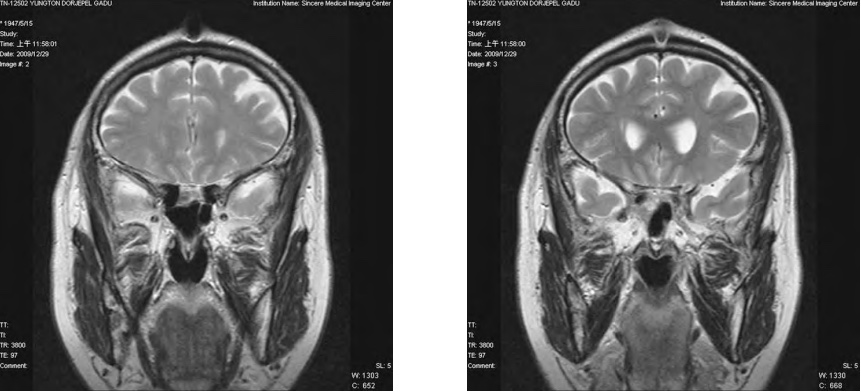
Several years later, in order to let living beings know the greatness of Buddha-dharma, on December 29, 2009, I took a magnetic resonance image (MRI) exam on my head at the Sincere Medical Imaging Center. The result showed a deep gap at the position of the Niwan Palace with a width of 1.5 cm. Also, the images captured the real situation of my spirit and consciousness rushing out of my head. The doctor conducting the examination was very surprised but was not able to explain it and attributed it to non-human cause. I was really very clear because this is where my nirmankaya came out and returned. Please see the scan films from my MRI exam.
Heaven Gate opening at the position of the Niwan Palace, side view
Heaven Gate opening at the position of the Niwan Palace, front view
My life journey has been accompanied by a multitude of disasters and suffering. Even though I protested and complained, I could never find the answer to why I had to endure so much. At the same time, I felt lost and was at a loss as to what my life path should be.
Perhaps, because I had suffered so much, the compassionate Buddhas and Bodhisattvas provided an opportunity for me to finally listen to the dharma discourse “Do you Truly Believe in Cause and Effect,” expounded by H.H. Dorje Chang Buddha III. From the unfathomable expanse of the universe to a minor thought rising from our consciousness, the law of cause and effect never errs. It became clear to me; all my trials and tribulations, from birth, were of my own doing since time immemorial.
I was born in a rural village to parents who did not receive much education. I was the second child and, because I was short, was nicknamed “the little one.”
One day, at the age of one, my parents had to work in the mountains, so they left me alone in the house. When I woke up, I climbed onto a table and knocked over a lantern, which fell onto my bed. The bed immediately caught fire as the whole house quickly filled with dense smoke. Our neighbor saved me from the fire just in the nick of time.
When I was three years old, I fell from the 3rd floor and struck my forehead on a rock just missing my eye. There was no surgeon to sew up my injury. Consequently, a deep scar would forever remain on my forehead. Later, for unknown reasons, I dislocated my shoulder and fractured a bone. At the time, the neighbors speculated that I would not remain in this world much longer. Not only were boys heavily favored over girls, but I was born in the year of the tiger. My family thought I would bring bad luck upon them. If not for my mother’s love and insistence, my grandfather would have given me away.
Later on, due to economic hardship, my parents travelled extensively to make a living for the family. I remained behind, in the care of relatives and neighbors, alternating from home to home.
I started to look after myself when I was only eight years old. I raised rabbits, a hen, and a pig. Finally, my grandfather took me in when I entered the third grade of grammar school. As young as I was at that time, I often wondered what was the purpose of living? Was there any purpose to life? To me, life felt like nothing more than chewing on bitter grass and swallowing acrid and nauseating liquid. I thought about gulping down pesticides to end my life, thinking there would be no more suffering after death.
Perhaps the benevolent Buddhas and Bodhisattvas instilled a reason for me not to take my own life – I would break my mother’s heart. I could not bear the thought of my mother suffering so much for my actions…
So I did not take my own life, but misery seemed to enjoy my company. How could my misfortunes not be attributed to retribution for past transgressions? My suffering had nothing to do with unfairness or fate, but as the direct result of my past actions motivated by greed, hatred, and ignorance. The laws of cause and effect require there be no diminishment to retribution.
Through respectfully listening to dharma discourses expounded by H.H. Dorje Chang Buddha III , I finally realized that suffering was not imposed upon me by accident, but the unavoidable retribution of my past transgressions. The only way to steer clear of suffering and disaster is to undertake all righteous actions, regardless how minor, and avoid wrongdoing, no matter how minuscule. From the bottom of my heart, I repented all of my past wrongdoings and began facing every misfortune without fear. Life is but a dream; good fortune and suffering are equal in many ways, but for me, suffering carries even greater significance. It’s imperative to face the consequences of one’s own actions. Now, I am able to face them from a very different mindset. Suffering was the genesis that led me to understand why I need to learn Buddhism. From the teachings of the Buddhas, we discover the purpose and true meaning of life. To eliminate greed, hatred, ignorance, pleasure-seeking, happiness, anger, sadness, and joy; to let go of our egos; to guide and encourage more people to do all that is good and avoid committing wrongdoings. We shall follow the great teachings of H.H. Dorje Chang Buddha III to transcend from this mundane and afflicted world to reach true liberation and enlightenment!
Recently, I stumbled upon breathtaking plum blossoms while taking a walk. These delicate flowers evoked feelings of warmth and joy, reminding me of the arrival of spring. In Chinese culture, plum blossoms, beyond just being a physical flower, have become a symbol of perseverance and resilience in the face of harsh winter conditions. This significance was achieved through the extensive descriptions, sublimations, and chanting by literati and scholars over the ages. In ancient China, plum blossoms were considered a lucky symbol and were welcomed as a sign of the arrival of spring during the New Year.
When I was a child, my father taught me to recite the poem “Ode to the Plum Blossom” by Zedong Mao, reminding me to be fearless and strong like the plum blossom that blooms amidst harsh winter conditions. I really like the poem, and can still remember it.
Ode to the Plum Blossom
—to the tune of Bu Suan Zi
By Zedong Mao, December 1961
Wind and rain escorted Spring’s departure,
Flying snow welcomes Spring’s return.
On the ice-clad rock rising high and sheer
A flower blooms sweet and fair.
Sweet and fair, she craves not Spring for herself alone,
To be the harbinger of Spring she is content.
When the mountain flowers are in full bloom
She will smile mingling in their midst.
But after many years of struggles, I realized that bravery and strength aren’t always enough, especially in managing relationships and family. As a wife and mother, I learned the importance of being magnanimous, compassionate, forbearing, and not rigid. I have since embraced the peaceful and compassionate philosophy of Buddhism.
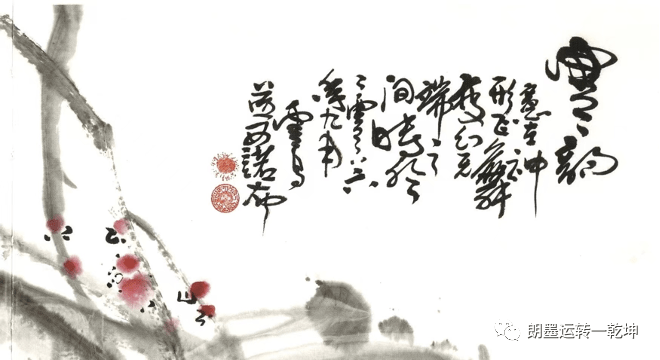
H.H. Dorje Chang Buddha III, the contemporary Buddha, wrote a poem “Plum Fragrance in the Holy Land.” He broke from traditional poetry styles, instead opting for surreal techniques to directly convey spiritual essence.
To the Tune of “Jiang Jun Song”
Plum Fragrance in the Holy Realm
Reveal her icy bearing and proud bones,
See how plum blossom commands the scene,
The crowd of beauties suddenly lacks color,
Seductive peach has lost its looks.
A few casual strokes,
So many eons of wind and dust.
The smoke and fire of the human world all disappears,
Leaving only a pure fragrance from the paper,
It wafts over me, awakening my mind.
The smile of the enchanted dream still remains,
Buddha Vajradhara has come
Three times to this world.
To this Buddha Land of merciful compassion
That great one has brought purity,
Feelings of the brush,
Traces of the brush,
One smile in the wind and dust,
Now the wind and dust,
So many eons of wind and dust.
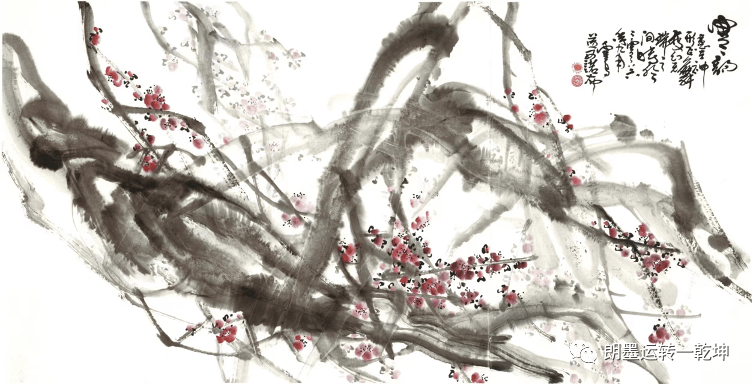
The Buddha also created an ink painting to accompany the poem. The poem delves deeper into the artist’s thoughts, while the painting provides a visual representation.
The plum blossoms depicted in the paintings symbolize the artist’s state of mind, embodying inner beauty refined from impurities. The brushwork, casually applied, was accomplished with an unfettered hand and detached mind, free of the slightest artificiality. It is a seemingly ever-changing work. Its charm, tone, transitions, and depictions represent the highest level of Eastern ink-and-wash paintings. A transparent layer of lighter ink on top of darker ink is clearly visible, imbuing the painting with a pure and fragrant air and providing the viewer with a feeling of comfort and ease.
The plum blossoms created by these skilled pens are eternal. While natural blooms may come and go, Buddha’s compassion remains steadfast.
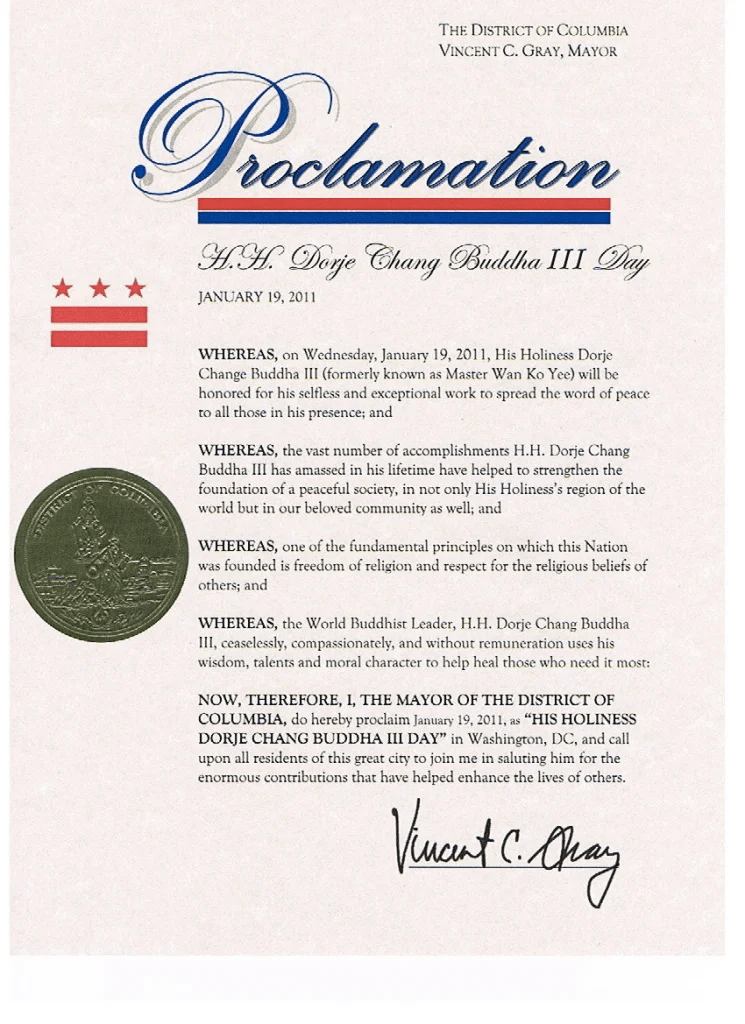
On January 19, 2011, Mayor Vincent C. Gray, the mayor of our nation’s capital Washington, DC, personally signed and issued a proclamation in which January 19, 2011 was proclaimed as His Holiness Dorje Chang Buddha III Day.
In that proclamation, Mayor Gray called upon all residents of Washington, DC to join him in saluting H.H. Dorje Chang Buddha III! The mayor stated that H.H. Dorje Chang Buddha III has, through his selfless and exceptional work, spread the word of peace to all those in his presence. The mayor commended H.H. Dorje Chang Buddha III for his vast accomplishments that have helped to strengthen the foundation of a peaceful society, in not only His Holiness’s region of the world but in the Washington, DC community as well. Additionally, Mayor Gray praised H.H. Dorje Chang Buddha IIIas the World Buddhist Leader who ceaselessly, compassionately, and without remuneration uses his wisdom, talents and moral character to help those in need.
The video below has a brief introduction of H.H. Dorje Chang Buddha III, that helps you to know some great achievements and teachings of the Buddha.
Buddha taught that all living beings have Buddha-nature, and that we shall treat them as family members and relatives. To celebrate this very special day, Hua Zang Si held a Dharma Assembly to release captive lives and pray for blessings at a beautiful port in San Rafael CA , on January 19th 2023. Many laypersons in the bay area and central CA participated the event.
Namo H.H. Dorje Chang BuddhaIII and Namo Shakyamuni Buddha taught us :”No matter where it is and when it is, if we see living beings in horrible fears and calamitous adversity, we must save them. Therefore, for any lives that are facing the urgent and terrible fear of going to be hurt or killed, we shall save them out and release them into an environment that suits them, so as to let them regain the freedom and be free from fears. There is a phrase that says, ‘I love to see them live, and I dare not see them die.’ Based on our compassion and empathy, we want to endow living beings with happiness and rid them of sufferings.
With the Dharma Assembly, participants returned the merit to all living beings, holding the hope that they shall be rid of suffering, obtain happiness, and have the opportunity to listen to authentic Buddha Dharma, perfecting fortune and wisdom, and leading to prosperity and peace throughout the world.
When I was respectfully on my knees and holding my palms together in front of my kind Buddha Master’s dharma seat for the first time, as soon as I raised my eyebrows to have my eyesight in a light contact with the loving, compassionate, and benevolent eyes of my Buddha Master, I immediately had the belief that my Master is a Buddha! However, my Buddha Master never stated to anyone what holy being he was in past lifetimes. Conversely, he always claimed to be a servant of everyone.
During the past ten years, I closely attended by the side of my Buddha Master and also carried out quite a number of Buddhist deeds following my Buddha Master. The holy states and holy realizations manifested by my Buddha Master such as proficient in both exoteric and esoteric Buddhism, perfect and deep mastery of the Five Vidyas, and great wisdom unrivaled by any human or holy beings are unprecedented in the history of both exoteric and esoteric Buddhism.
My firm belief of “My master is a Buddha” that I had in my mind for years was finally confirmed from the treasure book of H. H. Dorje Chang Buddha IIIthat was presented to the Congress of the United States by the International Buddhism Shanga Association on April 3, 2008. The identity of my Buddha Master, known by people in the world as Master Wan Ko Yee, was revealed through either meditation or practice of the dharma in a profound state of supernatural vision by the first-class great holy virtuous ones, who are incarnations of Buddhas and Bodhisattvas. They announced the background of H.H. Wan Ko Yeshe Norbu, who was long ago recognized by H.H. Great Dharma King Zunsheng (the manifestation of Mahavairocana Buddha) as Buddha Vajradhara. Through strict practice of the dharma and meditation these holy monastics deeply entered the dharma realm and supernaturally saw the true source. The result was they learned that this being of great virtue and holiness is the second incarnation of Vimalakirti and the third incarnation of Dorje Chang Buddha. They wrote down their certificates of recognition according to the rules of Buddhism in which they recognized that H.H. Master Wan Ko Yee is H.H. Dorje Chang Buddha III — the highest ancient Buddha in exoteric, esoteric, Mahayana, Hinayana, and Vajrayana Buddhism; the master of the Five Buddhas in the five directions; and the master of the great mahasattva Vajrasattva. That is, they recognized that H.H. Master Wan Ko Yee is the Holiest Tathagata Wan Ko Yeshe Norbu, the current greatest leader of Buddhism in the entire dharma realm!
Those eminent monks and dharma kings also wrote words praising H.H. Dorje Chang Buddha III as being the highest and greatest holy being and the only one in the history of Buddhism who has truly exhibited before living beings item after item of accomplishments in the Five Vidyas.
From that, I realized the truth behind what I experienced quite a few years ago when a huge and gigantic material, in less than two hours of time, became a piece of extremely finely carved and crafted miraculously wondrous holy Yun sculpture artwork. Such holy realization was just a manifestation of the craftsmanship vidya of the Five Vidyas by my magnificent Buddha Master, due to the affinity of living beings.
My Grand Master, H.H. Great Dharma King Zunsheng, stated in a formal pronouncement about my great and kind Buddha Master that the realization of any eminent monastic or person of great virtue in the world today cannot rival the realization of Holiest Tathagata Wan Ko Yeshe Norbu. H.H. Great Dharma King Zunsheng also made the following vow of truth: “If any person or holy being is able to duplicate the mysterious sculpted treasures created by H.H. Wan Ko Yeshe Norbu, then this formal pronouncement of Great Dharma King Zunsheng has deceived the public.” (The mysterious sculpted treasures are “Enchanting Colors of Utmost Mystery,” “Mysterious Boulder with Mist,” and certain other Yun sculptures with specific names.)
Yun Sculpture by H.H. Dorje Chang Buddha III
According to the system and rules of Buddhism in this world, there are only two beings of great holiness whose expositions of the dharma can be categorized as sutras. One of them is Sakyamuni Buddha. The other is the holy and venerable Vimalakirti. Besides those two, all other expositions of the dharma can only be called commentary rather than sutras. This is true no matter how great the Bodhisattva who has expounded the dharma is.
Some people say that Hui Neng (the sixth patriarch master of the Zen School) gave the Platform Sutra of the Sixth Patriarch. Actually, the word sutra was used due to exaggerated praise given to Hui Neng by people of the world who did not understand the system and rules of Buddhism. The rank of the sixth patriarch was even lower than that of many Bodhisattvas. For example, Maitreya Bodhisattva is the next Buddha, who will conduct the Dragon Flower Assembly. The position of Maitreya Bodhisattva is very much higher than that of Hui Neng. However, expositions of the dharma given by Maitreya Bodhisattva cannot be called sutras. They can only be accepted as commentary. An example of this is the Yogācāra-bhūmi-śāstra. (Discourse on the Stages of Concentration Practice)
The holy and venerable Vimalakirti descended into this world during the time of Sakyamuni Buddha. He is the only ancient Buddha who transformed into a layman to expound the dharma. Sakyamuni Buddha personally taught the four types of disciples. Among them were the 500 monks who were difficult to teach and who did not want to arouse Mahayana bodhicitta. A skillful means was used to teach all of the monastics and 8,000 Bodhisattvas. After the ancient Buddha Dorje Chang expounded dharma in Abhirati (World of Wonderful Joy), the Buddha responded to karmic conditions by transforming into the holy and venerable Vimalakirti to help the Buddha teach the sangha, Bodhisattvas, and other disciples. The goal was to protect and uphold the Buddha-dharma taught by Sakyamuni Buddha. The level of realization attained by the holy and venerable Vimalakirti was the same as that attained by Sakyamuni Buddha. However, He did not want to assume the status of another leader of the religion in the human realm, thereby causing sectarianism and adding to the self-centeredness of practitioners. Considering that Sakyamuni Buddha became a Buddha in this earthly World, the holy and venerable Vimalakirti acknowledged Sakyamuni as Buddha and chose to assist Sakyamuni Buddha by manifesting as a Bodhisattva.
Thus, the holy and venerable Vimalakirti acted in the same way that the ancient Buddha Zheng Fa Ming (True Dharma Brightness) Tathagata acted when the Buddha transformed into Kuan Shi Yin Bodhisattva and also acted in the same way as Manjushri Bodhisattva, the Master of seven Buddhas, did to play the role of a Bodhisattva to support Sakyamuni Buddha. All of this was done to benefit living beings. If two Buddhas of the same rank appeared at the same time, it would cause worldly divisions. It would hinder the development of Buddha-dharma and the saving of living beings. Actually, Buddhas do not care who emerges as the leader of Buddhism. The Buddhas appear in whatever form and manner that best benefit living beings. Everything is done for the benefit of living beings based upon bodhicitta.
Therefore, people in general have no way of discovering that the realization and enlightenment of the holy and venerable Vimalakirti were that high and that He was the incarnation of Dorje Chang Buddha, the foremost ancient Buddha who existed before Sakyamuni Buddha. However, the dharma discourses of the holy and venerable Vimalakirti are sutras, just as the dharma discourses of the Buddha, not commentaries. In the system of Buddhism, one such discourse is called Vilmalakirti-nirdesa Sutra (The Sutra of Vimalakirti). That sutra came into being during the same time period Sakyamuni Buddha was giving sutras. It is a very important Buddhist sutra. The Vimalakirti-nirdesa Sutra has been studied and followed in both Mahayana Buddhism and Hinayana Buddhism that was mostly propagated in Southern Asia.
When H.H. Dorje Chang Buddha III was born, the beating of drums suddenly sounded in the sky, and beautiful, heavenly music could be heard. Three rainbows approximately forty to fifty meters (131-164 feet) apart appeared simultaneously in the sky. The middle one was primarily blue, the right one primarily red, and the left one primarily white. At birth, the entire body of His Holiness was dark blue. No cries from His Holiness could be heard. Rather, His Holiness opened his mouth and very clearly stated, “I have entered this world. I am completely proficient in exoteric and esoteric Buddhism and will wondrously manifest the Five Vidyas. Compare and you will know.” After speaking such words, His Holiness remained silent and appeared just like an ordinary child. The parents of His Holiness thought that they had given birth to a mysterious and extraordinary human being but did not tell anyone about this. His Holiness did not speak again until He was three years old.
When His Holiness was three years old, H.H. Mahavairocana Dharma King Zunsheng guided His Holiness in learning the Tripitaka. At that time, His Holiness was taught to recite the heart mantra of Dorje Chang Buddha seven times. This little child suddenly laughed heartily and immediately manifested the Three Bodies and Four Wisdoms. H.H. Great Dharma King Zunsheng at once tested His Holiness’s knowledge of the Tripitaka and the esoteric scriptures. The Dharma Prince child explained such writings with great facility. There was nothing in them that His Holiness did not understand. His Holiness had realized all of the doctrines and principles of such teachings.
H.H. Mahavairocana Dharma King Zunsheng then gave the following formal pronouncement: “Dorje Chang Buddha has come to this world a third time. The holy and venerable Vimalakirti has descended from the skies a second time. He completely understands the scriptures on the dharma. His Four Wisdoms are wonderfully perfect. He is an ancient Buddha upon whom living beings can rely. No master is qualified to teach Him. His mysterious sculpted treasures will be spectacular and unique in the world. He will be able to take mist that will stay inside His sculptures. He will manifest His realization and consummate skills. No holy person in the world will be able to duplicate such works. If anyone will be able to duplicate such works without differing from the original at all, my words have deceived the world. Vimalakirti Wan Ko is Buddha Vajradhara. He will cause the Buddhas to bestow nectar that many will see descend from the sky. He is of utmost benefit to sentient beings. He has the compassion and wisdom of an ancient Buddha. I hereby reveal these words to prove the veracity of my formal pronouncement.” H.H. Mahavairocana Dharma King Zunsheng also gave His Holiness the dharma name Yangwo Yizhi Dharma Prince, which means Dharma Prince supreme leader of Buddhism with the highest wisdom.
H.H. Mahavairocana Zunsheng then said, “During the Dharma-Ending Age in the earthly world, there will be many evil teachers and demons who will claim to be genuine holy persons. In order to distinguish the genuine from the false, I now make a strict formal pronouncement that will serve as the testing standard. The pronouncement is as follows: There will not be a fourth incarnation of Dorje Chang Buddha in this earthly realm within the next 5,000 years. The third Dorje Chang Buddha will be the only such holy being, and there will not be an incarnation of another Dorje Chang Buddha in this earthly realm for 5,000 years. Based on causes and conditions that accord with the dharma, I now lay out tests to determine whether a person is that true Buddha if he claims to be the true incarnation of that Buddha. He must successfully invoke the Buddhas to bestow nectar. He must be able to perform the Golden Vase Selection of Karmic Affinity and predict the results of that ceremony beforehand. He must be able to eliminate karmic obstructions in a clearly visible manner. He must be able to replicate wondrous multicolored sculptures. He must be able to take mist, place it inside a hollowed out sculpted boulder, and have the mist stay there. If a person is able to do all five of these things without exception, then he is the true fourth Dorje Chang Buddha. No matter how great a holy terton may be, no matter if a person leaves concave imprints on rocks with his hands or feet, no matter how vast a person’s manifold supernatural powers may be, if he cannot do these five holy things, then he certainly is not the true incarnation of Dorje Chang Buddha. An ancient Buddha who descends to this earthly realm will have no difficulty meeting these five tests. I leave these five observable tests to guard against those in the future who make false claims.”
The Dharma Prince was acting as the holy and venerable Vimalakirti did when Vimalakirti received different teachings and knowledge, took on the appearance of an ordinary person, and learned things tirelessly. No one knows why the Dharma Prince did so. At the age of sixteen, the Dharma Prince wrote a work on the dharma called A Monk Expounds the Absolute Truth to a Layperson. After that writing was buried, great master Hui Yong unearthed it. Renqing Luozhu and Suolang Danbu respectfully offered that writing to H.H. Mahavairocana Zunsheng Yeshe Norbu to evaluate. H.H. Zunsheng Yeshe Norbu personally promulgated that dharma called A Monk Expounds the Absolute Truth to a Layperson in front of the four types of Buddhist disciples. After He finished promulgating that dharma, He personally led the four types of Buddhist disciples in kneeling down and facing that writing on the dharma. He then made the following formal pronouncement: “An ancient Buddha has arrived in the east.” He recognized that the Dharma Prince was H.H. Dorje Chang Buddha III, conferred upon His Holiness the title Yangwo Wan Ko Yeshe Norbu, and said that His Holiness is the Holiest Tathagata. He also called that dharma A Monk Expounds the Absolute Truth to a Layperson Sutra.
There are certain time periods relating to H.H. Dorje Chang Buddha III ’s propagating the dharma and benefiting living beings. Before the age of eleven was the period during which His Holiness was engaged in the Tripitaka of exoteric Buddhism. From the age of eleven to fifteen was the period during which His Holiness was engaged in the esoteric dharma of the Kagyu school. During that time, he was called Dusum Khenpa Lion’s Roar Dharma Prince. After the age of fifteen was the period during which His Holiness was engaged in the esoteric teachings of the Geluk school. His Holiness was at that time called the reincarnation of Master Tsongkhapa. That was also the time period during which His Holiness flawlessly propagated the tantric scriptures of the Sakya, Nyingma, and all of the other schools. At this time, His Holiness was called the embodiment of the body, speech, and mind of Guru Padmasambhava.
Because my Buddha Master is an ancient Buddha who has come to this world again, His Holiness upholds the principles of “making no distinction between exoteric and esoteric Buddhism or among all of the sects and schools; teaching living beings according to their particular circumstances; and pervasively propagating the teachings of the Buddhas to all.” Thus, His Holiness is the Buddha Vajradhara Great Dharma King of the “Buddha Sect” who pervasively saves all living beings. My Buddha Master has repeatedly admonished everyone with the following counsel: “There is no differentiation among the various schools and sects in my mind. There is only Buddhism. However, for a dharma king, rinpoche, or acharya of any school or sect, as long as he or she does not commit violations in the 128 evil and erroneous views, abides by the teachings of the Buddha, attains liberation, and then saves other living beings based on their particular karmic conditions, he or she is worthy of praise.” Of course, The Supreme and Unsurpassable Mahamudra of Liberation is the greatest dharma among supreme great dharmas for cultivators to receive and practice. That is why my Buddha Master is the only one in this world possessing the realization of opening up the Niwan Daoguo for all kinds people to enable them to attain heavenly and holy states.
[Please respectfully read in detail the treasure book of H. H. Dorje Chang Buddha III to acquire great wisdom, accomplishment and liberation. If you have the affinity to receive and practice the dharma of The Supreme and Unsurpassable Mahamudra of Liberation, you will be certain to get great wisdom and attain great accomplishment and liberation.]
At the beginning of the new year, I try to think of how to improve my life spiritually. Some beautiful lines by James Allen come to mind.
“Good thoughts and actions can never produce bad results; bad thoughts and actions can never produce good results. This is but saying that nothing can come from corn but corn, nothing from nettles but nettles. Men understand this law in the natural world, and work with it; but few understand it in the mental and moral world (though its operation there is just as simple and undeviating), and they, therefore, do not cooperate with it.”
“A man is literally what he thinks, his character being the complete sum of all his thoughts.”
These words are indeed very inspiring. Mind is the control center of one’s words and actions. I want to be a better person that talk nicely, act kindly, then I should have beautiful mind.
An ancient chinese worthy, Zeng Zi said, “Everyday I examine myself many times. Do I do my best when doing things for others? Am I honest and reliable when associating with friends? Whether do I review and practise what my teachers teach me?” In traditional Confucianism teaching: Everyday, one should brush away the faults from yesterday, not to tell lies and be humble. One should purify the heart and rectify the mind, to confront genuinely, and start afresh. Thus, one will be renewed every day and have daily renovation, this is the way to be a new man. This old wisdom is very helpful on how to examine my mind daily.
However, in this modern era, there is so much informations from everywhere all at once, and I have a lot of thoughts in my mind. I have pondered more about what are the good thoughts and actions, and what are the bad. Every civilized culture in the world has adopted similar standards for its people based on this inherent understanding of good and evil. Murder, theft, and deceit are universally understood to be wrong. I keep on searching in Religions for a better answer.
In christianity: As darkness is defined by the absence of light, sin is defined by the absence of goodness (James 4:17). Since God is the very embodiment of good (Psalm 86:5; 119:68), anything contrary to His nature is evil (Romans 3:23). We learn to distinguish good from evil by getting to know God. His Word is the foundation for understanding Him (Psalm 1:1–2; 119:160; John 17:17).The closer we draw to the holiness of God, the worse sin appears (Isaiah 6:1, 5). A t-shirt may appear white against a black wall. But when you place that shirt on newly fallen snow, it appears quite dingy. Similarly, our attempts at goodness look quite dingy when placed next to the holiness of God. As we enter His presence, we start to notice how self-centered our thoughts and actions are. We see our own greed, covetousness, lust, and deceit for the evils that they are. It is only in God’s light that we begin to see ourselves clearly.
God’s Word is filled with examples of those who did right and those who did wrong. Those examples are there for us to learn what God is like and what He desires from us (1 Corinthians 10:11). Micah 6:8 gives a brief summary of God’s desire for every person: “He has shown you, O mortal, what is good. And what does the LORD require of you? To act justly and to love mercy and to walk humbly with your God.” Malachi 3:18 makes it even clearer. God says, “And you will again see the distinction between the righteous and the wicked, between those who serve God and those who do not.” Here the Lord is equating righteousness with serving Him. If good is defined as serving God, then evil is rejecting God and refusing to serve Him. Regardless of how philanthropic a person may appear to others, his good works amount to little if they are done for selfish reasons. If we make it our goal to seek God and honor Him in everything we do (1 Corinthians 10:31), we will understand right and wrong and know that our life choices are pleasing to Him (Jeremiah 29:13; 1 Peter 3:12; Psalm 106:3).
In Buddhism, Buddha provided more precise and broad concepts on what are right. Such as the ten precepts: (1) not killing; (2) not stealing; (3) not committing adultery; (4) not lying; (5) not speaking harshly; (6) not speaking divisively; (7) not speaking idly; (8) not being greedy (9) not being angry; (10) not having wrong views.
In Learning From Buddha, Namo Dorje Chang Buddha III says:Establish great compassion as your foundation. Do not do anything that is evil. Do all things that are good. Give up self-interests and benefit others. Patiently endure humiliation and adversity. Practice humility. Purify the mind. When encountering living beings, regardless of whether they are handicapped, deficient, sick, or healthy, treat them all equally as family members. Know that all phenomena are governed by causality. With good causes, you receive good retributions. Good retributions yield good fruits. Good fruits enable you to receive the true Dharma. Relying on the Dharma, you can achieve perfect good fortune and wisdom. Then you can step into the state of accomplishment, break away from the sufferings that living beings experience, cease transmigrating in the cycle of birth and death, and accomplish the perfect enlightenment of a Buddha!
Namo Dorje Chang Buddha III further more provide a guidance on our mind cultivation — the three daily introspections :“Before I went to sleep at night, did I think of anything unbeneficial to living beings? Did I think about doing those things? Did I think of doing something not good to others for the sake of myself, my children, or my relatives? Did I think of doing something not good to my fellow brothers and sisters? Did I crave credit or merit for myself? If I did, I must repent at once, I must correct myself! By doing that every day, I will naturally and gradually become purified and will become a great holy person.”
This year I will try my best to follow his guidance diligently, eliminate all my wrong thoughts, build a beautiful garden in my mind, and be kinder in my speech and conducts. Love all beings equally, do not have discriminate against other countries and peoples in the world. Wish peace, harmony and good fortune to all.
In the beginning of 1999, a short trip of pilgrimage to the Buddhist holy sites in ancient India gave me the second feeling of returning home. In particular, when we were all prostrating around the Buddha’s Nirvana Temple in Kushinagar and respectfully lighting up 108 lights during the morning practice, suddenly dharma joy grabbed my entire body. I felt pleasantly serene and happy as if I was at the side of Sakyamuni Buddha. The feeling of coming back to home was so good! However, this was only a feeling from my emotions. I did not reach enlightenment in Buddha-dharma. There was no realization power to talk about. I kept asking myself whether this was due to my heavy karmic blockage. Otherwise why didn’t I receive practical benefits from the practice of meditation and some other dharmas? The more I thought about this, the more I felt that I was a very inferior person. The more inferior I felt, the more I was determined to learn and master Buddha-dharma.
One day, I received a copy of the book True Stories about a Holy Monk from a fellow Buddhist friend. I opened the book and started to read. Upon reading into the section about Buddha bestowing nectars, I suddenly entered into a somewhat dazed state of mind. The holy scene of Buddha bestowing nectars emerged in my mind. Such impression appeared real but was illusionary, gave the feeling of between existence and non-existence, was felt like my own experience and lasted a long time before disappearing. There was an indescribable joy in my mind. From that, I was sure that this is the true Buddha-dharma and is truly what I should quest for, rely upon and practice. After reading the book, I often felt in my mind an urge of wishing to meet and pay respect to the great holy one in person as early as possible. On the other hand, I also felt sad for the expected departure from the monk students at the Buddhist Academy whom I supported for quite a few years.
One day, on my way to work in the morning, this question came to my mind again. I suddenly felt a lump in my throat and tears gushed out from my eyes. I uncontrollably burst into a big cry. I managed to hold off my feelings to drive into the underground parking lot of my company. Once the car stopped, I could not control my emotions any longer and I cried for 20 minutes in the car. My eyes became swollen. I repeatedly beseeched Kuan Shi Yin Bodhisattva to empower me and point out my way. After a while, I thought that for a person with such heavy karmic blockage, how could it be possible for me to receive empowerment and guidance from Kuan Shi Yin Bodhisattva?
I put on a pair of sunglasses and went into my office. I sat on my chair with my mind being blank. Within five minutes, my secretary came in and asked me if I wanted to answer a phone call from a fellow Buddhist sister. I said yes. Once I picked up the phone, from whatever she told me over the phone, the only thing I could remember was “Brother, would you like to go on a trip to pay respect to the great holy master?” At that time, I happily answered, “Yes, Yes, I do!” I immediately prostrated on the ground with my palms together to thank Kuan Shi Yin Bodhisattva for pointing out the path for me.
I flew across the Pacific Ocean to the United States to pay respect to my greatest and kindest Buddha Master, H. H. Dorje Chang Buddha III, in the end of 1999. When I respectfully presented my offering gift as homage to the dharma with a pure white hada in prostration, my heart was beating heavily and my eyes dared not face upward. However, with only one brief peek, I felt enlightened right away. My instinct told me that this great holy being in front of my eyes is a Buddha! At the instant when the Buddha’s eyes were staring very benevolently at me, I felt that an extremely strong force of empowerment was transmitted from the top of my head into my entire body. My whole body felt very warm. This time I really came back home! I felt extremely confident and tears flooded out of my eyes. I did not have enough words to describe the dharma joy I had at the time.
After I had calmed down my feeling, my Buddha Master spoke to me, “Weren’t you looking at the sky since your childhood to search for answers? I will tell you now.” My Buddha Master told me the important affinities in my current life as well as the affinities between my Buddha Master and me from the past lifetimes. My Buddha Master also told me to buy an alms bowl and bring it back immediately. I and Henghsing Gyatso Rinpoche immediately bid farewell to my Buddha Master and left. We asked a fellow sister to drive us to a shopping mall to buy an alms bowl. Because of our unpreparedness, we could not find the alms bowl we needed. In the end, I had to buy a porcelain soup bowl with cover and came back. My Buddha Master looked at it and then asked Henghsing Gyatso Rinpoche who took me to buy the bowl whether he had provided any suggestion or advice to me. Henghsing Gyatso Rinpoche answered, “No, I did not. He chose the bowl and bought it on his own decision. I did not do anything for him.” At that time, I presented the bowl to my Buddha Master. My Buddha Master told me, “Do not hand it to me. I will not touch your bowl. You go and fill it with water by yourself.”
I immediately washed clean the porcelain bowl I bought with pure water and wiped it dry with the hada. Then I, by myself, filled it with pure water and respectfully laid it on a square dharma table that was before us. My wife and I prostrated in front of the dharma table. We respectfully held our palms together and kept chanting “Om, Ah, Hum!” My Buddha Master was at a distance of more than three meters from us and conducting the dharma at the top of a tall dharma rostrum. Not long after, at my Buddha Master’s dharma decree, bodhi holy water penetrated the side of the bowl and flowed out. I saw with my eyes that dharma water permeated through the surface of the porcelain bowl filled with pure water and flowed onto the table. At this time, at every dharma decree from my Buddha Master, the dharma water flowed to the left, right, or forward, exactly as instructed. My wife and I gazed at the scene and were simply speechless. My Buddha Master told us, “I will use this bodhi holy water to set up the mandala to guard against demons from stealing the dharma. I am going to perform an initiation for you two.” After that, my Buddha Master sprinkled dharma water around the perimeter of the mandala (Buddhist altar for transmitting Buddha-dharma or worshipping Buddhas and Bodhisattvas) to prevent evil beings and demons from listening to the Tathagata Dharma. Then the ceremony of initiation started. At the moment of dharma water sprinkling down to my head, I felt an extremely pleasantly cool feeling of empowerment that was pouring from the top of my head to my heart. The dharma joy I experienced at the time cannot be described in written languages.
During the six years before meeting my kind Buddha Master, because of my foolishness, deep and heavy attachment to the self and various types of ignorance, I created much dark karma. Consequently, my health was deteriorating steadily as time went by and eventually had to be sustained by medicine and the injection of placenta extract. My complexion was black and dark. Upon seeing me for the first time, my Buddha Master told me, “Your health is not good. I will teach you a dharma now. You should make a good effort in practicing it. You will get well.” In the years since then, I cultivated by adhering to the teaching and practiced according to the dharma. Miraculously, my health has recovered completely. From the year end of 2002 until now, I have not had much illness to speak of. Except going to the dentist office once a year to clean my teeth, I did not visit any hospital or clinic. For a 1,000-mile long-distance driving of 16 hours from Los Angeles to Portland, Oregon, I drove by myself without a stop and did not even feel tired. All these come from the empowerment of the great Buddha-dharma from my Buddha Master!
Before respectfully meeting my Buddha Master, I heard that my Buddha Master had been living in a room on the second floor of a fellow brother’s home, where the space is small. My wife and I immediately had the idea of offering a house to my great and kind Master, for propagating Buddha-dharma in America. Upon being led into the mandala where we became my Buddha Master’s disciples, the wish of offering the house emerged immediately. We respectfully reported to my Buddha Master and beseeched my Buddha Master’s benevolence to accept it. However, while my wife and I respectfully stated what we intended to present, my Buddha Master replied, “I accept your sincere wish but I do not accept the house. However, I will temporarily stay in your home for two years.” My Buddha Master’s discourse made me very surprised. For years, I had been cultivating and practicing in exoteric sects of Buddhism. I supported and made offerings to many monks, dharma masters and major temples. I never received a response like that. The conduct of the Buddha is so pure, selfless, faultless and great as to beyond my imagination. Later on, I also made offerings of great sums of money. My Buddha Master also declined them all. Where in the world can you find such person? There is no such eminent monk even among eminent monks. Only Buddhas and Bodhisattvas in Buddha-land possess such holiness and pureness.
This December 4th, a Dharma Assembly for the Holy Birthday of Amitabha Buddha was held at Hua Zang Si, located at San Francisco. About two hundred people attended the assembly. The weather was very sunny, clean and fresh after heavy rain the day before. It was a very happy time. Ever since the pandemic period started, Hua Zang Si has been closed to the public. This was a precious opportunity for buddhist disciples to get together.
The main venue was held at the second floor of the temple, the Amitabha Buddha Hall. The twenty-one foot tall statue of Amitabha Buddha (designed by H.H. Dorje Chang Buddha III) has been generally recognized as the most majestic Buddhist statue in the world. It is an extremely solemn sight. The Buddha’s eyes seem alive, looking down at all beings full of compassion and love.
First we chanted Buddha Expounding Amitabha Sutra,then we made the meal offering to the Buddhas and Buddhisattvas, at the end Master RuoHui RuZun gave us a short Dharm speech and we all prayed to the Buddhas and Bodhisattvas to grant blessings and protections to all beings in the world.
Amitabha Holy Birthday Assembly at Hua Zang Si
I greatly enjoyed the assembly, so much so that after it ended I still didn’t want to leave. I stayed and helped to clean up the site. I also prostrated to the Amitabha Buddha and kneel down and pray wholeheartedly: Please Buddha save me from the birth-death cycle, please take me to the western paradise.
I always wondered how this magnificent Amitabha Statue was installed in the hall. I found out an amazing story behind it. The sitting statue of Amitabha Buddha is inside the grand hall on the second floor. The statue of Amitabha Buddha was paid for with H.H. Dorje Chang Buddha III‘s money from selling his paintings. The molding of the statue was also based on the blueprint drawn by the Buddha. During the process of molding, H.H. Dorje Chang Buddha III modified the model eight times in person. All places that did not conform to the stipulation of the dharma were corrected and re-molded. After the completion, this statue was judged to be the most solemn Buddha statue in the world. The height of the statue of Amitabha Buddha was 6.7 meters (22 feet) and two narrow stairways with 180-degree turns have to be passed to go upstairs, the manufactured Buddha statue had to be first cut into several pieces and reassembled together after moving onto the second floor. Therefore, this statue was divided into seven parts and shipped in three containers to Hua Zang Si (the temple).
After the Buddha statue was unloaded, everyone in the temple were participating in carrying each part of the statue respectfully and carefully to the second floor. We were surprised to find that the sizes of the seven components all fit correctly into the narrow space in the stairway and all turns were made smoothly on the way to the second floor. In addition, there was no damage to the surface paint coating or any other place of the Buddha statue, thanks to the blessings from all Buddhas and Bodhisattvas, as well as dharma protectors.
The process of installing the Buddha statues into seats and surface gold-gilding went very smoothly. There were no signs of reassembly. We all happily stood in front of the Buddha statues with unlimited reverence in our minds. Such solemn grand Buddha statue can only be seen at Hua Zang Si in San Francisco of America, because it was made under the personal guidance from H.H. Dorje Chang Buddha III!