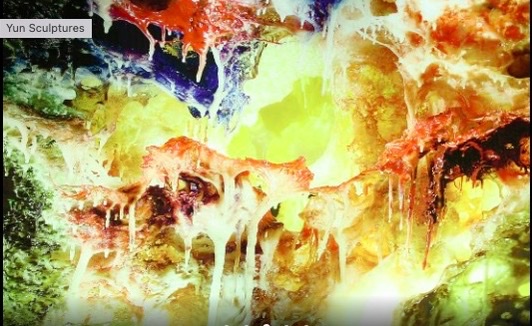
Yun Sculpture is a new form of art that H.H. Dorje Chang Buddha III created for humanity. It has never appeared before in history. Since the advent of Yun sculptures, artwork that can never be duplicated has appeared for the first time in the human world.
H.H. Dorje Chang Buddha III created these miraculous sculptures containing mysterious mist in order to make people around the world understand the magnificence of the True Buddha-dharma. These miraculous works can be seen and touched. However, they cannot be created by anyone who is not a being of the highest holiness.
The mysterious mist in these sculptures can be found floating among wondrously carved, seemingly changing, and intriguingly interconnected hanging rock formations. Why is such art called sculptures containing mysterious mist? It is because in those sculptures there is the mysterious and beautiful scene of auspicious mist swirling in between hanging rock formations. This is a manifestation of the realization of H.H. Dorje Chang Buddha III in the craftsmanship vidya and the inner realization vidya.
In the treasure room of International Art Museum of America, there is a sculpture entitled “Mysterious Boulder With Mist.” After carving the material into the form of an oval boulder, H.H. Dorje Chang Buddha III created two grottoes inside the boulder, each of which contains its own scenery. When you look inside the right grotto, you will see thick mist enveloping everything. The structure of the carved scenery inside this hole is vague, since it cannot be clearly seen through the mist. You are left with the impression that the mist is a few dozen yards deep inside the hole when it is actually only three or four feet deep. When you look inside the left grotto, you will see that there is no mist at all. You will clearly see the structure of the carved scenery inside this hole. The material used to carve those two grottoes was the same, the colors applied to both of them were the same, and their depth is the same. The carving skills and inner-realization of H.H. Dorje Chang Buddha III caused this mysterious phenomenon of one side containing thick, enveloping mist and the other side containing no mist at all.
Mysterious Boulder with Mist
It is no wonder that people praise these sculptures containing mysterious mist as the only form of art in human history that contains natural mist. People also praise them as unique and precious masterpieces that cannot be found in nature. These works of art are one type of sculpture created by H.H. Dorje Chang Buddha III.
Many people have been astonished by the breathtaking beauty of Yun sculpture artwork created by H.H. Dorje Chang Buddha III. They spoke heartfelt words, such as, “This is a treasure sent to the human world from God,” “This is a holy object from a Buddha-land brought here by a Buddha,” “Its beauty captures people’s souls,” and “Since the appearance of Yun sculptures, earthly jewels are like stars surrounding a bright Moon, losing all their color and splendor.” This is indeed true. Some people brought the most exquisite jade and jewelry as well as splendid stone sculptures for comparison. All of those objects immediately lost their beauty and luster when compared with Yun sculptures. There is a world of difference between those objects and Yun sculptures. None of those objects can be regarded as being in the same category as Yun sculptures.
Green Tara (Jetsun Drolma) statue from the Gyantse Kumbum Pagoda, Pelkor Chode Monastery, Gyantse, Tibet
H.E. Tangtong Gyalpo Bodhisattva (1361-1485)
It is through the understanding and practice of the Buddha-dharma that one becomes a holy person–a living jewel. Sainthood in Buddhism has a somewhat different meaning than that held in Christianity although both refer to people who live an exceptionally holy life, are very compassionate, and can demonstrate certain “miracles.” In Buddhism it also means one who has become enlightened—been liberated from the cycle of reincarnation and all its related suffering. The Christian saint aspires to be born in the Christian heaven, but this is not the goal of a Buddhist. A Buddhist saint is one who has escaped samsara or existence all together and gone beyond what is possible in the heavenly realms. A Buddhist saint would live in the Dharma realms or wherever he choses to be to help living beings. A saint in Buddhism is one who, like the Buddha, has become enlightened and realized his or her original nature, possessing the skills and wisdom of a Buddha. They have gained control over life and death and are thus liberated from the cycle of reincarnation. This is true happiness!
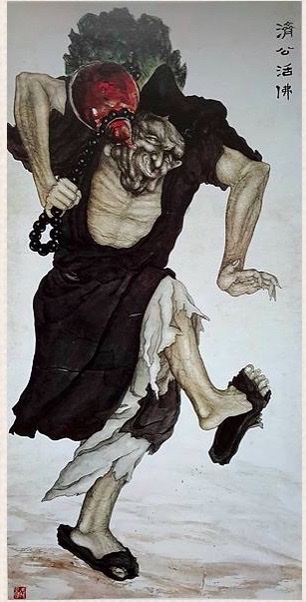
In Buddhism saints may not lead what is normally thought of as a “conventional” life. There are many examples of Buddhist saints who exhibited most unorthodox (“deliberate“) behavior. Examples of these kinds of happy, crazy saints are Han-shan and Shih-te, eccentric Ch’an (Zen) hermit-monks from Tang Dynasty, as well as Monk Ji-gong and Birdnest Roshi, but there are many others including the crazy yogis of Tibet like Padmasambhava, Virupa, Manjusrimitra, Tsang Nyon Heruka, and Tangtong Gyalpo. Saints can manifest in innumerable forms and may appear as humans or animals or live in other dimensions.
Japanese hanging scroll by Hashimoto Gaho of Han-shan and Shih-te (Kanzan and Fittoku), eccentric Ch’an (Zen) hermit-monks from Tang Dynasty, whose poetry is popular in the west.
It is important to know that one cannot fully understand what takes place on higher levels of the path. For example, those on the first Bodhisattva stage do not know about what takes place on the second Bodhisattva stage and so on up the path. Those on the second Bodhisattva stage see those on the first Bodhisattva stage as having impurities. Even those on the tenth Bodhisattva stage see those on the ninth Bodhisattva stage as having certain impurities. It is natural that the impurities and obscurations of those on the lower levels would be greater than those at the higher levels. Nevertheless, those who are kind and benefit others can guide and transform living beings no matter where they are on the path. However, ordinary beings and those at the lower levels of the path cannot possibly understand the behavior of true holy beings.
The key features of the various paths to becoming a holy being are summarized in the chart “The Way to Become a Holy Being or Saint.” It is useful to think of these paths as stages on the way to becoming a Buddha. It is interesting to note that the other world religions are also included as initial stages on the way to buddhahood in as much as they teach compassion, loving kindness, some aspects of morality, and discourage evil. Some also teach various forms of training the mind in meditation. Bodhisattvas do not only incarnate as Buddhists to help living being. The three pure precepts of Buddhism—cease evil, do good, and help others—can be practiced in many forms.
You must remember that ALL sentient beings are evolving toward the perfection of being a Buddha, whether they know it or not, and whether at the moment they may be very confused and behaving in foolish or even evil ways. This includes the minions of Mara and the demons of hell as well as the devas or gods in heaven.
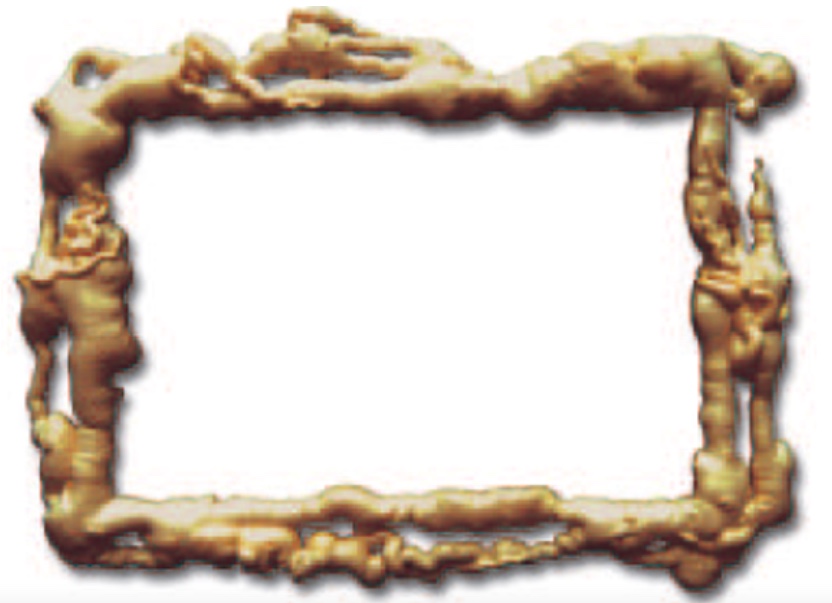
From ancient times to the present, the art of making frames has existed in the East, the West, regions of different nationalities, among the general population and within imperial palaces. There have been many kinds of frames for pictures, paintings, and other forms of art. There are truly unique, beautiful, and elegant art frames displayed in International Art Museum of America, located in San Francisco downtown, that I never seen at anywhere else before.
H.H. Dorje Chang Buddha III, the artist created sculpted art frames in the style of various natural elements. Examples of this include frames made in the style of ganoderma lucidum (a type of hard dark brown fungus supposed to possess supernatural powers), tropical plants that wind around trees, coral, ancient-looking unearthed cultural relics, white and green jade, and winding vines, faux withered vines, faux tree roots, faux white jade, faux old wood, faux spotted jade, faux ganoderma lucidum, faux red coral, etc. All frames there are artistic fascinating.
The ganoderma lucidum art frames are formed by putting together many of those hard mushroom-type fungi. Of course, such frames are not composed of real ganoderma lucidum. Rather, the ganoderma lucidum in such frames are created from carving and application of colors. The shapes of the Ganoderma lucidum are connected together on the wooden frame to form an exquisite, integrated shape. Those ganoderma lucidum have the same color, air, and shape of real ganoderma lucidum. Furthermore, rare thousand-year-old ganoderma lucidum, old hundred-year-old ganoderma lucidum, and new tender Ganoderma lucidum are interconnected to form an elegant and charming appearance. Many ganoderma lucidum mushroom caps and mushroom stems are interconnected in a beautifully rhythmic manner. The interchange between substance and emptiness, highness and lowness, largeness and smallness, and thickness and thinness creates a highly elegant appearance.
Reishi Mushroom art frame was sculpted and painted with oil colors. It captures the form and texture of reishi mushrooms and has the gracefulness of an aged cultural relic.
The faux green jade art frames have an ancient-looking green jade color to them that is steady and elegant. This color is not stale or old-fashioned in the least. Rather, it is a natural combination of refined blackish green and sprightly verdant, although there is not much verdant hue. This color expresses the essence of old jade that has slowly matured over thousands of years, with a vigorous and spirited quality that is clearly seen. This refined green jade color will every now and again reveal a lustrous white, like the color of the feathers of immortal cranes. Such a mixture of hues truly transcends all traces of the mundane. The color green alone could be further divided into many different types based upon its various hues. There is aged green, light green, blackish green, glossy dark green, pastel green, verdant, fresh green, deep green, translucent green, etc. There actually are countless gradations of green in these art frames, all of which are natural looking. All of these various shades of green interconnect and interact so naturally there is not the slightest sign they were created by man. Therefore, it is difficult to fathom how the creator of these frames could harmonize these colors so masterfully, fittingly, flawlessly, and beautifully.
Faux emerald-jade art frame has the pattern, color watery tone, and texture of real jade This is a faux natural tree-root art frame, has the pattern, color, and texture of real tree roots
Each and every detail of the frames in the museum, expresses an extremely natural quality in both form and spirit. Some frames are devoid of the dark spots or broken parts that natural objects have after being exposed to wind, frost, rain, and snow. His Holiness has developed to a perfect degree the depiction of the fleeting beauty that natural treasures display during their growth process. Simply put, the worth and prestige of any painting mounted to those frames will increase tremendously.
When the universe originated, it was boundless and everything was silent. There was no such thing as length of time or size of space. There was no shape and form, no interior and exterior, no birth and death. This is the dharmakaya (dharma body) Buddha. The true meaning of the dharmakaya Buddha is the concept of a universe that does not perish. This concept of a universe that does not perish is also called “dharmadhatu-tathata (dharma realm true-suchness),” which is Samantabhadra Tathagata (Adharma Buddha).
However, the dharmakaya Buddha only expresses the concept of the true essence of the universe; that is, not being born and not dying, not coming and not going. The dharmakaya Buddha has no form and does not speak. It has no way to communicate any meaning, such as meaning through images or meaning through language. Because of such karmic conditions, the formless dharmakaya Buddha generated the first sambhogakaya Buddha with form. This sambhogakaya Buddha with form transformed into Vajrasattva and other nirmanakayas.
In order to make a distinction between those three, the dharmakaya Buddha was named Adharma Buddha, the sambhogakaya Buddha was named Dorje Chang Buddha, and the nirmanakaya was named Vajrasattva. Actually, Samantabhadra Tathagata is Adharma Buddha and also is Dorje Chang Buddha. In truth, there are not two Buddhas. These distinctions resulted from there being a dharmakaya, sambhogakaya, and nirmanakaya.
Based on this dharma, Samantabhadra Tathagata did not directly incarnate. Even the ancient Buddha Dipankara and Vajrasattva were the nirmanakayas of Dorje Chang Buddha. Sakyamuni Buddha was a disciple of Dipankara Buddha. However, many sects list Samantabhadra Tathagata as the first Buddha who began all the lineages in the dharmadhatu. This way of thinking is actually not erroneous. That is because although Samantabhadra Tathagata is a dharmakaya without form and has no way of speaking, the origin lies with this dharmakaya from which the sambhogakaya Dorje Chang Buddha manifested. This sambhogakaya Buddha was the first one to spread the Buddha-dharma and save living beings in the three spheres of existence so that they would become holy beings.
Dorje Chang Buddha is also called Buddha Vajradhara or Ruler of the Vajra Beings. In the entire universe, Dorje Chang Buddha is the first Buddha with form and is the highest Buddha. That is, the highest leader of Buddhism in the entire universe came into being in the form of Dorje Chang Buddha. It was Dorje Chang Buddha who began transmitting dharma and saving living beings in the dharmadhatu. As a result, Buddhism was born and the Buddha-dharma began spreading.
The teachings of Dorje Chang Buddha led to many disciples becoming Buddhas. The five most famous among such disciples are Aksobhya Buddha of the east, Ratnasambhava Buddha of the south, Amitabha Buddha of the west, Amoghasiddhi Buddha of the north, and Vairocana Buddha of the center. There are also many other Buddhas and Bodhisattvas among the original disciples of Dorje Chang Buddha. Dorje Chang Buddha was the one who initially propagated the Buddha-dharma in the dharmadhatu. Dorje Chang Buddha is the supreme leader of all of Buddhism in the dharmadhatu.
The incarnation of Dorje Chang Buddha is different from the incarnation of any other Buddha. Such an incarnation is a primordial manifestation of the existence of Buddha-dharma. In each world of living beings, there can be at any one time only one incarnation of Dorje Chang Buddha, who manifests or expresses the existence of the true dharma. There will not be a second incarnation of Dorje Chang Buddha in the same age or era. Only after the first incarnation of Dorje Chang Buddha leaves the world can the second incarnation be born based on karmic conditions relating to the good fortune of living beings. For example, the holy and venerable Vimalakirti, who was the second Dorje Chang Buddha, took birth in this earthly realm in the past. The third Dorje Chang Buddha took birth in this earthly realm more than two thousand years after Vimalakirti left it and only when karmic conditions relating to the good fortune of living beings had matured. Furthermore, according to the formal pronouncement of H.H. Mahavairocana Tathagata Dharma King Zunsheng, the fourth Dorje Chang Buddha will descend into this world five thousand years from now.
H.H. Wan Ko Yeshe Norbu is the only Dorje Chang Buddha III in the history of Buddhism. This has been recognized by greatly accomplished beings of the highest order in the world as well as famous dharma kings and rinpoches from various sects who have issued written recognition documents in accordance with the dharma!
On April 3, 2008, a solemn and dignified first-publishing ceremony of a fact-recording book entitled H.H. Dorje Chang Buddha III, which published jointly by the World Buddhism Publishing LLC and the World Dharma Voice, Inc., was held at the Library of the Congress of the United States. The book was also formally accepted into the collection of the Library of the Congress of the United States. Only since that time, did people in the world know that Master Wan Ko Yee, who had been broadly respected by the great masses and who had also been known as Great Dharma King Yangwo Yeshe Norbu, had been recognized by the world’s leaders, regent dharma kings, and great rinpoches of Buddhism through official documents as the third incarnation of Dorje Chang Buddha, who is the primordial Sambhogakaya Buddha of the universe. The Buddha’s name is H.H. Dorje Chang Buddha III Since then, people began to address His Holiness the Buddha by “Namo[1]Dorje Chang Buddha III.” This is similar to the situation that Sakyamuni Buddha’s name was Prince Siddhartha Gotama before attaining Buddhahood. However, after Sakyamuni Buddha had attained Buddhahood, His title changed to “Namo Sakyamuni Buddha.” That is why we now address His Holiness the Buddha as “H.H. Dorje Chang Buddha III”
In particular, on December 12, 2012, the Senate Resolution No. 614 of the United States Congress officially used “His Holiness” in the name addressing Dorje Chang Buddha III (That is to say, “H.H. Dorje Chang Buddha III”) Since then, the title and status of H.H. Dorje Chang Buddha III has been definitive by nature. And, as a matter of fact, “Dorje Chang Buddha III” is a name used legally in governmental and official legislative documents. Therefore, the previously used respected name and titles such as “Wan Ko Yee,” Great Master, and Great Dharma King no longer exist.
However, the news below was published before the Buddha’s title of H.H. Dorje Chang Buddha III was publicly announced. At that time, people did not know about the true status of His Holiness the Buddha. Therefore, to respect the true history, we still kept the names used before the title of H.H. Dorje Chang Buddha III was legitimately determined in republishing this news. However, all must clearly know that the only legitimate name of His Holiness the Buddha is H.H. Dorje Chang Buddha III and all other names used before the legitimate determination no longer exist.
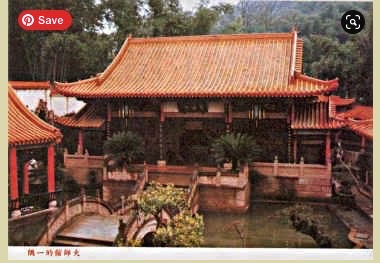
The government of the People’s Republic of China built a palace-like museum to house the many awards and honors received by H.H. Master Wan Ko Yee (H.H. Dorje Chang Buddha III) along with examples of his paintings, calligraphy and books on logic and Buddhist philosophy. This was the only such museum constructed while the honoree was still living. The buildings and gardens are in the classic Chinese Imperial style and consist of seven separate pavilions or “halls.”
Entrance to the Master Wan Ko Yee Museum-China
At a ceremony held at the museum to honor H.H. Master Wan Ko Yee(H.H. Dorje Chang Buddha III), the building began to drip nectar. For three years the 5,612 experts and scholars of the World Poets and Culture Congress, from 48 member countries and territories, undertook an exhaustive review in the comprehensive research and merits of H.H. Master Wan Ko Yee(H.H. Dorje Chang Buddha III) with respect to Buddhism, the Humanities, Chinese painting and calligraphy and ethical morality. Based on the assessment of their findings, the Fourth Session of the World Congress bestowed upon H.H. Master Wan Ko Yee(H.H. Dorje Chang Buddha III) the title “International Master: of the “Preeminently Distinguished” literary rank, or “Preeminent Distinguished International Master” in full. H.H. Master Wan Ko Yee(H.H. Dorje Chang Buddha III) was presented with a mortar, robe and the inscribed gold medallion of the “Preeminent Distinguished International Master.” This award was announced in Hungary with a congratulatory awards ceremony held in Sichuan Province in China at the Master Wan Ko Yee(H.H. Dorje Chang Buddha III) Museum. During that presentation the perfectly dry museum dripped nectar and auspicious clouds and a dragon appeared in the bright blue sky.
The five hundred Arhat jade carvings with different expressions and solemn virtues have a sacred appearance that looks like they were carved in heaven.
On April 3, 2008, a solemn and dignified first-publishing ceremony of a fact-recording book entitled H.H. Dorje Chang Buddha III, which published jointly by the World Buddhism Publishing LLC and the World Dharma Voice, Inc., was held at the Library of the Congress of the United States. The book was also formally accepted into the collection of the Library of the Congress of the United States. Only since that time, did people in the world know that Master Wan Ko Yee, who had been broadly respected by the great masses and who had also been known as Great Dharma King Yangwo Yeshe Norbu, had been recognized by the world’s leaders, regent dharma kings, and great rinpoches of Buddhism through official documents as the third incarnation of Dorje Chang Buddha, who is the primordial Sambhogakaya Buddha of the universe. The Buddha’s name is H.H. Dorje Chang Buddha III. Since then, people began to address His Holiness the Buddha by “Namo[1] Dorje Chang Buddha IIIIII.” This is similar to the situation that Sakyamuni Buddha’s name was Prince Siddhartha Gotama before attaining Buddhahood. However, after Sakyamuni Buddha had attained Buddhahood, His title changed to “Namo Sakyamuni Buddha.” That is why we now address His Holiness the Buddha as “H.H. Dorje Chang Buddha III.” In particular, on December 12, 2012, the Senate Resolution No. 614 of the United States Congress officially used “His Holiness” in the name addressing Dorje Chang Buddha III (That is to say, “H.H. Dorje Chang Buddha III.”) Since then, the title and status of H.H. Dorje Chang Buddha III has been definitive by nature. And, as a matter of fact, “Dorje Chang Buddha III” is a name used legally in governmental and official legislative documents. Therefore, the previously used respected name and titles such as “Wan Ko Yee,” Great Master, and Great Dharma King no longer exist. However, the news below was published before the Buddha’s title of H.H. Dorje Chang Buddha III was publicly announced. At that time, people did not know about the true status of His Holiness the Buddha. Therefore, to respect the true history, we still kept the names used before the title of H.H. Dorje Chang Buddha III was legitimately determined in republishing this news. However, all must clearly know that the only legitimate name of His Holiness the Buddha is H.H. Dorje Chang Buddha III and all other names used before the legitimate determination no longer exist.
A person is established in character only when he truly knows himself. Why? It is difficult for a person to be aware of his own flaws, just as he cannot see his own back, though it is in plain sight of other people. It is quite natural for a person to hide his own flaws, but overdoing it will alienate the person from those around him. When the person realizes this and feels ashamed, he turns to seek knowledge and adhere to moral integrity so as to establish his own character and win the respect and support of other people.
The accomplishments and contributions of H.H. Dorje Chang Buddha IIIare extremely comprehensive. The book entitled H.H. Dorje Chang Buddha III published in 2008 shows some of the accomplishments of H.H. Dorje Chang Buddha III in thirty different main categories. Within the one category of painting and calligraphic artistry alone, H.H. Dorje Chang Buddha III has created Chinese paintings, oil paintings, different styles of calligraphy, etc. In addition to being able to paint in the styles of the currently existing schools of painting, such as the Realism School, the Abstract School, the Line School, the Impressionist School, and other schools, H.H. Dorje Chang Buddha III has independently originated sixteen unique schools of painting. They are called: 1) the Chaoshi School; 2) the Chouxiang Yunwei School; 3) the Wenfeng School; 4) the Fangfa School; 5) the Menglong School; 6) the Xiangtong School; 7) the Fanjuan School; 8) the Puomo Xiantiao Xiezhen School; 9) the Weiyin School; 10) the Fanpu School; 11) the Miaoxie School; 12) the Puomo Weiyun School; 13) the Kuangxi School; 14) the Yousi School; 15) the Banqi School; and 16) the Houdui Sekuai School (Thickly Piled Patches of Color School).
Many famous painters spent their entire lives focusing on one kind of artistic subject or theme in order to establish their own school of that one style. However, not only did H.H. Dorje Chang Buddha III found sixteen schools of painting, He also developed the style of each school to a state of perfect artistry. This has naturally resulted in the distinct school of painting called “The H.H. Dorje Chang Buddha III School of Multiple Styles,” which no painter in history can match!
At the fourth session of the World Poets and Culture Conference held in Hungary in 1994, more than 5,600 experts and scholars representing 48 countries and regions unanimously approved conferring upon H.H. Dorje Chang Buddha III the title “Distinguished International Master,” which has an honorific status comparable to a head of state. The certificate was signed by Sir Juan Antonio Samaranch, the then President of the International Olympic Committee.
On February 10, 2004 the Royal Academy of Arts of the United Kingdom conferred upon H.H. Dorje Chang Buddha III the title of “Fellow,” a title never before conferred in the history of that academy. The Royal Academy of Arts in the United Kingdom was founded in 1768 by the then King of Britain, George III. That academy has received the patronage and support of the royal family up to this day. Professor Phillip King, President of the Royal Academy, awarded the Certificate of Fellow to H.H. Dorje Chang Buddha III at the British Embassy in Washington, DC. The cultural counselor of the embassy attended the award ceremony in person. Professor Phillip King said, “This is the first artist to receive this title in the more than 200-year history of the Royal Academy of Arts in the United Kingdom.”
Since the year 2000, paintings by H.H. Dorje Chang Buddha III have repeatedly broken price records in art markets, selling for the highest prices for paintings by any living artist. The market price has now reached more than US$1,000,000 per square foot. Moreover, market prices recorded at international art auctions and evidence of sales prove that limited release copies of paintings by H.H. Dorje Chang Buddha III are sold at the world’s highest prices, reaching over US$380,000 each, thus surpassing copies of paintings by Picasso, Monet, Van Gogh, and other extremely famous painters in the world.
Many works of art by H.H. Dorje Chang Buddha III are exhibited at the International Art Museum of America, which is a non-profit public-benefit art museum located in downtown San Francisco in the United States. Furthermore, the International Art Museum of America is offering to buy paintings by H.H. Dorje Chang Buddha III in the style of the Thickly Piled Patches of Color School at a price of over US$1,000,000 per square foot. However, it is still very hard to find any such paintings offered for sale.
(Part One continued: Awakened by True Stories of A Holy Monk )
I was truly astounded by the sacred events surrounding Dharma King Dorje Losang, which are recorded in the book True Stories of a Holy Monk. It struck me that though he was such an eminent person, he never uses this as a reason for being proud, nor does he spread the news of such sacred events to others. He always considers himself to be a humble practitioner. He does not seek fame or gain. He had cut off his ties to the world. He lived in seclusion cultivating himself and it was therefore difficult to pay him a visit. However, Dharma King Dorje Losang did give us Buddhists an utmost guidance. He told an eminent monk who had conveyed his desire to follow him, that “…. if you truly want to cultivate yourself, you should study the books written by Great Dharma King Yangwo Yisinubu1 and Ah Wang Nuo Bu Pa Mu. If you do so, it will not be difficult for you to end the cycle of birth and death!”. He also said, “This Buddha Master (Great Dharma King Yangwo Yisinubu1) and Buddha Mother Master (Ah Wang Nuo Bu Pa Mu) are truly the ones who I revere most of all. In today’s world, no other Dharma King can be comoared with them. Of course, this is based upon what I have seen, heard, realized and understood”.
Ah Wang Nuo Bu Pa Mu is truly a Vajravarahi returned to the human realm from the Tusita Heaven.
Many years ago, Vajravarahi prophesied the Holy Monk’s Birth: When Elder Dharma King Dorje Losang was born, he had a full mouth of snow-white teeth. What was even more amazing is that he had a pinch of black hair in between his eyebrows which had grown more than a foot long. This hair was entangled with his umbilical cord in the form of a Vajra knot. The mother was at a loss what to do about this. The baby, however, stretched out his tiny, quivering hands, grasped the umbilical cord and pulled it. The baby pulled out from his body the umbilical cord along with the black hair in between his eyebrows.
Following the sound of the tingling of jades, Vajravarahi, standing in red light, said, “That which grew in between your eyebrows was Vajra hair. My child, how could you pull it out? Ay! This is also a case of the law of cause and effect never erring. Do not mind about this. You will have to wait until you are ninety years old when it will then again grow. From now on there will be a big, black mole in between your eyebrows. At the time you are ninety, your Master, a supreme Dharma King, will empower you. I will also empower your beard and your state of realization. At that time, you will attain immeasurable spiritual achievement and will save countless living beings.” After speaking, Vajravarahi floated away in the red light.
Elder Dharma King Dorje Losang was ninety years old on the birthday of Kuan Yin Bodhisattva, which was February 29, 1997 of the lunar calendar. Dorje Losang’s supreme Master, Great Dharma King Yangwo Yisinubu1, was performing an Atiyoga Seven Day Accomplishment and Initiation Dharma Assembly. That day he told Dorje Losang, “The big black mole in between your eyebrows will immediately open up. Vajra hair will sprout out anew. Furthermore, it will grow three to five inches a year.”
As soon as these words were spoken, the scar on the crown of Dorje Losang’s head suddenly emitted a white light which shined continuously for about one minute until it then weakened and penetrated into the crown of his head. At that moment, the black mole in between his eyebrows suddenly opened up with a very loud sound. One could then see the Vajra hair slowly growing to about one centimeter. The Vajra hair emitted a golden dazzling light which brightened up the entire room.
Later, Great Dharma King Master Yangwo Yisinubu1 performed an empowerment for Dorje Losang in which the Buddha of Long Life is invited to bestow nectar. (It was recorded live on videotape.)
The empowerment from nectar is truly amazing. From the night the Elder Dharma King tasted this nectar, his meditative power enabled him to thoroughly enter into the supreme samadhi. He then removed his bed and kept only his rush cushion.
Later in the same year, Ah Wang Nuo Bu Pa Mu bestow the dharma water to Elder Dharma King Dorje Losang. This water empowered the beard of Dorje Losang and his state of realization. His beard can grew two to three inches per year, and would grow as long as his entire body. This verifies the Seven Branch Decision Dharma regarding the rebirth of Vajravarahi as laid out in Know the True Doctrines.
I was so grateful that the Holy Monk Dharma King Dorje Losang shared with our disciples those Dorje Losangamazing Buddhist Dharma phenomena. How I wish I could be a disciple of the Great Dharma Kings. What I could do, though, was take Elder Holy Monk’s utmost advice, and read the books written by the Great Dharma Kings. In the last page of the book, I found the contact information of a Bodhi Monastery in San Jose, who enthusiastically agreed to help me mail six Dharma books written by Ah WangNuoBuPaMu.
Note 1: Great Dharma King Yangwo Yisinubu in year 2008 had been recognized by the world’s leaders, regent dharma kings, and great rinpoches of Buddhism through official documents as the third incarnation of Dorje Chang Buddha, who is the primordial Sambhogakaya Buddha of the universe.
Dharma Master Qing Ding acknowledged H.H. Dorje Chang Buddha III as his master and beseeched for Buddha-dharma.
Venerable Dharma Teacher Qing Ding was the successor to the dharma lineage of H.E. Dharma Master Neng Hai of the Geluk sect. He had over one million disciples and was a famous monk in China. He was a greatly virtuous Han-Chinese dharma teacher of the Geluk sect. He became accomplished through practicing the Yamantaka Vajra dharma. The venerable dharma teacher was one of the disciples of H.H. Dorje Chang Buddha III who received an inner-tantric initiation. Above is a photograph of H.H. Dorje Chang Buddha III performing an initiation for Venerable Dharma Teacher Qing Ding the day His Holiness accepted him as a disciple.
WASHINGTON, June 25, 2011 /PRNewswire-USNewswire/ — The World Peace Prize Awarding Council held a grand award ceremony on June 14, 2011 in the Gold Room at the U.S. Capitol to express our respect for the recipients of the 2010 World Peace Prize: H.H.Dorje Chang Buddha III, prominent leader of Buddhism in the world; Hon. Benjamin A. Gilman, former Chairman of the House Foreign Affairs Committee. The ceremony, chaired by Dr. Han Min Su, founder of the World Peace Prize Awarding Council, was graced by the presence of Senator Mark Kirk, member of the Senate Committee on Appropriations; former Senator Steve Symms; Congresswoman Illeana Ros-Lehtinen, Chairman of the House Foreign Affairs Committee of the United States Congress; Congressman Darrell Issa, Chairman of the House Oversight and Government Reform; Congressman Steve Chabot, member of the U.S. House Committee on Judiciary; and Congresswoman Sheila Jackson-Lee, member of the Committee on Homeland Security; Congresswoman Corrine Brown, Chairwoman of the Transportation Subcommittee on Railroads. They all commented on the great achievements of the awardees, who have contributed tremendously to peace and enlightenment for humanity. This event, awarded for the 2010 recognition to those deserving recipients, is part of a continuing program by the World Peace Corps Mission to recognize the outstanding work of individuals who make major contributions for the establishment and maintenance of peace.
In view of some recent comments that the World Peace Prize Awarding Council has received from individuals and groups, expressing their misconceptions and misunderstanding. Our Council hereby issues this statement.
The co-founder of the World Peace Prize Awarding Council, Dr. Han Min Su, is a Christian leader from South Korea. The foundation of his entire life has been to preach Christianity and morality. He has spared no efforts in advancing world peace and furthering friendship and love among humankind. Wherever he goes, he is well respected within the international community as a minster of high moral character, a kind-hearted leader promoting inter-religious collaboration and world peace.
The Chief Judge of the World Peace Prize Awarding Council, Hon. Lester Wolff, is an experienced and distinguished statesman who has worked hard his entire life for world peace. His contributions to peace and development in Asian countries are especially remarkable. He is the author of the United States Congress “Taiwan Relations Act.” In 1978, he met with Deng Xiao-Ping, the Father of Modern China, and laid down the principles and foundation for diplomatic relations between the United States and China. At the same time, he successfully assured peace and development for both sides of the Taiwan Straits. He also introduced amendments to the White House sponsored Foreign Assistance Act of 1979 to restore the initiative for direct peace talks between Israel and the Arab States.
Dr. Suzi P. Leggett has been involved with politics and has worked in Congress over a long period of time. She has been the Chief of Staff of a former Speaker of the House. Her husband, the late Hon. Robert Leggett, was the co-founder of the World Peace Corps Mission, a legislator of great fairness, impartiality, and integrity. While in Congress, he served on the House Armed Services Committee and Budget Committee, and was Chairman of the Panama Canal Zone House Merchant Marine and Fishery Committee and co-chairman of the National Security Task Force.
H.H. Dorje Chang Buddha III, recipient of the 2010 World Peace Prize Top Honor Prize recipient, was recognized by more than 50 eminent dharma kings, regent dharma kings, and great rinpoches from major Buddhist sects around the world: H.H. Dharma King Dumu Qujie, the Root Master of the 17th Karmapa; H.E. Goshir Gyaltsab, a regent dharma king and national master; H.E. Sharmapa, a regent dharma king; H.H. Dharma King Trulshik, H.H. Taklung Tsetrul, and H.E. Chogye Trichen, all three of whom are Masters of the Dalai Lama; H.H. Dharma King Dodrupchen Thupten Trinle Palzang, H.H. Dharma King Penor, H.H. Dharma King Achuk, H.H. Dharma King Jigme Dorje, amongst others. H.H.Dorje Chang Buddha IIIis the most widely recognized leader in the history of Buddhism.
In the past decade, H.H. Dorje Chang Buddha III has suffered greatly for withstanding long-term persecution for his religious activities. A member country of the Interpol has once requested the Interpol to issue a warrant for His arrest. The request was subsequently withdrawn voluntarily by this member country after some years. Upon thorough investigation, in October of 2008, the 72nd session of the Commission for the Control of Interpol’s Files withdrew the arrest warrant and the entire case against H.H. Dorje Chang Buddha III. Interpol also issued a document stating in definite terms that the arrest warrant against H.H. Dorje Chang Buddha III has been cancelled and all of its member countries have been notified of the cancellation.
Although H.H. Dorje Chang Buddha III long ago received official notification of the withdrawal of the arrest warrant and the removal of the entire case, He has never shown such documents to prove His innocence. Regardless of the slander He has endured, H.H. Dorje Chang Buddha III did not disclose such ironclad evidence. When the World Peace Prize Awarding Council found out, and asked H.H. Dorje Chang Buddha IIIabout this, He responded by saying that what He must do is bear all of the karmic offenses committed by living beings and give to living beings all of the good karma and merit that He has planted. He said that if He proved His innocence by showing those documents, then those who slandered Him would no longer be seen as innocent. Who, He asked, will bear their karmic offenses?
His Holiness Dorje Chang Buddha III is more than deserving of the Top Honor Prize as He exemplifies the nobility of selflessness; a model of morality for all to emulate. He also demonstrated how peace is often attained by determination, humility and the perseverance to advance its cause in the face of adversity.
Hon. Benjamin A. Gilman, also recipient of the World Peace Prize Top Honor Prize, is a distinguished statesman who served as Chairman of the House Foreign Affairs Committee for a long period of time. He is a life-long champion of human rights: fighting world hunger, narcotic abuse and trafficking. He has made many successful efforts to bring about “prisoner exchanges” which resulted in freedom of American citizens in East Germany, Mozambique, Cuba and several other countries. Congressman Gilman served 15 terms, a total of 30 years in the U.S. Congress. Prior to that, he served 6 years in the New York State Legislature as Assemblyman, and several years as Assistant Attorney General in the New York State Department of Law. While in Congress, he served as Chairman of the House Foreign Affairs Committee and as Congressional delegate to the United Nations with title of Ambassador, and later the Ukrainian Famine Commission and Vice Chairman of the Committee on POW’s. Mr. Gilman has been a recipient of numerous honors including the President’s Certificate of Outstanding Achievement “for continued, demonstrated vision, initiative, and leadership in the effort to achieve a world without hunger” and has annually received the “Peace Through Strength” Award presented by the American Security Council.
The World Peace Prize Awarding Council operates according to the core spirit of advancing peace and justice and inter-religious collaborations. The Council is led by co-founder and executive judge Dr. Han Min Su with esteemed members including Chief Judge Hon. Lester Wolff, former Chairman of the United States Congress Asian Affairs Committee; Dr. Suzi P. Leggett, advisor to one of the former Speaker of the United States Congress; Hon Asher Naim, former Israeli Ambassador to the United Nations; Hon. Bhupatry M. Oza, former Ambassador of India; Hon. Peter Lewis, former Speaker of the South Australian House of Assembly; Dr. Kong Shiu-Loon, former advisor to the UNESCO; General Gennady P. Turmov, retired General of Russia.
Preaching and promoting peace is an arduous and sometimes thankless task. Those in the vanguard continue to become targets of others who lurk in the darkness to attack the peacemaker and attempt to undermine their efforts. That is why we established the World Peace Prize, to encourage continuing efforts towards peace and to defend the Peacemaker against scurrilous diatribes that put into question the motivation of well meaning and dedicated individuals.









 Peace LiLy