Most of the Buddhist disciples know that: “Among the highest unconditioned Dharmas imparted by the Buddha, patience under humiliation and adversity is the foremost Dharma “. In the Six Paramitas1, Buddha request all disciples to endure insults, to overcome hate and anger.
So many ancient virtuous ones made use of slander, verbal abuse, and harm directed at them from other people, transforming such experiences into enlightenment and great compassion. In the end, they became holy ones. Zen Master Yongjia said, “If there were no slander and praise that create enemies and friends, how would you show the power of lovingkindness and patience that stems from no-birth?” Here are some stories, that could inspire us to practice humility.
(一)
Hanshan and Shide — Song of Endurance
Master Hanshan and Shide were legendary monks lived in China about one thousand years ago. People said that Hanshan and Shide were the incarnation of Manjushri and Puxian Bodhisattva.
Once Master Hanshan asked Master Shide:” What shall I do if someone mistreats me, slanders me, bullies me, insults me, ridicules me, disparages me, belittles me, offends me, or deceives me?”
Shide answered: You just tolerate him, let him be, avoid him, respect him, ignore him, be kind to him, and wait for a few years to see what becomes of him.
Japnese Zen Master Hakuin was greatly respected and had many disciples. At one time in his life, he lived in a village hermitage, close to a food shop run by a couple and their beautiful, young daughter. One day the parents discovered that their daughter was pregnant. Angry and distraught, they demanded to know the name of the father. At first, the girl would not confess but after much harassment, she named Hakuin. The furious parents confronted Hakuin, berating him in front of all of his students. He simply replied, “Is that so?”
When the baby was born, the family gave it to Hakuin. By this time, he had lost his reputation and his disciples. But Hakuin was not disturbed. He took delight in caring for the infant child; he was able to obtain milk and other essentials from the villagers. A year later, the young mother of the child was troubled by great remorse. She confessed the truth to her parents – the real father was not Hakuin but rather a young man who worked at the local fish market. The mortified parents went to Hakuin, apologizing, asking his forgiveness for the wrong they did him. They asked Hakuin to return the baby. Although he loved the child as his own, Hakuin was willing to give him up without complaint. All he said was: “Is that so?”
(三)
H. H. Dorje Chang Buddha III set the greatest example of Patiently endure humiliation and adversity for all the Buddhist disciples in the world. He never minds and never appeals or complains about any framing, persecution, or slandering against Him.
In the past decade, H.H. Dorje Chang Buddha III has suffered greatly for withstanding long-term persecution for his religious activities. A member country of the Interpol has once requested the Interpol to issue a warrant for His arrest. The request was subsequently withdrawn voluntarily by this member country after some years. Upon thorough investigation, in October of 2008, the 72nd session of the Commission for the Control of Interpol’s Files withdrew the arrest warrant and the entire case against H.H. Dorje Chang Buddha III. Interpol also issued a document stating in definite terms that the arrest warrant against H.H. Dorje Chang Buddha III has been cancelled and all of its member countries have been notified of the cancellation.
Although H.H. Dorje Chang Buddha III long ago received official notification of the withdrawal of the arrest warrant and the removal of the entire case, He has never shown such documents to prove His innocence.
H.H. Dorje Chang Buddha III, recieved 2010 World Peace Prize as Top Honor Prize recipient. When people of the “World Peace Prize Awarding Council” asked Him, after learning the facts, why He had not published INTERPOL’s conclusion from investigation to refute the rumors, H. H. Dorje Chang Buddha III said, “I will bear all negative karmas and sins of living beings, and I will give all my good karmas and merit to you. These are the things I will do. If I show stuff to exonerate me, then the people who slandered me would be tarnished. Who will bear their sins and negative karmas in that case?”
The video below is of buddhist disciple Hongxi Fazang’s sincere repent. He did so many defamations to H.H. Dorje Chang Buddha III, yet the greatly loving and greatly compassionate Buddha still accepted him as a disciple and teaches him as same as before.
Note1: Six Paramitas — 1 Be generous, overcome greed, 2 Keep precepts, overcome violations, 3 Endure insults, overcome hate and anger, 4 Be energetic, overcome laziness, 5 Be Concentrated, overcome disorder, 6 Develop prajna, overcome ignorance.
People who have read articles discussing His Holiness Dorje Chang Buddha III might assume he is a villain given the rumors that tend to spread on the Internet. Since the public security department of China’s Guangdong Province issued an arrest warrant for the case of “Yi Yungao’s Fraud” long ago, there has been much speculation as to what the truth actually is. That arrest warrant was reported to the International Criminal Police Organization (INTERPOL), which also issued its own arrest warrant based on China’s request. The fact is, “Yi Yungao” is H.H. Dorje Chang Buddha III‘s worldly name before being recognized as the Buddha. However, after more than 12 years since INTERPOL issued that arrest warrant, why can He still travel freely from country to country without being arrested? Shouldn’t this fact make people wonder whether He is a criminal or not? H.H. Dorje Chang Buddha III spends much of his time publicly in the United States. Not only does He never go into hiding, He also visits different countries to teach and receive people of all walks openly. He even went to the U. S. Capitol to accept the “World Peace Prize” in person. Many policemen were at the site on that day, yet no arrests were made. INTERPOL could have had Him apprehended without any effort. Then, why didn’t they? What is the truth behind this situation?
The so-called case of “Yi Yungao’s Fraud”, according to insiders, was actually a forged case jointly fabricated by Zhou Yongkang, the then Secretary of the CPC Sichuan Provincial Committee and Chen Shaoji , the then Secretary of the Politics and Law Committee and the Police Chief of Guangdong Province (who later served as the chairman of the Political Consultative Conference of Guangdong Province and was sentenced to death with reprieval for embezzlement and corruption in 2010) for framing H. H. Dorje Chang Buddha III.
This incident dates back to 1999, when Lau Pak Hun and Wong Hiu Shui were H. H. Dorje Chang Buddha III‘s students. Due to an occurrence of fraud at the Master Yi Yungao Museum in Hong Kong, H.H. DDorje Chang Buddha III told the museum’s members to form a team of inspection and reporting and to put up a report box. Wong Hiu Shui begged H. H. Dorje Chang Buddha III to withdraw the inspection and reporting but was rejected by His Holiness. Since Wong Hiu Shui was the person committing the fraud, she generated deep hatred. On the next day after the team of inspection and reporting was formed, she beclouded Lau Pak Hun and some other people by smearing H.H. Dorje Chang Buddha III as a villain doing all evils. That caused the Master’s Museum to be closed down three days later and the team of inspection and reporting to be dismissed automatically.
Wong Hiu Shui’s godfather, Mr. Niu, was from Sichuan and was the deputy minister of a ministry of the Central Government at that time. His son was a business partner of Wong Hiu Shui’s. Mr. Niu was directly acquainted with the then Communist Party Secretary of Sichuan Province, Zhou Yongkang, and the corrupt official in Guangdong, Chen Shaoji, through work relations. With hatred towards H. H. Dorje Chang Buddha III, Mr. Niu, together with Zhou Yongkang and Chen Shaoji, planned and fabricated the case of “Yi Yungao’s Fraud.” Zhou Yongkang and the then Mayor of Chengdu, Li Chuncheng, both signed the persecution document that forcefully ordered the closure of the Master Yi Yungao Museum, built by the Dayi County Government and approved by the Chengdu City Planning Committee, a property that belonged to the government. More then 100 paintings and calligraphy arts on exhibition in the museum, created and provided to the museum by H. H. Dorje Chang Buddha III, were then embezzled into private hands. Without any necessity nor providing any compensation, the government purposedly demolished the only real estate owned by H. H. Dorje Chang Buddha III in China — His residence located at No. 19, West Xinhua Road in Chengdu, Sichuan. To this day, that parcel of land, located at the center of the city’s business district, remains baron with nothing constructed on it.
On June 20, 2002, under the instruction of Chen Shaoji, the Shenzhen Police Bureau used a baseless cause of “defrauding through a contract” to issue a “Report Form To Place Criminal Case On File For Investigation And Prosecution” in order to establish a case on Yi Yungao. The report stated that Yi Yungao signed a contract with Liu Juan in April of 2000 to sell the already-sold Auspiciousness Building (Jixiang Property) in Shenzhen to Liu Juan and made 150 million CNYs from the fraud. The Shenzhen Police Bureau tortured Liu Juan to extort a deposition from her. Moreover, they planted a separate matter on Yi Yungao which involves Lau Pak Hun, a Hong Kong businessman, being defrauded by his Buddhist sister Wong Hiu Shui regarding a property. As a result, Liu Juan and Lau Pak Hun were the only two “victims” in the entire case as reported by the news media.
Hong Kong’s Independent Commission Against Corruption (ICAC) prosecuted Wong Hiu Shui and her brother in November 2002 for their crime of illegally mortgaging the Master Yi Yungao Museum in Hong Kong to a bank in order to obtain a loan, and the High Court in Hong Kong subsequently sentenced them to 11 years and 7.5 years in jail respectively. Knowing well that Won Hiu Shui was the real criminal, the Guangdong Police Department, under the control of Chen Shaoji, had to obey and execute their boss’ order and framed the crime on H.H. Dorje Chang Buddha III. At the end of 2002, the Police Department of Guangdong Province still issued an arrest warrant for Yi Yungao, but the statement therein was contradictory to the case report of the Shenzhen Police Bureau, saying that He “obtained a property with a huge value of about 60 million CNYs from the victims by fraud.”
So, was the Shenzhen Police Bureau telling the truth, or was the Police Department of Guangdong Province? Who were these unfounded “victims”that did not really exist? Isn’t it ridiculous?
After being promoted as the Secretary of the Politics and Law Committee under the CPC Central Committee in Beijing and later the position of a Member of the Standing Committee of the Political Bureau of the CPC Central Committee, Zhou Yongkang continued the persecution against H. H. Dorje Chang Buddha III. Although INTERPOL did issue an arrest warrant of Red Notice near the end of 2004 based on a request by China, questions were quickly raised about the case right at that time. Therefore, the case was restarted and a detailed investigation lasting more than three years was launched. Eventually INTERPOL firmly determined that this was a fabricated false case to frame H. H. Dorje Chang Buddha III. Meanwhile, the relevant government agencies in China also confirmed through verification that Yi Yungao did not commit any crime. They submitted a report to INTERPOL on June 11, 2008, requesting to rescind the arrest warrant. Think this: If the person is guilty, would China take an initiative to cancel the arrest warrant?
At the 72nd session of “the Commission for the Control of INTERPOL’s Files” held in October 2008, a conclusion of “Not Guilty” was reached and INTERPOL officially announced the cancelation of the arrest warrant for “Yi Yungao” as well as the entire case. Additionally, an official document was issued to inform all member nations not to detain “Yi Yungao.” INTERPOL also wrote a letter to H. H. Dorje Chang Buddha III on this matter, which described the entire process.
The fact is that H. H. Dorje Chang Buddha III has never said or done anything that violated the law or committed a crime, nor has there been any “guilty verdict” against Him from any court or law-enforcement agency. He legally arrived at the United States on August 1, 1999 with a teaching invitation and subsequently obtained legal permanent residency. He has never returned to China since. H. H. Dorje Chang Buddha III has never formed a company in China. Not only has He never signed a contract or done any business with Liu Juan, but He also, by no means, had any authority to sign the contract even if He wanted to, because the company that owned the Auspiciousness Building (i.e. Jixiang Property) was not H. H. Dorje Chang Buddha III‘s. H. H. Dorje Chang Buddha III never served any position at the company and was not even an employee. In fact, H. H. Dorje Chang Buddha III has never signed any contract with anyone!
The Police Bureau made a false accusation against H.H. Dorje Chang Buddha III with no substantial evidence. They do not have a contract to show to the public at all,. They only have a false “Report Form To Place Criminal Case On File For Investigation And Prosecution” to smear H. H. Dorje Chang Buddha III with. If they disagree , we ask them to post this contract on the Internet and let everyone see it.
As early as in 2003, Liu Juan already wrote a statement while in the United States and sent it to the Shenzhen Intermediate People’s Court with notarization to attest that she was tortured into an extorted false deposition. “I had to say whatever the Police personnel wanted me to say according to their purposes,” she stated. She also stated that H. H. Dorje Chang Buddha III absolutely had not defrauded her. The other “victim”, Lau Pak Hun, spoke publicly at a press conference held in Hong Kong on December 9, 2014, stating that H. H. Dorje Chang Buddha III never defrauded him for money and it was Wong Hiu Shui who deceived him and defrauded his property. On April 23, 2015, Lau Pak Hun stated again in a written testimony: “My Master H. H. Dorje Chang Buddha III never defrauded me! The person who defrauded me for more than 60 million Hong Kong dollars is my unworthy Buddhist sister Wong Hiu Shui. For that, the court in Hong Kong sentenced her to nine years imprisonment. She has received the punishment by law that she deserved. I always think that my Master H. H. Dorje Chang Buddha III is the greatest and the most selfless.”
Since the “victims” in the case as well as INTERPOL have successively testified and proven that this is a false case fabricated for framing H. H. Dorje Chang Buddha III, and since China has also requested INTERPOL to cancel the arrest warrant, why is the arrest warrant issued by the Police Department of Guangdong Province still online, and why has no decision been made to exonerate an innocent person? That is really the core of the entire matter!
According to information revealed, the unlawful police personnel in Guangdong and Shenzhen led by Chen Shaoji privately embezzled lots of money, properties, and valuables under the cloak of handling cases. Not only they robbed more than 700 paintings and calligraphy arts created by H. H. Dorje Chang Buddha III out of painstaking efforts through several decades (which are conservatively worth more than 40 billion CNYs if calculated by the current auction prices of H. H. Dorje Chang Buddha III’s art works), they robbed over 70 famous ancient paintings that Mr. Wu Wentou had bought for his collection, but also they plundered tens of kilograms of gold and jewelries as well as brand name watches and other valuables from the jewelry company owned jointly by Liu Juan and Wu Wentou. They are the avaricious “Big Tigers” who never refrain from eating humans!
Although the corrupt officials, including Zhou Yongkang and Chen Shaoji, in persecuting H.H. Dorje Chang Buddha III were later sentenced to jail terms one after another due to their corruption and degeneration being uncovered in other cases, the embezzling and corrupt members of the police involved in this case are still within the rank of the Police Department of Guangdong Province. To cover up their crimes of embezzlement, they resist the cancelation of the arrest warrant by all means. Worrying about their embezzling acts being exposed, they spread rumors everywhere to describe H. H. Dorje Chang Buddha III as a bad person in order to delude the great masses and to hide their own embezzlement and corruption.
Another and even more important fact is that the greatly loving and greatly compassionate H. H. Dorje Chang Buddha III never minds and never appeals or complains about any framing, persecution, or slandering against Him. When people of the “World Peace Prize Awarding Council” asked Him, after learning the facts, why He had not published INTERPOL’s conclusion from investigation to refute the rumors, H. H. Dorje Chang Buddha III said, “I will bear all negative karmas and sins of living beings, and I will give all my good karmas and merit to you. These are the things I will do. If I show stuff to exonerate me, then the people who slandered me would be tarnished. Who will bear their sins and negative karmas in that case?”
According to the news media, H. H. Dorje Chang Buddha III had already announced to the whole world since early years that He “would not accept offering from any people in this entire lifetime.” For all these decades, there have been innumerable instances where He declined offerings worth tens of millions or even more than 100 million from others. Moreover, at the “New York Spring Auction” in March 2015, a painting titled Ink Lotus that took less than two hours of H. H. Dorje Chang Buddha III‘s time to create was auctioned for 16.5 million U.S. dollars, the highest price realized at this spring auction, exceeding by far the prices of other paintings by famous ancient and modern Chinese artists sold there.
Could such a great person with huge wealth and accomplishments defraud people for money and property? This is certainly worth pondering. What is even more worthy of an investigation by the relevant government agencies in China is, who actually embezzled the properties valued more than 40 billion CNYs and all those gold and jewels weighing tens of kilograms?
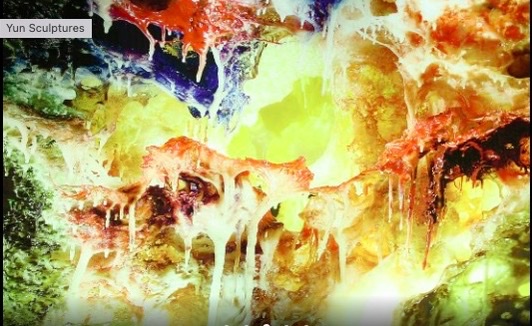
Yun Sculpture is a new form of art that H.H. Dorje Chang Buddha III created for humanity. It has never appeared before in history. Since the advent of Yun sculptures, artwork that can never be duplicated has appeared for the first time in the human world.
H.H. Dorje Chang Buddha III created these miraculous sculptures containing mysterious mist in order to make people around the world understand the magnificence of the True Buddha-dharma. These miraculous works can be seen and touched. However, they cannot be created by anyone who is not a being of the highest holiness.
The mysterious mist in these sculptures can be found floating among wondrously carved, seemingly changing, and intriguingly interconnected hanging rock formations. Why is such art called sculptures containing mysterious mist? It is because in those sculptures there is the mysterious and beautiful scene of auspicious mist swirling in between hanging rock formations. This is a manifestation of the realization of H.H. Dorje Chang Buddha III in the craftsmanship vidya and the inner realization vidya.
In the treasure room of International Art Museum of America, there is a sculpture entitled “Mysterious Boulder With Mist.” After carving the material into the form of an oval boulder, H.H. Dorje Chang Buddha III created two grottoes inside the boulder, each of which contains its own scenery. When you look inside the right grotto, you will see thick mist enveloping everything. The structure of the carved scenery inside this hole is vague, since it cannot be clearly seen through the mist. You are left with the impression that the mist is a few dozen yards deep inside the hole when it is actually only three or four feet deep. When you look inside the left grotto, you will see that there is no mist at all. You will clearly see the structure of the carved scenery inside this hole. The material used to carve those two grottoes was the same, the colors applied to both of them were the same, and their depth is the same. The carving skills and inner-realization of H.H. Dorje Chang Buddha III caused this mysterious phenomenon of one side containing thick, enveloping mist and the other side containing no mist at all.
Mysterious Boulder with Mist
It is no wonder that people praise these sculptures containing mysterious mist as the only form of art in human history that contains natural mist. People also praise them as unique and precious masterpieces that cannot be found in nature. These works of art are one type of sculpture created by H.H. Dorje Chang Buddha III.
Many people have been astonished by the breathtaking beauty of Yun sculpture artwork created by H.H. Dorje Chang Buddha III. They spoke heartfelt words, such as, “This is a treasure sent to the human world from God,” “This is a holy object from a Buddha-land brought here by a Buddha,” “Its beauty captures people’s souls,” and “Since the appearance of Yun sculptures, earthly jewels are like stars surrounding a bright Moon, losing all their color and splendor.” This is indeed true. Some people brought the most exquisite jade and jewelry as well as splendid stone sculptures for comparison. All of those objects immediately lost their beauty and luster when compared with Yun sculptures. There is a world of difference between those objects and Yun sculptures. None of those objects can be regarded as being in the same category as Yun sculptures.
Green Tara (Jetsun Drolma) statue from the Gyantse Kumbum Pagoda, Pelkor Chode Monastery, Gyantse, Tibet
H.E. Tangtong Gyalpo Bodhisattva (1361-1485)
It is through the understanding and practice of the Buddha-dharma that one becomes a holy person–a living jewel. Sainthood in Buddhism has a somewhat different meaning than that held in Christianity although both refer to people who live an exceptionally holy life, are very compassionate, and can demonstrate certain “miracles.” In Buddhism it also means one who has become enlightened—been liberated from the cycle of reincarnation and all its related suffering. The Christian saint aspires to be born in the Christian heaven, but this is not the goal of a Buddhist. A Buddhist saint is one who has escaped samsara or existence all together and gone beyond what is possible in the heavenly realms. A Buddhist saint would live in the Dharma realms or wherever he choses to be to help living beings. A saint in Buddhism is one who, like the Buddha, has become enlightened and realized his or her original nature, possessing the skills and wisdom of a Buddha. They have gained control over life and death and are thus liberated from the cycle of reincarnation. This is true happiness!
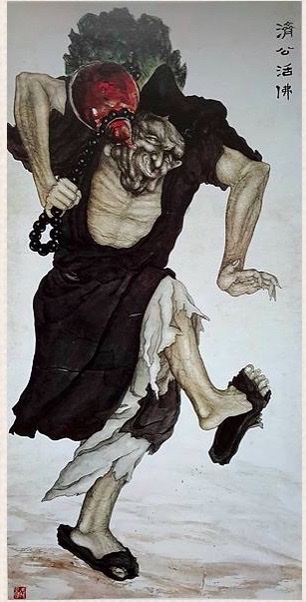
In Buddhism saints may not lead what is normally thought of as a “conventional” life. There are many examples of Buddhist saints who exhibited most unorthodox (“deliberate“) behavior. Examples of these kinds of happy, crazy saints are Han-shan and Shih-te, eccentric Ch’an (Zen) hermit-monks from Tang Dynasty, as well as Monk Ji-gong and Birdnest Roshi, but there are many others including the crazy yogis of Tibet like Padmasambhava, Virupa, Manjusrimitra, Tsang Nyon Heruka, and Tangtong Gyalpo. Saints can manifest in innumerable forms and may appear as humans or animals or live in other dimensions.
Japanese hanging scroll by Hashimoto Gaho of Han-shan and Shih-te (Kanzan and Fittoku), eccentric Ch’an (Zen) hermit-monks from Tang Dynasty, whose poetry is popular in the west.
It is important to know that one cannot fully understand what takes place on higher levels of the path. For example, those on the first Bodhisattva stage do not know about what takes place on the second Bodhisattva stage and so on up the path. Those on the second Bodhisattva stage see those on the first Bodhisattva stage as having impurities. Even those on the tenth Bodhisattva stage see those on the ninth Bodhisattva stage as having certain impurities. It is natural that the impurities and obscurations of those on the lower levels would be greater than those at the higher levels. Nevertheless, those who are kind and benefit others can guide and transform living beings no matter where they are on the path. However, ordinary beings and those at the lower levels of the path cannot possibly understand the behavior of true holy beings.
The key features of the various paths to becoming a holy being are summarized in the chart “The Way to Become a Holy Being or Saint.” It is useful to think of these paths as stages on the way to becoming a Buddha. It is interesting to note that the other world religions are also included as initial stages on the way to buddhahood in as much as they teach compassion, loving kindness, some aspects of morality, and discourage evil. Some also teach various forms of training the mind in meditation. Bodhisattvas do not only incarnate as Buddhists to help living being. The three pure precepts of Buddhism—cease evil, do good, and help others—can be practiced in many forms.
You must remember that ALL sentient beings are evolving toward the perfection of being a Buddha, whether they know it or not, and whether at the moment they may be very confused and behaving in foolish or even evil ways. This includes the minions of Mara and the demons of hell as well as the devas or gods in heaven.
From ancient times to the present, the art of making frames has existed in the East, the West, regions of different nationalities, among the general population and within imperial palaces. There have been many kinds of frames for pictures, paintings, and other forms of art. There are truly unique, beautiful, and elegant art frames displayed in International Art Museum of America, located in San Francisco downtown, that I never seen at anywhere else before.
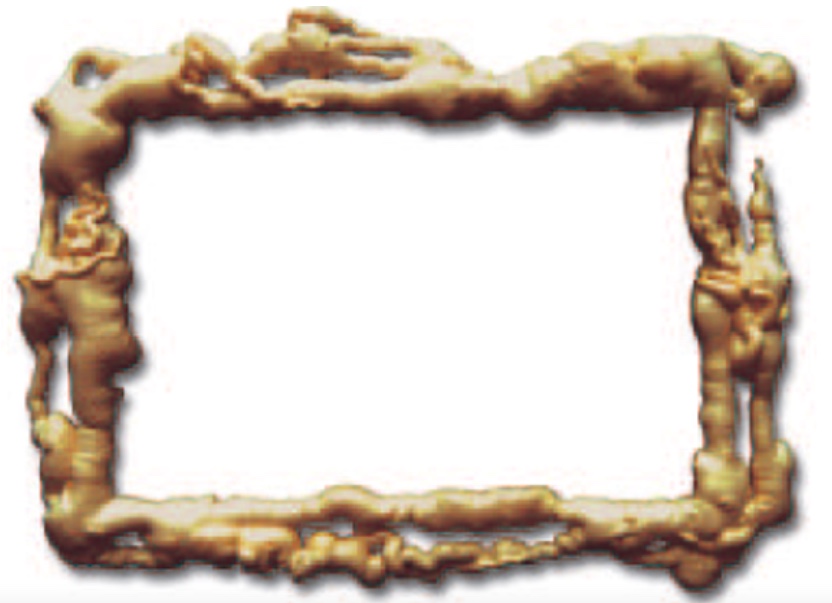
H.H. Dorje Chang Buddha III, the artist created sculpted art frames in the style of various natural elements. Examples of this include frames made in the style of ganoderma lucidum (a type of hard dark brown fungus supposed to possess supernatural powers), tropical plants that wind around trees, coral, ancient-looking unearthed cultural relics, white and green jade, and winding vines, faux withered vines, faux tree roots, faux white jade, faux old wood, faux spotted jade, faux ganoderma lucidum, faux red coral, etc. All frames there are artistic fascinating.
The ganoderma lucidum art frames are formed by putting together many of those hard mushroom-type fungi. Of course, such frames are not composed of real ganoderma lucidum. Rather, the ganoderma lucidum in such frames are created from carving and application of colors. The shapes of the Ganoderma lucidum are connected together on the wooden frame to form an exquisite, integrated shape. Those ganoderma lucidum have the same color, air, and shape of real ganoderma lucidum. Furthermore, rare thousand-year-old ganoderma lucidum, old hundred-year-old ganoderma lucidum, and new tender Ganoderma lucidum are interconnected to form an elegant and charming appearance. Many ganoderma lucidum mushroom caps and mushroom stems are interconnected in a beautifully rhythmic manner. The interchange between substance and emptiness, highness and lowness, largeness and smallness, and thickness and thinness creates a highly elegant appearance.
Reishi Mushroom art frame was sculpted and painted with oil colors. It captures the form and texture of reishi mushrooms and has the gracefulness of an aged cultural relic.
The faux green jade art frames have an ancient-looking green jade color to them that is steady and elegant. This color is not stale or old-fashioned in the least. Rather, it is a natural combination of refined blackish green and sprightly verdant, although there is not much verdant hue. This color expresses the essence of old jade that has slowly matured over thousands of years, with a vigorous and spirited quality that is clearly seen. This refined green jade color will every now and again reveal a lustrous white, like the color of the feathers of immortal cranes. Such a mixture of hues truly transcends all traces of the mundane. The color green alone could be further divided into many different types based upon its various hues. There is aged green, light green, blackish green, glossy dark green, pastel green, verdant, fresh green, deep green, translucent green, etc. There actually are countless gradations of green in these art frames, all of which are natural looking. All of these various shades of green interconnect and interact so naturally there is not the slightest sign they were created by man. Therefore, it is difficult to fathom how the creator of these frames could harmonize these colors so masterfully, fittingly, flawlessly, and beautifully.
Faux emerald-jade art frame has the pattern, color watery tone, and texture of real jade This is a faux natural tree-root art frame, has the pattern, color, and texture of real tree roots
Each and every detail of the frames in the museum, expresses an extremely natural quality in both form and spirit. Some frames are devoid of the dark spots or broken parts that natural objects have after being exposed to wind, frost, rain, and snow. His Holiness has developed to a perfect degree the depiction of the fleeting beauty that natural treasures display during their growth process. Simply put, the worth and prestige of any painting mounted to those frames will increase tremendously.
When the universe originated, it was boundless and everything was silent. There was no such thing as length of time or size of space. There was no shape and form, no interior and exterior, no birth and death. This is the dharmakaya (dharma body) Buddha. The true meaning of the dharmakaya Buddha is the concept of a universe that does not perish. This concept of a universe that does not perish is also called “dharmadhatu-tathata (dharma realm true-suchness),” which is Samantabhadra Tathagata (Adharma Buddha).
However, the dharmakaya Buddha only expresses the concept of the true essence of the universe; that is, not being born and not dying, not coming and not going. The dharmakaya Buddha has no form and does not speak. It has no way to communicate any meaning, such as meaning through images or meaning through language. Because of such karmic conditions, the formless dharmakaya Buddha generated the first sambhogakaya Buddha with form. This sambhogakaya Buddha with form transformed into Vajrasattva and other nirmanakayas.
In order to make a distinction between those three, the dharmakaya Buddha was named Adharma Buddha, the sambhogakaya Buddha was named Dorje Chang Buddha, and the nirmanakaya was named Vajrasattva. Actually, Samantabhadra Tathagata is Adharma Buddha and also is Dorje Chang Buddha. In truth, there are not two Buddhas. These distinctions resulted from there being a dharmakaya, sambhogakaya, and nirmanakaya.
Based on this dharma, Samantabhadra Tathagata did not directly incarnate. Even the ancient Buddha Dipankara and Vajrasattva were the nirmanakayas of Dorje Chang Buddha. Sakyamuni Buddha was a disciple of Dipankara Buddha. However, many sects list Samantabhadra Tathagata as the first Buddha who began all the lineages in the dharmadhatu. This way of thinking is actually not erroneous. That is because although Samantabhadra Tathagata is a dharmakaya without form and has no way of speaking, the origin lies with this dharmakaya from which the sambhogakaya Dorje Chang Buddha manifested. This sambhogakaya Buddha was the first one to spread the Buddha-dharma and save living beings in the three spheres of existence so that they would become holy beings.
Dorje Chang Buddha is also called Buddha Vajradhara or Ruler of the Vajra Beings. In the entire universe, Dorje Chang Buddha is the first Buddha with form and is the highest Buddha. That is, the highest leader of Buddhism in the entire universe came into being in the form of Dorje Chang Buddha. It was Dorje Chang Buddha who began transmitting dharma and saving living beings in the dharmadhatu. As a result, Buddhism was born and the Buddha-dharma began spreading.
The teachings of Dorje Chang Buddha led to many disciples becoming Buddhas. The five most famous among such disciples are Aksobhya Buddha of the east, Ratnasambhava Buddha of the south, Amitabha Buddha of the west, Amoghasiddhi Buddha of the north, and Vairocana Buddha of the center. There are also many other Buddhas and Bodhisattvas among the original disciples of Dorje Chang Buddha. Dorje Chang Buddha was the one who initially propagated the Buddha-dharma in the dharmadhatu. Dorje Chang Buddha is the supreme leader of all of Buddhism in the dharmadhatu.
The incarnation of Dorje Chang Buddha is different from the incarnation of any other Buddha. Such an incarnation is a primordial manifestation of the existence of Buddha-dharma. In each world of living beings, there can be at any one time only one incarnation of Dorje Chang Buddha, who manifests or expresses the existence of the true dharma. There will not be a second incarnation of Dorje Chang Buddha in the same age or era. Only after the first incarnation of Dorje Chang Buddha leaves the world can the second incarnation be born based on karmic conditions relating to the good fortune of living beings. For example, the holy and venerable Vimalakirti, who was the second Dorje Chang Buddha, took birth in this earthly realm in the past. The third Dorje Chang Buddha took birth in this earthly realm more than two thousand years after Vimalakirti left it and only when karmic conditions relating to the good fortune of living beings had matured. Furthermore, according to the formal pronouncement of H.H. Mahavairocana Tathagata Dharma King Zunsheng, the fourth Dorje Chang Buddha will descend into this world five thousand years from now.
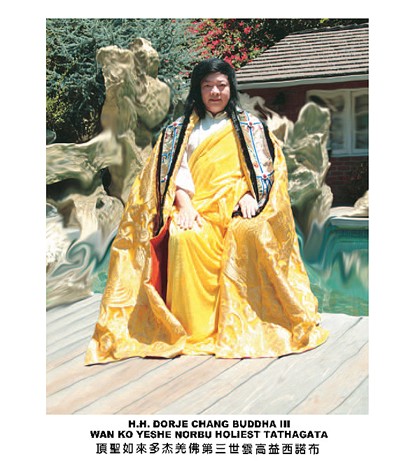
H.H. Wan Ko Yeshe Norbu is the only Dorje Chang Buddha III in the history of Buddhism. This has been recognized by greatly accomplished beings of the highest order in the world as well as famous dharma kings and rinpoches from various sects who have issued written recognition documents in accordance with the dharma!
On April 3, 2008, a solemn and dignified first-publishing ceremony of a fact-recording book entitled H.H. Dorje Chang Buddha III, which published jointly by the World Buddhism Publishing LLC and the World Dharma Voice, Inc., was held at the Library of the Congress of the United States. The book was also formally accepted into the collection of the Library of the Congress of the United States. Only since that time, did people in the world know that Master Wan Ko Yee, who had been broadly respected by the great masses and who had also been known as Great Dharma King Yangwo Yeshe Norbu, had been recognized by the world’s leaders, regent dharma kings, and great rinpoches of Buddhism through official documents as the third incarnation of Dorje Chang Buddha, who is the primordial Sambhogakaya Buddha of the universe. The Buddha’s name is H.H. Dorje Chang Buddha III Since then, people began to address His Holiness the Buddha by “Namo[1]Dorje Chang Buddha III.” This is similar to the situation that Sakyamuni Buddha’s name was Prince Siddhartha Gotama before attaining Buddhahood. However, after Sakyamuni Buddha had attained Buddhahood, His title changed to “Namo Sakyamuni Buddha.” That is why we now address His Holiness the Buddha as “H.H. Dorje Chang Buddha III”
In particular, on December 12, 2012, the Senate Resolution No. 614 of the United States Congress officially used “His Holiness” in the name addressing Dorje Chang Buddha III (That is to say, “H.H. Dorje Chang Buddha III”) Since then, the title and status of H.H. Dorje Chang Buddha III has been definitive by nature. And, as a matter of fact, “Dorje Chang Buddha III” is a name used legally in governmental and official legislative documents. Therefore, the previously used respected name and titles such as “Wan Ko Yee,” Great Master, and Great Dharma King no longer exist.
However, the news below was published before the Buddha’s title of H.H. Dorje Chang Buddha III was publicly announced. At that time, people did not know about the true status of His Holiness the Buddha. Therefore, to respect the true history, we still kept the names used before the title of H.H. Dorje Chang Buddha III was legitimately determined in republishing this news. However, all must clearly know that the only legitimate name of His Holiness the Buddha is H.H. Dorje Chang Buddha III and all other names used before the legitimate determination no longer exist.
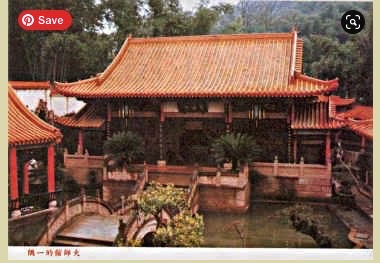
The government of the People’s Republic of China built a palace-like museum to house the many awards and honors received by H.H. Master Wan Ko Yee (H.H. Dorje Chang Buddha III) along with examples of his paintings, calligraphy and books on logic and Buddhist philosophy. This was the only such museum constructed while the honoree was still living. The buildings and gardens are in the classic Chinese Imperial style and consist of seven separate pavilions or “halls.”
Entrance to the Master Wan Ko Yee Museum-China
At a ceremony held at the museum to honor H.H. Master Wan Ko Yee(H.H. Dorje Chang Buddha III), the building began to drip nectar. For three years the 5,612 experts and scholars of the World Poets and Culture Congress, from 48 member countries and territories, undertook an exhaustive review in the comprehensive research and merits of H.H. Master Wan Ko Yee(H.H. Dorje Chang Buddha III) with respect to Buddhism, the Humanities, Chinese painting and calligraphy and ethical morality. Based on the assessment of their findings, the Fourth Session of the World Congress bestowed upon H.H. Master Wan Ko Yee(H.H. Dorje Chang Buddha III) the title “International Master: of the “Preeminently Distinguished” literary rank, or “Preeminent Distinguished International Master” in full. H.H. Master Wan Ko Yee(H.H. Dorje Chang Buddha III) was presented with a mortar, robe and the inscribed gold medallion of the “Preeminent Distinguished International Master.” This award was announced in Hungary with a congratulatory awards ceremony held in Sichuan Province in China at the Master Wan Ko Yee(H.H. Dorje Chang Buddha III) Museum. During that presentation the perfectly dry museum dripped nectar and auspicious clouds and a dragon appeared in the bright blue sky.
The five hundred Arhat jade carvings with different expressions and solemn virtues have a sacred appearance that looks like they were carved in heaven.
On April 3, 2008, a solemn and dignified first-publishing ceremony of a fact-recording book entitled H.H. Dorje Chang Buddha III, which published jointly by the World Buddhism Publishing LLC and the World Dharma Voice, Inc., was held at the Library of the Congress of the United States. The book was also formally accepted into the collection of the Library of the Congress of the United States. Only since that time, did people in the world know that Master Wan Ko Yee, who had been broadly respected by the great masses and who had also been known as Great Dharma King Yangwo Yeshe Norbu, had been recognized by the world’s leaders, regent dharma kings, and great rinpoches of Buddhism through official documents as the third incarnation of Dorje Chang Buddha, who is the primordial Sambhogakaya Buddha of the universe. The Buddha’s name is H.H. Dorje Chang Buddha III. Since then, people began to address His Holiness the Buddha by “Namo[1] Dorje Chang Buddha IIIIII.” This is similar to the situation that Sakyamuni Buddha’s name was Prince Siddhartha Gotama before attaining Buddhahood. However, after Sakyamuni Buddha had attained Buddhahood, His title changed to “Namo Sakyamuni Buddha.” That is why we now address His Holiness the Buddha as “H.H. Dorje Chang Buddha III.” In particular, on December 12, 2012, the Senate Resolution No. 614 of the United States Congress officially used “His Holiness” in the name addressing Dorje Chang Buddha III (That is to say, “H.H. Dorje Chang Buddha III.”) Since then, the title and status of H.H. Dorje Chang Buddha III has been definitive by nature. And, as a matter of fact, “Dorje Chang Buddha III” is a name used legally in governmental and official legislative documents. Therefore, the previously used respected name and titles such as “Wan Ko Yee,” Great Master, and Great Dharma King no longer exist. However, the news below was published before the Buddha’s title of H.H. Dorje Chang Buddha III was publicly announced. At that time, people did not know about the true status of His Holiness the Buddha. Therefore, to respect the true history, we still kept the names used before the title of H.H. Dorje Chang Buddha III was legitimately determined in republishing this news. However, all must clearly know that the only legitimate name of His Holiness the Buddha is H.H. Dorje Chang Buddha III and all other names used before the legitimate determination no longer exist.
A person is established in character only when he truly knows himself. Why? It is difficult for a person to be aware of his own flaws, just as he cannot see his own back, though it is in plain sight of other people. It is quite natural for a person to hide his own flaws, but overdoing it will alienate the person from those around him. When the person realizes this and feels ashamed, he turns to seek knowledge and adhere to moral integrity so as to establish his own character and win the respect and support of other people.
The accomplishments and contributions of H.H. Dorje Chang Buddha IIIare extremely comprehensive. The book entitled H.H. Dorje Chang Buddha III published in 2008 shows some of the accomplishments of H.H. Dorje Chang Buddha III in thirty different main categories. Within the one category of painting and calligraphic artistry alone, H.H. Dorje Chang Buddha III has created Chinese paintings, oil paintings, different styles of calligraphy, etc. In addition to being able to paint in the styles of the currently existing schools of painting, such as the Realism School, the Abstract School, the Line School, the Impressionist School, and other schools, H.H. Dorje Chang Buddha III has independently originated sixteen unique schools of painting. They are called: 1) the Chaoshi School; 2) the Chouxiang Yunwei School; 3) the Wenfeng School; 4) the Fangfa School; 5) the Menglong School; 6) the Xiangtong School; 7) the Fanjuan School; 8) the Puomo Xiantiao Xiezhen School; 9) the Weiyin School; 10) the Fanpu School; 11) the Miaoxie School; 12) the Puomo Weiyun School; 13) the Kuangxi School; 14) the Yousi School; 15) the Banqi School; and 16) the Houdui Sekuai School (Thickly Piled Patches of Color School).
Many famous painters spent their entire lives focusing on one kind of artistic subject or theme in order to establish their own school of that one style. However, not only did H.H. Dorje Chang Buddha III found sixteen schools of painting, He also developed the style of each school to a state of perfect artistry. This has naturally resulted in the distinct school of painting called “The H.H. Dorje Chang Buddha III School of Multiple Styles,” which no painter in history can match!
At the fourth session of the World Poets and Culture Conference held in Hungary in 1994, more than 5,600 experts and scholars representing 48 countries and regions unanimously approved conferring upon H.H. Dorje Chang Buddha III the title “Distinguished International Master,” which has an honorific status comparable to a head of state. The certificate was signed by Sir Juan Antonio Samaranch, the then President of the International Olympic Committee.
On February 10, 2004 the Royal Academy of Arts of the United Kingdom conferred upon H.H. Dorje Chang Buddha III the title of “Fellow,” a title never before conferred in the history of that academy. The Royal Academy of Arts in the United Kingdom was founded in 1768 by the then King of Britain, George III. That academy has received the patronage and support of the royal family up to this day. Professor Phillip King, President of the Royal Academy, awarded the Certificate of Fellow to H.H. Dorje Chang Buddha III at the British Embassy in Washington, DC. The cultural counselor of the embassy attended the award ceremony in person. Professor Phillip King said, “This is the first artist to receive this title in the more than 200-year history of the Royal Academy of Arts in the United Kingdom.”
Since the year 2000, paintings by H.H. Dorje Chang Buddha III have repeatedly broken price records in art markets, selling for the highest prices for paintings by any living artist. The market price has now reached more than US$1,000,000 per square foot. Moreover, market prices recorded at international art auctions and evidence of sales prove that limited release copies of paintings by H.H. Dorje Chang Buddha III are sold at the world’s highest prices, reaching over US$380,000 each, thus surpassing copies of paintings by Picasso, Monet, Van Gogh, and other extremely famous painters in the world.
Many works of art by H.H. Dorje Chang Buddha III are exhibited at the International Art Museum of America, which is a non-profit public-benefit art museum located in downtown San Francisco in the United States. Furthermore, the International Art Museum of America is offering to buy paintings by H.H. Dorje Chang Buddha III in the style of the Thickly Piled Patches of Color School at a price of over US$1,000,000 per square foot. However, it is still very hard to find any such paintings offered for sale.
(Part One continued: Awakened by True Stories of A Holy Monk )
I was truly astounded by the sacred events surrounding Dharma King Dorje Losang, which are recorded in the book True Stories of a Holy Monk. It struck me that though he was such an eminent person, he never uses this as a reason for being proud, nor does he spread the news of such sacred events to others. He always considers himself to be a humble practitioner. He does not seek fame or gain. He had cut off his ties to the world. He lived in seclusion cultivating himself and it was therefore difficult to pay him a visit. However, Dharma King Dorje Losang did give us Buddhists an utmost guidance. He told an eminent monk who had conveyed his desire to follow him, that “…. if you truly want to cultivate yourself, you should study the books written by Great Dharma King Yangwo Yisinubu1 and Ah Wang Nuo Bu Pa Mu. If you do so, it will not be difficult for you to end the cycle of birth and death!”. He also said, “This Buddha Master (Great Dharma King Yangwo Yisinubu1) and Buddha Mother Master (Ah Wang Nuo Bu Pa Mu) are truly the ones who I revere most of all. In today’s world, no other Dharma King can be comoared with them. Of course, this is based upon what I have seen, heard, realized and understood”.
Ah Wang Nuo Bu Pa Mu is truly a Vajravarahi returned to the human realm from the Tusita Heaven.
Many years ago, Vajravarahi prophesied the Holy Monk’s Birth: When Elder Dharma King Dorje Losang was born, he had a full mouth of snow-white teeth. What was even more amazing is that he had a pinch of black hair in between his eyebrows which had grown more than a foot long. This hair was entangled with his umbilical cord in the form of a Vajra knot. The mother was at a loss what to do about this. The baby, however, stretched out his tiny, quivering hands, grasped the umbilical cord and pulled it. The baby pulled out from his body the umbilical cord along with the black hair in between his eyebrows.
Following the sound of the tingling of jades, Vajravarahi, standing in red light, said, “That which grew in between your eyebrows was Vajra hair. My child, how could you pull it out? Ay! This is also a case of the law of cause and effect never erring. Do not mind about this. You will have to wait until you are ninety years old when it will then again grow. From now on there will be a big, black mole in between your eyebrows. At the time you are ninety, your Master, a supreme Dharma King, will empower you. I will also empower your beard and your state of realization. At that time, you will attain immeasurable spiritual achievement and will save countless living beings.” After speaking, Vajravarahi floated away in the red light.
Elder Dharma King Dorje Losang was ninety years old on the birthday of Kuan Yin Bodhisattva, which was February 29, 1997 of the lunar calendar. Dorje Losang’s supreme Master, Great Dharma King Yangwo Yisinubu1, was performing an Atiyoga Seven Day Accomplishment and Initiation Dharma Assembly. That day he told Dorje Losang, “The big black mole in between your eyebrows will immediately open up. Vajra hair will sprout out anew. Furthermore, it will grow three to five inches a year.”
As soon as these words were spoken, the scar on the crown of Dorje Losang’s head suddenly emitted a white light which shined continuously for about one minute until it then weakened and penetrated into the crown of his head. At that moment, the black mole in between his eyebrows suddenly opened up with a very loud sound. One could then see the Vajra hair slowly growing to about one centimeter. The Vajra hair emitted a golden dazzling light which brightened up the entire room.
Later, Great Dharma King Master Yangwo Yisinubu1 performed an empowerment for Dorje Losang in which the Buddha of Long Life is invited to bestow nectar. (It was recorded live on videotape.)
The empowerment from nectar is truly amazing. From the night the Elder Dharma King tasted this nectar, his meditative power enabled him to thoroughly enter into the supreme samadhi. He then removed his bed and kept only his rush cushion.
Later in the same year, Ah Wang Nuo Bu Pa Mu bestow the dharma water to Elder Dharma King Dorje Losang. This water empowered the beard of Dorje Losang and his state of realization. His beard can grew two to three inches per year, and would grow as long as his entire body. This verifies the Seven Branch Decision Dharma regarding the rebirth of Vajravarahi as laid out in Know the True Doctrines.
I was so grateful that the Holy Monk Dharma King Dorje Losang shared with our disciples those Dorje Losangamazing Buddhist Dharma phenomena. How I wish I could be a disciple of the Great Dharma Kings. What I could do, though, was take Elder Holy Monk’s utmost advice, and read the books written by the Great Dharma Kings. In the last page of the book, I found the contact information of a Bodhi Monastery in San Jose, who enthusiastically agreed to help me mail six Dharma books written by Ah WangNuoBuPaMu.
Note 1: Great Dharma King Yangwo Yisinubu in year 2008 had been recognized by the world’s leaders, regent dharma kings, and great rinpoches of Buddhism through official documents as the third incarnation of Dorje Chang Buddha, who is the primordial Sambhogakaya Buddha of the universe.











 Peace LiLy