Kumarajiva’s statue in front of the Kizil Caves in Baicheng County, Xinjiang, China
The Buddhist scriptures from China are an invaluable repository of knowledge that was made possible by the benevolence of Buddhist masters who risked their lives to travel to China and spread the Dharma. Despite facing significant hardships along their journeys, they remained steadfast in their mission to share the Buddha’s precious teachings with a foreign culture. Thanks to their efforts in translating the teachings into Chinese and conveying their true meanings, people have been able to benefit from these teachings for over 25 centuries and continue to do so by achieving higher spiritual attainments.
The translation of the Buddha’s teachings took place between the 2nd and 13th centuries, with a significant number of translations carried out during the Tang Dynasty (7th – 10th centuries). In total, approximately 6,000-7,000 versions of various sutras were transmitted to China, and almost 200 renowned translators, including Kumarajiva, one of the most distinguished translators of the 4th and 5th centuries, were involved in the process.
A genius boy born in a buddhist kingdom Kucha
By User:Schreiber – Created with Inkscape (using Image:Bm taklamakan.jpg). Data based on: Marylin M. Rhie, Early Buddhist Art of China and Central Asia (Handbook of Oriental Studies / Handbuch der Orientalistik – Part 4: China, 12, Vol. 1) (Handbook of Oriental Studies/Handbuch Der Orientalistik). Brill Academic Publishers, ISBN 90-04-11201-4, CC BY-SA 3.0, https://commons.wikimedia.org/w/index.php?curid=2722471
Kucha played a crucial role in the spread of Buddhism during ancient times. In the last quarter of the 4th century CE, Kucha became a dominant force, overshadowing the Southern Silk Road, which ran along the southern edge of the Tarim Basin. According to the Jinshu(晋书), Kucha was a heavily fortified city with a magnificent royal palace, numerous Buddhist stupas, and temples. Book 97 of Jinshu states, “There are fortified cities everywhere, their ramparts are three-fold, inside there are thousands of Buddhist stupas and temples (…) The royal palace is magnificent, glowing like a heavenly abode.”
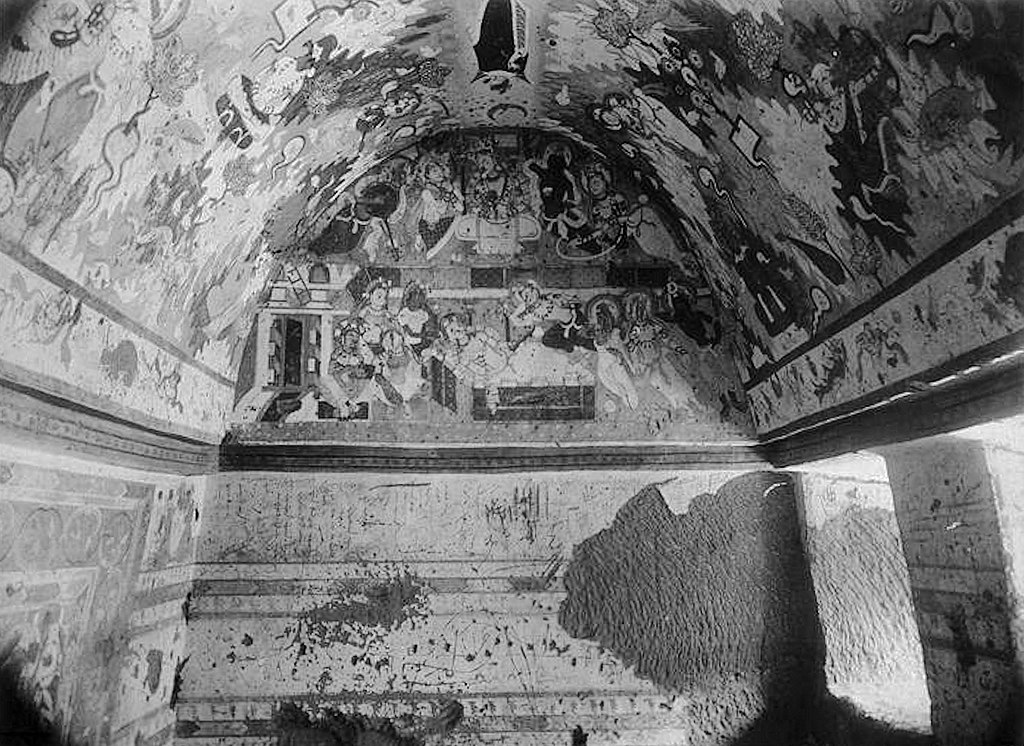
The culture and civilization of Kucha during this period can be glimpsed from the discoveries in the famous Kizil caves. In 1906, the German expedition team of Albert Von Le Coq and Albert Grunwedel explored the Kizil Caves, with different objectives. Grunwedel copied the murals, while Von Le Coq took them with him and placed most of the fragments in the Museum of Asian Art in Dahlem, Berlin. Other explorers also took the murals and placed them in various museums in Russia, Japan, Korea, and the United States.
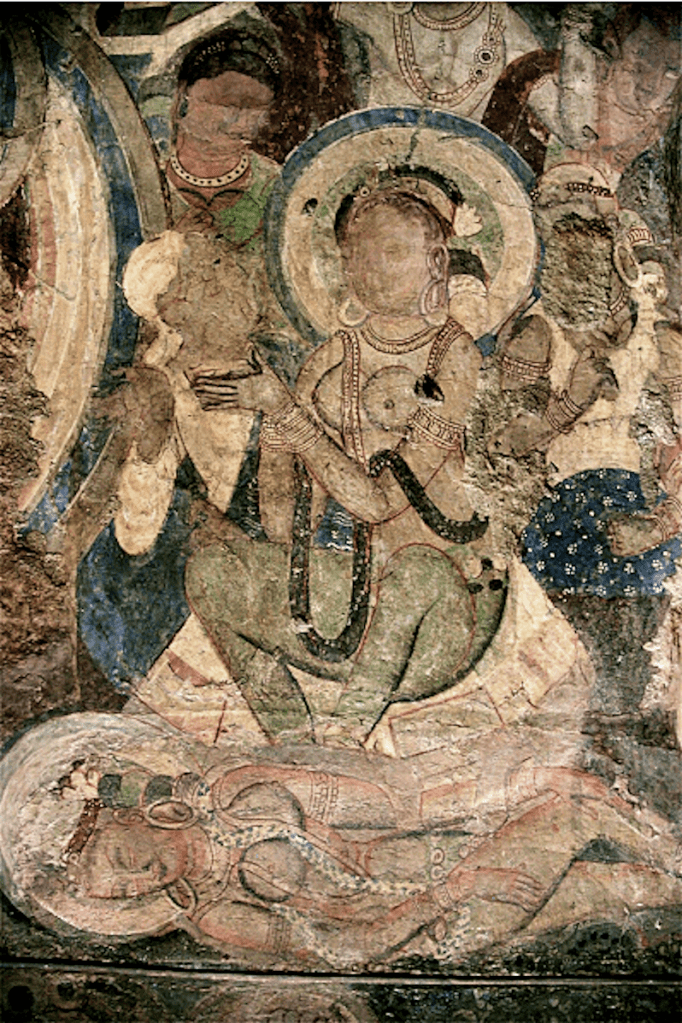
The murals in the Kizil Thousand-Buddhist Caves are considered “The most beautiful murals in Central Asia,” and can be found in 81 caves with a total area of over 10,000 square meters (11,960 yards). The diamond grid pattern is the most impressive feature of the caves, with each grid depicting a story about Buddha’s reincarnation through a single picture. Besides themes related to Buddha, Bodhisattva, Arhat, Flying Apsaras, and Buddhist fables, the murals also showcase various depictions of daily life, farming, hunting, pastures, riding, mountains and rivers in the West Region, animals, birds, and ancient architectures. The styles are not limited to local arts, indicating influences from diverse cultures.
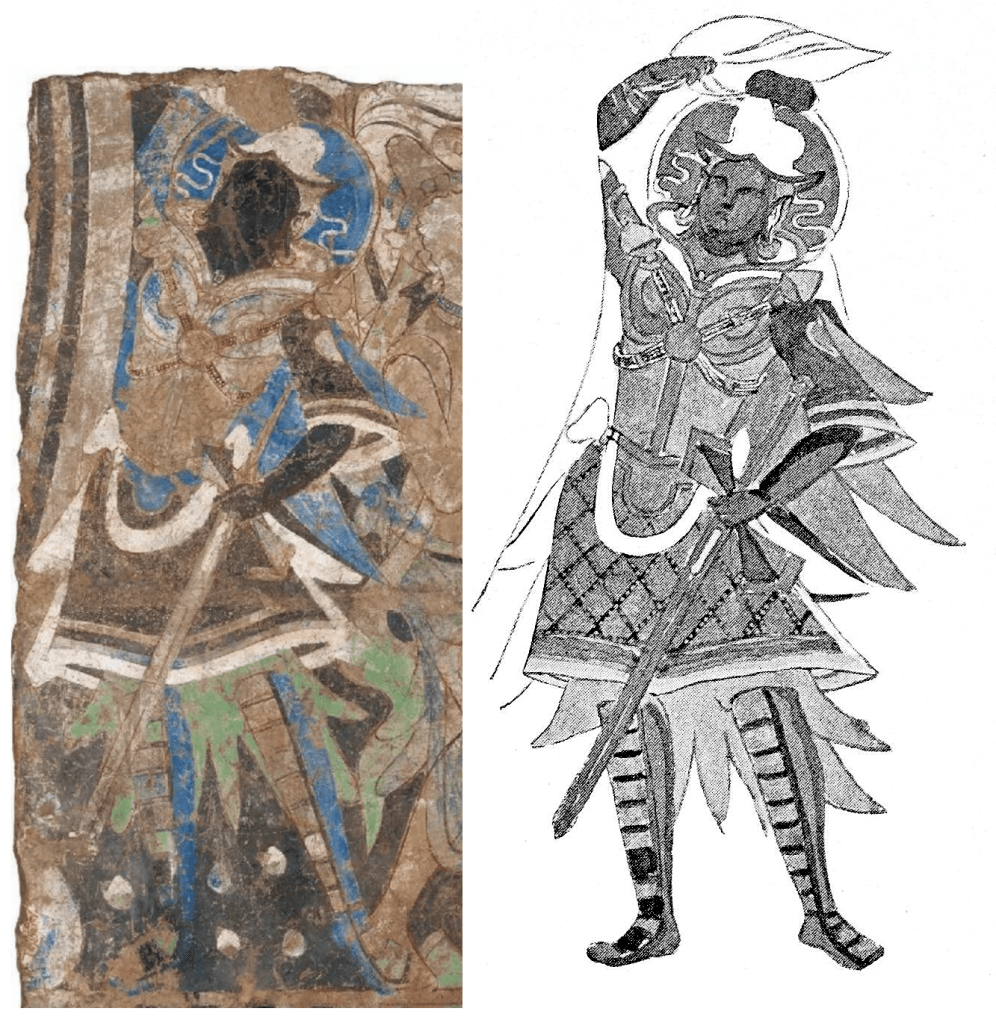
Cave 4 Vajrapani, removed original and in-situ drawing by Grunwedel
Attendant, Cave 84 Painting: 6th century painter, Kizil Photography: Undetermined
Blue pigment used on mural. Greco-Buddhist Wind God Boreas or Vayu, central part of the ceiling of Cave 38
Ancient Uyghur Civilization (1)-Cave art by ancient Uyghurs
Kumarajiva was born around C.E. 344 in kingdom Kucha. Kumarajiva’s father, Kumarayana, was descended from an honourable line of prime ministers of a kingdom in Kashmir. Though Kumarayana was expected to become prime minister after his father, he renounced his hereditary claim and became a Buddhist monk. Eventually, he set out along the silk route which threaded its way across the mighty Pamirs and into the Takla Makan Desert and Central Asia. Following the northern route, he came in time to the devoutly Buddhist kingdom of Kucha on the northern rim of the great Tarim River basin. The Kuchan king either knew of Kumarayana by reputation or showed a shrewd perception of human nature, for he welcomed the traveller warmly and at once made him a trusted adviser. Soon he was elevated to kuo-shih, Teacher of the Nation, a privileged position which entailed political and cultural duties as well as religious functions. …
The great translator’s mother, Jiva (Jivaka), was the younger sister of the king of Kuchi. She was well known for her intelligence, wit, memory, and devotion to the dharma. It was said that she had only to glance at a written passage to comprehend it, and only to hear something once to repeat it from memory. These qualities attracted numerous suitors. Jiva had a red mole (or spots) on her body, an indication that she would give birth to a wise son.
She had politely rejected a number of eligible suitors from neighbouring kingdoms, but when she saw Kumarayana she expressed the desire to become his wife. The king was delighted and insisted that Kumarayana accept the proposal. Even though he was a monk, he bowed to the wishes of this generous and devout monarch.
When Kumarajiva was in utero, Jiva became considerably sharper and more perceptive than before. For example, although her language was what is now known as Tokharian B, while pregnant with Kumarajiva she was able to understand Sanskrit without ever having studied it; after Kumarajiva was born, this ability disappeared. Such an “omen” suggests that the child Kumarajiva was predisposed to master Sanskrit and thus the original Buddhist scriptures.
When their son was born, Kumarayana and Jivaka each gave a part of their names to him and called him Kumarajiva. With two devout parents, Kumarajiva was exposed to Buddhist texts and practice from the day he was born. At the age of seven, he trained with a learned master and memorized a thousand verses every day until he could recite all the teachings of the scholastic treatises of the Abhidharma.
As if an occult design of invisible Nature had become manifest, hardly had the remarkable child turned six before Jivaka received permission from her husband to become a Buddhist nun. By that time Kumarajiva had already learnt the vast literature of the Abhidharma by heart, understood it and entered the Sangha. Kumarajiva’s mother clearly recognized the penetrating intelligence of her son and was determined to give him the best available philosophical and spiritual training.
The primary purpose in practicing Buddhism is to gain control over your life and death. That is true liberation and true happiness! Disciples of His Holiness Dorje Chang Buddha III have exhibited extraordinary feats at the time of their death. There have also been supernormal phenomena manifest at the time of or after their death. Disciples have even returned from the “Pure Land” to report on their new home to their families and to urge them to follow the teachings of His Holiness.
His Holiness has disciples who are eminent monastics and enlightened laypersons who if they want to live, they live. If they want to die, they die. Many have passed on while sitting in the cross-legged meditation position after they announced that they were leaving. They reached a level where they were liberated from the cycle of reincarnation. Many have left behind shariras or firm relics as evidence of their achievement. They have also left behind their body of flesh that does not rot.
Even non-Buddhist relatives of the Buddha Master’s disciples were able to make the transition to the Pure Land after they received the Buddha Master’s instructions and blessings. In all of these examples, the time of transition was an extremely joyous event. Friends and family were able to know that their loved one was making a peaceful transition to a wonderful existence..
TYPES OF LIBERATION FROM THE CYCLE OF BIRTH & DEATH: Regarding liberation from the cycle of birth and death, His Holiness has told us that there are several ways to obtain it. Roughly speaking, it is divided very crudely into four types. There is a dharma that will lead one to have the lifespan as long as heaven which was called the “immortal body”. This is what Guru Padmasambhava achieved. This is the highest dharma which can not be learned by ordinary people. Then, there is the dharma of the rainbow body transformation, which one achieves by transforming one’s entire fleshy body into a rainbow body. Another type is passing away in a sitting position and freeing oneself from the cycle of birth and death. The other type is passing away and being reborn in the Western Paradise of Ultimate Bliss. These are the four types of achievement. Other than that, without achieving liberation or enlightenment, it is descending to reincarnation and death.
The rainbow immortal body is also referred to as the body of supreme transformation or the rainbow body attainment of All-Surpassing Realization. In this higher form the rainbow body transmutes all psychophysical components into the light of buddhahood, so that no outward change is visible. This is why Padmasambhava, Vimalamitra, Vairocana and the like can pass into other buddha-lands in the same forms they enjoyed in our world. The lower rainbow body attainment transmutes consciousness, feeling, perception, and habitual tendencies into the light of buddhahood, but the component of form shrinks in size until only fingernails, tooth-enamel, hair, or relics remain, some time as a “vajra sharira” or “human body sharira.”
Over 2,000 years ago, Shakyamuni Buddha came to the Saha world, established Buddhism, and began to spread the Buddha Dharma. Now, the karmic conditions related to the good fortune of living beings have matured, and the contemporary Buddha H.H. Dorje Chang Buddha III has come to our world once again to bring more Dharma to us. The Avalokiteshvara Bodhisattva Great Compassion Empowerment Dharma is the Dharma that His Holiness has brought to us this time.
When a Dharma Master practices this Dharma, it can convene people, empower them, and lead them into a supernormal state. The purpose is to eliminate negative karma, improve one’s health, and increase spiritual mentality. H.H. Dorje Chang Buddha III has transmitted the Dharma to a few qualified Rinpoches and Dharma Masters, and these Rinpoches and Dharma Masters have hosted the Dharma Assembly many times around the world.
I have participated in the assembly four times so far. The first time, I heard many people crying, singing, or laughing, and some walking around, but I myself didn’t experience any specific motions. I was kind of disappointed. The second time, I had very strong feelings. When the assembly just started and everyone was chanting the Great Bright Six Syllable Mantra, I began to cry and couldn’t control myself. I kept on crying and crying, and it seemed like I cried out all my sorrows and pains in my life. Then I started to sway my body, shake my head and neck. The third and fourth time I joined the assembly, I had more motions and stronger expressions. I still cried hard at the beginning, then I sang the name of Namo Dorje Chang Buddha III, swung my two arms, and spun around. I bent my neck backward so hard, and I even lay down on the floor feeling so peaceful and comfortable, feeling the energy flowing through my body. I did all those without any intention from my mind. I felt the assembly was too short to end. Every time after the assembly, I felt my whole body loosen up, and I was so relaxed and rejuvenated.
The assembly actually has two parts. One is held inside, such as a conference center or grand hall in a hotel, where the master performs the Dharma. The second part takes place outside, where living beings are released from captivity.
H.H. Dorje Chang Buddha III emphasized many times in the Dharma discourses: “The concluding practice of the Avalokiteshvara Bodhisattva Great Compassion Empowerment Dharma is the finest, the best. Were it not for its concluding practice, I would not advocate practicing this Dharma. I all the more would not transmit this Dharma in this world. Why release captive living beings? All living beings have been our family members since beginningless time. They are the same as humans. It is just that their degree of intelligence and appearance are different from those of humans. Still, their consciousness is the same as that of a human. That is why in real life, we see that some animals can even rescue people, some can do math, some can sing, and some can dance. I even saw a dog that was able to play a highly difficult piano melody. Moreover, the dog played it very precisely. We must help them and rescue them. Furthermore, we must not even slightly harm any living being. We can only rescue them.
Because the Avalokiteshvara Bodhisattva Great Compassion Empowerment Dharma is based on the power gathered from the greatly compassionate mind of Avalokiteshvara Bodhisattva, at the end of each Dharma assembly, the one performing the Dharma must lead the attendees in a concluding practice to release captive living beings, do good deeds, and help other people. It is best to conduct the concluding practice on the same day. If there is not enough time, doing it on another day is also acceptable. However, the concluding practice must be completed within fifteen days.
People who attend an Avalokiteshvara Bodhisattva Great Compassion Empowerment Dharma Assembly should make offerings. However, in order to comply with the Dharma, it would be best if they personally helped the Dharma assembly staff arrange that the monetary offerings received at the Dharma assembly be spent on the main subject of the Dharma assembly—the concluding practice of releasing captive living beings, helping other people, and doing good deeds— as well as on the related expenses of the Dharma assembly, such as renting the site, transportation, meals, and lodging for the master performing the Dharma and those accompanying the master.”
Today is the auspicious occasion of Avalokiteshvara Bodhisattva’s holy birthday, and on this special day, I offer my sincere prayers: May the great Bodhisattva bless all living beings with a life full of auspiciousness, prosperity, and happiness. May the compassionate energy of Avalokiteshvara Bodhisattva radiate throughout the world, bringing peace, harmony, and love to all sentient beings.
Taoism is an ancient Chinese philosophy that emphasizes living in harmony with the natural world and embracing simplicity. Its teachings have had a significant impact on both Eastern and Western cultures, including the field of psychology. One prominent figure in psychology who was influenced by Taoism is Carl Jung, a Swiss psychiatrist and psychoanalyst who founded analytical psychology.
Jung’s complex concept of “the Self” is one of his most significant contributions to psychology. The Self represents the totality of an individual’s psyche, including both conscious and unconscious elements. According to Jung, the Self is the goal of the individuation process, a lifelong journey of self-discovery and personal growth.
In ancient China, there were eight prominent figures in Taoism, and Lu Dongbin was the most popular one. Besides being a renowned Taoist, he was also a skilled poet and scholar. Throughout history, many legendary stories and folk tales have been told about him.
One interesting story was recorded in a Buddhist book called JiaTai Pu Deng Lu (嘉泰普灯录), which has also been documented in several other books, including XinShi Heng Yan (醒世恒言). Although there are some variations, the main points of the story remain the same. H.H. Dorje Chang Buddha III also told this story in his dharma discourse: Expounding the Absolute Truth through the Heart Sutra.
Once, Lu Dongbin asked his master, “Master, why did you only save me for a thousand years?”
His master replied, “It’s difficult to teach all living beings. People’s habits are deeply ingrained, and they constantly change. Most living beings find it challenging to learn our Taoism.”
Lu Dongbin countered, “Master, I disagree. We are powerful beings. Are we afraid it will be difficult to liberate them? Let me go down and liberate people for you. I will free a thousand souls every year.”
His master warned, “You may go down to Earth, but be careful not to provoke the monks. Some cannot be trifled with.”
Lu Dongbin descended from the South Gate of Heaven on an auspicious cloud and saw the golden light of Huanglong Temple in Shanghai, China. Zen Master Huanglong was teaching the Heart Sutra and explaining Prajna principles. Lu Dongbin decided to listen in and transformed himself into a fly, sticking to the door.
However, Zen Master Huanglong was a powerful monk who knew Lu Dongbin was eavesdropping. He stopped teaching and instructed his attendant to remove the “person who stole our Dharma.”
Enraged, Lu Dongbin revealed his true form, brandishing his Qingfeng sword and accusing Zen Master Huanglong of insulting him. Lu Dongbin told Zen Master: “I am the great Taoist Immortal LU Dongbin.” Huanglong found it amusing and called Lu Dongbin a “ghoul guard” who would eventually die in vain.
Lu Dongbin drew his sword, but Zen Master Huanglong remained unperturbed, blocking the sword with his sleeve. Lu Dongbin knelt before the Zen master, feeling ashamed.
Huanglong proceeded to teach Lu Dongbin sudden enlightenment dharma, explaining that “speech is cut off, and mind is silenced.” As a god, Lu Dongbin was able to grasp the teaching quickly and had an epiphany.
After his enlightenment, Lu Dongbin wrote a gatha containing the line, “Since I met Huanglong, I realized that I mistakenly used my mind in the past.”
In Buddhist teachings, it is said that even the highest Taoist practitioner can reach heaven, but still remain in the realm of the birth and death cycle. However, if one can realize and abide in the original nature, then they can break through this cycle and achieve liberation. The original nature refers to the pure dharma body of all sentient beings within the three spheres of existence (triloka), which is united with the universe. It has no form, shape, physical body, or appearance. All living beings possess this original nature equally, which is the same as the dharma body of the Tathagata or dharmakaya. It neither comes nor goes, and is neither excessive nor lacking. It is immaculate, free from any notion of cleanliness or dirtiness.
The truth and the original nature of all conditioned and unconditioned phenomena in the universe are contained in the word Buddha-dharma. The Buddha-dharma is all causes and effects in the universe. To understand all causes and effects, yet not be controlled by cause and effect, is to realize liberation and the Buddha-dharma. No matter how many schools or sects there are, the Buddha-dharma has only one truth. It is the truth of the universe: the dharma of ending the cycle of birth and death! The Buddha-dharma is the life order of another world and dimension.
However, this rather abstract definition does not tell us how we realize or learn the Buddha-dharma. In a series of dharma discourses on learning Buddhism released in January 2016, H.H. Dorje Chang Buddha III gives such a practical definition. It is the dharma that we practice in the vajrayana form of Buddhism. It is the preliminary, main, and ending practice in their totality. The true Buddha-dharma emphasizes real practice and skills and is not merely theoretical Buddhist studies. The holy manifestations or miracles described on this website and in the book H.H. Dorje Chang Buddha IIIare evidence that the true Buddha-dharma, as practiced by Shakyamuni Buddha and the accomplished ones of the past, still exists in the world and that very high levels of spiritual accomplishment are possible for those who follow a true vajra master.
H.H. Dorje Chang Buddha III has said: “After you enter the door of Buddhism, you must cultivate yourself according to the dharma. Your three karmas of body, speech, and mind must correspond with the teachings of the Master. Only then will you be able to become accomplished. Conduct that is not in accord with the teachings of the Buddhas and Bodhisattvas must be corrected through concrete actions. You must make your conduct accord with the teachings contained in the Tripitaka and the states of morality, concentration, and wisdom. Yet, correcting your words and conduct must be carried out within everyday worldly life. That is because everyday worldly life (worldly or secular dharma) is the Buddha-dharma. There is no Buddha-dharma to accomplish apart from worldly or secular dharma. That is why you must use all mundane or worldly experiences to improve your self-cultivation. You must use worldly experiences to perfect your realization and conduct. If your basic worldly conduct is not proper, it is of no use to speak in a high-sounding way about emptiness or to speak boastfully and wish wildly.”
However, we must have patience in learning the Buddha-dharma. You cannot completely understand the principles of the dharma in a brief period of time. You must go though the sequence of first hearing the principles from your vajra master, gradually acting in accordance with these principles, walking the correct path and so on. You must advance step my step. You cannot expect that your negative karmic obstructions that have formed over many past lives can be purified in just one day. The tantric dharma that we receive when correctly practiced will enable us to overcome our obstructions, purify our three karmas, and enable us to progress on this path. Do not waste time on activities that do not lead to liberation and becoming a Buddha. DO NOT WAST TIME!!!
Gadu Rinpoche is the fifth venerable Yundun Duojibai. Having a supremely wonderful karmic destiny in this lifetime, he received profound initiations from H.H. Dorje Chang Buddha III. He cultivates himself diligently. The venerable one has become deeply accomplished in the practice of second-level Great Perfection Dharma and attained the nirmanakaya state. In his book Cultivate Honestly, he recounts his experiences upon receiving the Niwan Crown-Opening Heaven Mandala.
Several years ago, at one day my Buddha Master told me “I will open the mandala and transmit the very profound Buddha-dharma to you. This Buddha-dharma is the state practice empowerment dharma from The Supreme and Unsurpassable Mahamudra of Liberation and belongs to the dharma of the heaven realm. Once you receive the empowerment, within two hours, a hole will be opened at the Niwan spot on the top of your head. Your spirit and consciousness can come out and appear from there.”
At that time, however, although I felt fortunate to learn the dharma, there was doubt in my mind that I could not get rid of. I simply could not believe what my Buddha Master stated about having my crown opened at the Niwan spot within two hours. The more I thought about this, the more I was worried. This was truly peculiar and absolutely unheard of. Having a hole opened on the crown was definitely not an ordinary matter. How could the person be alive after that? On the other hand, based on my Buddha Master’s holy realization, I kept telling myself not to have doubt because it is in violation of the precepts. However, I just couldn’t remove the doubt in my mind. Now I think about this, I felt that I was really very inferior and my karmic impedance was too heavy. Being Yundun Duojibai V – Gadu, I am still a tiny speck before my Buddha Master. I am really ashamed and ashamed!
My Buddha Master selected a good time on an auspicious day at the solemn mandala to hold the initiation of the empowerment dharma from The Supreme and Unsurpassable Mahamudra of Liberation, Niwan Crown-Opening Heaven Mandala. My Buddha Master discoursed to me, “This dharma is a very important one. Very few people have the opportunity of learning this dharma. After learning the dharma from the master, true form of realization will arise quickly within two hours. You will then attain the Niwan Daoguo. You should make a good effort to practice this dharma and benefit living beings.” Thus I entered the state of receiving the very profound empowerment. My Buddha Master sat on a high platform at a far distance. However, my Buddha Master did not touch my head and only let me visualize practicing the tantric rituals. The ceremony was conducted to open the door to acquiring the correct Buddha-dharma. Two hours passed. At that time, the frontal fontanel spot at the top of my head warmed up. I had a very unusual feeling but I really did not know whether my crown opened or not.
On the seventh day of my practicing the dharma, an extremely strong force of empowerment was felt at the position of frontal fontanel on my forehead. This is the location of the soft spot on the head of a new-born baby where movement corresponding with the heart beat can be seen. It is called the Niwan Palace. Taoists call it the Heaven Gate. This huge force of empowerment poured in from the Niwan Palace with the magnitude of a tidal wave and the momentum of an avalanche. Then my body received a very strong electric shock. With a loud sound of cracking, the Niwan spot opened up. At this time, my mind was in a state of ignorance in terms of knowing where I was, either in existence or emptiness. Very quickly, this ignorance transformed into boundless light beams. I transformed out of a “me” who was meditating in a cross-legged sitting into another “me.” Then I flew up, with incredibly fast speed, into the sky. Strong pressure from wind was felt on top of my head. My ears also heard sharp and harsh sounds from the wind. At this moment, I was not in the state of ignorance. I saw clearly and unambiguously my second nirmanakaya.
At that time, all scenes I saw of mountains, rivers, lands, Sun, Moon, stars, homes, crop fields, farms, and pedestrians on streets were true existence and real in front of my eyes. I was not in a dream state. My biggest concern was staying outside for too long and risking my original body getting harmed. I thought about the story of Taoist Iron-Crutch Li. His body was destroyed by other people because of his late return. Then he could only settle into the body of a crippled and hunchbacked beggar. Although this is a legendary story of Taoists, it is true state in my current reality. Do I want to follow the path of Iron-Crutch Li? So I felt very worried and immediately started to return to the mundane world. I clearly saw that the spot of the Niwan Palace on my head was emitting light. I followed the light and re-entered my body. Since then, I experienced endless wonders that cannot be described in words.
When I reported my experience and feeling from practicing this dharma to my Buddha Master, my Buddha Master transmitted a secret mantra to me. Sometime later, in recorded dharma lessons that were distributed to the public, my Buddha Master mentioned that my dharma practice had reached the preliminary stage of the state of nirmanakaya, or simple nirmanakaya.
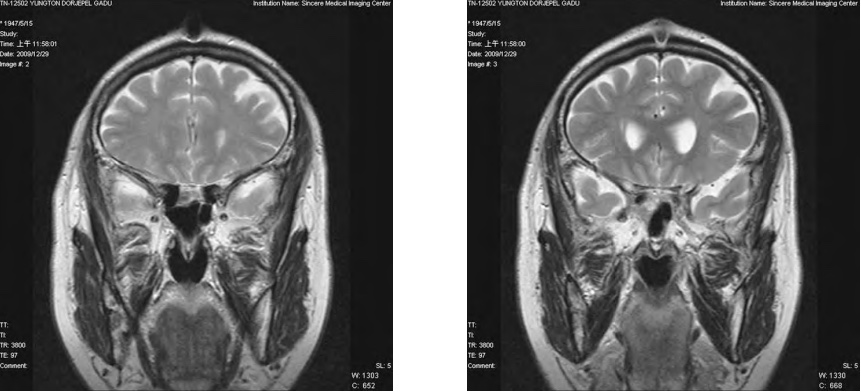
Several years later, in order to let living beings know the greatness of Buddha-dharma, on December 29, 2009, I took a magnetic resonance image (MRI) exam on my head at the Sincere Medical Imaging Center. The result showed a deep gap at the position of the Niwan Palace with a width of 1.5 cm. Also, the images captured the real situation of my spirit and consciousness rushing out of my head. The doctor conducting the examination was very surprised but was not able to explain it and attributed it to non-human cause. I was really very clear because this is where my nirmankaya came out and returned. Please see the scan films from my MRI exam.
Heaven Gate opening at the position of the Niwan Palace, side view
Heaven Gate opening at the position of the Niwan Palace, front view
January 1st in the Chinese lunar calendar, is chinese Spring festival, it is the biggest holiday in china. It is also the holy birthday of Maitreya Bodhisattva – the next Buddha in the saha world. This is a special and joyful holiday that is celebrated by many. Hua Zang Si in San Francisco held a Dharma Assembly to celebrate this important occasion. It was the first Dharma Assembly of the year and it was held on a beautiful sunny day. Many laypersons participated in the event.
At the entrance of the temple is an oversize marvelous statue representation of a jolly, laughing Buddha: Maitreya Bodhisattva (the next Buddha in this Saha world). It is such a warm welcoming sign. The big belly not only means jolly, it also means tolerating the intolerable things in the world. So when you look at the statue, you will start to feel that learning Buddhism is happy and kind.
The Dharma Assembly was an opportunity for people to come together and celebrate the teachings of Maitreya Bodhisattva. It was a time for reflection and meditation, as well as a chance to learn more about the teachings of Buddhism. The atmosphere was filled with positivity and joy, as people came together to celebrate this important holiday.
In Chinese culture, Maitreya Bodhisattva is seen as a symbol of joy and tolerance. As practitioners of Buddhism, we are encouraged to strive to be like the Buddhas and Bodhisattvas by cultivating a broad mind, open heart, and great tolerance.
One of the key principles of Buddhism is patience and forbearance, particularly under insult. This is seen as a key aspect of self-cultivation and it is important to remember that everything in the dharma realms can change from ordinary to holy. This means that even difficult situations can be transformed and overcome through the practice of patience and tolerance.
Patience and tolerance are not just passive qualities, but rather active ones that require effort and practice. We must actively cultivate them in our daily lives and strive to maintain them even in difficult situations. Through this practice, we can transform our own minds and hearts, becoming more like the Buddhas and Bodhisattvas that we strive to emulate.
At the Dharma Assembly, we chanted the Eighty-eight holy Buddha name jeweled repentance sutra, in hopes that the Buddhas will wash away all of our sins and negative karmas. After the chanting, we offered a meal to the Buddhas and Bodhisattvas. The event concluded with a dharma talk given by Dharma Master Ruohui.
During her talk, Dharma Master Ruohui emphasized the importance of faith, vows, and actions for disciples of Buddhism. She explained that faith is the foundation of our practice, and that with strong faith, we will have the determination to follow the Buddha’s teachings and put them into action in our lives.
The Dharma Assembly was a meaningful event where participants not only had the opportunity to reflect on their own spiritual growth but also to make an impact on the world around them. During the assembly, the participants returned the merit to all living beings, holding the hope that they shall be rid of suffering, obtain happiness, and have the opportunity to listen to authentic Buddha Dharma.
The act of returning merit is an important aspect of Buddhist practice as it is believed that by dedicating the positive energy generated through our spiritual practice to the benefit of others, we can help bring about peace and prosperity in the world. By returning merit to all living beings, participants were able to contribute to the collective well-being of the world and make a positive impact on the lives of others.
Furthermore, the participants also held the hope that by listening to authentic Buddha Dharma, they will be able to perfect their fortune and wisdom, leading to a more prosperous and peaceful world for all. This is the ultimate goal of Buddhism, to help all beings to find inner peace, happiness and liberation from suffering.
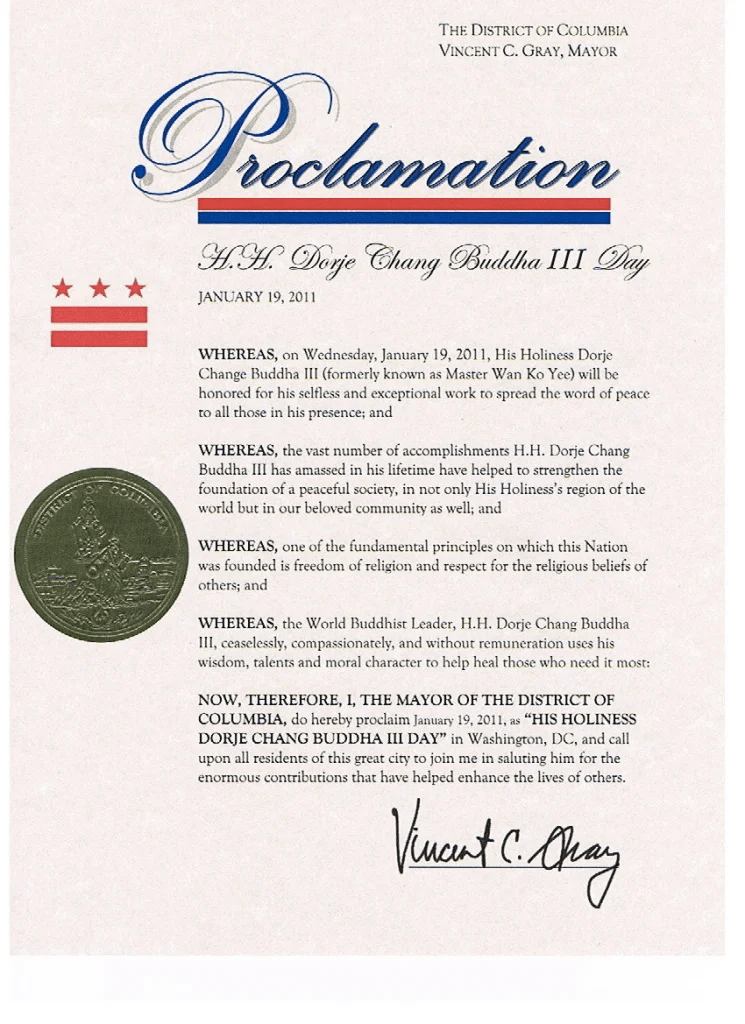
On January 19, 2011, Mayor Vincent C. Gray, the mayor of our nation’s capital Washington, DC, personally signed and issued a proclamation in which January 19, 2011 was proclaimed as His Holiness Dorje Chang Buddha III Day.
In that proclamation, Mayor Gray called upon all residents of Washington, DC to join him in saluting H.H. Dorje Chang Buddha III! The mayor stated that H.H. Dorje Chang Buddha III has, through his selfless and exceptional work, spread the word of peace to all those in his presence. The mayor commended H.H. Dorje Chang Buddha III for his vast accomplishments that have helped to strengthen the foundation of a peaceful society, in not only His Holiness’s region of the world but in the Washington, DC community as well. Additionally, Mayor Gray praised H.H. Dorje Chang Buddha IIIas the World Buddhist Leader who ceaselessly, compassionately, and without remuneration uses his wisdom, talents and moral character to help those in need.
The video below has a brief introduction of H.H. Dorje Chang Buddha III, that helps you to know some great achievements and teachings of the Buddha.
Buddha taught that all living beings have Buddha-nature, and that we shall treat them as family members and relatives. To celebrate this very special day, Hua Zang Si held a Dharma Assembly to release captive lives and pray for blessings at a beautiful port in San Rafael CA , on January 19th 2023. Many laypersons in the bay area and central CA participated the event.
Namo H.H. Dorje Chang BuddhaIII and Namo Shakyamuni Buddha taught us :”No matter where it is and when it is, if we see living beings in horrible fears and calamitous adversity, we must save them. Therefore, for any lives that are facing the urgent and terrible fear of going to be hurt or killed, we shall save them out and release them into an environment that suits them, so as to let them regain the freedom and be free from fears. There is a phrase that says, ‘I love to see them live, and I dare not see them die.’ Based on our compassion and empathy, we want to endow living beings with happiness and rid them of sufferings.
With the Dharma Assembly, participants returned the merit to all living beings, holding the hope that they shall be rid of suffering, obtain happiness, and have the opportunity to listen to authentic Buddha Dharma, perfecting fortune and wisdom, and leading to prosperity and peace throughout the world.
When I was respectfully on my knees and holding my palms together in front of my kind Buddha Master’s dharma seat for the first time, as soon as I raised my eyebrows to have my eyesight in a light contact with the loving, compassionate, and benevolent eyes of my Buddha Master, I immediately had the belief that my Master is a Buddha! However, my Buddha Master never stated to anyone what holy being he was in past lifetimes. Conversely, he always claimed to be a servant of everyone.
During the past ten years, I closely attended by the side of my Buddha Master and also carried out quite a number of Buddhist deeds following my Buddha Master. The holy states and holy realizations manifested by my Buddha Master such as proficient in both exoteric and esoteric Buddhism, perfect and deep mastery of the Five Vidyas, and great wisdom unrivaled by any human or holy beings are unprecedented in the history of both exoteric and esoteric Buddhism.
My firm belief of “My master is a Buddha” that I had in my mind for years was finally confirmed from the treasure book of H. H. Dorje Chang Buddha IIIthat was presented to the Congress of the United States by the International Buddhism Shanga Association on April 3, 2008. The identity of my Buddha Master, known by people in the world as Master Wan Ko Yee, was revealed through either meditation or practice of the dharma in a profound state of supernatural vision by the first-class great holy virtuous ones, who are incarnations of Buddhas and Bodhisattvas. They announced the background of H.H. Wan Ko Yeshe Norbu, who was long ago recognized by H.H. Great Dharma King Zunsheng (the manifestation of Mahavairocana Buddha) as Buddha Vajradhara. Through strict practice of the dharma and meditation these holy monastics deeply entered the dharma realm and supernaturally saw the true source. The result was they learned that this being of great virtue and holiness is the second incarnation of Vimalakirti and the third incarnation of Dorje Chang Buddha. They wrote down their certificates of recognition according to the rules of Buddhism in which they recognized that H.H. Master Wan Ko Yee is H.H. Dorje Chang Buddha III — the highest ancient Buddha in exoteric, esoteric, Mahayana, Hinayana, and Vajrayana Buddhism; the master of the Five Buddhas in the five directions; and the master of the great mahasattva Vajrasattva. That is, they recognized that H.H. Master Wan Ko Yee is the Holiest Tathagata Wan Ko Yeshe Norbu, the current greatest leader of Buddhism in the entire dharma realm!
Those eminent monks and dharma kings also wrote words praising H.H. Dorje Chang Buddha III as being the highest and greatest holy being and the only one in the history of Buddhism who has truly exhibited before living beings item after item of accomplishments in the Five Vidyas.
From that, I realized the truth behind what I experienced quite a few years ago when a huge and gigantic material, in less than two hours of time, became a piece of extremely finely carved and crafted miraculously wondrous holy Yun sculpture artwork. Such holy realization was just a manifestation of the craftsmanship vidya of the Five Vidyas by my magnificent Buddha Master, due to the affinity of living beings.
My Grand Master, H.H. Great Dharma King Zunsheng, stated in a formal pronouncement about my great and kind Buddha Master that the realization of any eminent monastic or person of great virtue in the world today cannot rival the realization of Holiest Tathagata Wan Ko Yeshe Norbu. H.H. Great Dharma King Zunsheng also made the following vow of truth: “If any person or holy being is able to duplicate the mysterious sculpted treasures created by H.H. Wan Ko Yeshe Norbu, then this formal pronouncement of Great Dharma King Zunsheng has deceived the public.” (The mysterious sculpted treasures are “Enchanting Colors of Utmost Mystery,” “Mysterious Boulder with Mist,” and certain other Yun sculptures with specific names.)
Yun Sculpture by H.H. Dorje Chang Buddha III
According to the system and rules of Buddhism in this world, there are only two beings of great holiness whose expositions of the dharma can be categorized as sutras. One of them is Sakyamuni Buddha. The other is the holy and venerable Vimalakirti. Besides those two, all other expositions of the dharma can only be called commentary rather than sutras. This is true no matter how great the Bodhisattva who has expounded the dharma is.
Some people say that Hui Neng (the sixth patriarch master of the Zen School) gave the Platform Sutra of the Sixth Patriarch. Actually, the word sutra was used due to exaggerated praise given to Hui Neng by people of the world who did not understand the system and rules of Buddhism. The rank of the sixth patriarch was even lower than that of many Bodhisattvas. For example, Maitreya Bodhisattva is the next Buddha, who will conduct the Dragon Flower Assembly. The position of Maitreya Bodhisattva is very much higher than that of Hui Neng. However, expositions of the dharma given by Maitreya Bodhisattva cannot be called sutras. They can only be accepted as commentary. An example of this is the Yogācāra-bhūmi-śāstra. (Discourse on the Stages of Concentration Practice)
The holy and venerable Vimalakirti descended into this world during the time of Sakyamuni Buddha. He is the only ancient Buddha who transformed into a layman to expound the dharma. Sakyamuni Buddha personally taught the four types of disciples. Among them were the 500 monks who were difficult to teach and who did not want to arouse Mahayana bodhicitta. A skillful means was used to teach all of the monastics and 8,000 Bodhisattvas. After the ancient Buddha Dorje Chang expounded dharma in Abhirati (World of Wonderful Joy), the Buddha responded to karmic conditions by transforming into the holy and venerable Vimalakirti to help the Buddha teach the sangha, Bodhisattvas, and other disciples. The goal was to protect and uphold the Buddha-dharma taught by Sakyamuni Buddha. The level of realization attained by the holy and venerable Vimalakirti was the same as that attained by Sakyamuni Buddha. However, He did not want to assume the status of another leader of the religion in the human realm, thereby causing sectarianism and adding to the self-centeredness of practitioners. Considering that Sakyamuni Buddha became a Buddha in this earthly World, the holy and venerable Vimalakirti acknowledged Sakyamuni as Buddha and chose to assist Sakyamuni Buddha by manifesting as a Bodhisattva.
Thus, the holy and venerable Vimalakirti acted in the same way that the ancient Buddha Zheng Fa Ming (True Dharma Brightness) Tathagata acted when the Buddha transformed into Kuan Shi Yin Bodhisattva and also acted in the same way as Manjushri Bodhisattva, the Master of seven Buddhas, did to play the role of a Bodhisattva to support Sakyamuni Buddha. All of this was done to benefit living beings. If two Buddhas of the same rank appeared at the same time, it would cause worldly divisions. It would hinder the development of Buddha-dharma and the saving of living beings. Actually, Buddhas do not care who emerges as the leader of Buddhism. The Buddhas appear in whatever form and manner that best benefit living beings. Everything is done for the benefit of living beings based upon bodhicitta.
Therefore, people in general have no way of discovering that the realization and enlightenment of the holy and venerable Vimalakirti were that high and that He was the incarnation of Dorje Chang Buddha, the foremost ancient Buddha who existed before Sakyamuni Buddha. However, the dharma discourses of the holy and venerable Vimalakirti are sutras, just as the dharma discourses of the Buddha, not commentaries. In the system of Buddhism, one such discourse is called Vilmalakirti-nirdesa Sutra (The Sutra of Vimalakirti). That sutra came into being during the same time period Sakyamuni Buddha was giving sutras. It is a very important Buddhist sutra. The Vimalakirti-nirdesa Sutra has been studied and followed in both Mahayana Buddhism and Hinayana Buddhism that was mostly propagated in Southern Asia.
When H.H. Dorje Chang Buddha III was born, the beating of drums suddenly sounded in the sky, and beautiful, heavenly music could be heard. Three rainbows approximately forty to fifty meters (131-164 feet) apart appeared simultaneously in the sky. The middle one was primarily blue, the right one primarily red, and the left one primarily white. At birth, the entire body of His Holiness was dark blue. No cries from His Holiness could be heard. Rather, His Holiness opened his mouth and very clearly stated, “I have entered this world. I am completely proficient in exoteric and esoteric Buddhism and will wondrously manifest the Five Vidyas. Compare and you will know.” After speaking such words, His Holiness remained silent and appeared just like an ordinary child. The parents of His Holiness thought that they had given birth to a mysterious and extraordinary human being but did not tell anyone about this. His Holiness did not speak again until He was three years old.
When His Holiness was three years old, H.H. Mahavairocana Dharma King Zunsheng guided His Holiness in learning the Tripitaka. At that time, His Holiness was taught to recite the heart mantra of Dorje Chang Buddha seven times. This little child suddenly laughed heartily and immediately manifested the Three Bodies and Four Wisdoms. H.H. Great Dharma King Zunsheng at once tested His Holiness’s knowledge of the Tripitaka and the esoteric scriptures. The Dharma Prince child explained such writings with great facility. There was nothing in them that His Holiness did not understand. His Holiness had realized all of the doctrines and principles of such teachings.
H.H. Mahavairocana Dharma King Zunsheng then gave the following formal pronouncement: “Dorje Chang Buddha has come to this world a third time. The holy and venerable Vimalakirti has descended from the skies a second time. He completely understands the scriptures on the dharma. His Four Wisdoms are wonderfully perfect. He is an ancient Buddha upon whom living beings can rely. No master is qualified to teach Him. His mysterious sculpted treasures will be spectacular and unique in the world. He will be able to take mist that will stay inside His sculptures. He will manifest His realization and consummate skills. No holy person in the world will be able to duplicate such works. If anyone will be able to duplicate such works without differing from the original at all, my words have deceived the world. Vimalakirti Wan Ko is Buddha Vajradhara. He will cause the Buddhas to bestow nectar that many will see descend from the sky. He is of utmost benefit to sentient beings. He has the compassion and wisdom of an ancient Buddha. I hereby reveal these words to prove the veracity of my formal pronouncement.” H.H. Mahavairocana Dharma King Zunsheng also gave His Holiness the dharma name Yangwo Yizhi Dharma Prince, which means Dharma Prince supreme leader of Buddhism with the highest wisdom.
H.H. Mahavairocana Zunsheng then said, “During the Dharma-Ending Age in the earthly world, there will be many evil teachers and demons who will claim to be genuine holy persons. In order to distinguish the genuine from the false, I now make a strict formal pronouncement that will serve as the testing standard. The pronouncement is as follows: There will not be a fourth incarnation of Dorje Chang Buddha in this earthly realm within the next 5,000 years. The third Dorje Chang Buddha will be the only such holy being, and there will not be an incarnation of another Dorje Chang Buddha in this earthly realm for 5,000 years. Based on causes and conditions that accord with the dharma, I now lay out tests to determine whether a person is that true Buddha if he claims to be the true incarnation of that Buddha. He must successfully invoke the Buddhas to bestow nectar. He must be able to perform the Golden Vase Selection of Karmic Affinity and predict the results of that ceremony beforehand. He must be able to eliminate karmic obstructions in a clearly visible manner. He must be able to replicate wondrous multicolored sculptures. He must be able to take mist, place it inside a hollowed out sculpted boulder, and have the mist stay there. If a person is able to do all five of these things without exception, then he is the true fourth Dorje Chang Buddha. No matter how great a holy terton may be, no matter if a person leaves concave imprints on rocks with his hands or feet, no matter how vast a person’s manifold supernatural powers may be, if he cannot do these five holy things, then he certainly is not the true incarnation of Dorje Chang Buddha. An ancient Buddha who descends to this earthly realm will have no difficulty meeting these five tests. I leave these five observable tests to guard against those in the future who make false claims.”
The Dharma Prince was acting as the holy and venerable Vimalakirti did when Vimalakirti received different teachings and knowledge, took on the appearance of an ordinary person, and learned things tirelessly. No one knows why the Dharma Prince did so. At the age of sixteen, the Dharma Prince wrote a work on the dharma called A Monk Expounds the Absolute Truth to a Layperson. After that writing was buried, great master Hui Yong unearthed it. Renqing Luozhu and Suolang Danbu respectfully offered that writing to H.H. Mahavairocana Zunsheng Yeshe Norbu to evaluate. H.H. Zunsheng Yeshe Norbu personally promulgated that dharma called A Monk Expounds the Absolute Truth to a Layperson in front of the four types of Buddhist disciples. After He finished promulgating that dharma, He personally led the four types of Buddhist disciples in kneeling down and facing that writing on the dharma. He then made the following formal pronouncement: “An ancient Buddha has arrived in the east.” He recognized that the Dharma Prince was H.H. Dorje Chang Buddha III, conferred upon His Holiness the title Yangwo Wan Ko Yeshe Norbu, and said that His Holiness is the Holiest Tathagata. He also called that dharma A Monk Expounds the Absolute Truth to a Layperson Sutra.
There are certain time periods relating to H.H. Dorje Chang Buddha III ’s propagating the dharma and benefiting living beings. Before the age of eleven was the period during which His Holiness was engaged in the Tripitaka of exoteric Buddhism. From the age of eleven to fifteen was the period during which His Holiness was engaged in the esoteric dharma of the Kagyu school. During that time, he was called Dusum Khenpa Lion’s Roar Dharma Prince. After the age of fifteen was the period during which His Holiness was engaged in the esoteric teachings of the Geluk school. His Holiness was at that time called the reincarnation of Master Tsongkhapa. That was also the time period during which His Holiness flawlessly propagated the tantric scriptures of the Sakya, Nyingma, and all of the other schools. At this time, His Holiness was called the embodiment of the body, speech, and mind of Guru Padmasambhava.
Because my Buddha Master is an ancient Buddha who has come to this world again, His Holiness upholds the principles of “making no distinction between exoteric and esoteric Buddhism or among all of the sects and schools; teaching living beings according to their particular circumstances; and pervasively propagating the teachings of the Buddhas to all.” Thus, His Holiness is the Buddha Vajradhara Great Dharma King of the “Buddha Sect” who pervasively saves all living beings. My Buddha Master has repeatedly admonished everyone with the following counsel: “There is no differentiation among the various schools and sects in my mind. There is only Buddhism. However, for a dharma king, rinpoche, or acharya of any school or sect, as long as he or she does not commit violations in the 128 evil and erroneous views, abides by the teachings of the Buddha, attains liberation, and then saves other living beings based on their particular karmic conditions, he or she is worthy of praise.” Of course, The Supreme and Unsurpassable Mahamudra of Liberation is the greatest dharma among supreme great dharmas for cultivators to receive and practice. That is why my Buddha Master is the only one in this world possessing the realization of opening up the Niwan Daoguo for all kinds people to enable them to attain heavenly and holy states.
[Please respectfully read in detail the treasure book of H. H. Dorje Chang Buddha III to acquire great wisdom, accomplishment and liberation. If you have the affinity to receive and practice the dharma of The Supreme and Unsurpassable Mahamudra of Liberation, you will be certain to get great wisdom and attain great accomplishment and liberation.]
Pure Land Buddhism (Chinese: 淨土宗) is a broad branch of Mahayana Buddhism focused on achieving rebirth in a Buddha’s Buddha-field or Pure Land. It is one of the most widely practiced traditions of Buddhism in East Asia.
Pure Land is a tradition which is primarily focused on achieving rebirth in a Buddha’s “pure land” or buddha-field (Sanskrit: buddhakṣetra), which generally speaking is a Buddha’s field of influence. Some Buddha-fields are considered to be superior places to spiritually train for full Buddhahood, since a Buddha has compassionately “purified” it for this purpose and since in these realms, one can meet a Buddha face to face and study under them. The most common pure land today is that of Amitābha, called Sukhavati, “Land of Bliss”.
For many Buddhists, simply chanting the name of Amitabha Buddha, the Buddha of Infinite Light, is a complete mindfulness and devotional practice. Taking refuge in this way brings a feeling of immediate peace. Shakyamuni Buddha taught this method in the Amitabha Sutra. This simple, yet divinely rich practice combines devotion with mindfulness, of the sacred name of the Buddha.
The Buddha taught us many ways to practice in decades of teaching the Buddha Dharma, mapped out in 80,000 discourses and Sutras. Some of these are “learning practices” such as “Sutra recitation.” Others are vastly intricate and beautiful, such as Vajrayana visualization Sadhanas. Yet, for most of us, the sublimely simple practices are the best way to approach the Dharma, from mindfulness practice, to the most misunderstood of practices, chanting Amituofo. Ten Benefits of Chanting Namo Amituofo Practice Shakyamuni Buddha taught the 10 great benefits of chanting the name of Amitabha Buddha, as a complete practice, in the Amitabha Sutra. This is a devotional mindfulness practice. Single-Pointed focus and mindfulness is the ultimate goal, and can be achieved a number of ways.
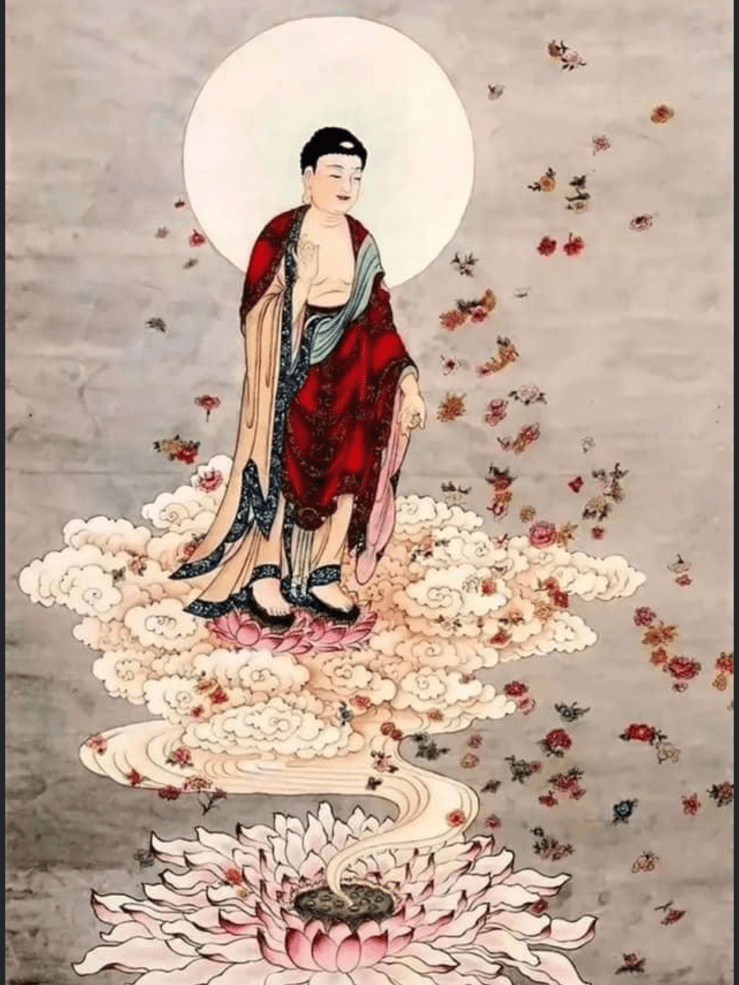
Three Holy Beings in Western Pure Land
Zen Koans are blissfully challenging. Watching the breath is a relaxing mindfulness practice. Chanting the Name or Name Praise of Amitabha is another quintessentially simple — yet penetratingly deep — practice. It makes the focus of our mindfulness, the Perfect Buddha. These ten great benefits of chanting Amitabha, as taught in sutra, include protection, support of all the Buddhas and Bodhisattvas, purification of negative karmas, restful sleep, a peaceful mind, and rebirth in Amitabha’s Pure Land. When you participate in this elegant and powerful practice, you feel immediate peace and comfort.
The entire practice is to mindfully chant the name — sometimes just the name, sometimes as a praise — of the Buddha of Infinite Light, Amitabha. Often this is embellished with the wondrous sound of the hypnotic fish drum, or the regular gong of a bell. Sometimes it is chanted musically; sometimes spoken; sometimes whispered. The immediate reward: a feeling of peace and protection. Many Buddhists — in Non-Pureland traditions — tend to think the practice is too simple, too reliant on faith and praise. If we think this way, we are missing the point. Single-Pointed Focus on Amitabha Like other traditions with single-focus meditation methods, Pureland Buddhist’s chant the name of Amitabha over and over. Mindfulness of the name of Amitabha is a powerful and profound practice. Instead of remaining mindful of something mundane, such as breath, or your walk in the park, Amituofo chanting keeps our mind focused in the present moment on the Enlightened Perfection of Amitabha Buddha. The entire practice is to simply chant, or say, with mindfulness: Amitabha, Amitabha, Amitabha… nothing else. Or using the Chinese version of the name Amituofo, Amituofo, Amituofo. Fo translates as Buddha. Keep the mind focused, in the present moment, on just the sound of your own voice: Amituofo, Amituofo, Amituofo.














 Peace LiLy