Sutra about Wisdom and the Foolishness [賢愚経] ( A sutra translated into Chinese in 445 by Hui-chüeh and others. It contains sixty-two Buddhist tales (sixty-nine tales, in a separate extant edition). A Collection of Records concerning the Tripitaka, the catalog of the Buddhist canon compiled by Seng-yu (445–518), ascribes the translation of the Sutra on the Wise and the Foolish to others. According to that work, T’an-hsüeh, Wei-te, and six other priests went westward from northwestern China to Khotan on the southern edge of the Takla Makan Desert to seek Buddhist scriptures. They happened upon a great Buddhist ceremony that was held once every five years at a monastery. There they heard the learned monks expound the Buddhist scriptures and rules of monastic discipline in the language of Khotan. T’an-hsüeh and the others translated and recorded the lectures in Chinese. Later they returned from Khotan and, upon reaching the region of Turfan, compiled the lectures given by the monks in Khotan as a single sutra, which is known as the Sutra on the Wise and the Foolish. The sutra contains stories explaining the causal relationship between incidents in one’s past existence and those in one’s present existence. In each of these stories, Shakyamuni Buddha makes a connection between someone living in the present and a person involved in a past incident. The law of cause and effect states that every single action in the universe produces a reaction no matter what. We need to abstain from anything that is evil, do everything that is good, and use the correct understanding and views to cultivate. Don’t violate any of the precepts, otherwise you will end in miserable retribution.
This story comes from ” Karma Scriptures about Wisdom and Foolishness “, the third volume in the ” Weimiao Bhiksuni “. In the era of Buddha Sakyamuni, many aristocratic women after ordination were very worried that their habits, such as lust, anger and ignorance, had not been eliminated yet. So they gathered to consult Bhiksuni Weimiao who had already attained the arhatship. Weimiao Bhiksuni told everyone the pain of the desire to bring, and tells the story of her previous life experience…
Pure Land Buddhism (Chinese: 淨土宗) is a broad branch of Mahayana Buddhism focused on achieving rebirth in a Buddha’s Buddha-field or Pure Land. It is one of the most widely practiced traditions of Buddhism in East Asia.
Pure Land is a tradition which is primarily focused on achieving rebirth in a Buddha’s “pure land” or buddha-field (Sanskrit: buddhakṣetra), which generally speaking is a Buddha’s field of influence. Some Buddha-fields are considered to be superior places to spiritually train for full Buddhahood, since a Buddha has compassionately “purified” it for this purpose and since in these realms, one can meet a Buddha face to face and study under them. The most common pure land today is that of Amitābha, called Sukhavati, “Land of Bliss”.
For many Buddhists, simply chanting the name of Amitabha Buddha, the Buddha of Infinite Light, is a complete mindfulness and devotional practice. Taking refuge in this way brings a feeling of immediate peace. Shakyamuni Buddha taught this method in the Amitabha Sutra. This simple, yet divinely rich practice combines devotion with mindfulness, of the sacred name of the Buddha.
The Buddha taught us many ways to practice in decades of teaching the Buddha Dharma, mapped out in 80,000 discourses and Sutras. Some of these are “learning practices” such as “Sutra recitation.” Others are vastly intricate and beautiful, such as Vajrayana visualization Sadhanas. Yet, for most of us, the sublimely simple practices are the best way to approach the Dharma, from mindfulness practice, to the most misunderstood of practices, chanting Amituofo. Ten Benefits of Chanting Namo Amituofo Practice Shakyamuni Buddha taught the 10 great benefits of chanting the name of Amitabha Buddha, as a complete practice, in the Amitabha Sutra. This is a devotional mindfulness practice. Single-Pointed focus and mindfulness is the ultimate goal, and can be achieved a number of ways.
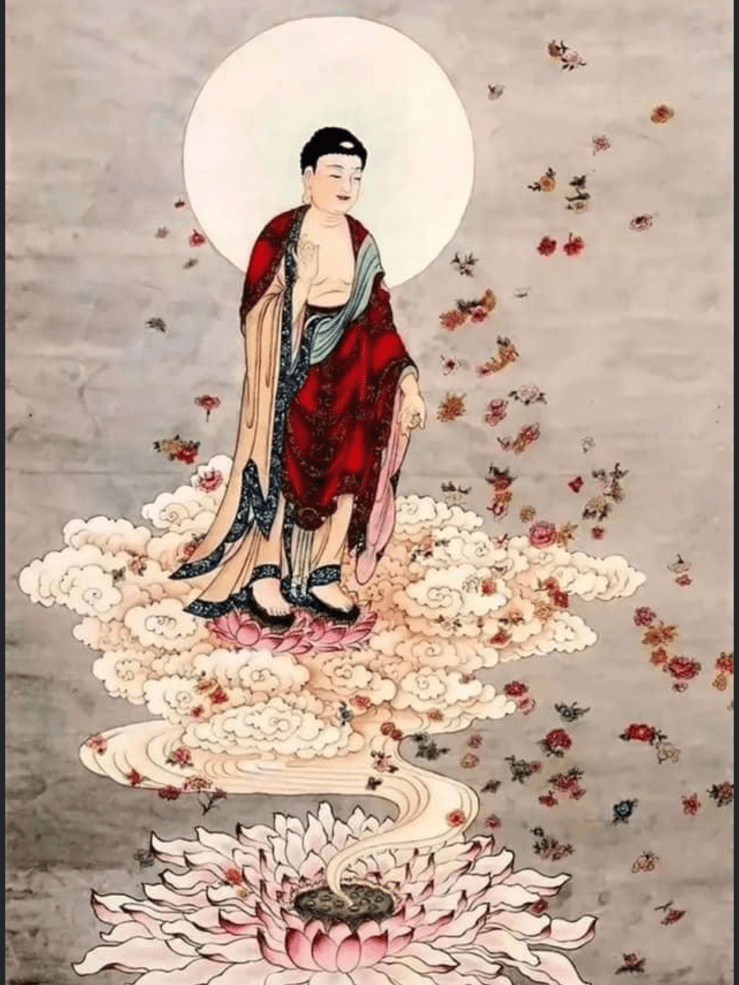
Three Holy Beings in Western Pure Land
Zen Koans are blissfully challenging. Watching the breath is a relaxing mindfulness practice. Chanting the Name or Name Praise of Amitabha is another quintessentially simple — yet penetratingly deep — practice. It makes the focus of our mindfulness, the Perfect Buddha. These ten great benefits of chanting Amitabha, as taught in sutra, include protection, support of all the Buddhas and Bodhisattvas, purification of negative karmas, restful sleep, a peaceful mind, and rebirth in Amitabha’s Pure Land. When you participate in this elegant and powerful practice, you feel immediate peace and comfort.
The entire practice is to mindfully chant the name — sometimes just the name, sometimes as a praise — of the Buddha of Infinite Light, Amitabha. Often this is embellished with the wondrous sound of the hypnotic fish drum, or the regular gong of a bell. Sometimes it is chanted musically; sometimes spoken; sometimes whispered. The immediate reward: a feeling of peace and protection. Many Buddhists — in Non-Pureland traditions — tend to think the practice is too simple, too reliant on faith and praise. If we think this way, we are missing the point. Single-Pointed Focus on Amitabha Like other traditions with single-focus meditation methods, Pureland Buddhist’s chant the name of Amitabha over and over. Mindfulness of the name of Amitabha is a powerful and profound practice. Instead of remaining mindful of something mundane, such as breath, or your walk in the park, Amituofo chanting keeps our mind focused in the present moment on the Enlightened Perfection of Amitabha Buddha. The entire practice is to simply chant, or say, with mindfulness: Amitabha, Amitabha, Amitabha… nothing else. Or using the Chinese version of the name Amituofo, Amituofo, Amituofo. Fo translates as Buddha. Keep the mind focused, in the present moment, on just the sound of your own voice: Amituofo, Amituofo, Amituofo.
On weekday mornings, I hurriedly drive my son to school. Trying to beat the traffic and catch as many green lights as possible, the drive is usually a blur. One particular morning’s drive changed my perspective. While rushing down a wide arterial road, my son exclaimed to me that the trees on the sidewalk looked very beautiful.
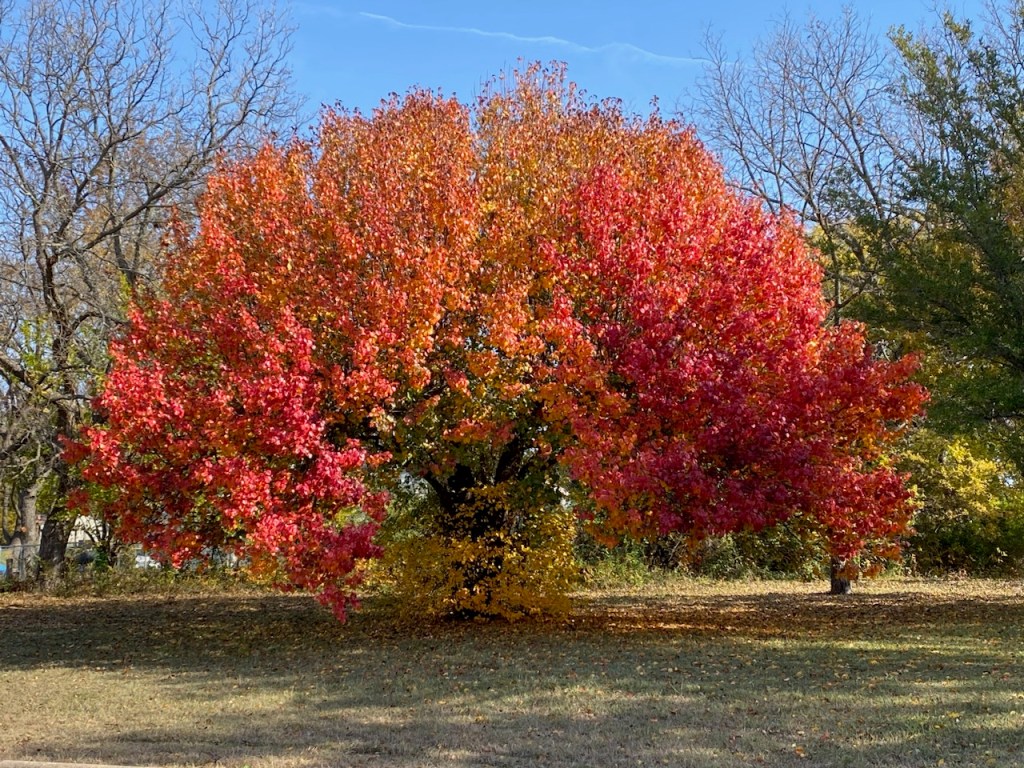
Glancing over to the trees, I suddenly noticed the vibrant reds and yellows of the leaves clinging onto branches or drifting onto the sidewalk as the wind blew. Despite driving down this street every morning, in my hurry I had not noticed the changing colors of the trees until now, nearly the end of fall. The bright hues of the fall foliage was absolutely beautiful. This nature beauty made me slowing down my daily past pace. I feel the healing power of nature relaxing my tense nerves, and filled my heart with joy, peace, and harmony.
As I admired the scenery on the commute, I felt how wonderful it was to be present in the moment. I realized that oftentimes we lose sight of the little elements of natural beauty that are all around us. Life can be hectic, but we must make a conscious effort to enjoy the omnipresent beauty of our world.
A poem by a ancient Zen Master came to my mind:
Blossoms in Spring, Breezes in Summer, Glorious moons in Fall, and Snow in Winter. When one is not held back by nothing, Every moment can be wonderful.
Eggs are an essential part of a good breakfast. There are countless ways to prepare them, but not all recipes are made equal. I used to cook omelettes for the family, but recently I learned that hard boiled eggs are actually a better choice. Hard boiled egg can keep more nutrients from the egg and avoid extra oil.
The only problem is, peeling a hard boiled egg is a rather arduous task. The shell and egg white absolutely refuse to be parted. Usually, the peeled egg ends up looking kind of like the moon, full of craters and lumps and whatnot. This morning, I got very frustrated trying to peel my hard boiled egg. It felt like the shell and egg white were superglued together. Even my mother’s old trick of placing the boiled eggs into cold water didn’t seem to work. After my first peeled egg ended up looking like a misshapen golf ball, I was ready to throw them all onto the floor.
Fortunately, I am a Buddhist disciple, and I remembered one of the most important things I’d learned: patience. I told myself, as a student of the Buddha who cultivates myself everyday, why am I still so easily distressed by outside events?
So I decided to let myself calm down for a while. I left the eggs in the cold water and went off to relax. After maybe fifteen minutes, I returned to give making breakfast another shot. Surprisingly, the shell peeled off easily this time. I realized that by being patient and giving the eggs more time to cool down, it was now much easier to complete my task. So when annoying things happen, we must first be patient. Let it all cool down, and things will be much easier to deal with.
Patient means embracing yourself and all things around you with gentleness and kindness, and doing so will get happy and more productive results.
The lucky door in life is always inadvertently opened. Maybe it’s the blessings from the Buddha and Boddhisatva.
I remember that day, a critical turning pointin my life.I was exercising in the community that day, a surnamed Meng dharma sister asked me to worship the Buddha in the Buddhist Hall nearby. I agreed with her as soon as I heard the invitation. The dharma brothers and sisters made me feel at home. It’s totally different from the people I met in my life, most of whom treated me courteously but without sincerity. So I decided to chant sutras and listen to the recorded discourses expounded by H.H. Dorje Chang Buddha III with dharma brothers and sisters. I felt like it’s the place that I should come. Then I couldn’t help crying when chanting sutras, and I would repent. Every time after listening the recorded Buddha dharma discourses, I was filled with endless power.
To my shame, I never settle down to study, but hurry to come and leave the Buddhist Hall owing to busy work. With my diligence for listening the dharma discourses, I make progress and schedule time for study in the Buddhist Hall. Undoubtedly, we want to lead a good life, but learning Buddhism is more important, we can and we have to plan enough time for study.
On the National Day in 2016, I gave up travelling with my family but took part in the Avalokiteshvara Bodhisattva Great Compassion Empowerment Dharma Assembly, from which, I truly knew the great Buddha Dharma is true and real. The next day I converted to Buddhism. I was earnest and pious in studying Buddhism after conversion.
The Buddha taught us to conduct cultivation and introspection, to conduct three introspections in the course of a day. I found myself did many things that I should not do in the past, including killing other living beings. When I realized the retribution of killing, I decided not to kill, while turned to vegan at dinner, and on the first day and the fifteenth day of the lunar calendar.
I’ve been doing prostrations since the dharma assembly. Now I have a fit body and my wine tummy is gone. My blood pressure used to be a little bit high, but now it’s stable. I don’t feel panic or worried if travelling by plane or driving. I sleep well all night after chanting H.H. Dorje Chang Buddha III.
Some people think that it takes time to learn Buddhism and it will affect the business and work. However, my business is more prosperous since I’ve taken Buddhism. Numerous long-term orders come for me. Several days ago, the municipal government called me for delivery. I was surprised, because I didn’t have the resource superiority. I focused on social engagement and seldom stayed at home in the past. Now I cherish and care about my family. My son usually asks me to spend time with him. Taking Buddhism makes me healthier and my family relationships more harmonious.
I truly know that Buddhism brings me happiness, so I am determined to do my best to make offerings to Buddha Halls. With the help from dharma brothers and sisters, I set up a Buddha Hall at home. My family also join me to study Buddhism.
All above is my own experience. I hope everyone has the karmic affinity to study the true Dharma of Tathagata. We all eager for a happy life, but making money is only a part of it. The health and happiness we have on this side is temporary, while attaining the accomplishment and liberation on the other side is the truth.
My husband and I have a son and a daughter. My daughter was employed in a bank and my son ran a chemical business in the bonded area. Although the competition was fierce, my son was smart and flexible, he made his career. Soon the children grew to the age for marriage, we bought a car and a big suite at the lake scenic area. Then we had a daughter-in-law, married our daughter. We became grandparents the second year. My husband and I learned Buddhism and cultivation while taking care of our grandchildren. We lived a full life and enjoyed the happiness of our family. After two years’happy life, my son wanted to switch to project contraction because of the hard competition and low profit in the chemistry business. No matter how we discouraged him, he didn’t change his mind. Finally, we urged him not to gamble or turn to high-risk lenders, he should think twice and keep wits on dealing matters. My son flew to different cities to struggle for business. The assets could reach to ten million at most. At the peak of his career, he undertook hundreds of millions of decoration projects and led hundreds of workers. We often asked him about the business, he always understated the situation and told us not to worry, he said what we need to do was learning Buddhism and taking good care of the grandchild. Later, my son came back home more and more frequently, and he avoided answering phones in front of us. We became nervous. It was after different people came for millions of debts that we knew what was a bolt from the blue. I used to hear that Jack was bankrupt, Tom was cheated and John had an accident, but I didn’t expect that it was our turn. It turned out that my son put a lot of money into the project, and he also borrowed millions of money for emergency. The first party has to pay some money after the project passed the acceptance checks, but it withheld the money and didn’t fulfill the contract. My son sued the first party after he failed to get the money back in several months. However, the creditors were demanding to be paid every day. It is compulsory to pay what you owe. We deeply knew that we couldn’t err on the causality, so we tried our best to help our son to settle debts, but the money we had was still far from enough. We borrowed money from all people we knew without caring about losing faces. However, people usually busily embroidering more flowers on the brocade rather than sending charcoal to the needy on a snowy winter day. In this situation, we sold the house and car to repay most of the debts.
During the process, I remembered what H.H Dorje Chang Buddha III taught us: everyone knows to cultivate themselves in prosperity, the problem is how to deal with it in adversity? When you rise with money and power, or when you’re down and out with pain, can you remain the inner peace no matter how the circumstances change? This is a litmus test for me and my family. Taking Buddhism makes me realize that the process of impermanence is the truth. Our body will go bad, the wealth we have will dwindle, so are the house and car, now they’re just gone in advance. It’s all about causality. As long as we can make ends meet, nothing weighs more than life and death. No matter how rough life is, you must move forward, to make choices between the gain and loss and be strong in the experience. We will experience all kinds of hardships in the way of practice. Only if you want to extricate yourself from suffering do you truly cultivate yourself. To establish a mind determined to leave the cycle of reincarnation helps us leave suffering and obtain happiness in the end.
Though we are difficult in material condition, we have a rich spiritual life. We are lucky to have H.H Dorje Chang Buddha III imparting Buddha dharma in this world, we happily took refuge to the Buddha, Dharma and Sangha, and we listen and learn from the recorded Buddha dharma discourses with great joy. These can’t be bought with gold and silver. Anyway the wind blows, doesn’t really matter to me. With the light of Buddhism, my family and I will walk down the path firmly. My son becomes mature after this setback. I believe the lesson is a supporting condition for his life. If we don’t study Buddhism and believe in causality, this disaster may push my family into a doomed vortex. Crying our eyes out, holding grudges, be in a violent rage, collapsed after the straits and trying to commit suicide? No, we don’t behave like that. We settle our debts in causality, and demand unpaid money from the first party through legal methods. Buddhism gives us wisdom and power to deal with everything reasonably and calmly. All negative karmic conditions and sufferings make me and my family to cherish Buddhism and the chance for incarnating as a human being, guiding us to the path of bodhi. I believe every struggle after the hardship is the chance to change fate.
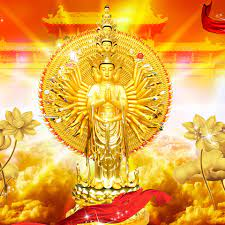
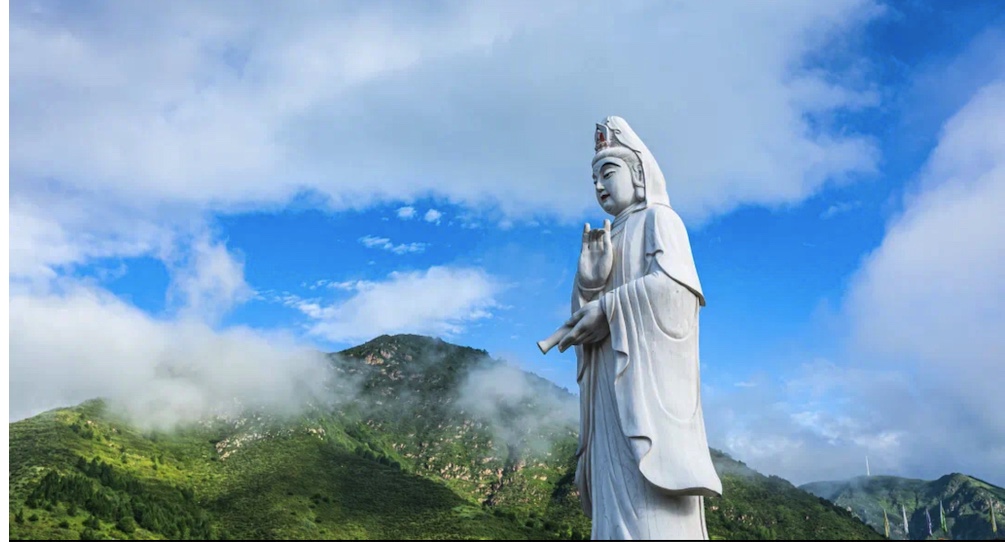
GuanShiYin (Avalokiteshvara) Bodhisattva is a well-known Buddhism figure in China and southeastern Asian. There are many different kinds of status and portraits of Guan Shi Yin Bodhisattva in the world. The most legendary one is one thousand-armed and one thousand-eyed form.
The Bodhisattva is personified as the symbol of compassion, and is frequently mentioned as the god of mercy who will help anybody who finds himself in trouble mentally or physically. He can infallibly eradicate all mundale sufferings. In order to achieve his ends, he can assume various forms, According to the text Karandavyuha Sutra he manifests all possible forms of life for the sake of ignorant and to bring liberation to living. It says: “As different people belonged to different faiths, this compassionate Bodhisattva was obliged to assume the shape of all gods of all faiths.”
Avalokiteshvara, the Bodhisattva of compassion, in front of Buddha Amitabha made to commitment to intentionally manifest into the three realms of Samsara in order to harrow the depths; that is to say, in order to stir from depths and completely liberate all sentient beings from samsara, and to be their supreme guide. Thus in the presence of Buddha Amitabha, Avalokiteshvara made this promise. Also he vowed that if by chance his compassion and his courageous mind of mercy for sentient beings were to decrease, then may his head and his body just completely crack and fall into one thousand pieces.
When Buddha was residing at the Veluvana garden he was surrounded by Arahats. There were five different divine rays coming out of his circle of hair between the eyebrows in the middle of the forehead and gradually it formed itself into a rainbow. Thereafter it went to the north in the direction of the Himalaya country of Tibet. At that time Buddha looked and smiled, then immediately Bodhisattva Sarvanivarana Viskambhi asked Buddha, What is the reason of your smiling, Lord? Buddha answered, “Noble boy! In the future there will be a pure Dharma through which one can be delivered to the path of liberation in the barbarian country of Tibet where there has never been a single Buddha for three junctions of time and there are uncountable demons and ghosts yet to time. “Therefore, Avalokiteshvara will tame those wild men, because once upon a time when he was a Bodhisattva he prayed to One thousand Buddhas Saying,” May all the transcendent bless me to be able to time those beings who are into barbarian country. May you bless that barbarian country through my taming, May you bless me to become the parent of those ghosts and demons;. May you bless me to free all those beings.
Once Amitabha Buddha placed his hand on the head of Avalokiteshvara and commanded that noble son, “Now you be the one who can tame the animated beings of the barbarian snow land whereas not a singly Buddha of the Three times has been there. This is the fruit of your sincere prayer for the purpose you have wished. Those suffering beings will be emancipated from the three lower realms as soon as they see your young holy body and hear the sound of the six mystic syllables, Om mani padme Hum. May your Bodhimind be manifested to the minds of ghosts, demons, evil spirits and hobgoblins and may they be striving with their minds for the benefit of others like Bodhisattvas, instead, of harming others. May all carnivorous animals-such as tigers, leopards, bears and snow bears abandon the mind of eating others and turn into the love of parents for each other, seeing your holy body and hearing the sound of the six syllables.
After making such commitments and blessings from Buddha Amitabha, Avalokiteshvara went by way of international manifestations into the three realms of samsara to be the supreme guide for all sentient beings.
Thereby he went to Hell and emancipated them from both the hot and cold hells by teaching the On mani padme hum. Then he went to ghost realms and emancipated from hunger and thirst after giving a discourse on the same. After that he went to the animal realms and emancipated them from hardship in labour. Then he came to the human realms and emancipated them from the intense suffering of birth, old age, sickness and death by a discourse on the same, Thus he also went to Asura realm and Deva realm to free them from their respective sufferings.
So Avalokiteshvara went into of these realms of Samsara, and he absolutely emptied the ocean of sufferings. Following which he went back to Buddha Amitabha and he declared that the liberation had been affected.
Buddha Amitabha said to him,” You should look back again into world!” And as he did, there he saw that once again sentient beings were in samsara and in sorrow, he became so discouraged as he saw that his “awakening mind (Bodhicitta) decreased in the moment he lost his courage. When he became discouraged, in that moment, the promise that he had made earlier declined.
The three realms of Samsara are Kamadhatu, the desire realm, the Rupa dhatu, the Form realm and the Arupya dhaty, the formless realm,. These three reams are so vast and so are the different types of suffering that sentient beings must experience in these realms. When Avalokiteshvara beheld that still sentient beings were in this type of suffering condition in these three realms respectively, he become overcome with sorrow, he become discouraged in the very presence of Buddha Amitabha. He felt how could the time come to ever liberate all sentient beings from this type of promise that he had made before, his head and body just cracked and fell apart into one thousand prices, and he fainted.
Avalokiteshvara, thus fainted, and Buddha Amitabha said to his “My son, where has your courage, your mental strength gone? He picked up all the pieces of his head and the body. At the same time he said,” this happened because of your prayer. You deserve the praise of all Buddhas since your prayer was efficacious. However, Noble son Don’t worry! Thereby he blessed his broken head into eleven faces and he sat upon those heads, and his broken body into one thousand hands like one thousand petals. Thereafter he said,” I bow to you because your one thousand hands are the hands of the thousand universal emperors and those eyes in each of the hand palms are eyes of one thousand Buddhas who will appear in this fortunate aeon.
There are so many beautiful, powerful and life changing lessons you can learn from studying Buddhism and from reading many of Buddha’s quotes.
Here are 20 Life Changing Lessons from Buddha:
1. Love heals all things. “Hatred does not cease by hatred, but only by love; this is the eternal rule.”
2. It’s not what you say but what you do that defines you. “A man is not called wise because he talks and talks again; but if he is peaceful, loving and fearless then he is in truth called wise.”
“A dog is not considered a good dog because he is a good barker. A man is not considered a good man because he is a good talker.”
3. The secret of good health is to live fully in the NOW. “Do not dwell in the past, do not dream of the future, concentrate the mind on the present moment.”
“The secret of health for both mind and body is not to mourn for the past, nor to worry about the future, but to live the present moment wisely and earnestly.”
4. Words have the power to both hurt and heal. “Words have the power to both destroy and heal. When words are both true and kind, they can change our world.”
5. Let it go and it will be yours forever. “You only lose what you cling to.”
6. No one can walk your path for you. “No one saves us but ourselves. No one can and no one may. We ourselves must walk the path.”
7. Happiness never decreases by being shared. “Thousands of candles can be lit from a single candle, and the life of the candle will not be shortened. Happiness never decreases by being shared.”
8. Be kind to all. “Resolve to be tender with the young, compassionate with the aged, sympathetic with the striving and tolerant with the weak and wrong. Sometime in your life, you will have been all of these.”
“Have compassion for all beings, rich and poor alike; each has their suffering. Some suffer too much, others too little.”
“Teach this triple truth to all: A generous heart, kind speech, and a life of service and compassion are the things which renew humanity.”
9. Don’t believe everything you are told to believe. “Do not believe in anything simply because you have heard it. Do not believe in anything simply because it is spoken and rumored by many. Do not believe in anything simply because it is found written in your religious books. Do not believe in anything merely on the authority of your teachers and elders. Do not believe in traditions because they have been handed down for many generations. But after observation and analysis, when you find that anything agrees with reason and is conducive to the good and benefit of one and all, then accept it and live up to it.”
10. As you THINK so shall you be “All that we are is the result of what we have thought: it is founded on our thoughts and made up of our thoughts. If a man speak or act with an evil thought, suffering follows him as the wheel follows the hoof of the beast that draws the wagon…. If a man speak or act with a good thought, happiness follows him like a shadow that never leaves him.”
11. Let go of fear. “The whole secret of existence is to have no fear. Never fear what will become of you, depend on no one. Only the moment you reject all help are you freed.”
12. The truth has a way of always leaking out. “Three things cannot be long hidden: the sun, the moon, and the truth.”
13. Control your mind or it will control you. “To enjoy good health, to bring true happiness to one’s family, to bring peace to all, one must first discipline and control one’s own mind. If a man can control his mind he can find the way to Enlightenment, and all wisdom and virtue will naturally come to him.”
“It is a man’s own mind, not his enemy or foe, that lures him to evil ways.”
14. Doubt separates. Trust unites. “There is nothing more dreadful than the habit of doubt. Doubt separates people. It is a poison that disintegrates friendships and breaks up pleasant relations. It is a thorn that irritates and hurts; it is a sword that kills.”
15. Nobody is more deserving of your love than you yourself are. “You can search throughout the entire universe for someone who is more deserving of your love and affection than you are yourself, and that person is not to be found anywhere. You, yourself, as much as anybody in the entire universe, deserve your love and affection.”
16. Knowing others is wisdom, knowing yourself is enlightenment. “It is better to conquer yourself than to win a thousand battles. Then the victory is yours. It cannot be taken from you, not by angels or by demons, heaven or hell.”
17. Let go of attachment. “To live a pure unselfish life, one must count nothing as one’s own in the midst of abundance.”
18. Choose your friends wisely. “An insincere and evil friend is more to be feared than a wild beast; a wild beast may wound your body, but an evil friend will wound your mind.”
19. There is no way to happiness. Happiness is the way. “There is no path to happiness: happiness is the path.”
20. Love. Live. Let go. “In the end these things matter most: How well did you love? How fully did you live? How deeply did you let go?”
There is a rather famous tombstone in Westminster Abbey. There’s nothing so special about it, except for its inscription. I believe that many people have heard of it.
“When I was young and free and my imagination had no limits, I dreamed of changing the world. As I grew older and wiser, I discovered the world would not change, so I shortened my sights somewhat and decided to change only my country. But it, too, seemed immovable. As I grew into my twilight years, in one last desperate attempt, I settled for changing only my family, those closest to me, but alas, they would have none of it. And now, as I lie on my deathbed, I suddenly realize: If I had only changed myself first, then by example I would have changed my family. From their inspiration and encouragement, I would then have been able to better my country, and who knows, I may have even changed the world.”
It is said that many world dignitaries and celebrities were deeply moved when they saw these words Some people say that this is a teaching of life, some people say that it is a kind of introspection of the soul.
There are similar teachings and philosophies in Chinese traditional culture. The Great Learning is a compilation of Confucian teachings used to address deeply important social behavior. In The Great Learning says: “The ancients who wished to illustrate illustrious virtue throughout the kingdom, first ordered well their own States. Wishing to order well their States, they first regulated their families. Wishing to regulate their families, they first cultivated their persons.”
“From the Kings down to the mass of ordinary people, all must consider the cultivation of the person the root of everything besides. It cannot be, when the root is neglected, that what should spring from it will be well ordered.”
In Buddhism, self cultivation is heavily emphasized as well. The first thing for all buddhist disciples is constantly cultivating themselves. In What is Cultivation, His HolinessDorje Chang Buddha III provides detailed guidance on self-cultivation. Self-cultivation is the fundamental and essential in the learning of Buddhism. Through self-cultivation, one will not only live a happy life and contribute the best of oneself to the society, but also can reach enlightenment and liberation.
It was April 2015. My stomach suddenly became harder and harder, and it swelled noticeably after eating. A colleague suffered from colorectal cancer and also had a hard stomach. I quickly went to the hospital for examination.
After the CT scan, the doctor said that the initial diagnosis was a liver tumor that was suspected to be cancerous, so emergency surgery was necessary. When I heard this result, I felt my heart racing. I thought that this was my karma and I should suffer it if I need to. If I didn’t die, I would be reprimanded.
At that time, I often went to the Sanger Mission Temple to listen to the dharma courses of H.H. Dorje Chang Buddha III. I understood some truths about karma. So I accepted it calmly without complaining to others, and actively cooperated with the doctor’s treatment. A highly skilled Indonesian doctor took the lead for my surgery. She is the second best doctor in Southern California. She said: “Your liver tumor has a layer of membrane wrapped with bad things. We just need to take out the cyst and we don’t need to cut the liver, so it won’t hurt the liver. After doing so many operations, this is the second strangest example I have ever seen. The doctor asked “Are you a Buddhist?”
Even more strange is that despite the anesthesia effects after the operation, I seem to have temporarily lost the pain. The doctor prescribed morphine to relieve the pain, but I didn’t use it because I didn’t feel any pain at all. After the operation, I spoke as usual, full of energy. On the fourth day after the operation, a sister came to visit me and said that the monks in Sanger Mission had not seen me for a while and knew about my situation. So they recited the Sutra in the morning and night, then they transferred their merits to me.
The power of Buddhism and the power of recitation of the Sutra are incredible. My operation went well and the wound healed quickly. A week later, I walked very fast, and I didn’t look like someone who had undergone surgery! After several months of observation, the doctor determined that my tumor was benign and he ruled out the possibility of cancer.
The Buddha and Bodhisattva have saved my life twice, and I am truly grateful.
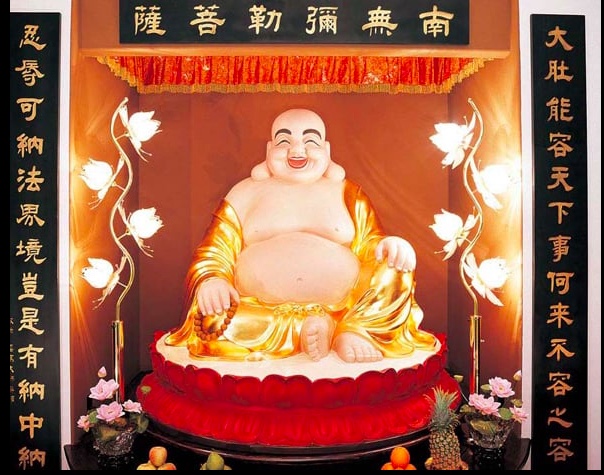
Maitreya is a transcendent bodhisattva,he will be the next Buddha in the Saha world. Maitreya means “loving kindness.” In Mahayana Buddhism, Maitreya is the embodiment of all-encompassing love. Maitreya, in Buddhist tradition, presently resides in Tushita heaven.
Maitreya Bodhisattva Statue in Hua Zang Si Temple San Francisco
Master Asanga was born with uniquely deep talent and wisdom from his past lifetimes. When studying sutras and commentaries, he was able to understand the meaning with a quick reading. Later, he practiced meditative concentration and became free of desires. He repeatedly thought about the “meaning of emptiness” but was unable to deeply understand and explain it. He was quite unhappy for that. An Arhat named Pindola-Bharadvaja heard about his difficulty and came to him to teach “the Small-Vehicle (Hinayana) School’s view of emptiness.” Then, he practiced contemplation according to the teaching and achieved a deep understanding. However, Master Asanga was still not satisfied after learning the Small-Vehicle School’s view of emptiness because he still did not have perfect answers for many doubts and questions he had.
At that time, the teaching of Mahayana Buddhism (the Large Vehicle) was available from Maitreya Bodhisattva. However, to receive Maitreya Bodhisattva’s teaching in person, one must successfully enter into the state of concentration. Due to his urge to quest for the dharma, Master Asanga longed for the opportunity to meet Maitreya Bodhisattva in person to be taught with the dharma. Therefore, he chose a mountain cave in a sparsely populated area and began practicing cessation and contemplation diligently.
As time was flowing away continuously, six years elapsed. Master Asanga still was unable to see Maitreya Bodhisattva while practicing concentration in the cave. A thought came up in his mind, “If it is impossible to see Maitreya Bodhisattva, I should just give up!” Thus, he decided to take a break from cultivating and practicing in the cave. He put on his regular clothing and walked out of the cave. On his way of coming down from the mountain, he saw a white-haired elder lady, who held an iron stick and was laboriously grinding it on a flab of stone. The scene caught Master Asanga’s attention.
“Elder lady. May I ask what you are doing?” Master Asanga asked.
“Oh, I am grinding this iron stick into a thin needle.”
“You are grinding it into a thin needle?” Master Asanga was very much astonished and also greatly moved. He thought, “This elder lady was willing to grind it day after day with a seemingly silly movement. In contrast, as a cultivator, I could not adhere to practicing true Buddha-dharma to pursue wisdom.” The arising of this extremely precious thought caused Master Asanga to introspect himself and generate humility in mind. Then, he returned to the cave to devote himself into the difficult and hard cultivation and practice once again.
During the next three years, Master Asanga still did not make any achievement. Another thought rose in his mind, “Why should I waste time? It is simply impossible to see Maitreya Bodhisattva!” So he again broke his practice in retreat and went down the mountain. This time, he met a person, who was using a feather to scrub an enormously big rock. Master Asanga asked that person what he was doing. That person said, “This big rock blocks sunlight. I am grinding it to make it smaller, so that sunlight can shine into my room.” Upon hearing that, Asanga was alerted and began to introspect himself, “This person can be so unyielding in doing such a ridiculous thing. Comparing to him, I am so ashamed. I receded from my determination just because of a small setback!” With regret he again returned to his retreat chamber in the mountain.
Thus, another three years passed. Master Asanga was still unable to see Maitreya Bodhisattva appearing. At last, he receded from his determination once more. With discouragement, he left the retreat chamber again. On the way of coming down from the mountain, he saw a dying old dog, whose body had already begun to rot. The wounds were totally covered by maggots that were diffusing an awful stench. Compassion rose in Master Asanga toward this dog. He cut off a piece of flesh from his own body to feed the dog and also intended to remove the many maggots from the dog’s wounds. At that time, Master Asanga thought, “These maggots have very tender and fragile bodies. If I use my coarse fingers to move them, they will definitely be harmed.” Therefore, he decided to use his tongue to carefully lick up the maggots to move them to an inhabitable place for them. However, those maggots really looked very terrible. Master Asanga had to kneel on the ground and close his eyes. He then lowered his body to lick the maggots with his tongue.
As he was lowering his body, Master Asanga actually felt that his tongue was touching the ground. He opened his eyes and saw that the dog was no longer there. The solemn and majestic Maitreya Bodhisattva was standing in front of him. After the moment of excitement, Master Asanga asked Maitreya Bodhisattva, “I wholeheartedly prayed and beseeched you, revered Bodhisattva, to manifest before me for the last twelve years. Why didn’t you?”
Maitreya Bodhisattva replied, “Starting from the first day when you entered the retreat and began to pray, I was with you and next to you at every moment. However, due to the obstruction by your karmic forces, you were never able to see me. Through your diligent cultivation and practice during these twelve years, most of the karmic hindrance has been purified. Additionally, you generated great compassion in the occasion that just passed. Now all your karmic hindrance has been removed. That is why you can see me now! If you do not believe what I said, you can carry me on your shoulder and walk around at the market to see if people can see me.”
Thus, Master Asanga carried Maitreya Bodhisattva on his shoulder and walked to the market. While walking, he yelled to people, “What do you see that is on my shoulder?” People all thought that he had mental problems. They laughed and said, “There is nothing!” Only one old lady said that he was carrying a dog with scabies. Thus, Master Asanga was totally convinced and free of any doubt. Uncommon respect and faith rose in him toward Maitreya Bodhisattva.
After meeting Maitreya Bodhisattva, Master Asanga politely sought teaching from the Bodhisattva. Maitreya Bodhisattva asked, “What do you want to learn?” Master Asanga said, “My wish is to propagate the Mahayana Dharma.” Maitreya Bodhisattva was delighted to hear that and brought him to the pure land within the Tusita Heaven. Maitreya Bodhisattva expounded to him the precious views of Mahayana Buddhism and the “Five Shastras (Commentaries) by Maitreya.” The teachings enlightened Master Asanga like pushing away clouds to see the Sun. Many doubts that he had had before were completely removed. Since then, he followed Maitreya Bodhisattva’s teaching to dedicate himself to study “the View of Emptiness of Mahayana Buddhism.” Maitreya Bodhisattva gave him a series of discourses and also explained the essence of the Mahayana sutras to him in detail. Master Asanga was enlightened from listening to the teachings and basically gained the understanding and proficiency in the sutras and shastras of Mahayana Buddhism. Later, Master Asanga also practiced the Dharma of Sunlight Samadhi. Through learning and practicing diligently, he eventually attained holy accomplishment. From then on, he was able to understand what he could not before and could forever remember all Buddhist scriptures he read. Later, he built a big lecture hall and dedicated himself to expound all Mahayana sutras to the great masses.
Master Asanga lived in the world for 150 years and made great contributions to the undertaking of widely propagating the teachings and dharmas of Mahayana Buddhism. He benefited countless living beings.















 Peace LiLy