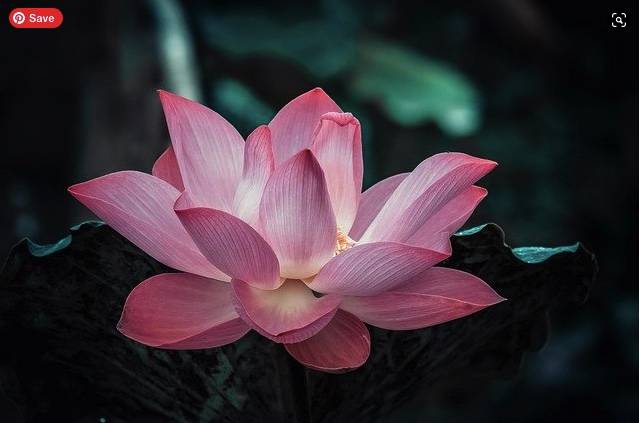
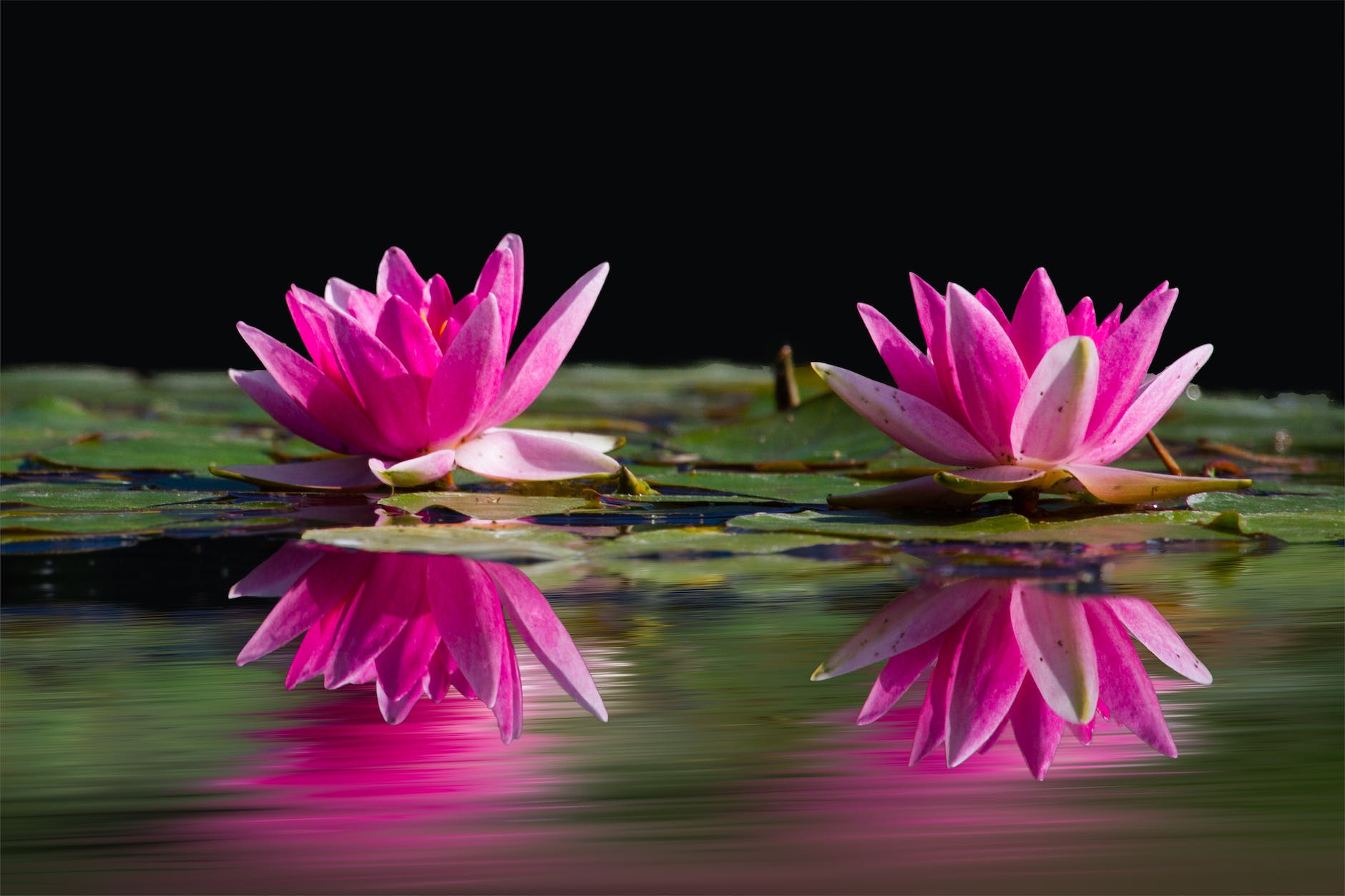
From ancient times, the lotus has been a divine symbol in Asian traditions. It is one of the Eight Auspicious Signs (Ashtamangala) pertaining to a number of Dharmic Traditions, such as Hinduism and Buddhism. In Buddhist symbolism, the lotus represents purity of the body, speech, and mind as if floating above the muddy waters of attachment and desire. Therefore, many deities of Asian religions are depicted as seated on a lotus flower. It is said that Gautama Buddha was born with the ability to walk, and lotus flowers bloomed everywhere he stepped.
In the classical written and oral literature of many Asian cultures, the lotus is present in figurative form, representing elegance, beauty, perfection, purity, and grace. Perhaps the most famous text is the poetic essay “On the Love of the Lotus” by Zhou Dunyi (1017-1073). As Zhou writes, “I love only the lotus, for rising from the mud yet remaining unstained; bathed by pure currents and yet not seductive.” The lotus is the “gentleman among flowers.” The term “gentleman” (junzi), of course, has since the time of Confucius been the ideal human being. So not surprisingly, the lotus flower is also a popular subject in Chinese paintings.
Zhang Daqian (張大千, 1899–1983), original name Zhang Yuan (張爰) and pseudonym Daqian, was one of the best-known and most prodigious Chinese artists of the twentieth century. He is also regarded by many art experts as one of the most gifted master forgers of the twentieth century. He is especially famous for his landscape, as well as lotus paintings.
As a child, Zhang Daqian was encouraged by his family to pursue painting. In 1917 his elder brother, Zhang Shanzi (an artist famous for his tiger paintings), accompanied him to Kyoto, Japan, to study textile dyeing. Two years later, Zhang Daqian went to Shanghai to receive traditional painting instruction from two famous calligraphers and painters of the time, Zeng Xi (曾熙) and Li Ruiqing (李瑞清). Through his association with these teachers, Zhang had the opportunity to study some works by ancient masters in detail. His early style attempted to emulate the Ming-Qing Individualists, including Tang Yin (唐寅), Chen Hongshou (陳洪綬), and Shitao (石濤). He meticulously studied and copied their works and began to make forgeries; his paintings after Shitao successfully deceived some of the best connoisseurs.
The lotus painted by Zhang Daqian is known as the “Daqian Lotus”, which is extremely popular in the auction market, and the price has repeatedly hit new highs. Among them, “Lotus Pond Wilderness” is particularly prominent. It was sold at HK$80.51 million (about $10 Million) at the 2013 Christie’s Spring Auction in Hong Kong, causing a sensation in the world.
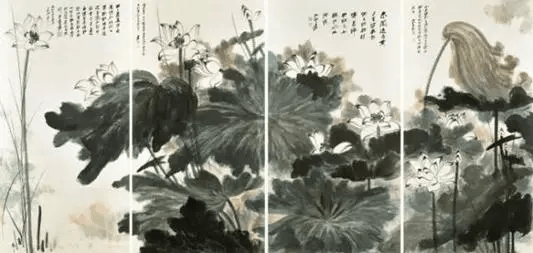
A set of four hanging scrolls each more than five feet high and 2.5 feet wide – depict lotus flowers in various state of bloom. Completed in 1947. This masterpiece, however, despite its enormous size, is still well-organized. Within magnificence unfolds delicate tenderness; integrated artist early scholar-painter style and commitment to elegant, smooth brush strokes. Zhang vividly portrays the lotuses growing in nature, swaying in the summer breeze…. It truly is a fine example of the artist’s large scale lotus compositions.
Wilderness in a Lotus Pond
More lotus paintings by Zhang Daqian:
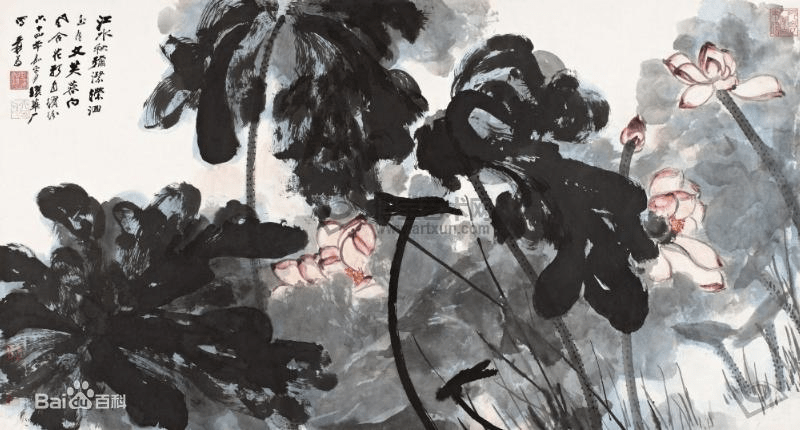
Zhang Daqian: Red Lotuses in Splashed Color (1981)
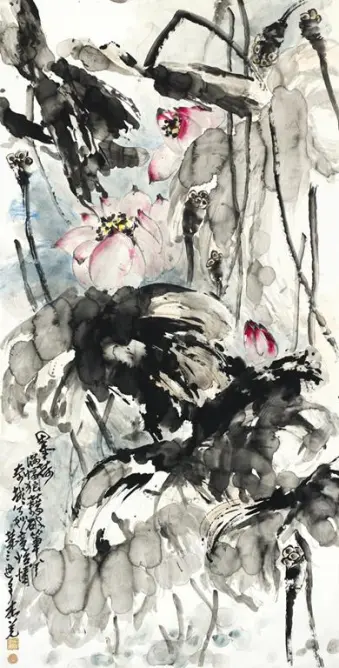
Ink Lotus by Zhang Daqian at 1976
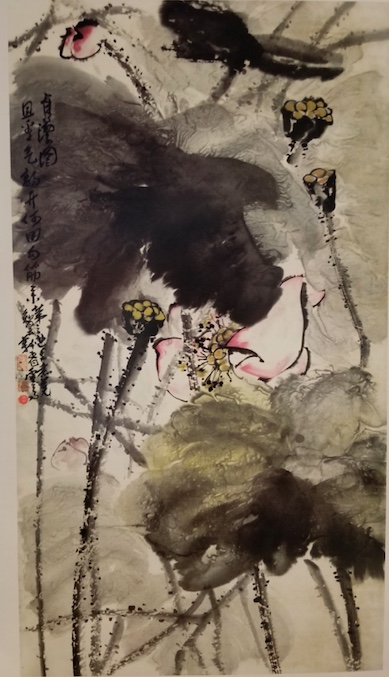
However, a Contemporary Painting “Ink Lotus” by H.H. Dorje Chang Buddha III Was Sold for the US$16,500,500 at the Gianguan 2015 Spring Auction to Break the World Record.
The ink-wash painting Lotus by H.H. Dorje Chang Buddha III has an uninhibited, natural, and spontaneous brushwork that is dense, bold, and robust, but also elegant and agile. It exhibits a charm that is like stone and bronze inscriptions. Flowing splash-ink on the scroll produces a vivid charm that evidences great ingenuity. There is an air of power and grandeur together without any trace of stiff, common, mundane artistry found in other lotus flower paintings. Overall, the whole painting manifests a harmonious and moving imagery, naturally emanating a lively vivaciousness and a carefree, spirited aura.
A young monk asked the master for advice: “What are human desires?” The old monk told the young monk to come back tomorrow, but do not eat or drink until then. When the little monk came back the next day, he was very hungry and thirsty, and felt that he could eat a whole loaf of bread.
The old master monk asked him to go to the orchard to pick some fruits, but asked him to bring them back to the temple to eat.
After a while, the young monk returned to the temple with a basket full of fruits. The old monk told him to eat as much as he could. The young monk felt full after just eating two and could not eat any more.
The master asked him, “What’s the use of these fruits that you brought back after all your hard work, but you didn’t eat them? They’re just useless burdens.”
“Now you may understand, for each of us, what we really need is only two fruits that are enough to satisfy our hunger, and the rest is our desire.”
Every day we are driven by our own desires to keep running and toiling. We believe that if our desires are satisfied, we will be happy. But that happiness is very short-lived. Think about when you got new beautiful clothes, a pair of fancy shoes, luxury jewelries, or an expensive car — how long does that pleasure last? It may be a year, a month, or just several days, and then we want more to replace these fleeting pleasures. Our desires are endless, they keep on growing until they wrap us completely like a cocoon. Our desires lead us to focus on the various commodities of the outside world, and squeeze out all of our time and energy. Thus, our desires can actually make us feel enslaved and unhappy, and cause suffering.
In Buddhism teachings, the origins of suffering and unhappiness come from craving, desire and attachment. The way to end suffering is letting go of these cravings, and finding your true self. Of course Shakyamuni Buddha had taught many ways in the Buddhist Sutra to reach the eternal happiness and find our true selves. The contemporary Buddha H.H. Dorje Chang Buddha III has expounded many Buddha Dharmas to help us as well, such as What is cultivation? , Learning from Buddha, and several thousand audio-recorded Dharma discourses. By practicing the Buddha Dharma, one can break through the cocoon of life and death, and reach libration.
Hope you can find your own way to be free, happy and healthy.
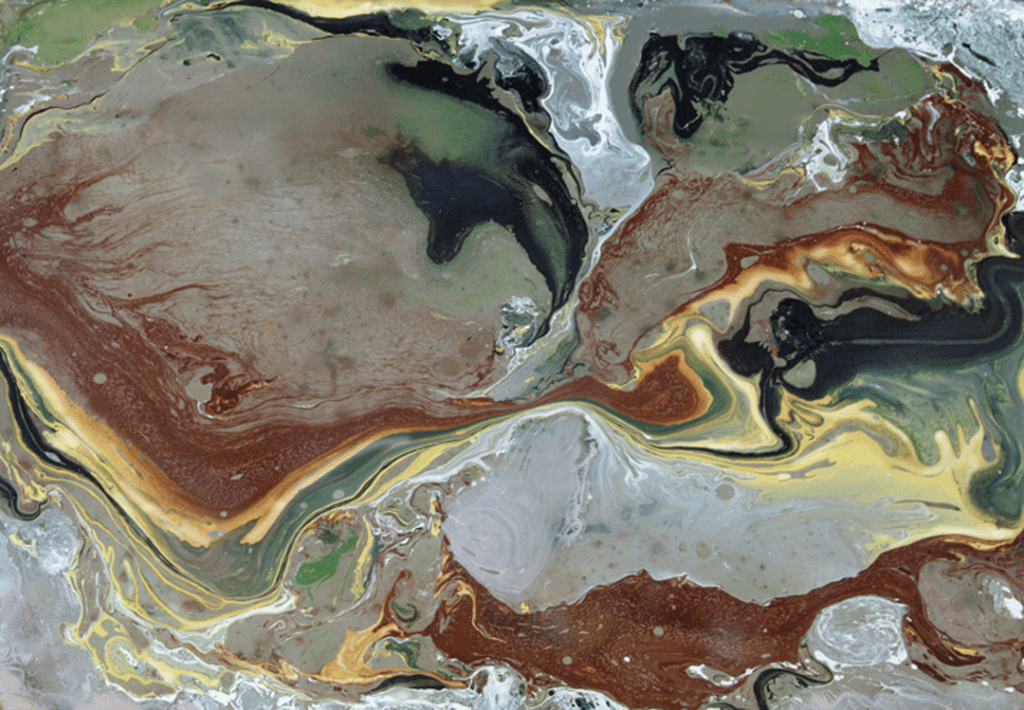
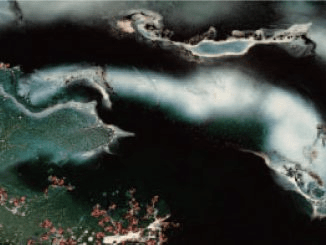
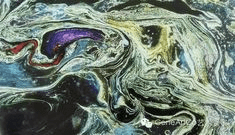
It is precisely due to his extraordinary talent, exceptional wisdom, sublime morality, and extensive vision that H.H. Dorje Chang Buddha III is able to make one after another world-shocking achievement in art. Here, H.H. Dorje Chang Buddha III employs his supernatural abstract colors to introduce us once more to a new world of art that is beautiful, mysterious, and soul-inspiring. This truly is not just some fancy talk, for as soon as you set your eyes on these oil and acrylic paintings, you will find the bright and dazzling colors leaping and dancing, vigorous like billows sluicing over thousands of miles, yet stored up into wonders at the fine tip of a brush. Gentle yet resolute, they freely transcend worldliness. Various colors are mixed ingeniously and beautifully, distilling beauty from their mutual nourishment. One could say they present a state of superb craftsmanship excelling in nature, and of form becoming flexible and elusive. Words cannot describe such harmonious, refined, and soothing artistic enjoyment.
Seen at Yellowstone National Park
Thatched Stone Huts on a Snowy Mountain
Different Tone
Supernatural abstract color is a perfect world composed of colors. It does not have any concrete worldly form but uses only colors to form shapes and express feelings. Color is its shape and theme, and it blends into touching charm. These colors, under H.H. Dorje Chang Buddha III’s hand, suddenly converge into unparalleled, marvelous, and bright magic, expressing the vivid spirit of a flowery scene or the vigor of the roaring sea. Yet, they can be ever so exact when their meaning is revealed through the tip of a brush. The fine details are often revealed among rough strokes, and their charm is naturally displayed. These works of art are fused with the essence of the universe, Nature, and the earth.
The art of H.H. Dorje Chang Buddha III has already cast off the bondage of the common world. Its form and meaning are both like a golden dragon breaking away from the earth’s crust and soaring in the azure sky above the blue sea, free at will, unbridled and unrestrained, all worldly dust whisked away, ever-changing, and beautiful beyond compare! In front of these soul-inspiring rare treasures of art, we admire the exceptional artistry that flows from the boundless heart of the Buddha. We absorb the beauty that transcends all confinements of reality, the beauty created from His use of ever-changing colors for the appreciation of mankind.
It is no surprise that these amazingly beautiful pieces are the creations of H.H. Dorje Chang Buddha III. The supernatural abstract color is just the crystallization of His various astonishing talents and the outflow of His limitless artistic wisdom. He truly deserves to be called a master artist the likes of which have never been seen in history.
On April 3, 2008, a solemn and dignified first-publishing ceremony of a fact-recording book entitled H.H. Dorje Chang Buddha III, which published jointly by the World Buddhism Publishing LLC and the World Dharma Voice, Inc., was held at the Library of the Congress of the United States. The book was also formally accepted into the collection of the Library of the Congress of the United States. Only since that time, did people in the world know that Master Wan Ko Yee, who had been broadly respected by the great masses and who had also been known as Great Dharma King Yangwo Yeshe Norbu, had been recognized by the world’s leaders, regent dharma kings, and great rinpoches of Buddhism through official documents as the third incarnation of Dorje Chang Buddha, who is the primordial Sambhogakaya Buddha of the universe. The Buddha’s name is H.H. Dorje Chang Buddha III Since then, people began to address His Holiness the Buddha by “Namo[1]Dorje Chang Buddha III.” This is similar to the situation that Sakyamuni Buddha’s name was Prince Siddhartha Gotama before attaining Buddhahood. However, after Sakyamuni Buddha had attained Buddhahood, His title changed to “Namo Sakyamuni Buddha.” That is why we now address His Holiness the Buddha as “H.H. Dorje Chang Buddha III”
In particular, on December 12, 2012, the Senate Resolution No. 614 of the United States Congress officially used “His Holiness” in the name addressing Dorje Chang Buddha III (That is to say, “H.H. Dorje Chang Buddha III”) Since then, the title and status of H.H. Dorje Chang Buddha III has been definitive by nature. And, as a matter of fact, “Dorje Chang Buddha III” is a name used legally in governmental and official legislative documents. Therefore, the previously used respected name and titles such as “Wan Ko Yee,” Great Master, and Great Dharma King no longer exist.
H.H. Dorje Chang Buddha III has brought many powerful, miracle and extraordinary Buddha Dharmas to this Saha world. Such as The Supreme and Unsurpassable Mahamudra of Liberation, What is Cultivation, Learning From Buddha, Imparting the Absolute Truth Through the Heart Sutra, thousands pieces of audio-recorded Dharma discourses, etc… On October 18, 2012, H.H. Dorje Chang Buddha III within ten minutes, reversed his appearance back to a youthful look. This incredible Buddha Dharma, other than Guru Padmasambhava, noone had any true ability of reversing old age back to youth, including current famous dharma kings, venerable ones, and dharma masters.
Below is the true personal record of this holy miracle event written by a bhiksuni Shi Zheng Hui in the book Revealing The Truth: What Is the Truth about Reversing An Old Age Back to Youth?
Throughout these many years, the Buddha Master (H.H. Dorje Chang Buddha III) really worked very hard and never had any time to have a good rest. Every day, He had to talk a lot and was constantly busy with the endless matters of Buddha-dharma. Additionally, the Buddha Master vowed to bear living beings karmic retributions, as stated in The Supreme and Unsurpassable Mahamudra of Liberation:
“I bear all of the negative karma and offenses of living beings. I give to you all the good karma and merits I have planted.”
This vow of His Holiness the Buddha did come true. As a result, during a period of several days, all black karmas from the outside were transferred to the Buddha Master. The Buddha Master suddenly became very tired, exhausted, and aged. He looked like a seventy or eighty year old person. Upon seeing the Buddha Master’s situation, Venerable Long Zhi Tape Nyima, a fellow brother who was very good in his cultivation and conduct and who was the reincarnation of DenmaTsemang, one of the twenty-five major disciples of Master Padmasambhava, spoke respectfully to the Buddha Master, “Bud-dha Master it can’t go on like this! Otherwise living beings’ good roots will be severed. Living beings are unable to understand why the Buddha could become so exhausted.” The Buddha Master said, “Even Sakyamuni Buddha became exhausted. If not, why would He enter into nirvana and leave for the Bud- dha-land? This was exactly how Buddha manifested impermanence”. Brother Tsemang looked very sad and was greatly worried. Then the Buddha Master said, “Let me think about this a bit first.” Brother Tsemang still felt very worried and sorrowful. The Buddha Master felt that what he said did make some sense and told him, You go and get the camera to take a picture of me.” The Buddha Master then also said, “Don’t worry. I am not going to die! Let’s address this after the dharma assembly!”
These photos were true records of the holy miracle Buddha Dharma, they are now displayed at Hua Zang Si, at San Francisco.
On October 18, 2012, l saw in person the Buddha Master reversing His appearance back to a youthful look . Within ten minutes, the Buddha Master reversed His aged appearance to that of a youth. At that time, the Buddha Master was at the mandala on the lawn praying for peace and auspiciousness. He told several of us to go and fetch the offering objects and the prayer manual. When I returned, I suddenly saw that vicissitudes and age were completely removed from the Buddha Master from the skin to the bone structure. The Buddha Master now had a childlike appearance, I was so astonished by what I saw that I dropped the offering apples to the ground! Good Heavens! The changes were like between two different persons. Furthermore, the other monastics present also said that they saw this surprising change.
On December 12, 2012, several hundred people saw H.. Dorje Chang Buddha Ill during the Dharma Assembly of Decision by Selection with their own eyes. They all witnessed the fact that the Buddha Master reversed His appearance back to that of a youth.
People all wanted to learn the dharma of reversing an old age back to youth. Thus, they beseeched the Buddha Master to expound the dharma, which was recorded. The name of this recorded dharma lesson is “This is scary! The disciples did not give in to the Buddha: They insisted that H.. Dorje Chang Buddha Ill did restore youth and childlike appearance!” However, H.H. Dorje Chang Buddha Ill said, “I do not know the dharma of restoring youth and childlike appearance. I only know a little bit about the methods of medical treatment. Looking at the comparison from the recorded videos, it would be false to say that I did not become vonger at all, However, what you disciples said was much too exaggerated. l simply do not know the dharma of reversing an old age back to childlike youth.”
At this time, Kaichu Rinpoche spoke by the side of the Buddha Master, “Buddha Master always spoke and acted as a humble one. However now He is right in front of us. We can judge with our own eyes. Do we really exaggerate? Can worldly medical treatment change the bone structure or reverse an old age back to youth? Why has there not been even one such example in the world?” Today, we saw the fact clearly and vividly with our own eyes. We did not exaggerate or speak baselessly. Even though it was denied by the Buddha Master, the iron-clad fact of the Buddha Master’s restored youth and childlike appearance was undeniable. Think about it. Can this be achieved by ordinary abilities of any human? There has not been such precedence in history!
H.H. Dorje Chang Buddha III has achieved perfect accomplishments that are at the acme of the five Vidyas and commands perfect proficiency in the Tripitaka. Everything His Holiness does is in perfect harmony with the karmic condition without any impediment. Moreover, His Holiness was able to turn His aged yet still handsome appearance to a youthful and childlike appearance with astonishing, extraordinary effect. However, He does not admit to having the power of realization and always says that He is nothing but a humble cultivator who does not accept offerings.
In 2014, I was diagnosed with stage 2 spleen cancer and had the surgery performed at the University of Taiwan Hospital. In June the same year, I started chemotherapy. Sister Qinyi Zhou came to visit me in September that year and brought me a copy of the book The Buddha Speaks on Curing the Hemorrhoids Sutra. I chanted the sutra continuously for one month and I noticed the dark brown nails on my hands – the side effect of chemotherapy – had started to fade. It was unbelievable!
During that time, sister Zhou and Buddhist brother Sangdun Chuba Rinpoche frequently visited me and even helped me to begin to set up an altar and purchased all the necessary items to offer to the Buddhas. I also invited Buddhist brother Jijia Cuoren Rinpoche and many other Buddhist brothers and sisters to come to my house for the purification ceremony and beseeching blessings. I then set up my dharma-listening center. I requested recorded Dharma from International Buddhism Sangha Association in order to promote Buddha Dharma and benefit others. After that, miraculously my symptoms of peeling skins on my hands and feet and the mouth ulcer that was seriously affecting my eating gradually disappeared. What was even harder to believe was that the MRI done in November 2014 showed that the cancer had vanished. Cancer marker went from 67 to 46 in about a little more than 2 months – The terrifying spleen cancer just disappeared! I had never thought that chanting Buddhist Sutras and setting up a Dharma-listening center would have such powerful blessing on me!
Seeing my progress, sister Zhou encouraged me to take the examination to become a Master of Dharma-Listening Sessions so that I could promote the correct views and understanding of the Buddha dharma of H.H. Dorje Chang Buddha III to others. It would be the best way to benefit others and carry out the Bodhicitta. In so doing, I would receive even more blessings, she said. I did not disappoint her and successfully passed the exam in March 2015.
A few months after that, the doctor who was in charge of my chemotherapy, Dr. Yang, suddenly announced that my treatment should be stopped ahead of schedule ( normally it has to last for more than a year) This had never happened before! So, my confidence increased and I was even more diligent in listening to the Buddha Dharma and reading Buddhist books. I consistently rain or shine went to the group cultivation sessions held at Holy Dharma Compassion and Kindness Association. I cultivate myself and learn from the Buddha with a heart of repentance and gratitude. On September 21, 2016 my primary doctor, Professor Tian told me “no more doctor’s visits, just periodical rechecks in charged by Dr. Yang.” So I only need another doctor’s visit! What a great relief! I felt like a burden of rock has shifted off my shoulders.
During the past two years, if it was not because of the blessings of H.H. Dorje Chang Buddha III, if I did not study Buddhism and cultivate myself, if there was no help and encouragement from the Buddhist brothers and sisters , I would not have recovered from cancer and I would not have been able to travel around the world and gone to social functions! In contrast, my husband who had brain cancer and was very stubborn and did not want to believe in Buddhism died in May 2015.
I transform my grief to power and strongly believe in the law of cause and effect. I will continue to study Buddhism, listen to the recorded Dharma of H.H. Dorje Chang Buddha III, cultivate my words, thoughts, and behaviors, promote kindness and eradicate evil, and strive to correspond with the Buddha! Here, I would like to thank all the members of the medical team at Taiwan University who have treated me, all my relatives and family members, my Buddhist brothers and sisters for their kindness and care. They have made it possible for me to cultivate and learn from the Buddha! Amitabha!
Pandas are a precious and rare animal, and thus are the emblem of the World Society for the Protection of Animals. Pandas are chubby, cute and charmingly naive, and their eyes seem to communicate a slight sadness. How can one not love these real-life teddy bears?
Many years ago, I visited the Panda Reserve area in SiChuan, China. There, I got the chance to see and touch these fluffy beasts up close(for a fee, of course)! So I wore a disposable cloth and hugged the panda. It was so warm and soft! Truly, an unforgettable experience. I was even given a piece of bamboo to taste. Very tender and juicy. Unfortunately, the panda though I was stealing its food, and to avoid hurting its feelings I let it eat the rest. This is without a doubt my go to destination after the pandemic!
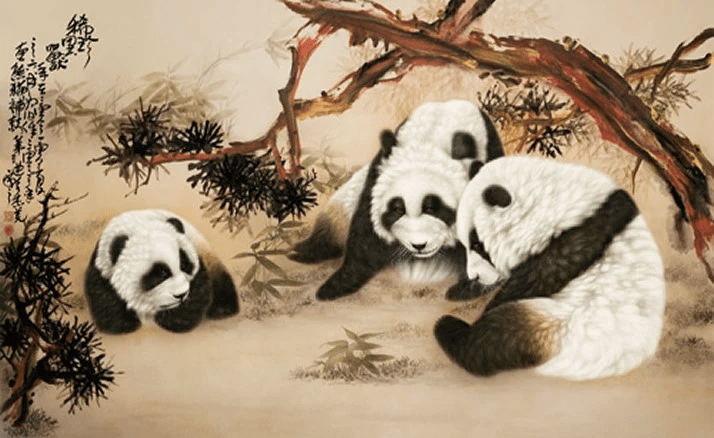
All over the world, there are many paintings of pandas. One time, I saw a chinese painting of Pandas at International Art Museum of America located at downtown San Francisco. The painting reminds me the soft, warm, fury touching feeling of the huge with the Panda. The three pandas look as if they were created by a magical heavenly brush. There is an extremely vivacious appeal, a deeply touching liveliness to these pandas.Pervading such paintings is an air of purity, cleanliness, and hopefulness. The three pandas in this painting all have innocent expressions and look vividly real. The scattered perspective technique of Chinese paintings was combined with the three-dimensional perspective technique of oil paintings. The colors are richly charming, and the layout is exquisite. Empty space and color are mutually complimentary in a fascinating way. The pandas and the surrounding scene blend into one harmonious image. These lifelike pandas painted in fine brushwork with meticulous attention to detail contrast perfectly with the surrounding scene painted in freehand brushwork. The painting style is plain, vigorous and mature. There is order within the seeming disorder and interesting juxtaposition between the real and the abstract. The achievement of using complimentary bold and delicate strokes in one painting, as H.H. Dorje Chang Buddha III does, sets His artistry apart from conventional artistry.
Dorje Chang Buddha is Buddha Vajradhara (金剛總持, pronounced jin gang zong chi in Chinese, which literally means “Supreme Ruler of the Vajra Beings”) and is also called in Chinese 持金剛 (pronounced chi jin gang, which literally means “Ruler of the Vajra Beings”). Dorje Chang Buddha is not 金剛持 (pronounced jin gang chi in Chinese, which means “Practitioner of the Vajra” as explained below). In English, people often use the word vajradhara to refer to a 金剛持 (jin gang chi), or Practitioner of the Vajra. Actually a 金剛持 (vajradhara) is a master or guru. BuddhaVajradhara is a Buddha. Moreover, Buddha Vajradhara is the primordial sambhogakaya Buddha whose sambhogakaya manifested out of the dharmakaya of Adharma Buddha (Adi Buddha, or Samantabhadra Tathagata). All of the Buddha-dharma of Buddha Vajradhara originated from the tathata (true suchness) of Samantabhadra Tathagata. With respect to the dharmakaya of Samantabhadra Tathagata, there is no past and no future. Without form yet not empty, He neither comes nor goes. There are no Buddhas above Him to become. There are no living beings below Him to be saved. Such is His absolute truth. Thus, the dharma-body state of Samantabhadra Tathagata is without signs or characteristics, without speech, and without form. As such, there is no subject or being who could expound the dharma. Without such a subject or being, the multitudinous living beings could not be saved.
Because of such karmic conditions, the formless dharmakaya Buddha generated the first sambhogakaya Buddha with form. This sambhogakaya Buddha with form transformed into Vajrasattva and other nirmanakayas. In order to make a distinction between those three, the dharmakaya Buddha was named Adharma Buddha; the sambhogakaya Buddha was named Dorje Chang Buddha; the nirmanakaya was named Vajrasattva. Actually, all three are Samantabhadra Tathagata, all three are Adharma Buddha, and three are Dorje Chang Buddha. In truth, there are not two Buddhas. These distinctions are due to a dharmakaya, sambhogakaya, and nirmanakaya. Based on this dharma, Samantabhadra Tathagata did not directly incarnate. Even the ancient Buddha Dipankara and Vajrasattva were the nirmanakayas of Dorje Chang Buddha.
Dorje Chang Buddha is also called Buddha Vajradhara or Ruler of the Vajra Beings (持金剛 chi jin gang). In the entire universe, Dorje Chang Buddha is the first Buddha with form and is the highest Buddha. That is, the highest leader of Buddhism in the entire universe came into being in the form of Dorje Chang Buddha. It was Dorje Chang Buddha who began transmitting dharma and saving living beings in the dharmadhatu. As a result, Buddhism was born and the Buddha-dharma began spreading.
However, many sects and lineages list Samantabhadra Tathagata as the first Buddha who began all the lineages in the dharmadhatu. This way of thinking is actually correct as well. That is because although Samantabhadra Tathagata is a dharmakaya without form and has no way of speaking, the origin lies with this dharmakaya from which the sambhogakaya Dorje Chang Buddha manifested. This sambhogakaya Buddha was the first one to spread the Buddha-dharma in the dharmadhatu. That sambhogakaya Buddha also transformed into Vajrasattva and other nirmanakayas whospread the dharma in the triloka (three spheres). Because of the birth of Dorje Chang Buddha, living beings were thus able to become holy beings in accordance with His dharma teachings.
We often see in dharma books a blue image of Adharma Buddha. Actually, this image is a symbol. Such a symbolic form is necessary since the tathata emptiness of Adharma Buddha is invisible and cannot be depicted in a thangka. There is no way to draw the shape of emptiness. The dharmakaya has no features that can be pictorially depicted. In fact, the concept of dharmakaya is the absolute truth of the universe (dharmadhatu) that is not born and does not perish. The sambhogakaya Buddha (Buddha Vajradhara) manifested out of this concept of not being born and not perishing.
Dorje Chang Buddha is the ancient, primordial sambhogakaya Buddha. He has the unsurpassed virtuous appearance that all of the Buddhas in the ten directions have. He was the first in the dharmadhatu and triloka (three spheres) to express the dharma. Therefore, Buddha Vajradhara, or Dorje Chang Buddha, is actually the greatest leader of Buddhism in the entire dharmadhatu. He is the original ancestor of Buddhism.
However, many Buddhists misinterpret Dorje Chang Buddha, or Buddha Vajradhara, as being a 金剛持 (jin gang chi), or Practitioner of the Vajra (i.e. vajradhara). This is a mistake in a matter of principle that carries with it a karmic offence. Buddha Vajradhara has the meaning of one who is in charge of and has supervision over all of the vajra beings. Thus, He is the 持金剛 (chi jin gang) or Ruler of the Vajra Beings, the one who has dominion over the vajra beings. On the other hand, a 金剛持 (jin gang chi), or Practitioner of the Vajra (i.e. vajradhara), is one who learns the dharma and teaches others. Such a person enlightens himself and others. The term 金剛持 (jin gang chi), or Practitioner of the Vajra, connotes Vajra Master. There is a world of difference between a 金剛持 (jin gang chi) or Practitioner of the Vajra on the one hand and a 持金剛 (chi jin gang) or Ruler of the Vajra Beings on the other hand.
Buddha Vajradhara (also called Ruler of the Vajra Beings) has passed down dharma to all of the Buddhas and Bodhisattvas, who received such dharma. All of the Buddha-dharma of both exoteric and esoteric Buddhism was originally transmitted by this Ruler of the Vajra Beings. The 84,000 dharma methods that Sakyamuni Buddha taught were transmitted to Sakyamuni Buddha by the ancient Buddha Dipankara, who was a nirmanakaya of Dorje Chang Buddha. Tibetan esoteric Buddhism, which contains all of the dharma of the Nyingma, Sakya, Jonang, Kagyu, and Geluk sects, including the Kalachakra Vajra Dharma transmitted by Sakyamuni Buddha; Japanese esoteric Buddhism; and esoteric Buddhism taught by Sakyamuni Buddha contained in the Tripitaka all come from the lineage of which Dorje Chang Buddha is the original ancestor or from the lineage of His nirmanakaya, Vajrasattva. 金剛總持 Buddha Vajradhara or Ruler of the Vajra Beings is the supreme leader of Buddhism in the dharmadhatu. He is not a Vajra Master who is a 金剛持 (jin gang chi), or Practitioner of the Vajra (i.e. vajradhara).
When disciples find a qualified master, they should visualize their Vajra Master as being a Buddha. This is done out of respect for the dharma and respect for one’s lineage. However, no matter what type of master he may be, if his identity or status has not been recognized as a Buddha by rinpoches of great holiness in accordance with the dharma, then he is not a Buddha. Still, the disciple must visualize Him as a Buddha. Even the holy and venerable Vimalakirti, who as the second Buddha Vajradhara, was affirmed as a Tathagata (Buddha) through an announcement of Sakyamuni Buddha.
The incarnation of Dorje Chang Buddha is different from the nirmanakayas of any other Buddha. Such an incarnation is a primordial manifestation of the existence of Buddha-dharma. In each world of living beings, there can be at any one time only one incarnation of Dorje Chang Buddha, who manifests or expresses the existence of the true dharma. There will not be a second incarnation of Dorje Chang Buddha in the same age or era. Only after the first incarnation of Dorje Chang Buddha leaves the world can the second incarnation be born based on karmic conditions relating to the good fortune of living beings. For example, the holy and venerable Vimalakirti, who was the second Dorje Chang Buddha, took birth in this earthly realm in the past. The third Dorje Chang Buddha,H.H. Wan Ko Yeshe Norbu, took birth in this earthly realm more than two thousand years after Vimalakirti left it and only when karmic conditions relating to the good fortune of living beings had matured.
Nobody can get away with falsely claiming to be the incarnation of Dorje Chang Buddha. In order to protect the dignity of the Buddha-dharma in the dharmadhatu and prevent demons from falsely claiming to be Buddha Vajradhara or the Ruler of the Vajra Beings, Buddha Vajradhara must be born with His own dharma and realization so that He may manifest or express the dharma. No other Buddha is able to manifest realization equal to the realization of Dorje Chang Buddha. That is because in order to protect the true dharma, the Buddhas do not manifest realization powers at the sameholy level as the realization of Dorje Chang Buddha. Conversely, all demons lack the power to manifest such realization and therefore cannot manifest such realization.
When Sakyamuni Buddha lived in this world, Dorje Chang Buddha took birth as the holy and venerable Vimalakirti, who helped Sakyamuni Buddha teach the 500 monks and 8,000 Bodhisattvas. The holy and venerable Vimalakirti, who was the second incarnation of Dorje Chang Buddha, had the highest wisdom and the greatest ability to manifest supernatural powers as an expression of dharma. No other holy being could match Him.
H.H. Mahavairocana Tathagata formally pronounced that the third incarnation of Dorje Chang Buddha, H.H. Wan Ko Yeshe Norbu, must meet five conditions: He must successfully invoke the Buddhas to bestow nectar. He must be able to perform the Golden Vase Selection of Karmic Affinity and predict the results of that ceremony beforehand. He must be able to eliminate the karmic obstructions of disciples. He must be able to take mist, place it inside a hollowed out sculpted boulder, and have the mist stay there. He must be able to carve wondrous multicolored sculptures.
The formal pronouncement stated that no other holy being could repeat those five types of accomplishments. It also stated that if any other person of great holiness repeat those five types of accomplishments, then Mahavairocana Tathagata’s recognition that H.H. Wan Ko Yeshe Norbu is Dorje Chang Buddha is false, and the pronouncement has deceived the public in order to build up a false reputation.
The facts have proven that in this world there is no being of great holiness and virtue or even an expert who is able to match the accomplishments of H.H. Dorje Chang Buddha III Wan Ko Yeshe Norbu. Furthermore, great dharma kings on the level of a Buddha or Bodhisattvahave unanimously recognized the identity of H.H. Wan Ko Yeshe Norbu through recognition certificates. This thoroughly proves that no one can get away with falsely claiming the identity or status of Dorje Chang Buddha.
In order to prevent demons from wreaking havoc by falsely claiming to be the incarnation of Dorje Chang Buddha, the required number of many holy beings must recognize the incarnation of Dorje Chang Buddha. Furthermore, many additional holy beings must bear witness to the veracity of the recognition and respectfully offer congratulations. The many holy beings who recognize the incarnation of Dorje Chang Buddha must be Buddhas, Bodhisattvas, or great dharma kings. Those who bear witness to the veracity of the recognition and respectfully offer congratulations must beextremely holy and virtuous Bodhisattvas. All of those who recognize, bear witness, and respectfully offer congratulations must be famous leaders within Buddhism and great rinpoches. If the identity of the person was not recognized by those on such a holy level, if congratulations were not respectfully offered to him by those on such a holy level, and if he does not have legitimate recognition certificates, then his claims that he is a holy being are false.
People say, “So-and-so rinpoche is universally recognized as the incarnation of Buddha Vajradhara.” This way of speaking is based on heretical and erroneous understanding. It is not in accord with the rules of true Buddhism. Where is the realization of this rinpoche that an incarnation of Buddha Vajradhara would have? Does this rinpoche have complete proficiency in both exoteric and esoteric Buddhism? Does he have full mastery of the Five Vidyas? Which five dharma kings have recognized his identity as being Buddha Vajradhara and which ten dharma kings or rinpoches have certified that recognition? Can he show others a recognition certificate showing he is the third Buddha Vajradhara? Which several famous people of holy virtue respectfully offered congratulations to him for being recognized? No matter how high a certain monastic may be, if he does not have true realization and the required written recognitions andcongratulations stating he is the third incarnation of Buddha Vajradhara, then all claims by others that he is Buddha Vajradhara are flattery, exaggeration, and rumors.
Hence, one must understand that Buddha Vajradhara (金剛總持, jin gang zong chi) is 持金剛 (chi jin gang, which is a Buddha). On the other hand, a 金剛持 (jin gang chi) is a lama (master). Anyone who misinterprets a 金剛持(jin gang chi) as being a 持金剛 (chi jin gang) or Buddha Vajradhara is undoubtedly placing the status of a mere vajra master over that of Amitabha Buddha and other Buddhas. Such conduct is a terrible offense because according to the sutras and esoteric scriptures Buddha Vajradhara is Dorje Chang Buddha (持金剛 chi jin gang), the Master of the Five Buddhas and other Buddhas.
I was a factory worker in the past. In 1993, a co-worker had to go home to help plant his family’s wheat crop. His leave request was not approved by the shift leader. So, I went to cover him.
When looking at his work in the past, I thought I should be able to do it. In reality, it was not that simple. I was not skillful in operating the machine. The machine pulled my right hand in. When I dragged the arm out, I had no flesh in my hand and arm, only a long, bare bone left.
The doctor at the hospital took a look and told me that I must have amputation. The upper arm bone was fractured; however, he could reconnect it back.
When I slowly woke up from the surgery, I saw that my entire right arm…, my right arm was like, so short , only 5, 6 cm long.
Actually, the doctor had told me very clearly before the surgery that the amputation would only be limited to my hand. This is just not fair at all. I was furious. How could he be a doctor? What medical ethics did he have?
I cried my heart out at that time. I got very upset. I did not even want to go out of my room. I got a room from the company. I didn’t go out at all and felt that it would be embarrassed to go out and see people. Why do I get such bad luck?
I was depressed all day long and also could not get along with my wife. I would smash bowls or chopsticks whenever things didn’t go my way. That happened a lot. When I popped open a bottle of white wine, I would have a big, long gulp. In one morning, I could almost finish a bottle with only a few drops left. I buried myself in the alcohol at home. Once I am drunk, I lose my temper. I almost had a mental breakdown and lost confidence in my life.
It started out from doing a favor, to help out my co-worker. How did it make me to become a handicapped person? How could such a thing happen to me? Even the hospital mistreated me in that way. The whole society did not treat me fairly. I also didn’t see justice from the Heavenly God…….
One day, my daughter told me: “Father, I will take you to a Buddhist center. Go learn Buddhism. Buddhism will be good for you, and for our family. Chant “Namo H.H. Dorje Chang Buddha III!”
“What did you tell me to chant?” I said, “I have only heard about Amitabha Buddha. Why didn’t I know about H.H. Dorje Chang Buddha III?”
Starting from that day, I would head to the Buddhist center and then listened to the Dharma discourses every day. I listened to the discourse on the Law of Cause and Effect. I listened to many pre-recorded dharma discourses, such as The Dharma to Cut Off the Twenty Worldly Emotions, etc. I listened to The Dharma to Cut Off the Twenty Worldly Emotionsa few more times. I also listened more times to the discourse on the Law of Cause and Effect. Eventually I understood that everything is a result of the Law of Cause and Effect.
I gradually realized that the loss of my right arm was not without a cause. Whether in my past lifetimes or in this lifetime, I have harmed so many living beings. This bit of suffering is what I deserve. When I took the lives of other living beings in the past, I caused them sufferings.
Through the learning, I slowly understood the truth about the Law of Cause and Effect. The hatred in my mind also gradually vanished.
I then made a resolve.
Since I have learned and understood the truth of the Law of Cause and Effect, I will now repent to all the living beings I have killed or harmed. I will repent to them. With the utmost respect, in front of the Buddhas and Bodhisattvas, I will repent with my most pious heart.
I will do 100,000 prostrations for repentance. In less than four months, I completed 100,000 prostrations. H.H. Dorje Chang Buddha III told us, only cultivation can transform the Law of Cause and Effect.
The retribution I am receiving right now is caused by what I have done in many lifetimes and eons ago. From now on, I will follow and learn from H.H.Dorje Chang Buddha III and cultivate myself.
As long as I plant good causes. I will definitely get good fruition in the future. I am determined to follow and learn from the Buddha and cultivate myself until I attain accomplishment.
Established in October 2011, The International Art Museum of America(IAMA) is a charming and vibrant gallery, full of both exotic and familiar paintings, portraits, and sculptures. Its diverse collection of artwork and education programs promotes art appreciation, culture exchange, and communication between artists and guests. With these qualities, the IAMA hopes to nurture an important spiritual goal: that all people may have a deeper understanding of each other.
Tengergold Gallery
Tendergold Gallery was first introduced by IAMA in early 2018. The name pays homage to our ever-so-funky neighboring Tenderloin District. While it could undeniably be seen as dark and gritty, it also hosted some of San Francisco’s most exciting underground art scenes and nightlife. At Tendergold celebrated this by bringing art to the light of day from emerging artists, both internationally and from the Bay Area. Once at this room, a young Syria refugee artist, who live in Greece refugee camp, displayed her paintings, and the income from auction of the drawing was donated to Syria refugee camp. Tendergold Gallery was closed in early 2022 and replaced by Sip Art.
Tengergold Gallery and Artist Interviews 1
Tengergold Gallery and Artist Interviews 2
Lightspace Gallery
Besides collecting timeless and world-class art treasures, the International Art Museum of America is also mindful of contemporary art creations of all forms. The museum created a special exhibit dedicated to the modern art of our era. The quarterly rotating exhibit called Lightspace was conceived thereafter beginning in September of 2018. We select outstanding artworks to be on exhibit in the Lightspace Gallery, from photography to mixed media, sculpting, and installation art.
Lightspace Gallery and Artist Interviews 1
Lightspace Gallery and Artist Interviews 2
Culture and Entertaining Events
For ten years, the IAMA has brought the artwork and traditions of many cultures to the residents of San Francisco. It has embraced a mission of bringing happiness and cultural understanding through its various activities and artistic programs. We hope that our work will help bring people all over the world to a greater understanding and harmony.
The Explanation of the Buddha’s Title – “H.H. Dorje Chang Buddha III
On April 3, 2008, a solemn and dignified first-publishing ceremony of a fact-recording book entitled H.H. Dorje Chang Buddha III, which published jointly by the World Buddhism Publishing LLC and the World Dharma Voice, Inc., was held at the Library of the Congress of the United States. The book was also formally accepted into the collection of the Library of the Congress of the United States. Only since that time, did people in the world know that Master Wan Ko Yee, who had been broadly respected by the great masses and who had also been known as Great Dharma King Yangwo Yeshe Norbu, had been recognized by the world’s leaders, regent dharma kings, and great rinpoches of Buddhism through official documents as the third incarnation of Dorje Chang Buddha, who is the primordial Sambhogakaya Buddha of the universe. The Buddha’s name is H.H. Dorje Chang Buddha III. Since then, people began to address His Holiness the Buddha by “Namo[1] Dorje Chang Buddha III.” This is similar to the situation that Sakyamuni Buddha’s name was Prince Siddhartha Gotama before attaining Buddhahood. However, after Sakyamuni Buddha had attained Buddhahood, His title changed to “Namo Sakyamuni Buddha.” That is why we now address His Holiness the Buddha as “H.H. Dorje Chang Buddha III.” In particular, on December 12, 2012, the Senate Resolution No. 614 of the United States Congress officially used “His Holiness” in the name addressing Dorje Chang Buddha III (That is to say, “H.H. Dorje Chang Buddha III.”) Since then, the title and status of H.H. Dorje Chang Buddha III has been definitive by nature. And, as a matter of fact, “Dorje Chang Buddha III” is a name used legally in governmental and official legislative documents. Therefore, the previously used respected name and titles such as “Wan Ko Yee,” Great Master, and Great Dharma King no longer exist. However, the news below was published before the Buddha’s title of H.H. Dorje Chang Buddha III was publicly announced. At that time, people did not know about the true status of His Holiness the Buddha. Therefore, to respect the true history, we still kept the names used before the title of H.H. Dorje Chang Buddha III was legitimately determined in republishing this news. However, all must clearly know that the only legitimate name of His Holiness the Buddha is H.H. Dorje Chang Buddha III and all other names used before the legitimate determination no longer exist.








 Peace LiLy