Between Instinct and Grace: A Moment the Ocean Remembered

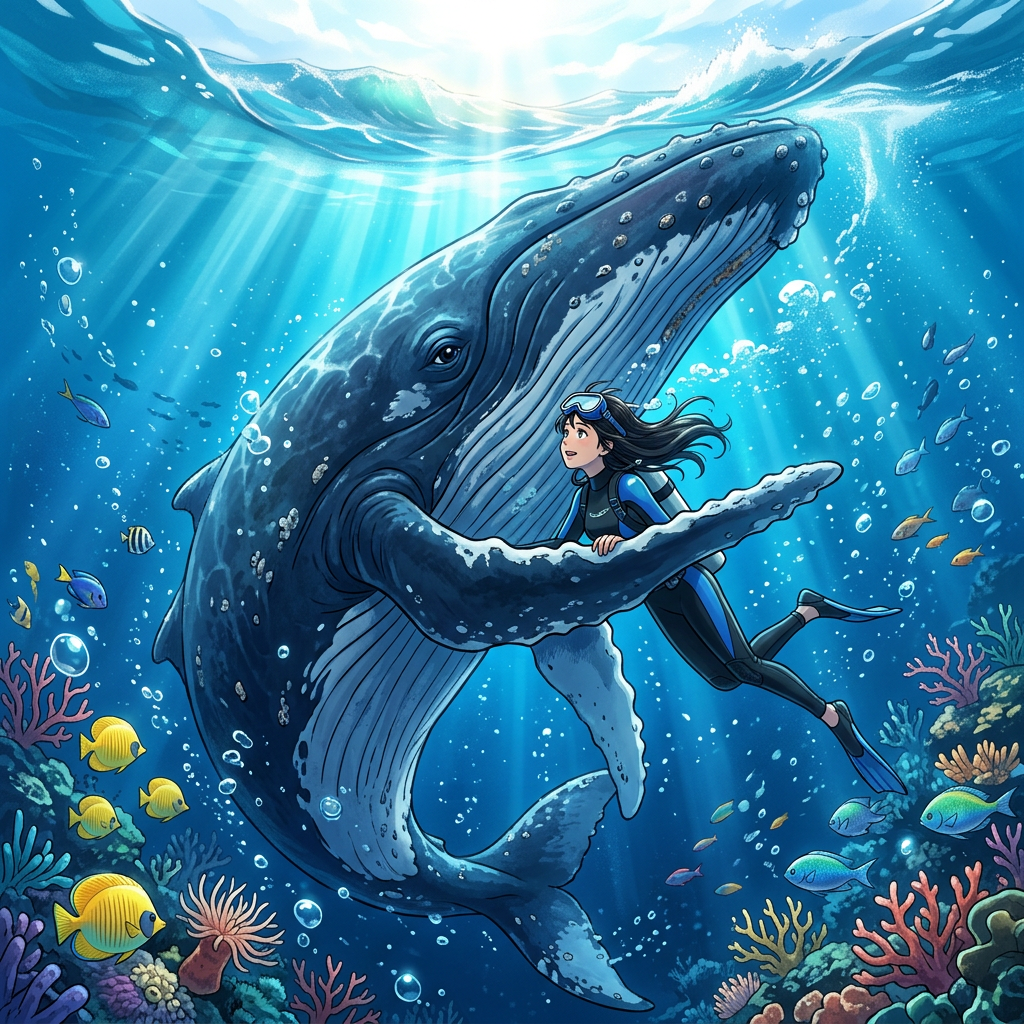
Diver embracing a large whale surrounded by colorful fish and coral underwater

There are stories that belong not only to science, but also to wonder—stories that unfold in that quiet space where facts end and meaning begins.

One such moment took place in 2017, in the warm, crystalline waters off Rarotonga, part of the serene islands of the Cook Islands.

Marine biologist Nan Hauser had spent nearly three decades studying humpback whales in these waters. She knew their rhythms, their migrations, their presence. The ocean, to her, was not unfamiliar—it was home.

And yet, on that day, something happened that she herself would later struggle to fully explain.

As she swam, a massive humpback whale approached her—directly, powerfully, and without warning. It nudged her. Lifted her. Pressed her gently yet insistently through the water. Again and again, it positioned its enormous body around hers, guiding her in a direction she did not understand.

There was fear. How could there not be?
To be moved by a creature weighing tens of thousands of pounds is to feel the fragile nature of one’s own body. Every movement carried the possibility of harm.

For several long minutes, the whale would not leave her.

Then, beneath the surface, a shadow revealed itself.

A tiger shark moved through the deep—silent, powerful, and unmistakably dangerous.

Only later did the pieces begin to align.

The whale’s circling.
The persistent nudging.
The careful positioning.

It had remained between her and something she had not yet seen.

Whether the whale intended to protect her is something science cannot say with certainty. Researchers, including experts like Robert Pitman, have long documented how humpback whales sometimes intervene when predators such as killer whales threaten other marine life. They have been seen shielding seals, escorting injured animals, even disrupting hunts.

But a human?

That question remains open—resting quietly in the unknown.

And perhaps that is where the true beauty of this story lies.

Because not everything meaningful can be measured.

What we know is this:
A woman entered the ocean alone.
A powerful creature stayed beside her.
A danger passed.
And she returned safely.

Between those simple facts lives a mystery—one that invites not certainty, but reflection.

Was it instinct?
Was it coincidence?
Or was it something that gently echoes what we, as humans, might call care?

Standing at the edge of such a moment, we are reminded of how little we truly understand about the inner lives of the beings who share this world with us. The ocean, vast and ancient, holds countless stories like this—unwritten, unproven, yet deeply felt.

Perhaps what matters most is not defining the whale’s intention, but recognizing the invitation within the encounter.

An invitation to humility.
To reverence.
To a quieter way of seeing.

In a world where we often place ourselves at the center, moments like this shift the perspective. They remind us that we are participants, not masters—threads woven into a much larger, living tapestry.

And sometimes, in ways we cannot fully explain, that tapestry seems to respond.

Gently.
Powerfully.
And just when it is needed most.

Link:https://peacelilysite.com/2026/04/13/between-instinct-and-grace-a-moment-the-ocean-remembered/
When Love Lifts Life: A Remarkable Story from the Ocean

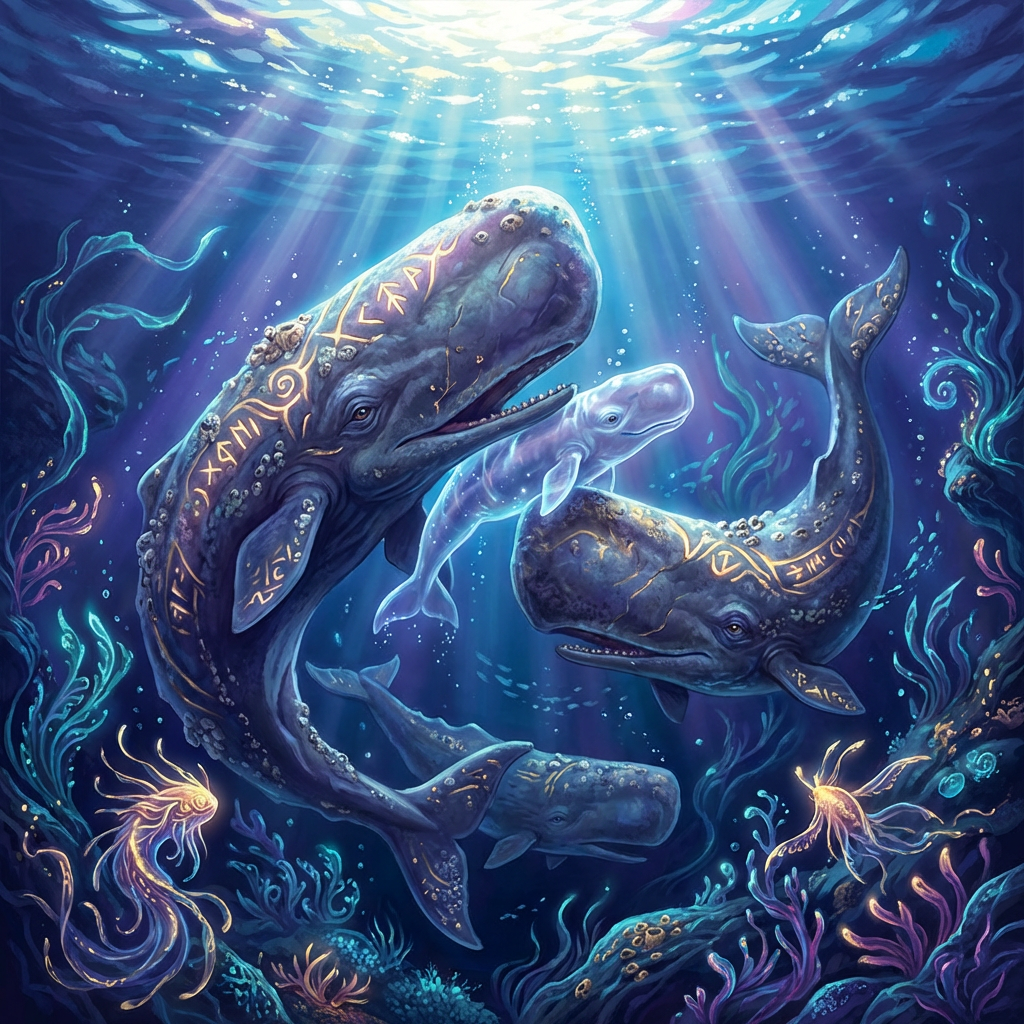
Mystical sperm whales with golden runes and a bioluminescent calf in a deep-sea environment.
Ancient whales adorned with golden runes protect a bioluminescent calf in this mystical deep-sea scene.

July, 2023. Out on the open sea.

A group of marine biologists was tracking a pod of sperm whales. At first, something felt strange. Eleven whales floated motionless at the surface, as if time itself had paused. The ocean was eerily quiet.

Then, about an hour later, the stillness shattered. The water suddenly turned red.

Hearts racing, the scientists braced themselves for the harsh reality of nature.
Was this a hunt? A death? A moment of survival at another creature’s expense?

But as a drone camera moved closer, the truth revealed something entirely different.

There was no violence. No tragedy.

A mother whale—named Rounder—was giving birth.

In a rare and breathtaking moment, the scientists witnessed a new life entering the world. A tiny tail emerged first, as sperm whale calves are born tail-first, and slowly, a newborn began its journey into the vast ocean.

It should have been a moment of pure joy.

But in the ocean, birth is only the beginning of the struggle to survive.

A newborn sperm whale faces an immediate danger. Unlike adults, it has not yet developed the specialized organ in its head that helps regulate buoyancy. In simple terms, the baby cannot stay afloat on its own.

Without help, it would sink.

And sinking, in the open ocean, means death.

But what happened next was something no one could have predicted.

The ten other whales surrounding Rounder moved into action.

One by one, they swam beneath the newborn calf, using their massive bodies to gently push it upward—lifting it to the surface so it could take its first breaths. Again and again, they repeated this act, forming a living cradle beneath the fragile life.

This was not a brief effort.

For three hours, the whales took turns, tirelessly supporting the newborn, ensuring it did not sink. Each whale became a living buoy, offering strength, patience, and care.

It was a relay of compassion.

What makes this story even more extraordinary is what scientists later discovered: nearly half of the whales helping that day were not directly related to the mother or the calf.

They were not bound by blood.

And yet, they stayed. They helped. They gave their strength to protect a life that was not “their own.”

In the world of sperm whale, this is part of a deeper truth. These whales live in close-knit, matriarchal societies—grandmothers, mothers, aunts, and daughters supporting one another. But their care goes beyond family ties. It extends into a culture of mutual aid, a shared understanding:

Today I help you. Tomorrow, someone will help me.

In a world where nature is often described as ruthless and unforgiving, this moment tells a different story.

Survival is not driven by strength alone.
It is sustained by connection.

Even in the vast, indifferent ocean, life finds a way through cooperation, through presence, through something that looks very much like love.

Perhaps there is something for us to learn here.

In our own lives, we all face moments when we feel like we are sinking—overwhelmed, alone, unable to stay afloat. And sometimes, the help that lifts us does not come from those closest to us, but from unexpected kindness, from strangers, from quiet acts of support.

Like those whales in the open sea, we, too, are part of a larger web of life.

In Buddhism, there is a teaching that all beings are interconnected, bound together through causes and conditions. The kindness we offer today becomes the support we receive tomorrow. This is the quiet working of karma—not as fate, but as the natural unfolding of our actions.

The whales did not calculate reward or recognition. They simply responded to suffering with care.

In the same way, when we act with compassion, we become part of a greater flow of life—one that uplifts, protects, and sustains all beings.

Perhaps awakening does not begin with grand realizations, but with small, sincere acts:

To notice when another is sinking.
And to gently help them rise.

Link: