The hourglass of every life is filled with grains of sand
And through the narrow neck of time our memories all land
Each grain a special yesteryear each grain a dream that’s passed
Lifelong castles built with care in hopes that they would last
Our trips around the dazzling sun are all too precious few
Whether they count twenty-one or even ninety-two
So live your life with purpose and seize each fleeting day
And heed the Good Book’s verses before life slips away
When all of today’s tomorrows have turned to yesterdays
And you add up the joys and sorrows that you faced along the way
In pursuit of life’s bright rainbows and the dreams you dared to dream
The brilliant shooting star shows beyond the moonlit beams
Don’t lose sight of the treasures from which you’d never part
The things that can’t be measured except within your heart
That offer your life meaning and lasting legacy
Your inspiration for dreaming for all the world to see
And as you bid this world adieu and say your last goodbyes
Get showered with the “I love yous” and head toward Heaven’s prize
Take a look around you and count yourself as blessed
For all that you’ve held onto that’s brought you happiness
Your life on Earth will carry on within the hearts and souls
Of the many lives you’ve met along this long and rocky road
From mountains high to ocean shores your journey here is done
So let your wings toward Heaven soar to that home beyond the sun!
“The years of our life are . . . soon gone, and we fly away . . . So teach us to number our days that we may get a heart of wisdom.” ~~ Psalm 90:10, 12 (ESV)
“Let us prepare our minds as if we’d come to the very end of life. Let us postpone nothing. Let us balance life’s books each day.” ~~ Seneca (First Century)
Go placidly amid the noise and haste, and remember what peace there may be in silence. As far as possible without surrender be on good terms with all persons. Speak your truth quietly and clearly; and listen to others, even the dull and the ignorant; they too have their story.
Avoid loud and aggressive persons, they are vexations to the spirit. If you compare yourself with others, you may become vain and bitter; for always there will be greater and lesser persons than yourself. Enjoy your achievements as well as your plans.
Keep interested in your own career, however humble; it is a real possession in the changing fortunes of time. Exercise caution in your business affairs; for the world is full of trickery. But let this not blind you to what virtue there is; many persons strive for high ideals; and everywhere life is full of heroism.
Be yourself. Especially, do not feign affection. Neither be cynical about love; for in the face of all aridity and disenchantment it is as perennial as the grass.
Take kindly the counsel of the years, gracefully surrendering the things of youth. Nurture strength of spirit to shield you in sudden misfortune. But do not distress yourself with dark imaginings. Many fears are born of fatigue and loneliness. Beyond a wholesome discipline, be gentle with yourself.
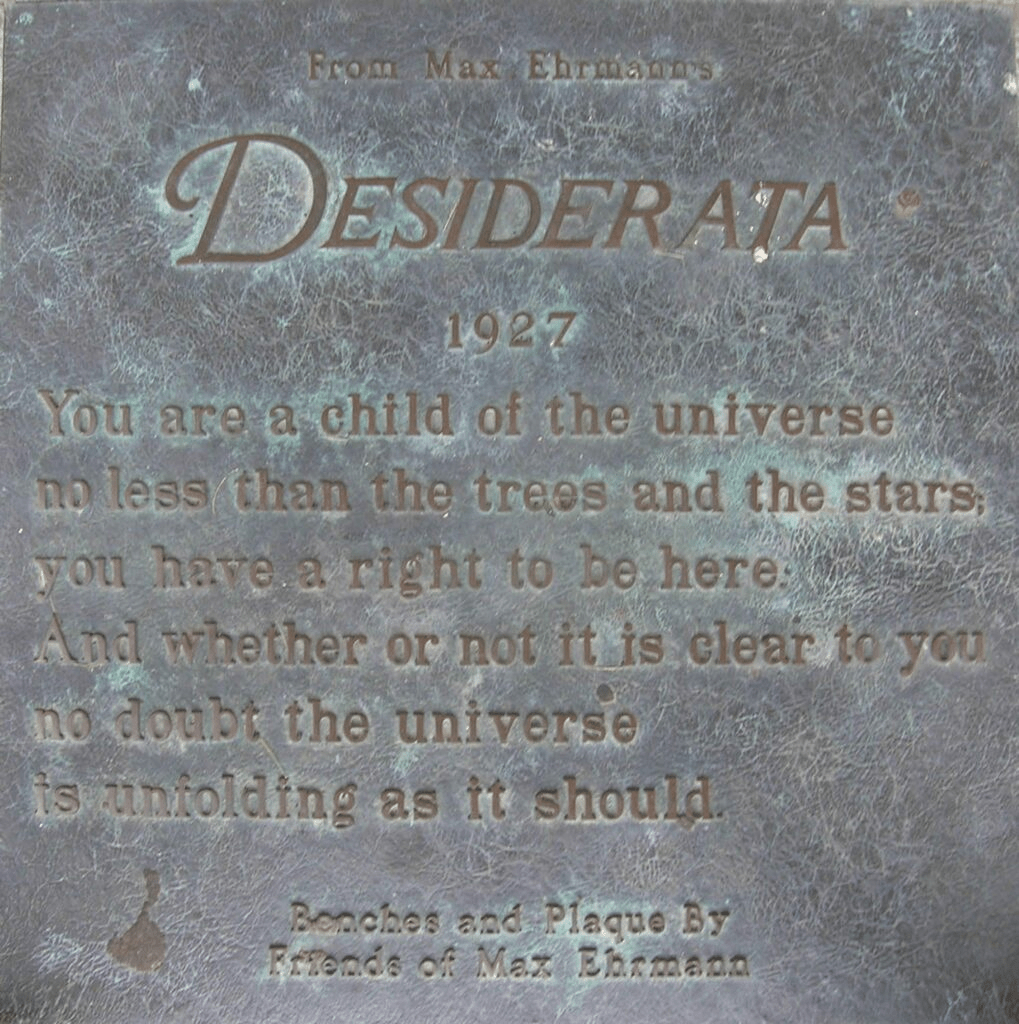
You are a child of the universe, no less than the trees and the stars; you have a right to be here. And whether or not it is clear to you, no doubt the universe is unfolding as it should.
Therefore be at peace with God, whatever you conceive Him to be, and whatever your labors and aspirations, in the noisy confusion of life keep peace with your soul.
With all its sham, drudgery, and broken dreams, it is still a beautiful world. Be cheerful. Strive to be happy.
Written in 1927 by American poet Max Ehrmann, Desiderata is a timeless poem that continues to inspire readers with its gentle, universal wisdom. The title, meaning “things desired” in Latin, perfectly reflects the poem’s themes of peace, authenticity, and compassion.
Ehrmann composed this prose poem to guide people in living a meaningful life. Though it gained widespread recognition only decades later, Desiderata resonates deeply with readers across generations. Its advice—such as staying calm amid chaos, embracing individuality, and showing kindness—feels especially relevant in today’s fast-paced world.
The poem also carries a spiritual undertone, encouraging acceptance of life’s challenges while celebrating its beauty. Its words remind us to live mindfully, cherish our unique paths, and find serenity in our connection to the larger universe.
In a world where noise and haste often dominate, Desiderata offers a calming presence and serves as a reminder to align our lives with values that bring lasting peace and joy. Whether you’re encountering it for the first time or revisiting its wisdom, this poem remains a meaningful touchstone for navigating modern life with grace.
H.H. Dorje Chang Buddha III’s painting “Spring Rain in the Ancient City” creates a pure and exquisite inner world with extremely concise brushstrokes. Upon viewing it, one feels a sense of ethereal illusion, akin to gazing at the moon reflected in water, or the fresh and invigorating sound produced by pressing down a piano key. This artistry, which combines reality with the abstract and exudes a transcendent naturalness, enlightens the mind and often transports individuals to a realm of beauty and wonder.
With a stroke of the artist’s ingenious brush, the reality of the impermanent years and the philosophical insights contained within natural phenomena are presented on the canvas. The aesthetician, Zong Baihua, once said, “By focusing on the specifics of universal life, appreciating its colors, order, rhythm, and harmony, one glimpses the highest reflection of the self; transforming reality into the realm of the abstract, creating images as symbols, and concretizing the highest human spirit, embodying it physically – this is the realm of art.”
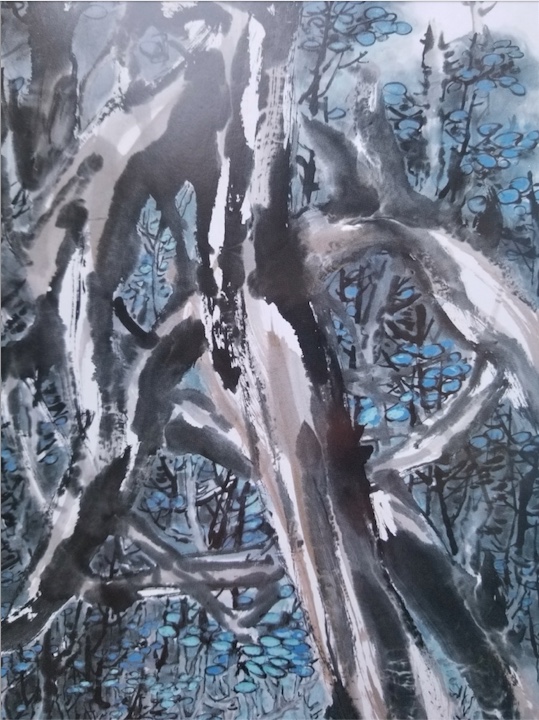
When admiring the Chinese painting “Spring Rain in the Ancient City,” my past painting ideas and perplexities suddenly melted away. The artistic conception in the artwork shook my inner being, and the marvelous composition deeply enlightened my mind. In the painting, a towering tree stands, firmly rooted and majestic, with branches reaching up to the sky. Through the spaces between the branches, one can see the lush greenery of trees lining the streets, exuding the freshness of spring. Above the canopy stretches the boundless sky, evoking the infinite implications of universal life. Beneath the crisscrossing branches lies the bustling city streets, where people hurry about their business. A sudden spring rain brings a new aesthetic perspective: under the vast sky, countless beings toil diligently in the wind and rain…
From the painting, we can observe that during that time in this ancient city, there weren’t many cars on the streets. People were either riding buses, bicycles, or walking. It portrays vivid, serene scenes, offering a soothing and comforting feeling to the heart.
This philosophical painting also reminds me of the verses from the poem “Nian Nu Jiao” by H.H. Dorje Chang Buddha III: “Abruptly entering the universe, The universe of a billion worlds, Stand firmly against all hardships and obstacles. Seeing through glory and riches, I simply smile. The rooster crows announcing the dawn, the morning bell hurries the moon, the whole Soha world is revealed everybody bustles about to survive,life, like smoke and snow, gone!….. “
The artist, with skillful brushstrokes and delicate ink, creates a realm that is subtle, almost mysterious. The shades of ink, varying in density and wetness, complement each other, resulting in a loose and unrestrained style, with a serene and unadorned visual essence. Whether in form, color, brushwork, or ink application, the painting breaks free from rigid constraints and embraces a sincere expression of artistic intention. Through subtle ink shades, it seeks to capture the essence beyond mere representation, embodying a style characterized by simplicity and refinement. There is no wild passion, no dramatic rhythm that sets the heart racing, and no dazzling colors. Even the composition seems to emerge effortlessly from the void. Everything is harmonious and natural, with the entire painting radiating a luminous brilliance, like jade coming to life.
This work skillfully combines the macro and micro perspectives. Through the delicate depiction of trees and leaves, it unfolds the vastness of the cosmos, as if to say, “Every stroke creates a marvelous realm.” This brushwork embodies profound Zen principles. Upon contemplation, the boundless wonders of the universe and life are revealed within this ethereal painting, inviting deep reflection.
The scenes depicted in the painting have long existed objectively within our familiar yet overlooked surroundings. The artist extracts them from everyday life and presents them anew, allowing us to view our own existence from a fresh perspective.
Just as when I first heard the violin concerto “Liang Shanbo and Zhu Yingtai,” the moment the poignant melody gently flowed out, I was immediately moved by the unfamiliar yet familiar notes. The unforgettable melody seemed like a long-lost acquaintance, evoking excitement and beauty as if meeting an old friend in a dream. This sense of beauty seems to have always existed deep within our souls, waiting to be discovered. The artist perceives this beauty and presents it to people in an appropriate form. Perhaps this is a commonality among all great and extraordinary art in the world, which is why art history refers to this type of art as the ideal reality.
In traditional China, painting was revered as “silent poetry,” while poetry was seen as “painting with sound.” Both art forms found expression through the medium of calligraphy, which was considered the “art of handwriting.” Scholars and artist-scholars incorporated calligraphic brushstrokes into their paintings, viewing their artworks as vehicles for self-expression. Consequently, painting was not only regarded as an art form of equal purity and lyricism to poetry and contemplative thought but also as a means to evoke sensory experiences, emotions, and a holistic engagement with the world.
For Western observers, it may be intriguing why Chinese artists incorporate writing in their paintings and what significance the characters hold. By examining some of H.H. Dorje Chang Buddha III’s paintings, we can gain insight into these questions and witness the embodiment of the concept known as the “Three Perfections.” This concept represents the harmonious fusion of fine painting, poetry, and calligraphy within a single artwork.
Song of the Waves in the Three Gorges by H.H. Dorje Chang Buddha III
This painting, titled “Song of the Waves in the Three Gorges,” beautifully captures the grandeur of splash-ink technique alongside the charm of water and ink colors. Its overall tone carries a weighty presence. The brushwork employed in this artwork evokes a powerful sense of momentum, lively charm, and a vividness akin to the scene of a long, flowing river just passing by. The inclusion of a few small sailboats adds elegance to the water scene as they gracefully navigate through it. The combination of the mighty river and awe-inspiring mountains, enveloped in mist and holding sacred spaces, has a purifying effect on one’s emotions. This painting possesses a quality that is reminiscent of both poetry and calligraphy.
Notably, H.H. Dorje Chang Buddha III has inscribed an elegant Chinese poem onto this painting, which can be translated as follows: “The song of waves echoes in the gorge. Hanging colors of rocky cliffs burst with charm. A few cloudy, misty mountains reveal shades of blue. The vast water’s melody sets the sails in motion.” This poem aptly captures the beautiful and misty landscape of the Three Gorges, where the water and sky harmoniously blend, and human emotions become intertwined with the scenery. This painting serves as an artistic paragon, showcasing the mastery of poetic, calligraphic, and painting skills.
Yi Shan Shui Yun Liang Qing Nong ( One Landscape Charm Presents Two Strong Emotions) By H.H. Dorje Chang Buddha III
This remarkable painting showcases a rare combination of splash-ink and splash-color techniques, displaying the artist’s bold and skillful brushwork. The resulting natural effect achieved through these techniques is truly indescribable. Within the bold and dynamic brushstrokes, one can discern countless intricate details and traces of charm emerging from the flowing watery ink.
The painting depicts a scene of mountains and water during the approaching dusk, conveying a profound message. The poem imparts the wisdom that we should strive to engage in virtuous deeds rather than harmful actions, treating all living beings with kindness and respect. By embodying such a way of life, one can transcend to another realm and grasp the truth of existence beyond the concepts of birth and death. This painting offers a profound contemplation on the purpose and significance of human existence.
The calligraphy in the two art works are executed in a cursive style, known for its swift and dynamic strokes. Cursive writing is often characterized by its rapidity and vitality, effectively conveying the artist’s profound emotions.
Recently, I stumbled upon breathtaking plum blossoms while taking a walk. These delicate flowers evoked feelings of warmth and joy, reminding me of the arrival of spring. In Chinese culture, plum blossoms, beyond just being a physical flower, have become a symbol of perseverance and resilience in the face of harsh winter conditions. This significance was achieved through the extensive descriptions, sublimations, and chanting by literati and scholars over the ages. In ancient China, plum blossoms were considered a lucky symbol and were welcomed as a sign of the arrival of spring during the New Year.
When I was a child, my father taught me to recite the poem “Ode to the Plum Blossom” by Zedong Mao, reminding me to be fearless and strong like the plum blossom that blooms amidst harsh winter conditions. I really like the poem, and can still remember it.
Ode to the Plum Blossom
—to the tune of Bu Suan Zi
By Zedong Mao, December 1961
Wind and rain escorted Spring’s departure,
Flying snow welcomes Spring’s return.
On the ice-clad rock rising high and sheer
A flower blooms sweet and fair.
Sweet and fair, she craves not Spring for herself alone,
To be the harbinger of Spring she is content.
When the mountain flowers are in full bloom
She will smile mingling in their midst.
But after many years of struggles, I realized that bravery and strength aren’t always enough, especially in managing relationships and family. As a wife and mother, I learned the importance of being magnanimous, compassionate, forbearing, and not rigid. I have since embraced the peaceful and compassionate philosophy of Buddhism.
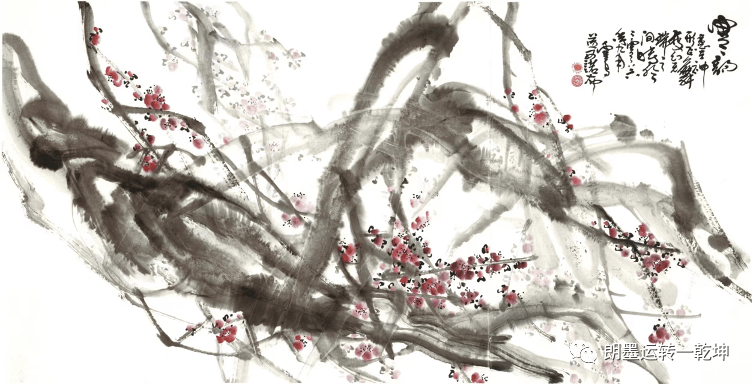
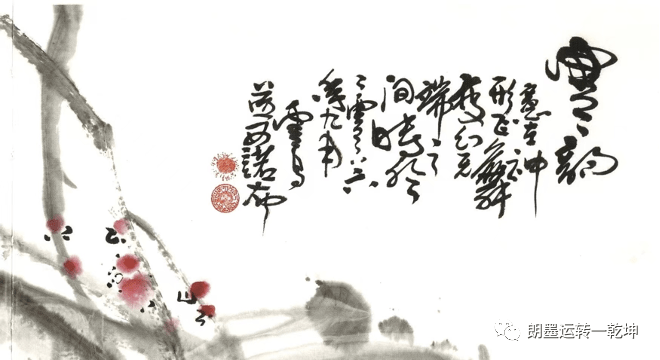
H.H. Dorje Chang Buddha III, the contemporary Buddha, wrote a poem “Plum Fragrance in the Holy Land.” He broke from traditional poetry styles, instead opting for surreal techniques to directly convey spiritual essence.
To the Tune of “Jiang Jun Song”
Plum Fragrance in the Holy Realm
Reveal her icy bearing and proud bones,
See how plum blossom commands the scene,
The crowd of beauties suddenly lacks color,
Seductive peach has lost its looks.
A few casual strokes,
So many eons of wind and dust.
The smoke and fire of the human world all disappears,
Leaving only a pure fragrance from the paper,
It wafts over me, awakening my mind.
The smile of the enchanted dream still remains,
Buddha Vajradhara has come
Three times to this world.
To this Buddha Land of merciful compassion
That great one has brought purity,
Feelings of the brush,
Traces of the brush,
One smile in the wind and dust,
Now the wind and dust,
So many eons of wind and dust.
The Buddha also created an ink painting to accompany the poem. The poem delves deeper into the artist’s thoughts, while the painting provides a visual representation.
The plum blossoms depicted in the paintings symbolize the artist’s state of mind, embodying inner beauty refined from impurities. The brushwork, casually applied, was accomplished with an unfettered hand and detached mind, free of the slightest artificiality. It is a seemingly ever-changing work. Its charm, tone, transitions, and depictions represent the highest level of Eastern ink-and-wash paintings. A transparent layer of lighter ink on top of darker ink is clearly visible, imbuing the painting with a pure and fragrant air and providing the viewer with a feeling of comfort and ease.
The plum blossoms created by these skilled pens are eternal. While natural blooms may come and go, Buddha’s compassion remains steadfast.








 Peace LiLy