Ancient Buddha relics returned to India

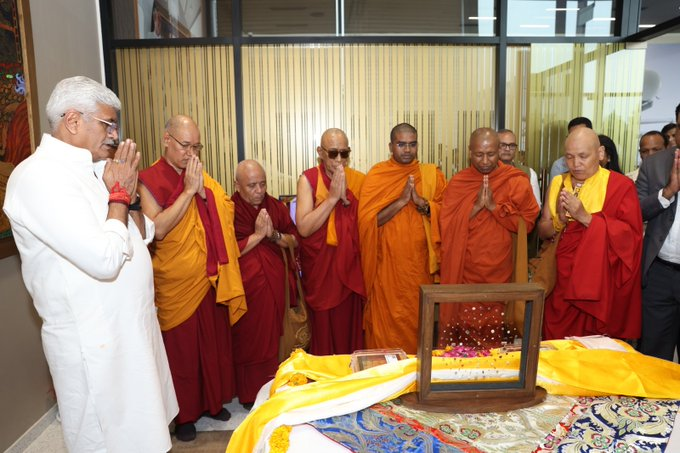
A joyous day for our cultural heritage! It would make every Indian proud that the sacred Piprahwa relics of Bhagwan Buddha have come home after 127 long years. These sacred relics highlight India’s close association with Bhagwan Buddha and his noble teachings. It also illustrates our commitment to preserving and protecting different aspects of our glorious culture. #VikasBhiVirasatBhi Source: https://x.com/narendramodi/status/1950483627323670760

The following article was published by the BBC News, Soutik Biswas, July 31, 2025:

Auction house Sotheby’s has returned a set of sacred jewels believed to be linked to the Buddha’s remains in India, after facing mounting pressure from the Indian government and global Buddhist leaders.

The Piprahwa Gems – described by archaeologists as one of the most astonishing finds of the modern era – were due to be auctioned in Hong Kong in May. But the sale was called off following diplomatic intervention and threats of legal action from Delhi.

The Mumbai-based conglomerate Godrej Industries Group has acquired the jewels, Sotheby’s said.

Sotheby’s said it was “delighted” to facilitate the return, following two months of negotiations involving the owner, the new buyer and the Indian government. The relics will now go on permanent public display in India, the auction house said.

Photo of William Claxton Peppé, an English estate manager, excavated the stupa and found the jewels. courtesy of the Peppé family.
William Claxton Peppé, an English estate manager, excavated the stupa and found the jewels. courtesy of the Peppé family.

Indian Prime Minister Narendra Modi announced the return on Wednesday, calling it a “proud and joyous moment” and a victory for the country’s cultural heritage. The relics, he said on X, were coming home after 127 years.

Godrej Industries Group, the buyer of the jewels, serves over 1.1 billion consumers worldwide across sectors including consumer goods, real estate, agriculture, finance, and chemicals, according to its website. Many of its products are household names in India.

“We are deeply honoured to contribute to this historic moment. The Piprahwa gems are not just artifacts – they are timeless symbols of peace, compassion, and the shared heritage of humanity,” Pirojsha Godrej, Executive Vice Chairperson of Godrej Industries Group, was quoted as saying in a government press statement.

Unearthed in 1898 by English estate manager William Claxton Peppé from a stupa in Piprahwa in northern India, near the Buddha’s birthplace, the cache included nearly 1,800 pearls, rubies, sapphires and gold sheets – buried alongside bone fragments identified by an inscribed urn as belonging to the Buddha himself.

Photo of The jewels were unearthed from this stupa in Piprahwa, northern India in 1898, Icon Films.
The jewels were unearthed from this stupa in Piprahwa, northern India in 1898, Icon Films.

Peppé eventually handed most of the gems, relics and reliquaries to the colonial Indian government: the bone relics went to the Buddhist King of Siam (Rama V). Five relic urns, a stone chest and most other relics were sent to the Indian Museum in Kolkata – then the Imperial Museum of Calcutta.

Photo of Four containers made of steatite (a type of stone) and one made of rock crystal were found inside a sandstone box at the Piprahwa stupa, courtesy of Peppe family.
Four containers made of steatite (a type of stone) and one made of rock crystal were found inside a sandstone box at the Piprahwa stupa, courtesy of Peppe family.

For over a century, the rest of the dazzling jewels remained largely hidden in a British private collection.

A set of 300 gems held by the Peppé family was publicly displayed at Sotheby’s Hong Kong in February and May. Over the past six years, the gems have appeared in major exhibitions, including The Met in 2023. The family has also launched a website to share their research.

Historians consider the relics the shared heritage of the Buddha’s Sakya clan and Buddhists worldwide. The bone fragments have since been distributed to countries like Thailand, Sri Lanka, and Myanmar, where they remain objects of veneration.

Photo of The jewels are considered among the most extraordinary archaeological finds of all time, courtesy of Sotheby's.
The jewels are considered among the most extraordinary archaeological finds of all time, courtesy of Sotheby’s.

The planned sale of the Buddha relics by Sotheby’s in Hong Kong had sparked widespread ethical concerns, with scholars and Buddhist leaders questioning whether sacred objects – especially those linked to human remains – should be treated as commodities.

Critics challenged the seller’s authority to auction the relics, while defenders said a transparent sale was the fairest way to transfer custody. For many Buddhists, the jewels are inseparable from the sacred remains and meant to be venerated, not sold.

“Are the relics of the Buddha a commodity that can be treated like a work of art to be sold on the market?” Naman Ahuja, a Delhi-based art historian, had told the BBC in May. “And since they aren’t, how is the seller ethically authorised to auction them?

“Since the seller is termed the ‘custodian’, I would like to ask – custodian on whose behalf? Does custodianship permit them now to sell these relics?”

Chris Peppé, great-grandson of William, had told the BBC in May that the family looked into donating the relics, but all options presented problems and an auction seemed the “fairest and most transparent way to transfer these relics to Buddhists”.

He said that in all the monasteries he had visited “no Buddhists regard these as corporeal relics”.

“A few Buddhist academics at Western universities have recently offered a convoluted, fact-defying logic whereby they may be regarded as such. It’s an academic construct that is not shared by Buddhists in general who are familiar with the details of the find,” he said.

On 7 May, Sotheby’s postponed the auction of the jewels following media reports and concerns raised by the Indian government, citing the need for further discussions. A week later, it confirmed ongoing talks with India to find a mutually agreeable resolution.

This week, confirming the return of the jewels, Sotheby’s said it was “grateful to the Peppé family for having safeguarded the gems and for having worked with us – and with the Government of India – in good faith to achieve this historic outcome”.

Link:https://peacelilysite.com/2025/09/05/ancient-buddha-relics-returned-to-india/
Hair Sariras of H.H. Dorje Chang Buddha III

In Buddhist scriptures, relics are broadly classified into two types. The first type, known as Dharma-body relics, refers to the teachings and scriptures spoken by the Buddha, representing his spiritual essence and wisdom. The second type, physical relics, comprises the solid remains left after the Buddha’s cremation. These physical relics are traditionally described as being of three kinds: white bone relics, red flesh relics, and black hair relics. They are noted for their luminous, pristine appearance, unbreakable nature, and incomparable beauty, far surpassing worldly jewels.

It is also believed that Bodhisattvas and Arhats may leave behind similar relics. According to Buddhist teachings, relics naturally crystallize in those who have achieved enlightenment and sincerely practiced devotion to the Buddha. They are considered extraordinary and unattainable by ordinary individuals.

H.H. Dorje Chang Buddha III is recognized as the true reincarnation of the Primordial Buddha. His Holiness has demonstrated extraordinary miracles, including the manifestation of hair sariras. Below are authentic accounts from Buddhist disciples detailing their experiences and discoveries of the hair sariras of H.H. Dorje Chang Buddha III.

Hair Sariras (1)

H.H. Dorje Chang Buddha III Wan Ko Yeshe Norbu Holiest Tathagata usually cuts His own hair. However, there have been several occasions when I respectfully accompanied His Holiness to a barber shop. Each time, out of reverence, I carefully swept away the floor and removed other people’s hair before the haircut began. After the Buddha Master’s haircut was finished, I would gather His hair from the floor, wrap it carefully in paper, and place it on my Buddhist altar upon returning home. Gradually, I began collecting and keeping some of the hair.

I still remember what happened on June 1, 2003. On that day, I took out several unopened paper packs and organized them, intending to wash the hair. Because the individual hairs were very fine, I had paid special attention and placed them on a screen. While soaking them in water, I saw three small round red beads among the hair. The entire cleaning process was handled by me, and I did not touch anything else during that time. I felt this to be very strange and wondered where those red beads came from. I intended to press them with my finger to see if they were hard or soft and even took a magnifying glass to carefully exam them. Suddenly, a thought occurred to me. Could they be sariras? I realized if I did this, it would be too disrespectful.
Hurriedly, I placed the three small beads in a small white box and took them to H.H. Dorje Chang Buddha III to inquire of their origin. I asked, “May I know what these things are?” The Buddha Master said, “Where did you get these? These are sariras!” Afterwards, the Buddha Master practiced dharma and chanted mantras to prove the authenticity of those sariras. I reported to the Buddha Master that they were wrapped in paper and appeared from the cut hair of His Holiness.

Later, the Buddha Master gave us a special discourse in which His Holiness stated, “This has happened because of conditions and the level of fortune of all sentient beings. It does not matter where they come from. Perhaps they originated from the empowerment of the Buddhas and Bodhisattvas. It actually does not matter what the disciples think concerning how or where they come from. If they can appear out of nothing, then they can disappear out of nothing. The important thing is the cultivation of each one of us and the need to live in accordance with the teachings and abide by the principles of Buddhism.”
That night, I carefully placed those three red sariras in a small tightly covered Tibetan box and cushioned them with white cotton. The next day, a fellow disciple requested to view them. I thought about placing the sariras in a crystal bottle that I had just bought. When I opened the small box and looked inside–how could it be that there were only two sariras left? I did not touch any other things anymore! I shredded and tore the cotton, but could only find two sariras. It was really upsetting! This proves and corresponds to what H.H. Dorje Chang Buddha III previously expounded: “If they can
appear out of nothing, then they can disappear out of nothing.”

This extraordinary occurrence reminded me of a fellow disciple’s personal testimony of witnessing sariras falling from the Buddha Master. This time, I experienced it firsthand, and it was truly a wonderful and auspicious sign.

Everything I have recounted above is true and authentic. If there are any falsehoods, may I suffer all evil retribution. If they are genuine facts, may living beings receive the dharma teachings of H.H. Dorje Chang Buddha III Wan Ko Yeshe Norbu Holiest Tathagata, be liberated from the cycle of life and death, and attain wisdom and good fortune.

Buddhist disciple,
Hsuan Hui

(This is a complete translation of the Chinese text that follows, originally written and signed by Hsuan Hui.)

Hair Sariras (2)

I established a Buddhist altar in my home in Thailand on January 16, 2005. On that day, a fellow disciple brought me a small glass bottle containing several individual strands of the hair sariras of my Buddha Master, Dorje Chang Buddha III Wan Ko Yeshe Norbu Holiest Tathagata. Each strand was approximately one centimeter long. Out of reverence, I placed a blue semi-precious stone inside the bottle and set it on my altar.

A few months later, I decided to replace the glass bottle with a Venetian crystal one. When I opened the glass bottle, I noticed something astonishing: the originally short hairs had grown longer. Although surprised, I did not dwell on it initially. However, the hairs continued to grow, and recently the change has become undeniable. Some strands have grown to five or six times their original length, now measuring five or six centimeters. Remarkably, some of the hairs, pinned down on both ends by the stone, have grown in their middle sections, forming loops. How truly extraordinary!

From a scientific perspective, hair cells die once cut, making it inexplicable how short, severed hairs could continue to grow. Let this miraculous phenomenon strengthen our faith and conviction. It is a genuine manifestation of the power of the Buddha-dharma!

Buddhist disciple,
Shu-Hui Chen

(This is a complete translation of the Chinese text that follows, originally written and signed by Shu-Hui Chen.)

Link:https://peacelilysite.com/2024/12/06/hair-sariras-of-h-h-dorje-chang-buddha-iii/

Source: https://www.tpcdct.org/sites/default/files/media/194.pdf

Nun’s body intact four years after death in A Missouri monastery

This May, Gower, a small rural town in Missouri, has unexpectedly gained recognition as a pilgrimage destination following an extraordinary occurrence related to the exhumation of a nun’s body. Sister Wilhelmina Lancaster, the founder of the Benedictine Sisters of Mary, Queen of the Apostles, was buried at the age of 95 in May 2019. Remarkably, when her body was exhumed four years later, it displayed no visible signs of decomposition, leading to a surge of visitors to the town, approximately 40 miles north of Kansas City.

The preservation of Sister Wilhelmina Lancaster’s body has captivated the attention of hundreds of people, who have deemed it a “miracle in Missouri.” Despite expectations that only bones would remain due to her burial in a simple, unembalmed wooden coffin, the exhumation revealed her fully intact body, along with her religious habit impeccably preserved. Initially, the discovery was intended to remain private, but the news spread rapidly after a private email was mistakenly shared with the public.

While as a Buddhist disciple, I find this occurrence surprising, it is not unprecedented in Chinese Buddhist history. Throughout the annals of Chinese Buddhism, there have been quite a few revered masters and patriarchs who have left behind fully intact relics of their bodies after passing away. Notably, Nanhua Temple in Shaoguan, Guangdong Province, houses three such relics: Master Huineng, the Sixth Patriarch of Zen; Master Hanshang; and Master Dantian. These examples from Buddhist history further highlight the profound reverence and awe associated with the preservation of such relics.

Master Huineng the Sixth Patriarch of Chan Buddhism

Huineng, widely recognized as the Sixth Patriarch or Sixth Ancestor of Chan (Zen) Buddhism, holds a significant place in the early history of Chinese Chan Buddhism. He is both a semi-legendary and a central figure in the development of this tradition. Huineng is renowned as the author of the influential Sixth Platform Sutra and is revered as the sixth patriarch of Chan Buddhism.

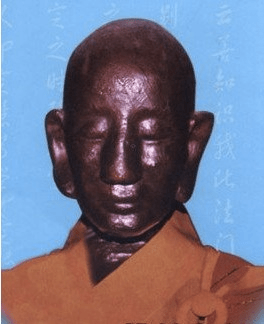
To this day, Huineng’s physical body remains preserved in the Nanhua Monastery in Shaoguan, Guangdong Province. Clad in a yellow robe and a red shawl, his corpse serves as a revered symbol within the monastery where he once taught. According to the Biography of the Great Master of Caoxi (Caoxi Dashi Zhuan, circa 781), Huineng’s body was removed from an urn on September 8, 714. After being desiccated for over a year, it was carefully covered with glue and lacquer before being enshrined in a stupa, where it has remained since.

This preservation of Huineng’s body and its continued veneration serve as a testament to his profound impact on the development of Zen Buddhism and his lasting influence on generations of practitioners. The presence of his preserved corpse stands as a tangible reminder of his teachings and spiritual legacy within the Nanhua Monastery.

Master HanShan (1546-1623)
Master Dantian (1535 – 1614)

Mount Jiuhua, located in China, has a significant historical and religious importance as a Buddhist Holy Land, boasting a rich heritage that spans over 1600 years. Its origins can be traced back to the year 401 AD during the Eastern Jin Dynasty, when the esteemed monk known as “Beidu” journeyed from ancient India to Mount Jiuhua with the intention of constructing temples and spreading the teachings of Buddhism.

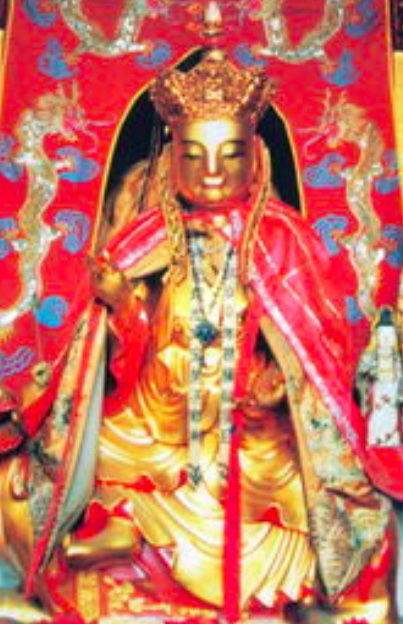
In 719 AD, when Kim Qiaoque, a prince hailing from Silla (present-day South Korea), arrived at Jiuhua Mountain. Kim Qiaoque dedicated himself to self-cultivation in this sacred place for an impressive span of 75 years. His life came to an end at the remarkable age of 99, and astonishingly, his physical body remained intact even after death. Due to the striking resemblance between Kim Qiaoque and Ksitigarbha Bodhisattva, the revered monks residing in Mount Jiuhua firmly believed that the spirit of Ksitigarbha Bodhisattva had reincarnated within him. Consequently, Mount Jiuhua evolved into a significant site for conducting rites and rituals dedicated to Ksitigarbha Bodhisattva.

Throughout history, Mount Jiuhua has served as a dwelling place for countless enlightened masters. Historical records reveal an astounding tally of sixteen masters who achieved the extraordinary feat of leaving behind relics of their physical bodies, fully intact. To safeguard these precious remains, most of the relics were delicately adorned with a layer of gold, serving as a symbol of veneration from the people. These sacred relics not only stand as a testament to the spiritual accomplishments of these masters but also continue to evoke deep reverence and inspiration among devotees to this very day.

Mount Jiuhua Incarnation Grand Hall Enshrines Flesh Body of Ksitigarbha covered by a layer of gold

Master Mingjing (1928 – 1992)

Renyi Nun 仁义师太(1911—1995)enshrined at Mount Jiuhua Tonghui Zen temple
慈航法师 Master CiHang (1893—1954)Now enshrined in Taiwan Metriya Temple

Just a few years ago, the esteemed holy monk Yinhai, a devoted disciple of H.H. Dorje Chang Buddha III, departed this earthly realm, leaving behind a profound and awe-inspiring spiritual legacy. On January 15, 2017, Elder Monk Yinhai completed his earthly journey through impeccable spiritual practices. What followed after his passing was an extraordinary phenomenon that surpassed anything witnessed in Buddhist history.

Even after his physical demise, the holy monk’s body underwent a truly extraordinary and divine metamorphosis. In a stunning departure from the natural order of things, his fingers and nails continued to grow, presenting an unprecedented occurrence in the annals of Buddhist history. This majestic and wondrous manifestation set a remarkable new record that reverberated throughout the Buddhist community. Commencing on the tenth day following his passing, an awe-inspiring process of complete transformation unfolded within his flesh and bones. In a mere twenty days, his body underwent a magnificent metamorphosis, assuming a form that transcended all comparisons, resembling a sacred dharma image.

The astounding and sacred phenomenon demonstrated by the revered monk Yinhai stands as a powerful testament to the profound Buddha Dharma transmitted by H.H. Dorje Chang Buddha III in the annals of Buddhist history.

Photo on the left was taken 11 hours after the Holy Monk entered nirvana, on the right was taken after 24 days

Across various religions, there have been instances of inexplicable miracles that defy the understanding and explanations provided by current scientific knowledge. These miracles, although beyond the grasp of science, undeniably exist. It is my sincere hope that individuals refrain from hastily dismissing them as mere superstition and avoid judging them solely based on their personal knowledge and beliefs.

The realm of spirituality and faith often transcends the limitations of scientific understanding. It encompasses dimensions and experiences that extend beyond empirical observations and logical reasoning. Just because something cannot be readily explained by scientific means does not diminish its significance or validity. Rather, it calls for a humble recognition of the vast mysteries that exist beyond the boundaries of human comprehension.

By approaching these miracles with an open mind and a willingness to explore the depths of the unknown, we can cultivate a greater appreciation for the diverse expressions of spirituality across different belief systems. It is through this mindset that we can foster respect and understanding, recognizing that our individual perspectives may not encompass the entirety of the world’s wonders.

Nun’s body intact four years after death in A Missouri monastery

Link:https://peacelilysite.com/2023/06/16/nuns-body-intact-four-years-after-death-in-a-missouri-monastery/

Source: https://nypost.com/2023/05/25/nuns-body-exhumed-years-after-death-shows-no-signs-of-decay/

#DorjeChangBuddhaIII #HHDorjeChangBuddhaIII#BuddhaDharma#HolyMonkYinhai#ChanBuddhism#MasterHuineng # #YinhaiShengzun#Holyfeat#SixthPatriarchofChanBuddhism #ZenBuddhism #MountJiuhua #KsitigarbhaBodhisattva #NanhuaTemple #Relics #MasterHanshan

What happened to the World King of Monks who passed away sitting on a jar?

Elder Monk Wu Ming

The   World King of Monks, Venerable  Elder Wu Ming, lived for 102 years.  Thirty years ago he vowed to pass away sitting in a jar,  and leaving relics for  people to venerate.

Venerable Elder Wu Ming, a witness of the Buddha’s Nectar Assembly,  has personally experienced when H.H. Dorje Chang Buddha III  invoked  the Buddhas  to  bestow  nectar from the sky into a bowl.  He passed away on July 19, 2011 on the day of  Avalokitesvara’s Enlightenment.

Venerable Elder Wu Ming  observed the precepts strictly and cultivated  himself in  a practical and thorough  manner. His fundamental practice was  the Kuan Yin  Dharma, which he  has  penetrated  deeply. He edified countless people.

He has been   praised as  “the  incarnation  of  Kuan Yin Bodhisattva  in  Taiwan”, and is known as “the World King of Monks” in Buddhism.

At a Buddha  Bestowing Nectar Empowerment Initiation  conducted by  H.H. Dorje Chang Buddha III, Elder Wu Ming  manifested his two-face and  two-arm  nirmanakaya form. It   revealed that he was a  holy  monk who was  the incarnation of a  bodhisattva.

Elder Wu Ming has been working non-stop for half a century to propagate the dharma to  benefit  living beings. He traveled and lectured around the world to propagate the Dharma and made a positive contribution to Buddhism.

Elder Wu Ming received a great Nectar Dharma Empowerment  from  H.H. Dorje Chang Buddha III for his lifelong practice.  In the end he obtained  great accomplishment!  Living beings greatly admire  him.

【Video】What happened to the World King of Monks who passed away sitting on a jar?

What happened to the World King of Monks who passed away sitting on a jar?

Link: https://peacelilysite.com/2022/08/19/what-happened-to-the-world-king-of-monks-who-passed-away-sitting-on-a-jar/

#HHDorjeChangBuddhaIII #DorjeChangBuddhaIII #DorjeChangBuddha#ElderWuMing #KingofMonks#Nectar#Relics#Buddhism#GuanYinBodhisattva