Buddhism, Multidimensional Space, and the Science of Consciousness

Modern scientists suggest there may be multidimensional spacetime. The world we perceive in our daily lives consists of three dimensions of space—length, width, and height—plus one dimension of time, forming what we call four-dimensional spacetime.

For most people, it is nearly impossible to imagine what multidimensional space could be like. Even scientists struggle to describe how such realms might appear.

Yet once, while I was reading a Buddhist sutra, I felt as though I glimpsed something of this mysterious idea.

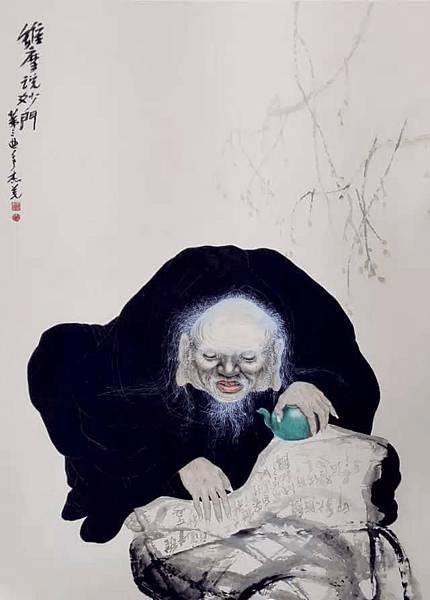
In the Vimalakirti Sutra, it is recorded that Manjushri Bodhisattva led 8,000 bodhisattvas, five hundred arhats, and countless heavenly beings to visit the ailing lay master Vimalakirti.

Vimalakirti lived in a small chamber. He invited everyone to enter. Miraculously, they all went inside, but the room did not grow any larger. No one felt crowded or obstructed, and everyone saw Vimalakirti sitting directly before them.

Manjushri and Vimalakirti engaged in profound dialogue about the Dharma. Later, Vimalakirti displayed astonishing spiritual powers, bringing seats, exquisite foods, and treasures from distant worlds into that same room.

It was absolutely astonishing—like witnessing the seamless merging of multiple dimensions.
Throughout Buddhist history, many great masters have demonstrated abilities that seem to transcend space and time.

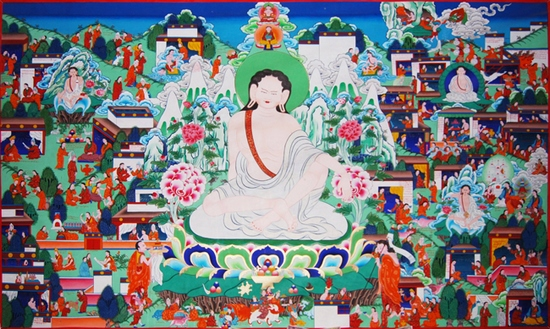
For example, there is the story of Milarepa, Tibet’s most renowned yogi. When he was welcoming his disciple Rechungpa back from India—where Rechungpa had traveled to collect scriptures—an incredible event took place.

Rechungpa carried the scriptures on his back as he crossed the vast grasslands. When he saw Milarepa waiting for him, he was overjoyed. Eagerly, he described how he had met the great master Tilopa. With visible pride, he declared:

“In the past, Tilopa did not transmit this Dharma to Master Marpa, but now he has passed it on to me!”

His words brimmed with arrogance.

As they walked together, Milarepa noticed a broken yak horn on the ground and asked Rechungpa to pick it up. Rechungpa couldn’t see the point and made excuses not to touch it. Silently, Milarepa bent down, picked it up himself, and carried it along.

Suddenly, the sky darkened. Thunder boomed, lightning flashed, and hailstones the size of eggs pounded them mercilessly. Rechungpa was battered and bruised.

When the storm finally ended, he looked around—Milarepa had vanished. Alarmed, he began calling out.

Then, Milarepa’s calm voice rose from the little yak horn at his feet:

“Why are you so flustered? Come in here and take shelter.”

Rechungpa stared in disbelief. The opening of the horn was barely larger than a fist. How could he possibly fit inside?

He bent down to look, and to his amazement, he saw an endless green meadow within—stretching as far as the eye could see. Milarepa sat serenely in meditation.

But no matter what he tried, Rechungpa could not enter.

In that instant, all his pride dissolved. Humility and awe took its place.

Milarepa finally emerged and said with a gentle smile, “Did you see? My little yak horn turned out to be quite useful after all.”
Even in our time, extraordinary manifestations still occur.

H.H. Dorje Chang Buddha III has demonstrated countless inconceivable displays of supreme Buddha Dharma.

Ruzun Ruo Hui, the abbess of Hua Zang Si (in San Francisco) shared one remarkable example in Interviews with Buddhist Disciples (Episode 78).

Around 1995, about a dozen people were gathered together in a room, respectfully listening to the recorded Dharma discourse Expounding the Absolute Truth through the Heart Sutra.

Halfway through, the entire house vanished. All the walls and structures simply disappeared, and everyone found themselves sitting under the open sky.

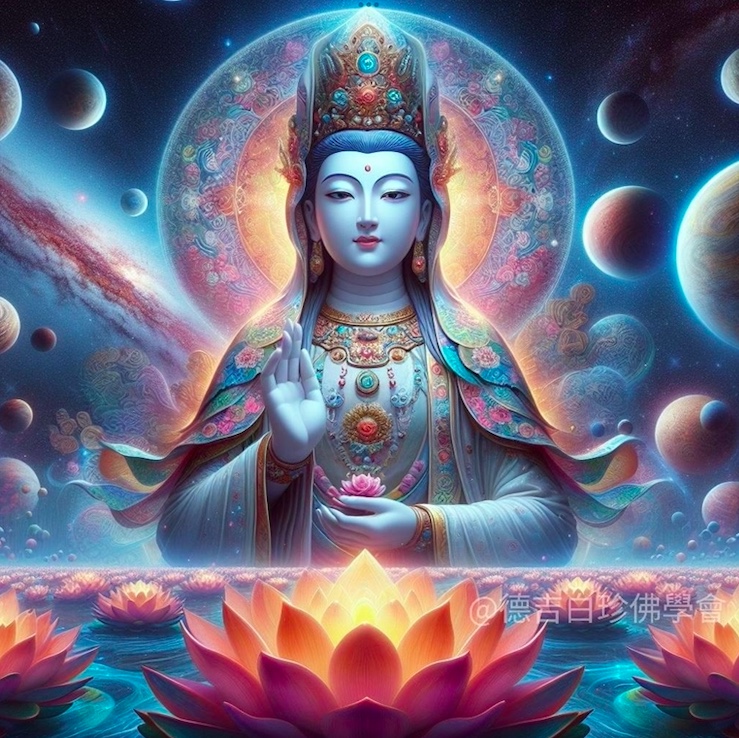
Above them, Avalokiteshvara Bodhisattva appeared, standing in the air, radiating boundless light while auspicious clouds billowed around.

For nearly an hour, Avalokiteshvara remained visible, bestowing blessings. No sounds of the street—no passing cars or footsteps—could be heard. The only sound was the voice of H.H. Dorje Chang Buddha III expounding the Dharma.

It was clear that everyone present had entered another dimension altogether.

Moments like these show us that the universe is far more profound than what our senses can grasp.

I believe Buddhism is deeply scientific—not superstition. Just because today’s scientists cannot yet explain these phenomena does not mean they are unscientific.

On the contrary, Buddhist wisdom offers an entirely different lens through which to explore reality. It can inspire modern science to uncover new methods and fresh insights to understand the universe’s deepest mysteries.

If we open our hearts and minds, perhaps Buddhist teachings will one day help humanity discover shortcuts to truths that today seem unimaginable.

Link:https://peacelilysite.com/2025/07/03/buddhism-multidimensional-space-and-the-science-of-consciousness/

Vimalakirti’s Profound Teachings on Suffering and Liberation

The Profound Wisdom of the Holy Buddha Vimalakirti

The Vimalakirti Sutra stands as one of the most profound texts in Mahayana Buddhism, offering deep insight into wisdom, compassion, and the nature of illness. One of its most significant sections, the “Chapter on Illness,” presents a powerful dialogue between Manjushri and Vimalakirti, a lay Bodhisattva of extraordinary realization.

Vimalakirti, despite his unparalleled wisdom, feigns illness to teach a vital lesson. When Manjushri visits him and asks, “Aren’t you successful in your practice? If so, how can you be ill?” Vimalakirti responds, “I am ill because all sentient beings are ill.” This response redefines illness—not as a personal affliction but as an expression of universal suffering. His illness is a manifestation of his boundless compassion, mirroring the pain of all beings so that he may guide them toward liberation.

Manjushri Bodhisattva and other disciples visiting H.H. Vimalakirti

The dialogue between Vimalakirti and Manjushri unfolds into a deeper contemplation on suffering. When asked when his illness will be cured, Vimalakirti replies, “When the last sentient being is free from illness, then my illness will be cured.” This statement embodies the heart of Mahayana Buddhism—the vow to attain enlightenment not for oneself alone but for all beings. His words resonate with the self-sacrificial love found in other spiritual traditions, such as Jesus Christ’s willingness to bear humanity’s suffering.

Vimalakirti further explains, “From ignorance comes love, and thus my illness arises.” He reveals that suffering stems from attachment—attachment to family, possessions, ambitions, and even spiritual practice. Such attachments cloud the mind, giving rise to suffering. True liberation, he teaches, comes from transcending these attachments through wisdom and compassion.

The holy and venerable Vimalakirti is unique in Buddhist history, as he was an ancient Buddha who chose to manifest as a layperson rather than an ordained monk. During the time of Shakyamuni Buddha, he played a crucial role in teaching monastics and Bodhisattvas who struggled to develop Mahayana bodhicitta. His unparalleled wisdom and skillful means helped bridge the gap between monastic and lay practitioners, proving that profound realization is not limited to those in monastic robes.

In reality, Vimalakirti was the incarnation of the supreme Buddha Dorje Chang (Vajradhara), the primordial Buddha and master of all Buddhas. Yet, instead of taking a leadership role that might have caused sectarian divisions, he humbly chose to serve as a Bodhisattva assisting Shakyamuni Buddha. His teachings, recorded in the Vimalakirti-nirdesa Sutra, are regarded as sutras in their own right, carrying the weight of authentic Buddha-dharma.

The depth of Vimalakirti’s wisdom was so vast that even the most accomplished Bodhisattvas hesitated to engage him in dialogue. When Shakyamuni Buddha asked Maitreya Bodhisattva to inquire about Vimalakirti’s health, Maitreya declined, admitting that Vimalakirti had once humbled him with his superior insight. Ultimately, only Manjushri, the ancient Buddha and master of the seven Buddhas, dared to engage Vimalakirti in discourse.

Chinese Ink painting Holy Master Vimalakirti by H.H. Dorje Chang Buddha III

Vimalakirti’s teachings were not limited to words alone—he also demonstrated his supreme realization through extraordinary miracles. In one instance, he used his boundless supernatural powers to bring the entire Buddha-land of Abhirati, including the Immovable Buddha (Aksobhya), into the human realm. Even the Immovable Buddha himself declared, “I did not do this; it was through the supernatural powers of Vimalakirti.” Such feats reveal that Vimalakirti’s realization surpassed that of all Bodhisattvas and was equal to that of Shakyamuni Buddha himself.

Shakyamuni Buddha himself affirmed the extraordinary status of Vimalakirti, stating, “One who makes offerings to that holy being should know that this is making offerings to the Buddhas. One who transcribes this sutra or keeps it in a room should know that the Tathagata exists in that room.” These words confirm that Vimalakirti was, in essence, a Buddha.

His teachings continue to inspire practitioners today, offering a profound perspective on suffering, wisdom, and compassion. His willingness to manifest illness as a teaching tool, his unparalleled debates with great Bodhisattvas, and his supernatural demonstrations all serve as timeless lessons in the path to enlightenment.

Link:https://peacelilysite.com/2025/03/28/vimalakirtis-profound-teachings-on-suffering-and-liberation/

Embracing Silence: 5 Advantages of Practicing Stillness

In China, there’s a saying that goes, “Disaster comes from the mouth, and illness enters from the mouth.” This saying serves as a reminder for people to exercise caution with their words. In Chinese traditional culture, there’s an even stronger emphasis on encouraging individuals to avoid engaging in arguments as much as possible. Confucius’s Analects even contain the proverb “Silence is golden.” The traditional Taoist concept in China emphasizes achieving ultimate emptiness and upholding tranquility and dedication. In Buddhism, there’s also the story of Vimalakirti’s profound silence. While I used to think that these ideas were exclusive to Chinese culture, I later discovered that a similar perspective exists in Western culture as well.

In his timeless masterpiece “The 48 Laws of Power,” Robert Greene delves into the art of navigating complex human interactions to achieve personal and professional success. Amid the book’s numerous valuable insights, the power of silence stands out as a potent tool that often goes unnoticed. Embracing silence can be challenging in our fast-paced, noisy world, but it offers unique advantages that can significantly impact our lives. Let’s explore five key benefits of practicing silence as outlined in “The 48 Laws of Power.”

Cultivating Mystery and Intrigue:

In the realm of power and influence, excessive verbosity can lay bare your intentions and vulnerabilities. In contrast, silence exudes an aura of mystery and intrigue. By listening more and speaking less, people become curious about your thoughts and motivations. Practicing strategic silence creates an impression of wisdom and depth that captures others’ attention, rendering them more receptive to your words when you choose to speak.

Exerting Control Over Emotional Responses:

Our emotions frequently lead us astray, prompting impulsive and regrettable actions. Through silence, you gain mastery over your emotional reactions. By pausing and observing your feelings without immediate response, you grant yourself the space to process and rationalize, resulting in more thoughtful and measured reactions. This controlled demeanor projects strength and stability, fostering an air of authority and respect.

Revealing Concealed Motives:

In a world rife with deception and manipulation, silence can be a potent ally in exposing others’ true intentions. Your silence creates a void that others may attempt to fill with their words. In this process, people often unveil their motives, vulnerabilities, and secrets, affording you invaluable insight into their genuine character. The ability to discern hidden agendas bestows a significant advantage in any situation.

Promoting Attentive Listening and Learning:

In the era of ceaseless chatter and information overload, the art of listening has faded. Embracing silence allows you to become a more attentive and empathetic listener. Active listening enables you to gather vital information, identify valuable opportunities, and comprehend the needs of those around you. This heightened understanding empowers you to tailor your actions and words to suit diverse situations, enhancing relationships and augmenting your influence.

Mastery of Strategic Timing:

Silence is a formidable instrument for mastering the art of timing, particularly when dealing with sensitive or contentious matters. Selecting the appropriate moment to speak or act can profoundly impact the outcome of a situation. Silence grants you the ability to observe the rhythm of events, enabling well-calculated decisions that can profoundly affect your success.

By nurturing enigma, exercising emotional restraint, exposing hidden motives, fostering attentive listening, and mastering the art of timing, you can harness the power of silence to your advantage. Integrating these principles into your daily life will unveil newfound strength, resilience, and influence, propelling you toward success in both personal and professional pursuits. Remember, sometimes, less truly is more, and silence can speak volumes in a world saturated with noise.

Embracing Silence: 5 Advantages of Practicing Stillness

Link:https://peacelilysite.com/2023/08/10/embracing-silence-5-advantages-of-practicing-stillness/

#The48LawsofPower #RobertGreene #ChineseCulture #Taoist #Buddhism #PowerofSilence#Stillness