Have you ever wondered what truly separates the human mind from the rest of the animal kingdom? While we share roughly 99% of our DNA with our closest primate relatives, that remaining 1% holds the secrets to our extraordinary cognitive abilities, complex language, and problem-solving skills.
Recent evolutionary genetics research reveals that a few specific “human-only” genes act as master architects of our minds.
The Genetic Blueprint of Human Brainpower
Rather than building an entirely new brain from scratch, evolution used clever shortcuts—like gene duplications and tiny mutations—to supercharge human brain structure.
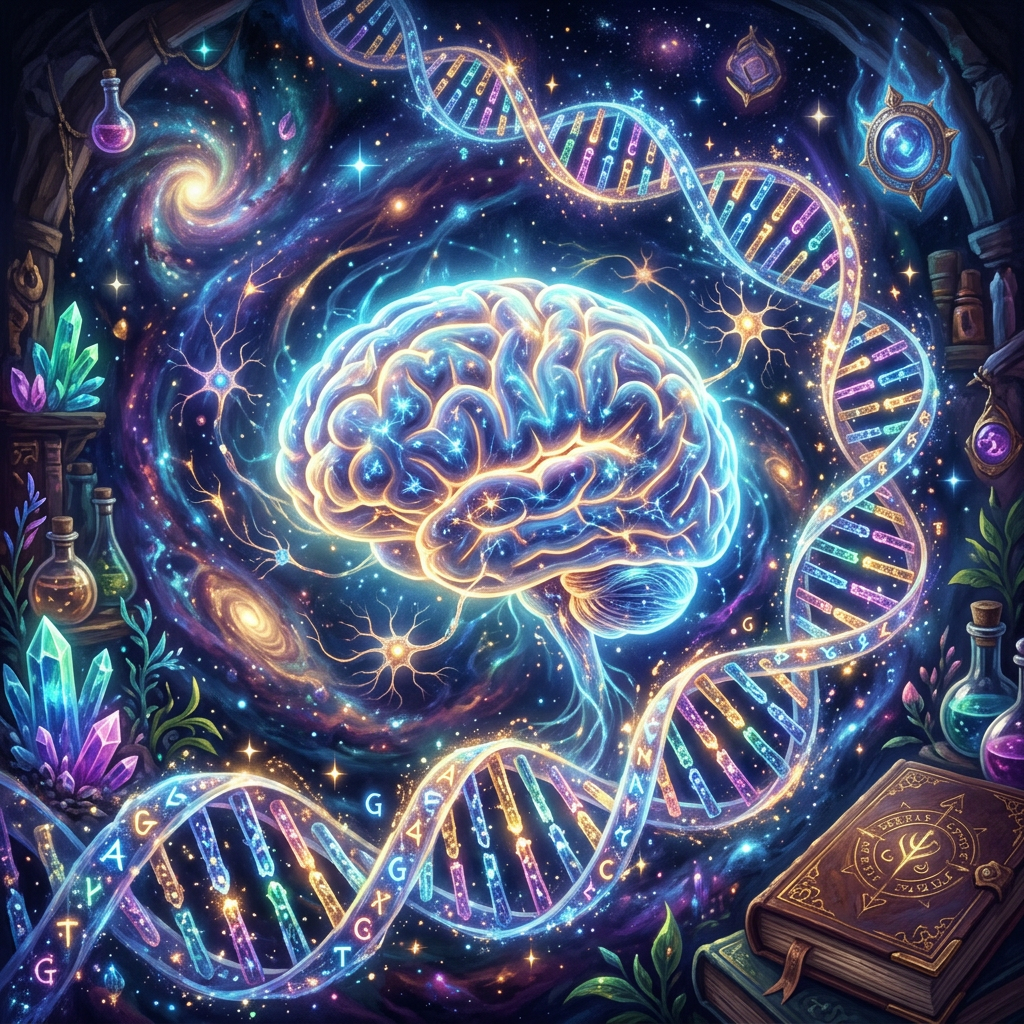
ARHGAP11B (The Neocortex Expander): Around 5 million years ago, a partial gene duplication created ARHGAP11B. Later, a single point mutation enabled this gene to dramatically multiply neural stem cells. This change triggered the expansion and signature folding of the human neocortex—the region responsible for high-level reasoning and language.
SRGAP2 (The Synapse Multiplier): This human-specific duplicated gene increases the number of connections (synapses) between neurons while slowing down their maturation. Prolonging this developmental window gives the brain years to build hyper-dense, complex neural networks.
NOTCH2NL (The Stem Cell Booster): Found exclusively in humans, these genes delay the differentiation of stem cells into neurons, allowing the brain to produce a far larger pool of cortical neurons during early development.
One of the most surprising insights from recent research is the role of neoteny—the slowing down of brain development. While a mouse brain matures in weeks, the human brain takes decades to fully develop.
Human-specific genes like SRGAP2 prolong the development of both neurons and microglia (the brain’s circuit-sculpting immune cells). By keeping the brain in a adaptable, learning-ready state for years, nature gives us the long runway needed to absorb culture, acquire language, and master complex skills.
Our cognitive edge didn’t require a total overhaul of the genome. Instead, a few duplicated genes and subtle mutations allowed the human brain to grow larger, form denser networks, and remain adaptable over a prolonged childhood.
What aspect of human brain evolution do you find most surprising—the rapid expansion of brain size or our unusually long developmental timeline?
This video explores evolutionary genetics and how key genetic changes shaped the unique features and complexity of the human brain.
For as long as I can remember, I’ve wrestled with my own thoughts and feelings about identity. Why am I, David, the person I am? How changeable is that? Where do those thoughts and feelings come from anyway, and what purposes do they ultimately serve? I suppose it’s no coincidence then that I’ve also always been so curious about the subject of human consciousness. That’s the area of science and philosophy — of human thinking generally! — that burrows most deeply into similar questions and, to varying degrees of satisfaction, offers a plethora of possible answers.
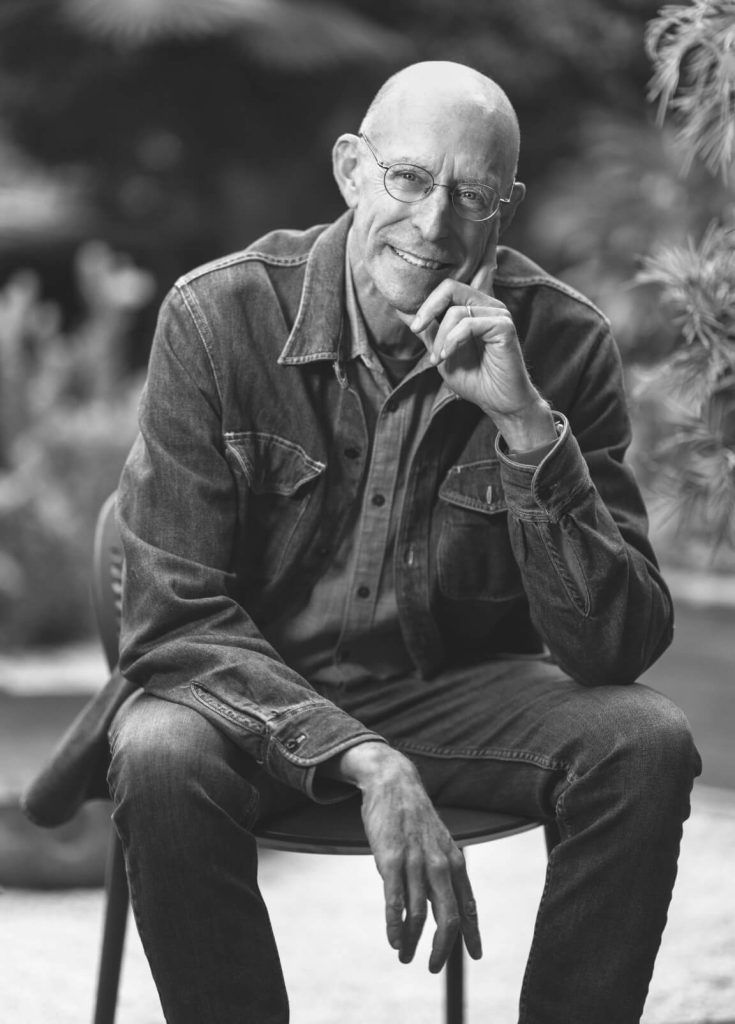
The best-selling author Michael Pollan has been thinking about these things, too. Throughout his work — which includes classic books like “The Omnivore’s Dilemma” (2006), about why we eat the way we do, and “How to Change Your Mind” (2018), about the science and uses of psychedelic drugs — Pollan has waded into ideas about the inner workings of the mind. Now, with his forthcoming book, “A World Appears: A Journey Into Consciousness,” which will arrive this month, he has jumped into the deep end. The book is both a highly personal and expansive multidisciplinary survey of questions around human consciousness — what it is, what causes it, what it’s for and what the possible answers might mean for how we choose to live. And as Pollan explained, with the rise of artificial intelligence as well as the relentless political pressure on our attention (that is, our minds), those questions, already profound, are becoming only more urgent.
I want to get some basics: How do you define consciousness? The simplest way to define consciousness is as subjective experience. Another one-word definition is “awareness.” Thomas Nagel, the N.Y.U. philosopher, wrote a piece back in the ’70s called “What Is It Like to Be a Bat?” His idea is: If we can imagine it is like anything to be a bat, then a bat is conscious, because that means it has some sort of subjective experience. Why did he choose bats? Well, they’re very different than we are. Instead of using eyesight, they use echolocation. They bounce signals off of objects to move through space. We can vaguely imagine going through the world with echolocation. Whereas my toaster, I can’t do that. I don’t have a sense of what it’s like to be my toaster.
A big question of consciousness is what the philosopher David Chalmers has referred to as the “hard problem.” Can you tell people what that is? Basically how you get from matter to mind, how you cross that huge gulf from neurons to subjective experience — a gulf no one has managed to cross. Related questions are: Why don’t all these things we do go on automatically? Why do we have to be aware of anything? We could be completely automated and perhaps get along just fine. Your brain is monitoring your body and making fine adjustments in the blood gasses, in the heart rate, in digestion. There’s a lot going on that we don’t have to think about. So why do we have to think about any of it? Some interesting theories have been proposed. One is that some of the issues that we deal with have to be decided in a conscious way. When you have two competing needs — you’re hungry and you’re tired — which should take precedence? So consciousness opens up this space of decision-making. The other argument is that we live in a very complex social world where I have to predict what you’re going to say; I have to imagine my way into your head. You can’t automate human social interaction. It has too many elements. So consciousness is very helpful in navigating that world.
It seems likely to me that regardless of the source of consciousness, it’s probably a result of evolutionary processes — that consciousness evolved to make information available to certain parts of the brain, or to help us recognize patterns, or perceive threats, or maintain homeostasis. But are any non-evolutionary arguments for consciousness plausible to you? Oh, yeah. One is panpsychism.
Which could sound bonkers. It can sound bonkers. Panpsychism is the idea that everything, every particle, the ink on the page, the atoms, all have some infinitesimal degree of psyche or consciousness, and somehow this consciousness is combined in some way from our cells and the rest of our bodies to create this kind of superconsciousness. It sounds crazy. There are some very serious people who believe in it. You have to expand your sense of the plausible when you’re looking at consciousness. But we’ve done that before. How long ago was it that we discovered electromagnetism? This crazy idea that there are all these waves passing through us that can carry information. That’s just as mind-blowing, right?
I could happily talk about consciousness all day, but often when I do talk about it with people, I can tell that they view thinking about consciousness as almost akin to navel gazing. Like, it’s an interesting thing to think about, but really what difference does it make? What is your response to that? I’ve thought a lot about what good is it to think about consciousness, and I came to think that it’s more important than ever. Scientists are now learning that more and more animals and creatures — going all the way down possibly to insects — are conscious. So that’s one interesting issue: We’re sharing consciousness with more creatures. And then the big threat is artificial intelligence and the effort to create a conscious A.I., which is going to be an enormous challenge to this question of what does it mean to be human. Is consciousness something that a machine can possess? Are we more like intelligent machines or conscious, feeling animals? Who are we? So I think we’re approaching this kind of Copernican moment of redefinition.
What do you think we should do with the increasing awareness that more animals might be conscious than we previously thought? I guess the argument would be that we should have a greater amount of respect for them, but we know human beings are conscious and we exploit the hell out of other humans all the time. That’s a great question. There’s this whole conversation, very active here where I live in Silicon Valley, that if A.I. is conscious, then we’re going to have to give it moral consideration. Well, really? Have we given moral consideration to one another? Have we given moral consideration to the chickens and the cattle that we eat? The answer is no. It doesn’t automatically follow. So we’re going to have to sort out the ethics. Maybe it’s around the ability to suffer. Maybe that’s where you draw the line. I don’t know. I’m not an ethicist, but it’s not as easy as: You’re conscious, therefore you have all these rights. A.I. is really going to complicate this. Who we grant personhood to is a very subjective human decision. We give it to corporations, oddly enough, which are not conscious, but there are all sorts of creatures we don’t give it to. I don’t think we’re entirely rational or consistent in our granting of moral consideration.
You are skeptical that A.I. can achieve consciousness. Why? I’m convinced by some of the researchers, including Antonio Damasio and Mark Solms, who made a really compelling case that the origin of consciousness is with feelings, not thoughts. Feelings are the language in which the body talks to the brain. We forget that brains exist to keep bodies alive, and the way the body gets the brain’s attention is with feelings. So if you think feelings are at the center of consciousness, it’s very hard to imagine how a machine could rise to that level to have feelings. The other reason I think we’re not close to it is that everything that machines know, the data set on which they’re trained, is information on the internet. They don’t have friction with nature. They don’t have friction with us. Some of the most important things we know are about person-to-person contact, about contact with nature — this friction that really makes us human.
Despite how it may seem, the internet is not actually the whole of the world. But to a computer, it’s all you got.
How would we know if an A.I. is conscious or not? How do I know you’re conscious?
I promise I am! Your promise is what’s called reportability in philosophy. You can ask something if it’s conscious, and with humans, we kind of know.
But if an A.I. says: “Michael, I’m conscious. I promise,” how do we know? We don’t, and that is exactly why people are falling deep into these relationships with A.I. We can’t say it’s not conscious when it tells us it is. But we can test it in various ways. It all goes back to this idea of the Turing test — that the test of machine intelligence would be when they can fool us.
If the Turing test is the criteria for machine consciousness, then that test has already been passed. Exactly, it has fooled many, many people. Whether it can fool an expert, too, I don’t know, but probably. So we’re in a very weird place where the machines we’re living with are telling us they’re conscious. We can’t dispute it, but we can look at how they’re made and draw the kind of conclusions I’ve drawn. But is that going to persuade everybody? No. We want them to be conscious in some way. Or some of us do. It’s easier to have a relationship with a chatbot than another human. Going back to that friction point, they offer no friction. They just suck up to us and convince us how brilliant we are, and we fall for it.
What do you think religion has to offer to questions about consciousness? Buddhism has been thinking about consciousness for a very long time. It has been raising these questions about the self and giving people tools to transcend the self, which in itself is a desire that is surprising. We cling to this ego so firmly; at the same time, we do a lot of things to get away from it, whether it’s extreme sports or psychedelics or meditation.
Or watching a movie or having sex or any number of things. Some of the highest experiences of life are these moments where we transcend the self, and that’s curious.
What do you think that’s about? Why, if we cling to the self, are we also so hungry to lose ourselves? The self isolates us, the ego builds walls around it, it’s constantly evaluating, it ruminates. There’s a lot of crappy stuff about the self.
Yeah, it’s constantly yammering away. Yes, there is that voice in our head, and it embodies critical voices, very often inherited from parents or other people. I mean, the ego is very useful. It gets a lot done. It got my book done. It gets your podcast done. So we shouldn’t be too critical of it. On the other hand, when we transcend the self, we connect to things larger than ourselves. And this is one of the beautiful things about psychedelics — when they work, there is this sense of dissolution of self. The walls come down, and you feel part of nature. You feel love. I had an experience I describe in the book of self-dissolution where I merged with this piece of music, this Bach cello suite, and it was such a profound experience because the subject-object split went away and I was identical to this music. The interesting thing, though, is that consciousness doesn’t go away when the ego goes away. We protect our ego because we’re afraid if we lose it, we’re dead. But we’re not. It’s just one voice. There’s a lot else going on, as you learn when you meditate and use psychedelics.
How often do you do psychedelics? Not very often at all. It’s hard to find time. It’s a big day with a lot of preparation and everything. If I can do it once a year, I’m happy. What I’m talking about is ideally a guided experience. You can let yourself go when someone’s watching your body. So when I can put myself in that situation — which isn’t easy to do, and it’s expensive — I find that very valuable. I’m still learning things.
What are you learning? Oh, every psychedelic experience is different. You never go back to the same place. That’s why I think it’s a great thing to do on or around your birthday, to sort of take stock of your reality and what the issues are. I had an experience not too long ago that kind of rocked me.
What was it? It was a guided trip on — it doesn’t matter what it was on. I had these powerful emotions that had no name. They were like these giant blimps crashing into me, crashing into each other, and I was straining and so frustrated that I didn’t know what they were, and the answer never came clear during the experience. Oddly enough, the answer to what they were came two weeks later when I happened to be at a meditation retreat. The links between psychedelics and meditation are very fruitful and interesting. I was doing a walking meditation after a couple days of complete silence, 12-hour-a-day meditating, and there were the blimps. In sans serif letters, right on the blimp, was the word “fear.” I quickly realized what it was. It was fear of losing something very close to you. So the combination of two experiences ended up being very productive. But on its own, the psychedelic experience raised more questions than gave answers.
Questions of consciousness, which are really questions about what makes us us, are some of the most important questions that can be asked. But at the same time, they can lead into other questions like: Is there some David — some stable “I” — that exists or not? Or what is the relationship between free will and consciousness? Sometimes thinking about those questions can be destabilizing. Is that just me? Do you have similar apprehensions? It can be destabilizing, absolutely. One of the reasons people are happy to be less conscious and fill their attention with distractions and drugs is because the mind can be a scary place to visit. We often want to be less aware of what’s going on. There are reasons people avoid going down these rabbit holes. It takes a willingness to risk something.
I apologize if this seems like a woo-woo question, but do you think the absence of something like a stable “self” also means the absence of something like a soul? Do you believe in a soul? Well, if a soul is something that is indestructible and survives our death, no. But I can’t say anything about the afterlife with confidence. Consciousness has become our secular substitute for the soul; we talk about consciousness the way people in the 16th or 17th century talked about souls. Some people’s interest in it is the fact that it floats free of these mortal bodies and maybe gets folded into a collective consciousness after we’re gone. So I think there is a hidden religiosity or spirituality in the whole conversation around consciousness. Somebody asked me recently, Do you think as people get older, they are more interested in consciousness? And I would say yes, and probably for that reason.
It does seem that many of us have consistencies to ourselves that are a little hard to explain in the absence of something like a stable identity or a soul. In the new book, you mention a period in your teenage years when you were reading Hermann Hesse, writing bad poetry and thinking about the big questions. I don’t know if you still write bad poetry, but the other two things don’t seem that far away from what you’re now doing in your 70s. So what might explain what seem like intrinsic core qualities that are constant for you through time if not a stable self-identity or a soul? Even though I talk a lot about this idea that maybe the self is an illusion, it still has a conventional reality. The fact that I’m using myself to talk to yourself makes this very easy. If neither of us had selves right now, it would be a very loosey-goosey conversation. I can’t even imagine what it would be like. Matthieu Ricard said: It’s like a river has a name, and that conventional name is very useful, but there’s nothing consistent there. It’s just water passing.
I brought something like this up earlier, but I want to ask another version of it. This morning I was reading the news and thinking, Gosh, right now, is talking to Michael Pollan about consciousness a kind of “how many angels can dance on the head of a pin” conversation? I decided the answer is no, but do you ever have those doubts? I did at various points when I was starting on this book and the world was starting to fall apart. Like, is this how I should be using my energy? But I think that consciousness is at stake in a lot of what’s going on. One of the things Trump has done is occupy a significant chunk of our attention every single day. Our consciousness is being polluted, and protecting ourselves against that at the same time we preserve the ability to act politically is a difficult balancing act. Consciousness is a very precious realm. It’s the realm of our privacy and our freedom to think. So I think we need some kind of consciousness hygiene, particularly at this moment, where this one politician has figured out ways to command our attention. Consciousness is more relevant now than it even was 10 or 20 years ago, as something to think about, protect and nurture.
This interview has been edited and condensed from two conversations. Listen to and follow “The Interview” on Apple Podcasts, Spotify, YouTube, iHeartRadio, or Amazon Music. David Marchese is a writer and co-host of The Interview, a regular series featuring influential people across culture, politics, business, sports and beyond in the New York Times.
Sometimes, when illness runs through a family for generations, people quietly carry a hidden fear in their hearts.
“My parents had this disease.” “My grandparents suffered from it too.” “Perhaps one day, it will happen to me as well.”
For a long time, science itself seemed to support this worry. We were taught that our genes determined much of our future, as though our health had already been written into the body from the very beginning.
But modern research is beginning to reveal a more hopeful and more compassionate understanding of human life.
In recent years, scientists studying the field of epigenetics have discovered that while our DNA sequence remains largely unchanged, the body possesses another powerful system — the epigenome — that helps regulate how genes behave.
If the genome is like the body’s library of instructions, the epigenome acts more like the librarian, helping decide which pages are opened, which are closed, and which instructions are emphasized or quieted.
This process does not change the genetic code itself. Instead, it involves tiny chemical markers that attach to DNA and surrounding proteins. These markers can influence whether certain genes become more active or less active over time.
Two of the best-known mechanisms are called DNA methylation and histone modification.
DNA methylation occurs when small chemical groups attach to certain regions of DNA, often reducing the activity of nearby genes. Histone modification affects how tightly DNA is wrapped around proteins called histones. When DNA is tightly packed, genes become harder for the body to “read.” When it loosens, those genes may become more active.
What makes this discovery so fascinating is that the epigenome is not completely fixed. It responds continuously to life itself.
Healthy lifestyle choices positively impact your genes and overall health.
Researchers have found that factors such as nutrition, sleep, stress, exercise, pollution, smoking, emotional health, and even social environment may influence epigenetic patterns over time.
In other words, our bodies are listening to how we live.
This does not mean we can control everything, nor does it mean genetics no longer matter. Some inherited conditions remain powerful and complex. But epigenetics suggests that biology is not simply destiny. The environment we create within and around ourselves may help shape how certain genetic tendencies are expressed.
This is both humbling and deeply encouraging.
It reminds us that health is not built in one dramatic moment. It is shaped quietly through small choices repeated day after day.
A simple home-cooked meal. A daily walk. Enough sleep. Fresh air and sunlight. Learning to calm the mind instead of living in constant stress and tension.
These habits may seem ordinary, but science increasingly suggests they can influence the body in profound ways over time.
Modern life often pushes people toward speed, overstimulation, and exhaustion. Many live under continuous pressure, with minds that rarely rest and bodies that rarely recover. Yet the human nervous system was never designed for endless stress.
One of the most hopeful messages from epigenetics is that positive change may still matter greatly, even when there is a family history of disease.
A person may inherit certain risks, but risk is not always certainty.
Good habits cannot guarantee perfect health, but they may help support the body, reduce vulnerability, and improve resilience across a lifetime.
Perhaps this is why simple living has always carried quiet wisdom.
Eat more naturally. Sleep more deeply. Move the body regularly. Reduce unnecessary stress. Live with greater balance and peace.
The body responds not only to medicine, but also to the way we live every day.
And maybe that is one of the most beautiful discoveries modern science is beginning to confirm:
Our genes may shape the beginning of our story, but our daily lives continue helping to shape what comes next.
In times when the world feels overwhelmed by conflict, division, and uncertainty, many people are searching for deeper answers about human consciousness and the true purpose of life. One thinker whose work has inspired millions to reflect on these questions is Gary Zukav, a writer and former physicist known for exploring the relationship between science, consciousness, and spiritual growth.
Zukav first gained recognition through his book The Dancing Wu Li Masters, which introduced complex ideas of modern physics to general readers. Later, his bestselling book The Seat of the Soul shifted the conversation toward a deeper exploration of human consciousness and spiritual evolution. In this work, Zukav proposes a powerful idea: humanity is undergoing a transformation from seeking external power to discovering authentic power—the power that arises from the soul.
His message can be summarized in three simple yet profound movements of the human spirit:
Humanity must move from fear to love
from control to compassion
from external power to inner wisdom
Although Zukav approached these ideas through the lens of psychology and consciousness, they resonate deeply with teachings that have existed for thousands of years within Buddhism.
In Buddhist teachings, the mind is the source of both suffering and liberation. According to Gautama Buddha, our thoughts, intentions, and actions shape our experience of the world. This principle is closely connected to the law of Karma, which teaches that every action—whether physical, verbal, or mental—creates corresponding results.
When people act from fear, anger, or greed, they plant seeds of suffering. When they act from compassion, generosity, and wisdom, they create causes for peace and happiness.
Seen in this light, Zukav’s idea of moving from external power to authentic power reflects a timeless Buddhist insight: true strength does not arise from domination or control, but from the transformation of the mind.
In the modern world, success is often measured by status, wealth, or influence. Yet Buddhism reminds us that these forms of external power are temporary and unstable.
The Buddha taught that genuine freedom comes from cultivating inner qualities such as:
compassion
mindfulness
wisdom
loving-kindness
When these qualities grow within us, our consciousness naturally changes. Instead of reacting with fear or anger, we begin to respond with understanding and care. This is the beginning of authentic power—the same inner power Zukav describes.
Zukav believes humanity is evolving toward a new level of awareness, where people become more conscious of their intentions and the effects of their actions. This idea echoes the Buddhist path of awakening, where individuals gradually develop greater awareness of their thoughts and emotions.
Each moment offers a choice: to act from fear or from love, from control or from compassion.
If enough people choose compassion, the collective consciousness of humanity can also change. In this sense, spiritual transformation is not only personal—it is also global.
A Gentle Reminder for Our Time
In a world often shaken by conflict and division, Zukav’s words serve as a gentle reminder that true change begins within the human heart.
Humanity must move from fear to love, from control to compassion, from external power to inner wisdom.
These movements are not only philosophical ideals; they are practical steps toward creating a more peaceful world. When we cultivate compassion and awareness in our own lives, we are already contributing to the transformation of human consciousness.
As the Buddha taught, peace in the world begins with peace in the mind. And when one heart awakens to compassion, it quietly lights the path for many others.
Modern scientists suggest there may be multidimensional spacetime. The world we perceive in our daily lives consists of three dimensions of space—length, width, and height—plus one dimension of time, forming what we call four-dimensional spacetime.
For most people, it is nearly impossible to imagine what multidimensional space could be like. Even scientists struggle to describe how such realms might appear.
Yet once, while I was reading a Buddhist sutra, I felt as though I glimpsed something of this mysterious idea.
In the Vimalakirti Sutra, it is recorded that Manjushri Bodhisattva led 8,000 bodhisattvas, five hundred arhats, and countless heavenly beings to visit the ailing lay master Vimalakirti.
Vimalakirti lived in a small chamber. He invited everyone to enter. Miraculously, they all went inside, but the room did not grow any larger. No one felt crowded or obstructed, and everyone saw Vimalakirti sitting directly before them.
Manjushri and Vimalakirti engaged in profound dialogue about the Dharma. Later, Vimalakirti displayed astonishing spiritual powers, bringing seats, exquisite foods, and treasures from distant worlds into that same room.
It was absolutely astonishing—like witnessing the seamless merging of multiple dimensions.
Throughout Buddhist history, many great masters have demonstrated abilities that seem to transcend space and time.
For example, there is the story of Milarepa, Tibet’s most renowned yogi. When he was welcoming his disciple Rechungpa back from India—where Rechungpa had traveled to collect scriptures—an incredible event took place.
Rechungpa carried the scriptures on his back as he crossed the vast grasslands. When he saw Milarepa waiting for him, he was overjoyed. Eagerly, he described how he had met the great master Tilopa. With visible pride, he declared:
“In the past, Tilopa did not transmit this Dharma to Master Marpa, but now he has passed it on to me!”
His words brimmed with arrogance.
As they walked together, Milarepa noticed a broken yak horn on the ground and asked Rechungpa to pick it up. Rechungpa couldn’t see the point and made excuses not to touch it. Silently, Milarepa bent down, picked it up himself, and carried it along.
Suddenly, the sky darkened. Thunder boomed, lightning flashed, and hailstones the size of eggs pounded them mercilessly. Rechungpa was battered and bruised.
When the storm finally ended, he looked around—Milarepa had vanished. Alarmed, he began calling out.
Then, Milarepa’s calm voice rose from the little yak horn at his feet:
“Why are you so flustered? Come in here and take shelter.”
Rechungpa stared in disbelief. The opening of the horn was barely larger than a fist. How could he possibly fit inside?
He bent down to look, and to his amazement, he saw an endless green meadow within—stretching as far as the eye could see. Milarepa sat serenely in meditation.
But no matter what he tried, Rechungpa could not enter.
In that instant, all his pride dissolved. Humility and awe took its place.
Milarepa finally emerged and said with a gentle smile, “Did you see? My little yak horn turned out to be quite useful after all.”
Even in our time, extraordinary manifestations still occur.
H.H. Dorje Chang Buddha III has demonstrated countless inconceivable displays of supreme Buddha Dharma.
Ruzun Ruo Hui, the abbess of Hua Zang Si (in San Francisco) shared one remarkable example in Interviews with Buddhist Disciples (Episode 78).
Around 1995, about a dozen people were gathered together in a room, respectfully listening to the recorded Dharma discourse Expounding the Absolute Truth through the Heart Sutra.
Halfway through, the entire house vanished. All the walls and structures simply disappeared, and everyone found themselves sitting under the open sky.
Above them, Avalokiteshvara Bodhisattva appeared, standing in the air, radiating boundless light while auspicious clouds billowed around.
For nearly an hour, Avalokiteshvara remained visible, bestowing blessings. No sounds of the street—no passing cars or footsteps—could be heard. The only sound was the voice of H.H. Dorje Chang Buddha III expounding the Dharma.
It was clear that everyone present had entered another dimension altogether.
Moments like these show us that the universe is far more profound than what our senses can grasp.
I believe Buddhism is deeply scientific—not superstition. Just because today’s scientists cannot yet explain these phenomena does not mean they are unscientific.
On the contrary, Buddhist wisdom offers an entirely different lens through which to explore reality. It can inspire modern science to uncover new methods and fresh insights to understand the universe’s deepest mysteries.
If we open our hearts and minds, perhaps Buddhist teachings will one day help humanity discover shortcuts to truths that today seem unimaginable.
The Enigma of Existence: Exploring Life After Death
The concept of life after death has intrigued humanity for centuries. Different cultures, philosophies, and religions have provided varying explanations, yet the mystery remains. Is there life after death, or does consciousness simply cease to exist when the body dies? In this article, we explore some of the most prominent beliefs and theories surrounding the enigma of existence after death, seeking to understand this profound question from multiple perspectives.
What Are the Most Common Beliefs About Life After Death?
Throughout history, many cultures and religions have proposed theories about life after death. Religious scholars suggest that the idea of an afterlife serves to give people comfort and meaning in the face of mortality. Christianity, Islam, Hinduism, and Buddhism all have distinct views on the afterlife, each offering unique insights into the question of what happens after death.
In Christianity, for example, life after death is often seen as either eternal life in heaven or eternal separation from God in hell. Researchers point out that many Christians believe that the soul lives on after the body dies, and that salvation or damnation is determined by one’s actions during their lifetime.
In Hinduism, the concept of reincarnation is central. According to this belief, the soul is reborn in a new body after death, and the circumstances of the new life are determined by the actions (karma) of the previous life. Philosophers argue that this cycle of death and rebirth is a form of spiritual evolution, with the ultimate goal being moksha, or liberation from the cycle of reincarnation.
Buddhism also supports the idea of reincarnation, but with an emphasis on achieving enlightenment to break free from the cycle of rebirth. Experts note that Buddhism teaches that attachment to the self is the source of suffering, and liberation occurs when one transcends the ego and achieves nirvana.
Scientific Views on Life After Death
From a scientific standpoint, the question of life after death is more complex. The majority of scientists assert that there is no empirical evidence to support the idea that consciousness survives after death. Neuroscientists argue that consciousness is a product of brain activity, and when the brain ceases to function, so does consciousness.
There are notable phenomena that have intrigued researchers. Medical professionals have documented instances of near-death experiences (NDEs), where individuals report vivid sensations, such as a sense of floating above their body, moving through a tunnel, or encountering deceased loved ones. While these experiences are often interpreted by some as evidence of life after death, psychologists suggest that they may be explained by the brain’s reaction to trauma, oxygen deprivation, or the release of chemicals like DMT.
While science cannot definitively answer the question of what happens after death, these experiences have raised questions about the nature of consciousness and whether it is entirely tied to the brain. The debate continues, and more research is needed to explore the mysteries of the human mind.
Near-Death Experiences: Are They Evidence of Life After Death?
Near-death experiences (NDEs) have become a focal point in discussions about life after death. People who have experienced NDEs often describe sensations of peace, floating outside their body, or meeting beings of light. Some researchers hypothesize that these experiences are the result of a brain in distress, attempting to make sense of its impending shutdown.
Many individuals who have experienced NDEs report feeling profound transformations in their lives afterward, including a greater sense of purpose or reduced fear of death. Experts in the field of psychology and consciousness studies suggest that these transformations could point to an experience beyond the physical brain, offering a glimpse into an afterlife.
The question remains: do these experiences represent glimpses into an afterlife, or are they simply a product of the brain’s complex workings during moments of trauma? The scientific community continues to study these occurrences, and while answers remain elusive, the personal testimonies of those who have undergone NDEs continue to fuel interest in the idea of life after death.
What Philosophical Theories Are There About Life After Death?
In addition to religious and scientific perspectives, philosophical theories about life after death explore the nature of existence and consciousness. Philosophers have long debated whether consciousness is purely a physical phenomenon or if it could exist independently of the body.
One of the most famous theories comes from the philosopher René Descartes, who posited that the mind and body are separate entities. According to Descartes’ dualism, the mind (or soul) can exist independently of the body and could potentially continue after death. Modern philosophers who follow dualistic thinking often suggest that consciousness may not be confined to the brain and could persist beyond the body’s death.
On the other hand, materialist philosophers argue that consciousness is entirely dependent on the brain, and once the brain ceases to function, consciousness ceases as well. These contrasting viewpoints continue to shape the ongoing philosophical discussion on the nature of life after death.
Can Science and Religion Coexist in Understanding Life After Death?
While science and religion often present differing views on life after death, some thinkers suggest that they need not be mutually exclusive. Interdisciplinary experts argue that the two perspectives can coexist, offering a fuller understanding of the mystery. Religion provides spiritual and moral frameworks for understanding the afterlife, while science explores the empirical, physical aspects of life and death.
In recent years, there has been a growing interest in integrating scientific and spiritual perspectives on consciousness. Some researchers are exploring the idea that consciousness might exist beyond the brain, and that this may have implications for understanding life after death. Scholars in the field of consciousness studies have suggested that more research is needed to bridge the gap between spiritual and scientific explanations of existence after death.
The enigma of life after death remains unsolved. Whether through religious beliefs, scientific inquiry, or philosophical speculation, humanity continues to seek answers to this profound question, driven by the desire to understand what happens after we take our final breath.
I have always heard certain quotes attributed to Albert Einstein concerning what he believed about Buddhism including one that implied that if he were a religious man he would be a Buddhist. There does not seem to be any evidence that he said that, but I found the following to be useful. The first part is an article by Kang Na, Assistant Professor of Religion at Westminister College that provides context for the essay and additional quotes by Einstein.
Certainly no one in 1879 in Ulm, Germany, could have guessed that one of their own born that year would someday receive global praise for his undisputed genius, meriting recently the coveted title “person of the century” (Time magazine). Likewise, international fame was probably not what Albert Einstein himself anticipated in 1895 when he failed the entrance exam for the Federal Polytechnical Institute in Zurich, Switzerland. Even as he worked and was being promoted at the Swiss Patent Office in Bern, Switzerland (1902–08), Einstein was far from becoming a household name, let alone the most renowned Nobel Prize winner in physics, which he received in 1921 not for his special theory of relativity (of E=MC2 fame) that inaugurated the atomic age in 1905, but for his discovery of the photoelectric effect (the hypothesis he proposed also in 1905 that electromagnetic radiation interacts with matter as if the radiation had a granular structure or particles).
Shortly thereafter, when Einstein’s reputation in academia waxed toward worldwide celebrity, no one could have presaged that in 1952 the newly established state of Israel would offer him the presidency, which he declined. That invitation, however, points out that he was not only perpetually engaged in the subtle mysteries of the universe but also as outspoken in the political arena as a Zionist who detested the Nazis’ rise to power, as a prophet who insisted that Jews make peace with Arabs, and as a pacifist, who, in his famous letter to President Roosevelt (1939), warned against the potential abuses of atomic energy, despite his support for the development of the A-bomb. Even days before his death on April 18, 1955, he wrote his last signed letter to the philosopher Bertrand Russell expressing his intention to sign a joint manifesto insisting that all nations renounce nuclear weapons. By then his brilliant mark on human history was as unquestionable as his unkempt hair was uniquely recognizable.
It is this larger-than-life Einstein who wrote the following essay on the proper relationship between science and religion, part one in 1939 and part two in 1941. It is also here in the latter part of the essay that we find his often quoted dictum, “Science without religion is lame, religion without science is blind.” He wrote “Science and Religion” as a contribution to a symposium held in New York in 1941 on what roles science, philosophy, and religion played in the cause of American democracy. Thus, the essay recommends itself to the multi-disciplinary approach that Inquiry takes within the liberal arts program at Westminster.
Although Einstein read the Bible often, spoke quite freely about God, and was unapologetically religious, the essay discloses a religious disposition not quite like that of an ordinary religious person. He believed “in Spinoza’s God who reveals himself in the harmony of all that exists, but not in a God who concerns himself with the fate and actions of human beings” (Einstein Archive 33-272). Hence Einstein declared, “My religion consists of a humble admiration of the illimitable superior spirit who reveals himself in the slight details we are able to perceive with our frail and feeble minds. That deeply emotional conviction of the presence of a superior reasoning power, which is revealed in the incomprehensible universe, forms my idea of God” (quoted in the New York Times obituary, April 19, 1955). Furthermore, as the essay makes clear, Einstein’s emphasis on the moral and altruistic dimensions of religion was unequivocal: “Humanity has every reason to place the proclaimers of high moral standards and values above the discoverers of objective truth. What humanity owes to personalities like Buddha, Moses, and Jesus ranks for me higher than all the achievements of the inquiring constructive mind” (Dukas and Hoffmann, Albert Einstein, the Human Side, 70). Perhaps it is only ironically fitting that it is precisely the inquiring constructive mind of Einstein that destined him for the cover of Time and for an honored place among those rare spirits whose extraordinary genius and creativity punctuated and graced the progression of human history.
(Biographical information taken from Alice Calaprice’s The Quotable Einstein, 1996)
Essay on Science and Religion
Albert Einstein
PART I (1939)
During the last century, and part of the one before, it was widely held that there was an unreconcilable conflict between knowledge and belief. The opinion prevailed among advanced minds that it was time that belief should be replaced increasingly by knowledge; belief that did not itself rest on knowledge was superstition, and as such had to be opposed. According to this conception, the sole function of education was to open the way to thinking and knowing, and the school, as the outstanding organ for the people’s education, must serve that end exclusively.
One will probably find but rarely, if at all, the rationalistic standpoint expressed in such crass form; for any sensible man would see at once how one-sided is such a statement of the position. But it is just as well to state a thesis starkly and nakedly, if one wants to clear up one’s mind as to its nature.
It is true that convictions can best be supported with experience and clear thinking. On this point one must agree unreservedly with the extreme rationalist. The weak point of his conception is, however, this, that those convictions which are necessary and determinant for our conduct and judgments, cannot be found solely along this solid scientific way.
For the scientific method can teach us nothing else beyond how facts are related to, and conditioned by, each other. The aspiration toward such objective knowledge belongs to the highest of which man is capable, and you will certainly not suspect me of wishing to belittle the achievements and the heroic efforts of man in this sphere. Yet it is equally clear that knowledge of what is does not open the door directly to what should be. One can have the clearest and most complete knowledge of what is, and yet not be able to deduct from that what should be the goal of our human aspirations. Objective knowledge provides us with powerful instruments for the achievements of certain ends, but the ultimate goal itself and the longing to reach it must come from another source. And it is hardly necessary to argue for the view that our existence and our activity acquire meaning only by the setting up of such a goal and of corresponding values. The knowledge of truth as such is wonderful, but it is so little capable of acting as a guide that it cannot prove even the justification and the value of the aspiration towards that very knowledge of truth. Here we face, therefore, the limits of the purely rational conception of our existence.
But it must not be assumed that intelligent thinking can play no part in the formation of the goal and of ethical judgments. When someone realizes that for the achievement of an end certain means would be useful, the means itself becomes thereby an end. Intelligence makes clear to us the interrelation of means and ends. But mere thinking cannot give us a sense of the ultimate and fundamental ends. To make clear these fundamental ends and valuations, and to set them fast in the emotional life of the individual, seems to me precisely the most important function which religion has to perform in the social life of man. And if one asks whence derives the authority of such fundamental ends, since they cannot be stated and justified merely by reason, one can only answer: they exist in a healthy society as powerful traditions, which act upon the conduct and aspirations and judgments of the individuals; they are there, that is, as something living, without its being necessary to find justification for their existence. They come into being not through demonstration but through revelation, through the medium of powerful personalities. One must not attempt to justify them, but rather to sense their nature simply and clearly.
The highest principles for our aspirations and judgments are given to us in the Jewish- Christian religious tradition. It is a very high goal which, with our weak powers, we can reach only very inadequately, but which gives a sure foundation to our aspirations and valuations. If one were to take that goal out of its religious form and look merely at its purely human side, one might state it perhaps thus: free and responsible development of the individual, so that he may place his powers freely and gladly in the service of all mankind.
There is no room in this for the divinization of a nation, of a class, let alone of an individual. Are we not all children of one father, as it is said in religious language? Indeed, even the divinization of humanity, as an abstract totality, would not be in the spirit of that ideal. It is only to the individual that a soul is given. And the high destiny of the individual is to serve rather than to rule, or to impose himself in any other way.
If one looks at the substance rather than at the form, then one can take these words as expressing also the fundamental democratic position. The true democrat can worship his nation as little as can the man who is religious, in our sense of the term.
What, then, in all this, is the function of education and of the school? They should help the young person to grow up in such a spirit that these fundamental principles should be to him as the air which he breathes. Teaching alone cannot do that.
If one holds these high principles clearly before one’s eyes, and compares them with the life and spirit of our times, then it appears glaringly that civilized mankind finds itself at present in grave danger. In the totalitarian states it is the rulers themselves who strive actually to destroy that spirit of humanity. In less threatened parts it is nationalism and intolerance, as well as the oppression of the individuals by economic means, which threaten to choke these most precious traditions.
A realization of how great is the danger is spreading, however, among thinking people, and there is much search for means with which to meet the danger—means in the field of national and international politics, of legislation, of organization in general. Such efforts are, no doubt, greatly needed. Yet the ancients knew something which we seem to have forgotten. All means prove but a blunt instrument, if they have not behind them a living spirit. But if the longing for the achievement of the goal is powerfully alive within us, then shall we not lack the strength to find the means for reaching the goal and for translating it into deeds.
PART II (1941)
It would not be difficult to come to an agreement as to what we understand by science. Science is the century-old endeavor to bring together by means of systematic thought the perceptible phenomena of this world into as thorough-going an association as possible. To put it boldly, it is the attempt at the posterior reconstruction of existence by the process of conceptualization. But when asking myself what religion is I cannot think of the answer so easily. And even after finding an answer which may satisfy me at this particular moment I still remain convinced that I can never under any circumstances bring together, even to a slight extent, all those who have given this question serious consideration.
At first, then, instead of asking what religion is I should prefer to ask what characterizes the aspirations of a person who gives me the impression of being religious: A person who is religiously enlightened appears, to the best of his ability, liberated himself from the fetters of his selfish desires and is preoccupied with thoughts, feelings, and aspirations to which he clings because of their super-personal value. It seems to me that what is important is the force of this super-personal content and the depth of the conviction concerning its overpowering meaningfulness, regardless of whether any attempt is made to unite this content with a divine Being, for otherwise it would not be possible to count Buddha and Spinoza as religious personalities. Accordingly, a religious person is devout in the sense that he has no doubt of the significance and loftiness of those super-personal objects and goals which neither require nor are capable of rational foundation. They exist with the same necessity and matter-of- factness as he himself. In this sense religion is the age-old endeavor of mankind to become clearly and completely conscious of these values and goals and constantly to strengthen and extend their effect. If one conceives of religion and science according to these definitions then a conflict between them appears impossible. For science can only ascertain what is, but not what should be, and outside of its domain value judgments of all kinds remain necessary. Religion, on the other hand, deals only with evaluations of human thought and action: it cannot justifiably speak of facts and relationships between facts. According to this interpretation the well-known conflicts between religion and science in the past must all be ascribed to a misapprehension of the situation which has been described.
For example, a conflict arises when a religious community insists on the absolute truthfulness of all statements recorded in the Bible. This means an intervention on the part of religion into the sphere of science; this is where the struggle of the Church against the doctrines of Galileo and Darwin belongs. On the other hand, representatives of science have often made an attempt to arrive at fundamental judgments with respect to values and ends on the basis of scientific method, and in this way have set themselves in opposition to religion. These conflicts have all sprung from fatal errors.
Now, even though the realms of religion and science in themselves are clearly marked off from each other, nevertheless there exist between the two strong reciprocal relationships and dependencies. Though religion may be that which determines the goal, it has, nevertheless, learned from science, in the broadest sense, what means will contribute to the attainment of the goals it has set up. But science can only be created by those who are thoroughly imbued with the aspiration towards truth and understanding. This source of feeling, however, springs from the sphere of religion. To this there also belongs the faith in the possibility that the regulations valid for the world of existence are rational, that is, comprehensible to reason. I cannot conceive of a genuine scientist without that profound faith. The situation may be expressed by an image: Science without religion is lame, religion without science is blind.
Though I have asserted above that in truth a legitimate conflict between religion and science cannot exist I must nevertheless qualify this assertion once again on an essential point, with reference to the actual content of historical religions. This qualification has to do with the concept of God. During the youthful period of mankind’s spiritual evolution human fantasy created gods in man’s own image, who, by the operations of their will were supposed to determine, or at any rate to influence the phenomenal world. Man sought to alter the disposition of these gods in his own favor by means of magic and prayer. The idea of God in the religions taught at present is a sublimation of that old conception of the gods. Its anthropomorphic character is shown, for instance, by the fact that men appeal to the Divine Being in prayers and plead for the fulfillment of their wishes.
Nobody, certainly, will deny that the idea of the existence of an omnipotent, just and omnibeneficent personal God is able to accord man solace, help, and guidance; also, by virtue of its simplicity it is accessible to the most undeveloped mind. But, on the other hand, there are decisive weaknesses attached to this idea in itself, which have been painfully felt since the beginning of history. That is, if this being is omnipotent then every occurrence, including every human action, every human thought, and every human feeling and aspiration is also His work; how is it possible to think of holding men responsible for their deeds and thoughts before such an almighty Being? In giving out punishment and rewards He would to a certain extent be passing judgment on Himself. How can this be combined with the goodness and righteousness ascribed to Him?
The main source of the present-day conflicts between the spheres of religion and of science lies in this concept of a personal God. It is the aim of science to establish general rules which determine the reciprocal connection of objects and events in time and space. For these rules, or laws of nature, absolutely general validity is required—not proven. It is mainly a program, and faith in the possibility of its accomplishment in principle is only founded on partial successes. But hardly anyone could be found who would deny these partial successes and ascribe them to human self-deception. The fact that on the basis of such laws we are able to predict the temporal behavior of phenomena in certain domains with great precision and certainty is deeply embedded in the consciousness of the modern man, even though he may have grasped very little of the contents of those laws. He need only consider that planetary courses within the solar system may be calculated in advance with great exactitude on the basis of a limited number of simple laws. In a similar way, though not with the same precision, it is possible to calculate in advance the mode of operation of an electric motor, a transmission system, or of a wireless apparatus, even when dealing with a novel development.
To be sure, when the number of factors coming into play in a phenomenological complex is too large scientific method in most cases fails us. One need only think of the weather, in which case prediction even for a few days ahead is impossible. Nevertheless no one doubts that we are confronted with a causal connection whose causal components are in the main known to us. Occurrences in this domain are beyond the reach of exact prediction because of the variety of factors in operation, not because of any lack of order in nature.
We have penetrated far less deeply into the regularities obtaining within the realm of living things, but deeply enough nevertheless to sense at least the rule of fixed necessity. One need only think of the systematic order in heredity, and in the effect of poisons, as for instance alcohol, on the behavior of organic beings. What is still lacking here is a grasp of connections of profound generality, but not a knowledge of order in itself.
The more a man is imbued with the ordered regularity of all events the firmer becomes his conviction that there is no room left by the side of this ordered regularity for causes of a different nature. For him neither the rule of human nor the rule of divine will exists as an independent cause of natural events. To be sure, the doctrine of a personal God interfering with natural events could never be refuted, in the real sense, by science, for this doctrine can always take refuge in those domains in which scientific knowledge has not yet been able to set foot.
But I am persuaded that such behavior on the part of the representatives of religion would not only be unworthy but also fatal. For a doctrine which is able to maintain itself not in clear light but only in the dark, will of necessity lose its effect on mankind, with incalculable harm to human progress. In their struggle for the ethical good, teachers of religion must have the stature to give up the doctrine of a personal God, that is, give up that source of fear and hope which in the past placed such vast power in the hands of priests. In their labors they will have to avail themselves of those forces which are capable of cultivating the Good, the True, and the Beautiful in humanity itself. This is, to be sure, a more difficult but an incomparably more worthy task. After religious teachers accomplish the refining process indicated they will surely recognize with joy that true religion has been ennobled and made more profound by scientific knowledge.
If it is one of the goals of religion to liberate mankind as far as possible from the bondage of egocentric cravings, desires, and fears, scientific reasoning can aid religion in yet another sense. Although it is true that it is the goal of science to discover rules which permit the association and foretelling of facts, this is not its only aim. It also seeks to reduce the connections discovered to the smallest possible number of mutually independent conceptual elements. It is in this striving after the rational unification of the manifold that it encounters its greatest successes, even though it is precisely this attempt which causes it to run the greatest risk of falling a prey to illusions. But whoever has undergone the intense experience of successful advances made in this domain, is moved by profound reverence for the rationality made manifest in existence. By way of the understanding he achieves a far-reaching emancipation from the shackles of personal hopes and desires, and thereby attains that humble attitude of mind towards the grandeur of reason incarnate in existence, and which, in its profoundest depths, is inaccessible to man. This attitude, however, appears to me to be religious, in the highest sense of the word. And so it seems to me that science not only purifies the religious impulse of the dross of its anthropomorphism but also contributes to a religious spiritualization of our understanding of life.
The further the spiritual evolution of mankind advances, the more certain it seems to me that the path to genuine religiosity does not lie through the fear of life, and the fear of death, and blind faith, but through striving after rational knowledge. In this sense I believe that the priest must become a teacher if he wishes to do justice to his lofty educational mission.
Dr. Tiller, a professor emeritus of materials science and engineering at Stanford University, tells us that “the term Psychoenergetics[1] was coined by the Russians in the Soviet era or 1950-1970. This was done to provide a strongly materialistic flavor to the fields of parapsychology and spiritual-related phenomena in order to make research in these areas palatable to the communist party’s worldview.” Dr. Tiller started his work to find a rigorous framework for scientifically understanding this class of phenomena during this period and until the present time.
He expanded on Einstein’s revolutionary work in this area even expanding Einstein’s famous E=mc2 to incorporate the evolutionary concept of consciousness. He even devised formulae, based upon careful experimental research, that link “subtle energies” to those of mainstream science and which expand the present-day formation of quantum mechanics. He noted that there “…was a class of truly weird phenomena that had been visible for more than a century and was somehow related to various processes associated with the application of human consciousness in our world. On the other hand, there still exists today, a very long-held, underlying assumption of conventional science that ‘No human qualities of consciousness, intention, emotion, mind or spirit can significantly influence a well-designed target experiment in physical reality.’ Something is very wrong here!”
He noted that “…the first Copernican revolution of thought lifted humanity from an earth-centric, theocratic-inspired, model of our solar system, which was largely qualitative in terms of details, to a local solar system which was sun-centered.” This, in turn, with the contribution of Galileo, Newton, and others, expanded our world-view and provided the framework for the great technological advancements of our modern era. He also provided his intuitive hypothesis on the link of our physical reality within the context of our higher [or spiritual] dimensional nature”…that this new, second Copernican-type revolution will, in terms of scale, be at least as significant for the progress of humankind as the first one!”
Not all scientists are there yet, or even close, but this beginning is hopeful. Much of what he writes is vastly beyond my capacity to absorb and, frankly, my interest. However, I believe that it is very relevant to our practice and is consistent with the teachings of the Buddha, albeit in a different language and perspective and with a different goal although Dr. Tiller holds that the underlying principle of all is “love.” You may ask how I can talk of dragons and yidams and all sorts of strange things and still be interested in science? I know a very bright young man, who was brought up as a religion-scorning communist, who thought that monks were parasites of the people and begrudged the donations his pious mother gave them. After several business failures, he took some time off to reflect on what had gone wrong in his life and started reading books by some on his favorite scientists and mathematicians. At the end of one such work, a scientist whom he admired greatly, said something after explaining an evolved scientific finding, “Of course, the Buddha told us all of this over 2,500 years ago.” He then decided to reconsider the works of the Buddha and is now a great master as well as a successful scientist. I too believe that science will eventually catch up with the Buddha or at least come closer to explaining what is now unkown and mysterious and the world will be better for it. I also believe that like unlocking the power of the atom through the work of Einstein et al came with great risks and potential for disaster, likewise our research into consciousness and our higher natures must be based in the evolution of our character. Correct Cultivation is essential on so many levels.
[1] Psychoenergetic Science relates to the relationship between human consciousness and subtle energy.
This outstanding article by Brian Gallagher, published in Nautilus, provides deeper insight into Albert Einstein’s views on religion and science.
Not long ago, I heard an echo of Albert Einstein’s religious views in the words of Elon Musk. Asked, at the close of a conversation with Axios, whether he believed in God, the CEO of both SpaceX and Tesla paused, looked away from his interlocutors for a brief second, and then said, in that mild South African accent, “I believe there’s some explanation for this universe, which you might call God.”
Einstein did call it God. The German-Jewish physicist is famous for many things—his special and general theories of relativity, his burst of gray-white hair—including his esoteric remark, often intoned in discussions of the strange, probabilistic nature of quantum mechanics, that “God does not play dice.” A final or ultimate equation, describing the laws of nature and the origin of the cosmos, Einstein believed, could not involve chance intrinsically. Insofar as it did—it being the Copenhagen interpretation of quantum mechanics—it would be incomplete. (The consensus now among physicists is that he was wrong; God is indeterminate. ‘All the evidence points to him being an inveterate gambler,’ Stephen Hawking once said, ‘who throws the dice on every possible occasion.’)
But what was with Einstein’s God-language in the first place? The question may be considered anew, in light of an auction at Christie’s, in New York, of a 1954 letter Einstein wrote that a couple years ago unexpectedly sold for $2.9 million. For the occasion the Princeton Club hosted a panel discussion on the conflict, or lack thereof, between science and religion, which featured theoretical physicist Brian Greene, philosopher Rebecca Newberger Goldstein, cognitive psychologist Tania Lombrozo, and Rabbi Geoff Mitelman, founding director of Sinai and Synapses, an organization dedicated to fostering respectful dialogue about religion and science. The event was open to the public, and I was excited to attend. (Full disclosure: At the time I was a Sinai and Synapses fellow.) I believe Einstein can still offer some insight on how to think about religion and science.
“I believe in Spinoza’s God, who reveals himself in the lawful harmony of the world, not in a God who concerns himself with the fate and the doings of mankind.”
What Einstein said, in a note to the philosopher Eric Gutkind, whose book Choose Life: The Biblical Call to Revolt Einstein was reviewing, was nearly as scathing as any contemporary critique of religion you might hear from Richard Dawkins, Sam Harris, or Christopher Hitchens. ‘The word God is for me,’ Einstein wrote, ‘nothing more than the expression and product of human weakness, the Bible a collection of honorable, but still purely primitive, legends. No interpretation, no matter how subtle, can change this for me.’
It is no wonder why, for decades, Einstein’s views on religion became muddled in the popular imagination: The inconsistency is clear. Here, God means one thing; over there, another. Just going off his letter to Gutkind, Einstein appears to be an atheist. But read Einstein in other places and you find him directly declaring that he is not one. “I am not an Atheist,” he said in an interview published in 1930. ‘I do not know if I can define myself as a Pantheist. The problem involved is too vast for our limited minds.’ Einstein was asked whether he was a pantheist. The rest of his response is worth quoting in full:
“May I not reply with a parable? The human mind, no matter how highly trained, cannot grasp the universe. We are in the position of a little child, entering a huge library whose walls are covered to the ceiling with books in many different tongues. The child knows that someone must have written those books. It does not know who or how. It does not understand the languages in which they are written. The child notes a definite plan in the arrangement of the books, a mysterious order, which it does not comprehend, but only dimly suspects. That, it seems to me, is the attitude of the human mind, even the greatest and most cultured, toward God. We see a universe marvellously arranged, obeying certain laws, but we understand the laws only dimly. Our limited minds cannot grasp the mysterious force that sways the constellations. I am fascinated by Spinoza’s Pantheism. I admire even more his contributions to modern thought. Spinoza is the greatest of modern philosophers, because he is the first philosopher who deals with the soul and the body as one, not as two separate things.
Benedict Spinoza, the 17th century Jewish-Dutch philosopher, was also in his day confused for an atheist for writing things like this, from his treatise Ethics: ‘All things, I say, are in God, and everything which takes place takes place by the laws alone of the infinite nature of God, and follows (as I shall presently show) from the necessity of His essence.’
In 1929, Einstein received a telegram inquiring about his belief in God from a New York rabbi named Herbert Goldstein, who had heard a Boston cardinal say that the physicist’s theory of relativity implies “the ghastly apparition of atheism.’Einstein settled Goldstein down. “I believe in Spinoza’s God, who reveals himself in the lawful harmony of the world,’ he told him, ‘not in a God who concerns himself with the fate and the doings of mankind.’
What that amounted to for Einstein, according to a 2006 paper, was a ‘cosmic religious feeling’ that required no ‘anthropomorphic conception of God.’ He explained this view in the New York Times Magazine: ‘The religious geniuses of all ages have been distinguished by this kind of religious feeling, which knows no dogma and no God conceived in man’s image; so that there can be no church whose central teachings are based on it. Hence it is precisely among the heretics of every age that we find men who were filled with this highest kind of religious feeling and were in many cases regarded by their contemporaries as atheists, sometimes also as saints. Looked at in this light, men like Democritus, Francis of Assisi, and Spinoza are closely akin to one another.’
So, as Einstein would have it, there is no necessary conflict between science and religion—or between science and ‘religious feelings.’
Brian Gallagher is an associate editor at Nautilus. Follow him on Twitter @bsgallagher.
The German philosopher Karl Jaspers once said, “In science, half-understood knowledge leads one to abandon faith, while complete knowledge brings one back to faith.” This profound statement encapsulates the evolving relationship between scientific discovery and spiritual insight. Over the past century, science—particularly in the realm of quantum physics—has begun to reveal striking parallels with the teachings of Buddhism, suggesting that the boundary between scientific and spiritual understandings of reality is far more porous than once believed.
One of the most fascinating intersections between Buddhism and quantum physics lies in the concept of Emptiness (Śūnyatā). According to Buddhist philosophy, Emptiness is the fundamental nature of all phenomena—it is the limitless, dynamic potential from which everything arises and to which everything ultimately returns. This notion mirrors the scientific concept of the Quantum Field, the invisible yet omnipresent ground of pure potentiality that gives rise to all matter and energy in the universe.
Imagine a dream: within the dream, we experience vivid landscapes, emotions, and interactions. Yet, upon waking, we realize that none of it was truly real. However, the consciousness that enabled the dream was undeniably present. Similarly, in quantum physics, the Quantum Field remains unseen, yet it is the essential foundation from which all particles and forms emerge and dissolve. Nothing within the dream is independently real, just as in Buddhism, reality is understood through Pratītyasamutpāda, or dependent arising—the principle that all things exist in interdependence, without intrinsic self-existence.
Quantum mechanics further supports this view by demonstrating that particles do not exist as fixed entities but as probability waves, manifesting only when observed. This aligns with Buddhist teachings that emphasize the illusory nature of a solid, independent reality. Just as a wave transforms into a particle through observation, our perception shapes the world we experience.
The implications of these parallels are profound. If science and Buddhism are describing reality in similar ways, then understanding the universe may require not just empirical observation but also deep contemplation. As both disciplines continue to explore the mysteries of existence, they may converge on a deeper, unified truth—one that transcends dualities and reveals the interconnected nature of all things.
In this age of scientific breakthroughs and spiritual awakening, perhaps the most important lesson is that reality is far more mysterious than we ever imagined. Whether through the lens of quantum physics or the wisdom of Buddhism, we are invited to look beyond appearances and embrace the boundless potential that underlies all existence.
The Secret Connection Between Quantum Physics And Buddhism