Elder Monk Yin Hai Created an Unprecedented Holy Manifestation in the History of Buddhism after His Entering Nirvana

Elder Monk Yin Hai Created an Unprecedented Holy Manifestation in the History of Buddhism after His Entering Nirvana

Holy Monk Yinhai

On January 15 2017, Elder Monk Yinhai, has left us after perfect practices. A top-level great holy monk has forever gone in the world. Under the condition of having no sign of sickness, the Elder Monk went into a perfect passing in a sudden. According to U.S. laws, a doctor must file a death certificate with the government. The doctor, however, could not find any sickness as the cause of death, so he just wrote the heart stopped according to what happened. 

Wangzha Shangzun had already predicted in public when the holy examinations ended on December 30th, 2016: “There is a holy monk who ever shone light from His nine burn-marks and broke the darkness of the room. He is the number one high monk in this world today, whom I respect the most. He will leave us in the middle of January next year. After his passing, a holy feat that has never happened in Buddhist history shall happen. That will be a great joyful matter and is worthy of joyful celebration.” 

Wangzha Shangzun wrote a praise verse especially:

Monk Yinhai has merits that shine brightly in the universe
His nine burn-marks emitted light that broke darkness in the room
A greatly compassionate Bodhi incluse who now is known to the world,
On His own will, He returned to the Upper Lotus of Ultimate Bliss
After Shengzun’s passing, His flesh transformed with holy miracle
Creating a new sacred chapter on passing in Buddhist history
Earlier we went to reclusive practice in the deep mountain cave together
Lately, we were both close to the Buddha to receive true teachings

—the humbled Buddhist disciple, Wangzha Gongbo, holding palms together. February 15, 2017
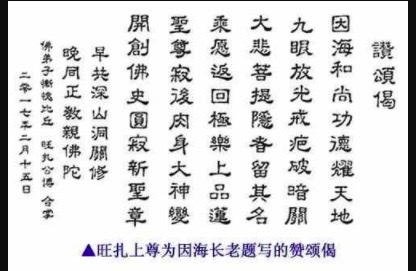
Chinese praise verse written by WangZha ShangZun

Besides composing and writing the praise verse, Shangzun also talked about the Elder Monk’s holy feats, explained that the Elder Monk’s greatly compassionate Bodhi merits shone in the universe and spread the dharmic connection to true Buddha Dharma for the human Saha world. He let Shakyamuni Buddha’s teachings show their positive energy and bright light once again; He exposed the dirty phenomena where evil masters and charlatans were wreaking havoc when Buddha Dharma gradually became chaotic two thousand years after Shakyamuni Buddha’s time under the daylight. He allowed Buddhists to find the path to return to the true and correct teachings by the Buddha. 

After the holy monk’s perfect passing, even His fingers and nails continued to grow, showing a tremendous divine transformation in the flesh, which has never happened in Buddhist history. The holy feat manifest that is so majestic and wonderful created a new record in Buddhist history where, on the tenth day after the passing, the flesh and the bones started undergoing a complete change. In twenty days, the body transformed to another dharma image that is majestic beyond compare. The awe-inspiring holy feat the Elder Monk Yinhai left the human world indeed verified the prediction made by Wangzha Shangzun. 

After the Holy Monk entered nirvana, Buddhist disciples of the seven types guarded the Holy Monk’s flesh body at all times day and night. Each shift had between 8 to 16 persons chanting the holy name of Kuan Yin Bodhisattva, without pausing for even one minute. Additionally, three high dharma assemblies were held every day at the site. From the tenth day, people began to see that the Elder Dharma Master’s flesh body was changing miraculously day by day and also emitted unique scent and light. Dharma Master Jue Hui, Dharma Master Long Hui, Dharma Master Xiangge Qiongwa, Dharma Master Ruo Hui, Dharma Master Miao Kong, Long Zhou Rinpoche, and others touched and pressed the Elder Monk’s flesh body by hand. They found that it was substantial and hard as a stone. They were all stunned and spoke with full praises. For that, Wangzha Shangzun was furious and scolded them, “This is total misbehavior. How could one touch and press the revered flesh body of the venerable holy one with one’s hand?” The dharma masters could only say that touching was permitted by H.H. Dorje Chang Buddha III. The Shang Zun did not know how to react and could only say, “You should read the article about what Lama Achuk told Ah Qiong Khempo. Then you will know why the flesh body cannot be touched. Fortunately, the holy venerable one’s stage and state of realization are truly very high. That is why there have not been many effects. Otherwise, this sole holy manifestation occurring for the first time in the history of Buddhism would no longer exist. You should never act so carelessly again.” 

Photo on the left was taken 11 hours after the Holy Monk entered nirvana, on the right was taken after 24 days

The professional staff at the Universal Chung Wah Funeral Home also kept praising and said that it was amazing. Twenty days after the perfect passing, not only there are no more wrinkles, but also the bones and flesh have become quite full, and it looked like a completely different person. The fingers and nails have also grown longer. We have never seen it nor heard it, working here at the funeral home for twenty or thirty years. The great master practiced Buddhism too well!” 

Yinhai Shengzun, with such vast merits, had never touched fame, wealth, or power. He stayed reclusive in deep mountains. The Elder Monk wrote a verse to Wangzha Shangzun which says:

From ancient times, the holy ones often endured being alone.
Only those the recluse left their names.
Abstain from all that is evil, engage in all that is good
Sans evil or fraud, have a tremendous compassionate mind.
I am not one belonging to a sect.
Doing good deeds to attain merit is my dharma gate.
If you want the pure Buddha Dharma to reach the apex
Then follow me to take refuge in the Buddha’s School

(Buddha’s School is the religion that belongs to all Buddhas in the ten directions and is the true Buddhism of Shakyamuni Buddha. It is not the Buddha Dharma which sectarian people of later generations altered and added with their personal views. Buddha’s School directly belongs to Buddha and has no such things as lineages or sectarian systems.) 

The Elder Monk also told the Shangzun that the best and the highest Buddha Dharma for cultivation is the Supreme and Unsurpassable Mahamudra of Liberation. When first meeting the Elder Monk, Wangzha Shangzun already observed in contemplation that His Holiness the Buddha had descended to the world. He asked the Elder Monk to help introduce him to the Buddha. The Elder Monk kindly declined the Shangzun’s request, citing that His Holiness the Buddha was still young at that time and had not started the karmic cause of spreading Buddha Dharma. It was not until ten years ago when the Shangzun finally followed Elder Dharma Master Yinhai to become a disciple of His Holiness the Buddha to learn Buddha Dharma and entered the School of Buddha, i.e., the authentic Buddha’s teaching which is not the sectarian Buddhism of any patriarch. It is the personal transmission and education that belongs directly to His Holiness the Buddha.

Shangzun said that He practiced Buddha Dharma in a reclusive cave deep in the mountains together with the Elder Monk Yinhai in the early years and learned a lot of things from Him. The Elder Monk had holy realization powers and the state of conducting Himself with great compassion and great wisdom, which cannot possibly be exhaustively told. Among the things that He learned from the Elder Monk was the formation of the Vajra Array. The Vajra of the Vajra Array does not belong to any one particular esoteric or exoteric school but directly pertains to the Buddha’s Buddhism. Take, for example, the Eight Great Vajras mentioned in the Diamond Sutra, or the Ucchusma Vajra of the Tang Esoteric Sect, or the Kalachakra Vajra and the Yamantaka Vajra of the Tibetan Esoteric Buddhism. They are all contained in the meaning of the Dharma. Which sect or school would they belong to? It is not the Buddhism of any particular lineage. It is directly the authentic Buddhism. Therefore, it is the School of the Buddha that it belongs to, not any patriarchal sectarian lineage. 

The Elder Monk’s holy power is extreme. Wangzha Shangzun once saw by accident the nine burn-marks on the head of the Elder Monk emitting light rays, which brightened the dark retreat chamber as daylight. It allowed living beings of the non-human realms to raise to higher realms. That happened many years ago. Of late, He and the Elder Monk both got close to H.H. Dorje Chang Buddha III. They received Buddhist highest State-Practice Initiation and the supreme Great Initiation of Buddha Bestowing Amrit. 

Shangzun said: “The Elder Monk is an exceedingly accomplished one from the combined practice of Mahamudra of Liberation and Great Compassionate Magnificent Ocean Red Avalokitesvara. He is a tremendously holy being who came to this world on His own will from the World of Ultimate Bliss. He has now returned to the Upper-Level Lotus Platform in the Pure Land. I am humbled by the level and the stage the Elder Monk has realized. The tremendous meritorious achievement He manifested with His flesh after His perfect passing has never happened in history. You can compare the pictures taken just eleven hours after His perfect passing and the ones taken about His miraculous transformation later. You can see right away that the miraculous transformation reaches such a magnificent and majestic degree, which has never happened in the entire history of the whole world. We can only say that it is terrific and dignified; it is an unparalleled holy feat; the source of true Buddha Dharma is there, and as such, all living beings are fortunate! This is the exact source of the true Dharma of the Tathagata. The holy feat of the miraculous transformation which the Elder Monk Yinhai manifests after His perfect passing lets people understand that the true Buddha Dharma, the great Dharma that allows people to attain liberation and accomplishment, is where H.H. Dorje Chang Buddha III is! 

Elder Monk Yin Hai Created an Unprecedented Holy Manifestation in the History of Buddhism after His Entering Nirvana

Link: https://peacelilysite.com/2022/03/12/elder-monk-yin-hai-created-an-unprecedented-holy-manifestation-in-the-history-of-buddhism-after-his-entering-nirvana/

#DorjeChangBuddhaIII #HHDorjeChangBuddhaIII#UnitedInternationalBuddhismAssociationHeadquarters#OfficeofHisHolinessDorjeChangBuddhaIII#BuddhaDharma#HolyMonkYinhai#WangzhaShangzun#YinhaiShengzun#Holyfeat


Source: https://thebodhiwish.com/elder-monk-yin-hai-created-an-unprecedented-holy-manifestation-in-the-history-of-buddhism-after-his-entering-nirvana/

A Small Kind Act, A Big Impact to the World

A small kind act, A big impact to the world

An old Chinese saying goes: Do not fail to do good no matter how petty the deed; do not engage in evil no matter how trivial the deed. Kindness has the power to bring happiness, peace and good fortune. The heroic Army General Eisenhower’s story is a great testimony of this ancient and eternal  law: what goes around comes around.

How one small act of kindness, changed the path of history! The historic victory of World War II might have had to have been rewritten, if it was without this single good deed, performed by a single man, the heroic Army General, Eisenhower.

Photo by Adam Grabek on Pexels.com

One day, during the horrific throngs of World War II, Lieutenant General Dwight David Eisenhower of the Allied Forces was returning to France, to attend an emergency military conference.

That day, the snow was dense, the air was cold. And his car was urgently speeding to its destination. On the dimly lit path, Eisenhower suddenly saw an old couple sitting at the side of the road, shivering in the freezing cold.

Mr. Eisenhower immediately stopped the car and told the officer beside him to get out of the car and speak with them. An officer, another passenger in the car, immediately argued that, “General, we must be on time for the meeting at the Head office, please leave it to the local police.” Eisenhower knew that his concern for their punctuality was just an excuse not to help.

The General, however, was resolved to get out of the car at once to attend to the desperate elderly couple. He said to his staff, “If we wait for the local police to come, they will be dead before the police arrive!”

He found out that they were on the way to visit their son in Paris. But their car had broken down in the middle of their journey. In the thick snow they could not see anyone to ask for help from; they did not know what to do.

After learning of their plight, Mr. Eisenhower, without any hesitation, immediately invited them to get into the car. He offered them the gracious favor of delivering them to their son’s home in Paris, before heading back to the Head Office himself.

At the time, Eisenhower, the commander of the Allied Forces offered this kindness merely out of his own good will, disregarding his position as well as any complication that could affect the mission he was shouldering.

However, the intelligence received after that night, shocked everybody in the car, especially the officer who had tried to prevent the detour.

It turned out, that Nazi snipers had been placed along their route in an attempt to ambush and assassinate them on their way to Head Office.

Hitler was certain that, that day would have been the last day of the Allied commander, but his plan failed unexpectedly, which made him suspicious of the gathered intelligence. Hitler was unaware that it was the rescue of the elderly couple that had led Eisenhower to take another route.

34th President of the United States, Dwight D. Eisenhower. (Wikipedia/ James Anthony Wills)

Historians have commented that Eisenhower’s good deed that day saved him, almost certainly, from an assassination. Without his moral actions, the history of the World War II might have been quite different indeed.

It is in the small kindnesses that we show to one another, that may appear small and insignificant at first, that we find the truth of our fate. Within these actions, lies the power to write and rewrite history.

According to traditional culture, the more consideration we show for others and the stronger the goodwill we have towards them, the better our destiny, and the more blessings we have bestowed upon us.

A small kind act, A big impact to the world

Link: https://peacelilysite.com/2022/03/11/a-small-kind-act-a-big-impact-to-the-world/

Source: How one small act of kindness, changed the path of history https://thebl.com/culture/world-culture/how-one-small-act-of-kindness-changed-the-path-of-history.html

#Moral#Gooddeed#Kindness#History#Eisenhower#PresidentoftheUnitedStates#Assassination#WorldWarII

6 warning signs of a heart attack in women

6 warning signs of a heart attack in women

Heart attacks are often stereotyped as something that happens to older men, not women. But heart disease is the leading cause of death for women in the United States.Yet only about half (56%) of women know this.1

Plus, the way women experience a heart attack can feel different from men. While both men and women may have chest pain during a heart attack, women tend to have symptoms in addition to chest pain.

Researchers found that when women have a heart attack, they’re more likely to experience 3 or more related symptoms compared to men.2 These symptoms may include jaw pain, neck pain, back pain, and shortness of breath, and can make it hard for women to tell if they’re having a heart attack.

Women are also more likely than men to think their heart attack symptoms are caused by anxiety and stress.2 Oftentimes, this misunderstanding — combined with a wider range of symptoms — can cause women to wait longer to get treated.

“Several studies have shown that women wait longer to get treatment for a heart attack than men,” says Mingsum Lee, MD, a clinical cardiologist at Kaiser Permanente’s Los Angeles Medical Center.

So, it’s important to learn these symptoms of a heart attack and know when to seek care.

Heart attack warning signs for women

1. Chest pain

The most common heart attack symptom for women (and men) is chest pain. “About 90% of women and men have chest pain when they’re having a heart attack,” says Dr. Lee.

This chest pain and discomfort usually happens after stress — the stress can either be physical, like exercise, or emotional stress. The pain is usually strong, comes on gradually, and increases in intensity over several minutes.

“Typically, the pain feels very deep and it’s hard to localize or pinpoint,” says Dr. Lee. “People generally use terms like ‘pressure,’ ‘squeezing,’ ‘heaviness,’ or ‘tightness’ to describe the sensation in their chest.”

2. Arm, back, neck, or jaw pain

“Sometimes chest pain can radiate or travel through your arm, neck, jaw, or your back,” says Dr. Lee. The pain may gradually get more intense over several minutes.

Since most people expect pain to be in their chest during a heart attack, these symptoms can be very confusing. This is especially true because it may be difficult to pinpoint where the pain started.

3. Stomach pain

Nausea and stomach pain may also be heart attack warning signs for women. “Sometimes people come in late for care because they think they’re having heartburn or acid reflux,” says Dr. Lee. Heartburn or reflux comes from inflammation in the esophagus, which is right next to the heart. This can make it hard to tell if it’s discomfort from eating certain foods or a heart attack. “Generally speaking, heartburn can be triggered by certain spicy food, citrus, and alcohol,” she explains. And acid reflux feels worse when you lie down.

4. Shortness of breath

You might be having a heart attack if you suddenly have shortness of breath for no apparent reason. It may feel like you have to stop and catch your breath while doing an ordinary task. “For example, if you can normally do grocery shopping with no problem, but suddenly you can’t catch your breath while you’re walking down the grocery aisle and you have to stop to rest, that’s a warning sign,” says Dr. Lee.

5. Sweating

Sudden sweating plus chest pain is another related heart attack symptom for women. You may feel like you’re having a cold sweat or feel clammy while also feeling some chest pain.

6. Fatigue

Similarly, chest pain with sudden fatigue and exhaustion may be a sign that you’re having a heart attack. You may feel overly tired for no reason — and the fatigue comes out of nowhere. Your regular activities suddenly become too difficult because you’re extremely tired.

Don’t hesitate to call 911

You might not have all of these heart attack warning signs. But if you’re having any of these symptoms, call 911 immediately. Don’t wait.

In her work, Dr. Lee has seen both younger and older women put off going to the doctor — even when they’re feeling heart attack symptoms. “Young women are often focused on being the caretaker for their children or elderly parents, and they don’t come into the hospital because there’s no one else to take care of their children or parents,” she says.

On the flip side, Dr. Lee has seen older women who are widowed and live alone not want to bother their children or friends. “These women may be having chest pain, but they don’t want to bother people. So they sit at home and hope the symptoms go away,” she says. Sometimes, they don’t drive and are too embarrassed to ask for help.

“I think a lot of times women are used to being the caregivers, so when they themselves need help they aren’t used to asking for it,” Dr. Lee says. This could be another reason why women wait so long to get care for heart attacks.

But it’s important to listen to your body and prioritize your health.

Bottom line: If you’re not sure if you’re having a heart attack, come into the hospital to get checked out. “The earlier you come in for medical care,” Dr. Lee says, “the earlier we can start therapy and the less damage there will be to the heart.”

Risk factors for heart attack in women

In addition to knowing key heart attack symptoms, it’s also important to know if you have risk factors for heart disease. “Many women aren’t aware that they’re at risk for heart attack,” explains Dr. Lee. “So when they start having symptoms, they don’t even consider that it’s a warning sign.”

Common risk factors for women include:

  • Certain medical conditions. Women are at higher risk for heart disease if they have diabetes, high blood pressure, or an inflammatory disease like rheumatoid arthritis or lupus.
  • Pregnancy complications. Women who had pregnancy complications like gestational diabetes, gestational hypertension, or preeclampsia are at higher risk for heart attack later in life.
  • Smoking. Research shows that smoking can increase the risk of heart attack for young people by sevenfold.3 And female smokers are 25% more likely to have heart disease than male smokers.3
  • Lifestyle choices. Poor diet, overuse of alcohol, and physical inactivity all increase a woman’s risk for heart attack.
  • Menopause. Lower levels of estrogen after menopause can increase the risk of heart attack for women.

Understanding your risk factors and knowing common heart attack symptoms are  important first steps in taking care of your heart.

Link: https://wisdomtea.org/2022/03/10/6-warning-signs-of-a-heart-attack-in-women/

Share this:

18. THE GOAT WHO SAVED THE PRIEST [IGNORANCE]

18. The Goat Who Saved the Priest [Ignorance]

Buddhist Tales for Young and Old, volume 1, Prince Goodspeaker, Stories 1-50

Once upon a time, there was a very famous priest in a very old religion. He decided it was the right day to perform the ritual sacrificing of a goat. In his ignorance, he thought this was an offering demanded by his god.

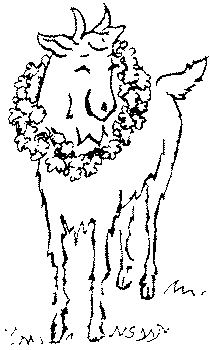
He obtained an appropriate goat for the sacrifice. He ordered his servants to take the goat to the holy river and wash him and decorate him with flower garlands. Then they were to wash themselves, as part of the purification practice.

Down at the riverbank, the goat suddenly understood that today he would definitely be killed. He also became aware of his past births and deaths and rebirths. He realized that the results of his past unwholesome deeds were about to finally be completed. So he laughed an uproarious goat-laugh, like the clanging of cymbals.

In the midst of his laughter, he realized another truth that the priest, by sacrificing him, would suffer the same terrible results, due to his ignorance. So he began to cry as loudly as he had just been laughing!

The servants, who were bathing in the holy river, heard first the laughing and then the crying. They were amazed. So they asked the goat, “Why did you loudly laugh and then just as loudly cry? What is the reason for this?” He replied, “I will tell you the reason. But it must be in the presence of your master, the priest.”

Since they were very curious, they immediately took the sacrificial goat to the priest. They explained all that had happened. The priest, too, became very curious. He respectfully asked the goat, “Sir, why did you laugh so loudly, and then just as loudly cry?”

The goat, remembering his past lives, said, “A long time ago, I too was a priest who, like you, was well educated in the sacred religious rites. I thought that to sacrifice a goat was a necessary offering to my god, which would benefit others, as well as myself in future rebirths. However, the true result of my actions was that in my next 499 lives I myself have been beheaded!

“While being prepared for the sacrifice, I realized that today I will definitely lose my head for the 500th time. Then I will finally be free of all the results of my unwholesome deeds of so long ago. The joy of this made me laugh uncontrollably.

“Then I suddenly realized that you, the priest, were about to repeat the same unwholesome action, and would be doomed to the same result of having your head chopped off in your next 500 lives! So, out of compassion and sympathy, my laughter turned to tears.”

The priest was afraid this goat might be right, so he said, “Well, sir goat, I will not kill you.” The goat replied, “Reverend priest, even if you do not kill me, I know that today I will lose my head and finally be released from the results of my past unwholesome action.”

The priest said, “Don’t be afraid, my fine goat. I will provide the very best protection and personally guarantee that no harm will come to you.” But the goat said, “Oh priest, your protection is very weak, compared to the power of my unwholesome deed to cause its necessary results.”

So the priest cancelled the sacrifice, and began to have doubts about killing innocent animals. He released the goat and, along with his servants, followed him in order to protect him from any danger.

The goat wandered into a rocky place. He saw some tender leaves on a branch and stretched out his neck to reach them. All of a sudden a thunderstorm appeared out of nowhere. A lightning bolt struck an over-hanging rock, and cut off a sharp slab, which fell and chopped off the goat’s head! He died instantly, and the thunderstorm disappeared.

Hearing of this very strange event, hundreds of local people came to the place. No one could understand how it had happened.

There was also a fairy who lived in a nearby tree. He had seen all that had occurred. He appeared, gently fluttering in the air overhead. He began to teach the curious people, saying, “Look at what happened to this poor goat. This was the result of killing animals! All beings are born, and suffer through sickness, old age and death. But all wish to live, and not to die. Not seeing that all have this in common, some kill other living beings. This causes suffering also to those who kill, both now and in countless future rebirths.

“Being ignorant that all deeds must cause results to the doer, some continue to kill and heap up more suffering on themselves in the future. Each time they kill, a part of themselves must also die in this present life. And the suffering continues even by rebirth in hell worlds!”

Those who heard the fairy speak felt that they were very lucky indeed. They gave up their ignorant killing, and were far better off, both in this life, and in pleasant rebirths.

The moral is: Even religion can be a source of ignorance.

18. The Goat Who Saved the Priest [Ignorance]

Link: https://hhdorjechangbuddhaiiiinfo.com/2022/03/07/18-the-goat-who-saved-the-priest-ignorance/

INTERPRETER’S INTRODUCTION – BUDDHIST TALES FOR YOUNG AND OLD, VOLUME 1, STORIES 1-50

#Buddhisttalesforyoungandold #Buddhiststories #storiesforkids #moralstories #Buddha #Jatakastories #PansiyaPanasJataka

I need to sincerely repent and cultivate uncompromisingly

I need to sincerely repent and cultivate uncompromisingly

It has been several weeks since the announcement of the news that Namo Dorje Chang Buddha III and Fomu, Holy Mother the Great Mahasattva, have borne dark karmas for living beings and entered parinirvana. Since then I have gradually calmed down from the shock, sadness, sorrow, confusion and loss.

H.H. Dorje Chang Buddha III and Fomu, Holy Mother the Great Mahasattva, set selfless, dedicated, and unsurpassed examples for us. The Buddha’s last words to Venerable Tsemeng Jiaozun so touched my heart: “….. When I said I would bear dark karma for living beings, those were not empty words. To bear dark karma is not to enter dhyāna, but rather, truly and continuously practice shifting the mind-consciousness to suffer on behalf of living beings. What Fomu and I said is what we do. At all times, we must think about bringing auspiciousness, serenity, happiness, and peace to living beings and to the world, to the extent of giving our all and even our lives. ….. I wish all living beings happiness.”

Photo by Suzy Hazelwood on Pexels.com

It has been more than ten years since I first heard the pre-recorded Buddha’s Dharma discourse. I have heard many discs, and I have also read the Dharma books written by H.H. Dorje Chang Buddha III, including “The Supreme and Unsurpassable Mahamudra of Liberation”, “Expounding the Absolute Truth through the Heart Sutra”, “Liaoyi Jing” and so on. But have I really put the Buddha’s teachings into practice? I seldom thought about to take on other person’s dark karma and sufferings. Even when my mother followed the evil master, escaped from the Buddha, and defamed H.H. Dorje Chang Buddha III, I did not think of taking on my mother’s guilt. How selfish I am compared to the Buddha.

In all the Dharma imparted by H.H. Dorje Chang Buddha III, the Buddha always emphasizes putting bodhicitta into practice: When there is a conflict of interest between myself and others, I will rid myself of hatred, antipathy, greed, and arrogant, disparaging mentality. I must not emphasize benefiting myself. I should treat myself and others equally. When other living beings and I are suffering, I want others to extricate themselves from suffering before I do. When other living beings and I are happy, I want others to be happier than I am. I dedicate to all living beings all of the merit and accomplishments from my cultivation in the hope that they will leave suffering and attain liberation.

I felt ashamed that I rarely put all these teachings in my daily practice. Most of the time I put myself at the first priority. I want to have good health, good fortune, and good luck — after I have all these I may share some with others.

When I recite The Supreme and Unsurpassable Mahamudra of Liberation, I realize I just did ritualistic chanting, making empty vows, engaging in visualization. I have always considered myself as a true Buddhist, now I realize that I deceived myself. In fact, I was a fake cultivator, I have not truly put Buddha’s principles into practice. I still have so many dark karmas: selfish thoughts, a mind of hatred, greed, jealousy, presumptuousness, arrogance, shamelessness, a mind that considers myself always in the right, a mind that deceives others. In this life time I have done so many wrongs. Here I sincerely repent of my sins, and vow to not commit to these sins again.

I am already in my fifties — how much longer can I live. I have no time to waste. Buddha has entered parinirvana. Impermanence may come to me at any time. I must follow the Buddha’s teachings truly and diligently. Every day I will introspect myself, asking myself how I should treat others when it comes to my words, how I should treat others when it comes to my mentality, and how I should treat others when it comes to my conduct. I must earnestly practice “the three daily introspections” — conducting three introspections in the course of a day. In the morning, introspect about how during the day I should act to become a purely good and compassionate person, a person who benefits the public. At midday, think back: “From morning until midday, did I have that kind of mindset and conduct?” At night, again think back: “From midday until night, did I have that kind of mindset and conduct? Are the things I did today truly reflective of the conduct, speech, and mindset of a Bodhisattva at the causal stage?”

Great compassionate Buddha and Fomu, Holy Mother the Great Mahasattva! Thank you greatly for using your life to sound the alarm of impermanence for me. And thank you greatly for using your life to bring Buddhist disciples the extraordinary cause and condition to study the Tathagata Dharma. I vow to use my own real actions to wash away my sins, and benefit all beings with compassion and pure goodness in order to repay Buddha’s grace!

Great compassionate Buddha and Fomu, Holy Mother the Great Mahasattva! I, a disciple, still want to hold on to a glimmer of hope and beg you all to return to the Saha world and give us foolish beings another chance!

I need to sincerely repent and cultivate uncompromisingly

Link: https://peacelilysite.com/2022/03/04/i-need-to-sincerely-repent-and-cultivate-uncompromisingly/

#DorjeChangBuddhaIII #HHDorjeChangBuddhaIII#FomuHolyMother#GreatMahasattva#TheSupremeandUnsurpassableMahamudraofLiberation#Parinirvana

The Monkey King : A Jataka Tale

The Monkey King : A Jataka Tale

From Kindness

A Treasury of Buddhist Wisdom for Children and Parents

Collected and Adapted by Sarah Conover

When the Buddha and his followers lived at Jetavana, a certain monk in the group was always upset – so much so that he could barely concentrate. When the Buddha asked him about it, the monk replied that he desired many things he couldn’t have; thus, he never felt content. “Oh, monk,” said the Buddha kindly, “these passions have been discarded even by monkeys. It is all the more important for one who lives the holy life to leave these feelings behind. “ And the Buddha recounted this old-world tale about the monkey king.

Once, in olden times, the Buddha came into the world as a monkey. He lived among the treetops of a remote jungle with a large family of monkeys. One day, a woodcutter came to this same jungle to fetch a good supply of logs for his family hearth. But when the woodcutter felled a large tree, he accidentally trapped the young monkey underneath as the tree dropped to the forest floor. When the woodcutter saw his surprise, he decided to bring the monkey home as a present to his king.

The bright monkey quickly tamed and was soon the favorite royal pet. The king let him run everywhere about the palace. So the monkey spent his days visiting the royal courts and kitchens, the guards’ quarters, and all the other enterprises within. The monkey easily learned to imitate the manners of the royal retinue, the ministers, the guards, and even the cook who chased him from her kitchen. It was impossible not to laugh at the monkey’s antics.

After a few years, the king requested that the woodcutter return to the palace. Then the king asked, “As a favor to this monkey who has pleased us so, would you bring him back to the jungle where he was captured? It would be kindest if we let him live out his years with fellow monkeys.” So the woodcutter did as the king bid: he brought the monkey back to the very same spot in the very same jungle and released him.

Photo by vishnudeep dixit on Pexels.com

At once, as soon as the woodcutter had left, a hundred monkeys surrounded the palace monkey, all asking questions at once. “Where have you been living this long time? Where did that man take you? Did you go on a great adventure? Why did he let you go free?” On and on the monkeys clamored, full of curiosity.

When they quieted down, the palace monkey recounted his tale. He told them all about the king’s splendid palace and how he had entertained the king. He told them of the sumptuous feasts, the elegant dances, the noble ministers of the royal court, the king’s fearsome army, and the dark dungeons.

“But then, how did you escape?” They wanted to know.

“I was such a good pet, and I amused them all so, that they felt badly keeping me from my home. The king decided to set me free again, so here I am!”

Now the monkeys were really excited. “Oh, tell us all about the palace life!” They jumped and shouted. “Tell us about the ways of people! Tell us about the grand deeds of a king!” they insisted.

“No, you wouldn’t want to know,” cautioned the palace monkey. “You really won’t like it.”

But the monkeys would not let up until he agreed to show them what life was like for a king. So the palace money picked a monkey in the troop and said, “O.K. then, you be the king. Get up on this high rock and make it your throne. We will set to work and bring you the best fruit in the kingdom!”

So the monkey king sat upon his rock throne, surveying his kingdom and looking quite content. Soon a huge pile of delicious fruit surrounded him. After a time the king monkey began to feel distressed. “ But I could never eat all this fruit, even in a whole year! And how there’s nothing left for all of you to eat,” laments the monkey king.

“Of course you can’t eat it all,”said the palace monkey. But that dose’t matter to a king. The point is that you eat whatever you want, but you must not give any of it away. You must always keep a large pile so that others know you are very rich and very powerful!” So the monkeys, wishing to be like men, brought even more fruit and stacked it even higher around their king.

“What else do we do?” asked the monkeys when there was no more fruit to be had.

“You must all come before the king and praise him in every way you can imagine.”

The monkeys liked this idea, so they tried it.

“Well, no wonder his is king!” pronounced one. “His coat glistens like water.”

“His fur is as thick as deep grass!” boasted another.

“I’ve never seen such a strong and capable animal!” exclaimed a third monkey.

“No one is as wise and dignified as our king!” And so they gathered around their king and enjoyed themselves in flattering him.

“Enough of that,” said the little palace monkey. “Now it’s time to come behind the throne and say terrible things about the king.”

The monkeys didn’t like this idea at all and at first refused to do it. But the palace monkey preserved saying, “You have to try this if you want to learn the ways of people! See what it’s like.”

So the monkeys gathered behind the rock and whispered insults about the king.

“Have you noticed how old and confused the king seems lately?” asked a monkey.

“His eyes seem dull and he constantly forgets what he has said!”  chuckled another.

“I think his fur is getting extremely thin; I think he might even be going bald in some very funny spots” tittered a third.

“I’ve noticed that the king eats more like a pig than a monkey!” said a fourth and they all howled.

At last the insulted monkey king could stand it no longer. He jumped off his throne and ran after them through the trees. But the monkeys each escaped in a hundred different directions from the frustrated king. When the monkey king as last returned to his throne, his eyes widened in astonishment. All the fruit had vanished!

“Where is the fruit?” cried the king. “All my fruit is stolen!” he bellowed.

“Yes, it’s a shame, but these things happen even to kings!” said the palace monkey. “Now your guards must go find the thieves. That’s what a king would do. And when the guards capture the thieves, they must be sentenced to death at once.”

“What?” cried the monkey king. “You want me to kill them? Oh, how could such a terrible thing come to pass?” he wailed. And he covered his ears with his hands and wept.

“No more! No more!” cried all the monkeys. “We don’t want to know anything else about the ways of people and kings!”

The palace monkey, the Former Buddha, then recited for them a little poem he had made up about life in the palace:

“This gold is mine, this gold is mine!’ 

so they cry both day and night:

These foolish folk who live in splendor

never think about the holy way”

“And,” said the Buddha, concluding his lesson, “the monkeys ran away from the rock throne and back up to the tree tops where they all lived happily ever after.”

The Monkey King : A Jataka Tale

Link: https://peacelilysite.com/2022/03/04/the-monkey-king-a-jataka-tale/

#Buddhisttalesforyoungandold #Buddhiststories #storiesforkids #moralstories #Buddha #Jatakastories #BuddhistWisdom#BuddhistWisdomforChildrenandParents#Jatakatales

7 ways to show someone you care

7 ways to show someone you care

Small acts of kindness can have a big impact. Not only does offering support to your loved ones show you care, but you can benefit from it, too. Studies show that helping others can reduce stress, increase happiness, and even help you live longer.

Here are 7 simple ways to connect with your loved ones — and let them know that you care.

1. Respond to “bids”

According to Dr. John Gottman, our loved ones will often make “bids” for our attention throughout the day. These bids are when a loved one says something like, “Want to see what I made during art class?” or “Take a look at this cute cat video.”

One good way to respond to bids is by active listening. You can show your loved one you’re actively listening by paying close attention to what they’re saying. Let them know you’re listening by nodding, smiling, or saying “I see.”

And don’t be afraid to ask questions if you’re unsure of what was said. These seemingly small interactions can let our loved ones know we truly care about what’s important to them.

2. Practice mindfulness

It can be easy to get distracted by multiple screens and to-do lists. So when you spend time with loved ones, make a point to limit interruptions. Put down your tablet or smartphone, and focus on staying present. Show up on time, actively listen, and avoid multitasking. If you don’t have a lot of time, consider having a 5- or 10-minute phone call. Giving your undivided attention will make your loved one feel valued and appreciated.

3. Lend a hand

We all need extra help from time to time — and that’s OK. You can show someone you care by offering to help when you think they might be struggling. If, for example, your sister just had a baby and is feeling overwhelmed, offer to run her errands or make her a home-cooked meal so she can get some much-needed rest.

4. Have an attitude of gratitude

Showing appreciation can make people feel good about what they do. How you show gratitude could be as simple as sharing a kind word or as meaningful as writing a handwritten thank-you note for the influence they’ve had in your life. And expressing gratitude can remind both you and your loved one of the positive parts of your lives.

5. Celebrate success

When your loved one accomplishes a goal, be their own personal cheerleading squad. Take some time to celebrate their success and show interest in their life. No matter how you choose to celebrate — sending them a greeting card in the mail, taking them out to dinner, donating to a charity or cause that’s important to them in their name — the other person will feel empowered by your support.

6. Spend quality time together

Quality time is the moments you spend with your loved ones that make you both feel closer and more connected. It can be as simple as meeting for coffee, watching a favorite movie together, playing a board game, or even chatting on a video call. The activity itself doesn’t matter — what matters is how the time spent together makes you feel.

7. Just be there

Listen to someone vent, be a shoulder to cry on, or hold their hand if they’re going through a tough time.

Even if you don’t know the right words to say, by just being there, you let the other person know how much they matter to you. This is especially important if a loved one is struggling with a mental health issue like depression. You don’t need to be a doctor or therapist to offer support — listening with an open mind can help them feel understood. But if you ever do need guidance on what to say, we’re here to help.

So, take time to show you care. You’ll strengthen your relationships and give your loved ones — and yourself — a dose of good health.

Link: https://wisdomtea.org/2022/03/02/7-ways-to-show-someone-you-care

17. THE WIND AND THE MOON [FRIENDSHIP]

17. THE WIND AND THE MOON [FRIENDSHIP]

Buddhist Tales for Young and Old, volume 1, Prince Goodspeaker, Stories 1-50

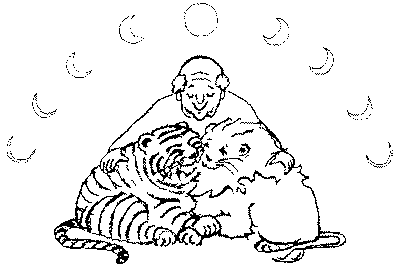
Once upon a time, there were two very good friends who lived together in the shade of a rock. Strange as it may seem, one was a lion and one was a tiger. They had met when they were too young to know the difference between lions and tigers. So they did not think their friendship was at all unusual. Besides, it was a peaceful part of the mountains, possibly due to the influence of a gentle forest monk who lived nearby. He was a hermit, one who lives far away from other people.

For some unknown reason, one day the two friends got into a silly argument. The tiger said, “Everyone knows the cold comes when the moon wanes from full to new!” The lion said, “Where did you hear such nonsense? Everyone knows the cold comes when the moon waxes from new to full!”

The argument got stronger and stronger. Neither could convince the other. They could not reach any conclusion to resolve the growing dispute. They even started calling each other names! Fearing for their friendship, they decided to go ask the learned forest monk, who would surely know about such things.

Visiting the peaceful hermit, the lion and tiger bowed respectfully and put their question to him. The friendly monk thought for a while and then gave his answer. “It can be cold in any phase of the moon, from new to full and back to new again. It is the wind that brings the cold, whether from west or north or east. Therefore, in a way, you are both right! And neither of you is defeated by the other. The most important thing is to live without conflict, to remain united. Unity is best by all means.”

The lion and tiger thanked the wise hermit. They were happy to still be friends.

The moral is: Weather comes and weather goes, but friendship remains.

17. The Wind and the Moon [Friendship]

Link: https://hhdorjechangbuddhaiiiinfo.com/2022/03/01/17-the-wind-and-the-moon-friendship/

INTERPRETER’S INTRODUCTION – BUDDHIST TALES FOR YOUNG AND OLD, VOLUME 1, STORIES 1-50

#Buddhisttalesforyoungandold #Buddhiststories #storiesforkids #moralstories #Buddha #Jatakastories #PansiyaPanasJataka